Kiyomi Yoshioka (2026). Development and Evaluation of Applications for Oral and Cognitive Rehabilitation: A Facial Rock-Paper-Scissors Program With Psychological Effects. In: Human Factors in Design, Engineering, and Computing. AHFE Open Access, vol. 238, pp. 2325–2333. https://doi.org/10.54941/ahfe1008458
We developed a “Facial rock-paper-scissors” program for oral and cognitive rehabilitation by incorporating mouth and cheek movements, and vocalizations used in swallowing training into the facial expressions and vocalizations of “rock,” “paper,” and “scissors.” In basic research, we investigated psychological evaluations when multiple programs with different facial-expression setting rules were implemented. The results showed improved mood when using a program in which the “scissors” expression involved stretching the mouth horizontally and raising the corners of the mouth to form a smiling face. Based on these results, we established a facial-expression setting for the program expected to produce positive psychological effects. Next, we developed two applications with different difficulty levels that allow users to easily perform the program. Both applications consist of a practice session for experiencing facial expressions and vocalizations, and a practical session. In the practical sessions, the system uses the tablet’s camera to recognize the user’s facial expressions and enables judgments of “win,” “lose,” and “draw,” thereby encouraging users’ motivation and promoting continuous engagement in rehabilitation. Practical evaluations of the applications conducted with a community-dwelling older adult suggested that implementing the program may have positive psychological effects such as increased vitality, pleasure, and arousal, may have cognitive function effects such as improved concentration and attention, and may contribute to improvements in orbicularis oris muscle strength. The developed applications were suggested to provide an engaging experience that contributes to users’ physical and mental functions.
As of 2025, pneumonia and aspiration pneumonia were respectively the fifth and sixth leading causes of mortality in Japan. By age group, the proportion of pneumonia increases with advancing age, ranking fourth for ages 70 and higher (Ministry of Health, Labour and Welfare, 2025). Given that approximately 70% of patients with pneumonia are aged 75 or older, and more than 70% of these patients have aspiration pneumonia (Ministry
2326 Yoshioka of Health, Labour and Welfare, 2016), urgent action is needed to combat aspiration pneumonia in today’s rapidly-aging society.
Research and other efforts in the medical field have shown that mouth, tongue, and cheek exercises used as swallowing training, successfully increase saliva secretion and improve feeding and oral functions (Takehara et al., 2014). As a practical example of efforts aimed at maintaining and improving cognitive function, one study in Japan reported on the effects of public awareness programs at community general support centers designed to prevent frailty. These results suggest that performing the task of responding orally and facially to rock-paper-scissors may also lead to maintenance and improvement of cognitive function (Omori et al., 2016). In that study, “rock” was expressed by pursing the lips and bringing the eyes and eyebrows close together, “scissors” was expressed by extending the tongue downward toward the chin, and “paper” was expressed by opening the eyes and mouth widely. In the facial rock-paper-scissors game, the subject must instantly recognize the opponent’s facial expression as rock, paper, or scissors, and then make a facial expression that beats their opponent’s choice. Since the subject performs conversion and reconversion processing of stimulus information, which is presumed to be susceptible to aging, the task is expected to maintain and improve cognitive function.
Based on these previous studies, we considered that it would be possible to perform rehabilitation to maintain and improve oral and cognitive functions by developing a new program that would simultaneously provide oral training and a facial rock-paper-scissors exercise. Therefore, we developed the “Facial rock-paper-scissors” program to be used in rehabilitation for maintaining and improving oral and cognitive functions. We also developed apps that allow users to easily run the “Facial rock-paper-scissors” program using a tablet device, and in this study, we conducted a practical study with a community-dwelling older adult.
OVERVIEW OF THE FACIAL ROCK-PAPER-SCISSORS PROGRAM We devised the “Facial rock-paper-scissors” program, which incorporates mouth and cheek movements and vocalizations used in swallowing training into a response-type rock-paper-scissors game involving orofacial movements.
Prior to program development, we examined previous studies on the effects of human facial expressions on other people. Previous research has shown that people have specific facial expressions when being presented pictures of a happy face or an angry face (Dimberg, 1982). Furthermore, another study suggests that individuals’ emotional state of mind is influenced by their own facial expressions (Tomkins, 1962). In our previous studies, we verified the synchronous response of smiling using an icon of a smiling face (composed of simply-shaped eye and mouth parts), and the resulting psychological effect of improved mood (Yoshioka, 2017a, 2017b). Based on these previous studies, we thought that incorporating design elements that induce people to smile in the program developed in this study would also have the psychological effect of improving mood. Therefore, we conducted a basic experiment to compare the psychological evaluations when multiple “Facial rock-paper-scissors” programs with different facial expression settings were implemented.
Development and Evaluation of Applications for Oral and Cognitive Rehabilitation 2327 As a result, the “Facial rock-paper-scissors” program confirmed that the “scissors” expression, formed by stretching the mouth horizontally and raising the corners of the mouth to create a smile, has the psychological effect of improving mood (Yoshioka, 2023). On the other hand, the program in which the “scissors” expression involved extending the tongue downward toward the chin, which has been implemented in an elderly care prevention awareness program (Omori et al., 2016), did not demonstrate psychological effects such as improvements in depressive symptoms or increased arousal. Therefore, in this program, the “scissors” expression, formed by stretching the mouth horizontally and raising the corners of the mouth to create a smile, is expected to have the psychological effect of improving mood.
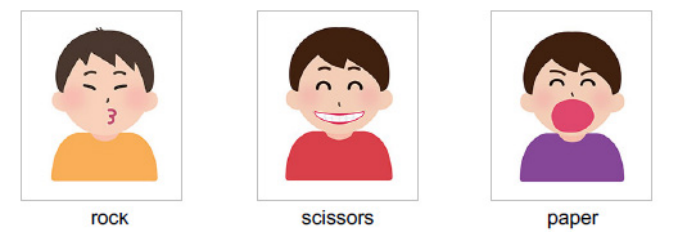
In Japan, “rock-scissors-paper” is respectively represented vocally as “guu,” “choki,” and “paa”. When facially expressing “paper” in the “Facial rock-paper-scissors” program, the vowel at the end of the syllable “paa” is stretched to pronounce “aaah” by opening the mouth widely in all directions, creating a mouth and cheek exercise. In facially expressing “scissors,” the vowel at the end of the word “choki” is stretched to pronounce “ii” by stretching the mouth widely and horizontally to perform another mouth and cheek exercise. In facially expressing “rock,” the vowel at the end of the syllable “guu” is stretched to pronounce “uuu” by pursing the mouth to perform a mouth and cheek exercise (Fig. 1). Furthermore, the images presented in the “Facial rock-paper-scissors” program use rather abstract face illustration images, which are considered to have little individual difference in suitability (preference) for faces.
Figure 1: Facial illustration images presented in “Facial rock-paper-scissors” program.
DEVELOPMENT OF THE “FACIAL ROCK-PAPER-SCISSORS” PROGRAM APP (PATENT PENDING) We developed the “Facial rock-paper-scissors” program that incorporates design elements which induce smiling, and confirmed the psychological effect of using the program (Yoshioka, 2023). Based on our research results, we developed two types of apps with different difficulty levels. The level of difficulty varies depending on the types and number of facial illustrations displayed on the screen. These apps run on a tablet device so that rehabilitation can be performed even at medical institutions and facilities with limited staff numbers, or by the elderly alone at home.
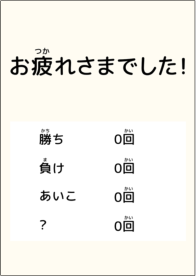
2328 Yoshioka The applications consist of a practice session for experiencing facial expressions and vocalizations, and a practical session. The practice session allows users to understand how to make correct facial expressions and vocalizations for rehabilitation. In the practical sessions, the system uses the tablet’s camera to identify the user’s facial expressions and enables judgments of “win,” “lose,” and “draw,” thereby encouraging users’ motivation and promoting continuous engagement in rehabilitation (Fig. 2). Furthermore, the display time for each image and the duration of the practical session can be set according to the user’s condition. Furthermore, these practical sessions can be used at three different difficulty levels, tailored to the user’s cognitive function level: making the same facial expression as the illustrated face image; making a facial expression that wins against the illustrated face image; or making a facial expression that loses against the illustrated face image.
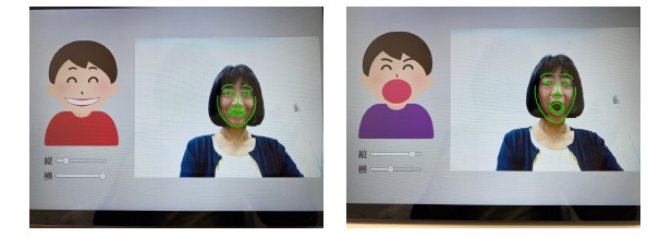
We also developed a test application that allows users to practice while viewing their face on the screen, recognizing the facial expressions corresponding to “rock,” “scissors,” and “paper,” as well as effective mouth and cheek movements (Fig. 3).
Settings screen Result Screen
Figure 2: Display screens of the “Facial rock-paper-scissors” program application.
Facial expressions corresponding to scissors (left) and paper (right)
Figure 3: Display screens of the test application.
Development and Evaluation of Applications for Oral and Cognitive Rehabilitation 2329 PRACTICAL EVALUATIONS OF THE APPLICATIONS CONDUCTED WITH A COMMUNITY-DWELLING OLDER ADULT
Research Method A practical evaluation was conducted to investigate the feasibility of using the “Facial rock-paper-scissors” program as rehabilitation support for preventive care among community-dwelling older adults, as well as its effects on physical and mental functions. In this study, one community-dwelling older adult (female, 86 years old, requiring Support Level 2 care, diagnosed with Parkinson’s disease) participated in the evaluation. The participant exhibited symptoms including masked faces (facial muscle rigidity) associated with Parkinson’s disease, reduced oral function, and decreased motivation. The participant practiced the “Facial rock-paper-scissors” program for seven consecutive days, first completing the practice session of the application, followed by the practical session. The total time spent on the program each day was approximately 11 minutes—practice session 3 minutes followed by the practical session of 8 minutes. During the practical evaluation, psychological state, oral function, and cognitive function were evaluated before and after the program.
Psychological status was evaluated using the TDMS-ST (Two-dimensional Mood Scale–Short Term; Sakairi et al., 2003). Oral function was evaluated using the “measurement of the distance between the left and right corners of the mouth,” which can be evaluated without the use of special instruments. This method is one of the evaluation techniques used in oral function improvement programs in Niigata Prefecture, Japan (Niigata Prefecture, n.d.). Measurement of the distance between the left and right corners of the mouth). Orbicularis oris muscle strength can be evaluated by measuring the distance between the corners of the mouth when the participant maximally stretches the mouth while pronouncing “ii” and when the participant maximally purses the lips while pronouncing “uuu.” Increased orbicularis oris muscle strength is indicated by a greater distance during “ii” pronunciation and a shorter distance during “uuu” pronunciation. Cognitive function was evaluated using an additional one-minute task. The participant was presented with a sequence of randomly arranged single-digit numbers and was required to add each pair of adjacent numbers. Repeated performance of simple calculation tasks requires concentration and attention, which tend to decline with cognitive impairment, and cognitive function can be evaluated based on calculation speed and the number of errors. Such calculation tasks have also been used in dementia rehabilitation programs in geriatric health service facilities, together with orientation and memory training, as exercises to improve concentration and attention, and their effectiveness has been reported (Kaku et al., 2016).
Results
As a result of the practical evaluation, the participant was able to engage in rehabilitation using the “Facial rock-paper-scissors” program every day for seven consecutive days without interruption. Because the evaluation involved
2330 Yoshioka repeated measurements in a single-case study, no statistical analyses were performed. Instead, the results were summarized descriptively.
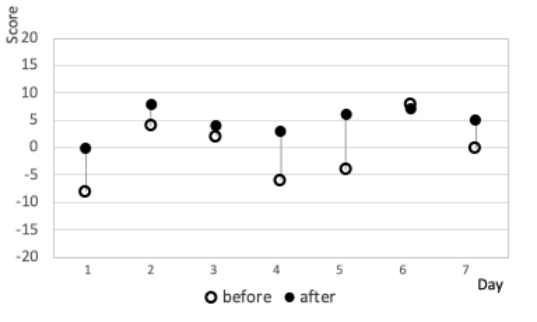
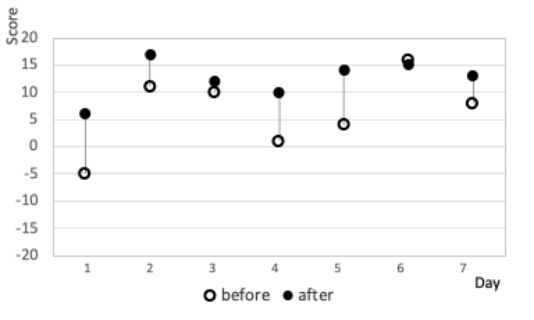
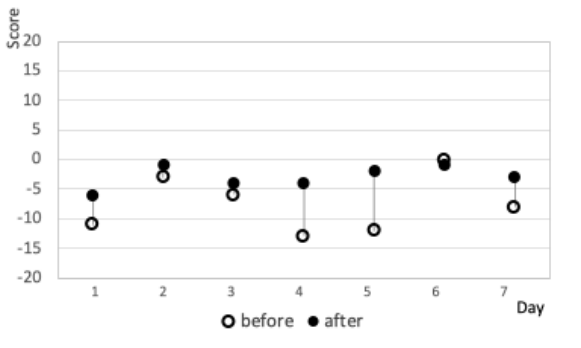
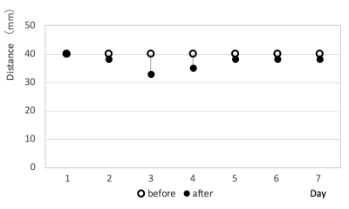
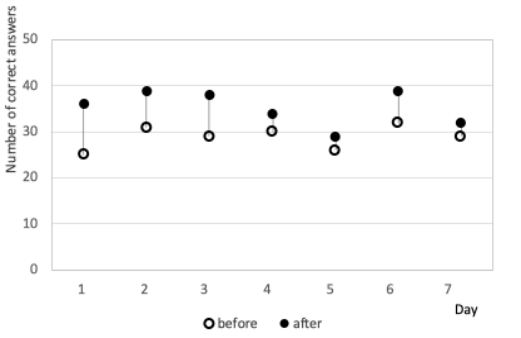
First, the psychological evaluation using the TDMS-ST showed higher scores for “Vitality,” “Pleasure,” and “Arousal” after implementation of the program compared with before implementation. These results suggested a more comfortable and positive mood state, and a reduction in inactive mood (Fig. 4–6). In the evaluation of oral function using the measurement of the distance between the corners of the mouth, the distance became longer during the pronunciation of “ii” and shorter during the pronunciation of “uuu” after implementation of the program compared with before (Fig. 7). This result indicates increased strength in the orbicularis oris muscle. In addition, the evaluation of cognitive function using the additional task showed a greater number of correct answers on every assessment day after implementation of the program compared with before, indicating a consistent tendency toward improvement (Fig. 8).
Figure 4: Comparison of “Vitality” scores.Figure 5: Comparison of “Pleasure” scores.Figure 6: Comparison of “Arousal” scores.
Pronunciation of “ii” Pronunciation of “uuu”
Figure 7: Measurement of the distance between the corners of the mouth.Figure 8: Number of correct answers in the additional task.
CONCLUSION
We developed the “Facial rock-paper-scissors” program that provides the psychological effect of improved mood in addition to rehabilitation to maintain and improve oral and cognitive functions. In the “Facial rock- paper-scissors” program, mouth and cheek movements and voicing included in swallowing training can be performed as a response-type facial rock- paper-scissors game using oral-facial movements to maintain and improve cognitive function. The program also incorporates a design element that is anticipated to have the beneficial psychological effect of improving mood by making the participants smile while adopting their “scissors” expression.
The “Facial rock-paper-scissors” program app we developed consists of practice sessions to experience facial expressions and voicing, and a practical use session, and can be easily used on a tablet device. The app allows the “Facial rock-paper-scissors” program to be performed to rehabilitate oral and cognitive functions even at medical institutions and facilities with limited staff numbers, or by the elderly alone at home.
Practical evaluations of the applications conducted with a community- dwelling older adult suggested that implementing the program may have positive psychological effects such as increased vitality, pleasure, and arousal, may have cognitive function effects such as improved concentration and attention, and may contribute to improvements in orbicularis oris muscle strength. It was suggested that the program may have potential to support the rehabilitation of patients with facial muscle rigidity. The developed applications were suggested to provide an engaging experience that contributes to users’ physical and mental functions. On the other hand, given the limited number of experimental participants, there are limitations to generalizing the results obtained. Therefore, we will continue conducting practical evaluations toward the broader real-world implementation of the “Facial rock-paper-scissors” program.
This research was conducted with the approval of the Research Ethics Committee of Meisei University.
Rehabilitation Support Device/Method/Program Patent Inventor/Owner: Kiyomi Yoshioka
ACKNOWLEDGMENT
This study was supported by JSPS KAKENHI Grant Number JP22K12686.
REFERENCES
Dimberg, U. (1982). Facial Reactions to Facial Expressions. Psychophysiology, 19, pp. 643–647. doi.org/10.1111/j.1469-8986.1982.tb02516.x Kaku, E., Yamaguchi, Y., Nagata, M. and Miyauchi, K. (2016). Study on the effectiveness
of intensive short-term rehabilitation for dementia and future issues. Proceedings of the Kyushu Physical Therapy and Occupational Therapy Conference 2016, 0, p. 275. https://www.jstage.jst.go.jp/article/kyushuptot/2016/0/2016_275/_pdf/- char/ja
Development and Evaluation of Applications for Oral and Cognitive Rehabilitation 2333 Ministry of Health, Labour and Welfare. (2016). The 2nd Working Group Meeting
on Home Medical Care and Partnership for Medical and Nursing Care: Measures for Diseases Increasing with Population Aging (Document 2-1). https://www. mhlw.go.jp/file/05-Shingikai-10801000-Iseikyoku-Soumuka/0000135467.pdf (Accessed: 7 June 2026). Ministry of Health, Labour and Welfare. (2025). Summary of Vital Statistics of Population, 2025. https://www.mhlw.go.jp/toukei/saikin/hw/jinkou/geppo/ nengai25/index.html (Accessed: 7 June 2026). Niigata Prefecture. (n.d.). Measurement of the Distance Between the Left and Right
Corners of the Mouth. https://www.kenko-niigata.com/material/files/group/3/ hintosyu_P8-10.pdf (Accessed: 6 February 2026). Omori, T., Anamizu, S., Taniai, S. and Ushikubo, Y. (2016). Age-related change in performance of win- or loss-resulting pursuant paper-rock-scissors expressed by orofacial movements. Japanese Journal of Cognitive Rehabilitation, 21(1), pp. 21–29. doi.org/10.50970/cogrehab.2016.003 Sakairi, Y., Tokuda, E. et al. (2003). Development of the Two Dimension Mood
Scale for Measuring Psychological Arousal Level and Hedonic Tone. Bulletin of the Institute of Health and Sport Sciences, University of Tsukuba, 26, pp. 27–36. http://hdl.handle.net/2241/11373 Takehara, I., Yamamoto, H., Takahashi, K., Hironaka, S., Katsumata, A., Nito, T., Koyama, T., Fujiwara, Y. and Fujishima, I. (2014). Summary of dysphagia rehabilitation methods (2014 edition): Medical Review Committee of the Japanese Society of Dysphagia Rehabilitation. The Japanese Journal of Dysphagia Rehabilitation, 18(1), pp. 55–89. https://www.jsdr.or.jp/wp-content/uploads/file/ doc/18-1-p55-89.pdf Tomkins, S.S. (1962). Affect Imagery Consciousness, Vol.1: The Positive Affects, New
York, Springer-Verlag. https://books.google.co.jp/books/about/Affect_Imagery_ Consciousness.html?id=WIpgNerqaIkC&redir_esc=y Yoshioka, K. (2017a). Mood Change Caused by Drawing of Face Icons: Characteristics of the Shapes and Facial Expression in Eyes and Mouth Parts. Bulletin of Japanese Society for the Science of Design, 63(5), pp. 43–48. doi:10.11247/jssdj.63.5_43. Yoshioka, K. (2017b). Physiological and Psychological Evaluation and Changes
in Facial Expression by Viewing, Placing, or Drawing of Face Icons. Bulletin of Japanese Society for the Science of Design, 64(1), pp. 11–17. doi:10.11247/ jssdj.64.1_11. Yoshioka, K. (2023). Psychological Evaluations of “Facial Rock-Paper-Scissors” Programs with Different Facial Expressions: Basic Research for the Development of a Rehabilitation Program to Maintain and Improve Swallowing and Cognitive Functions, and that has Psychological Effects. Bulletin of Japanese Society for the Science of Design, 70(2), pp. 47–54. doi:10.11247/jssdj.70.2_47.
SEARCH THE AHFE DIGITAL BOOKSTORE BY ISBN
Explore the complete digital volume
Human Factors in Design, Engineering, and Computing
Read this individual research paper free through the original publisher, or explore the full digital proceedings book.