Zilin Xiong, Sidi Yang (2026). Focus Pup: A Design Study on a Companion Robot for Self-Management Among Adults With ADHD. In: Human Factors in Design, Engineering, and Computing. AHFE Open Access, vol. 238, pp. 275–286. https://doi.org/10.54941/ahfe1008261
Adult Attention-Deficit Hyperactivity Disorder (ADHD) is a condition characterised by poor attentional stability, impaired executive function and weak self-management ability. Most existing non-pharmacological interventions rely on external mandatory constraints as their core logic, and lack sustainable intervention approaches integrating physiological and psychological dimensions.This study explores attentional and self-management traits in adults with ADHD, constructing a two-dimensional programme to boost self-management executive capacity based on flow theory. First, a literature review establishes the theoretical foundations of flow theory and ADHD cognitive intervention. Second, semi-structured interviews and naturalistic behavioural observations are carried out with clinically diagnosed adults with ADHD to identify core attention pain points and self-management demands. Building on these findings, this work systematically maps flow theory to design practice, proposes Focus Pup — an intelligent emotional companion device — and develops its hardware prototype. A between-groups controlled experiment is planned to examine the solution’s efficacy, combining data from the Flow State Scale (FSS), NASA Task Load Index (NASA-TLX) and behavioural observations via quantitative statistics and qualitative analysis.This paper elaborates on the function of flow theory in cultivating self-management capacity for people with ADHD, and proposes that physical isolation, physiological soothing and instant feedback may serve as external compensations for executive function deficits, with their effects to be examined in a planned between-groups controlled experiment. Empirically, it supplements real-world evidence describing adults’ ADHD attention and self-management patterns. Theoretically, it broadens the application scope of flow theory within neurodiversity intervention research. Practically, it offers design references for tangible interaction and attention intervention tailored to ADHD groups in human-computer interaction (HCI).
Attention-Deficit/Hyperactivity Disorder (ADHD) is a lifelong neurodevelopmental condition whose core symptoms persist into adulthood for roughly two-thirds of diagnosed individuals (Wang Huihui, 2023). In workplace and learning environments, adults with ADHD experience profound deficits in attention and self-management driven by dual-channel impairments in executive function and
276 Xiong and Yang motivational processing. Although pharmacological treatments and cognitive behavioral therapy (CBT) exist, their widespread adoption is constrained by side effects and high costs. Concurrently, existing digital attention-support tools often trigger user resistance due to tedious training protocols, while existing robotic assistants lack emotional support, physical distraction-shielding, and positive experience mechanisms (Berrezueta-Guzmán, 2021; Li Liting, 2025). Specifically, existing non-pharmacological interventions for adult ADHD suffer from three key limitations: they rely predominantly on coercive deficit correction rather than positive flow-state cultivation, overemphasize cognitive factors at the expense of physical and multi-sensory emotional comfort, and remain largely software- based without leveraging physical entities for executive-function compensation (Berrezueta-Guzmán, 2021). Based on this, this study addresses the following two core research questions:
RQ1: What are the current characteristics of attention and self-management abilities among individuals with ADHD?
RQ2: How can individuals with ADHD be supported in developing self-management-based executive functions from both physiological and psychological perspectives?
To address the central challenge of how to support self-management in adults with ADHD from both physiological and psychological perspectives, this study introduces Focus Pup, an integrated hardware-software emotional support agent designed as a physical proxy for external executive function (Berrezueta-Guzmán, 2021; Sandygulova, 2019). Guided by flow theory, we translated user-identified pain points (phone-induced friction, environmental monotony, and racing thoughts) into a dual-dimensional framework combining physiological regulation with psychological motivation. The main contributions of this study are threefold: first, it empirically delineates the distinct attention dynamics and self-management needs of adults with ADHD; second, it introduces flow theory to non-pharmacological ADHD interventions by establishing a dual-dimensional framework; and third, it articulates design strategies for embodying flow principles within desktop physical robots.
RELATED THEORIES AND WORK Cognitive Characteristics and Behavioral Needs of Adult ADHD
Adult ADHD is characterized by persistent sustained attention deficits and executive dysfunction (Csikszentmihalyi, 1990). Cognitively, impaired endogenous attentional control (Barkley, 1997) renders individuals vulnerable to both external environmental distractions (Barkley, 1997; Willcutt, 2005) and high-frequency internal task-irrelevant thoughts (Smallwood, 2006). Lacking sufficient metacognitive inhibition, users often follow these internal flashes of inspiration, causing focus breakdown. In terms of executive function, deficits in behavioral inhibition (Barkley, 1997) trigger severe task initiation friction and procrastination. The lack of impulse control over immediate gratification (e.g., smartphones) makes physical distraction- shielding exceptionally difficult. Furthermore, task-induced anxiety often
Focus Pup: A Design Study on a Companion Robot 277 manifests as hyperactive motor restlessness (e.g., fidgeting) (Barkley, 1997; Willcutt, 2005). Consequently, rather than intrusive pop-ups or rigid digital lockouts that deplete scarce executive resources (Bakker, 2016), adults with ADHD require non-intrusive, embodied interaction systems that provide physical boundaries, external behavioral cues (O’Connell, 2024), and sensory self-regulation outlets.
Flow Theory and Its Application in Human–Computer Interaction Flow theory provides a framework to reshape focus experiences without altering neurodevelopmental traits. Flow represents an optimal cognitive state of deep absorption, driven by clear goals, immediate feedback, and balanced challenge-skill ratios (Csikszentmihalyi, 1990). In HCI, these antecedents translate into interactive mechanisms: ritualized embodied interaction gestures can trigger clear spatial/psychological boundaries to lower initiation friction (Csikszentmihalyi, 1990; O’Connell, 2024); low- intrusiveness peripheral feedback replaces high-intensity screen pop-ups to avoid visual hijacking and preserve flow continuity (Bakker, 2016); and cognitive offloading mechanisms reduce working memory load by caching intrusive thoughts (Risko & Gilbert, 2016). Combining flow theory with embodied interaction offers a promising pathway for non-pharmacological interventions, shifting the design logic from intrusive external management to supportive internal motivation (O’Connell, 2024).
Research Gaps and the Focus of This Study Current ADHD interventions exhibit three critical limitations: an intervention logic reliant on coercive deficit correction (e.g., forced lockouts) that provokes high resistance rather than fostering flow-driven immersion (Wang Huihui, 2023); a narrow focus on isolated cognitive tasks that ignores multi- sensory physical interactions for emotional and arousal regulation; and a software-dominated medium lacking physical distraction barriers, emotional companionship, or ADHD-specific robotic mechanisms (Berrezueta-Guzmán, 2021; Sandygulova, 2019). To bridge these gaps, this study introduces Focus Pup, an integrated hardware-software emotional support system. Guided by flow theory, its dual-dimensional framework combines physiological regulation with psychological motivation to explore how tangible interactive entities can assist adults with ADHD in transitioning from passive constraint to active immersion.
DESIGN RESEARCH BASED ON FLOW THEORY User Research Methods
Following the DSM-5 diagnostic framework (American Psychiatric Association, 2013), we recruited 12 clinically diagnosed adults with ADHD (N = 12, aged 18–42, 7 females, 5 males) with active work or learning demands. Non-clinical attention fluctuations were excluded. Data were collected through 30-to-40-minute semi-structured interviews exploring
278 Xiong and Yang focus barriers, initiation challenges, and tool expectations, alongside non- intrusive 45-minute naturalistic office observations to capture authentic task interruptions, phone-checking, and motor fidgeting. Using Braun and Clarke’s thematic analysis framework (Braun and Clarke, 2006), anonymized transcripts and observation logs underwent five analytical phases—from open coding to theme definition—to systematically categorize user pain points and design requirements.
USER PROFILES AND ATTENTION BEHAVIOR CHARACTERISTICS Statistical Overview of Participants’ Basic Information
A total of 12 adult ADHD users were recruited for this study, aged between 18 and 42, all of whom held a diagnosis of adult ADHD issued by a medical institution. Of these, 5 were male, and 7 were female. The age distribution was predominantly concentrated in the 22–35 age group, comprising 12 participants, or 83.3 percent of the total. Participants’ occupational backgrounds included internet industry employees, administrative staff, freelancers and postgraduate students. All participants had consistent study or work requirements and did not participate in any other similar experiments involving attention-support products during the study period to minimize the influence of external factors on their descriptions of the user experience.
Attention Behavior Characteristics and Self-Management Challenges Qualitative synthesis revealed three primary attention dynamics in desktop environments: severe sustained attention deficits requiring continuous external structural support, strongly fluctuating immersion cycles characterized by brief focus followed by forced restarts, and heightened sensitivity to immediate sensory stimuli driven by weak impulse control against external distractions. Furthermore, participants exhibited critical self-management deficits. Severe task initiation friction causes executive paralysis and procrastination when facing ambiguous tasks. Inadequate planning skills prevent goal decomposition, while an emotional-behavioral dysregulation loop creates a vicious cycle where focus breakdown fuels self-doubt, further degrading subsequent cognitive performance.
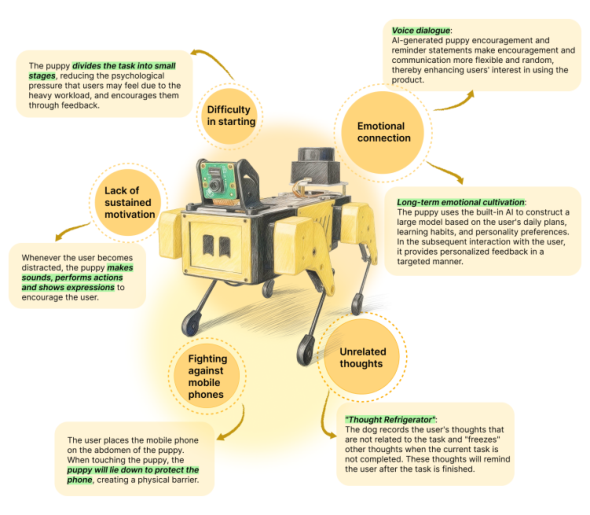
Design Mechanisms Based on Flow Theory and User Pain Points To address mobile phone friction, environmental monotony, and racing internal thoughts without altering neurodivergent traits, we translated flow antecedents, clear boundaries, low-distraction environments, and immediate feedback (Csikszentmihalyi, 1990), into tangible interaction mechanisms (Figure 1).
Figure 1: Mapping between ADHD users’ core pain points, flow antecedents, and Focus Pup design mechanisms.
Session Initiation Mechanism Driven by Physical Isolation To lower initiation friction, the system introduces a physical landing pad attached to the sensor cradle. Placing the mobile phone onto the cradle physically blocks the core source of distraction while triggering session initialization with a unique Session ID. Accompanied by low-intrusiveness LCD visual animations and soft voice instructions, this physical handover ritual establishes clear spatial and psychological boundaries (Csikszentmihalyi, 1990; O’Connell, 2024), dramatically lowering the willpower threshold required to initiate focus.
Low-Interference Companionship Under Peripheral Vision Based on peripheral vision theory in HCI, subtle physical movements restricted to low amplitudes and low operational noise provide reassurance out of the corner of the eye (Bakker, 2016). Once focus stabilizes, the system executes low-frequency breathing and gentle tilting movements. These biomimetic rhythms provide low-interference environmental companionship, soothing loneliness and regulating physiological arousal without interrupting flow continuity.
Two-Stage Damping Touch-Based Emotional Comfort Mechanism To address motor fidgeting and anxiety, the system features a two-stage damped touch function. Operating via a high-frequency touchpad status
280 Xiong and Yang check, the first stage provides smooth tactile feedback paired with a screen emoji, serving as a harmless outlet for fidgeting (Csikszentmihalyi, 1990). When high-frequency stroking indicates elevated emotional volatility, the system escalates to a second-stage burst reward, triggering visual cues and affectionate physical movements to relieve metacognitive anxiety and return users to flow (Barkley, 1997; O’Connell, 2024; Risko & Gilbert, 2016).
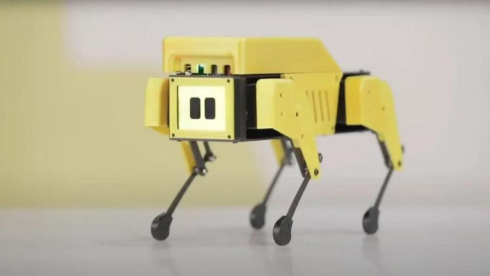
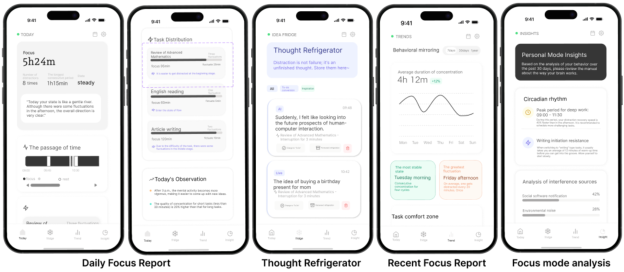
Figure 2: Focus Pup physical hardware prototype.Figure 3: Core functional interface of the Focus Pup mobile app. (four interface groups: Daily Focus Report, Idea Fridge, Recent Focus Report, and Focus Mode Analysis).
Design and Implementation of Distraction Management and Flow Protection To provide low-cognitive-load attention support, Focus Pup adopts an integrated hardware-software architecture comprising four core modules (Figures 2 and 3): a physical mobile phone docking module acting as a spatial gate; a mobile control app for network configuration, task planning, status monitoring, and focus logs; an embodied multimodal actuator driving low- noise biomimetic movements; and a multi-source perception architecture integrating a high-frame-rate camera with cloud-based LLM nodes via ROS 2 to defend against external behavioral and internal cognitive distractions.
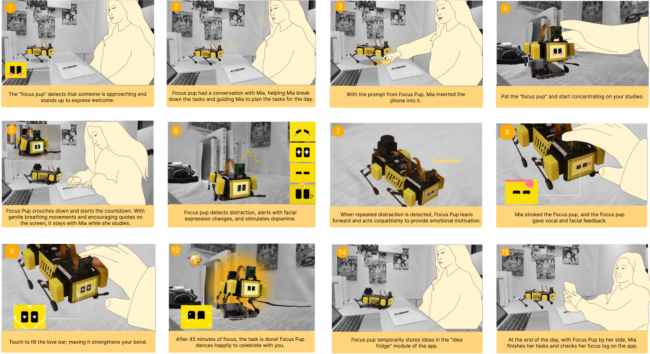
Figure 4: Storyboard of a typical Focus Pup usage scenario. (a 12-frame sequence illustrating the full user interaction process).
Design of Embodied Physical Recall for External Behavioral Distractions Illustrated in the interaction storyboard in Figure 4, the system actively intervenes during unconscious gaze shifts or focus fragmentation. In normal focus states, the hardware maintains a silent low-frequency breathing rhythm. When vision perception nodes detect distraction exceeding a set duration, the app displays a warning while physical servos drive wide- range bodily deflections to awaken metacognitive awareness without harsh acoustic alarms. Technically, the visual sensor uses MediaPipe FaceMesh and YOLOv8-Pose algorithms to extract line-of-sight vectors, facial angles, and upper-limb joint topologies, publishing data across user retention, gaze tracking, and pose estimation topics. An adaptive behavior tree processes these streams to maintain low-frequency posture acknowledgements during focus, trigger corrective hardware deflections during sustained distractions, and asynchronously log start times and durations into a local SQLite database and WebSocket-linked mobile dashboard for focus depth profiling.
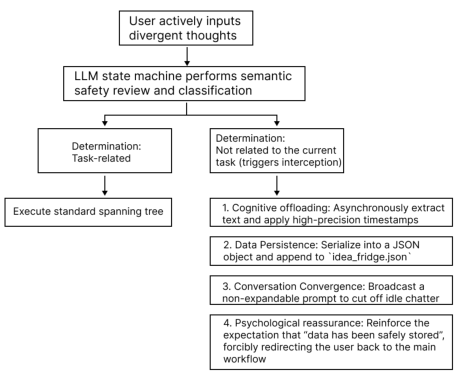
Implementation of the ‘Thought Fridge’ Mechanism for Internal Cognitive Distractions To resolve task-unrelated thoughts (TUTs) that trigger severe anxiety if not immediately investigated, the system introduces an “Idea Fridge” mechanism based on cognitive offloading theory (Risko & Gilbert, 2016). Operating as a cognitive gatekeeper, an embedded LLM manages a four-state state machine—Planning, Focus, Rest, and Distraction Pause—synchronized with the mobile app, as shown in Figure 5. When users express task-irrelevant verbal thoughts during focus mode, the LLM intercepts the input after speech-to-text conversion. If classified as a task-unrelated distraction, the system truncates open-ended conversation, serializes the idea string with
282 Xiong and Yang high-precision timestamps into a JSON object, and asynchronously caches it to both local hardware storage and the mobile app list. After multi-device persistence is confirmed, the LLM delivers a convergent voice prompt assuring the user that their inspiration is safely stored for post-work review, preserving continuous flow.
Figure 5: State machine workflow of the LLM cognitive gatekeeper for intercepting task-unrelated thoughts.
EXPERIMENTAL DESIGN PLAN BASED ON COMPANION ENTITIES Aims of the Experiment
This study intends to adopt a single-blind, between-groups controlled design to examine the intervention effects of a dual-dimensional flow framework on attention maintenance among adults with ADHD. The independent variable is the system interaction mode: the experimental group will use the Focus Pup emotional companion entity with flow-oriented mechanisms, while the control group will use a baseline desktop assistant offering standard functionality without emotional feedback or flow regulation. Tracking subjective flow, cognitive load, and behavioral performance, this exploratory study aims to compare experiential differences across modes rather than establish definitive causal inferences at this stage.
Participant Recruitment The study plans to recruit approximately 24 adults aged 18–40 with ADHD via online communities and university channels based on DSM-5 diagnostic criteria (American Psychiatric Association, 2013). Inclusion criteria require consistent work or study demands, no systematic pharmacological interventions in the past three months, and no severe psychiatric comorbidities. Using stratified randomization to balance gender and baseline attention, the study plans to assign participants into an experimental group and a control group of 12 participants each for preliminary exploratory comparisons.
Focus Pup: A Design Study on a Companion Robot 283 Experimental Procedure
To maximize ecological validity, the study plans to conduct a four-week naturalistic experiment in participants’ daily work environments using a single-blind design. The protocol spans three chronological phases. During the baseline phase, participants will complete a 60-minute unassisted task to establish baseline flow, cognitive load, and behavioral metrics. In the four- week intervention phase, following initial training, participants will complete a 60-minute daily task using either Focus Pup or a baseline hardware system identical in physical form factor but lacking flow mechanisms. During the data collection phase, post-session evaluation instruments, background system logs, and structured observation coding (Lofland, 2006) will capture task completion, switching behaviors, and unautomated attention metrics.
Measurement Tools and Data Analysis Methods The study plans to evaluate subjective flow state using the Flow State Scale (FSS) (Jackson and Marsh, 1996) and perceived cognitive load via the NASA Task Load Index (NASA-TLX) (Hart and Staveland, 1988). Objective behavioral metrics, including task persistence, switching patterns, and distraction signs, will be extracted from background logs and structured behavioral coding. Quantitative between-group differences will be analyzed using independent samples t-tests (Gosset, 1908), while qualitative interview feedback and observation logs will undergo thematic analysis (Braun and Clarke, 2006) to explore user interaction experiences.
DISCUSSION
Observed Research Phenomena and Comparison With Previous Studies The behavioral characteristics observed in this study among adults with ADHD in a natural office setting are generally consistent with existing research findings on executive function deficits and sustained attention difficulties.
Previous research has shown that, at the level of executive function, individuals with ADHD typically exhibit characteristics such as difficulty in task initiation, weaker inhibitory control, and higher working memory load (Barkley, 1997; Willcutt, 2005). Furthermore, in the absence of external structural support, their ability to sustain attention is more prone to fluctuations, and they demonstrate greater sensitivity to immediate stimuli (Sonuga-Barke, 2003). This study observed similar phenomena during interviews and naturalistic observations: users were able to enter a state of high task engagement within a short period, but this state was often difficult to sustain and was easily disrupted by external or internal distractions. These observations bear some resemblance to the description of a state of high concentration in flow theory (Csikszentmihalyi, 1990), but they also suggest that, within the neurodiverse population, this state may exhibit more pronounced phasic and intermittent characteristics rather than a continuous, stable structure. This is consistent with existing research findings on attention regulation difficulties in ADHD (Barkley, 1997; Sonuga-Barke, 2003).
Flow theory is typically defined as a state of deep immersion experienced by an individual when skill and challenge are well matched, accompanied by clear goals and immediate feedback (Csikszentmihalyi, 1990).
However, within the context of this study’s design, this state may be subject to the continuous moderating influence of external structural support mechanisms, which is consistent with the view in cognitive load theory that ‘external scaffolding can reduce the consumption of cognitive resources’ (Kirschner, Sweller and Clark, 2006; Sweller, 1988). Based on this, this study proposes the concept of ‘externally scaffolded flow’ to describe the process of attentional regulation supported by the continuous involvement of an external system. This concept resonates with research on ‘cognitive scaffolding’ (Pea, 2004); however, this study employs it solely as a design-oriented interpretative framework rather than as a formal revision of flow theory.
Design Implications and Limitations While our design rationale suggests that physical feedback and ambient cues can optimize focus compliance, this study has three primary limitations. First, the planned evaluation will rely on self-reports and observational coding rather than continuous physiological or eye-tracking metrics (Fairclough, 2009). Second, short-term evaluations remain susceptible to novelty effects (Klasnja, 2011). Third, as an exploratory design study, formal randomized controlled trials have not yet been completed, precluding clinical causal inferences. Future work will deploy long-term tracking across larger cohorts to explore long- term experiential and operational outcomes in real-world environments.
CONCLUSION
This study addresses the focus challenges and workplace self-management needs of adults with ADHD. Grounded in flow theory, we identified core user pain points, including sustained attention deficits, task initiation friction, and emotional- behavioral dysregulation, through qualitative research with 12 diagnosed participants. Moving away from traditional deficit correction approaches, we proposed an interactive intervention framework integrating environmental regulation and psychological motivation, instantiated through Focus Pup, an integrated hardware-software support system. This work contributes empirically by detailing workplace behavioral patterns in neurodivergent users, theoretically by conceptualizing externally scaffolded flow (Pea, 2004), and practically by establishing a reusable tangible interaction design paradigm for attention support. Future work will conduct controlled user studies and long-term evaluation to examine user engagement and cross-context adaptability.
ACKNOWLEDGMENT
We thank all the volunteers taking part in our user trials and in the requirements analysis. The authors appreciate the contributions of all individuals and organizations that supported this work, either directly or indirectly.
REFERENCES
American Psychiatric Association. (2013). Diagnostic and Statistical Manual of Mental Disorders (5th ed.). Washington, DC: American Psychiatric Association Publishing. Bakker, S., Hausen, D. and Selker, T. (2016) “Introduction: Framing Peripheral
Interaction”, in: Peripheral Interaction: Challenges and Opportunities for HCI in the Periphery of Attention, Bakker, S., Hausen, D. and Selker, T. (eds.). pp. 1–10. Cham: Springer. Barkley, R. A. (1997) Behavioural inhibition, sustained attention, and executive functions: Constructing a unifying theory of ADHD. Psychological Bulletin, 121(1), 65–94. Berrezueta-Guzmán, J., Pau, I., Martín-Ruiz, M.-L. and Máximo-Bocanegra, N.
(2021) Assessment of a robotic assistant for supporting homework activities of children with ADHD. IEEE Access, 9, 93450–93465. https://doi.org/10.1109/ ACCESS.2021.3093123 Braun, V. and Clarke, V. (2006) Using thematic analysis in psychology. Qualitative Research in Psychology, 3(2), 77–101. https://doi.org/10.1191/1478088706 qp063oa Csikszentmihalyi, M. (1990). Flow: The Psychology of Optimal Experience. New
York: Harper & Row. Fairclough, S. H. (2009) Fundamentals of physiological computing. Annual Review of Psychology, 60, 221–242. Gosset, W. S. (Student). (1908) The probable error of a mean. Biometrika, 6(1), 1–25.
https://doi.org/10.1093/biomet/6.1.1 Hart, S. G. and Staveland, L. E. (1988) “Development of NASA-TLX (Task Load Index): Results of empirical and theoretical research”, in: Human Mental Workload. pp. 139–183. North-Holland: Elsevier. Jackson, S. A. and Marsh, H. W. (1996) Development and validation of a scale to
measure optimal experience: The Flow State Scale. Journal of Sport and Exercise Psychology, 18(1), 17–35. https://doi.org/10.1123/jsep.18.1.17 Kirschner, P. A., Sweller, J. and Clark, R. E. (2006) Why minimal guidance during instruction does not work: An analysis of the failure of constructivist, discovery, problem-based, experiential, and inquiry-based teaching. Educational Psychologist, 41(2), 75–86. https://doi.org/10.1080/00461520.2011.614971 Klasnja, P., et al. (2011) HCI and longitudinal study challenges, Proceedings of
the SIGCHI Conference on Human Factors in Computing Systems, New York, pp. 1767–1776. ACM Press, New York. https://doi.org/10.1145/1978942.1978956 Li, L. (2025) Design of intervention product system for children with functional dysarthria based on flow theory. Master’s Dissertation, Jiangnan University, Wuxi. Lofland, J. et al. (2006). Analyzing Social Settings: A Guide to Qualitative Observation
and Analysis, 4th ed. Belmont: Wadsworth. O’Connell, M., et al. (2024) Embodied canine companion: Minimalist robotic interactions to support focus in neurodivergent populations. International Journal of Human-Computer Studies, 182, 103–115. Pea, R. D. (2004) The social and technological dimensions of scaffolding and related
theoretical concepts for learning, education, and human activity. Educational Psychologist, 39(3), 161–174. Risko, E. F. and Gilbert, S. J. (2016) Cognitive offloading. Trends in Cognitive Sciences, 20(9), 676–688. Sandygulova, A., Zhexenova, Z., Tleubayev, B., Nurakhmetova, A., Zhumabekova, D.,
Assylgali, I., Rzagaliyev, Y. and Zhakenova, A. (2019) Interaction design and methodology of robot-assisted therapy for children with severe ASD and ADHD. Paladyn, Journal of Behavioural Robotics, 10, 330–345.
286 Xiong and Yang Smallwood, J. and Schooler, J. W. (2006) The restless mind. Psychological Bulletin,
132(6), 946–958. Sonuga-Barke, E. J. S. (2003) The dual pathway model of AD/HD: An elaboration of neuro-developmental characteristics. Neuroscience & Biobehavioural Reviews, 27(7), 593–604. Sweller, J. (1988) Cognitive load during problem solving: Effects on learning.
Cognitive Science, 12(2), 257–285. https://doi.org/10.1207/s15516709cog1202_4 Wang, H. (2023) Research on the Design of Digital Games for Attention Training of ADHD Children based on Flow Theory. Master’s Dissertation, South China University of Technology, Guangzhou. Willcutt, E. G. (2005) The prevalence of ADHD executive function deficits:
A meta-analytic review. Biological Psychiatry, 131(1), 49–57. https://doi. org/10.1037/0033-2909.131.1.49 Xiang, J. (2022) Attention characteristics and their neural basis in adults with high ADHD traits. Master’s Dissertation, Southwest University, Chongqing.
SEARCH THE AHFE DIGITAL BOOKSTORE BY ISBN
Explore the complete digital volume
Human Factors in Design, Engineering, and Computing
Read this individual research paper free through the original publisher, or explore the full digital proceedings book.