Jamie Johann Tan, Kenneth Y. T. Lim (2026). Designing a Gamified Hawker Centre Simulation for Language and Cultural Learning in Singapore. In: Human Factors in Design, Engineering, and Computing. AHFE Open Access, vol. 238, pp. 2842–2852. https://doi.org/10.54941/ahfe1008508
Gamification has emerged as a growing method in the field of education, utilising game elements to sustain student engagement and active learning to address ineffective traditional methods found in formal education. This study aims to utilise this technique in the context of language and cultural education in multicultural Singapore. Currently, Singaporeans utilise our unifying language of English to communicate between communities, thus introducing a gap between formal language education and real world interactions with local communities. This study addresses this gap through the development of an educational video game that immerses players in a culturally relevant scenario with the objective of enhancing Singaporeans' ability to learn their non-mother-tongue language and thereby improve cross-cultural understanding. In the context of a food establishment, the game tasks players with taking orders, preparing food and serving customers that only speak their mother tongue. By simulating authentic yet consequence-free interactions, the game aims to build vocabulary, listening comprehension and cultural familiarity. Data will be collected through in-game performance metrics, tracking players' playthroughs and scores over time. The project seeks to contribute to ongoing discussions regarding the role of gamification beyond academic education and its potential to cultivate practical life skills, intercultural competence and social understanding.
Singapore is a multicultural nation that champions a bilingual education policy, requiring students to learn both English and their designated mother tongue language. Through this policy, English has become the dominant language of communication across educational, professional, and public settings, while mother tongue languages are more commonly practised within families and specific cultural communities. This approach has contributed significantly to social cohesion by providing a common language that Singaporeans of different ethnic backgrounds can communicate effectively with.
However, it may have also unintentionally reduced opportunities for Singaporeans to engage with languages outside their own ethnic backgrounds. In everyday life, English is often sufficient for most interactions, creating
Designing a Gamified Hawker Centre Simulation 2843 little practical necessity for individuals to learn or use another community’s mother tongue despite living in a highly diverse society.
This presents a gap between formal language education and authentic intercultural communication. Despite exposure to multiple languages through education and public spaces, opportunities to practise and apply these languages in real-world contexts remain limited. As a result, language learning often becomes focused on examinations and academic achievement rather than practical communication and cultural understanding.
One possible approach to addressing this issue is through gamification. Within education, gamification has been increasingly adopted to improve learner engagement, motivation, and knowledge retention. Educational games provide learners with safe environments where mistakes carry minimal consequences, encouraging experimentation, repetition, and active participation.
This project explores the use of gamification as a means of promoting language learning and intercultural understanding within the Singaporean context. Through the development of an educational video game situated in a hawker centre, players are exposed to the practical use of language while engaging with scenarios that reflect everyday interactions between members of different communities. Ultimately, the project seeks to investigate whether gamification can serve as an effective supplementary tool for language and cultural education beyond traditional classroom settings.
LITERATURE REVIEW/BACKGROUND Demand for Language Education
Facilitating additional language education through formal settings may prove counterproductive. Students at pre-tertiary levels already experience significant academic workloads, and introducing another compulsory language to learn may increase stress and reduce overall learning effectiveness. Furthermore, the widespread use of English in Singapore minimises the practical necessity of utilising other languages in everyday communication, resulting in fewer opportunities and reduced incentive for independent language learning.
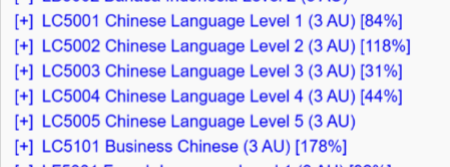
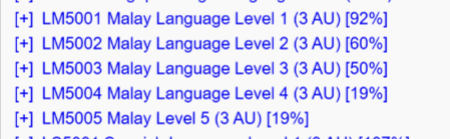
Despite these challenges, evidence (Fig 1, Fig 2, Fig 3) suggests that interest in learning additional languages remains present. Examining enrolment data from Nanyang Technological University’s (NTU) Student Automated Registration System indicates consistently high demand for language modules, particularly those involving two of Singapore’s official mother tongue languages: Chinese and Malay. Though Tamil was not included, Hindi as a representation of the Indian community in Singapore, did showcase demand from NTU students as well.
Figure 1: Module subscription for Chinese Language.Figure 2: Module subscription for Malay language.Figure 3: Module subscription for Hindi language.
High module enrolment and class fulfilment rates suggest that students are willing to invest time and effort into acquiring additional language skills despite the absence of formal requirements.
This demand thus provides the necessity for this project.
Gamification in Education Deterding et al. (2011) define gamification as the use of game design elements, such as rewards, progression systems, leaderboards, and challenges, in non- game contexts. Within educational settings, these elements are employed to encourage participation, increase learner motivation, and improve knowledge retention. Unlike traditional instructional methods that often rely on passive information delivery, gamified learning environments encourage learners to actively interact with educational content through immediate feedback and goal-oriented progression.
Hamari, Koivisto and Sarsa (2014) conducted a comprehensive literature review examining the impact of gamification across various fields, including education. Their findings suggested that gamification generally produces positive outcomes, particularly in increasing user engagement, motivation, and participation. However, effectiveness was found to depend heavily on the design of the system and the context in which it was implemented. The study highlights that gamification is most successful when game mechanics support meaningful learning objectives rather than acting as superficial reward systems.
Additionally, Shortt et al. (2021) analysed the growing body of research surrounding language learning in Duolingo and found that its use of gamification elements, including experience points, achievement badges, and leaderboards, contributes significantly to sustained learner engagement. The study suggests that gamified systems can support language acquisition by encouraging consistent practice and reducing learner attrition. However, it also notes that engagement alone does not necessarily guarantee deep language mastery, highlighting the importance of balancing motivation with meaningful learning activities.
These findings suggest that gamification possesses potential as a supplementary approach to language education. By creating interactive and consequence-free learning environments, educational games can encourage learners to actively apply language skills rather than merely
Designing a Gamified Hawker Centre Simulation 2845 memorising vocabulary. This project builds upon these principles by introducing a culturally contextualised game environment that combines language learning with authentic social interactions commonly encountered within Singapore’s multicultural society.
AIMS AND OBJECTIVES After literature and source reviews, the objectives of this project are as follows:
1. To design and develop an educational video game that supports language
and cultural learning 2. To provide learners with opportunities to engage with non-mothertongue languages through simulated interactions 3. To design a learning experience that goes beyond language vocabulary
and memorisation for players to actively learn and apply their knowledge 4. To integrate culturally relevant scenarios into gameplay to promote intercultural understanding 5. To investigate the applicability of gamification as a tool for language
education in Singapore
METHODOLOGY
Game Design & Development The game will be developed using the Unity game engine.
As discussed earlier, gamification becomes strengthened if the activities are contextualised in a meaningful environment rather than simple activity repetition. Thus, the game is set within a hawker stall environment. Hawker centres are a culturally significant aspect of Singaporean society and serve as a gathering place where individuals from diverse ethnic backgrounds regularly interact. Due to the multilingual nature of Singapore, hawkers often possess a basic understanding of commonly used terms across different mother tongue languages. This makes the hawker environment an appropriate setting for facilitating language exposure and intercultural communication.
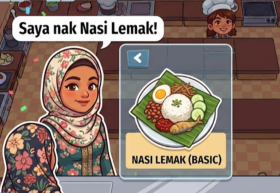
Within the game, the player assumes the role of a hawker taking customer orders and preparing meals. Customers communicate exclusively in their mother tongue (Fig 4), requiring players to interpret their requests and prepare the corresponding dishes correctly. Through this process, players are exposed to practical vocabulary and language usage within a realistic but consequence-free environment.
Figure 4: Customer ordering Nasi Lemak.
2846 Tan and Lim The players are placed behind the service counter with the ingredients and cooking stations. The player’s objective is to complete customer orders accurately and efficiently. The core gameplay loop consists of receiving an order, interpreting the language used, selecting the correct ingredients, applying the appropriate cooking method, and serving the completed dish to the customer.
A table of all possible customer orders (Table 1) was collated below.
Table 1: Lists of orders in-game.
Table available in the original PDF paper.
Ingredients Cooking Process
No. Order Origin Community
English Translation Chicken, Rice Roast chicken, steam
1 烧鸡饭 Chinese Roasted chicken rice
rice Chicken, Rice Steam the rice, fry the Malay Fried rice with chicken
2 Nasi Goreng Ayam
rice and the chicken together
3 Masala Thosai
Indian Lentil crepe with spiced potatoes
Rice, Dosa water, Potatoes
Steam the rice, blend rice with dosa water, fry on pan, add potatoes
4 Nasi Lemak
Chicken, Rice, Coconut milk
Malay Coconut rice with various ingredients
Add coconut milk to rice, steam the rice, fry chicken
Indian Butter chicken Chicken,
5 Murgh Makhani
Butter Sauce
Fry the chicken, add it to pot with butter sauce, leave it to simmer
6 白鸡饭 Chinese Steamed chicken rice
Chicken, rice Steam the chicken, steam the rice For example, if a customer orders “烧鸡饭” (roasted chicken rice), the player must identify the words associated with chicken and rice, roast the chicken and steam the rice. If a customer orders “Nasi Goreng Ayam”, the player should instead stir-fry the rice and chicken.
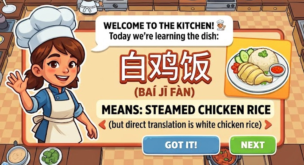
To support learning progression, the game incorporates a tutorial stage with an assistant character that translates the order for the player (Fig 5). This character introduces the various languages’ vocabulary and cooking method seamlessly. Once the tutorial is completed, the assistant is removed. Players must then rely on their memory and accumulated knowledge to complete orders independently.
Figure 5: Assistant chef translating the order.
Designing a Gamified Hawker Centre Simulation 2847 Quantitative Data Collection Framework
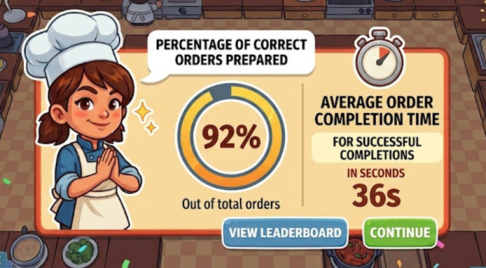
The game includes two built-in analytics metrics that can be utilised to evaluate player performance and the effectiveness of the educational experience:
1. Percentage of Correct Orders Prepared 2. Average Successful Order Completion Time (per order, per round) These metrics were selected because they directly reflect both language comprehension and application. The first metric measures a player’s ability to correctly interpret customer orders and associate foreign- language vocabulary with the appropriate ingredients and cooking methods. Higher scores indicate greater vocabulary recognition and understanding.
The second metric measures the speed players are able to interpret and respond to customer orders. A reduction in completion time suggests increased familiarity with the vocabulary and game mechanics, indicating improved recall and processing efficiency.
The game automatically displays the relevant performance metrics (Fig 6) upon completion of each round.
Figure 6: End of round scores and performance metrics.
It is hypothesised that repeated gameplay will lead to improvements in both metrics. As players become increasingly familiar with the in-game language, they should demonstrate higher order accuracy and faster response times. Improvements in these measures would suggest that the game is successfully facilitating language learning through repeated exposure and active engagement.
To evaluate this hypothesis, a trial session was conducted involving six participants aged between 20 and 25 years old. Each participant was required to complete five playthroughs of the game. Repeated play sessions were intentionally incorporated to encourage reinforcement and repetition, both of which are recognised as important factors in language learning and memory retention.
While the gameplay analytics provide quantitative evidence of language learning, they are limited in their ability to evaluate broader outcomes such as the effectiveness of the game’s design as a learning medium and its contribution towards cultural understanding. To complement the quantitative findings, a qualitative evaluation was incorporated following the gameplay sessions.
After the session, participants were asked to complete a post-game questionnaire consisting of ten statements measured using a five-point Likert scale (1 = Strongly Disagree, 5 = Strongly Agree). The questionnaire was divided into two categories. The first evaluated participants’ perceptions of the game’s design as an educational tool while the second evaluated the game’s cultural learning objectives.
Participants also took part in a short semi-structured interview of five open-ended questions. The interview builds upon the questionnaire, seeking to capture participants’ personal reflections and provide richer insights into aspects of the learning experience that could not be measured numerically.
Interview responses from all participants were reviewed and compared to identify recurring ideas relating to their gameplay experience and language cultural takeaways. These themes were subsequently used to complement the quantitative findings and provide a more comprehensive evaluation of the game’s effectiveness.
The post-game questionnaire consisted of the following statements: Game Design
1. The gameplay made learning feel more enjoyable than traditional
vocabulary memorisation. 2. Preparing customer orders helped me associate unfamiliar words with their meanings. 3. The tutorial prepared me well for playing the game independently. 4. The game provided an appropriate level of challenge without becoming
boring or frustrating. 5. I would continue playing this game if more languages, dishes, or levels were added.
Cultural Education
1. The hawker centre setting felt like a realistic representation of everyday
Singapore. 2. The game increased my awareness of the different languages used in Singapore. 3. Playing the game made me appreciate Singapore’s multicultural society
more. 4. The game made me feel more confident interacting with people who speak another local language. 5. I believe games like this can promote cultural understanding in Singapore.
RESULTS AND DISCUSSION
Quantitative Findings The two gameplay metric results of the trial session are as follows:
Table 2: Individual participant performance across five playthroughs.
Table available in the original PDF paper.
Participant P1 Correct (%)
P1 Time (s)
P2 Correct (%)
P2 Time (s)
P3 Correct (%)
P3 Time (s)
P4 Correct (%)
P4 Time (s)
P5 Correct (%)
P5 Time (s)
1 8 60 28 58 45 47 55 41 65 34
2 14 56 36 53 46 42 56 38 68 32
3 27 54 39 47 48 41 59 37 66 31
4 22 52 31 52 46 45 62 37 69 32
5 33 47 40 44 50 41 60 36 73 30
6 18 59 34 47 46 42 58 37 70 31
Avrg 20.3 54.7 34.7 50.2 46.8 43 58.3 37.7 68.5 31.7 During the first playthrough, participants achieved an average accuracy score of 20.3% for correctly prepared orders. The average successful order completion time was recorded at 54.7 seconds. These initial results suggest that players possessed limited prior knowledge of the language vocabulary and required time to interpret customer requests and determine the appropriate actions.
The second, third and fourth playthroughs demonstrated positive trends in both performance indicators.
By the fifth and final playthrough, participants achieved an average order accuracy score of 68.5% while reducing their average completion time to 31.7 seconds. These results represent substantial improvements compared to the first playthrough and suggest that meaningful learning occurred throughout the gameplay experience.
The observed improvements support the educational potential of gamification as a language-learning tool. The increase in order accuracy indicates that players were able to acquire and retain vocabulary associated with food items, ingredients, and preparation methods. Through repeated interaction with the game environment, participants gradually developed stronger associations between foreign-language terms and their corresponding meanings.
Similarly, the reduction in completion times suggests that players became increasingly efficient at processing and applying the acquired knowledge. Rather than relying solely on trial-and-error, players appeared to develop stronger recall abilities and greater familiarity with the language content. This indicates movement beyond simple memorisation towards active application of learned vocabulary.
These findings has quantitatively proven the game design’s success in contributing to language understanding and education with all six participants obtaining an increasing score and lower completion time between playthroughs.
After conducting the questionnaire, the results are as follows:
Table 3: Mean score of Likert scale questions across all six participants.
Table available in the original PDF paper.
Statement Mean Score A) The gameplay made learning enjoyable. 4.7
B) Preparing customer orders helped associate unfamiliar words with their
3.5
meanings.
C) The tutorial prepared me well for independent play. 3.5 D) The game provided an appropriate level of challenge. 3.7
E) I would continue playing if additional content were added. 5 F) The hawker centre setting felt authentic. 4.7
G) The game increased my awareness of Singapore’s different languages. 2.2 H) The game increased my appreciation of Singapore’s multicultural
4
society.
I) The game improved my confidence interacting with speakers of other
2.7
local languages.
J) Games like this can promote cultural understanding. 4 Overall, participants responded positively towards the game’s design and cultural objectives. The highest-rated statement belonged to E, supporting the already strong relationship gamification has with player engagement and motivation. It also suggests an intrinsic motivation to learn through challenge and activity, as the project itself did not demand any formal evaluation of what they learnt at the end of the trial session.
Comparatively lower ratings were found for statement G, prompting me to investigate for further insights from the participants through the interview stage
Interview Findings Interview responses revealed three recurring themes.
Theme 1: Gameplay Enhanced Learning Most participants commented that learning vocabulary through gameplay felt more engaging than conventional memorisation techniques. Associating customer orders with ingredients and cooking actions enabled participants to form stronger connections between unfamiliar words and their meanings.
“I was surprised that the Chinese word for steamed wasn’t actually used for steamed chicken rice. Is just white, which is damn generic. So it’s interesting that direct translations doesn’t happen but makes it more funny and easier to remember I guess.” (Participant 1, 2026) This quotation indicates that fun and interesting-ness were factors at play that allowed the participant to more actively recall the language and its meaning.
Designing a Gamified Hawker Centre Simulation 2851 Theme 2: Authentic Cultural Context
Participants generally agreed that the hawker-centre environment reflected a familiar aspect of everyday Singaporean life. Several participants noted that situating language learning within a recognisable local setting made the experience more immersive and meaningful.
“Is a very Singaporean space. Not many other cultures can replicate. So it makes the learning more authentic and applicable since I can at least hear it everyday when I go to order food.” (Participant 5, 2026) This response supports the game’s objective of utilising familiar and authentic spaces to draw stronger associations and thus application to enable learning.
Theme 3: Increased Cultural Awareness This theme scored poorly in the Likert scale questionnaire. Upon further discussions with the participants, many shared how though this was effective in learning the basics or more applicable words of a language, it did not substantially increase their cultural awareness.
“I don’t think learning how to order food in their language is enough to make me say I am more aware. Maybe if the history of the word or the food was shared. But for now I think it’s too dramatic for me saying learning a few words auto means I am more aware of the culture.” (Participant 2, 2026) The explanation serves to point to an improvement my game and future projects could develop upon. In an effort to make the game simple and scalable, participants noted and confessed that their language learning would not generate cultural awareness and understanding, and that the game would require modified or additional content in order to truly bridge the gap between learning about a foreign language to learning about the culture it originates from.
Taken together, the quantitative and qualitative findings suggest that the game demonstrates potential as a supplementary educational tool for language and cultural education. The gameplay analytics indicate improvements in language performance, while participant feedback supports the effectiveness of the game’s contextual design and its ability to promote engagement and cultural appreciation.
Nevertheless, several limitations remain. As discussed in theme 3, the game is still lacking in its ability to bridge that final step between language learning and cultural education. Increasing the game’s content or integrating historical or cultural titbits is one possible suggestion to tackle this limitation.
Additionally, the study involved only six participants, too small a sample size to declare any concrete conclusions. Furthermore, the qualitative findings reflect participants’ self-reported perceptions, which may be influenced by personal bias and the relatively short duration of the study. Future work should evaluate the game with a larger and more diverse participant group over an extended period to investigate longer-term language retention and broader cultural learning outcomes.
CONCLUSION
This project explored the development of a gamified educational video game designed to support language learning and cultural education within Singapore’s multicultural context. By creating an immersive food-service environment in which players interact with customers speaking different mother tongue languages, the project sought to simulate authentic social interactions and provide opportunities for practical language application.
The project drew upon principles of gamification and experiential learning to create an interactive educational experience. Analysis of gameplay data demonstrated consistent improvements across quantitative performance metrics. Participants showed increased accuracy in preparing customer orders and reduced completion times over multiple playthroughs, suggesting successful vocabulary acquisition and improved language recall. Qualitative data also showed promise, with participants sharing their engagement with the game and potential longevity should it continue production with more content.
These findings support existing literature that identifies gamification as a potentially effective approach for enhancing learner engagement and encouraging repeated practice. By providing a consequence-free environment in which mistakes serve as learning opportunities rather than failures, educational games may complement traditional language-learning methods and facilitate active participation.
Overall, this project demonstrates the potential of gamification as a supplementary tool for language education beyond traditional classroom environments. Through the integration of culturally relevant scenarios and interactive gameplay, educational games may offer accessible and engaging opportunities for language practice while supporting broader goals of intercultural communication and social understanding within Singapore’s diverse society.
ACKNOWLEDGMENT
This research project was supported by Nanyang Technological University under the URECA Undergraduate Research Programme.
I would also like to formally thank my supervisor Dr Lim Yang Teck Kenneth. His trust and professionalism allowed me to tackle this research project with my own creative autonomy which greatly improved my perception to the field of research.
REFERENCES
Deterding, S., Dixon, D., Khaled, R., & Nacke, L. (2011). From Game Design Elements to Gamefulness: Defining Gamification. Proceedings of MindTrek 2011. Hamari, J., Koivisto, J., & Sarsa, H. (2014). Does Gamification Work? A Literature
Review of Empirical Studies on Gamification. Hawaii International Conference on System Sciences. Shortt, M., Tilak, S., Kuznetcova, I., & Martens, B. (2021). Gamification in Mobile- Assisted Language Learning: A Systematic Review of Duolingo Literature. Computer Assisted Language Learning.
SEARCH THE AHFE DIGITAL BOOKSTORE BY ISBN
Explore the complete digital volume
Human Factors in Design, Engineering, and Computing
Read this individual research paper free through the original publisher, or explore the full digital proceedings book.