Yingjiao Jia, Hsin-Hsien Chiu (2026). The Impact of Gamification Elements in Art Therapy on Behavioral Intention Among University Students With Trait Anxiety: A Self-Determination Theory Perspective. In: Human Factors in Design, Engineering, and Computing. AHFE Open Access, vol. 238, pp. 186–196. https://doi.org/10.54941/ahfe1008253
Publisher statistics will load when you open Metrics.
AHFE OPEN ACCESS OPEN ACCESS CONFERENCE PROCEEDINGS PAPER
The Impact of Gamification Elements in Art Therapy on Behavioral Intention Among University Students With Trait Anxiety: A Self-Determination Theory Perspective
Trait anxiety is a relatively stable tendency to interpret situations as threatening, leading to persistent worry and unease. For university students navigating academic, interpersonal, and career pressures, accessible early emotional support is paramount. While art therapy leverages creative media (e.g., painting, music, and audio-visual interaction) to facilitate nonverbal expression and emotion regulation, sustaining engagement remains challenging. Gamification can provide structure and enhance adherence; however, its specific impact on the acceptance of gamified art therapy among trait-anxious students remains underexplored. Drawing on the Stimulus-Organism-Response (SOR) model and Self-Determination Theory (SDT), this study investigates how achievement-, immersion-, and social-related gamification elements drive behavioural intention by fulfilling the basic psychological needs of autonomy, competence, and relatedness. Using partial least squares structural equation modelling (PLS-SEM), we analysed survey data from 250 trait-anxious university students. Results supported all hypothesized paths. Notably, immersion-related elements exhibited the strongest association with autonomy, which in turn was the primary predictor of behavioural intention. These findings underscore that gamified art therapy should prioritize immersive contexts, user autonomy, supportive feedback, and low-pressure social interactions to effectively address the psychological needs of trait-anxious students.
Trait anxiety refers to a relatively stable tendency to appraise a wide range of situations as threatening and to respond with worry, unease, or fear (Spielberger et al., 1983). Elevated trait anxiety not only heightens attentional bias toward threats but may also weaken goal-directed attentional control, making it more difficult to disengage from negative or threatening stimuli (Eysenck et al., 2007; Xing et al., 2022). This persistent tendency may further affect cognitive flexibility, emotion regulation, and everyday adjustment. The 2022 Report on the Mental Health of Chinese University Students found
The Impact of Gamification Elements in Art Therapy on Behavioral Intention 187 that only 54.72% of respondents were classified as having no anxiety risk, indicating that anxiety is prevalent in this demographic (Fang et al., 2023). University students are simultaneously navigating personal development and changing social roles while facing academic pressure, employment competition, interpersonal demands, self-evaluation, and future planning. Under such conditions, high trait anxiety may intensify and prolong negative responses to stress and uncertainty, increasing difficulties in sustaining attention, adapting cognitive strategies, and managing academic and daily life (Dong et al., 2022). Therefore, early emotion-regulation support that is low-pressure, readily acceptable, and suitable for everyday use is crucial for mitigating the persistent effects of trait anxiety and maintaining the mental health and well-being of these students.
University counseling, professional psychotherapy, and pharmacological treatment provide essential support for students with anxiety. However, for university students who do not meet clinical diagnostic criteria but remain affected by persistent anxious tendencies, the need for everyday, low-intensity, and sustained emotion-regulation support remains largely unmet. Professional services often require fixed appointments and dedicated settings, limiting their integration into daily routines. Some students may also experience psychological discomfort when directly disclosing personal distress, which can hinder sustained participation and self-regulation. Consequently, non-pharmacological approaches with lower participation barriers, reduced pressure for direct disclosure, and greater compatibility with daily life have gained increasing attention as valuable complements to university mental-health services.
Art therapy is a prominent non-pharmacological approach that utilizes creative media—including painting, music, movement, drama, and video—to facilitate self-expression, emotional externalization, and psychological recovery (Stuckey and Nobel, 2010). Compared to language-dependent interventions, it emphasizes nonverbal, symbolic, and process-oriented expression. This allows individuals with anxiety to explore difficult-to-verbalize experiences within a relatively safe context and to foster emotional release and self- awareness through creation. Previous studies have demonstrated its positive effects on anxiety reduction, emotional well-being, and perceived social support (Slayton et al., 2010). Nevertheless, conventional art therapy remains constrained by logistical requirements, including dedicated venues, specific materials, trained professionals, organized sessions, and mechanisms for sustained engagement. Furthermore, for university students with trait anxiety, uncertainty during art-making and the self-evaluation of the final product may undermine their willingness to participate and the overall quality of the therapeutic experience.
With advances in digital technology, art therapy has expanded from in-person activities to digitally mediated interactive formats (Ding et al., 2025). By integrating images, sound, animation, interactive feedback, and intelligent recommendation systems, digital media can diversify modes of artistic expression and lower the barriers to engaging in art-making. For university students, who are typically frequent users of digital platforms,
188 Jia and Chiu digital art therapy may offer more flexible, personalized, and accessible opportunities for emotion regulation. Gamification provides a compelling direction for this digital transformation. Through goals, guided tasks, immediate feedback, staged rewards, narrative contexts, and social interaction, gamification can make non-game activities more structured, responsive, and engaging, thereby bolstering motivation and sustained participation (Deterding et al., 2011). In digital health, gamification has been effectively applied to health behavior management, mental-health support, and mobile interventions, demonstrating significant value in promoting engagement and continued use (Sardi et al., 2017; Cheng et al., 2019).
Gamified art therapy integrates game design with art therapy by embedding goals, tasks, feedback, narratives, and interactive elements into artistic-expression activities. For instance, Fang et al. (2019) developed an art-therapy-embedded game system that converted users’ drawings into levels resembling Angry Birds, seamlessly linking artistic creation with task challenges and feedback. For university students with trait anxiety, clear goals and task decomposition may reduce the ambiguity and uncertainty often associated with artistic expression, while narrative contexts and role- taking can provide a less direct and psychologically demanding avenue for communicating personal distress. Options for self-directed choice and timely feedback may further strengthen perceived control and encourage continued participation. However, different gamification elements may not benefit this population equally. It is therefore imperative to examine how specific elements shape the psychological experience during art therapy and how these experiences, in turn, influence behavioral intention, thereby informing the optimized design of gamified art therapy for trait-anxious university students.
Accordingly, this study investigates how gamification elements in art therapy influence the psychological needs and behavioral intention of university students with trait anxiety, with the overarching goal of informing gamified art-therapy design. To achieve this, the study adopts the Stimulus- Organism-Response (SOR) model as its analytical framework. Originally proposed by Mehrabian and Russell (1974), the SOR model posits that environmental stimuli affect internal emotional, cognitive, or psychological states, which subsequently drive behavioral responses. It has since been widely applied in information systems, human-computer interaction, and digital services to explain how design cues shape users’ internal experiences and behavioral choices (Eroglu et al., 2001). Prior gamification research has similarly employed the SOR framework to analyze relationships among gamified stimuli, internal user states, and behavioral outcomes (Gatautis et al., 2016). Thus, the model provides an ideal structure for examining the process linking gamification elements, psychological experience, and behavioral intention in the present context.
To further specify the psychological variables represented by the organism component, this study draws on Self-Determination Theory (SDT). Because gamification design fundamentally aims to stimulate and sustain users’ motivation, SDT is a paramount theoretical framework for explaining the
The Impact of Gamification Elements in Art Therapy on Behavioral Intention 189 formation of intrinsic motivation. Deci and Ryan (1985) proposed that intrinsic motivation hinges on the satisfaction of three basic psychological needs: autonomy, competence, and relatedness. Ryan, Rigby, and Przybylski (2006) further demonstrated that game experiences can profoundly influence motivation and participation by fulfilling these needs. Similarly, Xi and Hamari (2019) identified strong correlations between gamification features and basic need satisfaction. Accordingly, this study integrates SDT to delineate the organism component of the SOR model, conceptualizing autonomy, competence, and relatedness as the core internal psychological states that elucidate behavioral intention toward gamified art therapy among trait-anxious university students.
RESEARCH FRAMEWORK, METHODS, AND RESULTS Gamification Elements and Basic Psychological Needs
Gamification elements are conceptualized as external stimuli that potentially shape participation in gamified art therapy among university students with trait anxiety. Gamification entails the application of game design elements within non-game contexts to amplify motivation and sustained engagement (Deterding et al., 2011). Within digital health and psychological-support paradigms, elements such as goals, feedback, rewards, narratives, and social interaction serve to render activities more structured and deeply participatory (Sardi et al., 2017; Cheng et al., 2019).
Yee (2006) identified achievement, social interaction, and immersion as three foundational dimensions of online gaming motivation. Building upon this framework, Xi and Hamari (2019) categorized gamification features into achievement-, immersion-, and social-related domains. Achievement-related features prioritize goals and performance feedback; immersion-related features facilitate narrative involvement and role-playing experiences; and social-related features promote interaction, collaboration, and interpersonal connection (Xi and Hamari, 2019; Koivisto and Hamari, 2019). Consequently, these three categories are positioned as the external stimuli in the current study.
In the context of gamified art therapy, achievement-related elements supply concrete goals and progress feedback; immersion-related elements foster contextual involvement via avatars, narratives, role-play, and audiovisual feedback; and social-related elements enable communication and collaboration. Existing literature substantiates that such features can critically influence participation and motivation by satisfying foundational psychological needs (Xi and Hamari, 2019; Sailer et al., 2017).
Within the SOR framework, the impact of external stimuli on behavioral responses is characteristically mediated by individuals’ internal states. Given that gamification is explicitly designed to motivate active and sustained participation, this study utilizes SDT to define the organism component of the SOR model. SDT posits that intrinsic motivation emerges from the fulfillment of autonomy, competence, and relatedness (Deci and Ryan, 1985; Ryan and Deci, 2000). Autonomy denotes a sense of choice, volition, and agency over one’s actions; competence signifies feeling capable of navigating
190 Jia and Chiu task demands and achieving desired outcomes; and relatedness involves feeling connected to, accepted by, and supported by others. Ryan et al. (2006) further contended that game mechanics stimulate behavior precisely when they satisfy these fundamental needs. Therefore, autonomy, competence, and relatedness are positioned as the central internal psychological variables within gamified art therapy.
In this therapeutic context, achievement-related, immersion-related, and social-related elements function as external design stimuli through mechanisms of goal feedback, immersive contextual experiences, and social interactivity. According to SDT (Deci and Ryan, 1985), these external stimuli are theoretically linked to users’ needs for autonomy, competence, and relatedness, which subsequently influence their acceptance of and active participation in gamified art therapy. Consequently, the following hypotheses are formulated:
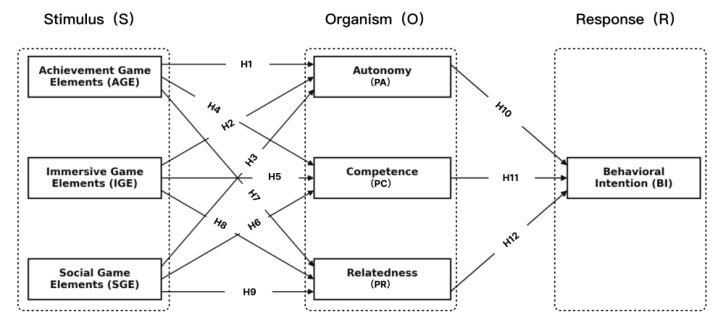
H1: Achievement-related gamification elements positively influence autonomy among university students with trait anxiety in gamified art therapy.
H2: Immersion-related gamification elements positively influence
autonomy among university students with trait anxiety in gamified art therapy.
H3: Social-related gamification elements positively influence autonomy among university students with trait anxiety in gamified art therapy.
H4: Achievement-related gamification elements positively influence
competence among university students with trait anxiety in gamified art therapy.
H5: Immersion-related gamification elements positively influence competence among university students with trait anxiety in gamified art therapy.
H6: Social-related gamification elements positively influence competence
among university students with trait anxiety in gamified art therapy.
H7: Achievement-related gamification elements positively influence relatedness among university students with trait anxiety in gamified art therapy.
H8: Immersion-related gamification elements positively influence
relatedness among university students with trait anxiety in gamified art therapy.
H9: Social-related gamification elements positively influence relatedness among university students with trait anxiety in gamified art therapy.
Basic Psychological Needs and Behavioral Intention In the SOR model, a behavioral response ensues following the impact of external stimuli on internal states (Mehrabian and Russell, 1974). Behavioral intention is extensively recognized as a robust proximal predictor of future adoption, utilization, or continued engagement (Venkatesh et al., 2003). Therefore, it is designated here as the response variable, encapsulating the willingness to participate in and utilize gamified art therapy.
The Impact of Gamification Elements in Art Therapy on Behavioral Intention 191 Autonomy, competence, and relatedness are investigated as the internal psychological predictors of this behavioral intention. The following hypotheses are thus proposed:
H10: Autonomy positively influences behavioral intention to participate in gamified art therapy among university students with trait anxiety.
H11: Competence positively influences behavioral intention to
participate in gamified art therapy among university students with trait anxiety.
H12: Relatedness positively influences behavioral intention to participate in gamified art therapy among university students with trait anxiety.
Figure 1: The hypothesis model of research.
Research Method and Questionnaire Design This study implemented a quantitative questionnaire survey. Drawing upon established literature and the specific context of gamified art therapy, selected items from validated scales were meticulously adapted to suit university students with trait anxiety while preserving their core constructs. The survey was deployed via the Chinese online survey platform Jianshu, utilizing its targeted sampling service to recruit eligible participants.
Participants underwent preliminary screening using the Trait subscale of the Chinese State-Trait Anxiety Inventory, revised by Li and Qian (1995). University students whose trait-anxiety scores satisfied the inclusion criteria were subsequently invited to complete the primary questionnaire. Post-data collection, responses characterized by anomalous completion times, failed attention checks, or discernible patterned responding were systematically excluded. Out of 282 distributed questionnaires, 32 were removed, resulting in a final cohort of 250 valid responses.
Data were analyzed utilizing SmartPLS 4.1 (Ringle et al., 2024) through partial least squares structural equation modeling (PLS-SEM) (Hair et al., 2011). The analytical process rigorously evaluated reliability, validity, explanatory power, and the statistical significance of the structural paths.
192 Jia and Chiu The survey instrument comprised three distinct sections: demographic profiling; conceptual descriptions combined with attention checks; and measurement scales evaluating gamification elements, basic psychological needs, and behavioral intention toward gamified art therapy.
Data Analysis The data analysis was executed in two sequential stages. Initially, the measurement model was scrutinized to ascertain reliability, convergent validity, and discriminant validity. Subsequently, the structural model was evaluated based on explanatory power, path coefficients, and statistical significance to rigorously test the proposed hypotheses.
Across the valid sample, item means spanned from 3.78 to 4.49, with standard deviations ranging from 0.827 to 1.019. Given the five-point Likert scale format, these means substantially exceeded the neutral midpoint of 3, denoting a generally moderate-to-high level of endorsement among participants.
Reliability was gauged via Cronbach’s alpha (CA) (Cronbach, 1951) and composite reliability (CR). All construct values surpassed the established 0.70 threshold, confirming robust internal consistency (Hair et al., 2019). Regarding convergent validity, item loadings ranged from 0.708 to 1.000, uniformly exceeding the recommended 0.70 benchmark, and were highly significant at p < 0.001. Average variance extracted (AVE) metrics ranged from 0.692 to 0.764, all comfortably above the 0.50 criterion (Fornell and Larcker, 1981). Discriminant validity was verified using the heterotrait- monotrait ratio (HTMT); all calculated values fell below the conservative 0.85 ceiling (Henseler et al., 2015). Consequently, the measurement model robustly satisfied all prerequisites for structural analysis.
The explanatory power of the structural model was then evaluated. The R² values were determined as 0.180 for relatedness, 0.231 for competence, 0.221 for autonomy, and 0.330 for behavioral intention. The corresponding adjusted R² values were 0.170, 0.222, 0.212, and 0.322, respectively.
Bootstrapping procedures were employed to ascertain the significance of the structural paths (Hair et al., 2019). Path coefficients (β) delineated the direction and magnitude of the relationships, while t and p values confirmed statistical significance. Strikingly, all 12 paths yielded t values exceeding 1.96 and p values below 0.05; therefore, hypotheses H1 through H12 were unequivocally supported.
Table 1: The predictable direct effect paths of the structural model.
Table available in the original PDF paper.
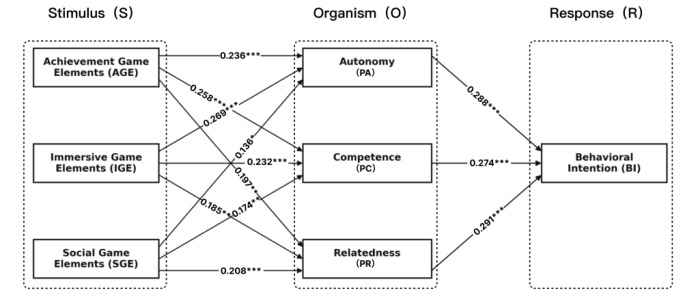
Hypothesis Direct Path Path Coefficient β t Value p Value Supported H1 Achievement-related elements → Autonomy 0.236*** 3.921 <0.001 Yes
H2 Immersion-related elements → Autonomy 0.269*** 4.003 <0.001 Yes H3 Social-related elements → Autonomy 0.136* 2.526 0.012 Yes
H4 Achievement-related elements → Competence 0.258*** 4.258 <0.001 Yes (Continued)
Table 1: Continued.
Table available in the original PDF paper.
Hypothesis Direct Path Path Coefficient β t Value p Value Supported H5 Immersion-related elements → Competence 0.232*** 3.996 <0.001 Yes
H6 Social-related elements → Competence 0.174** 3.039 0.002 Yes H7 Achievement-related elements → Relatedness 0.197** 3.132 0.002 Yes
H8 Immersion-related elements → Relatedness 0.185** 2.993 0.003 Yes H9 Social-related elements → Relatedness 0.208*** 3.222 0.001 Yes
Figure 2: PLS results for the research (*p < 0.05, **p < 0.01, ***p < 0.001).
The paths connecting achievement-related, immersion-related, and social- related gamification elements to autonomy, competence, and relatedness were universally statistically significant. Achievement-related elements positively predicted autonomy (β = 0.236), competence (β = 0.258), and relatedness (β = 0.197). Immersion-related elements positively predicted autonomy (β = 0.269), competence (β = 0.232), and relatedness (β = 0.185). Similarly, social-related elements positively predicted autonomy (β = 0.136), competence (β = 0.174), and relatedness (β = 0.208).
Furthermore, autonomy, competence, and relatedness each significantly predicted behavioral intention, demonstrating coefficients of 0.288, 0.274, and 0.219, respectively. Autonomy exhibited the most robust association. Collectively, these results robustly support all 12 hypotheses.
In summary, the comprehensive evaluation of the measurement and structural models verified that the questionnaire scales possessed highly satisfactory reliability, convergent validity, and discriminant validity.
194 Jia and Chiu Concurrently, all hypothesized paths within the structural model proved statistically significant. These empirical results form a solid foundation for the ensuing discussion and conclusions.
CONCLUSION
The findings definitively illustrate that achievement-, immersion-, and social- related gamification elements are all positively and significantly associated with fulfilling the basic psychological needs of trait-anxious university students. Consequently, within the framework of gamified art therapy, these elements operate far beyond mere superficial external incentives; they actively and deeply shape the satisfaction of users’ fundamental psychological needs, thereby profoundly enriching the participatory experience. Most notably, immersion-related elements demonstrated the strongest association with autonomy. By strategically leveraging narrative contexts, personalized avatars, role-playing mechanics, and responsive audiovisual feedback, these immersive elements cultivate a cohesive, secure, and highly engaging therapeutic environment. For individuals grappling with trait anxiety, design strategies must unequivocally prioritize the mitigation of initial uncertainty while concurrently scaffolding self- expression within a safe, meticulously structured context to effectively reinforce both autonomy and competence.
Among the trio of basic psychological needs, autonomy emerged as the paramount predictor of behavioral intention. This pivotal finding underscores that trait-anxious students harbor an acute, foundational need for choice, perceived control, and psychological freedom during therapeutic engagement. Consequently, design frameworks that proactively empower users to self-determine their modes of expression, pacing, and participation pathways are highly likely to eclipse systems that rely predominantly on rigid, task-based reward structures. Although competence and relatedness yielded comparatively smaller path coefficients, their positive impacts remained highly significant. Therefore, the architecture of gamified art therapy should structurally prioritize user agency, deliver clear and deeply supportive feedback to cultivate competence, and integrate low-pressure, strictly voluntary social interactions to authentically nurture relatedness.
In conclusion, this study rigorously validates the structural relationships linking specific gamification dimensions to basic psychological needs, clearly delineating their respective instrumental roles in driving behavioral intention. It compellingly suggests that the future development of gamified art therapy must transcend the rudimentary superimposition of game mechanics. Instead, developers must aim to deeply synergize specific design elements with the nuanced psychological profiles of anxious users. Immersive contextualization that deepens cognitive and emotional involvement, paired with activity processes that fiercely safeguard meaningful user choices, represent the most critical design trajectories for maximizing engagement. Ultimately, this research furnishes robust, empirical insights crucial for sophisticated therapeutic design, particularly
The Impact of Gamification Elements in Art Therapy on Behavioral Intention 195 regarding the strategic selection of gamification elements, the optimization of psychological need satisfaction, and the catalytic promotion of sustained behavioral intention.
REFERENCES
Cheng, V.W.S., Davenport, T., Johnson, D., Vella, K. and Hickie, I.B. (2019).
“Gamification in apps and technologies for improving mental health and well- being: Systematic review”, JMIR Mental Health, 6(6), e13717. Cronbach, L.J. (1951). “Coefficient alpha and the internal structure of tests”, Psychometrika, 16(3), pp. 297–334. Deci, E.L. and Ryan, R.M. (1985). Intrinsic Motivation and Self-Determination in
Human Behavior. New York: Plenum Press. Deterding, S., Dixon, D., Khaled, R. and Nacke, L. (2011). “From game design elements to gamefulness: Defining gamification”, in Proceedings of the 15th International Academic MindTrek Conference. New York: ACM, pp. 9–15. Ding, H., Lin, B., Xu, Y., Shang, D. and Han, Y. (2025). “VR sculpting as a therapeutic
intervention for alleviating anxiety: A case study from a university art class”, Frontiers in Psychiatry, 16, 1588745. Dong, Z., Wang, P., Xin, X., Li, S., Wang, J., Zhao, J. and Wang, X. (2022). “The relationship between physical activity and trait anxiety in college students: The mediating role of executive function”, Frontiers in Human Neuroscience, 16, 1009540. Eroglu, S.A., Machleit, K.A. and Davis, L.M. (2001). “Atmospheric qualities of online
retailing: A conceptual model and implications”, Journal of Business Research, 54(2), pp. 177–184. Eysenck, M.W., Derakshan, N., Santos, R. and Calvo, M.G. (2007). “Anxiety and cognitive performance: Attentional control theory”, Emotion, 7(2), pp. 336–353. Fang, Y., Wang, L. and Chen, Z. (2023). “2022 nian Zhongguo daxuesheng xinli
jiankang zhuangkuang diaocha baogao [Report on the mental health status of Chinese university students in 2022]”, in Fu, X., Zhang, K., Chen, X. and Chen, Z. (eds.), Zhongguo guomin xinli jiankang fazhan baogao (2021–2022) [Report on National Mental Health Development in China (2021–2022)]. Beijing: Social Sciences Academic Press, pp. 70–99. Fang, Z., Paliyawan, P., Thawonmas, R. and Harada, T. (2019). “Towards an Angry- Birds-like game system for promoting mental well-being of players using art- therapy-embedded PCG”, in 2019 IEEE 8th Global Conference on Consumer Electronics (GCCE). Osaka: IEEE, pp. 947–948. Fornell, C. and Larcker, D.F. (1981). “Evaluating structural equation models with
unobservable variables and measurement error”, Journal of Marketing Research, 18(1), pp. 39–50. Gatautis, R., Vitkauskaite, E., Gadeikiene, A. and Piligrimiene, Z. (2016).
“Gamification as a mean of driving online consumer behaviour: SOR model perspective”, Engineering Economics, 27(1), pp. 90–97. Hair, J.F., Ringle, C.M. and Sarstedt, M. (2011). “PLS-SEM: Indeed a silver bullet”, Journal of Marketing Theory and Practice, 19(2), pp. 139–152. Hair, J.F., Risher, J.J., Sarstedt, M. and Ringle, C.M. (2019). “When to use and how
to report the results of PLS-SEM”, European Business Review, 31(1), pp. 2–24. Henseler, J., Ringle, C.M. and Sarstedt, M. (2015). “A new criterion for assessing discriminant validity in variance-based structural equation modeling”, Journal of the Academy of Marketing Science, 43(1), pp. 115–135.
A review of gamification research”, International Journal of Information Management, 45, pp. 191–210. Li, W. and Qian, M. (1995). “Revision of the State-Trait Anxiety Inventory with a sample of Chinese college students”, Acta Scientiarum Naturalium Universitatis Pekinensis, 31(1), pp. 108–114. Mehrabian, A. and Russell, J.A. (1974). An Approach to Environmental Psychology.
Cambridge, MA: MIT Press. Ryan, R.M. and Deci, E.L. (2000). “Self-determination theory and the facilitation of intrinsic motivation, social development, and well-being”, American Psychologist, 55(1), pp. 68–78. Ryan, R.M., Rigby, C.S. and Przybylski, A. (2006). “The motivational pull of video
games: A self-determination theory approach”, Motivation and Emotion, 30(4), pp. 344–360. Sailer, M., Hense, J.U., Mayr, S.K. and Mandl, H. (2017). “How gamification motivates: An experimental study of the effects of specific game design elements on psychological need satisfaction”, Computers in Human Behavior, 69, pp. 371–380. Sardi, L., Idri, A. and Fernández-Alemán, J.L. (2017). “A systematic review of
gamification in e-Health”, Journal of Biomedical Informatics, 71, pp. 31–48. Slayton, S.C., D’Archer, J. and Kaplan, F. (2010). “Outcome studies on the efficacy of art therapy: A review of findings”, Art Therapy, 27(3), pp. 108–118. Stuckey, H.L. and Nobel, J. (2010). “The connection between art, healing, and public
health: A review of current literature”, American Journal of Public Health, 100(2), pp. 254–263. Venkatesh, V., Morris, M.G., Davis, G.B. and Davis, F.D. (2003). “User acceptance of information technology: Toward a unified view”, MIS Quarterly, 27(3), pp. 425–478. Xi, N. and Hamari, J. (2019). “Does gamification satisfy needs? A study on the
relationship between gamification features and intrinsic need satisfaction”, International Journal of Information Management, 46, pp. 210–221. Xing, C., Zhang, Y., Lu, H., Zhu, X. and Miao, D. (2022). “Trait anxiety affects attentional bias to emotional stimuli across time: A growth curve analysis”, Frontiers in Neuroscience, 16, 972892. Yee, N. (2006). “Motivations for play in online games”, CyberPsychology &
Behavior, 9(6), pp. 772–775.
SEARCH THE AHFE DIGITAL BOOKSTORE BY ISBN
Explore the complete digital volume
Human Factors in Design, Engineering, and Computing
Read this individual research paper free through the original publisher, or explore the full digital proceedings book.