Xiaohui Long, Buzhou Tang (2026). Collaborative System Design of Natural Landscape Art Therapy and Visual Breathing Therapy for Alleviating Working Adults' Depression. In: Affective and Pleasurable Design. AHFE Open Access, vol. 204, pp. 282–288. https://doi.org/10.54941/ahfe1007354
Affected by long-term work pressure, working adults suffer from a high incidence of hidden depressive emotions. Traditional psychological intervention is costly and relies on professional sites and hardware, which cannot meet their fragmented, online and low-stress healing demands. Although the restorative characteristics of natural landscape, emotional regulation logic of art therapy, and theoretical value of visual breathing mindfulness intervention have been widely recognized, a mature collaborative healing system integrating the three has not been formed, and there is still a lack of exclusive visual interaction design paradigm for working adults. Targeting at alleviating depressive emotions among working adults, this paper constructs a collaborative design system of natural landscape art therapy and visual breathing therapy. Based on digital mindfulness and slow breathing intervention theories, dynamically scaled ink wash halos are adopted as visual breathing guidance cues following the scientific rhythm of 4-second inhalation and 6-second exhalation, establishing a visual interaction mode that guides users to adjust breathing synchronously. Combined with four types of differentiated natural landscapes, artistic visual creation is implemented to form a lightweight online healing design solution without additional hardware dependence. This study clarifies the internal collaborative mechanism of natural landscape, art therapy and visual breathing guidance at the theoretical level, and completes the systematic integrated design of healing logic, visual symbols, breathing rhythm and landscape narration. It provides a low-threshold and popularizable self-healing approach for working adults, and offers theoretical support and design references for restorative landscape application, affective interaction design and digital art therapy, laying a foundation for future empirical research and practical product development.
Modern working adults frequently experience chronic stress, leading to sub- clinical depression, anxiety, and emotional burnout. Traditional psychological therapies are often inaccessible due to time and resource constraints. Digital mental health interventions, particularly brief video-based and immersive Received May 22, 2026; Revised June 3, 2026; Accepted June 18, 2026; Available online July 20, 2026
Collaborative System Design of Natural Landscape Art Therapy and Visual 283 formats, offer a promising path for accessible emotional support in fragmented timeframes.
This study proposes a collaborative system synthesizing Natural Landscape Art Therapy and Visual Breathing Therapy. Designed from a digital media art perspective, the system provides a low-barrier, 3-minute interactive intervention rooted in the concept of “Calm Technology.” Users are not dependent on dedicated hardware; instead, they synchronize their breathing to an expanding and contracting traditional Chinese ink-wash halo layered over carefully curated natural landscapes, fostering an accessible, low-stress healing approach.
THEORETICAL BACKGROUND AND RELATED WORK Virtual Nature and Emotional Relief
Exposure to natural environments is a recognized non-pharmacological intervention for mental health. Virtual natural landscapes offer anxiolytic effects by leveraging Attention Restoration Theory (ART), providing “soft fascination” that allows executive cognitive networks to rest. High-fidelity, aesthetically coherent virtual settings can elicit real physiological relief, effectively mitigating negative emotional states.
Mechanisms of Paced Breathing Paced breathing practices emphasizing extended exhalation effectively mitigate stress by increasing vagal tone and heart rate variability (HRV). These interventions directly counteract the physiological hyperarousal associated with emotional dysregulation, promoting a shift towards parasympathetic relaxation.
Digital Breathing Interventions and Peripheral Guidance While recent HCI research explores complex modalities like Virtual Reality (VR), gamification, and virtual agents, these often require specialized hardware. In contrast, peripheral paced respiration interfaces effectively regulate respiration by operating at the edge of the user’s focus, demanding lower cognitive load.
SYSTEM DESIGN AND METHODOLOGY The core design methodology integrates traditional Chinese aesthetic principles with scientifically validated physiological parameters to create a low-cognitive-load interactive experience.
The “4-6” Breathing Rhythm and Ink-Wash Visual Cue The system sets a strict 3-minute duration (180 seconds) per module, consisting of 18 continuous respiratory cycles. Each 10-second cycle follows a precise 4-second inhalation and 6-second exhalation rhythm to maximize parasympathetic activation.
284 Long and Tang A central ink-wash halo visually guides this rhythm: expanding and fading in during inhale (4s), and contracting/fading out during exhale (6s). The edges are blurred to reduce sharp visual contrast, creating a peripheral visual cue that avoids center-focus fatigue.
SCENARIO-BASED EMOTIONAL INTERVENTION MODULES Recognizing occupational depression’s varied emotional manifestations, the system maps four distinct natural landscapes to specific affective conditions to ensure targeted emotional regulation. The following sections provide detailed descriptions and visual prototypes of each scenario.
Module 1: Fatigue and Exhaustion (Alpine Meadow) Features a wide-angle view of an alpine meadow. A warm, low-saturation palette (warm beige, light gold) with soft lighting and morning fog provides warmth without cognitive drain. Dynamics are extremely slow. Grass swaying micro-movements are restricted. The audio is restricted to very low-volume wind and subtle grass friction to minimize user energy consumption.
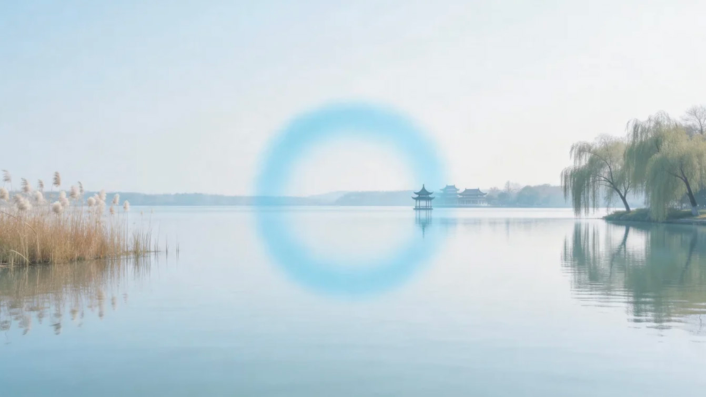
Module 2: Restlessness and Anxiety (Tranquil Lake) Utilizes the mirror-like surface of a tranquil lake. A cool, translucent palette acts as a visual suppressant for sympathetic arousal. Minimalist negative space dominates, with clear water occupying two-thirds of the screen. Pristine reflections and barely audible ripples promote mental convergence and thoughts suppression.
Figure 2. Module 2: Tranquil Lake prototype visualization tailored for restlessness.
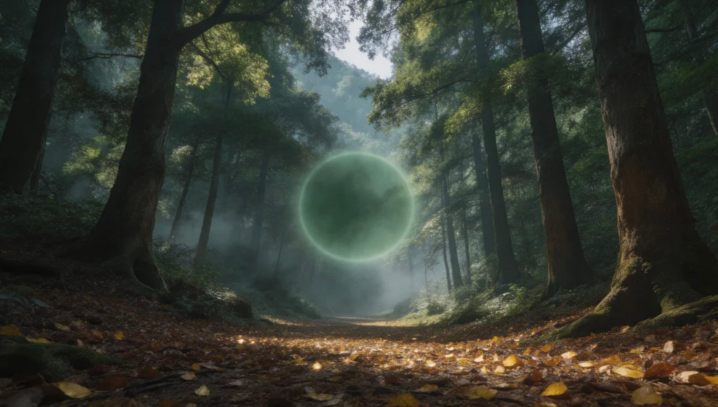
Module 3: Emptiness and Isolation (Deep Forest Valley) Set in a deep, quiet forest valley featuring ancient trees. A low-brightness, deep cyan-green palette creates envelopment and safety. Focus is on rich, textured details (moss, slow falling leaves), encouraging mindfulness and safe processing of isolation. Auditory cues are limited to distant bird calls and soft water streams.
Figure 3. Module 3: Deep Forest Valley prototype visualization tailored for emptiness.
Features the structured lines of terraced fields enveloped in morning fog. A light cyan/blue palette promotes a refreshing experience. Orderly geometric lines organize chaotic inputs, visually representing thought alignment. Simultaneously, fog reduces overall complexity, lowering analytical pressure towards mental clarity.
PROPOSED EXPERIMENTAL EVALUATION PROTOCOL To systematically validate the empirical efficacy and user experience, a mixed-methods evaluation protocol has been established for the next phase of research.
Evaluation Hypotheses
H1 (Physiological Relaxation): The 3-minute intervention will significantly increase parasympathetic nervous system activity (elevated HRV: RMSSD and HF power) compared to baseline.
H2 (Targeted Affect Amelioration): Scenario-based modules will significantly reduce subjective ratings of corresponding negative emotions (VAS scores).
H3 (Calm Interaction UX): Peripheral ink-wash halo guidance will exhibit a low cognitive load (SUS and NASA-TLX), achieving high usability without technological friction.
Planned Methodology and Participants A randomized within-subjects laboratory experiment protocol (N = 40 working adults) has been designed. Participants will be recruited from
Collaborative System Design of Natural Landscape Art Therapy and Visual 287 high-pressure office sectors, with criteria requiring high daily stress and excluding individuals with relevant cardiovascular or respiratory conditions.
The framework consists of three sequential phases:
1. Phase 1: Baseline: Participants complete an intake anxiety/emotion assessment (VAS) and a 2-minute baseline HRV recording. 2. Phase 2: Targeted Intervention: Participants are exposed to the module matching their predominant negative state, naturally synchronizing respiration with the ink-wash halo while continuous HRV is tracked. 3. Phase 3: Post-Test Debriefing: STAI-S, SUS, and NASA-TLX post-tests are administered, followed by semi-structured qualitative interviews.
DISCUSSION AND CONCLUSION This study bridges the gap between natural restorative landscape art, affective interaction design, and evidence-based breathing therapeutics. By replacing gamified tasks with fluid ink-wash dynamics, the design minimizes friction experienced by depressed users, adhering to principles of Calm Technology. The 3-minute duration ensures high adherence in workplaces. Future empirical validation using the proposed protocol will provide foundational data for restorative landscape application and cross-platform digital therapeutics.
REFERENCES
Amsalem, D., et al. (2022) Destigmatising mental health treatment and increasing openness to seeking treatment: randomised controlled trial of brief video interventions. BJPsych Open, 8(e169). Bentley, T.G.K., et al. (2023) Breathing Practices for Stress and Anxiety Reduction:
Conceptual Framework of Implementation Guidelines. Brain Sciences, 13(1612). Brooks, J., et al. (2024) BreathePulse: A Cross-Modal Interaction Framework for Augmented Breathing Regulation. Proceedings of ACM HCI, 38. Browning, M.H.E.M., et al. (2023) Daily exposure to virtual nature reduces
symptoms of anxiety in college students. Scientific Reports, 13(1239). Chen, L., Yan, R. and Yu, J. (2025) Virtual nature, real relief: how exposure to virtual natural environments reduces anxiety. npj Digital Medicine, 8(679). Dar, J.F., et al. (2022) Virtual Human Breathing: A Paradigm for Social and Affective
Interaction Design. Proceedings of ACM CHI, 45. Grassini, S. (2022) A Systematic Review and Meta-Analysis of Nature Walk as an Intervention for Anxiety and Depression. Journal of Clinical Medicine, 11(1731). JMIR Publications (2024) Visual and Biofeedback Mechanisms for Respiration in
VR. JMIR Mental Health, 11(4). Kitson, A., et al. (2018) Immersive Interactive Technologies for Positive Change.
Frontiers in Psychology, 9(1354). Leyro, T.M., et al. (2021) Cognitive Mechanisms Linking Anxiety to Respiration: A Review. Anxiety Stress Coping, 34(3). Miri, P., et al. (2020) Designing Pervasive Interventions for Implicit Breathing
Regulation. Proceedings of ACM HCI, 41. Moraveji, N., et al. (2011) Peripheral Paced Respiration: Mediating Users’ Respiratory Rhythm via Peripheral Displays. Proceedings of ACM CHI, 32. Weiser, M. and Brown, J.S. (1995) Designing Calm Technology. PowerGrid Journal, 1.
Section A: Demographic and Baseline Information
1. Age Group: [ ] 22–28 | [ ] 29–35 | [ ] 36–45 | [ ] Above 45 2. Average Weekly Working Hours: [ ] <40 | [ ] 40–50 | [ ] 50–60 | [ ] >60 3. Work-related Stress Frequency (Past Month): [ ] Never | [ ] Rarely | [ ] Sometimes | [ ] Often | [ ] Always Section B: Quantitative Usability and Workload Scale
(1 = Strongly Disagree, 5 = Strongly Agree)
U1. Central ink-wash halo dynamic scaling was clear and intuitive.
U2. “4s inhale, 6s exhale” rhythm was comfortable.
1. Visual Perception: Describe the visual detail you found most restorative and why. 2. Comparative Paradigm: Primary advantage of this collaborative paradigm over other methods (e.g., pure music)? 3. Interactive Friction: Describe any moments of distraction or urge to disengage. 4. Design Iteration: Functional recommendations for a workplace mini-program.
LISTED IN THE AHFE DIGITAL BOOKSTORE CATALOGUE
Explore the complete digital volume
Affective and Pleasurable Design
Read this individual research paper free through the original publisher, or explore the full digital proceedings book.
ISBN 978-1-964867-80-9
Explore this ISBN in the AHFE Bookstore ↗Listed in the July 2026 bookstore catalogue; search by ISBN to confirm current availability · Digital book purchase optional