Chang Guo, Anglu Li (2024). Artificial Intelligence Generated Content (AIGC's) Cutting-Edge Practices and Challenges in The Field of Art Therapy. In: Intelligent Human Systems Integration (IHSI 2024): Integrating People and Intelligent Systems. AHFE Open Access, vol. 119, pp. 697–705. https://doi.org/10.54941/ahfe1004534
The purpose of this study is to explore how AIGC (Artificial Intelligence Guided Creation) can be applied in the field of art therapy, and to discuss its potential challenges. We hope to provide insights into the tremendous potential of AIGC in art therapy through the practice design of AIGC in art therapy. This study designs possible ways of using AIGC in art therapy. Through the use of human-computer collaboration by AIGC, users can create personalized sand art works to assist in expressing emotions, helping doctors better understand the unspoken thoughts in the user's mind. This method not only increases the diversity of therapy, but also provides users with a novel way of self-exploration and self-understanding. However, the use of AIGC in art therapy also faces many challenges. These include how to ensure the safety and appropriateness of the generated content, and how to deal with data privacy issues. In general, AIGC shows tremendous potential in the field of art therapy, but we still need to face and overcome some challenges in practice. Future research should further explore how to safely and effectively integrate AIGC into art therapy practices to provide a better therapy experience.
As society rapidly evolves, people often find themselves troubled by busyness and anxiety, leading to increasing attention to mental health issues (Yang). Artificial Intelligence (AI) has shown tremendous potential in many fields, especially in the arts, where the integration of AI and Generative Comput- ing has given rise to a new form of art - Artificial Intelligence Generative Computing (AIGC) (Chaoning et al., 2023). This technology can mimic the creative process of artists to generate unique and creative works. However, the use of AIGC extends beyond just creating art pieces. It has the poten- tial to play a positive role in the field of art therapy (Yang). Art therapy is a psychological therapy method based on artistic creation (Kim et al.), using the process of creating art to help individuals express and understand their emotions for psychological therapy. With technological advancements, AI has begun to be applied in this field. The potential of AIGC in art therapy has garnered significant interest. This study will first explore the technical
principles of AIGC and how it can be designed and applied in art therapy. We will analyze how AIGC assists users in creating personalized sandbox works as a tool for expressing emotions, helping doctors better understand the inner world of the users (Zheng). This application not only enriches the diversity of therapy but also offers users a novel, AI-based method for self- exploration and understanding. However, there are several challenges in the application of AIGC in art therapy. For example, ensuring the safety and appropriateness of AI-generated content and addressing data privacy issues are critical concerns that need to be resolved (Wang et al., 2023b). These challenges must be addressed while advancing the application of AIGC in art therapy to ensure its positive effects. In summary, although AIGC faces many challenges in the field of art therapy, its potential merits further research and exploration. Future studies should delve deeper into how to integrate AIGC into art therapy practices more effectively and safely, providing a better ther- apy experience. In the following chapters, we will elaborate on the principles and application of AIGC and conduct in-depth discussions and analyses on its practice and challenges in art therapy.
THE UTILIZATION OF AIGC IN ART THERAPY In the field of art therapy, the key to the design application of AIGC tech- nology lies in how to combine advanced artificial intelligence technology with traditional art therapy methods to create a new therapy model. This model not only needs to consider the characteristics of AIGC technology, such as its generative capabilities and learning mechanisms (Song et al.), but also needs to consider the goals and principles of art therapy, such as personalized therapy, emotional expression, and psychological support (Bussa et al.).
In practice, AIGC can be designed as an interactive system that allows users to input their emotions, thoughts, or psychological states through an intuitive interface (Yang and Qian). Based on these inputs, the AIGC sys- tem can generate corresponding painting artworks that not only reflect the user’s inner world but also guide users to further explore and understand their emotions and thoughts. The focus of AIGC’s application in art therapy is to promote human-machine collaboration, especially in the creation of person- alized sand tray artworks. Sandbox therapy is a common art therapy method, which allows users to express their experiences and feelings by arranging var- ious objects in a sand tray (Liu et al.). With the help of AIGC, the process of generating sand tray artworks becomes more intuitive and easier to oper- ate and can reflect the user’s personality and inner state at a deeper level (Wang et al.). For example, the AIGC system can provide customized sym- bols and image suggestions based on the text and sketches shown by the user, thus helping users to express their emotions and thoughts more accurately. In addition, this human-machine collaboration method also helps therapists to better understand users. By analyzing the choices and layouts of users in sand tray artworks, therapists can gain deeper insights into the users’ psy- chological states, thereby providing more precise psychological support and intervention. The application of AIGC in art therapy also extends to the fields
of emotional expression and psychological understanding. Through the art- works generated by AIGC, users can express their emotions and experiences in a non-verbal way, which is especially valuable for those users who have difficulty expressing themselves verbally. At the same time, these artworks can also serve as discussion materials during the therapy process, helping therapists to better understand the users’ emotional and psychological needs (Salomon and Levinger, 2020).
Overall, the application of AIGC in art therapy has opened a new method of therapy. Through human-machine collaboration and innovative art generation, it provides users with a new way of self-expression and self- understanding, and provides doctors with more means to understand users and intervene in their conditions (Xu and He).
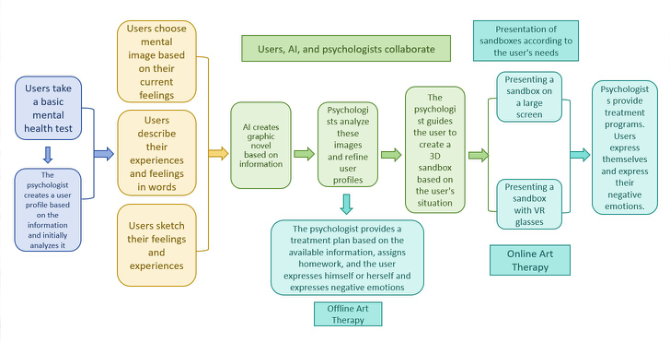
THE DESIGN SCHEME OF AIGC APPLIED IN ART THERAPY In today’s digital age, the rise of artificial intelligence generated content (AIGC) technology has brought about innovation in multiple fields, including the field of art therapy. This study proposes an art therapy scheme utilizing AIGC technology, which is centered on personalization and dynamic interac- tion, aiming to provide users with a customized art therapy experience. See Figure 1 for the flowchart.
Figure 1: Art healing process flowchart.
First, we administer a basic mental health test and questionnaire to the user. Mental health professionals conduct a preliminary analysis based on the information collected. Users choose from several pre-set psychological image templates according to their current feelings and describe their expe- riences and emotions in words and drawings, expressing personal emotions through a combination of text and images (Wang et al., 2023a). Using AIGC, we analyze the user’s emotional state and preferences to determine person- alized needs for art therapy (Atmaraman and Sundararaman). Then, based on this information and the user’s sketches, the AIGC system generates flat
700 Guo and Li
narrative illustrations and adjusts them according to user’s expressions. This is a process of human-computer collaboration in which AIGC serves the user, helping them to express themselves visually. The process of completing a por- trait of the inner world is also a journey of self-exploration, thereby achieving psychological expression and art therapy. In addition, the advanced offline version integrates Virtual Reality (VR) technology, creating an immersive 3D sandbox space to further enhance user interaction and achieve therapy effects on multiple sensory levels (Wang et al.). After the therapy process, AI eval- uates the user’s feedback and the effect of the therapy, providing a basis for subsequent scheme optimization. Doctors can also obtain more psychological information about the user to aid in therapy.
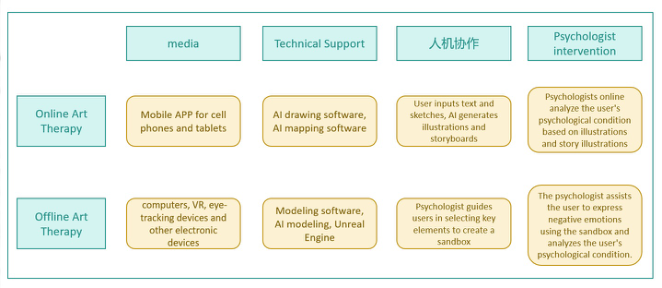
In practical implementation, we have designed two versions of therapy: online and offline, to cater to users with varying levels of therapy needs. The online therapy version, using a mobile application platform and rely- ing on big data and machine learning algorithms, collects users’ personal information and health status. It uses AI to generate personalized artistic content that matches the user’s emotions and preferences based on their input text and sketches. In this process, the AI system can make real-time human- computer collaborative design adjustments according to the user’s therapy and psychological exploration needs. Moreover, by integrating AI recogni- tion technology and emotion analysis, this scheme can deeply customize the therapy experience, achieving more precise emotional intervention. In con- trast, the offline version focuses more on creating immersive 3D spaces, such as sandbox environments (Ji). Combining Virtual Reality (VR) technology, we aim to create a multi-dimensional sensory interactive art therapy environ- ment (Sharma et al.). In this environment, users can immerse themselves in the AI-generated sandbox space, freely combine and move objects in this unreal space for full-hearted emotional expression, facilitating self-exploration and enabling doctors to capture users’ subconscious information. The focus of this scheme is to use technological innovation to provide an immersive art therapy space, allowing users to have a unique therapy experience at the inter- section of the real and digital worlds. A comparative diagram of the online and offline versions is shown in Figure 2.
Figure 2: Comparison chart between online and offline programs.
In both modes, the application of AIGC technology aims to achieve per- sonalized therapy and enhance user involvement, promoting mental health and emotional recovery (Xu). The online solution highlights the convenience and accessibility of the technology, while the offline solution emphasizes immersive spaces. Whether online or offline, the intervention of AI makes art therapy more refined and responsive, bringing a new perspective of technological innovation to traditional art therapy.
The innovation of this approach lies in its combination of AI’s data pro- cessing capabilities with creative generation abilities, driving the transition of art therapy from traditional practice to technology-driven transformation, and showcasing the integration of technology with humanitarian care (Zhao and Li). The core of the entire program is the integration and innovative application of AI technology. By deeply understanding individual differences and generating personalized artistic content, it provides a comprehensive, multi-sensory art therapy environment. This method not only improves participation and satisfaction in the therapy process but also extends the boundaries of traditional art therapy through the power of technology.
CHALLENGES AND RESPONSE STRATEGIES In the process of applying AIGC technology, we inevitably face some chal- lenges. AIGC helps users’ express emotions and understand themselves by generating art (Gu et al.), but ensuring the safety and appropriateness of the generated content is a significant challenge (Wang et al.). During the generation process, AIGC might create content that could provoke negative emotions in users or trigger sensitive topics, potentially having an adverse effect on the users’ recovery process. To address this challenge, we can design an algorithm capable of monitoring and filtering potentially sensitive or inap- propriate content generated by AIGC (Wang et al.). Additionally, we can introduce a manual review process, where experienced therapists examine and validate the content generated by AIGC, ensuring it is beneficial and harmless to users. When using AIGC, users’ personal information, psycholog- ical state, and interaction data during the therapy process might be collected and used. How to handle these data and protect users’ privacy rights is another important challenge we must face. For this, we can adopt a series of data protection measures. Firstly, we need to ensure that users’ data is only used for therapeutic purposes and only accessible to authorized per- sonnel. Secondly, we can anonymize and encrypt users’ data to prevent data breaches. Finally, we need to regularly review and update our data protection measures to respond to new data security threats (Huang et al., 2023).
Facing the challenges, we need to develop a comprehensive response strat- egy. Firstly, we need to make improvements at the technical level, such as optimizing the AIGC generation algorithm to enhance the safety and appro- priateness of the content, while strengthening data protection measures to ensure users’ privacy rights (Guo et al., 2023). Secondly, we need to standard- ize at the policy level, formulate relevant laws and regulations, and clearly stipulate the principles and standards to be followed when using AIGC tech- nology. At the same time, we also need to train therapists so they understand
702 Guo and Li
the operating mechanism of AIGC and possible risks, improving their appli- cation skills and risk prevention awareness. Lastly, we need to establish a feedback mechanism, encouraging users and therapists to raise issues and suggestions they encounter when using AIGC, so that we can continuously improve and optimize its application. Although the use of AIGC in art ther- apy faces some challenges, through technical optimization, policy regulation, and the establishment of a feedback mechanism, we are confident that we can effectively address these challenges and promote the widespread use of AIGC in art therapy.
DISCUSSION AND FUTURE DIRECTIONS The use of AIGC technology in art therapy offers users a new way of expres- sion and therapy. By generating personalized artworks, AIGC helps users express their emotions and thoughts in an intuitive and innovative way. This not only aids users in better understanding themselves but also provides therapists with new tools and perspectives to understand and support their clients (Wang). The use of AIGC also demonstrates its potential in enhancing engagement and satisfaction in therapeutic settings.
The value of AIGC in art therapy is primarily reflected in its innova- tion and personalization. AIGC can generate appropriate artworks based on the specific needs of users, making the therapy process more person- alized and efficient. Additionally, AIGC can promote interaction between therapists and users, enhancing the interactivity and enjoyment of the ther- apy process. Future research should focus on evaluating the actual effects of AIGC in art therapy and exploring how to further optimize its algo- rithms and applications. This includes developing more accurate emotion analysis tools to better understand users’ needs and improving the user inter- face to make it more user-friendly. Future studies should also explore how to integrate AIGC more effectively with traditional art therapy practices. This may include developing new therapy models that combine AIGC with traditional art therapy methods such as music therapy, painting therapy (Jeon), and exploring the possibilities of using AIGC in different therapy environments.
As the use of AIGC in art therapy becomes more widespread, research into data privacy and ethical issues becomes increasingly important. Future research needs to focus on how to better identify users’ emotional inten- tions, how to protect users’ privacy information, and how to use AIGC while ensuring safety and appropriateness.
CONCLUSION
AIGC demonstrates tremendous potential and value in art therapy. Through future research and development, we hope to address the current challenges and further expand the application of AIGC in the field of art therapy. Through these efforts, we can anticipate AIGC bringing more innovation and more pronounced therapy effects to art therapy.
Atmaraman, S. R. & Sundararaman, J. Computer aided mental health self-assessment and consultation method, involves interacting authorized person with mental health consultation system to obtain mental health data, reports and mental health training. AU2003204909-A1 AU204909 25 Jun. 2003 AU2003204909-B2 AU204909 25 Jun. 2003. Bussa, V., Kalyan, B., Trivedi, G. & Shelly, B. I. Method for providing per-
sonalized positive airway pressure (PAP) therapy recommendations to patient, involves determining in controller from analyzing of patient information personalized PAP therapy recommendations for patient. US2022016369-A1 US138242 30 Dec. 2020 WO2022017893-A1 WOEP069691 15 Jul. 2021 IN202347005339-A IN47005339 27 Jan. 2023 EP4182939-A1 EP751507 15 Jul. 2021 CN116171478-A CN80060534 15 Jul. 2021 JP2023534133-W JP578701 15 Jul. 2021. Chaoning, Z., Zhang, C., Zheng, S., Qiao, Y., Li, C., Zhang, M., Dam, S. K., Thwal, C. M., Tun, Y. L., Huy, L. L., Kim, D., Bae, S. H., Lee, L. H., Yang, Y., Shen, H. T., Kweon, I. S. & Hong, C. S. 2023. A Complete Survey on Generative AI (AIGC): Is ChatGPT from GPT-4 to GPT-5 All You Need? arXiv. arXiv. Gu, R., Li, H., Su, C. & Wu, W. Innovative Digital Storytelling with AIGC:
Exploration and Discussion of Recent Advances arXiv. Guo, D. H., Chen, H. X., Wu, R. L. & Wang, Y. A. 2023. AIGC challenges and opportunities related to public safety: A case study of ChatGPT. Journal of Safety Science and Resilience, 4, 329–339. Huang, X., Li, P., Du, H., Kang, J., Niyato, D., Kim, D. I. & Wu, Y. 2023. Federated
Learning-Empowered AI-Generated Content in Wireless Networks arXiv. arXiv. Jeon, E. J. Method for providing art treatment and music therapy using DIY kit, involves receiving sound source information for treatment from music therapy expert terminal and providing link information for allowing user to access sound source. KR2018109775-A KR102302 29 Aug. 2018. Ji, X. Sandbox game therapy device for psychological counseling, has screw thread
fixed at bottom part of box body, magnet fixedly equipped at bottom of sand table model, and box body whose upper end is provided with box cover. CN108652649-A CN10488069 21 May 2018. Kim, S. H., Bae, J. S., Ha, J. L. & Yoon, S. I. System and method for offering optimal music/art therapy based on measurement and inference for mental/physical state of user. KR2005039268-A KR074698 24 Oct. 2003 KR582596-B1 KR074698 24 Oct. 2003. Liu, L., Du, W., Lu, W., Jia, X. & Hao, J. Game sand table model for psychology, has
rotating mechanism installed at lower end of supporting rod, and sand box rotated by rotating mechanism to move model in sandbox in circumferential direction, where patient enters into inner side of sandbox. CN212593423-U CN20513607 10 Apr. 2020. Salomon, M. & Levinger, S. 2020. The experience of art therapists who work in private practice when retaining clients’ artworks after therapy termination. Arts in Psychotherapy, 70, 9. Sharma, A., Jain, S., Sethi, K. H., Samal, A. & Khurana, M. Artificial intelligence
based VR therapy system for providing personalized and effective pain man- agement for patients after medical procedures such as medications and physical therapy, has virtual reality headset and set of smart sensors. IN202311035322-A IN11035322 20 May 2023.
704 Guo and Li
Song, R., Wang, Z., Zhou, B., Yang, C. & Liu, Y. Artificial intelligence generated content based program development auxiliary method, involves controlling arti- ficial intelligence generated content model to generate information matched with prompt word when confirming that prompt word is regular. CN116991990-A CN10814622 04 Jul. 2023. Wang, D., Li, X., Wu, Q. & Zhang, W. Artificial Intelligence Generated Content
automatic modeling system, has model generating unit for evaluating generated adaptive model and displaying generated adaptive model to user. CN116306317- A CN10530137 12 May 2023 CN116306317-B CN10530137 12 May 2023. Wang, D., Liu, D., Li, X., Mi, X. & Zhang, W. Artificial intelligence in grid computing based scenic spot multi-scene content creation and application system, has user action collecting module provided with data collecting unit and stor- age unit, where data collecting unit collects interest keyword. CN116304356-A CN10526215 11 May 2023 CN116304356-B CN10526215 11 May 2023. Wang, E., Shen, J., Xve, D., Zhao, Z., Ji, Q. & Xue, D. Intelligent psychologi-
cal evaluation and intervention system for independent space, has psychological intervention cabin and central database capable of realizing data interaction, where data processing module connected to central database. WO2021077993- A1 WOCN118301 28 Sep. 2020 CN112704499-A CN11022217 25 Oct. 2019 GB2605888-A GB007268 28 Sep. 2020 US2022369977-A1 US17771809 25 Apr. 2022. Wang, J., Du, H., Niyato, D., Xiong, Z., Kang, J., Mao, S., Xuemin & Shen 2023a.
Guiding AI-generated digital content with wireless perception arXiv. arXiv. Wang, T., Zhang, Y., Qi, S., Zhao, R., Xia, Z. & Weng, J. Security and Privacy on Generative Data in AIGC: A Survey arXiv. Wang, Y., Pan, Y., Yan, M., Su, Z. & Luan, T. H. 2023b. A Survey on ChatGPT:
AI-Generated Contents, Challenges, and Solutions arXiv. arXiv. Wang, Z. Computer auxiliary system for psychological crisis intervention, has intervention executing module receiving instruction of intervenor and transferring materials provided by resource management module to execute crisis interven- tion proposal. CN101584902-A CN10086661 17 Jun. 2009 CN101584902-B CN10086661 17 Jun. 2009. Xu, J. & He, F. Rapid and synchronous psychological evaluation and intervention
realizing method, involves completing psychological assessment and intervention realizing processes if psychological test answers and signs are within normal range value. CN109620264-A CN11546843 18 Dec. 2018. Xu, T. Human-computer interaction based psychological intervention method, involves performing structural analysis on physiological data or psychological data, and determining psychological intervention program based on analysis results. CN111261262-A CN10138046 02 Mar. 2020. Yang, M. & Qian, Y. Artificial intelligence generated context (AIGC) technol-
ogy based automatic slide generation method, involves using machine learning technology, and combining text analysis results and slide content with slide tem- plate to automatically arrange and layout slides to generate final finished slide. CN116595202-A CN10518518 09 May 2023. Yang, S. Method for healing heart physical therapy based on machine vision and AIGC during treating psychological disease of patient by using intelligent conver- sation robot, involves obtaining initial conversation video of patient with psycho- logical disease and intelligent conversation robot. CN116884577-A CN10970208 02 Aug. 2023.
Zhao, Y. & Li, Y. Mother-infant nutrition consultation system based on AIGC for use in technical field of artificial intelligence and medical health, has user end that is used for multi-mode input consultation question and receiving answer information given by platform end. CN116936131-A CN11183935 14 Sep. 2023. Zheng, H. Portable psychological sandbox for psychological therapy, has transparent
storage bag set in inner side face of box cover and having video capture device which comprises high definition camera connected to universal shaft of telescopic rod. CN107398002-A CN10335650 19 May 2016.
LISTED IN THE AHFE DIGITAL BOOKSTORE CATALOGUE
Explore the complete digital volume
Intelligent Human Systems Integration (IHSI 2024): Integrating People and Intelligent Systems
Read this individual research paper free through the original publisher, or explore the full digital proceedings book.
ISBN 978-1-958651-95-7
Explore this ISBN in the AHFE Bookstore ↗Listed in the July 2026 bookstore catalogue; search by ISBN to confirm current availability · Digital book purchase optional