Brandon King, Jeremy Gouzd (2026). Evaluating Occupational Heat Stress Using Wearable Physiological Monitoring: A Field Study of Environmental and Physiological Response. In: Human Factors in Design, Engineering, and Computing. AHFE Open Access, vol. 238, pp. 2927–2936. https://doi.org/10.54941/ahfe1008516
Industrial and Management Systems Engineering, Benjamin M. Statler College of Engineering and Mineral Resources, West Virginia University, Evansdale Drive, Morgantown, United States ↗
Occupational heat stress is a significant safety hazard for workers performing physically demanding tasks in hot environments. Current heat stress management relies predominantly on environmental metrics, such as Wet Bulb Globe Temperature (WBGT), which measure ambient exposure but do not account for individual physiological responses. This study examined relationships among estimated Wet Bulb Globe Temperature (eWBGT), heart rate, and core body temperature, and assessed each predictor's relative contribution in an occupational setting. We collected data using the Slate Safety Band V2® wearable device, monitoring ten workers performing heat-exposed occupational tasks over a one- to two-week period. We used a linear mixed-effects modeling approach to evaluate eWBGT and heart rate as predictors of core body temperature, accounting for repeated measures nested within individual workers. Results showed that heart rate and eWBGT were significant independent predictors of core body temperature (p < .001). Heart rate emerged as the more direct predictor of physiological heat strain. Fixed effects explained 51.3% of the variance, and worker-level random effects increased the explained variance to 69.2%. An ICC of 36.8% indicated substantial variability between workers under comparable environmental conditions. These findings support integrating wearable physiological monitoring into occupational heat stress programs alongside environmental measurements. This study provides evidence relevant to emerging heat stress management regulatory frameworks and highlights the need for worker-specific physiological thresholds in elevated-heat occupational environments.
Occupational heat stress is an increasingly challenging hazard affecting employees across multiple industries, where such workers perform physically demanding tasks in elevated thermal condition environments. Exposure to these conditions can result in a range of adverse health outcomes, including dehydration, heat exhaustion, and heat stroke (OSHA, 2024).
2928 King and Gouzd Traditional approaches to occupational heat stress management rely heavily on environmental monitoring tools, such as Wet Bulb Globe Temperature (WBGT), and standardized work-rest cycles (Notley et al., 2018). Environmental monitoring alone cannot fully represent the physiological burden experienced by workers, as factors such as workload, hydration status, acclimatization, physical fitness, and underlying health conditions significantly influence heat strain responses (Ioannou et al., 2022; Notley et al., 2018). Consequently, two workers performing an identical task under identical environmental conditions could experience substantially different levels of physiological strain.
Advances in wearable sensor technology presently enable monitoring of physiological indicators, such as heart rate and estimated core body temperature, within occupational settings (Cannady et al., 2024). These systems provide the opportunity to complement environmental monitoring, with individualized physiological assessment during heat exposure. Despite these advancements, relatively few studies have examined wearable physiological monitoring under real-world, continuous, field-based data collection conditions. Existing studies are often limited by reduced sample cohorts, brief monitoring periods, or controlled environments (Specht et al., 2025).
This study examined the relationship between environmental heat exposure and physiological responses, by employing continuous wearable monitoring in a real-world occupational setting. Particular attention was given to individual variability in heat strain responses, by integrating environmental and physiological data.
METHODOLOGY
This research study was conducted after receiving Institutional Review Board (IRB) Approval #2503120737 from West Virginia University, to ensure adherence to ethical guidelines and for the protection of individuals participating in the study. A multi-site study design was employed, selecting various locations across the Southern US, based on the likelihood of exposing workers to heat stress. Companies participating in the study were selected through voluntary agreements with the research team, which offered mutually beneficial collaborations. Participating companies had to demonstrate a working environment in which workers could experience heat stress, providing relevance to the real-world conditions investigated in the study (Cannady et al., 2025). Within each company, a minimum of 10 workers were recruited to serve as a representative sample of the company’s workforce and to provide varied physiological responses to heat exposure. The participating workers were equipped with wearable sensor bands specifically designed to provide continuous, automated physiological metrics, including heart rate and core body temperature (Cannady et al., 2025).
In addition to collecting data from each worker through wearable bands, the study also collected environmental data, using mounted beacon devices throughout the work environment. The beacons could collect
Evaluating Occupational Heat Stress Using Wearable Physiological Monitoring 2929 environmental data that could contribute to heat stress, including ambient temperature, heat index, and WBGT, enabling a comprehensive assessment of the external heat stress that a worker experiences (Specht et al., 2025). Among other field implementations, beacon measurements were informally checked against a calibrated TSI QUESTemp 32® instrument at one site, to identify any large discrepancies. Minor deviations were observed at times, particularly when the beacon was exposed to direct sunlight. However, these were limited and did not substantially affect overall measurement trends. The dual-mode monitoring, which included both individual physiological data and environmental measurements, provided an opportunity to shed further light on interactions between factors within and outside the body under heat stress. Using real-time feedback with wearable sensor technology, participants received immediate alerts for tachycardia (elevated heart rate) or other measurements outside the defined thresholds established by the American Conference of Governmental Industrial Hygienists for safety (Cannady et al., 2025).
The wearable bands were worn for 1–2 weeks, depending on the companies’ agreements with the research team, during which a substantial dataset of realistic work behaviors and exposures was collected. Demographic variables were not collected as part of the study, in accordance with IRB-approved data collection protocols that limit data collection to physiological and environmental measures. Similar to prior field-based heat stress studies that combined environmental and physiological monitoring (Specht et al., 2025), this study collected real-time data in operational work environments. However, this approach was extended through continuous wearable monitoring over a longer time duration and with a larger dataset. Data collected using the wearable V2 bands were compared with data from the environmental beacons to examine the relationship between environmental exposure and physiological response in real-world occupational conditions (Cannady et al., 2025). This approach builds on prior findings that physiological strain can occur under varying environmental conditions (Specht et al., 2025).
This study also aimed to examine the relationship between environmental heat exposure and physiological response in real-world occupational settings, with a focus on individual variability. The V2 armband’s ability to measure individual heat strain is ideal, as it tracks physiological biometrics such as heart rate and estimated core body temperature. One benefit of selecting a band over a shirt is that it does not add to the layer of clothing that can potentially trap heat, while also being reusable and not requiring laundering between uses (Callihan et al., 2023; Cannady et al., 2025). Prior validation studies have demonstrated strong performance for heart rate monitoring and supported the use of wearable physiological monitoring systems in real-world occupational settings. They recognize that wearable-derived core temperature estimates are more appropriate for operational monitoring than direct clinical measurements (Callihan et al., 2023; Richard et al., 2025). Participants performed typical daily work tasks during data collection, reflecting real-world occupational conditions (Callihan et al., 2023).
2930 King and Gouzd Wearable technology that uses software to collect individual biometric data is believed to mitigate the risk of heat-related illness (Cannady et al., 2024; Cannady et al., 2025). An armband system that collects biometric data and simultaneously monitors body temperature and heart rate establishes a foundation for early identification of the physiological manifestations of heat stress (Callihan et al., 2023). Data collected from all participants were stored anonymously on a secure cloud server, accessible only to approved research personnel, consequently ensuring participants’ confidentiality and data protection. Prior to data collection commencement, each participant was provided with informed consent documents and was advised that their participation was voluntary and that they could withdraw at any point in the study without consequence. To protect the confidentiality of the participating agencies, and in accordance with the funding agency’s data protection protocols throughout the study, the names of the companies, sites, and workers were removed from all files. Each company was coded with a generic designation, and numbered identifiers were assigned to workers. These ethical practices were the pillars of the research process’s ethical rigor.
RESULTS
Descriptive Overview Following data cleaning and preparation, the final analytical dataset consisted of approximately 30,000 time-based observations across multiple workers. Analyses focused on examining the relationship between environmental heat exposure (eWBGT) and physiological response, particularly, core body temperature. Descriptive statistics for the primary physiological and environmental variables are presented in Table 1.
Table 1: Descriptive statistics of physiological and environmental variables.
Table available in the original PDF paper.
Variable N Mean SD Min Max Core Body Temperature (°F) 30,131 99.87 0.61 98.2 103.4
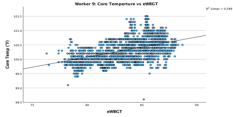
Relationship Between Environmental Exposure and Core Body Temperature Scatterplot analysis was conducted to analyze the relationship between eWBGT and core body temperature at both the overall and individual worker levels. Across aggregate level, a general positive trend was observed, indicating that increases in environmental heat exposure were associated with increases in physiological strain. This is demonstrated in Figure 1, which highlights variability in the strength of this relationship across individual workers.
(a) (b) (c)
Figure 1: Relationship between estimated Wet Bulb Globe Temperature (eWBGT) and core body temperature across selected workers. The figure illustrates variability in the strength of association across individuals, including (a) strong, (b) moderate, and (c) minimal relationships, highlighting differences in physiological response under similar environmental conditions.
However, substantial variability was observed when examining individual worker-level relationships. Linear regression trendlines applied to individual scatterplots produced R² values ranging from approximately 0 to 0.289, indicating a wide range in the strength of association between eWBGT and core body temperature across workers, as summarized in Table 2.
Table 2: Coefficients of determination (R²) for the relationship between estimated Wet Bulb Globe Temperature (eWBGT) and core body temperature by worker, ranked to illustrate variability in association strength.
Table available in the original PDF paper.
Worker ID R² Value Strength of Relationship Worker 07 ~0.000 None
Worker 08 0.01 Very Weak Worker 02 0.035 Very Weak
Worker 09 0.289 Moderate–Strong Workers could be broadly grouped based on the strength of this association. A subset of workers demonstrated moderate associations between environmental exposure and physiological response, with R² values exceeding 0.20 (e.g., Worker 9: R² = 0.289; Worker 6: R² = 0.239). Other workers exhibited weak relationships (R² ≈ 0.05–0.15), while several others displayed minimal to no observable relationship (R² < 0.05), including cases where the association was effectively negligible.
In order to quantify the relationship between environmental heat exposure and physiological response, a linear mixed-effects model was developed with core body temperature as the dependent variable and eWBGT and heart rate included as fixed effects. Concomitantly, worker ID was incorporated as a random intercept to account for repeated measures and within-subject correlation.
Results illustrated that both heart rate and eWBGT were statistically significant predictors of core body temperature (p < 0.001). In the combined model, heart rate demonstrated a significant positive association with core body temperature (B = 0.020, 95% CI [0.020, 0.021], p < 0.001), indicating that for every one-unit increase in heart rate, core body temperature increased by approximately 0.020 °F, holding other variables constant. Similarly, eWBGT illustrated a positive association (B = 0.020, 95% CI [0.019, 0.021], p < 0.001), indicating that increases in environmental heat exposure were associated with increases in core body temperature. The narrow confidence intervals reflect stable and precise estimates across observations.
Model fit statistics further supported these findings. The marginal R² value (0.513) indicated that fixed effects alone explained approximately 51.3% of the variance in core body temperature. When accounting for worker-level variability, the conditional R² increased to 0.692, demonstrating that inclusion of random effects substantially improved model explanatory power. The intraclass correlation coefficient (ICC) revealed that approximately 36.8% of the variance in core body temperature was attributable to differences between workers, highlighting the importance of individual variability in physiological response to heat exposure.
Although substantial variability in worker-level relationships was observed in the exploratory analysis, the random slopes model did not identify strong variability in slope parameters. This suggests that differences between workers are more strongly reflected in baseline physiological responses than in changes in core body temperature relative to environmental exposure. Given the small sample size of workers, the ability to detect variability in the slope could have been limited.
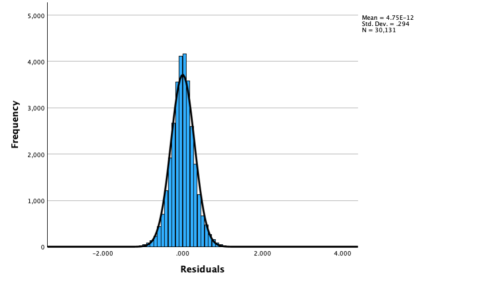
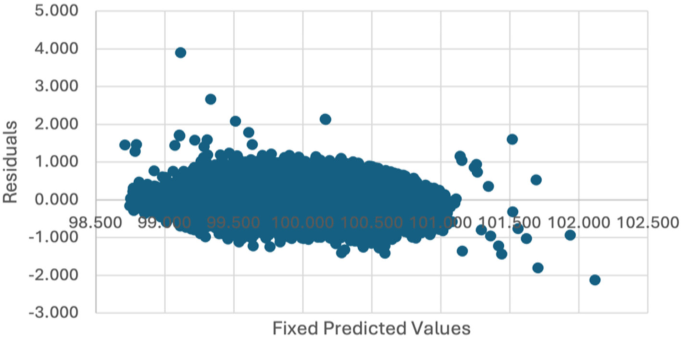
Model assumptions were evaluated through diagnostic procedures. Residuals were visually inspected and appeared approximately normally distributed, with no substantial deviations from normality observed. Residual-versus-predicted plots showed no clear systematic pattern, indicating that assumptions of linearity and homoscedasticity were reasonably met. Additionally, multicollinearity diagnostics presented no evidence of problematic collinearity among predictors, with variance inflation factors near 1.0 and tolerance values well above recommended thresholds. Visual representations of model diagnostics are provided in Figures 2 and 3.
Figure 2: Distribution of model residuals from the mixed-effects model, with overlaid normal curve. The residuals appear approximately normally distributed and centered around zero, supporting the assumption of normalityFigure 3: Residuals plotted against fixed predicted values from the mixed-effects model. Residuals were randomly dispersed around zero with no clear systematic pattern, indicating that assumptions of linearity and homoscedasticity were reasonably satisfied.
Overall, the mixed-effects modeling results demonstrated that while environmental heat exposure contributes to physiological strain, individual physiological responses—particularly heart rate—provide a more consistent and direct predictor of core body temperature in real-world occupational settings.
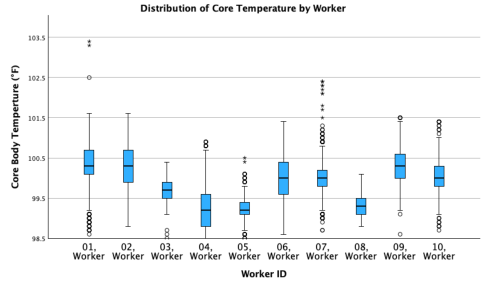
Variability in Physiological Heat Strain To further assess individual variability, box-and-whisker plots were used to examine the distribution of core body temperature by worker. The box plot provided a step-by-step view of worker-level heat strain, by identifying median core temperature, spread of values, and outlying observations for each worker, as shown in Figure 4.
Figure 4: Distribution of core body temperature by worker, illustrating inter-individual variability in heat strain.
First, differences in median core body temperature were observed across workers: Workers 01, 02, 06, 07, 09, and 10 generally exhibited higher core temperature distributions, while Workers 04, 05, and 08 showed lower median values. This indicated that workers exposed within the same general occupational setting did not experience heat strain uniformly.
Second, the spread of the box plots showed differences in variability across workers. Several workers had wider distributions, suggesting greater fluctuation in physiological response over time, while others had tighter distributions, indicating more stable core temperature patterns.
Third, several workers showed outliers above and below their typical ranges. These outliers suggest that short-term spikes or drops in core temperature occurred during the monitoring period, reinforcing that heat strain can vary both within the same worker, and between workers.
Overall, the box plot results support the mixed-effects model findings, revealing that individual worker differences meaningfully influence core body temperature. These findings suggest that environmental exposure alone may not fully capture heat stress risk and, consequently, worker-level physiological variability should be considered in heat stress assessment.
DISCUSSION
The results of this study demonstrate that while the eWBGT is associated with increases in core body temperature, it does not fully explain variability in physiological heat strain. Instead, heart rate emerged as a more consistent and direct predictor of core body temperature across workers.
A key finding of this study was the substantial variability in physiological response between workers. These findings suggest that environmental exposure alone may not fully capture individual heat strain under similar occupational conditions. In addition, the high-frequency time-series nature of the data introduces potential temporal autocorrelation. While a mixed- effects framework was used to account for repeated measures, residual autocorrelation structures such as AR(1) were not fully implemented due to computational constraints. Consequently, statistical estimates should be interpreted with this limitation in mind. Heart rate reflected both thermal
Evaluating Occupational Heat Stress Using Wearable Physiological Monitoring 2935 strain and physical exertion, which could not be fully separated in the current analysis. Occupational heat stress approaches that rely primarily on environmental thresholds may not fully account for individual differences in physiological response. Integrating wearable physiological monitoring can improve the identification of at-risk workers and support more adaptive and individualized intervention strategies. Future research should include additional work sites, direct validation of wearable-derived physiological measures, and advanced longitudinal modeling approaches to better account for temporal dependence in repeated observations.
Limitations This study has several limitations. Analysis focused on a single primary worksite and a relatively reduced worker cohort (n = 10), which limited generalizability and statistical power for more complex model structures. Additional datasets from other participating worksites remain available for future analyses.
Physiological and environmental measurements were estimated, rather than measured with standard instrumentation. Core body temperature was derived from wearable algorithms rather than direct clinical measurement, while environmental exposure was measured using WBGT-estimating beacons. Informal comparisons with a calibrated QUESTemp instrument revealed only minor deviations when under direct sunlight.
The high-frequency nature of the dataset also introduced potential temporal dependency between observations. While mixed-effects modeling accounted for repeated measures within workers, explicit residual autocorrelation structures such as AR(1) were not fully implemented. Additional limitations included limited artifact filtering for heart rate data, active heat management interventions during data collection, and the absence of contextual variables, such as hydration, acclimatization, fitness level, and workload characterization.
CONCLUSION
This study examined the relationship between environmental heat exposure and physiological response using wearable monitoring in real- world occupational settings. Findings demonstrated that the eWBGT was associated with increases in core body temperature, while physiological indicators, particularly heart rate, provided a more consistent representation of individual heat strain. Substantial variability between workers further suggested that environmental exposure alone might not fully capture physiological risk under similar conditions. Overall, these findings support integrating physiological monitoring alongside environmental assessment to improve occupational heat stress management strategies.
REFERENCES
Callihan, M., Cole, H., Stokley, H., Gunter, J., Clamp, K., Martin, A. & Doherty, H.
2023. Comparison of Slate Safety Wearable Device to Ingestible Pill and Wearable Heart Rate Monitor. Sensors (Basel), 23.
2936 King and Gouzd Cannady, R., Warner, C., Yoder, A., Miller, J., Crosby, K., Elswick, D. & Kintziger,
K. W. 2024. The implications of real-time and wearable technology use for occupational heat stress: A scoping review. Safety Science, 177, 106600. Cannady, R. T., Yoder, A., Miller, J., Crosby, K. & Kintziger, K. W. 2025. Understanding and perceiving heat stress risk control: Critical insights from agriculture workers. J Occup Environ Hyg, 22, 203–213. Ioannou, L. G., Foster, J., Morris, N. B., Piil, J. F., Havenith, G., Mekjavic, I. B.,
Kenny, G. P., Nybo, L. & Flouris, A. D. 2022. Occupational heat strain in outdoor workers: A comprehensive review and meta-analysis. Temperature (Austin), 9, 67–102. Notley, S. R., Flouris, A. D. & Kenny, G. P. 2018. On the use of wearable physiological monitors to assess heat strain during occupational heat stress. Appl Physiol Nutr Metab, 43, 869–881. OSHA 2024. Heat Injury and Illness Prevention in Outdoor and Indoor Work
Settings. In: HEALTH, O. S. A. & ADMINISTRATION (OSHA), L. (eds.). Washington, DC: Federal Register. Richard, N. A., Cheung, S. S., Claydon, V. E., Koehle, M. S. & Cote, A. T. 2025.
Accuracy and Precision of the SlateSafety BandV2 and CORE Devices in Estimating Resting and Moderate Hyperthermic Exercise Temperature in Eumenorrheic Females. Int J Sports Physiol Perform, 20, 1068–1078. Specht, J. W., Garcia, S. A., Tourula, E., Hite, M. J., Walker, C., Yoder, H. A., Wegman, D. H., Glaser, J., Schlader, Z. J. & Amorim, F. T. 2025. Heat stress and strain in commercial construction workers in the summer: A pilot study. J Occup Environ Hyg, 1–14.
SEARCH THE AHFE DIGITAL BOOKSTORE BY ISBN
Explore the complete digital volume
Human Factors in Design, Engineering, and Computing
Read this individual research paper free through the original publisher, or explore the full digital proceedings book.