Alexis M. Cady, Kelly DiCristina, Robert DeMarco, Lucas Hess, Saniyah L. Bullock, Michael Menegus, Dominic Cheng, Florence B. Chua, Jose J. Rodriguez (2026). Blast and Physiological Wearables: Hardware Testing and Voice of the Customer Analysis. In: Human Factors in Design, Engineering, and Computing. AHFE Open Access, vol. 238, pp. 2937–2947. https://doi.org/10.54941/ahfe1008517
A literature review conducted in early 2026 identified various biosignals that have the potential to be affected by blast overpressure (BOP) exposure. These key physiological markers were identified as heart rate variability (HRV), electroencephalography (EEG), and electrooculography (EOG), gait, and balance, with further investigation needed into respiratory rates. For the physiological and BOP wearable systems to be utilized in tactical military scenarios, hardware reliability and end-user acceptance must be evaluated. Methodology: Two surveys were distributed in May 2026, the first End-user Voice of the Customer (VoC) survey was distributed to U.S. Army Soldiers to determine initial wearable preferences for comfort in sensor placements, willingness to wear, form factor, and data usage. The second was a Leadership VoC survey focused on how leadership would want to receive, view, and utilize the data from BOP and physiological sensors to make informed decisions. Preliminary hardware evaluation was conducted using commercial-off-the-shelf (COTS) devices such as physiological sensors, BOP wearable sensors, and Pencil Probes. An airgun was used and the previously mentioned devices were set up in various configurations to determine if the incident pressure wave creates any noise or interference with the hardware. The level of quality/reliability was also determined between the wearable sensors and the gold-standard Pencil Probe. Results and impact: The end-user survey results identified concerns of snagging and size, preferences towards a non-intrusive, lightweight sensor, a device that can be taken on/off. The leadership survey results identified a preference for a numerical Soldier readiness score that could be displayed on a computer or tablet. During bench testing the physiological device used for testing was equipped with the capability to record EKG, HRV, IBI, respiration, temperature did not experience interference or noise from exposure to the incident pressure waveform when mounted near the blast, not connected to a person. Path Forward: Future field testing will outfit soldiers with synchronized COTS devices for physiology and BOP wearable devices. A wearable survey instrument has been developed to gather data on Soldiers’ perspectives on the comfort of the wearables during their training, which will inform the results from the Voice of the Customer survey. The results from the operational tests should provide a better understanding of the effects BOP has on the readiness and performance of the operators of Army systems.
Blast overpressure (BOP) is a rising concern among the Department of War (DoW) as a whole, specifically in the Army due to the demanding nature and inherent risks of their mission sets. BOP, defined as the sudden rise in pressure above normal atmospheric pressure, has been seen to cause negative health effects in Soldiers both acutely (LaValle et al., 2019) and long-term (Martindale SL, 2025). A major source of BOP among Soldiers emanates from occupational low-level exposure that can be caused from firing weapon systems, breaching, or explosions (McBirney, 2024; Martindale SL, 2025). Individuals exposed to occupational BOP may experience symptoms such as tinnitus, fatigue, dizziness, irritability, sleep problems, delayed thinking and reaction time, concentration problems, and headaches (Traumatic Brain Injury Center of Excellence, 2025). Multiple studies have investigated biomarkers that could be used to identify biosignals sensitive to BOP exposure such as heart rate variability (HRV), electroencephalography (EEG), electrooculography (EOG), gait, balance, and respiratory changes (Kutilek et al., 2017; Kemmer et al., 2026). While research has begun on occupational BOP, it is still unknown which sensors and biosignals are sensitive to small physiological changes and can be collected accurately in real-time within an operational military setting.
There are multiple considerations that need to be studied in addition to identifying the most accurate and sensitive biosignals, such as the proper placement of these sensors without interrupting the Soldiers’ primary roles and responsibilities. It has been previously shown that the orientation of the sensors will alter the reading of the blast waves (Misistia et al., 2020). Studies have also investigated the user preferences for different sensors to be worn on the Soldiers person, however, many sensors have not yet been tested or surveyed. There is still a great need in the field to better understand these sensors performance in occupational settings, the preferences and comfort of these devices to the Soldiers in their mission sets, and how the information will be used by Leadership to make informed decisions on Soldier safety and mission success.
This work sought to investigate Commercial Off the Shelf (COTS) sensors in tactical scenarios, and measure hardware reliability and end- user acceptance. To study the usability of the physiologic wearables, two surveys were administered to both U.S Army Leadership to understand what information they need and how it can be used for mission readiness, as well as the U.S Army Soldiers to determine their comfort and willingness to wear these sensors, and their rating of the devices.
Additionally, a physiological sensor, BOP wearable sensors, and Pencil Probes were tested to investigate the usability of these devices to be worn and accurately collect signals on the Soldier. BOP wearable sensors were also tested in their ability to measure blast waves and were compared to the gold standard of Pencil Probes currently used in the field (Lavayssiere et al., 2023).
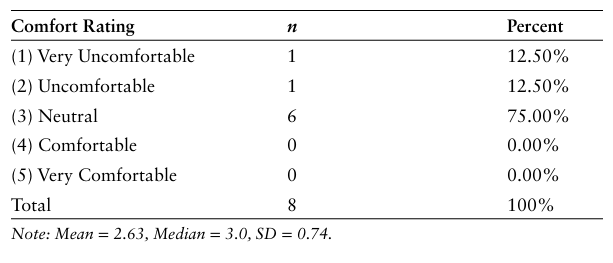
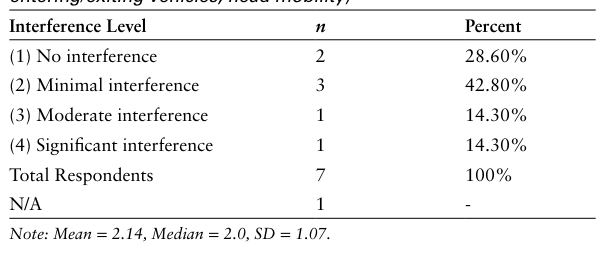
WARFIGHTER WEARABLE SENSOR FEEDBACK SURVEY To gather Soldiers opinions, an email was sent to collect their opinions on devices and sensors that could measure BOP and physiology signals either in training or in the field. Table 1 shows the distribution of Military Occupational Speciality (MOS) respondents, showing most respondents were 31B, military police (38.3%), and 11B, infantryman (17%). Of the 47 respondents only eight have worn a BOP wearable sensor either in the field or in training. When looking at the eight respondents six scored the comfortability of the sensor as neutral, one as uncomfortable, and one as very uncomfortable (Table 2). Soldiers also responded on the amount of interference they experienced while wearing the sensors, where two reported no interference, three reported minimal interference, and one respondent each reported moderate and high interference (Table 3).
Table 1: Distribution of soldier respondents.
Table available in the original PDF paper.
Survey Item: What is your primary Military Occupational Specialty (MOS) or Area of Concentration (AOC)?
What is Your Primary Military Occupational Specialty (MOS) or Area of Concentration (AOC)
Frequency (n) Relative Frequency (%) 11A Infantry Officer 2 4.26%
11B Infantryman 8 17.02% 11C Indirect Fire Infantryman 1 2.13%
MILITARY POLICE Branch 1 2.13% Grand Total 47 100.00%
Table 2: Comfortability of wearing blast sensors.
Survey item: On a scale of 1 (Very Uncomfortable) to 5 (Very Comfortable), please rate the general comfort of wearing blast sensors.
Table 3: Level of interference from blast sensors.
Survey item: To what extent did wearing blast sensors interfere with your operational duties? (e.g., shouldering a weapon, wearing a pack, entering/exiting vehicles, head mobility) Interference Level n Percent
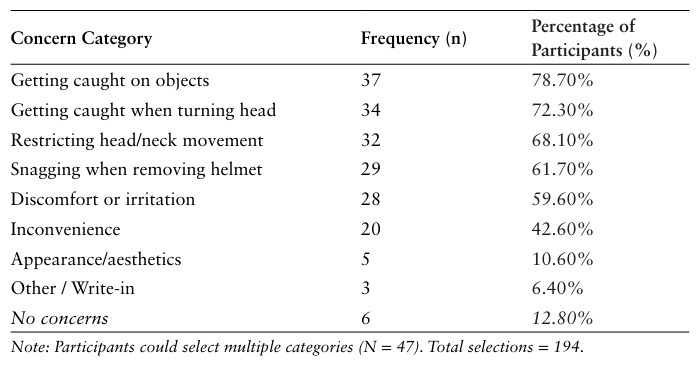
Of all 47 responses, 59.6% of Soldiers were willing/very willing to wear sensors, 12.8% of respondents reported unwilling/very unwilling, while 27.7% were neutral in their response. Wire concerns were also probed to understand the acceptability of having external wires run from their helmet to their torso. This was rated by participants on a 5-point Likert scale (1 = Very unacceptable, 5 Very acceptable), which showed low acceptance (M = 2.32, SD = 0.96, Mdn = 2.00, N = 47). This was also echoed in the frequency of concerns for having the wires get caught and snagging on objects when moving (n = 37, 78.7%) and restricting the head/neck movement (n = 32, 68.1) (Table 4). Participants were also asked what their preferred form factor for a sensor was and most frequently chose a device that can be taken on/off (e.g., a watch or ring) (n = 17, 36.2%). The next option was a ‘fully integrated’ sensor (29.8%, n = 14), followed by ‘no preference’ (n = 12, 25.5%) with the least two preferred options being a ‘small, disposable adhesive patch’ (n = 2, 4.3%), and other (n = 2,4.3%).
Table 4: Concerns about wire placement from helmet to body.
Survey item: What concerns do you have about wires from your helmet to your body? (Select all that apply) Concern Category Frequency (n) Percentage of Participants (%)
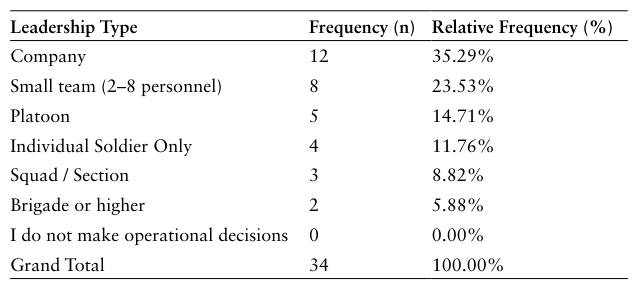
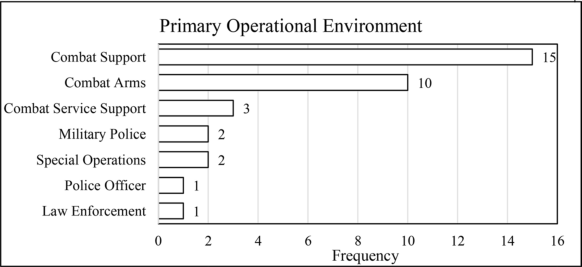
MILITARY LEADERSHIP SURVEY: SOLDIER MONITORING SYSTEM REQUIREMENTS SURVEY The military leadership survey was sent out via email to identify commander requirements for wearable device data visualization to enhance operational readiness and decision-making. Of the 46 respondents only 34 qualified to participate in the study, 12 were excluded due to not being Military Leadership. Table 5 and Figure 1 display the leadership type that participated and their operational environments, with most respondents leading a company (n = 12, 35.29%) or a small team (n = 8, 23.53%) and a primary operational environment of combat support (n = 15) and combat arms (n = 10).
Table 5: Distribution of leadership respondents.
Survey Item: What level of personnel do you typically make decisions for? (Select one) Leadership Type Frequency (n) Relative Frequency (%)
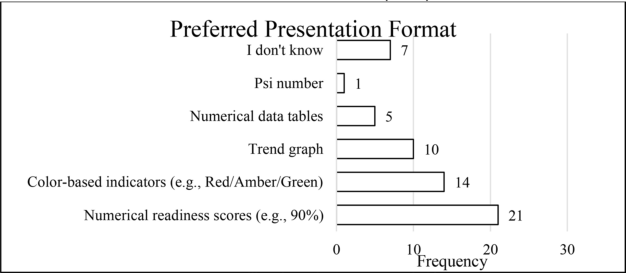
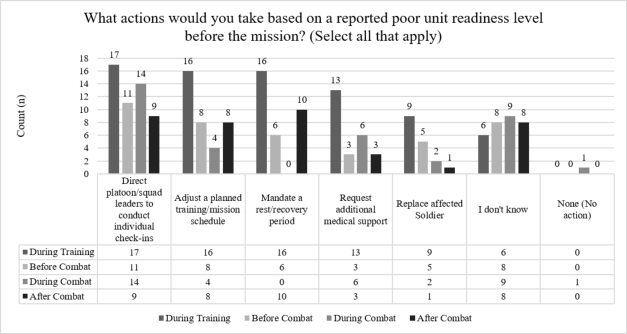
Figure 1: Primary operational environment of leadership respondents.Figure 2: Preference of format for leadership to receive readiness exposure levels.Figure 3: Comparison of leadership actions resulting from readiness levels during training vs combat missions.
Within the results of the survey, a vast majority of leaders (70.6%, n = 24) preferred a need for an overall Soldier readiness score, indicating that
Blast and Physiological Wearables: Hardware Testing and Voice 2943 viewing individual scores are the higher priority at (n = 18, 52.9%), followed by unit level. In a “Select all that apply” question leadership preferred to receive readiness information on a desktop/ laptop interface 58.8% (n = 20) opposed to hard copy, or through ATAK. Even though desktop/ laptop interface was the highest, approximately 1/3 of leadership chose ATAK, and 25% of participants choose “I don’t know.”
Table 6: Confidence levels required to act on BOP or biosignal information by leadership.
Moderate confidence (trend-based, not fully validated) Low Confidence (acceptable for awareness) 3 8.82%
Not sure 8 23.53% Total 34 100.00%
In terms of the confidence levels required for them to accept the BOP or biosignal data, 67.6% (n = 23) of leadership required that the confidence level would need to be at least moderate to high (see Figure 4). BOP data with a moderate to high confidence score, leaders were also polled to understand how they would use the information of BOP sensors in both training and mission settings. This information would be used in a context dependent manner. If leadership was given information on low soldier readiness scores from the BOP sensors, both in training and combat the most likely course of action will be direct soldier check-ins (n = 17 in training, n = 16 in combat). The mission or training schedule, however, saw a large disparity in combat with only 4 leaders considering changing the mission schedule based on this information and 16 would consider changing it in training. Interestingly, n = 16 leaders would mandate rest and recovery in training, and none would mandate it in a mission setting.
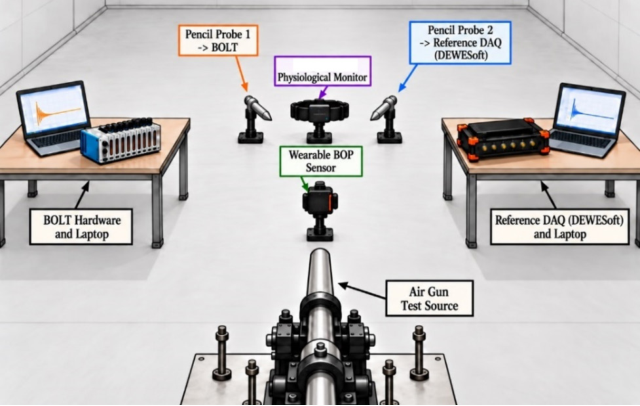
WEARABLE TESTING Airgun testing was conducted over three days (~60 shots at 80–100 psi) with two pencil probes, each attached to a different acquisition software. The wearable BOP sensor had five channels that simultaneously captured data from multiple directions. A physiological device was also turned on and mounted by the probes.
Methods
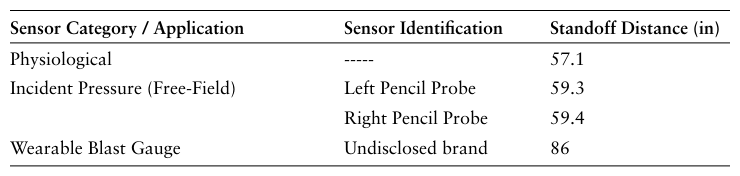
Testing was conducted with an airgun containing a 2.5” inch barrel. Table 6 provides the standoff distance between the muzzle and each of the sensors that were placed for data collection.
Table 7: Distances of instrumentation relative to airgun barrel muzzle.Figure 4: Airgun testing set-up.
Preparation:
The airgun was hooked up to the compressor.
In-house data acquisition system, Blast Overpressure Lightweight Tracker (BOLT) & DEWEsoft, commercial-off-the-shelf data acquisition system, were set up on a separate table and connected to the sensors.
Pencil probe pressure sensors were positioned facing the airgun muzzle.
BOP Sensor secured over the pencil probe.
Day 1 and 2 of Testing:
Diaphragm(s) were secured
The airgun was charged prior to each shot with a fast manual release of pressure to quickly burst the diaphragms. There were some diaphragms that did not immediately rupture upon release of pressure and caused ballooning.
Scoring the mylar in an X pattern aided in the rupture, some needed to be in asterisk pattern.
Blast and Physiological Wearables: Hardware Testing and Voice 2945 Day 3 of Testing:
Diaphragm(s) were secured
The airgun was filled with pressure until the disc ruptured
Some diaphragms did not rupture and causing the air to be released using the valve and trying again with a new diaphragm
RESULTS
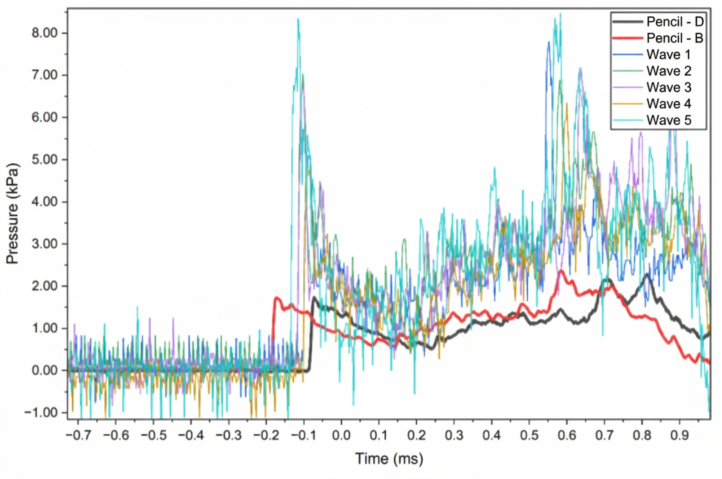
BOP wearable gauges could not capture the initial peak pressure at the edge cases tested during this experimentation. As such, instead of placing the BOP wearable gauge next to the pencil probe, the BOP wearable gauge was moved closer to the airgun firing; the pencil probe setup would not allow for moving to the closer set up. This was done to ensure data was captured by the wearable gauge. While the different set-up locations allowed for the collection of data on both sensors, it also resulted in the inability for a direct compassion be made between the two gauges in terms of accuracy of waveform. The wearable gauge was more susceptible to noise. A portion of this can be accounted for based on the difference in mounting conditions, however, there was an increase in high frequency noise during baseline within the sensor.
Figure 5: Representative first waveform peak with the time scale adjusted to view the data clearly.
During data collection, the raw timing shows the wave reaching the wearable sensor before the pencil probes. Further Peak, or the secondary peak
when the initial shock wave reflects off nearby solid surfaces, of the wearable is significantly higher than the pencil probe, which may be explained by the reflected pressure measured by the closer location while the pencil probe measured the incident pressure further behind the wearable sensor. Wearable acquisition system has a failure rate of 27., where it was unable to capture usable data from the event.
After reviewing the physiological data, the first day the devices powered down after not receiving stimuli, the second and third day the recordings did not yield an indication of noise across wave forms from the blasts. Future proposed testing would be conducted using physiological sensors for data collection on individuals during training or semi controlled environments. To determine if any artifacts appear while collecting biosignal data.
DISCUSSION
The surveys and preliminary hardware testing identified both user needs and technical considerations for wearable BOP and physiological monitoring systems. Soldier concerns about snagging and restricted movement highlight the importance of evaluating sensors with operational equipment during representative tasks. Though most respondents expressed willingness to wear sensors, only eight had prior BOP sensor experience. Therefore, these findings primarily reflect anticipated preferences rather than demonstrated acceptance during use.
Leadership responses suggest that monitoring information may support different actions in training and combat. Interest in an overall readiness score identifies a desired decision-support feature but does not establish that sensor measurements can validly determine readiness. Future work should distinguish exposure measurements from readiness indicators and assess how leaders interpret uncertainty and translate information into decisions.
Hardware testing identified missed pressure peaks, noise, and acquisition failures requiring further investigation. Differences in sensor placement prevented direct accuracy comparisons with reference probes. Similarly, the absence of observed disturbances in the available physiological recordings applies only to the bench conditions tested and requires confirmation during actual wear.
These findings are limited by the survey samples, hypothetical responses, and preliminary test configurations. Future evaluations should combine controlled verification of sensor performance with field assessments of signal quality, comfort, task interference, and interpretation of the resulting information.
CONCLUSION
To determine the usability of BOP and physiologic measurements within the Army operationally, both U.S. Soldiers and Leaders were given two different VoC surveys. The data give Soldier feedback on topics such as sensors/ placement of sensors, how Leadership would like to receive this information, and how usage of this information would differ in training and combat.
Blast and Physiological Wearables: Hardware Testing and Voice 2947 The results of the Leadership survey suggest that the BOP measurements from wearable sensors would hold more weight in determining the personnel and tempo used in training and would be less of a factor when deciding how to carry out operational missions. An airgun was also utilized to determine the accuracy of the different BOP wearables and physiological monitoring systems near blasts. Following the preliminary evaluation of BOP wearables, the BOP sensor measured in this study was able to collect some data from the blast of an airgun, however, more data and testing would be required to compare the measurements against the gold standard pencil probe. Taken together, these finding suggest that U.S. Army Soldiers are willing to wear BOP wearable sensors that are able to capture low level blasts while Leadership is willing to consider these data in their decision making.
ACKNOWLEDGMENT
The authors gratefully acknowledge Maia Frank for her volunteer contributions to Army Combat Capabilities Development Command Armaments Center and her support during the literature review phase.
REFERENCES
Kemmer, J., Williamson, J. R., Kim, J., Halford, E., Rao, H. M., & Smalt, C. J.
(2026). Wearable Tracking of Eye and Body Movements During Breaching Training: Towards Real-Time Blast Injury Monitoring. Journal of Neurotrauma, 1623–1635. Kutilek, P., Volf, P., Viteckova, S., Smrcka, P., Krivanek, V., Lhotska, L., Hana, K., Doskocil, R., Navratil, L., Hon, Z., Stefek, A. (2017). Wearable Systems for Monitoring the Health Condition of Soldiers: Review and Application. 2017 International Conference on Military Technologies (ICMT), 748–752. LaValle, C. R., Carr, W. S., Egnoto, M. J., Misistia, A. C., Salib, J. E., Ramos, A.
N., & Kamimori, G. H. (2019). Neurocognitive Performance Deficits Related to Immediate and Acute Blast Overpressure Exposure. Frontiers of Neurology. Lavayssiere, M., Lefrancois, A., Crabos, B., Genetier, M., Daudy, M., Comte, S.,Dufourmentel, A., Salsac, B., Sol, F., Verdier, P., Pons, P. (2023). Toward Improvements in Pressure Measurements for Near Free-Field Blast Experiments. Sensors (Basel). Martindale SL, K. C. (2025). Blast exposure and long-term diagnoses among
veterans: A millennium cohort study investigation of high-level blast and low- level blast. Frontiers of Neurology. McBirney, S. (2024). Repeated Exposure to Low-Level Military Occupational Blasts: An Overview of the Research,. Rand. Misistia, A., Skotak, M., Cardenas, A., Alay, E., Chandra, N., & Kamimori, G. H.
(2020). Sensor orientation and other factors which increase the blast overpressure reporting errors. PLoS One. Traumatic Brain Injury Center of Excellence. (2025). Blast overpressure provider support tool. Health.mil. https://www.health.mil/Reference-Center/Fact- Sheets/2025/09/16/Blast-Overpressure-Provider-Support-Tool
SEARCH THE AHFE DIGITAL BOOKSTORE BY ISBN
Explore the complete digital volume
Human Factors in Design, Engineering, and Computing
Read this individual research paper free through the original publisher, or explore the full digital proceedings book.