Olivia Hosie, Mats Isaksson, John McCormick, Oren Tirosh, Chrys Hensman (2026). Comparison of Threshold-Based and Continuous Measurement Methods for Assessing Wrist and Finger Posture During Hand-Controller Interaction. In: Human Factors in Design, Engineering, and Computing. AHFE Open Access, vol. 238, pp. 339–350. https://doi.org/10.54941/ahfe1008267
Background. Hand-controller ergonomics are important in precision-control applications, including robot-assisted surgery, but comparisons depend on how wrist and finger posture is measured. This study examined whether threshold-based and continuous measures produced similar controller ergonomic comparisons and whether wrist-only assessment represented hand postural exposure. Methods. Twelve participants completed 1-min and 5-min trials of a game using six controllers. Wrist and finger angles were recorded using a validated wearable data glove. Outcomes included mean absolute and 95th-percentile joint angles, time beyond wrist and finger reference postures, and wrist-only, finger-only and simultaneous wrist-finger exposure. Mixed-effects models included controller, trial length and their interaction, with participant as a random intercept. Associations were examined using repeated-measures correlation. Results. Controller type significantly affected all eight kinematic outcomes, χ²(5) ≥ 40.89, p< .001. Wrist threshold exposure was strongly associated with mean absolute wrist angle (rᵣₘ = .89) and moderately associated with 95th-percentile wrist angle (rᵣₘ = .67). Associations were weaker for the fingers (rᵣₘ = .63 and .38, respectively; all p < .001). Threshold exposure and mean absolute angle produced the same controller ranking for the wrist (ρ = 1.00) and a similar ranking for the fingers (ρ = .89). Across all trials, 67.6% of threshold-defined exposure occurred in the fingers without concurrent wrist exposure. Conclusion. Threshold exposure and mean absolute angle produced similar controller comparisons, particularly for the wrist. Wrist-only assessment missed substantial finger exposure. Hand-controller assessments should include wrist and finger kinematics and select outcomes according to whether the aim is to describe exposure duration, overall posture or peak posture.
Input controllers are used in many precision-control environments. These interfaces range from common computer input devices to specialised controls used in applications such as robot-assisted surgery. In these settings, controller design affects not only task performance but also the physical demands placed on the hand and wrist (Strasser, 2007). Different controller designs require different hand configurations and can alter wrist and finger posture during use (Oude Hengel et al., 2008). Therefore, input-device studies often compare controllers using outcomes such as task accuracy, comfort and wrist posture (Hemati et al., 2020; Oude Hengel et al., 2008).
Wearable sensors are increasingly used to continuously measure posture during occupational tasks (Stefana et al., 2021). Inertial measurement units (IMUs) and resistive flex sensors (RFSs) are used to record joint angles of the wrist and fingers in data gloves (Hosie et al., 2025; Weber et al., 2016). However, continuously recorded joint-angle data can be interpreted in several ways. Threshold-based measures describe the percentage of time spent beyond predefined reference postures, while measures such as mean and upper-percentile angles describe typical and more extreme posture magnitudes within a trial (Thamsuwan et al., 2020; Zare et al., 2020). The choice of measure can affect how ergonomic exposure is interpreted. Previous occupational research has shown that different methods of defining physical exposure can lead to different descriptions of posture during the same task (Jones and Kumar, 2007). Despite this, it remains unclear whether threshold- based and continuous joint-angle measures lead to consistent comparisons when derived from the same controller interaction.
The anatomical region included in the measurement may also affect the resulting outcome. Controller studies commonly report wrist posture, whereas metacarpophalangeal (MCP) joint angles are less frequently measured despite repeated finger inputs in many devices (Lin et al., 2015; Mariano et al., 2023). Both wrist and finger posture can influence carpal tunnel pressure, meaning that wrist- only measurements may not fully represent posture-related loading across the hand (Keir et al., 1997; Keir et al., 2007). Studies have reported increased carpal tunnel pressure associated with non-neutral wrist and finger postures, providing a basis for using wrist and finger postures to characterise threshold-defined exposure (Keir et al., 2007). These reference postures indicate changes in internal loading rather than clinical injury thresholds.
Controller studies often compare devices using individual kinematic measures, but it is unclear whether different ways of summarising the same movement data produce similar conclusions. Wrist-centred assessment may also overlook finger exposure occurring without concurrent wrist-threshold exposure. Comparing threshold-based and continuous measures, while separating wrist-only, finger-only and simultaneous wrist-finger threshold exposure, may therefore help determine how wearable joint-angle data should be summarised and which regions of the hand should be measured.
This study used a previously validated wearable sensor glove to record wrist and four-finger posture during standardised use of six controller interfaces. The first objective was to determine whether threshold exposure, mean absolute joint angle and 95th-percentile joint angle produced consistent
Comparison of Threshold-Based and Continuous Measurement Methods 341 comparisons between controllers. The second was to determine whether wrist-only assessment adequately represented threshold-defined exposure across the hand by separating wrist-only, finger-only and simultaneous wrist- finger exposure. The findings are intended to support future assessment of specialised interfaces, including robot- assisted surgical controls.
MATERIALS AND METHODS
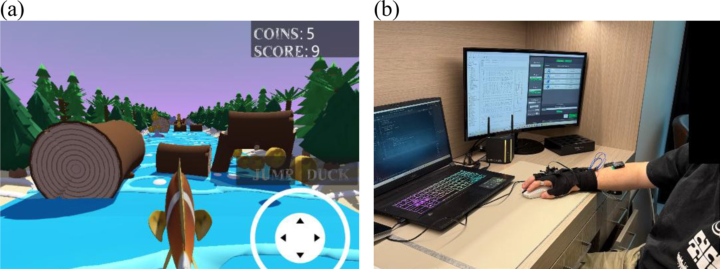
Experimental Task and Controller Conditions A standardised precision-control game was developed using Godot Engine (version 4.2.2, Godot Foundation). Participants guided an on-screen character laterally to avoid obstacles and collect coins. Game timing, task sequence and input mapping were held constant across conditions. The experimental setup and game are shown in Fig. 1.
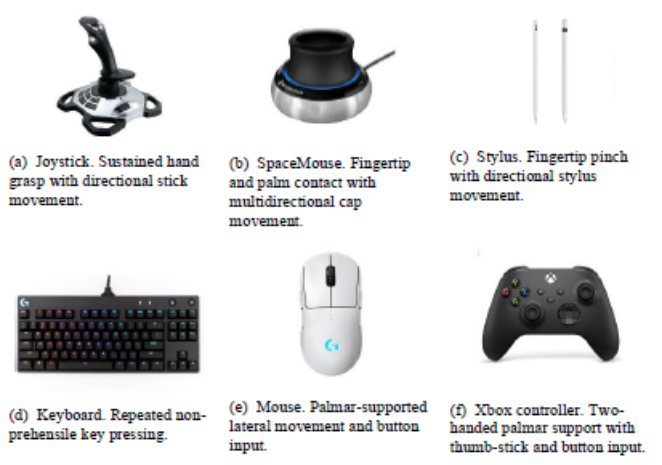
Six interfaces were assessed: a Logitech Extreme 3D Pro joystick, 3Dconnexion SpaceMouse Compact, Xbox Wireless Controller, Logitech G PRO LIGHTSPEED keyboard, Logitech G305 LIGHTSPEED mouse and an Apple Pencil Pro. The devices represented differences in geometry, hand support, hand configuration and primary input method. All were mapped to the same game actions. The controllers are shown in Fig. 2.
Participants Twelve healthy adults participated in the study, including six women and six men. Participants had a mean age of 22.75 ± 1.36 years; 10 were right- handed and two were left-handed. Mean hand length, hand span and wrist circumference were 19.05 ± 0.93 cm, 21.68 ± 1.53 cm and 17.67 ± 1.34 cm, respectively. Participants reported no known musculoskeletal condition affecting the hand or wrist.
Figure 1: Experimental context for the standardised controller task: (a) screenshot of the precision-control game used during testing and (b) participant positioning and testing setup.
Participants were most familiar with keyboard and mouse use, while none had previously used a SpaceMouse. The study was approved by the Swinburne University Human Research Ethics Committee (SUHREC; Ref. 20248258- 20311), and all participants provided written informed consent before testing.
Figure 2: Controller interfaces used during the standardised task.
Experimental Protocol Participants were seated at an adjustable workstation with relaxed shoulders, approximately 90° of elbow flexion and their elbows close to but unsupported by the table. The monitor was placed directly ahead, and each controller was positioned in front of the participant, as shown in Fig. 1. Wrist and finger angles were recorded at 50 Hz using a previously validated custom open- palm glove containing wrist-mounted inertial measurement units (IMUs) and resistive flex sensors (RFSs) positioned over the thumb and fingers (Hosie et al., 2025). After the participant donned the glove, the sensors were aligned with each knuckle. Before each trial, the glove was calibrated by having the participant hold their hand flat and then form a fist for 5 s in each position (Hosie et al., 2025).
For each controller, participants first completed a 1-min trial, followed by a 1-min rest period and then a 5-min trial. A 3-min rest period was provided before the next controller condition. This procedure was repeated for all six controllers. The two trial lengths were used to compare wrist and finger posture during shorter and longer periods of controller use. The controller order was randomised for each participant to minimise order effects.
Joint Angle Data Processing and Outcome Measures Kinematic data were processed in MATLAB and analysed separately for each participant, controller and trial length. Raw sensor outputs were converted to joint angles using the calibration procedures established for the glove (Hosie et al., 2025). Positive angles represented extension and negative angles represented flexion. Joint-angle data were analysed using continuous kinematic outcomes and threshold-based postural exposure outcomes.
Comparison of Threshold-Based and Continuous Measurement Methods 343 Continuous outcomes included mean absolute joint angle and 95th-percentile absolute joint angle. Wrist values were calculated from the absolute wrist angle at each sample. Finger values were calculated from the absolute angle of each available finger channel and then averaged across the index, middle, ring and little fingers, preventing flexion and extension values from cancelling.
Threshold-based outcomes represented the percentage of trial time beyond wrist and finger reference postures informed by experimental studies of carpal tunnel pressure (Keir et al., 1997; Keir et al., 2007). Wrist threshold exposure was defined as the percentage of samples for which the absolute wrist flexion-extension angle exceeded 30°.
Finger threshold exposure was present when at least one available finger exceeded its MCP reference posture, defined as greater than 45° of flexion or any extension beyond neutral (>0°). Wrist, finger and simultaneous wrist- finger threshold exposure were calculated. Each sample was also classified as wrist-only, finger- only, or simultaneous exposure. These mutually exclusive states were used to calculate the proportion of threshold-defined exposure occurring in the fingers without concurrent wrist exposure.
Task Performance Measures Task performance was assessed using movement variability and accuracy. The horizontal position of the on-screen fish character was recorded throughout each trial. Consecutive changes in horizontal position were calculated, and their standard deviation was used to represent variation in directional movement. Lower values indicated more consistent movement, whereas higher values indicated greater variability in movement corrections.
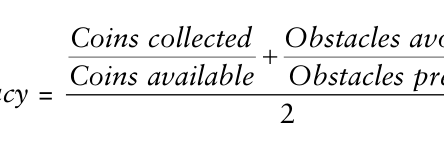
Accuracy combined target collection and obstacle avoidance. For each trial, the proportion of available coins collected and the proportion of obstacles avoided were calculated and averaged: Coins collected Obstacles avoided Coins available Obstacles present Accuracy +
Equation reproduced from the original PDF.
A separate linear mixed-effects model was fitted for each kinematic outcome, with controller type, trial length and their interaction included as fixed effects, and a participant-specific random intercept included to account for repeated measurements within participants. Fixed effects were tested using likelihood- ratio tests from models fitted with maximum likelihood and reported as chi-square statistics. Models were then refitted using restricted maximum likelihood to obtain estimated marginal means and 95% confidence intervals.
Within each controller, the 5-min and 1-min trials were compared using two-sided Wald contrasts. The six contrasts for each outcome were adjusted using the Holm method. Model assumptions were assessed using residual diagnostics. Trial condition was not interpreted as a pure duration or fatigue effect because the 1-min trial always preceded the 5-min trial. Results were
presented separately by trial condition where an interaction or significant within-controller contrast was identified; otherwise, conditions were pooled.
Repeated-measures correlations were used to examine associations between threshold exposure and the corresponding mean absolute and 95th-percentile wrist and finger angles. Controller rankings were compared using Spearman’s rank correlation. The proportion of threshold-defined exposure missed by wrist- only assessment was calculated for each trial, averaged within participants, and summarised using the overall mean and 95% confidence interval. Task- performance outcomes were analysed using the same mixed-effects model structure. Statistical significance was set at p < .05, with exact values reported where possible and values below .001 reported as p < .001.
RESULTS
Joint Angle Data Controller type affected all eight wrist and finger outcomes, χ²(5) ≥ 40.89, p < .001 (Table 1). Trial length affected finger threshold exposure and the 95th-percentile wrist and finger angles. For the 95th-percentile finger angle, the change between the 1-min and 5-min trials differed between controllers, p = .003.
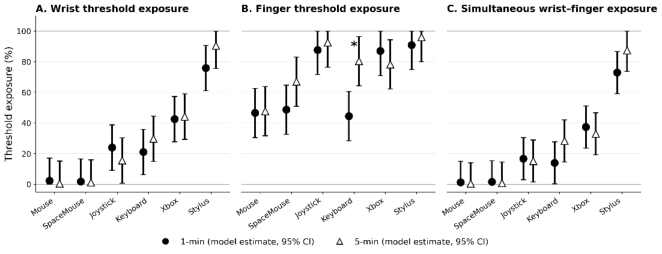
The stylus had the highest wrist threshold exposure in both trials, increasing from 75.9% in the 1-min trial to 90.5% in the 5-min trial. It also had the highest simultaneous wrist-finger exposure, at 72.9% and 87.4%, respectively. Wrist exposure was also high for the Xbox controller but remained low for the mouse and SpaceMouse (Fig. 3).
Finger threshold exposure was high for several controllers, although it often occurred without the wrist also exceeding its threshold. Finger-only exposure was highest for the joystick and SpaceMouse, while simultaneous wrist-finger exposure was highest for the stylus and Xbox controller. For the keyboard, finger threshold exposure increased from 44.5% in the 1-min trial to 80.4% in the 5-min trial, Holm- adjusted p = .009. No other within- controller threshold comparisons were significant.
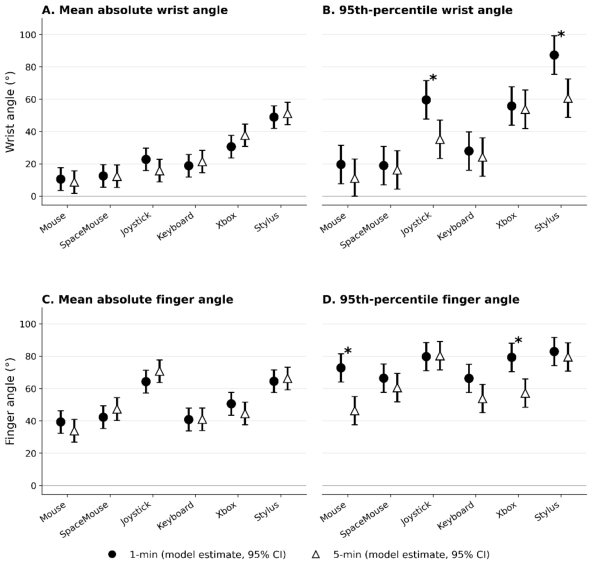
The continuous wrist measures showed a similar controller pattern. The stylus had the largest mean absolute wrist angle in both trials, at 49.0° and 51.2°, while the mouse and SpaceMouse had the smallest values, at 9.7° and 12.4°, respectively, pooled across trial length. The 95th-percentile wrist angle decreased significantly between trials for the joystick, from 59.6° to 35.2°, Holm-adjusted p = .023, and the stylus, from 87.4° to 60.6°, Holm-adjusted p = .011.
Table 1: Likelihood-ratio tests from the mixed-effects models. All models included participant as a random intercept.
Table available in the original PDF paper.
Outcome Controller Type Trial Length Controller × Length χ²(5) p χ²(1) p χ²(5) p Wrist threshold exposure (%) 117.58 <.001 0.32 .572 3.35 .646
Mean absolute finger angle was highest for the joystick, at 64.3° and 70.8°, and the stylus, at 64.5° and 66.3°. The 95th-percentile finger angle decreased significantly between trials for the mouse, from 72.8° to 46.4°, Holm-adjusted p < .001, and the Xbox controller, from 79.3° to 57.2°, Holm-adjusted p < .001.
Threshold exposure was more closely related to mean absolute angle than to the 95th-percentile angle. For the wrist, the correlations were rrm = .89, 95% CI [.85–.92], p < .001, for mean absolute angle and rrm = .67, 95% CI [.56–.75], p < .001, for the 95th percentile. For the fingers, the corresponding correlations were rrm = .63, 95% CI [.51–.72], p < .001, and rrm = .38, 95% CI [.22–.51], p < .001.
Threshold exposure and mean absolute angle gave the same controller ranking for the wrist, ρ = 1.00, and a similar ranking for the fingers, ρ = .89. Across all trials, 67.6% of threshold exposure occurred in the fingers without concurrent wrist threshold exposure, 95% CI [61.2–74.0]. Measuring the wrist alone would therefore have missed around two-thirds of the threshold- defined exposure.
Figure 3: Threshold exposure across controller types during the 1-min and 5-min trials. Points show estimated marginal means with 95% confidence intervals. Asterisks indicate significant Holm-adjusted within-controller differences between trial lengths.
Task Performance Accuracy was highest for the keyboard, at 90.9%, 95% CI [86.2–95.7], and lowest for the stylus, at 78.1%, 95% CI [73.3–82.8]. Accuracy was generally higher in the 5-min trials and increased significantly for the Xbox controller,
from 81.2% in the 1-min trial to 91.7% in the 5-min trial, Holm-adjusted p = .019. Overall, accuracy differed between controller types, χ²(5) = 37.90, p < .001, and trial lengths, χ²(1) = 15.95, p < .001, but the change between trials did not differ between controllers, p = .694.
The lowest estimated movement variability was found for the keyboard, at .079, 95% CI [.073–.085], and the highest for the mouse, at .088, 95% CI [.081–.094], although the overall controller effect was not significant, p = .272. There was also no overall trial-length effect, p = .375, but the change between trials differed between controllers, χ²(5) = 29.40, p < .001. Variability increased for the SpaceMouse from .078 to .095, Holm-adjusted p = .022, and decreased for the joystick from .094 to .070, Holm-adjusted p < .001. No other within-controller changes were significant.
DISCUSSION
This study compared threshold-based and continuous measures of wrist and finger posture across six hand controllers. Controller type influenced every kinematic outcome, showing clear differences in the hand postures required to use each interface. Threshold exposure was most closely related to mean absolute angle, particularly at the wrist, and these measures produced the same wrist-based ranking of the controllers. This relationship was weaker for the 95th-percentile measures and for the fingers. Importantly, wrist posture alone did not capture overall hand exposure. Across all trials, 67.6% of threshold-defined exposure occurred in the fingers while the wrist remained below its threshold.
The close relationship between wrist threshold exposure and mean absolute wrist angle suggests that these measures captured a similar overall pattern across controllers. The stylus produced the highest values for both, while the mouse and SpaceMouse produced the lowest. Mean absolute angle provided a similar comparison without requiring a predefined posture threshold. Threshold exposure still offers a useful ergonomic interpretation because it describes how much of a task is spent beyond joint angles that have previously been used to examine changes in carpal tunnel pressure. The two measures describe different aspects of exposure and should therefore be viewed as complementary rather than interchangeable. Mean absolute angle reflects posture across the full trial, whereas threshold exposure depends on where the reference threshold is set. The weaker relationships with the 95th-percentile measures also suggest that angles at the upper end of the distribution do not reflect overall exposure as closely as the mean posture across the task. This is consistent with previous occupational exposure research showing that different definitions of posture can produce different descriptions of the same physical exposure (Jones and Kumar, 2007).
The finger results further showed the limitations of assessing the wrist alone. The joystick and SpaceMouse had comparatively low wrist exposure but high finger-only exposure. In contrast, the stylus and Xbox controller more often placed the wrist and fingers beyond their respective thresholds at the same time. A controller could therefore appear relatively neutral when assessed at the
Comparison of Threshold-Based and Continuous Measurement Methods 347 wrist while still requiring substantial finger postures. Previous device studies have shown that interface design can affect both wrist and finger posture (Lin et al., 2015; Oude Hengel et al., 2008). The present study extends this by showing that these exposures do not necessarily occur at the same time. These findings suggest that finger posture should also be considered, particularly when comparing interfaces that use different grips or hand support.
The results also show that wrist and finger demands did not necessarily change together. The mouse and SpaceMouse maintained relatively low wrist angles, despite both showing substantial finger exposure. The lower wrist angles observed with the mouse relative to the stylus are consistent with Hemati et al. (2020), who also reported lower wrist flexion and extension during mouse use than during touch-pen use. The stylus required a sustained precision grip and produced the highest wrist and simultaneous wrist- finger exposure, while the joystick produced high finger exposure despite considerably lower wrist exposure than the stylus or Xbox controller. These findings do not suggest that any one controller is universally more ergonomic. Instead, each interface created a different distribution of postural demands across the hand. As a result, conclusions about the relative ergonomic demands of a controller may change depending on whether the wrist, fingers or both are assessed.
Trial length affected only a small number of outcomes, including finger threshold exposure and the 95th-percentile wrist and finger angles. Because the 1-min trial always preceded the 5-min trial, these differences cannot be separated from possible order or familiarisation effects.
Task accuracy differed between controllers and was generally higher in the 5-min trials, suggesting that the observed differences in wrist and finger posture were not simply accompanied by poorer task performance. Movement variability showed a less consistent pattern, with no overall difference between controllers but some controller-specific changes between trials. Together, these results suggest that posture and performance did not necessarily change in parallel, reinforcing the value of considering ergonomic exposure separately from task performance when comparing controller interfaces.
Several limitations should be considered when interpreting these findings. The study included 12 healthy young adults completing a standardised game, rather than experienced users completing prolonged occupational tasks. The findings therefore describe differences between controller interfaces under controlled conditions and may not directly generalise to specialised or long-duration applications. The fixed order of the 1-min and 5-min trials also means that trial duration could not be separated from order or familiarisation effects. In addition, the posture thresholds were informed by experimental studies of carpal tunnel pressure and should be treated as reference postures rather than direct injury limits (Keir et al., 1997). Finally, the combined finger measures summarised the index, middle, ring and little fingers and may therefore mask differences between individual digits.
Despite these limitations, the study shows that wearable measurements of both the wrist and fingers can distinguish the postural demands associated with different controller designs. It also demonstrates that the choice of measurement approach affects how those demands are described. Threshold-based and mean-angle measures produced similar overall wrist comparisons, while measures focused on more extreme postures showed weaker relationships. Most importantly, the large proportion of finger-only exposure indicates that wrist measurements alone may overlook a substantial component of hand posture during controller use. This approach may be particularly useful for robot-assisted surgical and industrial robotic controls, where sustained hand support, precision finger inputs and directional control may distribute ergonomic demands differently across the wrist and fingers.
Figure 4: Mean absolute and 95th-percentile wrist and finger angles across controller types during the 1-min and 5-min trials. Points show estimated marginal means with 95% confidence intervals. Asterisks indicate significant Holm-adjusted within- controller differences between trial lengths.
CONCLUSION
Threshold-based and continuous measures produced similar overall controller comparisons, particularly at the wrist, although the relationship was weaker for measures focused on more extreme joint angles. Importantly, wrist posture alone did not capture the full pattern of hand use, with around
Comparison of Threshold-Based and Continuous Measurement Methods 349 two-thirds of threshold-defined exposure occurring in the fingers without concurrent wrist exposure.
These findings support measuring finger posture alongside the wrist and using a combination of kinematic outcomes to describe different aspects of exposure.
This provides a useful basis for assessing specialised controller interfaces, including those used in robot-assisted surgery and industrial robotic control, where wrist-only assessment may overlook substantial finger demands.
REFERENCES
Hemati, K., Mirjalili, S., Ghasemi, M.S., Abdolahian, Y., Siroos, R., Sanati, P., Aghilinejad, M., Dehghan, N. (2020). “Functional parameters, wrist posture deviations and comfort: A comparison between a computer mouse and a touch pen as input devices”, *Work*, 65(4), pp. 701–706. https://doi.org/10.3233/WOR-203124 Hosie, O., Isaksson, M., McCormick, J., Tirosh, O., Hensman, C. (2025). “The
design and validation of an open-palm data glove for precision finger and wrist tracking”, *Sensors*, 25(2), 367. https://doi.org/10.3390/s25020367 Jones, T., Kumar, S. (2007). “Assessment of physical demands and comparison of multiple exposure definitions in a repetitive sawmill job: Board edger operator”, *Ergonomics*, 50(5), pp. 676–693. https://doi.org/10.1080/00207720601164597 Keir, P.J., Wells, R.P., Ranney, D.A., Lavery, W. (1997). “The effects of tendon load
and posture on carpal tunnel pressure”, *The Journal of Hand Surgery*, 22(4), pp. 628–634. https://doi.org/10.1016/S0363-5023(97)80119-0 Keir, P.J., Bach, J.M., Hudes, M., Rempel, D.M. (2007). “Guidelines for wrist posture based on carpal tunnel pressure thresholds”, *Human Factors*, 49(1), pp. 88–99. https://doi.org/10.1518/001872007779598127 Lin, M.Y.C., Young, J.G., Dennerlein, J.T. (2015). “Evaluating the effect of four
different pointing device designs on upper extremity posture and muscle activity during mousing tasks”, *Applied Ergonomics*, 47, pp. 259–264. https://doi. org/10.1016/j.apergo.2014.10.003 Mariano, L.A., Priadythama, I., Loh, P.Y., Muraki, S. (2023). “Effect of gaming controllers on wrist angles”, in: Proceedings of the 9th International Ergonomics Conference – ERGONOMICS 2022, pp. 215–222. Springer. https://doi. org/10.1007/978-3- 031-33986-8_23 Oude Hengel, K.M., Houwink, A., Odell, D., van Dieën, J.H., Dennerlein, J.T. (2008).
“Smaller external notebook mice have different effects on posture and muscle activity”, *Clinical Biomechanics*, 23(6), pp. 727–734. https://doi.org/10.1016/j. clinbiomech.2008.01.013 Stefana, E., Marciano, F., Rossi, D., Cocca, P., Tomasoni, G. (2021). “Wearable devices for ergonomics: A systematic literature review”, *Sensors*, 21(3), 777. https://doi.org/10.3390/s21030777 Strasser, H. (2007). *Assessment of the Ergonomic Quality of Hand-held Tools and
Computer Input Devices*. IOS Press. Thamsuwan, O., Galvin, K., Tchong-French, M., Aulck, L., Boyle, L.N., Ching, R.P., McQuade, K.J., Johnson, P.W. (2020). “Comparisons of physical exposure between workers harvesting apples on mobile orchard platforms and ladders, part 1: Back and upper arm postures”, *Applied Ergonomics*, 89, 103193. https:// doi.org/10.1016/j.apergo.2020.103193
Weber, P., Rueckert, E., Calandra, R., Peters, J., Beckerle, P. (2016). “A low-cost sensor glove with vibrotactile feedback and multiple finger joint and hand motion sensing for human-robot interaction”, in: *2016 25th IEEE International Symposium on Robot and Human Interactive Communication (RO-MAN)*, pp. 99–104. https:// doi.org/10.1109/ROMAN.2016.7745096 Zare, M., Bodin, J., Sagot, J.-C., Roquelaure, Y. (2020). “Quantification of exposure
to risk postures in truck assembly operators: Neck, back, arms and wrists”, *International Journal of Environmental Research and Public Health*, 17(17), 6062. https://doi.org/10.3390/ijerph17176062
SEARCH THE AHFE DIGITAL BOOKSTORE BY ISBN
Explore the complete digital volume
Human Factors in Design, Engineering, and Computing
Read this individual research paper free through the original publisher, or explore the full digital proceedings book.