Lindsey McIntire, John McIntire, Benjamin Mandani, Gideon Farhadian, Jackson Tell, Kassandra Guinto, Lukas Goodworth, Will Allison, Daniel Jensen (2026). Purported and Measured Waveform Characteristics of Vagus Nerve Stimulation Devices. In: Human Factors in Design, Engineering, and Computing. AHFE Open Access, vol. 238, pp. 351–362. https://doi.org/10.54941/ahfe1008268
In this work, we conduct a first-of-its-kind comparative evaluation of commercially available non-invasive vagus nerve stimulation (nVNS) devices, providing detailed waveform characteristics for the devices’ outputs and comparing the purported waveform characteristics with those from laboratory measurements. The vagus nerve travels from the brainstem through the neck and has connections to many major organs, such as the heart and stomach, via the parasympathetic nervous system. There is a rising prevalence of VNS technology aimed at improving health. Wearable nVNS devices deliver (output) either electrical current, acoustic, or magnetic signals through the skin to the vagus nerve near either the ear, neck, skull, or chest cavity. While the development and use of these devices have increased, there is very little published data on specific characteristics of the waveforms these devices produce. This paper aims to conduct a review of 7 popular commercial off-the-shelf nVNS devices by providing the product details, purported waveform specifications, and measured waveform specifications for each device. The devices we investigated are the gammaCore®, Neuvana Xen®, Pulsetto Fit®, Vagustim V2®, ZenoWell Vita®, VeRelief Mini®, and the AmofitS®. The measured waveform specifications were obtained using an oscilloscope to determine the waveform characteristics. These are compared with the purported waveform characteristics. Notable inconsistencies are addressed. The detailed waveform characteristics could be used in future studies to correlate the waveform variables with specific treatment success.
INTRODUCTION AND BACKGROUND The earliest recorded use of vagus nerve stimulation (VNS) might be in 46 AD when Scribonius Largus, a Roman physician, used electric torpedo fish to treat migraines (Sarmiento, 2016). Later, the scientific study of bioelectricity was launched by Luigi Galvini’s experiments in the 1780s, when he unexpectedly observed frog legs twitching due to an accidental electrostatic spark (Colzato, 2020). The use of electricity to stimulate the human body developed into modern VNS, utilized to treat patients with epilepsy, which received FDA approval in 1997. While VNS devices were at first surgically implanted, more
recently non-invasive VNS (nVNS) devices have become prominent. nVNS has been shown to aid in migraine relief, improved memory, pain reduction, treatment of atrial fibrillation, mitigation of opioid withdrawal symptoms, improved fatigue recovery, and schizophrenia care, while avoiding the risks and costs of an implantable device (Hilz, 2022). Emerging evidence in VNS research also suggests a variety of further potential human benefits, including anxiety regulation, better sleep quality, improved cognitive function, and general regulation of the parasympathetic nervous system (Hilz, 2022; Yap et al., 2020; McIntire et al., 2021; and Miyatsu et al., 2024). Two common forms of nVNS are Transcutaneous cervical VNS, which stimulates the vagus nerve through the neck, and transcutaneous auricular VNS, which stimulates via electrodes placed on the ear (Austelle et al., 2024). While one nVNS device we investigated, the gammaCore, has been approved for medical use by the FDA (US FDA, 2017a), all other devices in our set are labelled “wellness devices” and are not FDA-controlled.
This work reviews seven popular commercial nVNS devices by providing the product details, purported waveform specifications, and measured waveform specifications for each device. The devices we investigated are the gammaCore®, Neuvana Xen®, Pulsetto Fit®, Vagustim V2®, ZenoWell Vita®, VeRelief Mini®, and the AmofitS®. The measured waveform specifications were obtained using an oscilloscope to determine the waveform characteristics. These are compared with the purported waveform characteristics. Commercial-Off-The-Shelf (COTS) nVNS devices deliver (output) either electrical (85–95%), acoustic (3–5%), or magnetic (1–2%) energy. VNS device manufacturers occasionally report some characteristics of the delivered (output) signals, but complete, detailed reporting is very rare. The output stimulation parameters that are of interest may include intensity (of the delivered energy), pulse width, pulse frequency, burst frequency, and waveform shape. Although some companies report some of this data for their devices, we did not find any devices that reported all this data. Apart from waveform characterization, stimulation placement location and duration are also important variables. The most common stimulation placements are the ear’s auricular concha (70–80%) or neck (20–30%), or less commonly, the chest (1–2%).
Understanding, characterizing, and confirming nVNS device waveforms and specifying stimulation parameters like on-body location and duration, is important for advancing the field of non-invasive brain stimulation. This knowledge can help researchers make sense of a large body of experimental literature that is testing many different device types, waveforms, and human data.
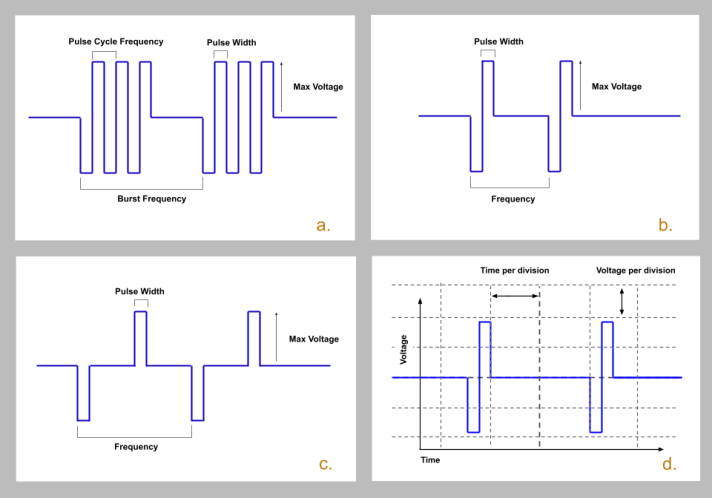
WAVEFORM CHARACTERIZATION FOR SEVEN DEVICES To document the waveform characteristics of the devices, each device was attached to a DPO2012 Oscilloscope (Tektronix, Inc., n.d.) across a standard 2 kΩ resistor. This resistance was chosen as representative of human skin resistance (Wikipedia, 2024). Depending on waveform shape, the parameters
Purported and Measured Waveform Characteristics 353 recorded were cycle frequency, burst frequency, pulse width, and intensity (max voltage). Se Figure 1 for examples.
We provide a product image, release date, FDA status, stimulation location, claimed effects, modes, cost, manufacturer, URL and a technical description of the device’s waveforms and zoomed in/out image captures of the oscilloscope-based waveform. Note that some devices have only one “mode.” Tables below compare the purported vs. measured waveform characteristics followed by comments on the comparison. Note that while we report up to 4 significant digits, our error is estimated at between 2% and 3%, including human and device accuracy.
Figure 1: Biphasic square waveforms with (a) burst pattern, (b) without burst pattern, (c) with interphase gap. (d) Oscilloscope axis and division reference.
DEVICE 1: GammaCore The gammaCore, released in August 2018, is an FDA-approved nVNS device (US FDA, 2017b). Although there have been additional releases of slightly altered versions of this device, the one we tested is the original FDA-approved device. It is a neck stimulation device medically prescribed to treat cluster headaches and migraines, featuring one default mode with adjustable intensity. The price is $598.00 per month due to the continual subscription cost (Clowers et al., 2019). The company is electroCore. See https://www.gammacore.com/
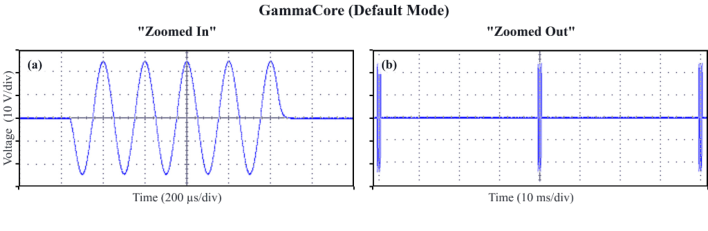
Waveforms The gammaCore waveform is a sinusoidal burst pattern, beginning in a negative phase and continuing for five cycles (zoomed-in chart), followed by a rest period (zoomed-out chart). This is the only sinusoidal pattern we observed, and it agrees with the company’s data, which dictates no direct (only alternating) current (US FDA, 2017a). Purported and measured data are consistent (Table 1).
Max Voltage Default Measured 25.05 Sinusoidal 0.1 5000 23.9 Claimed 25 Sinusoidal 0.1 5000 23 ± 2 FDA
DEVICE 2: Neuvana Xen The Neuvana Xen, released in October 2019, is a consumer wellness nVNS product utilizing two earbuds and a saline spray to assist with conduction. The left earbud provides the nVNS, but both can play audio. This device is marketed to improve focus and attention and features four “quickstart” preset modes, each with user- variable intensity: Ocean, Sleep, Calm, and Focus. This device, from Neuvana, LLC, costs $449.00. https://neuvanalife.com/.
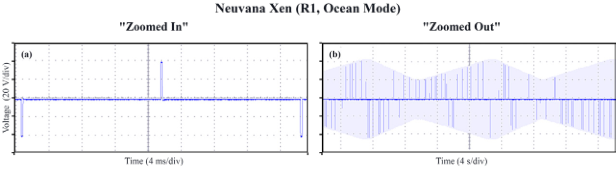
Waveforms The device’s Ocean mode is a biphasic square wave with an interphase gap (zoomed-in chart). The zoomed-out chart shows the signal’s intensity is modulated in a way similar to a sine wave. The modes “calm” and “focus” are similar, with interphase gaps (IPG) but also have distinct parameters, including the shape of the intensity modulation. “Sleep” mode was the only mode without an interphase gap.
Additionally, the user manual claims waveform shape, stimulation duration, and intensity are adjustable via the Neuvana app. The duration is automatically set to 15 minutes but is adjustable, and intensity is described as a unitless range from 0 to 25 (Neuvana, n.d.a). The app allows the user to set a wide variety of output characteristics, including “waveform” and “sensation”. It is unclear what waveform characteristics these correspond to, as the only numerical purported values are a 30 Hz stimulation with a 200-microsecond pulse width (Neuvana, n.d.b). These two parameters are verified by our measurements (Table 2); however, some cells are marked N/A due to measurement problems with those parameters.
DEVICE 3: Pulsetto Fit
Pulsetto, debuting in July 2025, is under the consumer wellness umbrella and uses conductive gel and a neck “collar” with electrodes on both sides of the neck. Marketed to reduce cortisol levels, improve sleep, and minimize stress, the Pulsetto Fit features five preset modes: Stress, Anxiety, Sleep, Burnout, and Pain. Priced $546.00 from UAB Pulsetto / Kilo group UAB https://pulsetto.tech/products/meet-pulsetto.
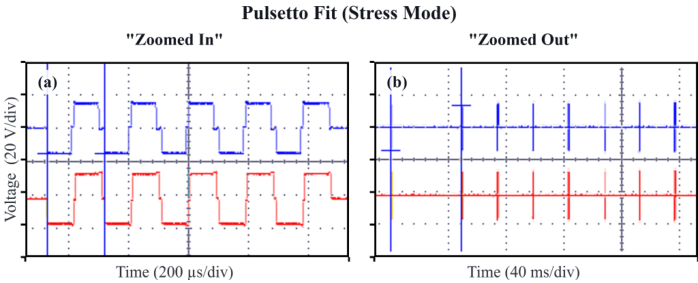
Waveforms As seen in the zoomed-in chart, the “stress mode” has an approximately square biphasic (BP) 40.7 Hz wave. The zoomed-out chart shows this pattern is pulsed (burst) at 5244 Hz. The Pulsetto website indicates that each of the five modes has different waveform characteristics (as seen in the table 3. However, we tested two different devices and found the output waveform characteristics to be the same for all modes. Note that max voltage did not come from Pulsetto’s website but Pulsetto’s official Federal Communications Commission (FCC) report, which claims a peak voltage of 30 volts.
Figure 4: Zoomed in/out pulsetto waveform O-scope screenshots (Blue right electrode, Red: Left electrode).Table 3: Pulsetto fit purported vs. measured waveform characteristics.
Table available in the original PDF paper.
Source
Mode Freq / Burst Freq (Hz)
Waveform Pulse Width (ms)
Pulse Cycle Freq (Hz)
Max Voltage Stress Measured 40.7 Square, BP 0.09 5244 17.92 Corp.
Purported and Measured Waveform Characteristics 357 DEVICE 4: Vagustim
Vagustim, released in late 2025, is a consumer wellness product that utilizes two earbuds and a water spray. It costs $369.00 and targets stress responses, heart rate, digestion, and overall mental/physical health. The product features nine preset modes (see table below). The device was created by Vagustim Health Technologies LLC. https://vagustim.io/collections/home/products/ vagustim-v2-vagus-nerve-stimulation-device.
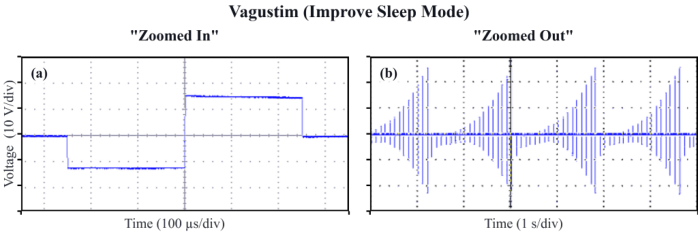
Waveforms Across its modes, the Vagustim produces a biphasic square waveform without interphase gaps (zoomed-in chart). However, the intensity is modulated in different shapes (zoomed-out chart), with some showing consistent modulation patterns like the “Improve Sleep” mode shown in the figure. Other modes had different modulation (zoomed-out) patterns. However, all modes show similar ramp-up modulation characteristics. The device manufacturers provide no quantitative data for the waveform characteristics, so we believe that the chart below provides the only published numerical characterization of the output. Of particular note is that the max intensity (voltage) is considerably higher for the “overall well-being” mode than for the other modes.
The Zenowell Vita, released in late June 2025, is a consumer wellness VNS device that uses a single left earbud and a conductive water spray. The product is marketed to assist in stress reduction, fatigue, sleep issues, and to improve mental clarity. It has three modes: “Sleep,” “Relax,” and “Meditate.” Cost, from the company Zenowell, is $269. https:// zenowell.ai/products/zenowell-vita.
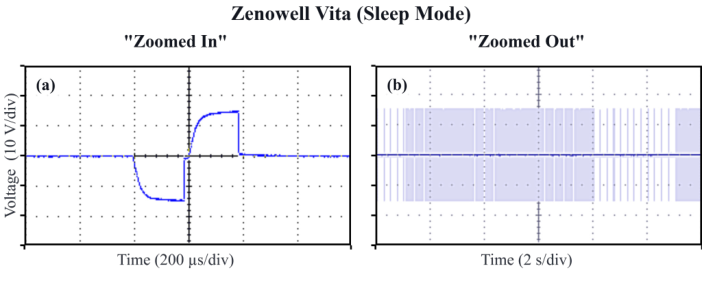
Waveforms The Zenowell Vita waveform shape has a nonlinear ramp-up section into each biphasic square wave pulse (zoomed-in chart). While not following a traditional burst pattern shape (zoomed-out chart), this device’s sleep mode has a repeating set of cycles with similar frequency and then a set with greater frequency. However, for the “Relax” and “Meditate” modes, instead of two frequencies, there is a period of time where the signal cuts off. As seen in the table below, purported values for burst frequency and pulse width correspond with the measured values. Note that the “claimed” data in the table is from a Reddit user who claimed they received the data from ZenoWell.
Figure 6: Zoomed in/out Zenowlll Vita waveform oscilloscope screenshots.Table 5: Zenowell purported vs. measured waveform characteristics.
The VeRelief Mini, released March 2023, is a neck nVNS device with gel-tipped electrodes, thus avoiding the need for a separate conductive solution. It is marketed for its calming effects and is sold by Hoolest Performance Technologies for $299. See https://hoolest.com/.
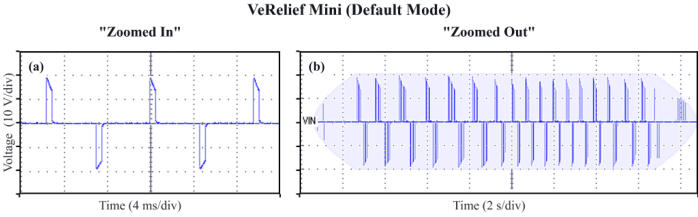
Waveforms The single VeRelief Mini waveform is a skewed square wave with a linear ramp-down section (zoomed-in chart). This is a continuous biphasic pulse (zoomed-out chart). The only purported waveform characteristics are the frequency and the pulse width (Hoolest Inc., n.d.). Both of these match the measured values.
Figure 7: Zoomed in/out VeRelief Mini waveform oscilloscope screenshots.Table 6: VeRelief Purported vs. Measured Waveform Characteristics.
DEVICE 7: AmoFit S The AmoFit S (released 2022 by AMO Lab) delivers “complex electromagnetic signals to the heart and the vagus nerve branches connected to the heart” (Amo, n.d.). It does not use traditional VNS methods like electrodes and does not need skin contact. It is worn like a medallion in the chest area and claims to be effective as long as it is within 9 inches of the nerve. AMO Lab funded two published works; in both, small but significant changes in high-frequency (HF) power in ECG-based heart rate variability measurements were detected. They claim this indicates a positive change in parasympathetic nervous system activity (Park et al., 2020). In one study with a small (n = 6) sample size, they showed a small difference in melatonin levels at night compared to a placebo group (Rathakrishnan, Kim, & Park, 2020). The device sells for $248 at https://www.amo-lab.com/.
Waveforms We attempted to measure the strength of the magnetic field using a PASCO magnetic field sensor. The AmoFit device claims to generate a magnetic field approximately 1/10th of the strength of the Earth’s field, which would be approximately 0.05 Gauss which is at the sensitivity limit of the PASCO sensor. We did not detect a field at all, suggesting extremely faint or non-existent emission.
Purported and Measured Waveform Characteristics 361 CONCLUSIONS & ACKNOWLEDGMENTS
Detailed numerical waveform data for many commercial, nVNS devices is difficult or even impossible to find. This data can be important if one wishes to correlate treatment outcomes or other research variables with waveform characteristics. Seven nVNS devices were studied and their waveform characteristics experimentally determined. Also, when purported data were available, the measured characteristics were compared with this purported data. We believe this work will be helpful to advancing the science of vagus nerve stimulation and more broadly for noninvasive neurostimulation. This work was funded by the AFRL Human Performance Directorate and Westmont College’s Undergrad Engineering Research Program.
REFERENCES
Amo Lab Co., Ltd., n.d. Revolutionary cVES Technology. amofit S. [online] Available at: https://www.amo-lab.com/pages/technology [Accessed 27 July 2026]. Austelle, C.W., Cox, S.S., Wills, K.E. and Badran, B.W. (2024). “Vagus nerve
stimulation (VNS): Recent advances and future directions.” Clinical Autonomic Research, 34, pp. 529–547. Clowers, M., Lo, N., Smith, A., Mahdavian, S. and Honeywell, M. (2019).
“gammaCore Noninvasive Vagus Nerve Stimulator.” US Pharmacist, 44(11), pp. 33–36. Colzato, L. and Beste, C. (2020). “A literature review on the neurophysiological underpinnings and cognitive effects of transcutaneous vagus nerve stimulation: challenges and future directions.” J. of Neurophysiology, 123(5), pp. 1739–1755. Hilz, M.J. (2022). “Transcutaneous vagus nerve stimulation - a brief introduction
and overview.” Autonomic Neuroscience, 243, 103038. Hoolest Inc., (n.d.). VeRelief Mini Quick Start. [online] Available at: https://hoolest.
“Cervical transcutaneous vagal nerve stimulation (ctVNS) improves human cognitive performance under sleep deprivation stress.” Communications Biology, 4, 634. Miyatsu, T., Oviedo, V., Reynaga, J., Karuzis, V.P., Martinez, D., O’Rourke, P., Key, M., McIntire, L., Aue, W., McKinley, R., Pirolli, P. and Broderick, T. (2024). “Transcutaneous cervical vagus nerve stimulation enhances second-language vocabulary acquisition while simultaneously mitigating fatigue and promoting focus.” Scientific Reports, 14, 17177. Neuvana, LLC (n.d.a). Science and Technology of Xen by Neuvana: Transcutaneous
Auricular Vagus Nerve Stimulation (taVNS). White paper. Neuvana, LLC (n.d.b). Xen. https://www.manualslib.com/manual/1660053/Neuvana- Xen.html. Park, S.J., Hong, S., Kim, D., Hussain, I., Seo, Y. and Kim, M.K. (2020). “Physiological
evaluation of a non-invasive wearable vagus nerve stimulation (VNS) device.” In: T. Ahram, ed. Advances in Human Factors in Wearable Technologies and Game Design. Cham: Springer, pp. 57–62. Rathakrishnan, K., Kim, M.K. and Park, S.J. (2020). “The effects of vagus nerve stimulation on insomnia persons for stress reduction and sleep induction.” Advances in Human Factors, Business Management & Society. Springer, pp. 579–585.
Sarmiento, C. I., San-Juan, D., & Prasath, V. B. S. (2016). Letter to the Editor: Brief history of transcranial direct current stimulation (tDCS): From electric fishes to microcontrollers. Psychological Medicine, 46(15), 3259–3261. DOI: 10.1017/ S0033291716001926. Tektronix, Inc. (n.d.). DPO2000 and MSO2000 Series Oscilloscopes: Specifications
and Performance Verification. Technical Reference 077-0096-00, Rev. B. U.S. Food and Drug Administration (2017a). De Novo Summary (DEN150048): gammaCore Non-invasive Vagus Nerve Stimulator. [online] Available at: https:// www.accessdata.fda.gov/cdrh_docs/reviews/DEN150048.pdf. U.S. Food and Drug Administration (2017b). Device Classification 513(f)(2) (De
Novo): gammaCore Non-Invasive Vagus Nerve Stimulator. DEN150048. Wikipedia (2024). Electrical injury: https://en.wikipedia.org/wiki/Electrical_injury. Yap, J.Y.Y., Keatch, C., Lambert, E., Woods, W., Stoddart, P.R. and Kameneva, T.
(2020). “Critical review of transcutaneous vagus nerve stimulation: Challenges for translation to clinical practice.” Frontiers in Neuroscience, 14, 284.
SEARCH THE AHFE DIGITAL BOOKSTORE BY ISBN
Explore the complete digital volume
Human Factors in Design, Engineering, and Computing
Read this individual research paper free through the original publisher, or explore the full digital proceedings book.