Tzu-Wen Tsai, Rung-Huei Liang (2026). Flipping Through My Day: Reimagining the Digital Calendar Through Novelistic Translation and Progressive Narrative Delivery. In: Human Factors in Design, Engineering, and Computing. AHFE Open Access, vol. 238, pp. 517–528. https://doi.org/10.54941/ahfe1008284
Contemporary digital life is governed by efficiency-driven tools that flatten qualitative human experiences into standardized metrics, promoting cognitive externalization and eroding episodic memory. To address these critical human factors within time-management infrastructures, this study proposes an alternative temporal interaction paradigm. We introduce "novelistic translation" and "emotional design" as interpretive interfaces, leveraging generative AI to transform quantified schedules into continuous literary narratives that reconstruct lived experiences. To evaluate this paradigm's potential in evoking situated awareness, we conducted a two-phase, longitudinal field deployment with efficiency-reliant users. In the first phase, a 3-day field experience introduced a progressive narrative transmission mechanism via a "10-5-2-0" cadence. By delivering condensed narrative fragments prior to events, the interface intentionally injected "temporal friction" to simulate memory recall, followed by immediate semi-structured interviews. In the second phase, one month post-deployment, all fragments were compiled into a physical "novelistic diary" to examine how this temporal span reshapes autobiographical reflections through literary text. Qualitative thematic analysis of both interview phases highlights the core capacity of novelistic interfaces to disrupt the instrumental rationality of time. The findings demonstrate that by introducing poetic narrative friction, the proposed interaction paradigm successfully reclaims users' situated awareness, deepens emotional connections with their daily schedules, and counters efficiency-oriented temporal governance.
Introduction and Research Background In contemporary digital life, calendars and productivity applications have internalized into cognitive frameworks for understanding time. Under the efficiency-driven mandate of platformized tempos and temporal governance, individuals increasingly evaluate their lives through task completion and timeutilization rates rather than how moments were uniquely lived (Dieter & Gauthier, 2019; Koivunen et al., 2023). Consequently, time functions as an allocatable resource where daily events are compressed into decontextualized
518 Tsai and Liang data points (e.g., dates and task tags), discarding the affective structures of original experiences (Hand, 2013; Ibrahim, 2018).
This cognitive shift aligns with the “Google Effect,” wherein the reliance on external digital memory prompts a mnemonic strategy prioritizing access paths over content retention (Sparrow et al., 2011). While this externalization enhances information accessibility, it fragments subjective time and induces a sense of acceleration (Markham, 2021). Critiquing this efficiency-driven culture that functionalizes lived experiences, this study investigates how digital interfaces actively reshape everyday perception. We propose a “novelistic narrative” translation mechanism to reassemble flat calendar data into texts with temporal depth, leveraging narrative structures to reorganize experience and self- understanding (Bruner, 1991; Ricoeur et al., 2012).
Research Questions and Objectives Moving beyond mere information management, this study explores an alternative temporal interface design that enables daily life to be read and felt rather than merely logged. By introducing novelistic storytelling as a translation mechanism, we investigate the possibility of shifting digital interfaces from “information presentation tools” to “generative narrative media.” To achieve this objective, this research addresses three core questions:
RQ1. How do the design logics of digital calendars and productivity tools shape users’ quantified perceptions of daily time? RQ2. Under the trend of digital memory externalization, how is the
contextuality and emotional depth of everyday events preserved or eroded? RQ3. Can novelistic narrative serve as a translational mechanism that transforms calendars into narrative interfaces, restoring affect and temporal thickness to daily events?
LITERATURE REVIEW
Core Theories and Concepts Digital Temporal Governance and Subjective Experience: Digital interfaces continuously structure time; reminders and scheduling mechanisms decompose temporal experiences into optimizable, governed units (Dieter & Gauthier, 2019; Koivunen et al., 2023). While existing literature demonstrates how platforms intervene in temporal organization through anticipatory structures like notifications, research rarely addresses how these efficiency- driven mechanisms affect the subjective “sense of the present.”
Memory Externalization versus Contextual Disconnection: Driven by the “Google Effect,” contemporary mnemonic strategies prioritize digital access paths over content retention (Sparrow et al., 2011). However, a critical tension arises: while external systems preserve data integrity, platformized sorting mechanisms strip away original context, rendering digital memory highly accessible but subjective experience fragmented and flattened (Hand, 2014; Ibrahim, 2018).
Narrative Reorganization and Gradual Delivery: Narrative functions as an experiential mechanism to configure discrete events into meaningful causal
Flipping Through My Day: Reimagining the Digital Calendar 519 and temporal sequences (Bruner, 1991; Ricoeur et al., 2012). In literary and digital humanities, prose is recognized as a “contextual memory container” that captures affective memory and situational ecologies through interior monologues and linguistic pacing (HOGAN, 2011; Oatley, 1999; Ryan et al., 2004; Zunshine, 2006). Building on prior research, the “Crescendo message” temporally releases segmented text to simulate memory emergence and construct a progressive experiential space (Tsai et al., 2015).
Research Gap While current digital systems precisely capture behavioral data and externalize memory traces, these outputs remain confined to a searchable “information layer” rather than a liveable “experience layer.” Furthermore, existing research predominantly treats narrative as a retrospective tool for post-hoc interpretation (Bruner, 1991; Ricoeur et al., 2012), lacking a design framework that directly integrates narrative generation with real-time digital data streams. This study addresses this gap by establishing a narrative interface capable of translating flattened calendar data into contextual, affect-rich experiential narratives.
METHODOLOGY
To evaluate how novelized renarratization affects digital time perception, we conducted a 3-day field deployment followed by a 1-month retrospective review. The design incorporates three core components with clear methodological rationales: (1) LINE-based delivery, leveraging its ubiquitous notification interface to introduce “narrative micro-frictions” without imposing high interaction burdens; (2) Google Gemini 2.5 Flash, chosen for low-latency contextual translation of flat calendar logs into sensory narratives; and (3) Dual stage qualitative interviews, structured to evaluate immediate emotional disruption (reflection-in-action) and longitudinal memory reframing (reflection- on-action).
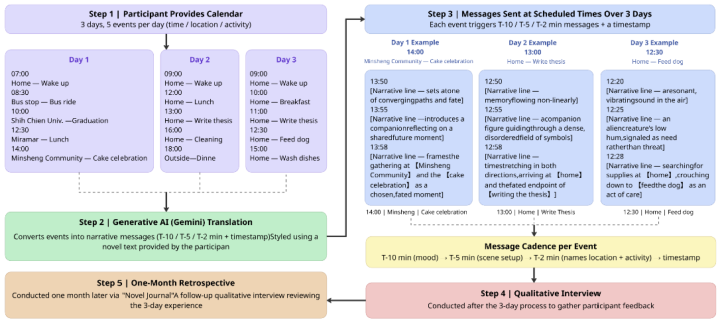
Research Design and Architecture The experimental framework is structured into four consecutive operational stages, designed to map calendar data onto the generated storyline timeline, as illustrated in the flowchart in Figure 1:
Initialization: Users input their personal configurations into the mobile prototype application, including the novel title (which defines the genre) and their username, to enable customized scenario generation.
Daily Pre-population: Users input their calendar schedule for the following day on a daily basis. This pre-entry mechanism extracts flat event entries (comprising timestamps, titles, and location tags) for translation by Gemini 2.5 Flash.
Progressive Experience: Throughout the 3-day operational period, the system sequentially delivers the translated novel narrative fragments via progressive push notifications at the corresponding calendar time points.
520 Tsai and Liang Retrospective Renarratization (or Retrospective Reframing): Qualitative interviews are conducted upon the conclusion of the 3-day experience.
One-Month Retrospective Reviewvia “Novel Journal”: One month later, participants review their experience through a “Novel Journal.” This stage assesses whether reflecting on the three separate days of journaled narratives alters their perspectives on their own memories, followed by a post-review qualitative interview.
Figure 1: The generated storyline timeline.
Participants This study recruited a purposive sample (N = 3) of active digital calendar users (graduate students and professionals). Selection targeted individuals heavily reliant on task-oriented tools (e.g., Google Calendar) to establish a distinct baseline contrast against narrative-driven time interfaces.
System Framework and Temporal Delivery Mechanism The core tool of this study is a large language model (LLM) framework customized through prompt engineering. This framework builds upon the “CrescendoMessage” mechanism from previous research to create a memory recall effect and strictly confines a single calendar event within a three-stage textual rhythm framework: an “introduction” of 10 to 15 characters, a “transition” of 30 to 45 characters, and a “specific scenario” of 50 to 70 characters (Tsai et al., 2015).
The 10-5-2-0 Progressive Delivery Mechanism:
T-10: 10 Minutes Pre-Event (10–15 Word Short Introduction): The system delivers the first-stage prologue 10 minutes prior to the scheduled event. The text focuses on internal monologues, inner mutterings, or environmental rhetoric, deliberately obscuring the specific details of the upcoming itinerary.
T-5: 5 Minutes Pre-Event (30–45 Word Transition Plot): The second stage is dispatched 5 minutes before the event. As the word count expands, the plot gradually unfolds, incorporating subtle metaphors.
T-2: 2 Minutes Pre-Event (50–70 Word Clear Context): The final act is delivered 2 minutes prior to the event, providing a comprehensive scenario.
T-0: Exact Event Time (Physical Medium Activation): At the exact onset of the event, online push notifications cease, shifting the experience into a physical ritual.
Evaluation Framework and Thematic Analysis The analysis phase employs a semi-structured interview protocol and qualitative thematic analysis, centered around the three core research questions of this study:
1. How productivity tools shape users’ quantified perception modes of daily time. 2. How contextuality and emotional richness are lost or preserved under
the trend of digital memory externalization. 3. Whether novelistic narrative, as a translation mechanism, can transform calendars into narrative interfaces, thereby imbuing daily events with emotional resonance and temporal thickness.
The interview transcripts will be coded using thematic analysis to reveal the qualitative shifts in how users re-interpret their real-life experiences when exposed to progressive, narrative-driven transmissions.
PRELIMINARY RESULTS AND DISCUSSION This study conducted an exploratory pilot study to evaluate the feasibility of the progressive delivery mechanism. In this preliminary phase, three participants who actively use digital calendars were recruited. The participants first selected their familiar and preferred fiction genres. Subsequently, the system processed 5 calendar events per day over 3 consecutive days for each user, totaling 15 event entries. The list of test subjects is shown in Table 1, includes age, calendar usage habits, chosen novel titles, and genres.
Table 1: The list of test subjects.
Table available in the original PDF paper.
Participant Age Calendar Usage Habits Chosen Novel Titles Genres P1 28 Frequent At Cafe 6 Youth/Bittersweet Romance
P2 26 Frequent Gabai Granny Nostalgia/Family Science Fiction P3 24 Frequent Stories of Your Life and Others
To simulate the gradual emergence of biological memory, these narrative fragments were ultimately delivered progressively via the LINE application.
522 Tsai and Liang This process employed a strict “10-5-2-0” temporal progressive delivery mechanism, sequentially dispatching the serialized text fragments to users at specific time points—10 minutes, 5 minutes, 2 minutes prior to, and at the exact onset of the event—allowing users to experience this alternative temporal interface within real-life contexts. This exploratory experiment successfully validated the operational feasibility of the system and laid the foundation for subsequent large- scale deployment and analysis.
Finally, through two qualitative interviews and thematic analysis, we revealed the qualitative changes in how users reinterpreted their real-life experiences when exposed to the narrative stimuli of the “novel diary” timeline.
The First Round of Qualitative Thematic Analysis This study adopts the qualitative thematic analysis framework proposed by Braun & Clarke to conduct a multi-stage deconstruction and coding of the post-experience interview transcripts (Braun & Clarke, 2006).
Flat Memory and the “Clearing Effect” Under Efficiency-Driven Pragmatism Corresponding to RQ1 and RQ2, this theme explores how traditional digital calendars, acting as functional “productivity dashboards,” constrain users’ perception of time, leading to the active erasing of daily memories from the brain once tasks are completed.
Calendars as “Spatiotemporal Coordinate Synchronizers” (Proactive Orientation): Interview data reveal that high-productivity users restrict traditional calendars to a quantified, proactive check. P2 noted: “The moment I check it... is primarily to confirm what the next step is.” This suggests that traditional tools are merely perceived as cold coordinate checkers, lacking an intermediate space to guide daily reflection. Similarly, P3’s past usage of Google Calendar was entirely based on such functional and task-oriented motivations.
The “Active Memory-Clearing Phenomenon” Post-Task Check-Off: The pursuit of a high-efficiency “checklist culture” and quantified achievement comes at the cost of losing daily emotional resonance. P2 admitted to packing her schedule to the limit (up to 12 items a day): “But it made me feel like I was at least getting a lot of things done.” P1 pointed out that the minimalist text of traditional calendars accelerates memory erasure after a task is checked off: “Whether it’s a major or minor event... once it’s completed, I feel like: it’s over, I don’t need to remember it anymore, so my brain just clears that part out.” For mundane chores, they are forgotten immediately after completion. P3 also confessed: “I just try my best to cross them off one by one,” adding that without external media (such as Instagram Story archives) to anchor them, the data quickly flatten out.
Flipping Through My Day: Reimagining the Digital Calendar 523 The Slow-Interaction Experience of the Progressive Transmission Mechanism
Corresponding to RQ1, this theme aligns with the theory of “Slow Technology,” analyzing how the system’s 10-5-2-0 progressive delivery and text-intensity amplification mechanism (Introduction → Transition → Clarity) transforms temporal friction into positive interaction (Hallnäs & Redström, 2001).
Information Opacity Triggering Cognitive Suspense: The staged increase in word count deliberately withholds complete information. P2 affirmed the suspense created by the short introduction in the first phase: “When I received the first highly condensed, novelistic introduction, I didn’t connect it to any specific itinerary at all... I would start actively searching and guessing in my mind.” P1 experienced a similar cognitive trajectory, noting that as the text expands, the actual itinerary can usually be recalled by the second message. Both participants strongly rejected receiving the full text all at once; meanwhile, P3 felt this mechanism successfully pulled their cognition back into the fictional world-building of the novel.
The Clash Between Daily Bustle and Waiting Friction: The “Emotional Ambush” of Instant Messaging: In real-world contexts, slow technology faces the challenge of users’ busy routines. P1 provided highly reflective feedback, noting that while users do not consciously wait around for messages, the notifications recreate the “emotional ambush when a notification pops up.” This triggers an impulse of “wanting to open it immediately to see what it is,” serving as a humorous and emotionally engaging interruption in a busy day.
Consensus on Practical Adjustments (Design Flaws): Both P1 and P2 pointed out that the 5-minute and 3-minute intervals were too tight. P2 reflected: “Receiving them in rapid succession creates a sense of urgency, leaving no time to actually savor it.” P1 added that if messages are missed due to a busy schedule and read all at once at the end, it causes information overload, leading to the opposite effect.
The Evocation of Collective Memory Through Micro-Daily Objects Corresponding to RQ2 and RQ3, this theme analyzes how specific novelistic text styles generated by Large Language Models (LLMs) act as psychological simulators to reconstruct micro-details that traditional tools fail to evoke.
Intergenerational Bonding and Object Anchoring: Reading the stories strongly triggered P2’s personal memories of her grandmother: “It felt like I was interacting with my grandma... like she was taking me out or accompanying me to do something.” Vintage props in the text, such as “riding a bicycle” or “paper torn from an old calendar,” successfully served as emotional anchors. Furthermore, the textual scenario describing a character “going to Taipei Station to print documents, feeling starving, and having a grandmother proudly looking at the thick stack of printed materials” highly coincided with the timing and actions of her actual day.
A Sense of Youthful Companionship and Status Reporting: Conversely, P1 experienced a sense of peer companionship within the youth literature genre, which led to a vivid restoration of sensory textures: “It felt like he and I were partners... like he was constantly reporting his status to me!”
When a discrepancy occurs between the AI-generated story and the real world, it often triggers what Oatley’s cognitive simulation theory describes as a “stimulus at the boundaries of real memory.”(Oatley, 1999).
Design Misalignment: While commuting on a train, P1 received an exaggerated literary trope (e.g., “In this world, the furthest distance is not between life and death”). Her immediate reaction was skepticism and laughter: “What on earth is this? I’m just taking a short trip home, how does this have anything to do with life and death?” Yet, this drastic design misalignment did not break the experience; instead, it created “meaning friction,” reframing her mundane commute into her most unforgettable memory over the three days.
Negative Effects of Misalignment Detachment: However, when reading texts with first-person narratives and complex world-building (such as Stories of Your Life and Others), P3 experienced “design misalignment regarding role identification (Role Confusion),” leading to detachment and confusion. Additionally, P1 noted that if real-world schedules shift too drastically due to uncontrollable factors, it causes an uncomfortable detachment: “At that point, I felt more like I was just reading someone else’s story... the sense of resonance with my actual life diminished.”
The Double-Edged Sword of Persona (Textual Style): P1 emphasized the significant impact of the text’s tone: “If the writing is too dull, it makes me feel disconnected from my daily life...” Therefore, choosing a vibrant and narrative- driven textual persona is critical for optimal efficacy.
The Second Round of Qualitative Thematic Analysis One month after the experience, follow-up interviews were conducted with P1, P2, and P3 to examine whether the themes identified in Section 4.1 remained explanatory over time, and four core themes were derived following Braun & Clark’s framework (Table 2) (Braun & Clarke, 2006). The interviews used a two- stage recall design: participants first freely recalled the story content and its connections to daily life (the free-recall stage), after which they were given a “novel diary”—a version of the progressive-transmission text re-edited into diary form—to read, followed by questions about any resulting changes in memory (the cued-recall stage). All three participants received diaries of the same length and were asked the same interview questions; only the personalized content varied according to each participant’s chosen novel.
Table 2: Post-test participant profile and data mapping table.
Table available in the original PDF paper.
Time Elapsed
Participant Chosen Novel Titles Testing Period Second Interview Date P1 At Cafe 6 2026/06/06-08 2026/07/07 29days
P2 Gabai Granny 2026/06/06-08 2026/07/07 29days 2026/06/13-15 2026/07/13 28days P3 Stories of Your Life and Others
Flipping Through My Day: Reimagining the Digital Calendar 525 Selective Memory Decay and Cue-Triggered Retrieval: Plot Blurring and the Persistence of Sensory-Image Anchors
Free-recall stage—plot blurred, but key images could still surface spontaneously: All three participants’ recall of plot content had blurred (P2: “not really”; P1: “I kind of forgot”; P3: “it’s gotten a bit fuzzy”), yet when prompted they could still spontaneously bring up key images: P2: “the grandma watching her grandson through the window”; P1: “damp and sticky… sweating the whole time”; P3: “the part about the dog… an alien creature.” This suggests sensory/key images are more spontaneously retrievable than the plot text itself.
Cued-recall stage—the diary confirms and fills in existing memories rather than creating new ones: After reading the diary, previously vague memories were confirmed and filled in rather than newly generated: P1: “that damp, sticky feeling… yes, it’s really all in there”; P3 connected the mention of “Shih Chien University” in the text to the memory of attending a friend’s graduation ceremony.
Re-activation of the original bodily sensation shows individual variation: Both P1 and P2 reported that the bodily sensation from the moment they originally received the messages was re-activated; P3, however, explicitly said she had “no” such recall of “that moment,” while still affirming that this retrospective reading itself was effective.
Diminishing novelty over repeated interactions: Both P2 and P3 noted that repetitive content in later segments (“it just repeats” / “the repetition rate is quite high”) reduced novelty, though P3 could still clearly distinguish the event transitions between segments.
Narrative Tension: How Congruence, Conflict, and Busyness Jointly Moderate Memory Vividness High congruence renders the effect invisible: P2’s life closely matched the story setting, so she “didn’t particularly notice anything different”—the effect was hard to perceive.
Strong conflict instead reinforces memory encoding: P1’s life sharply conflicted with the story’s tone (“such a huge contrast”), yet precisely because of this, “it was so jarring that—I guess that’s why I remember it,” echoing the “meaning friction” phenomenon from the first interview.
Busyness may suppress the formation of memory connections: P3 had been busy recently, so “I just didn’t think about anything extra,” suggesting that busyness may be a third moderating factor alongside congruence and conflict.
The Narrative’s Emotional Aftertaste: A Long-Term Comparison With Efficiency-Oriented Tools Narrative restores emotion and context to events: All three participants felt the narrativized record carried more aftertaste than a conventional calendar: P2: “it already does all the extra scaffolding”; P1—“it actually made it stick with me even more”; P3 noted that an ordinary calendar is “done and
526 Tsai and Liang forgotten the same day,” whereas the narrativized version’s “aftertaste… is genuinely stronger.”
The optimal time distance shows individual differences: P1 and P2 both felt one month was still “too soon,” and that the nostalgic effect might need years to fully emerge; P3, however, felt one month was “pretty good,” citing recent experience to explain that too short an interval (e.g., a week) would still lack a sense of distance—suggesting the optimal review interval may vary by person and by type of event.
CONCLUSION
The results of this study indicate that, by introducing poetic narrative tension, the proposed interactive paradigm successfully reawakened users’ awareness of the situation, deepened their emotional connection to their daily routines, and countered efficiency-driven time management. Specifically, the empirical qualitative findings demonstrate that while precise plot details naturally fade over time, concrete sensory imagery functions as a durable memory anchor that can be spontaneously retrieved or cued via novelized diaries. Furthermore, narrative friction—created through structural contrast between story themes and daily life—facilitated deeper cognitive encoding, providing an “emotional aftertaste” that traditional, efficiency-oriented calendars lack. In terms of interaction design, participants strongly favored embedded narrative integration over explicit typography marking, emphasizing the importance of narrative immersion in temporal tools. While this exploratory study offers rich qualitative insights, its scope is constrained by a small sample size (N = 3) and a relatively short reflection window (one month). Nevertheless, this work serves as a foundational inquiry into “de-efficiency” in time-reflection tools. By shifting the paradigm from purely productivity- driven tracking to poetic, narrative-driven reflection, this study highlights the speculative potential of interactive systems to reframe our daily lived experiences and subjective perception of time.
FUTURE WORK
Based on the preliminary findings of the pilot study, we propose three key directions for future research to further explore the speculative value of the novelistic calendar within HCI and time perception:
1. System Architecture of the Prototype Application: To operationalize
the “slow technology” and “de-efficiency” principles, we developed an integrated mobile prototype. Its core architecture encompasses user authentication (name, novel selection), an interactive calendar, schedule management (adding and viewing events), and narrative unlock mechanisms. 2. Dynamic Calibration of Progressive Delivery Intervals: While the fixed “10–5–2–0” countdown mechanism effectively generated temporal friction, future work will explore dynamic interval adjustments. We will conduct controlled experiments comparing different delivery spans (e.g., a
Flipping Through My Day: Reimagining the Digital Calendar 527 30- minute long-span narrative build-up vs. a 5-minute compact stimulus) and “textual crescendo” slopes. Subsequently, a formal 3-day deployment study with a broader sample will be conducted to quantitatively and qualitatively identify the optimal delivery model aligned with subjective time perception and memory consolidation. 3. Enhancing Native Interactivity and User Engagement: Drawing on
participant feedback (e.g., P2’s desire for real-time reflection when story and reality aligned), future designs will integrate native interactive features into the app. Building upon the spontaneous dialogue dynamics observed in the LINE platform, these features will systematically capture real-time user reflections and emotional engagement.
REFERENCES
Braun, V., & Clarke, V. (2006). Using thematic analysis in psychology.
Qualitative Research in Psychology, 3(2), 77–101. https://doi.org/10.1191/ 1478088706qp063oa Bruner, J. S. (1991). The Narrative Construction of Reality. Critical Inquiry, 18, 1–21. https://api.semanticscholar.org/CorpusID:143550845 Dieter, M., & Gauthier, D. (2019). On the Politics of Chrono-Design: Capture, Time
and the Interface. Theory, Culture & Society, 36, 026327641881905. https://doi. org/10.1177/0263276418819053 Hallnäs, L., & Redström, J. (2001). Slow Technology—Designing For Reflection.
Personal and Ubiquitous Computing, 5, 201–212. https://doi.org/10.1007/ PL00000019 Hand, M. (2013). Ubiquitous Photography. Polity Press. https://books.google.com.
tw/books?id=5vhezpWiR_AC HOGAN, P. C. (2011). Affective Narratology: The Emotional Structure of Stories.
University of Nebraska Press. http://www.jstor.org/stable/j.ctt1df4gnk Ibrahim, Y. (2018). Production of the “Self” in the Digital Age. In Production of the “Self” in the Digital Age. https://doi.org/10.1007/978-3-319-74436-0 Koivunen, A., Nikunen, K., Hokkanen, J., Jaaksi, V., Lehtinen, V., Soronen, A.,
Talvitie-Lamberg, K., & Valtonen, S. (2023). Anticipation as Platform Power: The Temporal Structuring of Digital Everyday Life. Television & New Media, 25, 152747642311782. https://doi.org/10.1177/15274764231178228 Markham, A. (2021). The limits of the imaginary: Challenges to intervening in future speculations of memory, data, and algorithms. New Media & Society, 23, 382–405. https://doi.org/10.1177/1461444820929322 Oatley, K. (1999). Why Fiction May be Twice as True as Fact: Fiction as Cognitive
and Emotional Simulation. Review of General Psychology, 3(2), 101–117. https:// doi.org/10.1037/1089-2680.3.2.101 Ricoeur, P., Blamey, K., & Pellauer, D. (2012). Time and Narrative, Volume 2.
University of Chicago Press. https://books.google.com.tw/books?id=7ta5Qh dkfAsC Ryan, M. L., Ruppert, J., & Bernet, J. W. (2004). Narrative Across Media: The Languages of Storytelling. University of Nebraska Press. https://books.google. com.tw/books?id=wStBECWtPwcC Sparrow, B., Liu, J., & Wegner, D. M. (2011). Google Effects on Memory: Cognitive
Consequences of Having Information at Our Fingertips. Science, 333(6043), 776–778. https://doi.org/10.1126/science.1207745
Interacting with Slow Messaging. https://api.semanticscholar.org/CorpusID: 216151157 Zunshine, L. (2006). Why We Read Fiction: Theory of the Mind and the Novel. Ohio State University Press. http://www.jstor.org/stable/j.ctt1kgqwk8
SEARCH THE AHFE DIGITAL BOOKSTORE BY ISBN
Explore the complete digital volume
Human Factors in Design, Engineering, and Computing
Read this individual research paper free through the original publisher, or explore the full digital proceedings book.