Xing Yao, Yehong Zhou, Qiheng Peh, Yanhao Tan, Xiaoqing Yu, Seung Ki Moon, Chun-Hsien Chen, Lam Haw Woei Sean, James Song (2026). A Human-Centered Framework for AI-Wearable Integration in Automotive Assembly Lines. In: Human Factors in Design, Engineering, and Computing. AHFE Open Access, vol. 238, pp. 811–820. https://doi.org/10.54941/ahfe1008313
Industry 5.0 shifts manufacturing from automation-centred production toward human-centred collaboration between operators and intelligent systems. Although artificial intelligence (AI), augmented-reality (AR) head-mounted displays, sensor-equipped wearables, and digital twins can support assembly quality, safety, training, and process optimisation, these technologies are often developed as isolated applications. This study proposes a process-oriented framework for integrating AI-assisted wearable systems into automotive assembly operations. The framework is developed through a structured synthesis of Industry 5.0, human–AI complementarity, wearable technologies, digital twins, Value Stream Mapping, Design for Assembly, concurrent engineering, and ergonomic system design. Process mapping and task decomposition are used to identify candidate operations characterised by bottlenecks, quality risks, repetitive activity, cognitive complexity, or ergonomic demands, while stakeholder analysis captures requirements from operators, quality, safety, maintenance, supervision, and management. The resulting framework combines a three-layer system architecture, a human–AI service blueprint, and a four-phase implementation roadmap that links wearable sensing and guidance with AI processing and backend systems such as digital twins, Manufacturing Execution Systems, and Quality Management Systems while retaining human decision authority. A structured evaluation plan is further proposed to assess operational performance, AI and sensing accuracy, system responsiveness, human-factors outcomes, and technical feasibility through controlled pilots, comparative testing, robustness analysis, and expert review. The framework provides a practical pathway for future evidence-based deployment of AI-assisted wearables in automotive and other complex manual-assembly environments.
Manufacturing is undergoing a transition from highly automated, technology- driven production toward more adaptive and human-centred systems.
While Industry 4.0 has promoted connectivity, automation, and data-driven decision-making, Industry 5.0 extends this vision by placing human wellbeing, resilience, and human–machine collaboration at the centre of manufacturing system design (Lu et al., 2022; Zhang et al., 2023). In this paradigm, artificial intelligence (AI) is expected not simply to replace human work, but to augment human perception, judgement, adaptability, and decision-making while preserving meaningful human control (Passalacqua et al., 2025).
This transition is particularly relevant to manual and mixed-model assembly, where operators remain essential because of their flexibility in handling product variety, unexpected conditions, and complex task sequences. However, manual assembly may also impose substantial physical and cognitive demands, particularly when operators must follow changing instructions, identify parts, verify task sequences, maintain production pace, and satisfy quality requirements. Recent reviews of digital assistance systems in assembly therefore highlight increasing interest in technologies that can support operators while maintaining productivity, quality, and ergonomic performance (König and Winkler, 2025).
AI-assisted wearable technologies provide a promising interface between operators and intelligent manufacturing systems. Augmented-reality head- mounted displays (AR-HMDs) can provide hands-free, context-sensitive visual guidance directly within the operator’s field of view, supporting assembly, inspection, training, and maintenance activities (Fang et al., 2023). Previous studies have also shown that AR-HMD interface design and information-presentation strategies can significantly influence usability, task performance, and operator experience (Jing et al., 2025; Yu et al., 2024). In parallel, wearable and physiological sensing devices can capture motion, posture, physiological responses, and other operator-related information, creating opportunities for real-time ergonomic assessment, task-state recognition, and adaptive assistance (Stefana et al., 2021). Recent work has further demonstrated the feasibility of using wearable photoplethysmography for assembly-quality detection under cross-participant conditions (Zhou et al., 2026). Beyond physical task monitoring, physiological and behavioural indicators have also been used to recognise higher-level cognitive and human– AI interaction states in safety-critical operational environments (Yao et al., 2026a, 2026b). These findings suggest that future AI-wearable systems may support not only physical task monitoring but also context-aware assessment of operator cognitive states, although such applications require domain- specific validation in manufacturing environments.
At the system level, digital twins provide an additional mechanism for connecting human, process, and equipment data with virtual representations of manufacturing operations. Recent research on Human Digital Twins has further extended this concept by explicitly incorporating human characteristics, behaviours, and states into digital manufacturing models, reflecting the growing importance of human-centricity in Industry 5.0 (Wang et al., 2024). Such integration creates opportunities to connect wearable sensing and AI-based decision support with Manufacturing Execution Systems (MES), Quality Management Systems (QMS), and broader production analytics.
A Human-Centered Framework for AI-Wearable Integration 813 Despite these advances, existing research remains fragmented across human-centred manufacturing, wearable assistance, AI-based decision support, digital twins, and assembly-system design. Individual technologies have demonstrated substantial potential, yet manufacturers still require a structured approach for determining where AI-assisted wearables should be deployed, what information should be sensed or presented, how responsibilities should be allocated between operators and AI, and how wearable-generated information should be integrated with existing manufacturing infrastructure. This gap becomes particularly important in automotive assembly, where technological effectiveness must be balanced with production requirements, operator workload, ergonomic constraints, system reliability, and scalability.
To address this gap, this study proposes a human-centred, process- oriented framework for integrating AI-assisted wearable systems into automotive assembly operations. The framework links task and process analysis, stakeholder requirements, wearable sensing and interaction, AI processing and decision support, human–AI responsibility allocation, and backend manufacturing infrastructure. It further incorporates a staged implementation roadmap and a multidimensional evaluation plan covering operational performance, AI and sensing accuracy, system reliability, human factors, and technical feasibility. The overall objective is to provide a scalable and repeatable pathway for deploying AI-assisted wearable systems while improving assembly performance and preserving effective human–AI complementarity.
RELATED WORKS Industry 5.0 reframes intelligent manufacturing around cooperation between human expertise and machine capability. AI is most valuable when it complements human creativity, contextual judgement, adaptability, and problem solving rather than replacing them (Oladele et al., 2024; Othman and Yang, 2023). In dynamic work settings, this implies an advisory role in which AI provides recommendations, predictions, or alerts while the operator retains appropriate decision authority (Gonzalez and Heidari, 2025). Transparency and understandable feedback are therefore important because poorly communicated recommendations can be ignored, misinterpreted, or over-relied upon (Gonzalez and Heidari, 2025; Nayan, 2025). Human-centred assembly research likewise shows that ergonomic considerations can improve productivity and worker wellbeing when they are incorporated into system design rather than treated as an afterthought (Battini et al., 2011).
Wearable devices provide a direct interface between operators and intelligent production systems. AR head-mounted displays can present contextual instructions, part information, warnings, and visual guidance while maintaining hands-free operation, whereas sensor-equipped gloves or wrist- worn devices can capture motion, interaction, and task-related physiological signals. Such capabilities create opportunities for real-time task verification,
ergonomic monitoring, training support, and quality assurance. At the same time, industrial deployment must account for device reliability, comfort, battery endurance, connectivity, and variability in sensing performance.
Digital twins provide a complementary backend layer by linking physical operations with virtual representations used for monitoring, simulation, and decision support. Prior studies have shown that digital-twin approaches can support process analysis, production optimisation, and ergonomic assessment (Caputo et al., 2019; Mendi, 2022). In automotive assembly, this creates a pathway for wearable-generated data to move beyond local feedback and contribute to MES/QMS records, process analytics, and longer- term improvement activities.
The literature therefore establishes the individual value of human- centred design, wearable assistance, AI-based monitoring, and digital-twin integration. However, these elements are typically discussed independently. A practical deployment framework must connect them at the assembly-system level: it should identify which tasks warrant intervention, define stakeholder requirements, specify information flows and human–AI responsibilities, connect edge devices with backend infrastructure, and provide a staged route for piloting and scale-up. This integration gap motivates the framework proposed in this study.
FRAMEWORK DEVELOPMENT METHODOLOGY The framework was developed through a structured, process-oriented synthesis rather than through the validation of a new algorithm or device. It combines manufacturing process analysis, stakeholder-needs analysis, and system-level integration principles to translate the literature into an implementable deployment pathway.
Process Mapping and Task Prioritisation The first step is to establish a baseline map of the target assembly process. Value Stream Mapping (VSM) and Design for Assembly (DFA) principles are used to decompose workstations into task sequences, cycle times, quality- critical operations, information requirements, and ergonomic demands (Abdullah et al., 2003). Candidate stations are prioritised when they exhibit persistent bottlenecks, repeated process deviations, quality risks, high cognitive demands, or elevated ergonomic exposure. As an initial screening criterion, a workstation may be flagged when its observed cycle time exceeds the target takt time:
Ci > Ttakt
where Ci denotes the cycle time of workstation i, and Ttakt represents the target takt time. This criterion is used only as a preliminary indicator of potential process bottlenecks and is considered together with defect rates, rework frequency, task complexity, and human-factors evidence when identifying suitable locations for AI-assisted wearable deployment.
A Human-Centered Framework for AI-Wearable Integration 815 Stakeholder Needs and Design Requirements
Technology selection should follow task and stakeholder requirements rather than begin with a preferred device. The framework therefore considers the needs of operators, quality personnel, environmental health and safety teams, supervisors, maintenance personnel, and management. Requirements include hands-free accessibility, comfort, freedom of movement, alert clarity, sensing accuracy, maintainability, privacy, interoperability, and the ability to preserve operator authority. The resulting requirement set is used to determine which wearable functions, AI services, and backend connections are appropriate for each candidate station.
PROPOSED HUMAN-CENTERED AI-WEARABLE INTEGRATION FRAMEWORK Three-Layer System Architecture
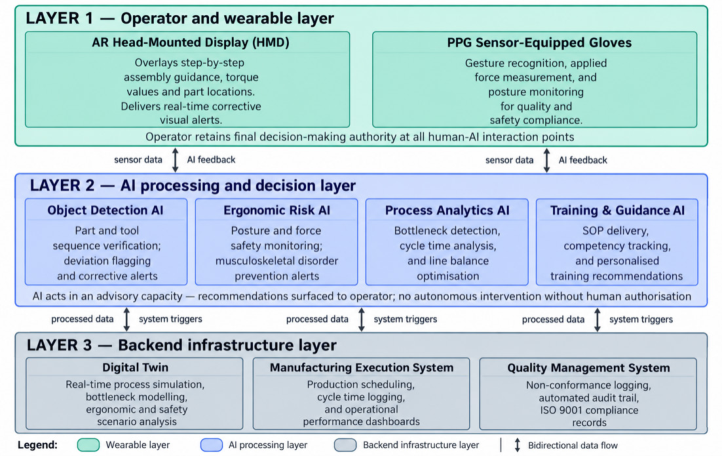
The proposed framework consists of three interconnected layers (Figure 1). The Operator and Wearable Layer captures task context and delivers guidance; the AI Processing and Decision Layer converts sensor and visual data into recommendations, alerts, and analytics; and the Backend Infrastructure Layer connects local functions to digital twins, MES, and QMS. Bidirectional information flow allows operational data to move upstream for analysis while relevant instructions and decisions are returned to the operator. Human decision authority is retained at safety- and quality-critical interaction points.
Figure 1: Three-layer architecture for AI-assisted wearable integration.
At Layer 1, an AR HMD can provide step-by-step instructions, part locations, process values, and corrective feedback, while sensor-equipped gloves or wrist- worn devices can capture task-relevant motion or physiological information.
The architecture shown in Figure 1 uses a PPG-enabled glove as one illustrative implementation; the framework itself is sensor-agnostic and can accommodate alternative devices when they better match the task.
Layer 2 contains AI functions for object and sequence verification, ergonomic- risk monitoring, process analytics, and training support. These functions are intended to operate in an advisory capacity: they surface evidence and recommendations rather than autonomously overriding the operator. Layer 3 provides persistence and enterprise integration. Digital twins support simulation and process modelling, MES provides production context and operational records, and QMS captures non-conformance and quality evidence.
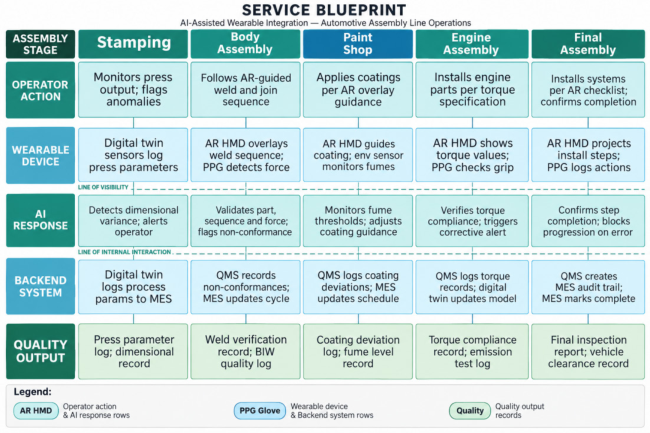
Human–AI Service Blueprint The service blueprint in Figure 2 translates the architecture into an operational view across representative automotive production stages. It links operator actions with wearable support, AI responses, backend activities, and quality outputs. The purpose is not to prescribe one fixed technology for every station, but to make dependencies visible: a wearable intervention should have a defined operator need, an interpretable AI function, a backend destination when required, and a measurable production or human-factors outcome. This process view also helps identify where human confirmation is required before an AI recommendation affects the production workflow.
Figure 2: Human–AI service blueprint across representative automotive assembly stages.
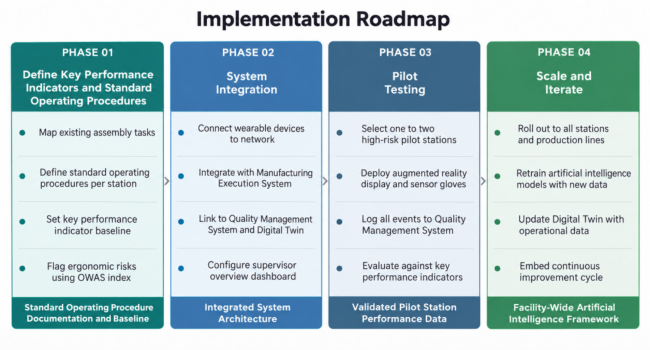
Practical Implementation Roadmap Deployment follows four phases (Figure 3). Phase 1 defines standard operating procedures, baseline KPIs, task priorities, and ergonomic risks. Phase 2 integrates and calibrates wearable hardware, AI services, networking, MES/
A Human-Centered Framework for AI-Wearable Integration 817 QMS interfaces, and digital-twin connections. Phase 3 conducts controlled pilot testing at selected stations, comparing AI-supported operation with the baseline and logging technical and human-factors outcomes. Phase 4 scales only those functions that demonstrate acceptable performance, usability, reliability, and organisational fit, while retaining an iterative improvement cycle.
Figure 3: Four-phase implementation roadmap.
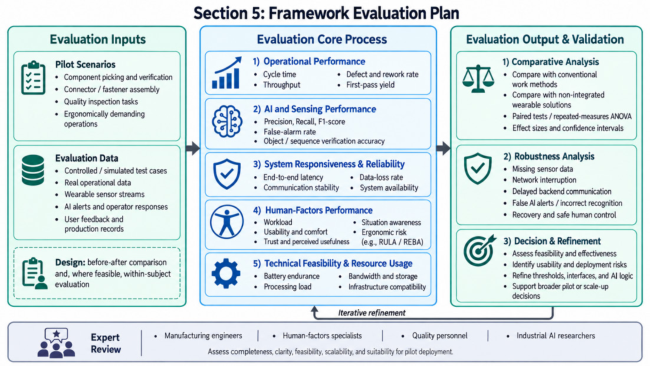
Framework Evaluation Plan Because the present study proposes an implementation framework rather than reporting a completed industrial validation, a structured evaluation plan is defined for future empirical assessment (Figure 4). The plan combines controlled pilot scenarios with operational production data and evaluates five complementary dimensions: operational performance, AI and sensing performance, system responsiveness and reliability, human-factors performance, and technical feasibility.
Figure 4: Proposed evaluation plan for the AI-wearable integration framework.
Evaluation Metrics Operational measures should include cycle time, throughput, defect and rework rates, deviation frequency, and first-pass yield. AI and sensing functions should be evaluated using task-appropriate measures such as precision, recall, F1-score, false-alarm rate, and sequence- or object-verification accuracy against ground truth from video annotation, production records, or expert assessment. System performance should capture end-to-end latency, data-loss rate, communication stability, and availability. Human-factors assessment should include workload, usability, comfort, situation awareness, perceived usefulness, trust, technology acceptance, and ergonomic measures such as RULA or REBA where applicable. Technical feasibility should consider battery endurance, bandwidth, processing load, storage, sensor-data completeness, and compatibility with existing infrastructure.
Pilot Design, Comparative Evaluation, and Robustness Pilot stations should be selected from tasks with high defect frequency, ergonomic risk, repeated cycle-time deviation, or substantial information demands. Controlled scenarios can introduce predefined component errors, sequence deviations, unsafe postures, network interruptions, or incorrect AI alerts to create repeatable test conditions. These data should be complemented by operational logs, wearable streams, AI outputs, operator responses, and user feedback collected during realistic production use.
Evaluation should compare the integrated framework with conventional work methods and, where relevant, with stand-alone wearable solutions that lack backend integration. A before-and-after design and, where feasible, within-subject comparisons can reduce the influence of individual differences. Statistical tests should be selected according to the design and data distribution, with effect sizes and confidence intervals reported alongside significance values. Robustness analysis should examine missing sensor data, delayed communication, false alerts, and recovery behaviour, while expert review by manufacturing, human-factors, quality, and industrial AI specialists can assess completeness, clarity, feasibility, scalability, and suitability for broader deployment.
Limitations and Future Work The framework is currently conceptual and has not yet been validated through a full-scale industrial deployment. Its effectiveness will therefore depend on the characteristics of the selected station, operator population, wearable hardware, sensing configuration, AI model, and plant infrastructure. Device- specific limitations such as sensor drift, fit, battery life, communication stability, and physical or visual discomfort may affect long-term use. The stakeholder analysis also requires direct validation with operators and relevant production personnel before deployment decisions are finalised.
Future work should begin with controlled pilots at representative assembly stations and progressively extend to live production once safety, usability, and technical requirements are satisfied. Particular attention should be given to
A Human-Centered Framework for AI-Wearable Integration 819 cross-worker robustness, sensor calibration, false-alert management, interface design, and interoperability with MES/QMS and digital-twin environments. After these foundations are established, predictive AI functions for task-state or movement forecasting may be explored where they provide demonstrable operational value without reducing human control.
CONCLUSION
This study proposes a human-centred, process-oriented framework for integrating AI-assisted wearable systems into automotive assembly. Rather than treating AR displays, wearable sensing, AI analytics, and digital twins as separate technologies, the framework connects task prioritisation, stakeholder requirements, a three-layer system architecture, a human–AI service blueprint, staged implementation, and multidimensional evaluation. The approach positions AI as an advisory capability and preserves operator authority while enabling relevant data to move between the physical workstation and enterprise systems. The accompanying evaluation plan provides a basis for testing operational benefit, sensing and AI performance, responsiveness, human-factors outcomes, robustness, and technical feasibility. The framework therefore offers a structured foundation for future pilot studies and evidence-based scale-up of AI-assisted wearables in automotive and other complex manual-assembly environments.
ACKNOWLEDGMENT
This research is supported by the HMGICS-NTU-A*STAR Corporate Lab under the Industry Alignment Fund—Industry Collaboration Projects (IAF- ICP) Grant (No. I2501E0048).
REFERENCES
Abdullah, T.A., Popplewell, K., Page, C.J., 2003. A review of the support tools for the process of assembly method selection and assembly planning. Int. J. Prod. Res. 41, 2391–2410. https://doi.org/10.1080/002075431000087265 Battini, D., Faccio, M., Persona, A., Sgarbossa, F., 2011. New methodological
framework to improve productivity and ergonomics in assembly system design. Int. J. Ind. Ergon. 41, 30–42. https://doi.org/10.1016/j.ergon.2010.12.001 Caputo, F., Greco, A., Fera, M., Macchiaroli, R., 2019. Digital twins to enhance the integration of ergonomics in the workplace design. Int. J. Ind. Ergon. 71, 20–31. https://doi.org/10.1016/j.ergon.2019.02.001 Fang, W., Chen, L., Zhang, T., Chen, C., Teng, Z., Wang, L., 2023. Head-mounted
display augmented reality in manufacturing: A systematic review. Robot. Comput.- Integr. Manuf. 83, 102567. https://doi.org/10.1016/j.rcim.2023.102567 Gonzalez, C., Heidari, H., 2025. A cognitive approach to human–AI complementarity in dynamic decision-making. Nat. Rev. Psychol. 4, 808–822. https://doi. org/10.1038/s44159-025-00499-x Jing, C., Cheng, X., Wang, X., Yu, D., Yao, X., 2025. Effects of AR-HMD interactive
interface layout on usability and obstacle avoidance in subway overhauls. Int. J. Human–Computer Interact. 41, 5817–5830. https://doi.org/10.1080/10447318. 2024.2366706
König, M., Winkler, H., 2025. Investigation of assistance systems in assembly in the context of digitalization: A systematic literature review. J. Manuf. Syst. 78, 187–199. https://doi.org/10.1016/j.jmsy.2024.11.015 Lu, Y., Zheng, H., Chand, S., Xia, W., Liu, Z., Xu, X., Wang, L., Qin, Z., Bao, J.,
2022. Outlook on human-centric manufacturing towards Industry 5.0. J. Manuf. Syst. 62, 612–627. https://doi.org/10.1016/j.jmsy.2022.02.001 Mendi, A.F., 2022. A Digital Twin Case Study on Automotive Production Line.
Sensors 22, 6963. https://doi.org/10.3390/s22186963 Nayan, K.R., 2025. Human-AI Collaboration in Manufacturing: Unlocking New Possibilities with Generative AI. J. Inf. Syst. Eng. Manag. 10, 1169–1174. https:// doi.org/10.52783/jisem.v10i57s.12543 Oladele, I.O., Okoro, C., Falana, S., Olanrewanju, O.F., Adelani, S.O., Onuh, L.N.,
2024. Advancement of human-machine collaboration in manufacturing: A review on industry 1.0 - 6.0. J. Mech. Eng. Sci. 10303–10329. https://doi.org/10.15282/ jmes.18.4.2024.7.0813 Othman, U., Yang, E., 2023. Human–Robot Collaborations in Smart Manufacturing Environments: Review and Outlook. Sensors 23, 5663. https://doi.org/10.3390/ s23125663 Passalacqua, M., Pellerin, R., Magnani, F., Doyon-Poulin, P., Del-Aguila, L., Boasen,
J., Léger, P.-M., 2025. Human-centred AI in Industry 5.0: A systematic review. Int. J. Prod. Res. 63, 2638–2669. https://doi.org/10.1080/00207543.2024.2406021 Stefana, E., Marciano, F., Rossi, D., Cocca, P., Tomasoni, G., 2021. Wearable Devices for Ergonomics: A Systematic Literature Review. Sensors 21, 777. https://doi. org/10.3390/s21030777 Wang, B., Zhou, H., Li, X., Yang, G., Zheng, P., Song, C., Yuan, Y., Wuest, T., Yang,
H., Wang, L., 2024. Human Digital Twin in the context of Industry 5.0. Robot. Comput.-Integr. Manuf. 85, 102626. https://doi.org/10.1016/j.rcim.2023.102626 Yao, X., Chen, C.-H., Liu, B., Ma, G., Yu, X., 2026a. An explainable eye-trackingbased framework for enhanced level-specific situational awareness recognition in air traffic control. Adv. Eng. Inform. 69, 103928. https://doi.org/10.1016/j. aei.2025.103928 Yao, X., Chen, C.-H., Liu, B., Zhou, Y., Yu, X., 2026b. Toward Safer Human–AI
Teaming: Phase-Specific Recognition and Interpretation of Automation Trust in Air Traffic Control. Int. J. Human–Computer Interact. 1–24. https://doi.org/10.1 080/10447318.2026.2689527 Yu, D., Yao, X., Yu, K., Du, D., Zhi, J., Jing, C., 2024. The effect of presentation position and multichannel approach on learning performance in the use of an augmented reality–head worn display interface for train-driving training. Interact. Learn. Environ. 32, 1656–1671. https://doi.org/10.1080/10494820.2022.2124426 Zhang, C., Wang, Z., Zhou, G., Chang, F., Ma, D., Jing, Y., Cheng, W., Ding, K.,
Zhao, D., 2023. Towards new-generation human-centric smart manufacturing in Industry 5.0: A systematic review. Adv. Eng. Inform. 57, 102121. https://doi. org/10.1016/j.aei.2023.102121 Zhou, Y., Yao, X., Xin, S., Chen, C.-H., Weng, M.-X., 2026. PPG-Based Assembly Quality Detection for Human-Centric Manufacturing: An Empirical Study of Cross-Participant Generalization, in: 2026 IEEE International Conference on Human-Machine Systems (ICHMS). Presented at the 2026 IEEE International Conference on Human-Machine Systems (ICHMS), pp. 536–541. https://doi. org/10.1109/ICHMS69701.2026.11602365
SEARCH THE AHFE DIGITAL BOOKSTORE BY ISBN
Explore the complete digital volume
Human Factors in Design, Engineering, and Computing
Read this individual research paper free through the original publisher, or explore the full digital proceedings book.