ZhengYang Wang, RuoChen Hu (2026). AI-Assisted Head-Shape Design for High- Speed Trains: Operationalizing Emotional Intent in a Designer-in-the-Loop Workflow. In: Human Factors in Design, Engineering, and Computing. AHFE Open Access, vol. 238, pp. 830–840. https://doi.org/10.54941/ahfe1008315
We present an AI-assisted, designer-in-the-loop workflow for high-speed train head-shape design that makes emotional intent actionable. Prior work optimizes aerodynamics or judges aesthetics post-hoc, offering little guidance while forms are being created. We elicit perception dimensions via interviews with 10 train enthusiasts and LDA, generate 50 parameterized designs with an L50 orthogonal array, and collect ratings from 27 participants. Random-forest regressors map 12 form and colour parameters to perceived responses; the resulting models are refined into an interpretable evaluation tool. Two professional designers then use the tool’s scores and cues to steer divergent concepting. Our contributions are: (1) a replicable, model-informed pipeline that links user language to editable parameters; (2) an interpretable evaluation model that supports early-stage exploration and trade-off reasoning; and (3) a practical, AI-assisted workflow prototype for complex engineered forms. This advances emotional intent from rhetoric to controllable design signals and informs decision-making during early design.
With the rapid advancement of artificial intelligence (AI), design is undergoing a profound transformation from a solely human-centred process to a collaborative human–AI workflow (Guo et al., 2023). AI not only enhances efficiency in engineering and manufacturing but also reshapes the cognitive foundations of design, enabling designers to engage in form interpretation, data analysis, and generative reasoning through algorithmic processes (Han, Childs and Luo, 2024; Sreenivasan and Suresh, 2024; Liu, 2025). Against this backdrop, design practice is gradually shifting from subjective intuition and personal experience toward data-driven and explainable human–AI collaboration processes (Quiñones-Gómez, Mor and Chacón, 2024). Particularly in domains involving complex geometry and affective expression, AI provides designers with new analytical and generative capabilities (Peckham et al., 2025).
Parametric modelling has become an essential approach for managing complex form relationships and improving design efficiency (Oxman, 2017; Li et al., 2025). In high-speed train design, previous studies have mainly
AI-Assisted Head-Shape Design for High-Speed Trains 831 focused on aerodynamic performance, drag reduction, noise control, and shape optimization (Hong-qi, 2019; Yao et al., 2016; Weidner et al., 2022; Yu et al., 2022; Dai et al., 2023). These studies provide a technological foundation for quantitative form generation, but systematic exploration of user perception and aesthetic experience remains limited (Monedero, 2000; Li et al., 2024).
Meanwhile, industrial design decision-making traditionally relies heavily on designers’ experience and users’ subjective feedback (Cross, 2007). Although intuition-based approaches can stimulate creativity, they are difficult to quantify and reproduce (Toyong, Abidin and Mokhtar, 2021; Hu et al., 2022). Existing affective design methods, such as Kansei Engineering, provide ways to relate product features to users’ emotional responses, but they are predominantly applied in post-evaluation stages rather than embedded in iterative design processes (Nagamachi, 2002; Lévy, 2013; López, Murillo and González, 2021). This creates a gap between emotional cognition and real-time form generation.
Recent developments in computational design and machine learning make it possible to encode Kansei and aesthetic cognition into algorithmic models and establish more explicit “emotion–form” mappings (Schütte et al., 2004; Hu et al., 2022). In this context, AI can serve as an analytical assistant by converting user perception data into interpretable emotional feedback and supporting goal-oriented form exploration (Bernardo and Seva, 2023). At the same time, previous studies on human–AI co-creation emphasize that designers’ agency remains central, and that AI should augment rather than replace creative decision-making (Guo et al., 2023; Song et al., 2022; Salma, Hijón-Neira and Pizarro, 2025).
This study therefore aims to address two key gaps in the design and evaluation of high-speed train head shapes. First, current research predominantly focuses on aerodynamic performance, structural constraints, and regulatory optimization, with relatively limited quantitative analysis of emotional perception, such as how a head shape conveys power or affinity. Second, existing affective design approaches are rarely integrated into real-time iterative design processes. To address these gaps, we propose a human–AI collaborative affective design framework that links users’ emotional cognition with parametric form development and introduces AI-driven emotional feedback into the iterative design process.
The framework follows three stages. First, we construct an affective prediction model that maps parametric shape descriptors to users’ perceptual evaluations using interview data, LDA-based semantic analysis, and Kansei evaluation. Second, the trained model is integrated into the creative iteration process to provide assessment and feedback during concept generation. Finally, we demonstrate how this workflow positions AI as a cognitive collaborator that supports design reasoning while preserving designers’ creative agency (Wang et al., 2025).
This study makes three main contributions. First, it introduces a data- driven approach to high-speed train head-shape design by linking qualitative emotion with quantitative design parameters and interpretable feedback. Second, it provides a practical framework that offers designers measurable
832 Wang and Hu affective feedback and decision support, allowing design outcomes to better reflect users’ perceptual needs (Liang, 2024). Third, it offers a transferable research approach for affective form development in other complex industrial design contexts.
KANSEI DESIGN FRAMEWORK FOR HEAD SHAPE DESIGN OF HIGH- SPEED TRAINS This study follows a three-phase methodology integrating qualitative affective extraction, parametric modelling, and machine-learning-based evaluation.
Data Collection and Extraction of Affective Features We conducted semi-structured interviews with ten participants aged 20–55 to investigate their affective perceptions of existing high-speed train head shapes. Participants were recruited through purposive sampling and included six designers and four high-speed train passengers, with a gender distribution of six males and four females. The interviews generated 86 valid qualitative comments. All participants provided written informed consent.
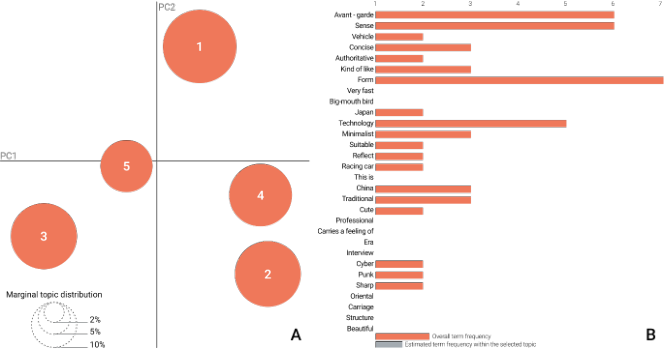
The interview data were transcribed and pre-processed by tokenizing the text and removing stop words and irrelevant content. We first conducted open coding on transcripts from five participants and identified five recurring themes. As no additional themes emerged in the subsequent analysis, thematic saturation was considered to have been reached. We then applied LDA to the full corpus, setting the number of topics to five, and interpreted the top- ranked keywords within the design context.
Figure 1: Intertopic distance map and top-30 most salient terms.
The analysis resulted in five affective dimensions associated with high- speed train head-shape design: (1) Power, (2) Technological Sense, (3) Affinity, (4) Aesthetic Orderliness, and (5) Cultural Sense. Each dimension corresponded to a cluster of affective descriptions identified in the interview corpus.
AI-Assisted Head-Shape Design for High-Speed Trains 833 Design Parameter Encoding and Kansei Modelling Procedure
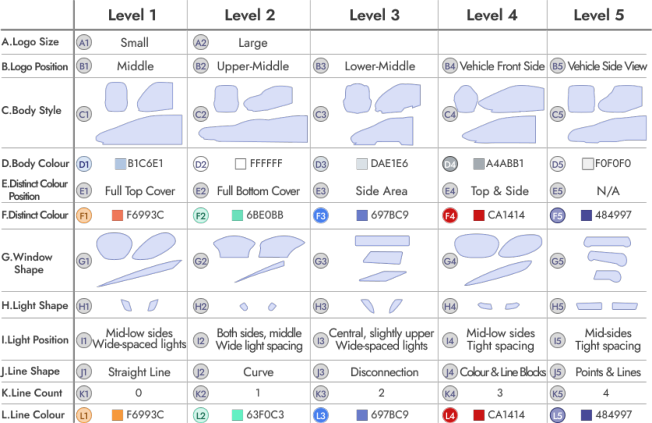
Through morphological decomposition and analysis of existing high-speed train head shapes, we first derived a set of candidate design parameters that represent essential form characteristics (Hsiao et al., 2018). These parameters encompass both morphological and chromatic attributes that are expected to significantly influence user perception. To ensure the validity and professional relevance of parameter selection, two industrial designers—each with more than three years of professional experience in transportation and product design—were invited to participate in the parameter definition process. Together with the author, they collaboratively discussed, refined, and evaluated the candidate parameters through multiple iterative sessions. This process yielded a final set of twelve key design parameters (see Figure 2).
Figure 2: Twelve key design parameters.
After determining the parameters, we employed the Taguchi L50 mixed- level orthogonal array to generate 50 representative design combinations by systematically arranging the parameter levels. Each combination produced a unique visual configuration of the head shape, ensuring that every variation in shape and colour was represented for evaluation.
To quantitatively assess users’ emotional responses to different design combinations, we conducted a Kansei evaluation experiment. 27 participants aged 18–50, including designers and high-speed rail passengers, evaluated all 50 design samples across the five predefined affective dimensions using 5-point Likert scales. An attention-check item was included to ensure data quality, and the mean score for each design across participants was calculated for each dimension and used as the dependent variable in subsequent regression modelling.
Based on the collected dataset, we constructed a predictive model to describe the relationship between design parameters and affective evaluations. A Random Forest (RF) regression approach was employed to
834 Wang and Hu capture the nonlinear mapping between the independent design variables and the dependent affective ratings. Each RF model used the twelve design parameters as input features and predicted one affective dimension as the output. The number of trees was set to 500 to ensure model stability and avoid overfitting. At each node split, a random subset of √p (p = 12) features was considered to enhance generalization. Model performance was evaluated using a combination of five-fold cross-validation (5-Fold CV) and out-of- bag (OOB) estimation. The former provided averaged performance metrics through repeated data partitioning, while the latter estimated an unbiased prediction error using samples not selected during bootstrap sampling.
The Random Forest regression models demonstrated distinct predictive performance across the five affective dimensions. Model accuracy was evaluated using the coefficient of determination (R²) and root mean square error (RMSE), computed on independent test datasets to assess generalization.
Table 1: Performance of random forest models.
Table available in the original PDF paper.
Affective Dimension R² RMSE Affinity 0.57 0.43
Power 0.38 0.62 Aesthetic Orderliness 0.34 0.66
Technological Sense 0.28 0.72 Cultural Sense –0.36 1.36
Mean (overall) 0.24 - Affinity achieved the highest predictive performance (R² = 0.57), followed by Power (0.38), Aesthetic Orderliness (0.34), and Technological Sense (0.28). Cultural Sense showed poor predictive validity (R² = −0.36) and was therefore excluded from subsequent optimization.
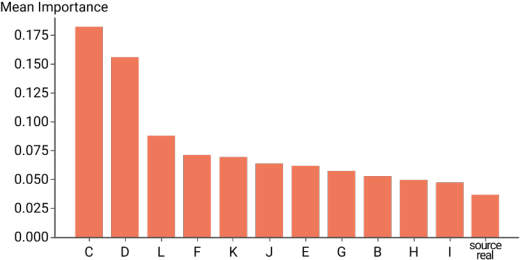
The importance of each design parameter was computed using impurity- based feature importance across 500 decision trees per model. Figure 3 shows the top twelve parameters ranked by their averaged importance across all affective dimensions. We found that head shape design (C), main colour (D), and line colour (L) consistently appeared as the dominant factors, with mean normalized importances of 0.18, 0.16, and 0.09, respectively. Together, these parameters accounted for over 40% of the total explanatory variance, confirming their crucial role in shaping affective impressions.
Figure 3: Top 12 features.
AI-Assisted Head-Shape Design for High-Speed Trains 835 To further interpret the Random Forest models, we examined the relationships between design parameters and affective dimensions using feature-importance distributions and sample-level trends. Power and Technological Sense were mainly associated with head shape (C) and colour contrast (D, L), Affinity with brightness and body proportion (F, L), and Aesthetic Orderliness with geometric structure and repetitive regularity (C, D, K). Cultural Sense remained weakly modelled, suggesting that higher-level symbolic perception may depend on contextual cues beyond the current parameters.
Overall, the models provided an interpretable understanding of how morphological and chromatic parameters jointly influence affective perception. Methodologically, this work extends classical Kansei Engineering by integrating machine-learning-based prediction and interpretability into the design evaluation process (Zamora-Polo et al., 2022).
MODEL-INFORMED DESIGN GENERATION AND OPTIMIZATION We embedded the trained affective prediction model into the design workflow, positioning artificial intelligence as a cognitive collaborator in the decision- making process. We have established an iterative “design–evaluation– optimization” mechanism that links creative exploration with data-driven feedback.
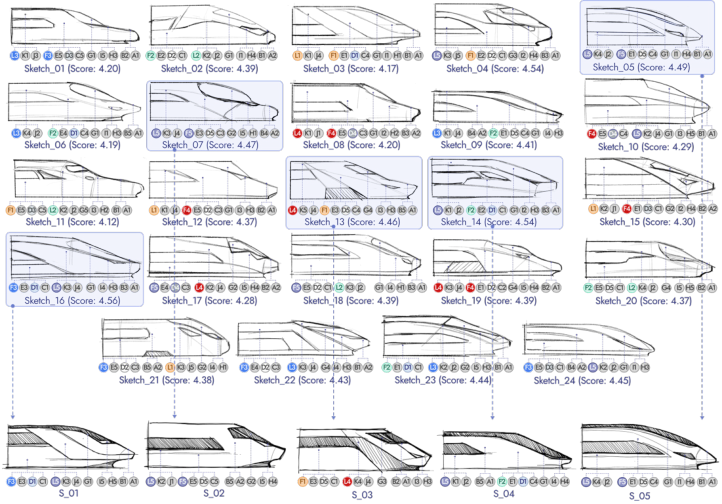
AI-Assisted Creative Exploration and Evaluation At this stage, we integrate the trained affective prediction model into the sketch-based design process. Two designers with four years of experience in transportation design collaborated with the research team to translate the model’s analytical insights into creative design generation. Guided by the feature-importance analysis from the Random Forest model, we focused on the parameters that exhibited the strongest influence on emotional perception, including head shape (C), primary colour (D), and line count (K), in order to explore perceptually diverse head shape alternatives for high-speed trains. Each conceptual sketch was then digitized and systematically encoded according to the established twelve design parameters (A–L), which captured geometric and chromatic attributes including body proportion, line configuration, and colour distribution. The encoded sketches were subsequently processed by the trained model, which computed predicted scores for the four affective dimensions.
Based on the model’s output results, we selected the top 5 design schemes with the highest scores for further refinement and optimized their forms. After the optimized sketches were re-encoded, the trained model was used again to predict their affective scores. The results, as shown in Table 2, indicate an overall improvement in affective performance compared with the first-round sketches. Among them, S_01 (4.57), S_03 (4.49), and S_05 (4.49) achieved the highest mean scores.
Figure 4: Parameter-encoded sketches.Table 2: Affective performance of optimized sketches.
Table available in the original PDF paper.
Number S_01 S_02 S_03 S_04 S_05 Average 4.57 4.29 4.49 4.29 4.49
Power 4.50 4.68 4.57 4.52 4.73 Technological Sense 4.75 4.18 4.51 4.68 4.65
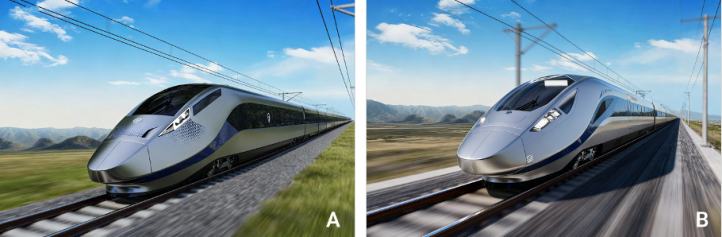
Building upon the high-scoring sketches identified in the previous evaluation phase, we further refined and synthesized their key morphological and affective characteristics into new design renderings. Overall, this process demonstrates how the trained model can be effectively integrated into the creative process, establishing a connection between intuitive sketch creation and quantitative evaluation in a designer-in-the-loop setting.
Figure 5: High-speed train head renderings.
AI-Assisted Head-Shape Design for High-Speed Trains 837 The results show that the model served as an analytical reference within the design process, providing interpretable affective feedback that guided our decision-making. Through iterative use, it helped relate subjective impressions to quantifiable parameters and supported the refinement of design sketches based on data-informed emotional cues.
In addition, we conducted brief follow-up interviews with participating designers to understand their experiences in applying the workflow. Their feedback revealed that the model’s outputs supported reflective reasoning during form development and improved communication within the design team. Overall, we confirmed that the AI-assisted evaluation mechanism enhanced the transparency, traceability, and interpretability of the affective design process (Hassija et al., 2024).
DISCUSSION
This study proposes a data-driven affective design framework that integrates semantic analysis, orthogonal experimental design, and machine-learning- based modelling to establish a quantitative link between emotional cognition and form optimization. Using high-speed train head-shape design as a case study, the framework reveals how morphological and chromatic parameters influence user perception.
From a theoretical perspective, the study advances Kansei methodology from a primarily post-hoc evaluation tool to an integrated, data-informed design process (López, Murillo and González, 2021). Random Forest models capture the nonlinear mapping between design parameters and emotional evaluations, helping identify dominant features and parameter interactions (Schütte et al., 2004; Hsiao et al., 2018). By formalising these relationships as an explicit predictive model, the framework makes designers’ tacit emotional intent more measurable and operational within the design process. Furthermore, by embedding the model into iterative form development, AI is positioned as a cognitive assistant rather than an autonomous creator, supporting rather than replacing designers’ creative agency (Guo et al., 2023; Liang, 2024).
From a practical perspective, the framework enables designers to visualize and quantify affective responses during early-stage form exploration. Predictive feedback supports iterative adjustment of geometric and chromatic parameters and provides a shared reference for discussing affective criteria during design reviews. The workflow may also be transferred to other form- sensitive domains, such as automotive and consumer electronics design, and integrated into AI-assisted sketching or generative design systems as a form of affective guidance (Chao et al., 2023; Wang et al., 2024).
Several limitations remain. The relatively small sample size and limited participant diversity may affect model generalizability, while the current parameterisation mainly captures visual form and does not fully represent contextual or cultural influences on emotional cognition (Schütte, 2005). The weak fit of the Cultural Sense dimension further indicates that higher- level symbolic meanings are difficult to model using the present parameters alone. Future work will therefore expand the dataset, recruit more diverse
838 Wang and Hu participants, compare alternative machine-learning algorithms, and test the framework on new design cases to evaluate its transferability and interpretability.
CONCLUSION
This study proposes a human–AI collaborative framework that connects users’ emotional cognition with high-speed train head-shape optimization through semantic extraction, parametric encoding, and machine-learning prediction (López, Murillo and González, 2021; Yong, 2024). By embedding affective prediction into iterative design, the framework positions AI as a cognitive assistant that supports rather than replaces designers’ creative reasoning (Zhou and Lee, 2024). The study provides a reproducible approach for linking qualitative emotion with quantitative design feedback, while future work will expand the dataset, incorporate contextual and cultural variables, and explore real-time affective feedback during conceptual design.
REFERENCES
Bernardo, E. and Seva, R. (2023) ‘Affective design analysis of explainable artificial intelligence (XAI): A user-centric perspective’, Informatics, 10(1), p. 32. Available at: https://doi.org/10.3390/informatics10010032.
Chao, C. et al. (2023) ‘An emotional design model for future smart product based on grounded theory’, Systems, 11(7), p. 377. Available at: https://doi.org/10.3390/ systems11070377.
Cross, N. (2007) ‘From a design science to a design discipline: understanding designerly ways of knowing and thinking’, in R. Michel (ed.) Design Research Now. DE GRUYTER, pp. 41–54. Available at: https://doi.org/10.1007/978-3-7643-8472-2_3.
Dai, Z. et al. (2023) ‘Research progress of aerodynamic multi-objective optimization on high-speed train nose shape’, Computer Modeling in Engineering and Sciences, 137(2), pp. 1461–1489. Available at: https://doi.org/10.32604/cmes.2023.028677.
Guo, X. et al. (2023) ‘Rethinking designer agency: A case study of co-creation between designers and AI’. Available at: https://dl.designresearchsociety.org/iasdr/ iasdr2023/fullpapers/170 (Accessed: 23 October 2025).
Han, J., Childs, P.R.N. and Luo, J. (2024) ‘Applications of artificial intelligence and cognitive science in design’, AI EDAM, 38, p. e6. Available at: https://doi. org/10.1017/S0890060424000052.
Hassija, V. et al. (2024) ‘Interpreting black-box models: A review on explainable artificial intelligence’, Cognitive Computation, 16(1), pp. 45–74. Available at: https://doi.org/10.1007/s12559-023-10179-8.
Hong-qi, T. (2019) ‘Review of research on high-speed railway aerodynamics in China’, Transportation Safety and Environment, 1(1), pp. 1–21. Available at: https://doi.org/10.1093/tse/tdz014.
Hsiao, S.-W. et al. (2018) ‘A methodology for brand feature establishment based on the decomposition and reconstruction of a feature curve’, Advanced Engineering Informatics, 38, pp. 14–26. Available at: https://doi.org/10.1016/j. aei.2018.05.008.
Hu, H. et al. (2022) ‘A quantitative aesthetic measurement method for product appearance design’, Advanced Engineering Informatics, 53, p. 101644. Available at: https://doi.org/10.1016/j.aei.2022.101644. AI-Assisted Head-Shape Design for High-Speed Trains 839
Lévy, P.D. (2013) ‘Beyond kansei engineering: the emancipation of kansei design’, International Journal of Design, 7(2), pp. 83–94.
Li, H. et al. (2024) ‘A comparative analysis of CAD modeling approaches for design solution space exploration’, Advances in Mechanical Engineering, 16(3), p. 1687 8132241238089. Available at: https://doi.org/10.1177/16878132241238089.
Li, Y. et al. (2025) ‘A review of artificial intelligence in enhancing architectural design efficiency’, Applied Sciences, 15(3), p. 1476. Available at: https://doi.org/10.3390/ app15031476.
Liang, J. (2024) ‘The application of artificial intelligence-assisted technology in cultural and creative product design’, Scientific Reports, 14(1), p. 31069. Available at: https://doi.org/10.1038/s41598-024-82281-2.
Liu, Z. (2025) ‘Human-AI co-creation: A framework for collaborative design in intelligent systems’. arXiv. Available at: https://doi.org/10.48550/ arXiv.2507.17774. López, Ó., Murillo, C. and González, A. (2021) ‘Systematic literature reviews in kansei engineering for product design—a comparative study from 1995 to 2020’, Sensors, 21(19), p. 6532. Available at: https://doi.org/10.3390/s21196532.
Monedero, J. (2000) ‘Parametric design: a review and some experiences’, Automation in Construction, 9(4), pp. 369–377. Available at: https://doi.org/10.1016/S0926-5805(99)00020-5.
Nagamachi, M. (2002) ‘Kansei engineering as a powerful consumer-oriented technology for product development’, Applied Ergonomics, 33(3), pp. 289–294. Available at: https://doi.org/10.1016/S0003-6870(02)00019-4.
Oxman, R. (2017) ‘Thinking difference: theories and models of parametric design thinking’, Design Studies, 52, pp. 4–39. Available at: https://doi.org/10.1016/j. destud.2017.06.001.
Peckham, O. et al. (2025) ‘Artificial intelligence in generative design: A structured review of trends and opportunities in techniques and applications’, Designs, 9(4), p. 79. Available at: https://doi.org/10.3390/designs9040079.
Quiñones-Gómez, J.C., Mor, E. and Chacón, J. (2024) ‘Data-driven design in the design process: a systematic literature review on challenges and opportunities’, International Journal of Human-Computer Interaction, 41, pp. 1–26. Available at: https://doi.org/10.1080/10447318.2024.2318060.
Salma, Z., Hijón-Neira, R. and Pizarro, C. (2025) ‘Designing co-creative systems: Five paradoxes in human–AI collaboration’, Information, 16(10), p. 909. Available at: https://doi.org/10.3390/info16100909. Schütte *, S.T.W. et al. (2004) ‘Concepts, methods and tools in kansei engineering’, Theoretical Issues in Ergonomics Science, 5(3), pp. 214–231. Available at: https:// doi.org/10.1080/1463922021000049980.
Schütte, S. (2005) Engineering emotional values in product design: Kansei engineering in development. Linköping: Linköpings universitet, Department of Mechanical Engineering.
Song, B. et al. (2022) ‘Decoding the agility of artificial intelligence-assisted human design teams’, Design Studies, 79, p. 101094. Available at: https://doi. org/10.1016/j.destud.2022.101094.
Sreenivasan, A. and Suresh, M. (2024) ‘Design thinking and artificial intelligence: A systematic literature review exploring synergies’, International Journal of Innovation Studies, 8(3), pp. 297–312. Available at: https://doi.org/10.1016/j. ijis.2024.05.001.
Toyong, N., Abidin, S.Z. and Mokhtar, S. (2021) ‘A case for intuition-driven design expertise’, pp. 117–131. Available at: https://doi.org/10.1007/978-981-16-0084-5_10. study across design experience’, Frontiers in Computer Science, 7. Available at: https://doi.org/10.3389/fcomp.2025.1672735.
Wang, Z. et al. (2024) ‘Affective product form bionic design based on functional analysis’, Expert Systems with Applications, 249, p. 123746. Available at: https:// doi.org/10.1016/j.eswa.2024.123746.
Weidner, D. et al. (2022) ‘Aerodynamics of high-speed trains with respect to ground simulation’, Fluids, 7(7), p. 228. Available at: https://doi.org/10.3390/ fluids7070228.
Yao, S.B. et al. (2016) ‘Parametric design and optimization of high speed train nose’, Optimization and Engineering, 17(3), pp. 605–630. Available at: https://doi. org/10.1007/s11081-015-9298-6.
Yong, L. (2024) ‘Product perceptual design optimization model based on BP neural network’, Frontiers in Mechanical Engineering, 10, p. 1503182. Available at: https://doi.org/10.3389/fmech.2024.1503182.
Yu, M. et al. (2022) ‘Shape optimization of the streamlined train head for reducing aerodynamic resistance and noise’, Applied Sciences, 12(19), p. 10146. Available at: https://doi.org/10.3390/app121910146. Zamora-Polo, F., de las Heras, A., Lama Ruiz, J.R. and Luque, A. (2022) ‘Use of machine learning techniques in the Kansei Engineering synthesis phase’, in Proceedings from the International Congress on Project Management and Engineering, 2022-July, pp. 798–814.
Zhou, E. and Lee, D. (2024) ‘Generative artificial intelligence, human creativity, and art’, PNAS Nexus, 3(3), p. pgae052. Available at: https://doi.org/10.1093/ pnasnexus/pgae052.
SEARCH THE AHFE DIGITAL BOOKSTORE BY ISBN
Explore the complete digital volume
Human Factors in Design, Engineering, and Computing
Read this individual research paper free through the original publisher, or explore the full digital proceedings book.