Yi-Pei Wu, Chien-Hsu Chen (2026). Designing With and Beyond Humans: An LLM-Based Human–AI Co-Creation Framework for Remote Curatorial Collaboration. In: Human Factors in Design, Engineering, and Computing. AHFE Open Access, vol. 238, pp. 1437–1446. https://doi.org/10.54941/ahfe1008372
As cross-border curatorial practices become increasingly common, remote collaboration has become an inevitable mode of work for curatorial teams—including curators, artists, and exhibition production teams—yet it also brings recurring challenges such as fragmented communication context, difficulties in consensus building, and reduced decision-making efficiency. Recent advances in large language models (LLMs) and multi-agent systems enable AI to shift from a task-oriented assistant to a reflective, collaborative co-designer that can reason, dialogue, and integrate perspectives across roles, helping teams form consensus more effectively in complex situations. Building on this premise, this study proposes an LLM-based self-collaborative design mechanism and constructs a Human–AI co-constructed curatorial knowledge model. In-depth interviews with curators and artists in real-world curatorial contexts were conducted and analyzed to identify key pain points and latent needs in remote curatorial collaboration, which were then translated into concrete design issues. A structured multi-agent discussion and reasoning process was conducted to generate actionable, traceable, and more feasible insights. The outcomes contribute: (1) a replicable LLM-based multi-agent research framework that provides an end-to-end methodological pathway from field data to multi-role reasoning, and from consensus extraction to guideline generation; and (2) a set of design guidelines for remote curatorial collaboration, offering strategic solutions and an eight-layer functional architecture. Therefore, this study not only addresses the practical needs of remote curatorial collaboration but also provides a knowledge-production mechanism that can be directly integrated into workflow and tool design, enabling teams to sustain collaborative quality and decision-making efficiency under resource constraints and high uncertainty.
In contemporary societies shaped by global artistic and cultural flows, transnational art exhibitions serve as key platforms for cultural exchange and perspective co-construction, yet collaboration among curators and geographically dispersed artists remains constrained by physical distance, time zones, and information gaps (Olson & Olson, 2000; Choudhury et al., 2021).
1438 Wu and Chen In-depth interviews further indicate that remote curation is limited by difficulties in building shared spatial understanding and by the absence of standard visual references, often resulting in misunderstandings, mismatched expectations, frustration, inefficiency, and risks to exhibition quality. Recent advances in large language models (LLMs), particularly LLM-driven multi- agent systems (MAS), have expanded human–AI interaction and supported a shift from AI-as-tool to AI as a participant in knowledge co-construction; “unmaking-with AI” frames design as meaning negotiation among human and non-human actors, emphasizing plural knowledge sources (Nicenboim et al., 2024), aligning with increasing attention to non-human actors in participatory design (Veselova & Gaziulusoy, 2019). Although digital and virtual formats broaden exposure (McAndrew, 2021), physical exhibitions remain irreplaceable for collective experience and connection (McKenna-Cress and Kamien, 2013; Kim & Lee, 2016), embodied spatial-material perception (Wang, 2019), serendipitous encounters (Mutibwa, Hess, and Jackson, 2020), and venue-specific atmosphere and memory (Moneta & Ho, 2016; Marontate, 2005), supported by interpretive infrastructures (Mulloli, 2021). Building on this context, an LLM-based multi-agent simulation mechanism is introduced for remote collaborative exhibition planning to support key roles and generate strategic solutions and design briefs.
AI AND MULTI-AGENT IN DESIGN COLLABORATION In recent years, the rise of large language models (LLMs) has greatly enhanced multi-agent systems (MAS), accelerating advances in agent communication languages, coordination protocols, and cognitive architectures, and enabling agents to simulate human team behaviours. With LLM-level natural language understanding and reasoning, LLM-based MAS is regarded as a key direction for achieving human-like collective intelligence (Lin et al., 2025). Such agents can increase creativity and facilitate knowledge sharing in collaboration, improving system flexibility and synergy potential (Li et al., 2024). Recent studies further show that LLM-driven MAS can support collaborative ideation and co-design, where AI functions as a “discussion partner” in early collaboration by simulating diverse needs and perspectives; well-designed MAS interactions can outperform single AI systems in mimicking collaborative dialogue and generating diverse, innovative ideas. Park et al. (2023) propose “Generative Agents,” demonstrating that observation, planning, and reflection are crucial for realistic virtual roles and that multi-agent LLM systems can simulate multiparty dialogues and collaborative planning. In design collaboration, MAS can model debates and reasoning across roles, generate solutions from varied professional standpoints, and provide iterative feedback and refinement (Ding et al., 2023), supporting coordinated decision-making and enabling need finding and participatory design through cross-agent knowledge sharing (Wang et al., 2025). LLM-based MAS can also overcome individual cognitive
Designing With and Beyond Humans: An LLM-Based Human–AI Co-Creation Framework 1439 constraints and mitigate design fixation (Lin et al., 2025). Xu et al. (2024) further propose a mixed-reality LLM multi-agent model in which agents act as collaborators and mediators, translating participant feedback into design cues and explanations to bridge communication gaps. Synthesizing this literature, LLM-based MAS can enhance early-stage design thinking by simulating social processes, assigning role-specific agents, and incorporating diverse perspectives to foster divergent thinking, motivating an investigation of LLM-based multi-agent collaboration for remote curatorial planning to address communication bottlenecks across cultures and locations.
REMOTE COLLABORATION AND VISUAL COMMUNICATION Remote collaboration is now common, yet distributed teams still face persistent challenges. Distance Matters argues that effective remote work requires shared knowledge, appropriate task interdependence, willingness to collaborate, and mature technology, supported by “rich” communication and visualization to offset distance-related information loss (Olson & Olson, 2000). Media Richness Theory further suggests that richer media convey diverse nonverbal cues, reducing uncertainty and ambiguity (Daft & Lengel, 1986); thus, text- or voice-only coordination in curatorial and design work often increases misunderstanding and inefficiency. Tangible Bits highlights the value of making digital information visible and manipulable through concrete visual/physical cues when face-to-face spatial cues are absent (Ishii & Ullmer, 1997). Information visualization is therefore central to cognitive alignment and mutual understanding (Verheijden & Funk, 2023; Maier et al., 2021). Accordingly, visualization tools supporting synchronous and asynchronous collaboration are needed for spatially and object-sensitive curation, motivating a visualization-centered framework and design guidelines.
METHODS
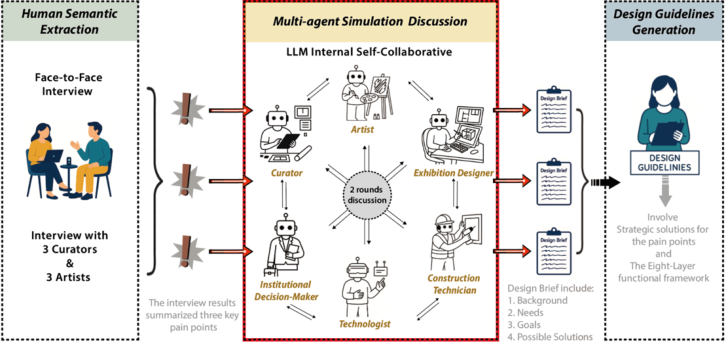
This study follows “Human Semantic Extraction → AI Multi-Agent Simulation → Human–AI Knowledge Integration → Design Guidelines Generation,” integrating in-depth interview data with an LLM-based self- collaborative mechanism (Figure 1) to ground design knowledge in practice while expanding design possibilities through AI reasoning. Face-to-face interviews with three curators and three artists (≥5 years international/ distributed experience) used role-specific open-ended protocols; transcript analysis identified three pain points—difficulty in spatial understanding, information integration and communication breakdown, and insufficient visual alignment (see Table 1)—informing an LLM simulation with six prompt-engineered persona agents encoding expertise and potential conflicts. To clarify provenance, the Results label content as interview findings, model- generated synthesis, or author interpretation.
Figure 1: Research methodology framework: Human-AI co-construction process for remote curatorial collaboration.Table 1: Pain point description.
Table available in the original PDF paper.
No. Specific Problem Description Pain Point 1 Overlapping schedules in concurrent exhibition projects often constrain time and resource allocation. During intensive production, artists cannot travel or stay on-site to assess spaces or join design discussions, instead relying on curator-provided photos, videos, and floor plans to infer spatial conditions and select works from limited cues.
Pain Point 2 Remote curation often relies on asynchronous tools (Email, Messenger, Line), but these can fragment communication: design information becomes complex and inconsistent in format, key details are missed, replies are delayed, access may expire, and compressed images reduce resolution.
Pain Point 3 Text-only communication rarely conveys exhibition-planning details; without concrete visual references, imagined elements invite divergent interpretations and increase errors. Lacking visual planning tools, curation may depend on experience and imagination, causing unexpected visual clashes and on-site fixes. Paper mock-ups are time-consuming to preserve; 3D models require meetings for revisions.
MULTI-AGENT PERSONA DESIGN Six persona agents were constructed in an LLM environment to represent core leaders in the remote curatorial ecosystem: curator, artist, exhibition designer, institutional decision-maker, construction coordinator, and technologist. Collaborative contexts among these roles were recreated, compared, and reimagined, framing design research as a human–AI co-constructed knowledge production process that extends the scope of human experience.
Designing With and Beyond Humans: An LLM-Based Human–AI Co-Creation Framework 1441 Each agent was defined through prompt engineering to encode role expertise and potential conflicts of interest, enabling realistic simulation of complex multi-stakeholder dynamics. Four simulation questions were used: the first three addressed the three pain points, yielding the three design briefs, while the fourth translated user needs into core functions for remote exhibition planning, informing the eight-layer architecture and future prototypes.
STRUCTURED MULTI-ROUND DIALOGUE SIMULATION Google Generative AI (Gemini 2.0 Flash) was used to run two rounds of structured multi-agent simulation. Task prompts specified clear agent responsibilities, background context, and required output formats. Each round followed a three-tier structure: Role Position Statement → Cross-role Critical Response → Consensus Building and Solution Formation. Round one elicited role-based stances, concerns, and preliminary solutions aligned with core pain points, highlighting diverse professional perspectives. Round two added critique, supplementation, and negotiation to identify feasible integration directions. After two rounds, an LLM focusing mechanism converted the full dialogue record into a structured AI-Generated Design Brief with four parts: Background, Needs, Goals, and Possible Solutions, expanding design semantic space without replacing human judgment.
DESIGN KNOWLEDGE GENERATION After the simulation, the researcher repeatedly read the transcripts to identify concepts, conflicts, and consensus recurring across roles, selected relevant passages, and translated them into design guidelines; this step constitutes the author-interpretation level.
RESULTS
Key outputs include three AI-generated design briefs addressing each pain point and an eight-layer functional architecture that structures AI insights into functional dimensions to guide tool development.
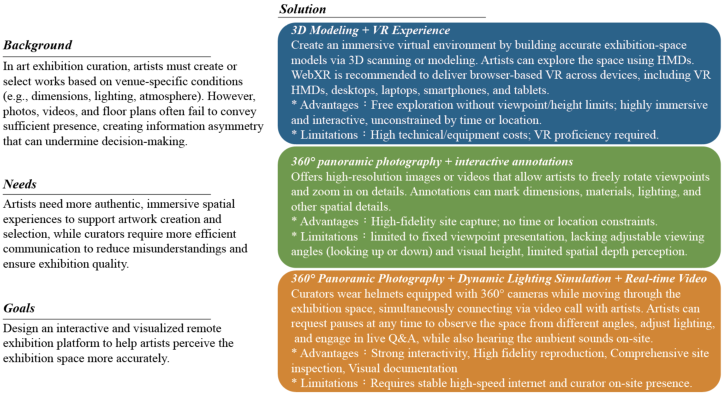
Pain Point 1: Difficulty in Spatial Understanding (see Figure 2) Interview finding: Artists relied on photos, videos, and floor plans to infer unseen venues (Table 1). Model-generated synthesis: Agents across roles supported immersive spatial experiences, rating VR as the most promising long-term option and 360° panoramas with real-time video as a feasible near-term bridge. Author interpretation: The researcher combined these into a “multi-level solution” adjusted to budget and schedule.
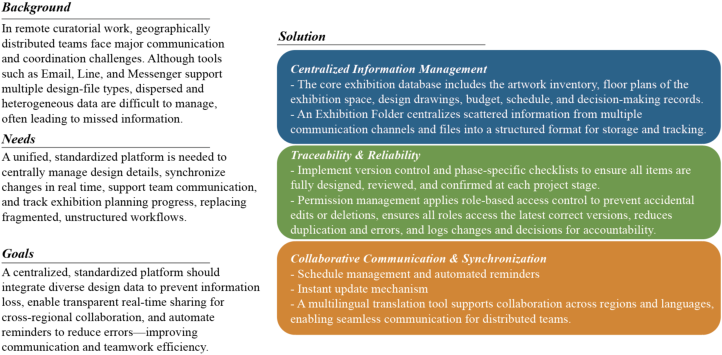
Pain Point 2: Information Integration and Communication Breakdown (See Figure 3) Interview finding: Asynchronous tools (Email, Messenger, Line) fragmented information and caused details to be missed (Table 1). Model-generated synthesis: Agents proposed a centralized platform integrating exhibition folders, version control, permissions, scheduling, and real-time notifications. Author interpretation: The researcher read these functions as jointly supporting traceability and collaboration efficiency.
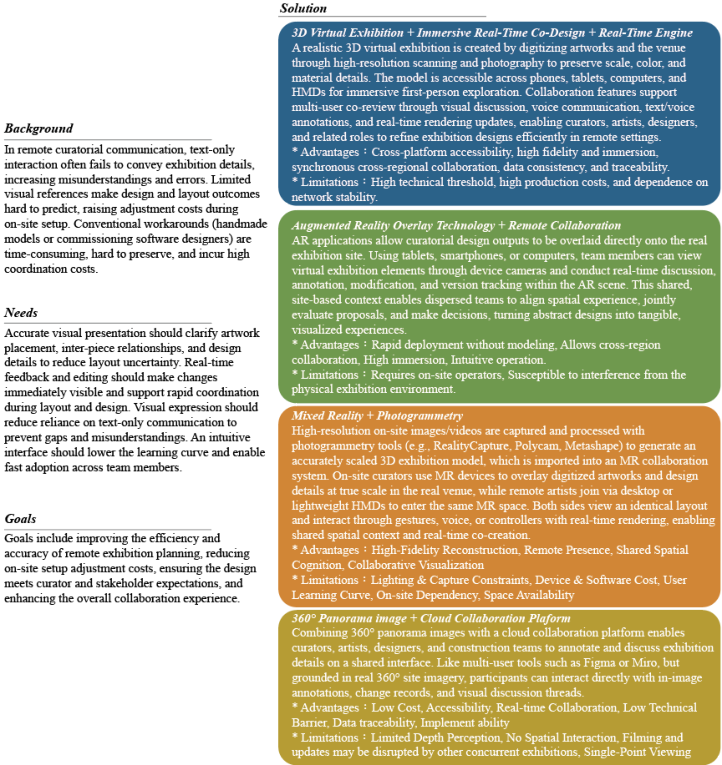
Designing With and Beyond Humans: An LLM-Based Human–AI Co-Creation Framework 1443 Pain Point 3: Insufficient Visual Alignment (See Figure 4)
Interview finding: Without visual references, text-only exchanges led to misinterpretation and on-site fixes (Table 1). Model-generated synthesis: Technologist and designer agents favoured VR/MR, whereas decision-maker and construction agents stressed cost and feasibility; a phased strategy emerged, moving from low-cost 360° and cloud tools to VR/MR. Author interpretation: The researcher treats this as one possible compromise among role priorities, pending practitioner assessment.
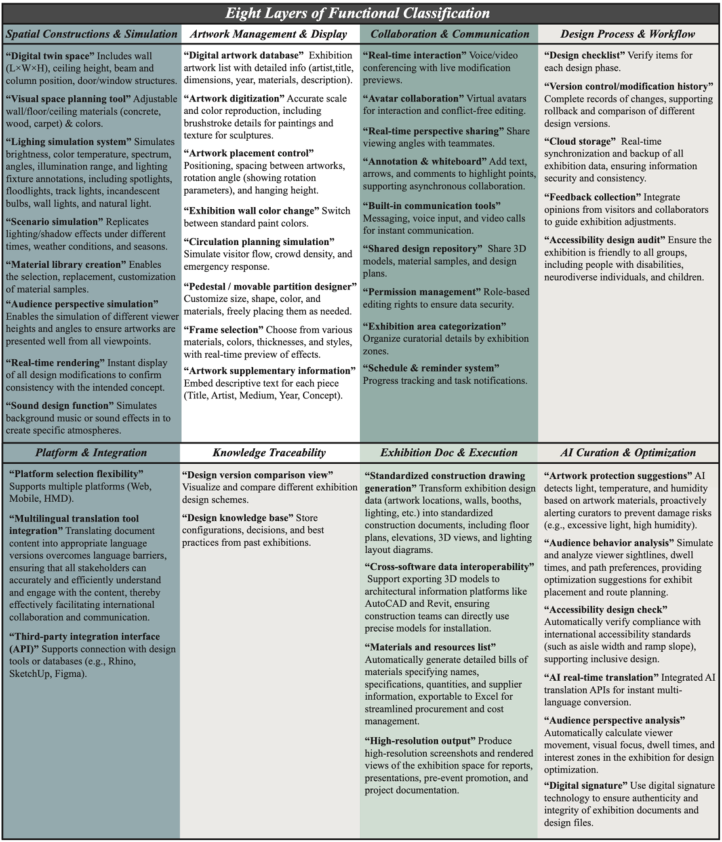
Eight-Layer Functional Architecture Author interpretation: Drawing on the functional suggestions from the multi- agent discussions, particularly the fourth simulation question, the researcher constructed an eight-layer functional architecture (see Figure 5) spanning
1444 Wu and Chen early planning, visual simulation, collaborative workflows, document output, and AI assistance. It offers a reference framework for designing remote curation and visual collaboration tools.
DISCUSSION AND CONTRIBUTIONS Traditional design research often depends on unidirectional interview data and subjective interpretation, which can be constrained by prior experience and cognitive bias and may privilege “past experiences” over “potential possibilities.” To address this limitation, multi-agent simulation outputs are used to explore role-specific perspectives beyond the interview data; these outputs are treated as model-generated hypotheses rather than stakeholder
Designing With and Beyond Humans: An LLM-Based Human–AI Co-Creation Framework 1445 evidence and are interpreted by the researcher into layered, extensible design knowledge. The framework is intended not to prescribe a single solution but to provide a reference structure for future tool and system development. For example, to mitigate limited immersive spatial perception, the guidelines recommend augmented reality (AR), virtual reality (VR), and 360-degree photography to approximate on-site experience for distributed collaborators. To reduce information dispersion and misunderstandings, integrated digital collaboration platforms are emphasized for centralized management of site plans, photos, videos, and related exhibition details, thereby reducing loss and errors associated with fragmented email exchanges. Overall, the approach positions AI not as a standalone generative tool but as a socio- technical mediator for multi-role knowledge negotiation, enabling simulation of conflicts and negotiation processes across professional standpoints and supporting the distillation of systematic design guidelines. Contributions include: (1) a methodology-centric research framework structured as “field in-depth interviews → problem induction → multi-agent simulated discussion → design knowledge generation → design guideline construction,” bridging real work contexts with unexplored design possibilities and extending to other cross-disciplinary remote collaboration scenarios; and (2) design guidelines grounded in three pain points—difficulty in spatial understanding, information integration and communication breakdown, and insufficient visual alignment—translated into AI-driven design briefs, strategic solutions, and an eight-layer functional architecture spanning data input, visual simulation, real-time collaborative communication, construction output, and AI assistance. The study translates practical curatorial challenges into operational design knowledge and illustrates a replicable model for AI-assisted design knowledge generation.
LIMITATIONS The empirical base is small (three curators and three artists), so the findings are exploratory. The simulation used a single model (Gemini 2.0 Flash) over two rounds, and its agents are prompted personas rather than actual stakeholders. The resulting guidelines have not yet been validated with users; future work will evaluate them with practitioners and replicate the simulation across models.
CONCLUSION
This study addressed remote art exhibition collaboration by combining practitioner interviews with an LLM-based multi-agent simulation. Three challenges (spatial understanding, information integration, and visual alignment) were identified from the interviews, explored through simulated cross-role discussion, and interpreted by the researcher into design briefs, guidelines, and an eight-layer functional architecture. Methodologically, the study illustrates one possible pathway for translating interviewees’ perspectives into design guidelines with LLM support. Future work will
1446 Wu and Chen validate the guidelines with users and explore alternative dialogue structures, such as hierarchical discussion, voting, and weighted consensus, to balance influence among agents.
REFERENCES
Choudhury, P., Foroughi, C. and Larson, B. (2021) ‘Work-from-anywhere: The productivity effects of geographic flexibility’, Strategic Management Journal, 42(4), pp. 655–683. https://doi.org/10.1002/smj.3251
Ding, S., Chen, X., Fang, Y., Liu, W., Qiu, Y. and Chai, C. (2023) ‘DesignGPT: multi-agent collaboration in design’, arXiv. https://doi.org/10.1109/ISCID59865.2023.00056
Daft, R.L. and Lengel, R.H. (1986) ‘Organizational information requirements, media richness and structural design’, Management Science, 32(5), pp. 554–571. https:// doi.org/10.1287/mnsc.32.5.554
Ishii, H. and Ullmer, B. (1997) ‘Tangible bits: Towards seamless interfaces between people, bits and atoms’, in Proceedings of the SIGCHI Conference on Human Factors in Computing Systems (CHI ’97), pp. 234–241. https://doi. org/10.1145/258549.258715
Li, X., Wang, S., Zeng, S., Wu, Y. and Yang, Y. (2024) ‘A survey on LLM-based multiagent systems: Workflow, infrastructure, and challenges’, Vicinagearth, 1(1), p. 9. https://doi.org/10.1007/s44336-024-00009-2 Lin, Y.C., Chen, K.C., Li, Z.Y., Wu, T.H., Chen, K.Y., ... and Chen, Y.N. (2025) ‘Creativity in LLM-based Multi-Agent Systems: A Survey’, arXiv preprint arXiv:2505.21116. https://doi.org/10.48550/arXiv.2505.21116
Maier, A.M., Eckert, C.M. and Clarkson, P.J. (2021) ‘Factors influencing communication in collaborative design’, Journal of Engineering Design, 32(12), pp. 671–702. https://doi.org/10.1080/09544828.2021.1954146
McAndrew, C. (2021) The Art Market 2021. Art Basel and UBS.
McKenna-Cress, P. and Kamien, J.A. (2013) Creating exhibitions: Collaboration in the planning, development, and design of innovative experiences. Hoboken, NJ: Wiley.
Nicenboim, I., Søndergaard, M.L.J., Lindley, J., Reddy, A., Strengers, Y., Redström, J. and Giaccardi, E. (2024) ‘Unmaking-with AI: Tactics for decentering through design’, ACM Transactions on Computer-Human Interaction, 31(6), pp. 1–20. https://doi.org/10.1145/3685275
Olson, G.M. and Olson, J.S. (2000) ‘Distance matters’, Human–Computer Interaction, 15(2–3), pp. 139–178. https://doi.org/10.1207/S15327051HCI1523_4
Park, J.S., O’Brien, J., Cai, C.J., Morris, M.R., Liang, P. and Bernstein, M.S. (2023) ‘Generative agents: Interactive simulacra of human behavior’, in Proceedings of the 36th annual ACM symposium (October). https://doi.org/10.1145/35861 83.360676
Verheijden, M.P. and Funk, M. (2023) ‘Collaborative diffusion: Boosting designerly co-creation with generative AI’, in Extended Abstracts of the 2023 CHI Conference on Human Factors in Computing Systems, pp. 1–8. Association for Computing Machinery. https://doi.org/10.1145/3544549.3585680 Veselova, E. and Gaziulusoy, A.İ. (2019) ‘Implications of the bioinclusive ethic on collaborative and participatory design’, The Design Journal, 22(sup1), pp. 1571–1586. https://doi.org/10.1080/14606925.2019.1594992
Xu, S., Wei, Y., Zheng, P., Zhang, J. and Yu, C. (2024) ‘LLM enabled generative collaborative design in a mixed reality environment’, Journal of Manufacturing Systems, 74, pp. 703–715. https://doi.org/10.1016/j.jmsy.2024.04.030
SEARCH THE AHFE DIGITAL BOOKSTORE BY ISBN
Explore the complete digital volume
Human Factors in Design, Engineering, and Computing
Read this individual research paper free through the original publisher, or explore the full digital proceedings book.