Gad Vitner (2019). Using Bill of Services (BOS) to Achieve Effective Service Delivery. In: Advances in The Human Side of Service Engineering. AHFE Open Access, vol. 8. https://doi.org/10.54941/ahfe100273
Services are usually performed at the exact moment that the customer demands it. Therefore, a service business must have optimal resources available in terms of skill and experience, at the right time and place. In order to achieve valuable service delivery, service organizations must develop supportive infrastructure so that the process of creating and delivering the service will be accomplished efficiently and effectively. Thus, the discipline of service design becomes a basic element in the development of services. Organizations must develop services that will meet customers' expectations, requirements, and demands, to be delivered when needed, to the complete satisfaction of the customer. Bill of Services (BOS) is a novel management tool designed to support service organizations in developing their services and planning resources to satisfy management’s strategy. This paper presents a methodology for configuration of the BOS in a manner similar to configuration of the Bill of Materials (BOM) in a manufacturing organization. The BOS assists management in the day-to-day planning and control of activities, and facilitates a professional management infrastructure in service organizations. Based on the BOS, the necessary resource capacities can be planned and service costing can be performed according to predefined service levels for each service characteristic.
In order to achieve valuable service delivery, service organizations must develop supportive infrastructure so that the process of creating and delivering the service will be accomplished efficiently and effectively. Thus, the discipline of service design becomes a basic element in the development of services. Organizations must develop services that will meet customers' expectations, requirements, and demands, to be delivered when needed, to the complete satisfaction of the customer. In order to preserve customer loyalty, organizations must consider the costs related to the service delivery process. Salvendy & Karwowski (2010) discuss the issue of service capacity while providing services. Excess capacity causes extra costs for workers that are not utilized effectively, while insufficient capacity can cause long customer waiting times. Thus, effective management of resource capacity in service delivery is a major issue that management must address.
The purpose of the paper is to design a management support tool for capacity and cost planning for service organizations. The paper attempts to adapt the Bill of Material (BOM) from the field of engineering design to service development and management. The integration of engineering and management is particularly relevant for the development of new services. The paper presents the Bill of Services (BOS), a tool for assisting service organizations in developing their services by identifying the resources needed to provide the service and the capacity of each resource. BOS is borrowed and adopted from the manufacturing field, enabling organizations to calculate quantities of the resource capacities needed in order to deliver the service elements emphasized by the service concept (Goldstein et al., 2002). Zeltin & Mandelbaum (2008) have developed a service operations management planning model to assist managers of service organizations in efficient allocation of their resources in order to meet customer demand. Dietrich (2006) reveals that the lack of a standard method for representing resource requirements for business services and resource capabilities used for delivering business services makes it difficult to directly apply the analytic tools developed for manufacturing and supply chains to business services. For conventional goods, each unit of production is typically associated with a well-defined set of resource requirements. In business services, the "unit of sales" is typically a contract describing business functions (e.g. banking services) that will be performed by a provider for a client over a specified period of time; a payment structure; and related obligations of the client and the provider. Exactly how the business functions will be provided, or what resources will be used and when they will be used, should be characterized by the service provider in order to satisfy customer demand on time and in an efficient manner (Dietrich, 2006). Sampson (2012) introduces the Process Chain Network (PCN) Analysis framework for service operations management (SOM). PCN analyzes the complexities of service operations in a systematic way, by depicting services as a specific type of resource/process configuration.
The BOM is a structured management mechanism that contains all the elements of the product. Product elements should support the product concept. When designing services based on the organization's strategy, the concept developed defines the service categories and characteristics and the service level for each service characteristic. Similar to the BOM, the BOS is a structured management tool that contains all the service elements. Based on the BOS, the necessary resource capacities can be planned and service costing can be performed according to predefined service levels for each service characteristic. The novelty of the approach is by enabling service organizations to design a detailed structure of the various services delivered to the customer and derivate the respective resources capacities needed to satisfy customers' needs and expectations. The BOS is a managing tool that allows the service designer to define for each service characteristics various service levels and make the respective cost effective computations in order to verify what should be the appropriate resource capacities.
In this article, the focus is on service design with the BOS as a supportive management mechanism to conduct service resources capacity planning and to verify service costing.
METHODOLOGY
Service Design Service design is concerned with systematically applying design methods and principles to the design of services. It assumes the customer/user as the starting point or lens into a specific service, and considers how the service can be performed through the use of creative, human-centered and user-participatory methods models (Holmid & Evenson, 2008). Furrer, (2005) states that in order to ensure service quality, the service delivery process should be well- designed and well-organized. The design of a service can have significant impact on an organization's key metrics, including costs, revenue, brand perceptions, customer satisfaction and loyalty, and employee satisfaction and loyalty (Ostrom et al., 2010). A commonly mentioned technique in service design is service blueprinting (Bitner et al., 2008). A typical service blueprint has five components: "Customer actions" include the steps that customers take as part of the service delivery process. "Onstage/visible contact employee actions" are actions of front-line contact employees that occur each time they cross the line of interaction with the customer. "Backstage/invisible contact employee actions" are nonvisible interactions with customers (e.g. telephone calls) and any other activities that contact employees do in order to prepare to serve customers. "Support processes" refer to activities carried out by individuals and units within the company who are not contact employees and that need to happen in order for the service to be delivered. "Physical evidence" means the tangibles that customers are exposed to that can influence their quality perception. In the physical surroundings of a service (“servicescapes”), customer cognition, behavior and experiences are influenced by the following dimensions: ambient conditions; spatial layout and functionality; signs, symbols and artifacts; and service typology and environmental dimensions (Bitner, 1992).
Service Concept The service concept is the starting point for the development of an operating strategy (Johnston et al., 2012).The service concept defines and characterizes the "skeleton" of the BOS. Drejeris and Zinkeviciute (2010) proposed a model for one stage of the development of a service concept feasibility assessment and designing of a service system. Every idea can be developed by several concepts. The application of the suggested model allows choosing the best concept of a new service.
Service Specifications A service specification is an extension of the service concept. The service concept provides a broad description about the service provided, the customer experience and its outcomes. This in turn should either be based on the needs, requirements and expectations of customers, or a perceived future need or desire for it. The service specification takes the elements of the concept and identifies the quality factors associated with each. It details the standards to be achieved and the necessary procedures to ensure conformance to this standard (Johnston et al., 2012).
Service specifications are designed using two dimensions: A. Service characteristics define the various service components (e.g. time waiting to sight the host in a restaurant). They may be defined by time units, tolerance on the time axis, and yield of a service activity (e.g. yield of the admission process in a hospital department). B. Service level is the second dimension of service specifications (e.g. a 2-minute waiting time in a bank versus a 6-minute waiting time). Different service levels require varying resource capacity in order to comply with a given service characteristic. Service specifications are defined to comply with customer expectations, but should satisfy management ability to allocate the needed resource capacities, or in other words, the budget needed to satisfy the service characteristics. In addition, most business services involve a significant labor component. Effective labor resource planning requires defining the attributes used to categorize human capital, modeling the role of social capital, and analyzing the value of flexibility within organizations and workforces (Dietrich, 2006).
The General Structure of the BOS With the BOM, the final product is the basic starting point which occupies level "0." For services, level "0" is the organization itself – although it could also be the department/service category under consideration. This is explained below. As our example, let us consider a Geriatric Hospital (any service organization would do). The hospital's level 1 BOS is presented in Figure 1.
Geriatric Hospital
Level 0
Level 1
y
House- keeping Securit
g Transp- ortation Laundr
y
Maintenanc e Food Nursin
Figure 1. The hospital's level 1 BOS
Figure available in the original PDF paper.
Figure 1 shows the hospital at level 0 (the service organization). Level 1 (service category) includes the service categories provided by the hospital: Laundry, Transportation, Security, Nursing, Food, Housekeeping and Maintenance. If we so desire, we could assign each of these service categories their own BOS with Level "0," as in Figure 2. In such a case, capacity requirements and costs would be assessed for each service category separately.
Let us assume we use the style shown in Figure 1 for Nursing (level 0). In level "1," we classify the various types of services provided (e.g. medical services) then in level 2 we define the service characteristics and the service level for each service type. For example, for the drugs administration service, the service characteristics might be defined as: Prepare personal drugs lists, Collect the prescribed drugs, and deliver the drugs to patients. Then the service level may be defined as: Three times a day (before meals or if otherwise needed. Similar definitions should be defined for all service types in level 1, with the goal of constructing a service tree containing all the characteristics and their corresponding service levels.
Nursing
Level 1
Level 2
Medical Services
Nursing
Para Medical
Dental Care Patient Care Emergency Drugs Admin. Labs. Services
Figure 2. Medical services – BOS level 2
Figure available in the original PDF paper.
Resources Capacity Planning Resources are the capabilities (tangible and intangible) of the service provider that must be in place in order to provide a service. Service provision is usually the availability, on a limited time basis, exclusively or shared, to the consumer of a resource belonging to the provider. Sometimes, offering a service mainly involves combining the supplier's own resources with those of third parties (Karakostas & Zorgios, 2008). Capacity is the ability to deliver services over a particular time period. Capacity is determined by the resources available to the organization in the form of facilities, equipment, and labor (Fitzsimmons et al., 2014). A major target of any business organization is to create an optimal resource capacity, such that the derivative costs are minimal but the customer receives the expected service level. Implementing the BOS as a regular management mechanism may support the achievement of optimal resource capacity.
After all service specifications are defined and the service tree is formulated, we may derive the resources capacity needed for complying with the BOS. For a given service specification (a given checklist), we may run simulations with different service levels as independent variables and resource capacity as dependent variables. Thus, the BOS supports the management in the decision related to capacity planning.
We will illustrate this with a simple example. When we observe the Medical Services BOS in figure 2 and focus on Patient Care Services we may calculate the capacity needed to maintain a given service level. For a 100 beds hospital and a policy of hourly rounds (service level) at five minutes per patient we would need to allocate 500 minutes per hour times 24 hours resulting with the need of 200 hours of labor. This means that we need to allocate about 9 nurses per a shift of eight hours. If the hospital policy is to monitor twice daily then it means that we need a total of 500 minutes times two resulting with about 16 hours of labor resulting with the need of only one nurse.
The same procedure is repeated in order to verify the necessary capacity of all the resources associated with all the service characteristics defined in the BOS. Finally, the BOS summarizes the total capacity of all resource types, thus supporting hospital management in the decision regarding total capacity of employees and facilities/equipment needed for a given BOS.
Service Costing For a given BOS, we may calculate the service cost based on the resources allocated to fulfill the service characteristics and the related service levels. To do so, we multiply the working hours of the various employee types by the hourly rate. Thus, the BOS supports management by aiding the costing process. Using the example of Patient Care Services we may calculate the respective costs of maintaining a service level of hourly Patient Care versus twice daily.
A DETAILED ILLUSTRATION OF A BOS APPLICATION
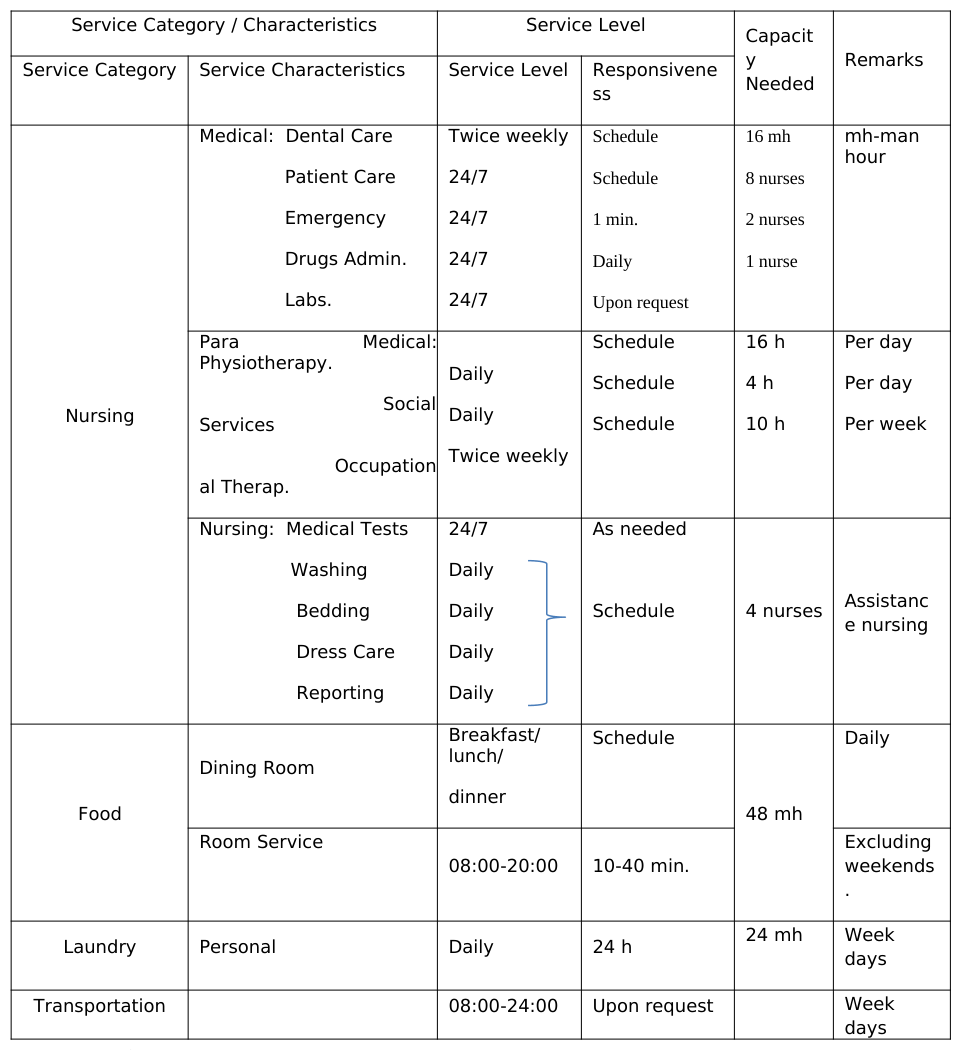
Table 1 presents a detailed BOS for a geriatric hospital showing all sub-levels based on the one-level BOS of Figure 1. In level 0, we define the hospital's services as a whole (service organization). Level 1 presents the service categories: nursing, housekeeping, food, security, transportation and laundry. We may then develop each category further, adding more levels as needed according to the service characteristics. Table 1 details the service characteristics for each service category, defines the service level with the relevant responsiveness and calculates the total capacity needed for each service characteristic. For example, the service category "Nursing" in level 1 is further developed to the level 2 service characteristics of Medical, Para medical and nursing. Figure 2 illustrates the characteristics for Medical services. Table 1 details for each service characteristics the service level (e.g. 24/7 or twice weekly) and/or the responsiveness assigned (e.g. 40 min for room service or upon request for transportation). Observing service category "Nursing" and service characteristics "Para medical" it may be noticed that Physiotherapy and Social services are scheduled daily where Occupational therapy is scheduled twice weekly. The definition of service level derives the resource capacity needed for each professional discipline. The main resource type is human resources but we should pay attention to physical resources like area needed for various activities or vehicles needed for transportation or material needed for occupational therapy. Also, it is clear that management may conduct simulations for different service levels and conduct the economic evaluation until finally decide what is the compatible service level.
This detailed example illustrates four steps of a generic methodology for defining the capacity of the various resources utilized when providing services: a. Define the service categories that the organization supplies (level 1).
b. For each category define the detailed characteristics of the services (levels 2, 3….).
c. For each service characteristic, define the service level/responsiveness (considering varying demand levels depending on time of the day, day of the week, or season).
d. For each service type, calculate the resource capacity (work force, equipment and technology) based on the service characteristics, the required service level and the demand.
Once management constructs a BOS, they may use it to run simulations to verify the quality of services delivered for a given resources capacity or the resource capacity needed to achieve a given service strategy.
GENERAL BOS APPLICATIONS - DISCUSSION Human Side of Service Engineering (2019)
The number of organizations that provide services is rapidly expanding. Examples include call centers, importers/exporters, law firms, clinics, health centers, fire departments, police stations, government services, restaurants, universities, schools, and hotels. Today’s manufacturing organizations are also heavily involved in providing services. These include quality assurance, inventory, production planning and control, costing, purchasing, inventory control, human resources, and warehousing. Figure 3 illustrates a general methodology of the service industry.
Table 1: BOS details for a geriatric hospital Service Level Service Category / Characteristics
The service process initiates with the customer who creates needs and expectations, and continues with the service provider that defines related service specifications based on company strategy and the service concept. For each service specification, we must define service characteristics, and for each set of service characteristics, we must assign the service level. Now we are at the stage where we can construct the BOS, enabling us to calculate resource capacity and the related costing.
Finally, we may check whether the constructed BOS complies with customer needs and expectations by conducting a survey to verify customer satisfaction
Customer
Customer
Needs Expectations
Service Specifications
Service Characteristics Service Level
Service Provider
BOS
Service Capacity Service Costing
Customer Satisfaction
Customer
Figure 3. General methodology of the service industry.
Figure available in the original PDF paper.
BOS IMPLEMENTATION IN SERVICE ORGANIZATIONS We chose to use a hospital as our example, but any type of service organization can implement the BOS management tool. These may include educational institutions and libraries; police departments; supermarkets; restaurants; transportation companies: airlines, trains, buses; law firms; banks; government services; municipal organizations; volunteer organizations; and charities.
As stated earlier, implementing the BOS method may support management in creating a service delivery infrastructure that ensures the customer gets what he needs, according to his expectations, at the right time and intensity, assuring effective usage of resource capacities (minimum idle resources).
Based on the organization's service strategy, management defines the service concept, and then develops the respective BOS as a step-by-step technical procedure. The strict analogy to a BOM is again relevant here. In manufacturing organizations, a product cannot be assembled without a reliable and accurate BOM. It assures that all the needed components are available at the right time and in the right amount, ensuring delivery to the customer of a specific order characterized by product type, quantity and delivery date. Service organizations benefit similarly through implementation of the BOS, which defines the right capacity for all resources in order to respond effectively to customers demand. As in manufacturing, the service organization may use subcontractors to deliver any or all of the services defined in the BOS.
CONCLUSIONS
The major purpose of a service provider is to satisfy customer needs and expectations. Customer needs should create service specifications and characteristics, and customer expectations must be fulfilled by the service level assigned.
Each of the service organizations mentioned above may create its own BOS that will support management decisions regarding capacity planning and costing for a given service specification.
We note that for any service characteristic, the related service level must have a quantitative figure. We cannot define service in relative terms such as "good" or "bad". Rather, service must be defined in terms of compliance (or non-compliance) with service specifications (both service characteristics and related service levels).
To the best of our knowledge, most service organizations do not specify or define written service specifications, related characteristics and the assigned service level for each service characteristic. Without defined service specifications and corresponding service levels, the organization has no professional way to plan and control the services provided to the customer. The result is that the organization must address customer complaints and service recovery activities.
The BOS is a valuable management tool for supporting the development of a reliable and appropriate infrastructure to deliver the right response at the right time to the customer. It is a planning and control mechanism enabling management to run simulations that will produce accurate answers to vital what/if questions. The managerial implications of implementing the BOS are very important for service organizations. It is a methodological and consistent managing tool enabling a professional design of the related services without missing any issue that may damage the service delivery process.
REFERENCES
Bitner, M.J. (1992), " Servicescapes: The impact of physical surroundings on customers and employees". JOURNAL OF MARKETING Volume 56 No. 2. Bitner, M.J., Ostrom, A.L., Morgan, F.N. (2008), "Service blueprinting: A practical technique for service innovation",
CALIFORNIA MANAGEMENT REVIEW Volume 50 No. 3.
Dietrich, B. (2006), "Resource planning for business services", COMMUNICATION OF THE ACM Volume 49 No. 7. Drejeris, R., Zinkeviciute, V. (2010). "Modelling of a new service concept development process", ISSUES OF BUSINESS & LAW Volume 2. Fitzsimmons, J.A., Fitzsimmons, M.J., Bordoloi, S.K. (2014), "Service management: operations, strategy, information
technology" (8th ed.) New York, N.Y.: McGraw-Hill. Furrer, O. (2005), "Service quality: Research perspectives", INTERNATIONAL JOURNAL OF SERVICE INDUSTRY MANAGEMENT Volume 16 No.4. Goldstein, S.M., Johnston, R., Duffy, J.A., Rao, J. (2002), "The service concept: the missing link in service design research?"
JOURNAL OF OPERATIONS MANAGEMENT Volume 20 No.2. Holmid, S., Evenson, S. (2008), "Bringing service design to service sciences, management and engineering", In: Service Science Management and Engineering: Education for the 21st Century, Hefley, B., Murphy, W., (Eds). pp.341-346. Johnston, R., Clark, G., Shulver, M. (2012), "Service operations management: Improving service delivery" (4th ed.) Essex,
England: Pearson. Karakostas, B., Zorgios, Y. (2008), "Engineering service oriented systems: a model driven approach", Hershey, PA: IGI Publishing. Ostrom, A.L., Bitner, M.J., Brown, S.W., Burkhard, K.A., Goul, M., Smith-Daniels, V., Demirkan, H. Rabinovich, E. (2010),
"Moving forward and making a difference: Research priorities for the science of service", JOURNAL OF SERVICE RESEARCH Volume 13 No. 1. Salvendy, G. Karwowski, W. (2010), "Introduction to service engineering", Hoboken, New Jersey: John Wiley & Sons. Sampson, S.E. (2012), "Visualizing service operations", JOURNAL OF SERVICE RESEARCH Volume 15 No. 2. Zeltyn, S., Mandelbaum, A. (2008), "Service engineering of call centers: Research, teaching, and practice", In: Service Science Management and Engineering: Education for the 21st Century, Hefley, B., Murphy, W., (Eds). pp. 318-327.
LISTED IN THE AHFE DIGITAL BOOKSTORE CATALOGUE
Explore the complete digital volume
Advances in The Human Side of Service Engineering
Read this individual research paper free through the original publisher, or explore the full digital proceedings book.
ISBN 978-1-4951-2091-6
Explore this ISBN in the AHFE Bookstore ↗Listed in the July 2026 bookstore catalogue; search by ISBN to confirm current availability · Digital book purchase optional