Emanuel Irrazábal, Juan M. Vara, Javier Garzás, Esperanza Marcos, Marcos López-Sanz (2019). Towards the Inclusion of Executive Coaching Concerns for the Improvement of Training in Service Development Companies. In: Advances in The Human Side of Service Engineering. AHFE Open Access, vol. 8. https://doi.org/10.54941/ahfe100278
Economic expansion and globalization have greatly increased the value associated to teamwork, thus promoting personal development and learning as distinguishing skills, especially in service development companies. This encourages workers to gain adaptability to changes due to a higher need of reaction capacity, particularly among supervisors and managers who demand more training according to their characteristics. In this regard, conducting in-company training is globally agreed as a possible solution. Such training activities are developed in a flexible way, varying both in the content and the level of the participants. Advanced training techniques such as mentoring or coaching (or its professional counterpart: executive coaching) have permitted the application of practices and processes that boost learning, improving the performance of the training. Although coaching has an individual focus, it also enhances the development of interpersonal skills such as leadership, assertiveness or teamwork, among others. This paper presents a statistical analysis of the evaluations conducted on a total of eight groups incorporating an in-company training activity performed in 2011. The work has focused on comparing assessments of participants in training for a large multinational company working in the field of service development. The main goal of the technical training was the improvement of service-software development processes incorporated in the company throughout the completion of various activities. These training activities were based on the application of executive coaching techniques so as to progressively improve the fulfilment of the expectations of the technical course. After the courses we analysed several evaluation questionnaires fulfilled by each of the participants in each group. The result of such analysis exposed a vast improvement in meeting the expectations of the training and even an overall improvement of the course.
INTRODUCTION AND MOTIVATION Economic expansion and globalization have greatly increased the value associated to teamwork. The tendency towards promoting collaborative work has thus encouraged personal development and learning as distinguishing skills (Zeus & Skiffington, 2001). This is especially important in service companies where interaction among stakeholders and governance interaction are key concerns for value co-creation (Spohrer et al. 2008). In addition, acquiring collaborative skills has been especially noticeable in the improvement of software development processes (Dyba, 2005). This entails constant changes and adaptations by workers, who demand more responsive and adequate training initiatives according to their characteristics (Sherman & Freas, 2004). Moreover, as mentioned in (Friday et al., 2004), the return on investment of proper training is now considered a valuable resource.
In this regard, conducting in-company training is usually acknowledged as a possible solution, with custom development of high-level training solutions varying in their content and in the flexibility of their formats. However, there still exist strong barriers to the incorporation of new knowledge in companies. The variable experience gained by workers derived from their daily activities in the company can be listed among other obstacles. We have Human Side of Service Engineering (2019) identified numerous factors that influence the degree of acquisition of knowledge by the employees of the companies including goal settings, collaborative problem solving issues, feedback obtained from participants, etc. (ICF, 2011).
The evolution of training techniques such as coaching (Sherman & Freas, 2004) or mentoring (Olivero et al, 1997) have permitted application of practices and processes that promote learning thus improving the performance of the training. In this context, one can find several alternatives based on different and novel techniques. Among them we have focused on coaching and, more specifically, on executive coaching. The International Coach Federation defines coaching as: “partnering with clients in a thought-provoking and creative process that inspires them to maximize their personal and professional potential” (ITF, 2011). As a consequence, coaching is closely related to learning activities in the way that it involves reflexion but more focused on the formulation of the appropriate questions rather than to the provision of answers (Sherman & Freas, 2004).
Although coaching has an individual focus, it generally aims to develop interpersonal skills such as leadership and teamwork, among others (Sherman & Freas, 2004). In fact, coaching is one of the personal development practices that have major impact not only over individual behaviours but also on business results, achieving a return of more than five times the cost of investment (Bunse et al., 2006). In business training environments, the technical content of the training is less important when the audience consists of managers with many years of experience in the same company. In that sense, giving feedback to participants and stimulating collaborative problem-solving (two basic aspects of executive coaching) are more important. According to (ITF, 2011) in executive coaching, students at a company have the opportunity to interact with teachers personally what creates a safer environment for deepening the knowledge acquired.
This paper presents a statistical analysis of the evaluations gathered from a total of eight groups that participated in in-company training experiments conducted in 2011. Throughout the various training activities, techniques associated with executive coaching were incorporated progressively. By doing so, it has been possible to check the effects of the addition of these practices in subsequent editions of the course. The results of the analysed data showed a vast improvement in the accomplishment of the training expectations and even an overall improvement of the course itself.
The following sections of the paper are organized as follows: Section 2 describes the conditions and characteristics of the training activities performed, the method used and the good coaching practices chosen to include in such activities. In Section 3 the evaluation method followed by students is described. Section 4 describes and analyses the results of the evaluations gathered from the students. It also includes the results related to the progressive inclusion of good practices from executive coaching. Finally, Section 5 concludes the article.
CHARACTERISTICS OF THE TRAINING ACTIVITY This section describes the insights of the training activity together with all the prior preparation as well as the good practices incorporated from the use of executive coaching techniques.
Description of the training activity As anticipated in the introduction, the training was carried out in eight groups with 7 to 10 participants. The courses were sequentially carried out between February and April of 2011, with a course per week. At the time of their participation, the 84 participants were working as managers and middle-level managers from a large multinational company working in the field of service development with over 1000 employees in the city of Madrid. Among the total participants, 40 were female and 44 male. The average age of the participants was 38 years old, with an average of 10 years’ experience. Figure 1 shows a graphical summary of this information.
The training target and goal has been the same for the eight groups: to take a course to improve service-oriented software development processes. The theoretical content and study material were identical for the eight groups, as well as the amount of time devoted to each of the theoretical sections. The methodology used was based on giving master classes for 3 days, 7 hours each, and conducted by an external consultant to the company. After the completion of the course, the participants completed an evaluation questionnaire which will be described later.
G1 G2 G3 G4 G5 G6 G7 G8 February -April
47,62% 52,38%
Participants:
84 people.
7-10 participants per group.
Average age: 38 years old.
Men Women
Figure 1. Overview of the training setting.
Figure available in the original PDF paper.
Situation before training and preparatory tasks Prior to the start of the course several interviews took place with the training supervisors of the company. During these interviews the risks of the training were analysed. The risks found were mainly two: rejection of training and lack of fulfilment of the expectations of the participants. Table 1 shows such risks together with additional information useful to cope with them (following the good practices recommended in (Thach, 2002)). The origin of these risks was primarily grounded on the completion of previous courses of poor quality. Also, it is important to remark that the aim of the preceding courses was to strengthen an organizational change undertaken by the company a few months ago. This fact could have increased the possibility of rejection and a lack of commitment.
Table 1. Risk of the training activities.
Table available in the original PDF paper.
Risks Occurrence probability Consequences Risk origin Lack of commitment of participants Medium High An average of one month annual courses. The course content often could not be used in everyday activities.
Not meeting the expectations of the participants High Medium Rejection of training for process improvement, as a threat to their way of working.
Apart from analysing the potential risks of a new training effort, before the start of the activities it was carried out an improvement and customization of the documentation. This way it was possible to ensure that the eight groups will be using the same documentation. Finally, a study of the potential good practices required to implement coaching techniques along the courses was conducted. These best practices will be explained later on.
Phases of the training activity A total of three phases were defined to study the impact of using executive coaching techniques for in-company training. The first phase involved two groups of training and the following two phases consisted of three groups each. The instructor has been the same for each of the groups during all the phases. Obviously, apart from having technical knowledge, the instructor had expertise on the executive coaching techniques to be employed.
The dynamics of the progression in use of good practices of coaching techniques during the training were as follows: during the first two groups of the training no issues associated with coaching good practices were added. Then, during the formation of groups 3, 4 and 5 two good practices, confidentiality and feedback, were added. Finally, during the formation of groups 6, 7 and 8, two additional good practices were added, goal setting and collaborative problem solving. All in all, the training was completed with the inclusion of four good coaching practices (see Figure 2).
February -April G1 G2 G3 G4 G5 G6 G7 G8
Phase2
Phase3
Phase1 + 2 best practices
+ 4 best practices
Master classes
Same instructor
Same general documentation
Gradual inclusion of coaching best practices
Figure 1. Phases of the training.
Figure available in the original PDF paper.
Choosing and applying best practices The best practices used in phases 2 and 3 of the training are explained next. To include these best practices in the training some explanations were decreased in time and detail, and some exercises were modified (Table 2 shows a summary of the implementation mechanism for each practice). In any case, the changes performed did not substantially modify the theoretical or practical content of the exercises used for the courses.
Table 2. Summary of implementation of coaching best practices. Best practice Application References Confidentiality Initial daily discussions to reinforce the idea of mutual confidence. Opinion questions during the exercises, to promote inner debates. (Paige, 2002) (Grant, 2003) (Stevens, 2003) (Gyllensten & Palmer, 2005) (Goldstein, 2001)
Table available in the original PDF paper.
Feedback Role-play games and exposition of personal experience from each of the participants. Feedback from all other participants.
(Paige, 2002) (Grant, 2003) (Stevens, 2003) (Wexley, 1991) (Reigeluth, 1999) Goal or target Establishing the objectives of each participant at the beginning of the course. Review the objectives at the end of each day.
Confidentiality According to many sources (Paige, 2002; Grant, 2003; Stevens, 2003; Gyllensten & Palmer, 2005; Goldstein, 2001), a crucial factor to achieve successful results in training is to keep the confidentiality between the coach (who directs the training) and the coachee (the person receiving the training). In the case of the presented training activities, confidentiality between the instructor and the participants was also considered a key aspect, especially taking into account the risk of lack of commitment from the participants. In this context, both (Grant, 2003) and (Gyllensten & Palmer, 2005) agree that an external instructor is more useful than one internal, because neutrality increases. Therefore, to achieve greater confidentiality, we opted for giving a short speech at the start of each day discussing the strict confidentiality of the course. Opinion questions were also included in the exercise sets to facilitate discussion plus gathering the opinions about the current activities of the organization. This way, we sought to improve the mutual confidence of the participants regarding the instructor.
Feedback Feedback refers to the provision of valuable information to the coachees derived from their efforts towards improvement. In some related articles, as in (Paige, 2002) or (Grant, 2003), feedback is considered as a positive aspect of coaching because it allows participants to be exposed to a constant evaluation. Also, Stevens (2005), Wexley (1991) and Reigeluth et al. (1999) refer to feedback as a positive practice.
In our case, groups 3, 4 and 5 of the training were the first ones using this good practice. To get benefits from feedback, role-play games were performed, adding questions about the experience gained in the exercises. The feedback obtained from participants in each group, throughout the activities and the role-playing, was shared in every group by all participants. Finally, discussions and opinions among participants were encouraged.
Goal or target setting According to Grant (2003) the process of coaching has the ultimate goal of helping coachees to regulate and guide their resources to achieve goals. Olivero, Bane, & Kopelman (1997) argue that the act of setting goals not only contributes directly to the process itself, but that it encourages the coachee to move forward. He advocates that the goals are useful, specific, measurable, assignable, realistic and time-bound (what is known as the “SMART model”).
For groups 6, 7 and 8, the initial and final talk of each day was changed to add the goal setting. Early in the course each of the participants were asked for individual goals, encompassing them to look for specific and realistic objectives. Finally, at the end of each day, they performed a review of the objectives.
Collaborative troubleshooting The main objective of this technique is to develop problem solving capabilities as a team from the active participation and mutual respect among team members (Brufee, 1998). Other authors have also included this best practice because of its importance (McGovern, 2001). This technique seeks to maximize collaboration between participants of a team, using an integrated environment, encouraging an active participation of each team member. It also enhances the exploration and analysis of content, encouraging diversity of views. This good practice is also quite used in the field of education (one example can be found in (Montgomery, 2004)).
In groups 6, 7 and 8 we added an exercise of brainstorming, promoting the respect for the turn of communicating ideas thus looking to foster a collaborative environment. Moreover, the end of each exercise was modified to incorporate debates and include the different views of the participants.
METHOD OF EVALUATION We now step on the explanation of the evaluation method before starting with the analysis of the results of the evaluations made by the participants. Upon completion of the three days of training, we handed out a survey among the participants consisting of 13 evaluation items. These items were divided into 3 different groups: evaluation of the performance of the instructor, usefulness of the course and evaluation of the documentation. The survey ended up with an additional item for overall course evaluation and a blank space left for additional comments. Regarding the scores of items, these ranged from 1 to 10, being 10 the highest.
The description of the features evaluated can be seen in Table 4. The first column shows the aforementioned categories followed, in a second column, by the description of the features in which each of them has been divided. The third column defines an identifier used to ease the subsequent process of analysis. Note that the last characteristic evaluated in the category of instructor also acts as an overall assessment of the entire category.
Once the surveys were handed out, the instructor left the classroom, thus reinforcing the premise of providing complete anonymity to the evaluation process. Evaluations were placed in an envelope without being seen and sent afterwards to a supervisor of the instructor for a further comprehensive analysis. This pursued to prevent changes in the content or bias in the form of interpretation.
Table 4. Description of the characteristics of the evaluation.
Table available in the original PDF paper.
Category Feature Ref.
Instructor
Clarity of exposition C1 Theoretical technical training of the instructor C2 Practical technical training of the instructor C3 Rhythm of exposure C4 Overall assessment of instructor C5
Course
Clarity of the course C6 Quality of content C7 Relationship to occupation C8 Fulfilment of expectations C9 Documentation Theoretical quality of documentation C10
Quality of documentation practice C11 Quality of practical exercises C12 General Overall evaluation of the course C13
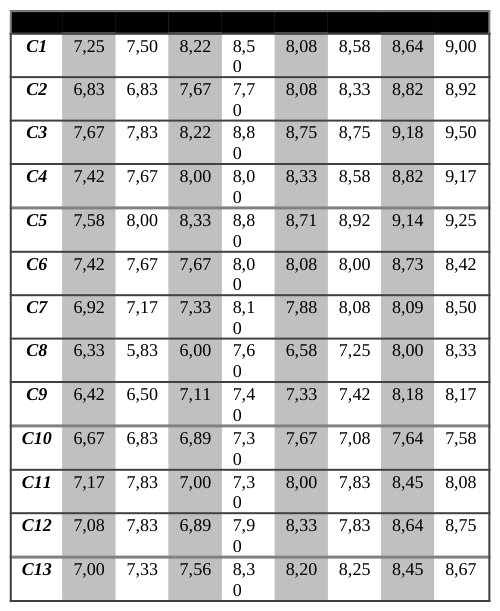
ANALYSIS OF RESULTS In the following we present the results of the evaluations of each participant group. The scores of each group, organized by items, are summarized in Table 5. Each column from G1 to G8 lists the average of the score given by the groups 1 to 8. This table reflects an increase in both the overall rating of the course (from 8.00 to 8.65) and the overall rating of the instructor (from 7.58 to 9.25) throughout the training. Moreover, it is possible to observe how the progress and expectation fulfilment have gained a similar growth rate, increasing by two points assessment.
Table 5. Summary of the evaluation scores.
Overall deviations between the global averages of the course, taking into account each individual feature and the global scores given by participants, have been also observed. This may be due to individual characteristics not taken into account in the evaluation but which are reflected in the overall evaluation. It may also be due to the weight that each participant gives to the individual characteristics that have evaluated the course. For example, the average score given to the characteristics of the instructor in the case of the first group (G1) is 7.29. When participants were instructed to evaluate the instructor, the note was 7.58.
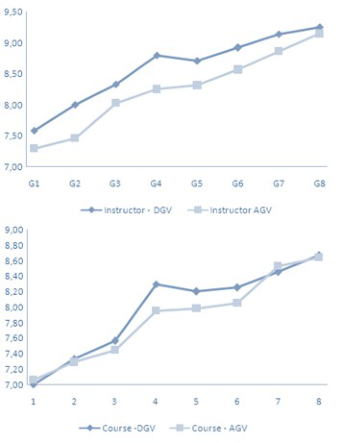
We have performed a further analysis by comparing the mean values and the standard values obtain in two of the characteristics evaluated for the overall evaluation of the course and the overall rating of the instructor. In both cases it can be seen that the detected score increase follows the same pattern. In general, the evaluations obtained by averaging features (C1 to c12, identified as AGV) is lower than the global rating directly obtained (C13, identified as DGV). This can be also noted when closely observing the evaluation of the instructor, shown in the upper graph of Figure 3.
Figure 3. Comparison of overall evaluations for the course and the instructor.
Figure 4 displays four graphs corresponding to the four global evaluations of the course and the instructor separated by phases (as indicated early in the beginning of this article). Each graph shows the average rating per phase. In such graphs we can clearly see the positive trend of the overall evaluation as it increases throughout the successive phases.
Figure 4. Comparison of averages and standard deviations between phases.
Figure available in the original PDF paper.
Threats to validation From the very first moment we have sought to minimize the potential threats within the framework of in- company training. We attempted to maintain independence between courses to prevent information leakage among the participants. As a result, no evidence of an in-depth knowledge of the course or the method of work by the late participants of the training course was found. Even though it is has been one of the clearest threats.
The use of the same instructor and the same documentation has attempted to provide homogeneity to the experiment. But it has also incorporated a new threat: the instructor was directly related to the activities of the company, which could lead to improvements in the sessions of the last groups. To mitigate this risk we explicitly sought to isolate the moments where good practice were included. Furthermore, the study also considers as a weakness the fact of being focused on a single company. Regarding that, we expect to overcome this threat and the work accomplished with new evaluations from different companies.
Finally, the results obtained are limited to an in-company training in a real company and do not represent a fully controlled experiment. In that sense it is important to take into account that at all times the research on including best practices from executive coaching has been framed in a real training environment. This issue may have affected the flexibility of the research activities performed.
CONCLUSIONS
The results found in the analysis of the evaluations indicate a clear relationship between the inclusion of good practices and the improvement of the evaluations. The changes have been significant, even reaching a difference of more than 2 points. It is also noteworthy that the course contained all the technical contents as contracted with the company and that the use of good coaching practices pursued the goal of improving the learning performance by participants.
One of the points of the analysis we would like to highlight, that has been also shown in previous works (see e.g. (Olivero et al., 1997)), is the large number of positive comments regarding the inclusion of good practices left on the blank section of the evaluation form by the participants. Although this has not been quantified throughout the article, it has been a remarkable issue during the analysis of the evaluations.
We have seen an increase in both the overall rating of the course (from 8.00 to 8.65) and the overall rating of the instructor (from 7.58 to 9.25) throughout the courses. Something that has caught our attention is the improvement in evaluation of the documentation, taking into account that any modification was made between groups. Therefore, we may conclude that the inclusion of good practices enforced the learning performance of the course (one of the risks identified in Table 1). Also, we see that the learning performance and fulfilment of expectations has shown a constant rate of growth throughout the training. Another remarkable result has been the difference between explicit (indicated by the participant) and implicit (obtained from averages) overall rating. The values of the overall characteristics were higher than that obtained as an average of the individual characteristics. This is a warning that affects the characteristics of the evaluation, which need to be revised to reduce this difference.
As future work, we can point out that new evaluations are being conducted currently, including other enterprises and other instructors. This will validate and assure the results obtained more firmly. We are also working on the study of the return on investment and productivity gained after training with good coaching practices.
ACKNOWLEDGEMENTS
This research has been partially funded by the Project MASAI (TIN2011-22617/TIN) from the Spanish Ministry of Science and Innovation.
REFERENCES
Brufee, K. (1998), “Collaborative Learning: Higher Education, Interdependence, and the Authority of Knowledge”, 2nd Edition, ISBN: 978-0801859748. The Johns Hopkins University Press. Bunse, C. et al. (2006), “Coaching Professional Software Developers - An Experience Report”, 19th Conference on Software
Engineering Education & Training (CSEET’06). pp. 123-130. Chapman, C. and Ward, S. (2003), “Project Risk Management: Processes, Techniques and Insights”, 2nd Edition, ISBN: 978- 0470853559, John Wiley & Sons. Dyba, T. (2005), “An Empirical Investigation of the Key Factors for Success in Software Process Improvement”, in: IEEE Trans.
Softw. Eng., Volume 31 No. 5, pp. 410-424. Friday, E. et al. (2004), “A reconceptualization of mentoring and sponsoring”, in: Management Decision, Volume 42 No. 5, pp.
628-644. Goldstein, I.L. (2001), “Training in organizations: Needs assessment, development, and evaluation”, 4th Edition, ISBN: 978- 0534345549, Wadsworth Publishing. Grant, A. (2003), “The impact of life coaching on goal attainment, metacognition and mental health”, in: Social Behavior and
Personality, Volume 31 No. 3, pp. 253-264. Gyllensten, K. and Palmer, S. (2006), “Workplace stress: Can it be reduced by Coaching?”, in: The Coaching Psychologist, Volume 2 No. 1, pp. 17. International Coach Federation (2011), “About Coaching”, http://www.coachfederation.org/intcoachingweek/ about-coaching/. McGovern, J. (2001), “Maximizing the Impact of Executive Coaching: Behavioral Change, Organizational Outcomes, and
Return on Investment”, in: The Manchester Review, Volume 6 No. 1, pp. 1-9. Montgomery, D. et al. (2004), “Engineering Statistics”, 4th Edition, ISBN: 978-0471735571, Wiley, 2004. Olivero, G. et al. (1997), “Executive Coaching as a Transfer of Training Tool: Effects on Productivity in a Public Agency”, in: Public Personnel Management, Volume 26 No. 4, pp. 461-470. Paige, H. (2002), “Examining the effectiveness of executive coaching on executives”, in: International Education Journal, Volume
3 No. 2, pp. 61-70. Reigeluth, C. et al. (1999), “Instructional design theories and models: A new paradigm of instructional theory”, 1st Edition, ISBN: 978-0805828597, Routledge. Sherman, S. and Freas, A. (2004), “Wild West of Executive Coaching”, in: Harvard Business Review, Volume 82 No. 11, pp. 71-
81. Stevens, J. (2005), “Executive Coaching from the Executive´s Perspective”, in: Consulting Psychology Journal: Practice and Research, Volume 57 No. 4, pp. 4. Spohrer, J. and Maglio, P. P. (2008), “The emergence of service science: Toward systematic service innovations to accelerate co-
creation of value”, in: Production and Operations Management, Volume 17 No. 3, pp. 1–9. Thach, E. (2002), “The impact of executive coaching and 360 feedback on leadership”, in: Effectiveness, Leadership & Organization Development Journal, Volume 23 No. 4, pp. 205-214. Wexley, K. (1991), “Developing and training human resources in organizations”, 2nd Edition, New York, Harpen Collins, pp.
73-80. Zeus, P. and Skiffington, S. (2001), “The Complete Guide to Coaching at Work”, 1st Edition, ISBN: 978-007470842, McGraw- Hill Book Company Australia.
LISTED IN THE AHFE DIGITAL BOOKSTORE CATALOGUE
Explore the complete digital volume
Advances in The Human Side of Service Engineering
Read this individual research paper free through the original publisher, or explore the full digital proceedings book.
ISBN 978-1-4951-2091-6
Explore this ISBN in the AHFE Bookstore ↗Listed in the July 2026 bookstore catalogue; search by ISBN to confirm current availability · Digital book purchase optional