Alfonso Siano, Maddalena Della Volpe, Clara Bassano, Maria Palazzo, Gennaro Romano (2019). Applying Ingredient Branding Strategy to Improve Competitiveness in Service Systems. In: Advances in The Human Side of Service Engineering. AHFE Open Access, vol. 8. https://doi.org/10.54941/ahfe100291
Intangibility is one of the main characteristics of services that create difficulties for users in perceived expectations of service. This viewpoint paper aims to highlight the role played by Ingredient Branding (IB) a strategy implemented to make service more effective. Thus, the paper focuses on the role IB plays in shaping the strategic communications. Starting from a literature review on Service Dominant Logic, Service Science Management Engineering + Design, Strategic Communication and IB, the role of this activity is studied within the service systems context. Then, in order to reach the goal of the paper, secondary sources were exploited generating qualitative data: illustrative examples show the practical use of IB strategies in the service systems. The main implication of the paper lies on the analysis of the important strategic work implemented by the members of the dominant coalition. The paper identifies two different IB strategies: “necessary” and “optional”. It shows that there are links between service levels (expected-core service or extended-supplementary service) and IB strategies. By dealing with these links effectively, it appears that IB is a strengthening strategy that could offer distinct competitive advantage in service systems, promote the value proposition and encourage the value co-creation.
Branding theory has been developed mainly in the context of consumer products, yet most economies are characterised by companies selling services instead of products. Understanding how branding works in service markets is consequently, a priority. In this paper some of the distinctive features of ingredient branding (IB) (Siano et al., 2009) – a basic concept of branding management – are discussed in order to understand their process of evolution in the service sector.
Starting from this theoretical standpoint, the paper collocates IB strategy in the context of service branding, Service- Dominant Logic, Service Science Management Engineering and Design (SSME+D) and Strategic Communication (see Figure 1). Then we consider IB as a special form of alliance that enables service branding to be implemented. Subsequently, the paper presents indications on the state of the art and developments by means of illustrative examples.
The aim of the paper is to highlight the role played by IB strategy in order to make services more tangible. It is well known that intangibility is one of the main features characterizing services and contributes to creating barriers in terms of perceived consumer expectations of promised services. The paper aims to suggest a new perspective that considers IB implemented by firms mainly involved in the service sector.
Service-Dominant
Service Science
Logic
Strategic Communication
Management Engineering and Design (SSME+D) Service Branding
Ingredient Branding
Figure 1. Theoretical steps to reach IB (Our elaboration) A definition of IB in the service sector is presented in the paper, thus narrowing the gap in service and branding literature. In this respect, the following research questions are: - it is possible to explore the role of IB in the service sector? - it is possible to implement the IB strategy to make services more tangible, reducing the perceived risk experienced by users? - it is possible to identify the specific corporate communication tools used by service companies? To these research questions, the paper tries to answer in the following sections.
Figure available in the original PDF paper.
FRAMEWORKS FOR APPLYING INGREDIENT BRANDING STRATEGY TO IMPROVE COMPETITIVENESS IN SERVICE SYSTEMS Service-Dominant Logic
The service-dominant (S-D) logic has provided impetus for developments in the field of marketing and at the same time it highlights the importance of co-creating a more marketing-grounded consideration about exchange/value. As scholars and researchers have pointed out, one of the most interesting factors discussed in the debate about S-D logic is that services are no longer considered as a particular kind of intangible element (in antithesis with goods) but, they are presented in a goods-dominant (G-D) logic term. For this reason, often, authors refer to the singular ‘service’ in S-D logic, “indicating a process of doing something for someone, rather than the plural ‘services’, implying units of output as would be consistent with G-D logic” (Lusch et al., 2008: 6). In brief, S-D logic presents a new perspective that may address the never-ending debate focussed on goods versus services. Actually, it supposes that there is no difference between goods and services; therefore, service is noting else that a good used in “service provision”. Taking into consideration the S-D logic, service seems to be the fulcrum of exchange and value creation; thus, there is no good-versus-service war according to S-D logic.
Moreover, several researchers have highlighted the fact that S-D logic seems to be based on a description of service that conflicts with established definitions. However, the new definition of service as “the application of specialized skills, through deeds, processes, and performances for the benefit of another entity or the entity itself” could be easily considered fully consistent with previously accepted ones. Actually it shows numerous similarities with Grönroos classification of services as: “processes consisting of a series of activities where a number of different types of resources are used in direct interaction with a customer, so that a solution is found to a customer’s problem” (2000: 48). Both statements pinpoint that service has some G-D logic feature. Furthermore, the idea of service being the essential concept of exchange/value involves that the company, as a whole, has “to provide service to stakeholders, including customers, stockholders, and employees” (Lusch and Vargo, 2006). In addition, Service Science, the study of service system, combines organization and human understanding with business and technological understanding to categorize and explain the types of service systems that exist as well as how service systems interact and evolve to co-create value (Maglio and Spohrer, 2008).
Starting from these considerations, in the next paragraph, the paper focuses on the important role played by Service Science Management Engineering and Design, Strategic Communication, service branding and ingredient branding in sustaining and implementing the presented S-D logic.
Service Science Management Engineering and Design (SSME+D) Service Science, Management, Engineering, and Design (SSME+D), or Service Science (SS) for short, is built on the top of Service Dominant (S-D) Logic and provides a framework for studying service systems by means of complex systems in which value exchanged is produced by various co-operating actors. In fact, these human-serving systems or service systems are the diverse, interconnected, complex systems that we live in, we study, and we work to change to benefit ourselves and future generations of humanity.
As an IBM research initiative, Service Science can be qualified as the study of diverse, interconnected, complex human systems in which value is co-created through different governance interaction (IfM and IBM, 2008). Furthermore, SS tends to promote a new discipline capable of responding (theoretically and practically) to the emergent research issue on Service Systems. The interdisciplinary project, deriving from studies on Computer Science (Spohrer et al., 2007), Human Behaviour (Mc Clelland, 1975) and on Organizational Theory (March, 1991) aims to sustain the concept of a new and better world which is socially, technologically and economically linked. In this respect, SS, starting from SDL, shifts to meet the needs of the society of Tomorrow; a society, based on the logics of a “systems of system” where the parts and not the parties are crucial and where the logics of role predominate (who does what for).
Service Systems represent sophisticated entities of value and knowledge which, seen as an extensive population of stakeholders interact on a cooperative basis to generate social and competitive advantage to be shared amongst customers, providers, authorities, competitors (Spohrer and Kwan, 2008; Gummesson, 2002, 2009). This implies that Service is none other than the result of applied competence (knowledge, expertise, resources, relationships) to generate benefits for other entities (Lusch and Vargo, 2004, 2008).
Growing competitiveness, the difficulty of the G-D logic to guarantee substantial and marked elements of differentiation and consequently, of distributional value, have embraced the relational-systems perspective in which value is seen as the synergistic result of inter-systems sharing and cooperative processes between structurally consonant and resonant actors in terms of objectives. In other words, value is not seen from a partial perspective of corporate benefit or in favour of other stakeholders, but rather in a global sense (whole value) the capability of the System to generate satisfaction and benefits both personal and for other entities (Golinelli et al., 2010).
“Applied expertise (skills and knowledge) for the entity itself (system)” (Maglio and Spohrer, 2008a; 2008b), necessarily shifts the perspective of analysis of value to where the goods themselves are interpreted as “mechanisms/objects of service distribution” (Lush and Vargo, 2004) and services as effective configurations of processes capable of differentiating and generating value for the stakeholders (Gummesson, 2002). The SSME+D approach furthermore acknowledges the value of human resources that guarantee competiveness and revitalize service systems even during recession.
In this perspective, to improve competitiveness, it is essential applying Ingredient Branding (IB) to service system which means that the offer is not merely focused on product and tangible benefits, but on the product, tangible benefits and intangible ones (in other words, service). In this situation, components co-evolve regardless of political changes and time factors (Spohrer et al., 2010).
Strategic Communication Recently, systematic corporate governance and strategic communication have become fundamental issues in the agenda of managers, scholars and communication practitioners (Goodman, 2006; Invernizzi and Romenti, 2009).
In both management and corporate communication fields, scholars seem to be focussed on how to manage mutually beneficial relationships inside and outside the company (Grunig et al., 2002). This concept highlights the fact that the company is a social institution that generates value, in economic and social terms (Hall, 1993; Gupta, 2011; Shin et al., 2012) as it is also highlighted in Service Systems. This situation helps to understand why there is a renewed discussion about what role communication plays in a company (Goodman, 2005; Burchell and Cook, 2008). This topic leads to an integrated governance system: “Taken as a whole, this network of relationships constitutes a ‘governance system’ for the modern corporation” (Post and Carroll, 2006: 133), in which dialogue is the basis.
As has been noted, dialogue is the essence of corporate communication (CC). Actually, communicate with stakeholders has several positive consequences: it decreases conflicts, decreases risks and enhances assurance (Burchell and Cook, 2006: 163-166). Thus, strategic communication creates commitment and could generate positive organisational behaviour not only in the main company but also in its partners. This perspective inevitably implies that communication managers need to be aware of the nature and strategic role of communication (Holm, 2006; Hallahan et al., 2007; Van Riel and Fombrun, 2007; Cornelissen, 2008). Moreover, as many researchers suggest, they should be totally involved in all strategic decisions arranged in a company (Grunig et al., 2002; Goodman, 2006). When this happens, it creates a bidirectional communication that leads to an authentic dialogic practice in which all parts involved express theirselves and do their best to create a sustainable competitive advantage (Steinmann and Zerfa, 1993; Baum, 2004; Stoker and Tusinski, 2006; Raupp and Hoffjann 2012). These considerations lead to a communication-oriented organization, rather than to an organization in which communication helps to guide and influence all major decision making processes (White and Mazur, 1995; Dolphin and Fan, 2000; Bowen, 2009; Johansson and Ottestig, 2011). In this situation, governance, particularly communication activity, needs, a well established and harmonized management of communication relationships with various stakeholder groups (Van Riel and Fombrun, 2007; Cornelissen, 2008; Michael, 2012).
In particular, the paper focuses on the role Ingredient Branding (IB) plays in shaping the strategic communications (McCarthy and Norris, 1999; Desai and Keller, 2002; Lorange and Roos, 1992).
LITERATURE REVIEW ON SERVICE BRANDIG AND INGREDIENT BRANDING (IB) Few research contributions have been published on service brands despite the fact that a service economy is developing today. Literature evidences that services have typically salient features, but to date, their implications for brand management have not been fully explored, especially in terms of achieving brand management goals thanks to strategic alliances. To understand how successful service brands can be developed and sustained, the paper argues that there is a link between branding services and the concept of IB, as a particular form of alliance. It appears that on the basis of brand management through strategic alliances, inspiration for service brand strategies can be evoked. Consequently, by taking IB into consideration, ways of limiting the problems of intangibility and heterogeneous quality can be found and opportunities for relationship building identified.
However, debate on product-service differences persists (Berry and Leonard, 1980; Blankson and Kalafatis, 1999; Berry and Leonard, 2000) and it is generally accepted that services can be difficult to identify because of the fact that they are intangible on both a mental and physical plane (Levitt, 1981; Rushton and Carson, 1985). In particular, discussion focuses on the fact that services are, different from products (Gronroos, 1990; Murray and Schlater, 1990; Cunningham, Lawrence, Young, Clifford and Moonkyu Lee, 1997;) and are characterized by numerous features, such as: intangibility, inseparability production/consumption, different degrees of quality and perishability (Rathmell, 1966; Shostack, 1977; Gronroos, 1978; Rushton and Carson, 1985; Bateson, 1995).
Starting from these observations on service brands, several authors have considered inseparability production/consumption an opportunity (Onkvisit and Shaw, 1989; Norman and Ramirez, 1994) to concretize the concept of prosumer, a new kind of consumer who takes part in the creation of services as a co-producer of value and consequently, of brand too (Priporas and Poimenidis, 2008).
As concerns intangibility, it is important for companies to transform this feature by attributing a brand to their services, based on a solid corporate identity thus bringing to mind functional and emotional values (Heskett, 1987; Kotter and Heskett, 1992; Fournier, 1998; Melewar and Storrie, 2001). In addition, it is generally perceived that “tangible products differ in that they can usually, or to some degree, be directly experienced-seen, touched, smelled, or tasted, as well as tested. Often this can be done before buying” (Levitt, 1981: 96). On the contrary, services (intangible products) “can seldom be tried out, inspected, or tested in advance” (Levitt, 1981: 96).
Furthermore, in order to reduce differences in quality, it might be useful for companies in a preliminary phase to transmit to staff, values that are aligned with the brand (Kunde, 2000) then strengthen such cultural values by means of training programmes and communicational processes (Schein, 1984; Murray and Schlacter, 1990; Lovelock, Vandermerwe and Lewis, 1999). This could compensate for the fact that services cannot be standardized, as products can (Rathmell, 1966; Sasser, 1976).
Finally, as regards perishability, it is clear that good reputation linked with strong brand awareness might be a successful way of solving this problem.
Literature tends to focus either on the existence of pure products and/or services (Shostack, 1977; Gronroos, 1978) or as a continuum that links them (Rathmell, 1966). This also involves considerations about service brands. According to Levitt (1981) customers do not buy products/services, but have different expectations which could be considered a mix of tangible and intangible components connected, in other words, to functional and emotional values typical of brands. Although it is clear that a different approach is needed in managing service branding, this does not imply that the brand with its specific functional and emotional values, differs as concerns product and service sectors (de Chernatony and Dall’Olmo Riley, 1999).
The paper attempts to explore the service theory in terms of its implications for branding taking into specific consideration IB and its importance for building service brand. The point is that service brands, treated thanks to IB, shape something that, to some extent, is tangible. This challenging opportunity to convert an intangible element to a tangible one, is related to the fact that intangible service organisations involve numerous tangible resources as well. examples are catering and insurance for airplane companies and spa centres for hotel companies, etc.. According to de Chernatony: “the relevance of intangibility in service organisations is not the ratio of intangibles to tangibles required to provide the service. It is instead, about the way that good customer service is achieved and how the expectations of the brand promise are fulfilled” (1999: 21). For a service company this occurs by means of another of its key characteristic: the inseparability of production/consumption. In fact, the service is perceived as satisfactory when the customer experiences what is known as a “service encounter” (Bowen, Chase and Cummings, 1990; de Chernatony and McDonald, 1998). The latter, influenced by the attitudes and motivation of the service company staff, creates a balance between tangible and intangible resources in several specific service companies. It is fundamental consequently, that the brand and its values are accepted by the staff of the service company considering that service brands depend significantly on such acceptance.
According to the most recent service branding literature, the focus is shifting away from information and knowledge towards connectivity and relationships. The implication is a need to look at service branding from different theoretical perspectives that consider managing brand services by implementing strategic alliances between different brands (Ohmae, 1989; Lorange and Roos, 1992; Parkhe, 1993; de Chernatony, 1993; Dall’Olmo Riley and de Chernatony, 2000). A consistent brand provides a real alternative for service companies desiring differentiation (Melewar and Otubanjo, 2007). In fact, entities within Service System exchange competence along at least four dimensions: information-sharing, work-sharing, risk-sharing and goods-sharing. Services, in Service System approach, hence, are valuable because of their features in terms of co-creation, configuration of people, technology, value proposition connecting internal and external service systems and shared information. In sum, service is the application of competencies for benefit of others (Maglio and Spohrer, 2008).
In this context, the paper argues that a strong brand alliance can play an important role in services through reducing consumer perceived risk and overcoming low levels of trust (Mitchell and Greatorex, 1993; Mitchell and McGoldrick,1995). Among the different promotional alliances, IB plays a key role (Norris, 1992; Desai and Keller, 2002). IB is a special form of alliance between two brands, based on firm cooperation in designing and delivering the product, with particular emphasis on the recognition and identification of the components used in the end product (Pfoertsch and Mueller, 2006; Luczak et al., 2007). IB is an accepted marketing device (Norris, 1992; Dover, 1997) although its significance has only started to emerge (Kotler and Pfoertsch, 2006). In today’s global economy, companies have to establish and maintain competitive advantage, create commercial success in the market and provide criteria to differentiate them from the competition (Trinquecoste, 1999).
Until recently, the focus was on tangible, but has now shifted towards intangible resources, such as brands
(Carpenter et al., 1994) and customer loyalty. For this purpose, companies and organizations favour branding efforts that create value for both consumers and companies. This has also had an impact on service marketing, where the fundamentals of IB apply. To succeed in finding customers for intangibles it is important to create surrogates (metaphors, similes, symbols) for tangibility (Levitt, 1981). For this reason, in today’s fast-changing markets scenario, IB is becoming a major marketing strategy as demonstrated by the increasing number of products sold with embedded branded components. For Levitt brand promise, implemented also thanks to IB, could resolve the paradox about this specific feature characterizing services: “the most important thing to know about intangible products is that the customers usually don’t know what they’re getting until they don’t get it” (1981: 100).
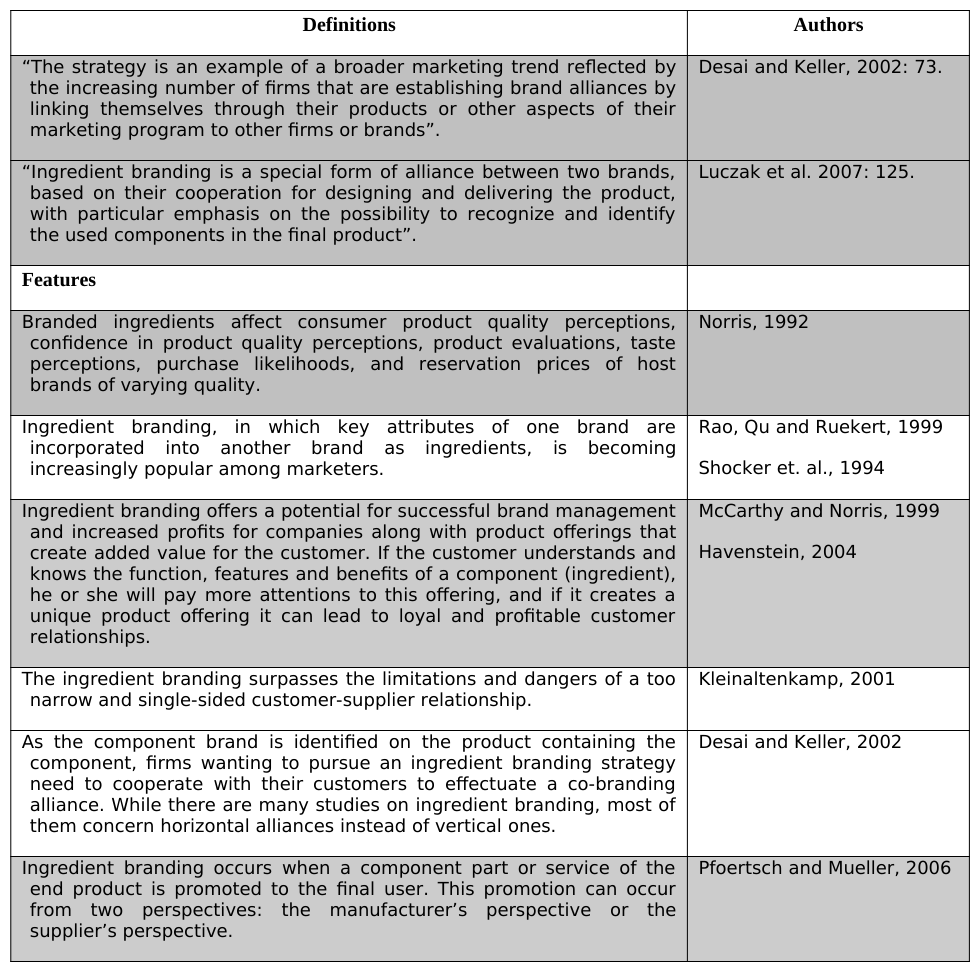
To clarify the relative concepts and characteristics linked to IB, the main features are outlined in Table 1 below:
Table 1. An overview of Ingredient Branding definitions and features Definitions Authors
The elements highlighted in grey in Table 1 were selected as specifically suitable for our analytic study on IB.
In short, this alliance is cemented when a component part or service of the end product is promoted to the final user. Evidence would appear to indicate that branded ingredients affect consumer product quality perceptions, product evaluations, likelihood of purchase and reservation prices of host brands of varying quality (Norris, 1992). Certainly, if the customer understands and knows the function, features and benefits of a component (ingredient), he will pay more attention to this offer, and if it creates a unique product offer it can lead to loyal and profitable customer relationships (Desai and Keller, 2002). Promotion can be from two perspectives: the manufacturer’s or the supplier’s (Pfoertsch and Mueller, 2006).
Furthermore, even if authors focus on manufactures – and therefore only take into account products - the paper highlights the fact that IB can benefit not only them but service providers too.
FINDINGS: SOME EXPLORATORY CASES VIGNETTES Starting from the premise that it can be difficult for users to estimate the value of intangible services, it is important that they identify tangible signs of the intangible (Rushton and Carson, 1985). In this context, the IB makes tangible the perceived consumer expectations (Rushton and Carson, 1985).
In the service sector IB can assume different features depending on whether service, considered as an ingredient, refers either to core (basic) service components or to supplementary (additional and or auxiliary) service components (Grönroos, 1982; Normann, 1984; Eiglier and Langeard, 1987). This study presupposes that the expression core service corresponds to the expression service “expected” in the product level model (Levitt, 1980) or better, refers to all those attributes and characteristics that customers expect to receive from a required service. It concerns basic irrenounceable elements of the service that users know are available thanks to technological progress, safety rules and standard quality of life levels. A core service is, therefore, the basic promise that companies make to customers (Grönroos, 1982; McDougall and Levesque, 2000). Not guaranteeing a core service in its minimal levels of expected quality means that service companies do not reach the minimal standard level necessary for competing in the market. In other words, when the service, considered as an ingredient, is an integral part of the promised core service offered, IB plays a “fundamental” role because the ingredient service brand is useful for strengthening perceptions of tangibility and reliability and the promise of core service quality, essential for the competitiveness of the offer. In short, IB allows customers to identify corporate partners and allows for consequently, the traceability of the service, a guarantee factor for potential customers. Figure 2 shows that there is a link between IB in its quality of essential strategy and expected service level with respect to core service components.
Figure 2. Links between service levels and IB strategies (Our elaboration)
Figure available in the original PDF paper.
For instance, the insurance available and meals served on board for passengers who have to take a plane or a train could be considered components of the core service that travellers expect to receive when they use the service. Companies involved in the transport sector service (e.g. Alitalia, Eurostar) and hotel chains (e.g. NH Hotels) apply IB to increase confidence in the core service thanks to the use of supplier brand image, or in specific cases, thanks to the insurance available and food served.
Aerea Italiana S.p.A. (Italian for Alitalia - Italian Air Company), is an Italian airline, which bought assets as a result of the liquidation process of the old Alitalia Company - Linee Aeree Italiane and the Company Air One. On January 2009, Air One and Alitalia began the process of merging their networks, their fleets and their entire administrative and commercial structure. The new Alitalia is run by private entrepreneurs who are well versed in quality of service and close attention to customers’ needs. For this reason, Alitalia has clinched a successful IB alliance with the Group Chef Italia, particularly with the Society AIR Chef 2000. Started in 1995 as part of the Group Chef Italia, the Society AIR Chef 2000 is a leader in the sector of in-flight catering and retail catering. Both the allied companies are fully aware that quality of service and close attention to customers’ needs are essential for them to succeed and grow. Indeed, the new Alitalia and Society AIR Chef 2000 share the same main inspiration: passengers are the focal point of the company development strategy. Offering both a complete service that provides not only flight service but also particular Italian cuisine, they show their commitment to providing top quality services on board so that every travel experience is characterized by a distinctive touch of Italian style. With regard to the co-branding activities put in place by both brands, Alitalia and Society AIR Chef 2000 have communicated their alliance through press releases and corporate web sites. Moreover, specific determinants have played a role in this particular IB strategy. One of these is the previous existing strategic relationships between Alitalia and Society AIR Chef 2000 that started in 1995. This strategic relationships was expressed thanks to a core theme coherent to corporate mission and value system of the two companies.
Eurostar is the high-speed rail service directly linking the UK to France and Belgium via the Channel Tunnel. It started operating in 1994, providing city centre to city centre services. Eurostar has chosen Mondial Assistance to offer its customers travel insurance solutions tailored to their individual needs. Mondial UK is a leading provider of assistance and third party travel insurance administration, conducting business with or on behalf of major blue chip companies. In terms of IB, this concerned Belgium, France and the UK with a potential to insure up to 7.85 million passengers choosing to cross the English Channel with Eurostar during 2006. Considering potential goals thanks to IB, Mondial Assistance have created an insurance offer that enables customers to purchase their insurance on the www.eurostar.com website at the same time as they book their trip. Eurostar and Mondial Assistance both have an excellent reputation and their expertise in e-commerce is widely recognised in Europe. It is therefore perfectly natural that Eurostar chose Mondial Assistance to implement IB. Thanks to IB, in fact, they can offer all their passengers – businessmen, families, skiers – very attractive insurance solutions and policies specifically adapted to their needs. Concerning the co-branding activities employed, both companies, Eurostar and Mondial Assistance have communicated their partnership through press releases and corporate web sites. In addition, several factors have influenced the IB strategy implementation. The previous existing strategic relationships between Eurostar and Mondial Assistance that began since Eurostar started operating in 1994. Moreover, the two companies decided to communicate to their publics trough a core theme coherent to their corporate mission and values.
The NH Hotels Group ranks third in the European business hotels classification. NH Hotels stands out in quality both as regards services and facilities, intended to please all tastes, uniform, and making the customer feel comfortable. The restaurants are another priority for hotels in the chain, offering customers first-rate cuisine. Furthermore, the prestigious restaurateur Ferrán Adriá has entered into an IB agreement with NH Hoteles, launching new concepts such as “nhube”, pioneering spaces in the hotel sector combining food, leisure and rest for the chain’s customers and with “Fast Good”. Ferran Adriá, the famous Spanish chef is regarded as one of today’s great innovators of world cuisine. “Fast-Good”‘s gastronomic offer is simple and highly innovative as are the ingredients it uses for making traditional fast-food meals have until now only been used in haute-cuisine. Thanks to this IB alliance, NH Hotels, Ferrán Adriá and Fast Good are providing a number of areas which make the entire service functional and dynamic. Consequently, the service offered could be seen as a pioneering concept in the hotel world, which combines eating, leisure and relaxation for hotel guests, in other words, a revolution in the hotel sector. The first hotel destined to have an “nhube” will be NH Balboa, in Madrid – a pilot project for testing the new product, which will be adapted to meet the requirements of the guests and to reflect their suggestions and recommendations. “nhube” will subsequently be installed in other hotels belonging to the chain. Actually, the implementation of this IB strategy was influenced by the preliminary communication made by NH Hotels to reach Ferrán Adriá and Fast Good in order to involve them into promotional alliances
Novotel is an international brand of contemporary hotel designed for living. It is one of a number of hotel chains owned by the French hotel group Accor. Novotel is introducing innovative Internet areas in its hotels: the “Web Corner on a Mac” with 24-inch iMacs. Web Corners on a Mac are the result of the implementation of a joint IB strategy between Novotel and Apple in order to offer a useful supplimentary service to their customers. Clients will have free access to the Internet, in 20-minute sessions, to all desktop functions. The first “Web Corner on a Mac,” in the lobby of the Novotel Budapest Congress, was a huge success. In two months over 6,000 connections were made, equal to 100 per day. Moreover, in 2003, Novotel and Orange, a key brand of France Telecom, one of the world’s leading telecommunications operators, joined forces to provide high-speed Internet access in more than 1,300 hotels across France operating under the different Accor brands. Thanks to this IB, Accor customers in France have high-speed Internet access at their disposal in lobbies, bars, meeting rooms and some guestrooms. Since October 2007, a further 220 hotels have extended their network coverage and are now totally WiFi-enabled, offering Internet access in all guestrooms and public areas. In addition, the partnership has expanded to include 50 hotels in Belgium and 80 in the United Kingdom. As part of its partnership with Orange, Accor offers its services to Orange mobile phone subscribers in France. In fact, customers can now book a room at any Accor hotel in the world simply by dialling 711 (travel section) from France. With regard to the co-branding activities put in place by Novotel and Apple, they are communicated thanks to press releases. While, Novotel and Orange communicate their alliance through their corporate web sites.
However, on the contrary, when IB plays an “optional” role there is a different scenario; especially, where the core service is practically identical for all competitors, the choice of users can be influenced by the supplementary services offered. In this circumstance, the brand of the ingredient service is used to strengthen the perception of tangibility and reliability and the promise of quality of supplementary service components. Figure 1 shows that there is a link between optional IB and extended service level concerning supplementary service components. These components can make the core service more attractive to customers because they mean differentiating offers. In actual fact, they define the “extended” service, as additional services that distinguish the service companies’ offer compared to other competitors. A service company can decide, therefore, to implement IB in order to strengthen the perception of tangibility of the “extended” service and to reinforce its traceability elements; two favourable effects that improve a service company’s strong points and consequently increase its competitiveness factor. Examples of optional IB are developed in the hotel sector, where players tend to take advantage of the brand image of ICT suppliers (e.g. Novotel) and of fitness suppliers (e.g. NH Hotels) to differentiate optional services available at their hotels.
The NH Hotels Group has created another IB alliance with Elysium. The Elysium Spanish centre specializes in hydrotherapy, fitness and beauty. It is the hallmark of NH hotels and defines a new way of experiencing the hotel services, linking them with hydrotherapy centres, health and beauty, spas, massages, muscle therapy and specific treatments. Through their joint strategy, Elysium and NH Hotels have created places where the most important thing is to achieve high standard levels of relaxation, health and well being. For this reason, companies have opened similar centres in Marbella (Hotel NH Alanda), in Seville (Hotel NH Central Convenciones) and in Madrid (Hotel NH Eurobuilding). With regard to the co-branding activities put in place by NH Hotels, Ferrán Adriá and Fast Good, they have communicated their alliance through press releases and different sections of corporate web sites. As concerns the co-branding created by NH Hotels and Elysium, this is presented to customers in a section of both corporate web sites. In actual fact, NH Hotels Group and Elysium IB strategy was influenced by the previous existing strategic relationships between partners; the preliminary comakership communication made by NH Hotels to reach its partner in order to put into practice co-branding and then the core theme of the messages coherent to corporate mission and value system.
The secondary data concerning the case histories presented in this section were selected from company literature, company profile documents, press releases and content of web sites.
PRACTICAL IMPLICATIONS AND FUTURE RESEARCH The intangibility of services necessitates the use of symbols, metaphors and other rhetorical devices of reality to render services more tangible and to raise customer perception and expectations of the promised service in advance. The main symbol used by service company is brand. It is largely assumed, that for a service company, its brand is a tool that enables greater customer perception of tangibility as the brand represents the organization which produces and supplies the service. Based on this premise, the central idea on which the paper focuses is that service companies should take advantage of this strategy considering that as thanks to IB, companies strengthen customer perception of tangibility enabling them to perceive promised service in advance. The reason for this could be due to the fact that the service is made more tangible by using at one and the same time, several symbols (brands). One consequence of the application of IB for service companies is that customer trust is increased not only because of the greater perception of tangibility created by the combined use of these symbols but also thanks to the fact that the positive perception of their own brand with brands of service component suppliers is strengthened. In effect, applying IB allows service companies to lever at the same time on their own brand image and on brand images of service component suppliers. Moreover, it is worth remembering that service companies could also take advantage of applied promotional alliance strategies in terms of sharing the costs incurred in implementing co-branding. Starting from the proposed analysis, several important practical implications for service companies could be underlined. About advantages of IB, it is necessary that managers of service companies develop skills to implement this strategy. However, the mayor managerial implications involve the optional IB strategy. Actually, applying this strategy, managers of service companies not only could make the service more tangible and reduce perceived risk experienced by users with regard to core services, but also, they could reach a more incisive positioning of supplementary services. In this way, they could differentiate the offer in comparison with competitors. Managers, in order to do better, have to take into consideration several relevant factors which play a very important role in implementing IB strategy. The examples show that three are the main factors: (1) the previous existing strategic relationships between partners; (2) the preliminary communication made by partners in order to involve all of them into promotional alliances (co-branding alliance); (3) the core theme of the IB strategy coherent to corporate mission and value system of involved service companies. In addition, the examples illustrated in the study, show, nevertheless, that IB is applied by means of an extremely limited number of communication media. These case histories show clearly that service companies use only two - press release and corporate website – communication tools to implement their IB strategy. Future research could verify whether these tools are widespread generally in other service companies and should this be the case, it could be useful to analyse if this potential underutilization of communicational tools could potential affect or not the efficacy of IB.
REFERENCES
Bateson, J. E. G., Hoffman, K. D. (1999),“Managing services marketing” (4th ed.). Chicago: The Dryden Press. Bateson, J. (1995),“Managing Services Marketing”. London: Dryden Press. Baum H. (2004), “The transparent leader: How to build a great company through straight talk, openness, and accountability”.New York:Harper Business. Berry, L. (1980). “Services marketing is different”, BUSINESSVolume 30 No. 3. pp. 324-29 Berry, L. (2000).“Cultivating service brand equity”, JOURNAL OF THE ACADEMY OF MARKETING SCIENCEVolume28
No. 2. pp. 128-137 Blankson, C., Kalafatis, S. (1999). “Issues and challenges in the positioning of service brands: a review”, JOURNAL OF PRODUCT & BRAND MANAGEMENT Volume 8 No. 2. pp. 106-118 Bowen, D., Chase, R., Cummings, T. (1990). “Service Management Effectiveness”. San Francisco: Jossey Bass Publishers. Bowen S.A. (2009). “What communication professionals tell us regarding dominant coalition access and gaining membership”,
JOURNAL OF APPLIED COMMUNICATION RESEARCH Volume 37 No. 4. Boyd, H.W., LevyS.J. (1963), “New Dimensions in Consumer Analysis”, HARVARD BUSINESS REVIEWVolume 41 November-December. pp. 129-140 Burchell J., Cook J. (2008), “Stakeholder dialogue and organisational learning: changing relationships between companies and
NGOs”, BUSINESS ETHICS: A EUROPEAN REVIEW Volume 17 No. 1. pp. 35-46 Carpenter, G.S., Glazer, R., Nakamoto K. (1994).“Meaningful Brands from Meaningless Differentiation: The Dependance on Irrilevant Attributes”, JOURNAL OF MARKETING RESEARCH Volume 31August. pp. 339-350 Cornelissen, J. (2008), “Corporate communication. A guide to theory and practice”. London: Sage. Cunningham, L.F., Young, C.E., Moonkyu, L. (1997).“A Customer-Based Taxonomy of Services: Implications for Service
Marketers”, ADVANCES IN SERVICES MARKETING AND MANAGEMENT Volume 6. pp.189- 202 Dall’Olmo Riley, F., de Chernatony, L. (2000), “The service brand as relationship building”, BRITISH JOURNAL OF
MANAGEMENT Volume11 No. 2. pp. 137-150 de Chernatony, L. (1993). “Categorising brands: evolutionary processes underpinned by two key dimensions”, JOURNAL OF MARKETING MANAGEMENTVolume 9 No. 2. pp. 173-188 de Chernatony, L., Dall’Olmo Riley, F. (1999). “Experts’ views about defining services brands and the principles of services
branding”, JOURNAL OF BUSINESS RESEARCH Volume 46 No. 2. pp. 181-192 de Chernatony, L., McDonald M. (1998). “Creating Pozverful Brands in Consumer, Service and Industrial Markets”. Oxford: Butterworth-Heinemann. Desai, K.K., Keller, K.L. (2002). “The Effects of Ingredient Branding Strategies on Host Brand Extendibility”, JOURNAL OF
MARKETINGVolume66 No. 1. pp. 73-93 Dolphin P., Fan Y. (2000). “Is Corporate Communications a Strategic Function?”, MANAGEMENT DECISION Volume 38 No. 2. Dover, J. (1997), “Adding Value through the “Intel Inside”Brand”, in: Customer Value: Moving Forward—Back to
Basics,Donath, B. (Ed.), ISBM REPORT. pp.29–31 Eiglier, P., Langeard, E. (1987),“Servuction”. Paris: McGraw-Hill. Fournier, S. (1998). “Consumers and their Brands: Developing Relationship Theory in Consumer Research”, JOURNAL OF CONSUMER RESEARCH Volume24 / Mar. pp. 343-373 Golinelli, G.M., Spohrer J., Barile S., Bassano C. (2010), “The evolving dynamics of service co-creation in a viable systems
perspective”, Proceedings ofThe 13th International Conference in Coimbra, Portugal, September 2-4. Goodman M.B. (2005). “Restoring trust in American business: the struggle to change perception”, JOURNAL OF BUSINESS STRATEGYVolume 26 No. 4. pp. 29-37 Goodman M.B. (2006).“Corporate communication practice and pedagogy at the dawn of the new millennium”, CORPORATE
COMMUNICATIONS: AN INTERNATIONAL JOURNAL Volume 11 No. 3. pp. 196-214 Gronroos, C. (1978). “A service-orientated approach to marketing of services”, EUROPEAN JOURNAL OF MARKETING Volume 12 No. 8. pp.588-601 Grönroos, C. (1982).“An Applied Service Marketing Theory”, EUROPEAN JOURNAL OF MARKETING Volume 16 No. 7.
pp. 30–41 Gronroos, C. (1990),“Service Management and Marketing”. Lexington: Lexington Books. Gummesson, E. (2002), “Total Relationship Marketing”. Oxford: Butterworth-Heinemann. Gummesson, E. (2009), “Marketing As Networks: The Birth of Many-to-Many Marketing”. Stockholm:PublishingHouseDjursholm. Heskett, J. (1987). “Lessons in the service sector”, HARVARD BUSINESS REVIEWVolume 65/ Mar-Apr. pp.118-126 Hallahan K., HoltzhausenD., van Ruler B., Verčič D., Sriramesh, K. (2007).“Defining Strategic Communication”, INTERNATIONAL JOURNAL OF STRATEGIC COMMUNICATION Volume 1 No. 1. Holm O. (2006).“Integrated marketing communication: from tactics to strategy”, CORPORATE COMMUNICATIONS: AN
INTERNATIONAL JOURNALVolume 11 No. 1. IfM, IBM. (2008). Succeding through Service Innovation: a Service Perspective for Education, Research, Business and Government. Cambridge. United Kingdom: University of Cambridge Institute for Manufacturiong. ISBN: 978-1-902546-65. Johansson C., Ottestig A.T. (2011).“Communication executives in a changing world: Legitimacy beyond organizational
borders”, JOURNAL OF COMMUNICATION MANAGEMENTVolume 15 No. 2. Kleinaltenkamp, M. (2001),“Ingredient Branding: Markenpolitik im Business-to-Business-Geschäft”in: Köhler, R. Majer, W., Wiezorek, H. (Eds.). München: Erfolgsfaktor Marke. pp.261-270 Kotler, P. andPfoertsch, W.A. (2006), “B2B Brand Management”. New York, NY: Springer. Kotter, J. and Heskett, J. (1992), “Corporate Culture and Performance”. New York: The Free Press. Kunde, J. (2000), “Corporate Religion”.London: Pearson Education. Levitt, T. (1980). “Marketing success through differentiation of anything”, HARVARD BUSINESS REVIEW, Jan-Feb.pp. 83-
91 Levitt, T. (1981). “Marketing intangible products and product intangibles”, HARVARD BUSINESS REVIEW, May-Jun. pp.
94-102 Lorange, P., Roos, J. (1992),“Strategic Alliances: Formations, Implementation and Evolution”. Oxford: Blackwell. Lovelock, C., Vandermerwe, S., Lewis, B. (1999),“Services Marketing”.London: Prentice Hall Europe. Luczak, C.A., Pfoertsch, W., Beuk, F., Chandler, J.D. (2007).“In-Branding: Development of A Conceptual Model”, ACADEMY OF MARKETING STUDIES JOURNALVolume 11 No. 2. pp.123-135 McCarthy, M.S., Norris, D.G. (1999).“Improving competitive position using branded ingredients”, JOURNAL OF PRODUCT
AND BRAND MANAGEMENT Volume 8 No. 4. pp. 267-285 McDougall, G.H.G., Levesque, T.J. (2000).“Customer satisfaction with services: putting perceived value into the equation”, JOURNAL OF SERVICES MARKETINGVolume 14 No. 5. pp. 392 – 410 March, J. (1991). “Exploration and Exploitation in Organizational Learning”, ORGANIZATION SCIENCE Volume2 No.1.
pp.71-87 McClelland, D.C.A. (1975),“Competency model for human resource management specialists to be used in the delivery of the human resource management cycle”. Boston: McBer. Miles, R. E., Snow, C. C. (1984). “Designing Strategic Human Resources Systems”, ORGANIZATIONAL DYNAMICS No. 13. Melewar, T.C., Storrie, T. (2001).“Corporate Identity in the Service Sector: A Case Study”, PUBLIC RELATIONS
QUARTERLYVolume46 No. 2. pp.20–26 Melewar, T.C., Otubanjo, T. (2007),“Corporate Brand Differentiation in the Financial Services Industry”, in: Dinnie, K. and
Heinemann,B. (Eds.). Nation branding: concepts, issues, practice. Oxford: Butterworth Heinemann. Michael J.M. (2012).“Strategic Communication and Social Media: An MBA Course From a Business Communication Perspective”, BUSINESS COMMUNICATION QUARTERLYVolume 75 No. 1. pp. 89-95 Mitchell, V.W., Greatorex, M. (1993). “Risk perception and reduction in the purchase of consumer services”, THE SERVICE
INDUSTRIES JOURNALVolume 13 No. 4. pp. 179-200 Mitchell, V.W., McGoldrick, P.J. (1995). “Consumer risk reducing strategies: a review and synthesis”, INTERNATIONAL JOURNAL OF RETAIL, DISTRIBUTION AND CONSUMER RESEARCH Volume 6 No. 1. pp. 1-33 Murray, K., Schlacter, J. (1990).“The impact of services versus goods on consumers’ assessment of perceived risk and
variability”, JOURNAL OF THE ACADEMY OF MARKETING SCIENCE Volume18 No.1. pp. 51-65 Normann, R. (1984), “Service Management: Strategy and Leadership in the Service Business”. Chichester: Wiley. Normann, R., Ramirez, R. (1994),“From Value Chaw to Value Constellation: Designing Interactive Strategy”. Chichester: John Wiley. Norris, D.G. (1992).“Ingredient Branding: A Strategy Option with Multiple Beneficiaries”, JOURNAL OF CONSUMER
MARKETING Volume 9 No.3. pp. 19-31 Ohmae, K. (1989).“The global logic of strategic alliances”,HARVARD BUSINESS REVIEW / Mar-Apr. pp. 143-54 Onkvisit, S., Shaw, J. (1989).“Services marketing: image, branding and competition”, BUSINESS HORIZONS / Jan-Feb. pp.
13-18 Parkhe, A. (1993).“Strategic alliance structuring: a game theoretic and transaction cost examination of inter-firm cooperation”, ACADEMY OF MANAGEMENT JOURNAL Volume 36 No. 4. pp.794-829 Pfoertsch, W., Mueller, I. (2006), “Marke in der Marke Ingredient branding”. Springer. Post J.E., Carroll T.D. (2006), “Governance and the stakeholder corporation: new challenges for global business”, in:
Transformations in global governance: implications for multinationals and other stakeholders, Edward ElgalPublising, Cheltenham,Vachani, S.(Ed.). pp. 120-145 Priporas, C.V., Poimenidis, I. (2008).“Services managers’ awareness of crisis management: attitudes and preparation”, INNOVATIVE MARKETING Volume 4 No.3. pp. 37-45 Rao, A.R., Lu, Q., Ruekert, R. (1999).“Signalling Unobservable Product Quality through a Brand Ally”, JOURNAL OF
MARKETING RESEARCH Volume 37 / May. pp. 258-268 Rathmell, J. (1966).“What is meant by services?”,JOURNAL OF MARKETINGVolume 30 / October. pp. 32-36 Raupp J., Hoffjann O. (2012).“Understanding strategy in communication management”, JOURNAL OF COMMUNICATION MANAGEMENT Volume 16 No. 2. pp. 146-161 Rushton, A.M., Carson, D.J. (1985).“The Marketing of Services: Managing the Intangibles”, EUROPEAN JOURNAL OF
MARKETINGVolume 19 No. 3. pp. 19-40. Sasser, W.E. (1976). “Match Supply and Demand in Service Industries”, HARVARD BUSINESS REVIEW / Nov-Dec. pp. 133- 141 Schein, E. (1984).“Coming to a new awareness of organizational culture”, SLOAN MANAGEMENT REVIEW/ Winter. pp. 3-
16 Shocker, A.D., Srivastava, R.K., Ruekert, R. (1994).“Challenges and Opportunities Facing Brand Management: An Introduction to the Special Issue”, Journal of Marketing ResearchVolume 31/ May. pp. 149-158 Shostack, G. L. (1977).“Breaking Free from Product Marketing”,JOURNAL OF MARKETING Volume 41/ Apr. pp. 73-81 Spohrer, J., Kwan, S. K. (2008). “Service Science, Management, Engineering, and Design (SSMED): An Emerging Discipline -
Outline & References”, INT. JOURNAL OF INFORMATION SYSTEMS IN THE SERVICE SECTOR Volume 1 No. 3. Spohrer, J., Maglio P.P., Bailey J., GruhlD.(2007).“Steps Toward a Science of Service Systems”, IEEE COMPUTER Volume 40 No. 1 / January. pp. 71-77 Spohrer, J., Maglio, P. P. (2008). “The emergence of service science: Toward systematic service innovations to accelerate co-
creation of value”,PRODUCTION AND OPERATIONS MANAGEMENT Volume 17 No. 3. pp. 1-9 Spohrer, J.C., Golinelli, G.M., Piciocchi P., Bassano, C. (2010). “An Integrated SS-VSA Analysis of Changing Job Roles”, Service Science Volume 2 No. 1 / 2. pp. 1- 20 Siano A., Palazzo M., Confetto M.G. (2009),“Ingredient branding: A strategic lever of the emerging Dual Marketing
Communications”, Proceedings of the Conference on Marketing - Putting Marketing in its Place; 6-9 July 2009, Leeds, UK: LeedsMetropolitan University. Steinmann H., Zerfa A. (1993).“Corporate dialogue – a new perspective for public relations”, BUSINESS ETHICS: A EUROPEAN REVIEWVolume 2 No. 2. pp. 58-63 Stoker K.L., Tusinski K.A. (2006). “Reconsidering public relations’ infatuation with dialogue: Why engagement and
reconciliation can be more ethical than symmetry and reciprocity”, JOURNAL OF MASS MEDIA ETHICSVolume 21 No. 2-3. pp. 156-176 Trinquecoste, J.F. (1999).“Pour une clarification théorique du lien marketing-stratégie”, RECHERCHE ET APPLICATIONS EN MARKETING Volume 14 No. 1. pp. 59-80 Vargo, S.L., Lusch, R.F. (2004). “Evolving to a New Dominant Logic for Marketing”, JOURNAL OF MARKETING Volume
68. pp. 1-17 Vargo, S.L., Lusch, R.F. (2008). “Service-dominant logic: continuing the evolution”, JOURNAL OF THE ACADEMY OF MARKETING SCIENCE Volume 36 No. 1. pp.1-10 White J., Mazur L. (1995), “Strategic Communication Management”. Wokingham:Addison-Wesley.
LISTED IN THE AHFE DIGITAL BOOKSTORE CATALOGUE
Explore the complete digital volume
Advances in The Human Side of Service Engineering
Read this individual research paper free through the original publisher, or explore the full digital proceedings book.
ISBN 978-1-4951-2091-6
Explore this ISBN in the AHFE Bookstore ↗Listed in the July 2026 bookstore catalogue; search by ISBN to confirm current availability · Digital book purchase optional