Paolo Barile, Sergio Barile, Clara Bassano, Paolo Piciocchi, Marialuisa Saviano, James Clinton Spohrer (2023). T-Shaped Professional (T-SP) Model to support Human-Machine Interaction. In: The Human Side of Service Engineering. AHFE Open Access, vol. 108, pp. 90–101. https://doi.org/10.54941/ahfe1003110
Researches and studies did not investigate in deep the importance to develop T-shaped skills and techniques for aligning human machine learning (Spohrer, Banavar, 2015) and to design more intuitive machine interfaces. Recently, in this direction, we can find some efforts with regards to the introduction of innovative approaches in education programs inspired by the T-Shaped Model (Barile and Saviano 2021; Saviano et al., 2017a; 2017b; Barile et al., 2015; 2015a). Thus, the aim of the paper is to explore the interpretative contribution of the VSA proposal of the T-Shaped Professional (T-SP) representation, to reconceive human-machine interaction in order to understand the characteristics that people must have to interact effectively (Barile et al., 2019; 2021; Bassano et al., 2020; 2021). Given our purpose, we refer to the trans-disciplinary approach based on Service Science (SS) and Viable Systems Approach (VSA) as methodological frameworks for highlighting the VSA contribution to frame the use of the revised T-Shaped Professionals (T-SP) Model – in which vertical expertise is combined with horizontal and cross-sectional knowledge (Maglio & Spohrer, 2008; Demirkan & Spohrer, 2015; Freund 2018; Moghaddam, Demirkan, and Spohrer 2018; Gardner & Maietta 2020) –, in the emerging context of the digital transformation where workforce’s personal and intellectual habits are challenged (Piciocchi et al., 2017; 2018; 2019). The paper could offer interesting insights for debating on the need for an actualized T-SP model that should be characterized by a proactive attitude, creativity and change management orientation. This assumption is coherent with the increasing demand for workers whose social emotional learning skills are crucial and not yet susceptible to computerization (Frey, C.B. and Osborne, 2017). This implies the need to understand why and how each person can access the rapidly growing digital workforce by reconfiguring own professional shape.
In the digital age, people and other service system are responsible entities: to become more conscious and explicit according to the learning investments.
T-Shaped Professional (T-SP) Model to Support Human-Machine Interaction 91
In fact, all responsible entities are constantly learning (AKA “upskilling”) by tacitly investing in exploration (doing things in new ways) and exploitation (doing things in habitual, entrenched, routine ways) (March, 1991; Spohrer, 2021). In this scenario, the needed change is hard because people have skills in a specific specialized knowledge domain and style of life (historical experie- nce) and this represents an inertia for change: in other words, the radicalized professional experience reflects on social life as difficulty:
1) to adapt or re-configure/re-structure own professional shape; as thus 2) to give response to how ensure to himself and relatives livelihood?
Undoubtedly, social and technological evolution requires to people would need to upskill for new opportunities of the digital scenario, and that is no simple in concrete.
Today, the need for workers has to be focused on a process of structuring of professional shape characterized by a coherent use of the Knowledge, Skills and Abilities (KSA) Model (Bloom, 1956) in respect of digital perspective: a) to discover our attitude (what I like to do/to be); b) to invest on learning for improve knowledge; c) to build capacities and competences according the T-Shaped professio- nal (hard and soft skills).
However, this means policy makers will have to define adequate projects and routes and an education policy aimed at preparing T-Shaped Professio- nals (T-SP) of the future for promoting a suitable the virtuous and circular orientation between humans and machines. At the same time, universities and researchers can play a key role by engaging with policy makers to design sustainable human-centred service systems (smarter and wiser); to favour the emerging learning investment focused on individual attitudes; to drive for new knowledge creation, stimulating quality of life progress for everyone, including the weakest in society.
From this scenario, it emerges that despite the increasing effort for introdu- cing innovative approaches in education programs inspired by the T-Shaped Model (Saviano et al., 2016; Barile et al., 2015), recent researches show few attempts in the direction of investigating the importance to develop T- shaped skills and techniques for aligning human machine learning (Spohrer & Banavar, 2015). Given our purpose, in the following section, we propose a Service System Based View (SESY bv), a trans-disciplinary approach based on Service Science (SS) and Viable Systems Approach (VSA) as frameworks for rethinking the actual T-Shaped Professionals (T-SP) Model, in which vertical expertise is combined with horizontal and cross-sectional capacities (Maglio & Spohrer, 2008; Demirkan & Spohrer, 2015; Freund 2018; Moghaddam, Demirkan, and Spohrer 2018; Gardner & Maietta 2020), considering the impact of the digital transformation on workforce’s personal and intellectual habits that is now gradually underway (Piciocchi et al., 2019; 2018; 2017). Then, as this is a first attempt to highlight the need to look for better models to support human-machine interactions and change in business and society, we discuss future directions and implications as much work has to be done.
METHODOLOGY: THE SERVICE & SYSTEMS BASED VIEW (SESY BV) According to the Service & Systems Based view (SESY bv) (Golinelli, 2010; Golinelli et al. 2010; Golinelli & Bassano, 2012; Barile & Polese, 2010; Maglio & Spohrer, 2008; Spohrer 2018), complex digital age requires people adequate in particular specialization and collaboration availability.
The problem that becomes is in which manner it is possible to image a governance configuration able to pilot the digital system and guarantee the collectively and inclusivity between traditional workers and the new digital profiles. This requires that sustainable viability of the complex digital service system imply a governance re-configuration - conceptual and operative - use- ful to manage a polycentric system characterized by a plurality and diversity of subjects with new and more functional specificities in order to withstand the challenge of digital modernity. It is which we call “governmentality” (Foucault, 2002).
Governmentality - achievable through a process of concertation, inclusi- veness, collaboration and bottom-up co-finalization - is conceived, on one hand as a specific and innovative method of policy making, and on the other hand as dynamic and complex process aimed at promoting collective social and economic well-being in the digital transition.
In this perspective, governmentality represents the ability to produce deci- sions consistent with the new digital paradigm, develop effective policies and implement programs that are able to broaden consensus and involve a diversity of actors/talents in the decision-making process (Piciocchi et al., 2012). The theoretical approach of governmentality (multi-level governance) is guided by a strategic-functional orientation of a polycentric matrix; it descri- bes the interpenetration between multiple decision-making levels and the interfusion between different operational specificities (Talents/T-Shaped Pro- fessionals). From a professional point of view, the multiplicity of the actors and/or of the distributed and coordinated capacities allows integration and cooperation in the complex processes of problem solving; in another sense, the construction of a participatory polycentric structure, in which the diffe- rent human capacities are put into a system with for developing skills distribu- ted throughout the whole service system (Spohrer et al, 2010:10), constitutes the socially and economically correct approach to face the challenges of the digital.
In this paper, we focus the analysis in two directions:
- how digital age changes the shape of professionals? - in which way we have to image the needed skill for supporting the human- machine interactions?
Giving a response to these questions means, in other words, to underline the relevance of the human adaptation profile to new expectation (Spohrer et al., 2010) for skills coherent with digital scenario.
The reason why we propose the Service System Based view (SESY bv) is that service and system based scientific communities seek to understand and interpret value co-creation logics in the digital age, integrating resources/w- orkers across human cultures, academic disciplines, and industrial/technical
T-Shaped Professional (T-SP) Model to Support Human-Machine Interaction 93
systems. Until now, however, value producing has been increasingly seen as an outcome of more powerful technical capacities, as it is for Artificial Intelligence (AI): Focus on AI and on its smart performance. Few studies put attention on the role of AI in value co-creation taking a humans-centred per- spective. Recent studies (Barile et al., 2021) with the aim of covering this gap, introduced an innovative view of value co-creation in the digital age in which this value co-creation empowers the humans’ skills. Specifically, an innova- tive concept of Intelligence Augmentation (IA) emerges (Barile et al., 2019; 2021; Bassano et al. 2020; 2021) to envision a possible positive impact of the use of AI on humans in terms of augmented wise decision making capabili- ties in conditions of complexity. Essentially, the issue is about how value is co-created in the digital era on the basis of human-machine interaction when AI is used and when the value to be co-created must serve human purpo- ses for the benefit of people, organization, and the whole planet, certainly not machines. Certainly, with the introduction of the IA perspective, new intelligent systems can be studied as entities in network systems implemen- ting cognition-as-a-service; this impact both occupations that aim to increase problem solving capacity, and occupations that aim to increase the systems’ wisdom and decision making capabilities (Spohrer & Banavar, 2015). In fact, AI rarely replaces an entire job, process or business model. More often, AI automates a task and therefore can be viewed as a complement to human activities. The most effective rule is giving certain types of tasks to machi- nes, while people lead and manage processes, while becoming more effective and efficient: designing and implementing new combinations of technologies, human skills, and financial assets to meet social and economic needs requires, then, human creativity and planning (Brynjolfsson and McAfee, 2017) and augmented performances.
In the digital age, two capacities are increasing their relevance: connectivity and upskilling. According these two characteristics, scientists, researchers, but managers too, discuss for predicting “if” and “in which way” human could survive to machine, preserving identity and control. In our opinion, in the next future will be complex that machines replace humans at all; this becomes more plausible in work activities that imply simultaneous capabilities in unpredictable decision-making and operational scenarios.
T-SHAPED PROFESSIONAL MODEL IN THE DIGITAL AGE The goal of companies is to reduce costs thanks to IT, scale networks to bet on business value and growth and change the direction of the business, to face instability and uncertainty deriving from supply chain problems as taught by the latest recent world events, from the Russian-Ukraine, to digital skills shortages and the energy crisis.
In this context, rather than cutting costs, companies need to accelerate the digital transformation to consolidate: improving company resilience, increasing employee confidence and skills and scaling towards new digital solutions through products and vertical offers. To achieve these results, we have to consider technology in terms of sustainability and adaptive survival of organizations both from a production point of view and from a wor- king point of view: the goal, therefore, is to improve the work approach,
culture and training, ensuring adaptability – as we said before, connectivity and upskilling – to be suitable to digital contexts.
Linked to human-machine interaction, another problem captures the inte- rests: the digitized world requires new professions with high-level skills; this increases concern for traditional professional profiles and operating techniques, or rather for the probable increase in the un-employability of low- skilled and innovative workers. Without any doubt, this underlines even the re-configuration problem – where it will be possible of course – of traditional workers and this aspect makes much more difficult the wishful sustainable human-machine interaction.
AI and Digital Age take off opportunities for new professions but not few risks for traditional ones. If we accept that AI could help to create innovative work shapes, humans have to use exploiting their potential, certainly not abdicating in absolute (machine substitution effect with respect to humans). This means we have to interpret AI in two manners:
1) AI as antagonistic; 2) AI as complementary.
In the digital age, the coherent way to have a balance in human-machine interaction is inherent with the potential and eclecticism of humans themse- lves. While acknowledging AI’s deterministic and computational capabilities that are incomparable to the human mind, man can, and must, seeks, thanks to his ability to adapt proactively, the solution that allows him not to “suffer” the change induced by the machine.
So, as a consequence, the questions are:
- in which way can we reduce the fading danger of the human-system into the machine cyber-system? - what are the Skills Set that people must have to interact effectively with smart machines realizing the wise evolution of service systems?
It seems shareable, then, to reflect on the potential adaptation human capa- cities which, like in the past, have always allowed humans to maintain their vitality and, as we can say, their ability to manage change.
Adaptation for change is based on often invisible but highly critical characteristics; for individuals and organizations this means acting on the mentality, skills and tools. In particular, professional profiles mentality – manager or not - influences the perception of the opportunities and threats of a strongly evolving and ganging context to which skills try to give a performing response.
Mentality is the cognitive scheme through which adaptive subjects (T-Shaped Professionals in Digital Age) read and interpret change: the men- tality of an innovator, if proactive, is able to shape the reference context, creating value for itself and for the context too.
Mind-set for innovation implies growth of possibilities, flexibility of analy- tical approach and the ability to modify ideas based on new perceptual and experiential information. While reasonableness induces passive adaptation (logic of stringent linear causality), the curiosity and focus on learning of the innovator allow proactive adaptation (logic of systemic circular causality).
T-Shaped Professional (T-SP) Model to Support Human-Machine Interaction 95
The two characteristics allow us to state that the adaptive subject interprets phenomena and acts in the context in not necessarily predictable manner.
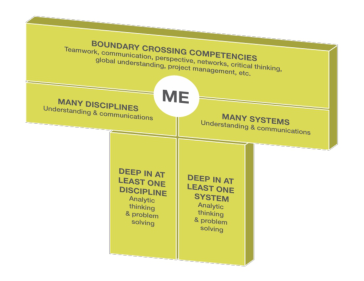
As we know as you can see from Figure 1, T-Shaped Professionals profile is built on two abilities:
- vertical dimension (hard skill) are considered teachable skills or skill sets, such as computer programming, knowledge of physics...in other words, degree and /or formal specialization; - horizontal dimension (soft skill) refers to problem solving, communica- tion, team working skills...these are skills of a personal and subjective nature.
Hard skills are more replaceable by AI than soft skills. The former are structural and defined, the latter are systemic and unpredictably behavioural.
Then, T-Shaped Professional represents the adaptive profile able to gua- rantee human-machines interactions equilibrium. People will need both emotional and social intelligence as well as increased technology- assisted rational intelligence to create a wise system. While rational intelligence and technical/hard skills are useful for verifying reliability of a result produced by intelligent machines, the social and emotional intelligences (Goleman, 1995) serve to verify the context adaptability of the solutions suggested by the machines.
In fact, they ensure the development of: i) intrapersonal (emotional) skills: understanding of one’s own values, awareness of one’s knowledge/awareness, flexibility, self-management; ii) interpersonal skills (social): relationships with others (including intelli- gent machines), understanding of other people’s values/empathy, active listening/communication, cooperation; iii) inter-generational skills for thinking long-term about the implications of today’s decisions to future generation, especially decisions that impact the resilience of next generations (ability to rapidly restart from scratch after catastrophes).
Figure 1: T-shaped skills (Freund, 2018).
What has been described therefore underlines an important aspect: resili- ence as the characteristic of each individual to resist or adapt positively to changes in the context (Soanes & Stevenson, 2005).
Adaptive resilience can be declined in:
- emotional resilience; - thinking resilience.
Emotional resilience, whose ingredients are social relationships and per- sonal emotions, is useful for managing the physiological responses to threats and challenges.
Thinking resilience, whose ingredients are elasticity and flexibility to change, serves instead to assume a positive attitude in the face of problems and criticalities.
T-Shaped Professionals (T-SP) resilience does not only imply knowing how to resist the pressures of the surrounding environment; in fact, it also implies a positive dynamic, an ability to “go beyond” despite the difficulties linked to Digital Age, in general, and human-machine interactions.
And this is all the more the true if we consider, as Kaplan says (1976), proactive adaptation resilience of the T-SP not only as a “process”, i.e. as the mutation and the reciprocal influence that is created between the various risk and protection, but also as a “result”, that is, as a physical and mental element that is not affected by adversity.
The T-SP resilience is therefore a system capable of reacting to the unex- pected of the AI, enduring and even absorbing the effort so that there is no prevalence in man-machine interaction.
As a complex viable system, T-SP is a self-organizing system that is cha- racterized by the presence of numerous social networks - and not only -, connected to each other and open to the outside, as well as for the subdivi- sion into autonomous consonant units, effective because they are coordinated with each other and in constant adaptation with respect to the changing conditions of the context.
However, it must be said that as a resilient system, T-SP is also something more than a complex system: it is a system capable of absorbing change and chaos, of working on the “why”, of seeing problems as opportunities for growth, managing to maintain its integrity and its fundamental purpose in the face of changes, preserving its adaptive ability.
Finally, T-SP is in constant dynamic equilibrium; this means that it is not simply in homeostasis (Cannon. W.B., 1932) with the environment, but in a situation of allostasis (Sterling, P., & Eyer, J. (1988): it maintains its stability through change, it continuously redraws its relationship with the environment.
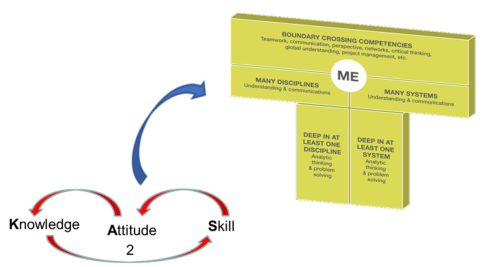
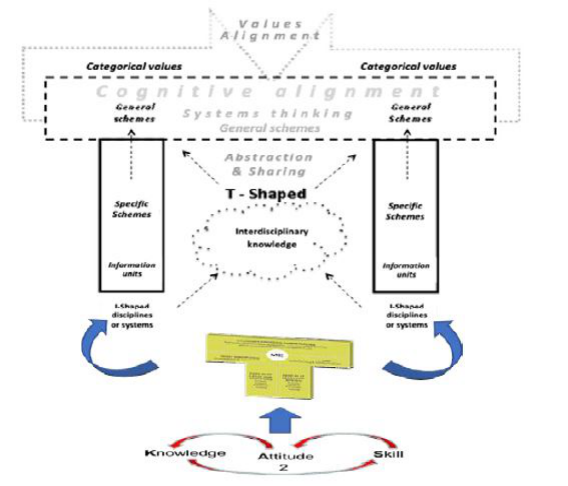
The following figures 2 and 3, show in which way T-SP focus their adaptability on personal characteristics, as we called soft skills.
Therefore, adequate human-machine interactions require a step-by-step process:
1. mapping of the needed resources; 2. profiling of individuals according to KSA Model;
T-Shaped Professional (T-SP) Model to Support Human-Machine Interaction 97
Figure 2: T-shaped skills emerging from KSA model (adapted from Freund 2018).Figure 3: T-shaped model of interdisciplinary emerging from KSA model (adapted from Barile and Saviano 2021, p. 32, www.asvsa.org).
3. acquisition/training of critical process resources; 4. implementation of a logic of governmentality for determining objectives and actions and for formalizing the interaction system for the syste- mic performance of collaboration/cooperation of the various T-Shaped human resources.
CONCLUSION
Interaction with artificial intelligence (IA) changes the way people mature own rational and emotional intelligence: for example, compared to peers ten years ago, digital natives experience technology as an essential and indispensable component in many processes of their life. An important implication of this change is that the way in which humans interact with
technology is much more relevant than the technology itself. Brands, encou- raged to know what kind of role they wish AI plays in value co-creation process, should understand the overall potential of humans use of AI and deploying these interactions properly to generate an IA performant effect. In a wise service system, IA technology and people are integrated, cooperate and co-create in a choral manner (Barile et al., 2018). From this interaction, more than an amplification of human capacities, a cognitive transformation emerges (Carter and Nielsen, 2017). This transformation is at the base of IA potential since it modifies the processes of human thought, change people thinking way (Carter and Nielsen, 2017).
Intelligence is the ability to increase efficiency; but we believe that the criti- cal element for clever/better interaction between human-machines is human wisdom as the ability to increase effectiveness, that is, to make the ‘right’ decision given certain circumstances.
It is in this sense that the action of the interpretative schemes guided by the value categories progressively make the overall human-machine system wiser in the decision-making processes, thus generating an IA effect (Barile et al., 2021). And it is this effect that should be better explored in the context of value co-creation in the digital age to understand the conditions for enhancing it, increasing the value co-created by empowering the system’s wise intellige- nce. In fact, interaction based on the action of value categories is expected to give wiser decision output, integrating the processing machine ability with the human values directions for decision and choices (Barile et al., 2018). It is in this broader perspective that the intelligence of wise systems is qualified not so much by the competence of solving a problem but by the ability to circumscribe it (Bassano et al., 2020). In essence, wisdom gives intelligence a ‘vision’ ability of a multi-faceted set of possible relevant elements of deci- sion beyond what emerges from the management of data and information: the system is capable of envisioning not so much more but better solution options.
In sum, the proposed view is in line with the much needed necessity to make service systems wiser rather than simply smarter (Carayannis et al., 2019). Specifically, smart service systems characterized by AI technologies would be wiser if people - as well as T-Shaped Professionals – effectively interact with these technologies for co-creating value through the right use of interpretative schemes directed by the humans’ values categories. An effe- ctive humans-AI interaction, over time, is expected to not simply amplify the human capacities but transforming the cognitive capabilities, hence, modif- ying the process of human thought: this is exactly what we mean with an IA effect. So, integrating humans with AI does not imply replacing humans, but being complementary with them by increasing their problem solving capability.
REFERENCES
Agile TM (2016). Productive Agile Teams: I, T, E and M Shaped People. Software process and Management.
T-Shaped Professional (T-SP) Model to Support Human-Machine Interaction 99
Badeaa A., Prosteana G., Hutanua A., Popa S. (2015) Competency Training in Collaborative Supply Chain Using KSA Model, Procedia - Social and Behavioral Sciences 191, 500–505. Barile, S.; Bassano, C.; Piciocchi, P.; Saviano, M.; Spohrer, J. C. (2021) Empowering
value co-creation in the digital age. The Journal of Industrial Marketing, pp. 1–14. Barile, S., Saviano, M., (2021) Interdisciplinary Systems Thinking for New Scientific Paradigm: Toward a Re-founding of Human Values, in: Multiplicity and Interdi- sciplinarity, Contemporary Systems Thinking, G. Minati (Ed.) Springer. Barile, S., Piciocchi, P., Bassano, C., Spohrer, J. C. and Pietronudo, M. C. (2019),
“Re-defining the role of artificial intelligence in wiser service systems”, in: Adva- nces in Intelligent Systems and Computing, Kacprzyk, J. (Ed.), Vol. 787, Springer pp. 159–170. Barile, S., Saviano, M., & Simone, C. (2015). Service economy, knowledge, and the need for Tshaped innovators. World Wide Web, 18(4), 1177–1197. Barile, S., Saviano, M., Polese, F., Caputo, F. (2015a). “T-Shaped People for addres-
sing the Global Challenge of Sustainability”, in: Service Dominant Logic, Network and Systems Theory and Service Science: Integrating three Perspectives for a New Service Agenda. Napoli, Gummesson, E., Mele, C., Polese, F. (Eds.), Giannini, pp. 1–23. Barile, S. and Polese, F. (2010). “Smart service systems and viable service systems: Applying systems theory to service science”, Service Science, Vol. 2 (1-2), pp. 21–40. Bassano, C.; Barile, S.; Piciocchi, P.; Saviano, M.; Spohrer, J. C. (2021). Explo-
ring New Digital Age Challenges. in: Advances in The Human Side of Service Engineering, C. Leitner, W. Ganz, D. Satterfield, C. Bassano (Eds.), vol. 266, pp. 57–66. Bassano, C., Barile, S., Saviano, M., Cosimato, S., Pietronudo, M. C. (2020), “AI technologies & value co-creation in a luxury context”, paper presented at the 53th Hawaii International Conference on Systems Sciences (HICSS), January-7. Bloom B. S. (1956). Taxonomy of Educational Objectives, Handbook I: The Cogni-
tive Domain. New York: David McKay Co Inc. Brown T (2010) T-Shaped Stars: The Backbone of IDEO’s Collaborative Culture.
IDEO. Cannon. W. B. (1932). The wisdom of the body. New York: Norton. Carayannis, E. G., Del Giudice, M., Saviano, M., & Caputo, F. (2018). “Beyond Big Data. From Smart to wise knowledge management”, Cybernetics and Systems: Social and Business Decisions, 297. Cardoso J, de Sousa F, Pellissier R, Monteiro I (2012). Creativity, Innovation and col-
laborative organizations. The International Journal of Organizational Innovation 5(1): 26–24. Carter, S. and Nielsen, M. (2017). “Using artificial intelligence to augment human intelligence”, Distill, Vol. 2 (12), e9. Chesbrough H. W (2006). Open Innovation: Researching a New Paradigm. Oxford
University Press. Degani, A., Goldman, C. V., Deutsch, O., Tsimhoni, O. (2017). On human–machine relations. Cognition, Technology & Work, 19(2-3), 211–231, (2017). Demirkan H, Spohrer J (2015). T-shaped innovators: Identifying the right talent to
support service innovation. Research-Technology Management. 2015 Sep 1;58(5): 12–5. Donofrio N, Sanchez C, Spohrer J (2008) Collaborative Innovation and Service Systems: Implications for Institutions and Disciplines. Holistic Engineering, IBM.
Donofrio N, Spohrer J, Zadeh HS (2010). Research- Driven Medical Education and Practice: A Case for T- Shaped Professionals. IBM. Freund LE (2018) MyT-Me—Your Personal T-Shape Scoring System. Chapter 11. In
Eds. Moghaddam, Demirkan, Spohrer, T-Shaped Adaptive Innovators. ISSIP BEP Collection - Service System Innovations in Business and Society. Business Expert Press. Frey, C. B., Osborne, M. A. (2017). The future of employment: how susceptible are jobs to computerization? Tech. Forec. and Soc. Chan., 114, 254–280. Foucault. M. (1991a). Governmentality, in: Graham Burchell, Colin Gordon, & Peter
Miller (eds.), The Foucault Effect: Studies in Governmentality, Hemel Hempstead: Harvester Wheatsheaf, pp. 87–104. Gardner P, Maietta HN (2020). Advancing Talent Development: Steps Toward a T- Model Infused Undergraduate Education. ISSIP BEP Collection - Service System Innovation for Business and Society. Business Expert Press (BEP). Goleman, D. (1995). Emotional intelligence. New York: Bantam Books. Golinelli GM, Spohrer J., Barile S., Bassano C. (2010). The evolving dynamics of
service co-creation in a viable systems perspective. 13th Toulon-Yerona Conf. Proc. lntemat. Conf. (Coimbra, Portugal). Golinelli, G. M. (2010). The Viable Systems Approach, Cedam, Kluwer, Torino. Golinelli, G. M., Bassano, C. (2012). “Human resources for governing business dynamics. The Viable Systems Approach”, Spohrer, J. C., Freund, L. E., (Eds.), Advances in the Human Side of Service Engineering, Taylor & Francis Ltd. (CRC Press), pp. 359–368. Griffin, R. W. (1997). Management, New Delhi AITBS Publishers. IfM and IBM (2008). Succeeding through service innovation: A service perspe-
ctive for education, research, business and government, University of Cambridge Institute for Manufacturing. Kaplan, S. (1976). Adaptation, structure and knowledge. In G. T. Moore and R.
G. Golledge (Eds.) Environmental knowing: Theories, perspectives and methods. Stroudsburg, PA: Dowden, Hutchinson and Ross. pp. 32–45. Le Boterf G (1997). De la compétence à la navigation professionnelle, Les Éditions d’Organisation, Paris. Lee M (2011). T-Shaped Skills, I-Shaped Skills and Dash-Shaped Skills. BizThoughts:
Thoughts on business, startups, and technology. Maglio P. P. and Spohrer J. (2008). “Fundamentals of service science”, Journal of the academy of marketing science, vol. 36, no. 1, pp. 18–20. March S. (1991). Exploration and Exploitation in Organizational Learning, Organi-
zation Science, Vol.2, no. 1. Meier JD (2013). E-Shaped People, Not T-Shaped, Agile. Moghaddam Y, Demirkan H, Spohrer J (2018) T-Shaped Professionals: Adaptive Innovators. Business Expert Press (August 23, 2018). Eds Spohrer J, Demirkan H. Service Systems and Innovations in Business and Society Collection. Onah, F. O. (2008). Human Resource Management. John Jacob’s Classic Publisher
Ltd Plot 7 Fmr ESUT Road, Nkpokiti Junction Enugu. Ostrom E (2009) Beyond markets and states: Polycentric governance of complex economy systems. Prize Lecture, December 8, Aula Magna, Stockholm University, Stockholm. Piciocchi P., Bassano C., Pietronudo M. (2018). Management of Human Resources
inside Open Innovation Organizations: Some Reflections, Ergonomics Internati- onal Journal, Medwin Publisher, Volume 2, Issue 2. Piciocchi, P., Bassano, C., Pietronudo, M. C. and Spohrer, J. C. (2019). “Digital Workers in Service Systems: Challenges and Opportunities”, in: Handbook of Service Science, Maglio, P. P., Kieliszewski, C. A., Spohrer, J. C., Lyons, K., Patricio, L. & Sawatani, Y. (Ed.s.), Vol. II - Springer, New York, pp. 409–432.
T-Shaped Professional (T-SP) Model to Support Human-Machine Interaction 101
Piciocchi, P., Spohrer, J. C., Martuscelli, L., Pietronudo, M. C., Scocozza, M. and Bassano, C. (2017). “T-Shape professionals co-working in smart contexts: VEGA (ST) – Venice gateway for science and technology”, in Advances in Intelligent Systems and Computing, Ahram, T. Z., Karwowski, W. (Ed.), pp. 178–190. Picocchi P., Spohrer J., Bassano C., Giuiusa A. (2012). Smart governance to mediate
human expectations and systems context interactions, in: Advances in the Human Side of Service Engineering, Spohrer, Freund (Ed.), Taylor & Francis. Rosenau and Czempiel. (1992). Governance without Government: Order and Change in World Politics, Political Science, Economics. Saviano, M., Barile, S., Spohrer, J. C., & Caputo, F. (2017a). A service research
contribution to the global challenge of sustainability. Journal of Service Theory and Practice, 27(5), 951–976. Saviano, M., Polese, F., Caputo, F., & Walletzký, L. (2017b). The contribution of systems and service research to rethinking higher education programs: A T-shaped model. Sinergie Italian Journal of Management, 35, 51–70. Siegel-itzkovich J. (2003). U of Haifa study: Bilingual people exhibit greater cognitive
flexibility. Tel Aviv, Israel. Soanes, C. & Stevenson, A. (Eds.). (2005). Oxford dictionary of English (2nd ed.).
Oxford, UK: Oxford University Press. Spencer L., Spencer S. (1993). Competence at Work: Models for Superior Performance, Wiley, ISBN: 978-0-471-54809-6 Spohrer, J. (2018). “Commentary on ‘Value Creation and Cognitive Technologies:
Opportunities and Challenges”’, Journal of Creating Value, vol. 4, no. 2, 2018, pp. 199–201. Spohrer, J., Banavar, G. (2015). Cognition as a service: an industry perspective. AI Magazine, 36(4), 71–86. Spohrer, J., Bassano, C., Piciocchi, P. and Siddike, M. A. K. (2017). “What
Makes a System Smart? Wise?”, in: Advances in Intelligent Systems and Com- puting, Ahram, T. Z., Karwowski, W. (Ed.), 49. Springer, pp. 23–34, ISBN 978-3-319-41947-3. Spohrer, J., Golinelli, G. M., Piciocchi, P. and Bassano, C. (2010). “An integrated SS-VSA analysis of changing job roles”, Service Science, Vol. 2(1-2). pp. 1–20. Spohrer, J., Piciocchi, P. and Bassano, C. (2012). “Three frameworks for service
research: exploring multilevel governance in nested, networked systems”, Service Science, Vol. 4 (2), pp. 147–160. Spohrer, J., Golinelli, G. M., Piciocchi, P. and Bassano, C. (2010). An integrated SS-VSA analysis of changing job roles, Service Science, 2(1-2), DOI: 10.1287/serv.2.1_2.1. Sterling, P., & Eyer, J. (1988). Allostasis: A new paradigm to explain arousal path-
ology. In S. Fisher & J. Reason (Eds.), Handbook of life stress, cognition and health (pp. 629–649). John Wiley & Sons. Ward, C. (2014). More ‘pi-shaped people’ needed for the retail sector. MyCustomer.
LISTED IN THE AHFE DIGITAL BOOKSTORE CATALOGUE
Explore the complete digital volume
The Human Side of Service Engineering
Read this individual research paper free through the original publisher, or explore the full digital proceedings book.
ISBN 978-1-958651-84-1
Explore this ISBN in the AHFE Bookstore ↗Listed in the July 2026 bookstore catalogue; search by ISBN to confirm current availability · Digital book purchase optional