Celina P Leão, Vinicius Silva, Susana Costa (2023). Human-Machine Interaction: is there a strategic direction towards space exploration?. In: Human-Centered Aerospace Systems and Sustainability Applications. AHFE Open Access, vol. 98, pp. 85–93. https://doi.org/10.54941/ahfe1003922
Human-Machine Interaction (HMI) is an interdisciplinary field that focuses on enhancing how humans and computers interact. It covers many different areas of knowledge, such as computer science, behavioural and cognitive sciences, ergonomics, psychology, and education. The growing interest in HMI has led to a wide range of applications across different domains, including industrial, medical, educational, and entertainment sectors. Human factors, which involve improving human performance in challenging environments, have also gained attention in this field. This study aims to identify the trends in the developments in HMI for space exploration by conducting a quantitative bibliometric analysis. Two citation indexes (Web of Science and Scopus) were combined to search for documents on the topic. The search was born on January 10th, 2023, yielding 203 documents after eliminating duplicates and for other reasons. The inclusion criteria considered conference papers, articles and book chapters, and the English language. A descriptive analysis was attained, allowing for a ‘big picture’ of the data distribution regarding the scientific area, countries, chronological evolution of the publications, keywords, citations, and other relevant information. The study results provide a better understanding of the current state of HMI in space exploration, identifying trends and areas for future research.
Human-Machine Interface (HMI) or Human-Machine Interaction is an inter- disciplinary field that focuses on enhancing how humans and computers interact (O’Malley, 2007). HMI includes designing interactive interfaces that cater to the needs of users. HMI encompasses various fields of study, such as computer science, behavioural and cognitive sciences, ergonomics, psychology, and education. The growing interest in HMI has led to a wide range of applications across different domains, including industrial, medical, educational, and entertainment sectors (Mahadewi et al., 2021).
Human Factors (HF) is a multidisciplinary field that focuses on understan- ding and improving human performance in a variety of settings, including in the workplace, transportation, and other environments. It draws from fields such as ergonomics, psychology, and sociology to develop guidelines
and principles for designing equipment, tools, and systems that are easy to use, comfortable, and safe for people to operate (Lee et al., 2017). HMI, on the other hand, is focused on designing interactive interfaces that enable effective communication between humans and machines. It also draws from fields such as computer science, ergonomics, and psychology, to design inter- faces that are easy to use and understand and minimize the risk of errors or accidents.
Together, HMI and Human Factors play a crucial role in ensuring that the systems, equipment and interfaces that are used in various domains are user- friendly and safe (Abdur et al., 2017). By considering the human element in the design process, both fields help ensure that technology is developed to enhance human performance and overall user experience.
The present paper aims to ascertain the development trends in HMI as an essential part of space exploration, also identifying areas for future research.
METHODOLOGY
A systematic literature review (SLR) was the method chosen to address the study’s main objective. An SLR involves a systematic and comprehensive sea- rch, review, and synthesis of existing literature on a specific topic (Denyer & Tranfield, 2009). A systematic literature review aims to identify, critically eva- luate, and summarize the current state of knowledge on a topic in a structured and unbiased manner. This method is used to identify gaps in current know- ledge, identify areas of consensus or controversy, and inform the development of new research questions.
The PRISMA (Preferred Reporting Items for Systematic Reviews and Meta-Analyses) 2020 statement was followed, providing a transparent and standardized framework for authors to report the methods and results of their systematic review clearly and consistently. The 2020 update includes new recommendations and clarification on existing ones to ensure high-quality reporting (Page et al., 2021).
The authors used VOS viewer software version 1.6.19 for building and visualizing bibliometric maps. VOS viewer was selected for its user-friendly interface and ability to create co-authorship and co-citation network maps, which aid in analysis (van Eck & Waltman, 2013; van Eck & Waltman, 2010). A descriptive analysis was attained, allowing for a ‘big picture’ of the data distribution regarding the scientific area, countries, chronologi- cal evolution of the publications, keywords, citations, and other relevant information.
Information Sources and Search Strategy The SLR was conducted based on all published studies on HMI and HF and their application areas, considering the Web of Science (WoS) and Scopus database. The authors conducted a keyword search using the following:
[(“Human Machine Interaction*”) OR (“Human Machine Interface”) OR (HMI)] AND [(aerospace OR “outer space” OR spaceship OR Mars)]
Human-Machine Interaction: Is There a Strategic Direction Towards Space Exploration? 87
in the article Title, Abstract, and Keywords fields when using Scopus and All Fields in the case of WoS Core Collection. The use of the character “*” allows for finding words with the same stems. The search covered various types of publications (Article, Proceeding Paper and Book Chapter) with no time restrictions, aimed to study the evolution of the topic and detect changes over time. The inclusion criteria considered conference papers, articles and book chapters, and the English language.
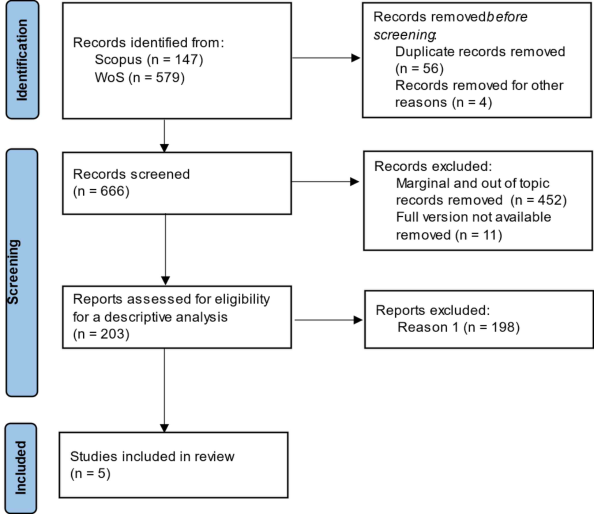
Data Collection and Analysis The search was performed on January 10th 2023, and results in 726 docu- ments (WoS: n = 579 and Scopus: n = 147). After removing duplicates and some books, the number of documents was reduced to 666. After that, 452 documents were considered out of topic, that is, documents that were exclu- ded since the main topic of research do not cover or that lack HMI and space, and also 9 documents that it was not possible to access the full version. After reading the abstract and keywords, 203 documents remained to continue the review process. The two last phases were performed by two researchers (two of the three authors of this paper), first individually and then comparing and confirming their findings. In case of disagreements, they were addressed through discussion and resolved through shared consensus. In the final stage, 5 documents were retained that focused specifically on all the research keyw- ords, representing the path of HMI’s development towards space exploration (see Figure 1).
Figure 1: PRISMA 2020 flow diagram for the systematic literature review. (Adapted from (Page et al., 2021)).
RESULTS AND DISCUSSION
Analyzing all 205 documents, a descriptive analysis was performed to gain a comprehensive overview, and a subset of documents was then selected for further critical analysis.
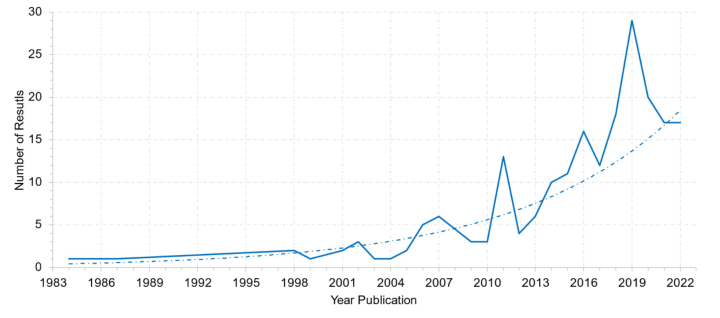
Mapping Analysis The first publication was found to be from 1984, and the number of publicati- ons has generally increased over the years, although some ups and downs can be observed until 2022, which shows 17 records, as can be seen in Figure 2, with periods of higher productivity (2011 and 2019) followed by a decrease. The increase observed in the last three years, 2020-2022, virtually corre- sponds to the pandemic period. The pandemic has likely led to an increase in the number of publications in technology-related research fields. This has created new challenges and opportunities for research in technology-related fields, leading to an increased focus on developing and improving existing technologies. Additionally, the need for innovative solutions to address the impacts of the pandemic has likely motivated more research and writing in these fields.
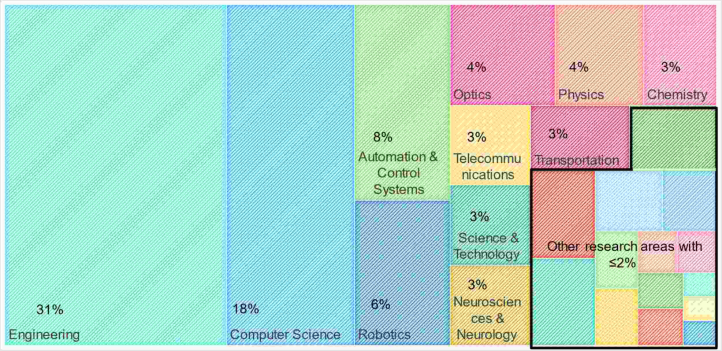
Most of the documents published correspond to conference papers (57.8%), and 41.7% correspond to articles. Concerning the research areas, engineering, computer science and automation & control systems are the majority (approximately 31%, 18% and 8%, respectively), followed by a wide variety of research areas such as robotics (around 6%), optics and physics (each with 4%) and chemistry, telecommunications, science & technology and neurosciences (each with 3%) (Figure 3).
Twenty-six countries were identified with at least one document. Table 1 lists the top 10 countries with their documents’ frequencies and a total of citations: Germany has the greatest number of publications (47, 28.5%), fol- lowed by the USA with 25 (15.2%) and the Netherlands, Italy and China with 18, 16 and 14, respectively (around 10% each).
Figure 2: Number of publications by year.
Human-Machine Interaction: Is There a Strategic Direction Towards Space Exploration? 89
Figure 3: Documents published by research area.Table 1. Top 10 coutries documents’ frequencies and total citations.
Table available in the original PDF paper.
Country Documents Citations Germany 47 1469 USA 25 619 Netherland 18 435 Italy 16 402 China 14 420 France 6 287 Singapore 5 157 South Korea 5 143 Czech Republic 4 209 UK 4 85
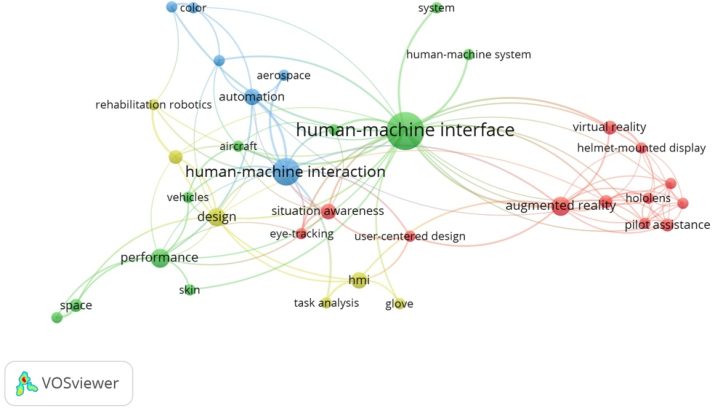
Figure 4 illustrates the network obtained for the keyword co-occurrence map based on bibliographic data. The proximity of two keywords in the visu- alization represents the correlation between them in terms of co-occurrence links: the stronger the relationship between two keywords, the closer they are to each other. Lines connect two items, and the keywords are by the label and a circle. The size of the label and circle is determined by its wei- ght, with heavier keywords having larger labels and circles. All the keywords were refined to obtain only one record per concept (e.g. “human machine interface” and “human-machine interface”, plus plural variations). Hence, based on all the keywords used (authors and indexed), four clusters (each of which with at least five keywords) are easily identifiable by their colours: red, green, blue and yellow. The keyword “human-machine interface” emer- ges in the green cluster located almost in a central position having connections to a large part of the remaining items. It is associated with different appli- cations where this concept can be used: “vehicles”, “aircraft”, “system”,
Figure 4: Network visualization based on keywords.
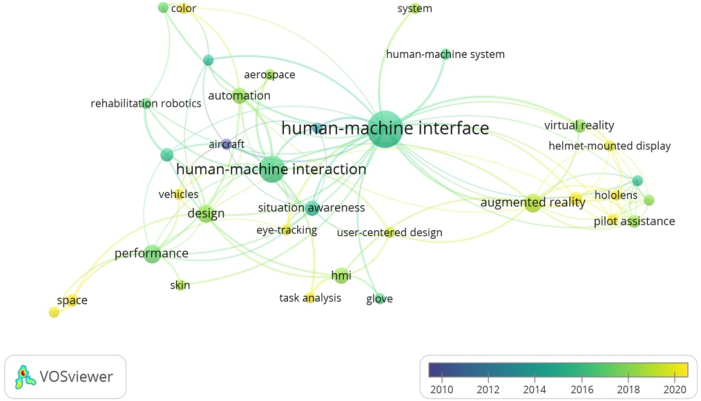
and “space” linked to “performance”. In turn, “Human-Machine Intera- ction”, in the blue cluster, is associated with “automation”, “aerospace”, and “supervisory control”. The term “human-machine interface” circle is larger than “human-machine interaction” since it is more commonly used. In the red cluster, “virtual reality”, “helmet-mounted display, “HoloLens”, “pilot assistance”, and “user-centered design” are gathered around the keyword “augmented reality”. For the yellow cluster, “rehabilitation robotics”, “tele- operation”, “glove”, “task analysis” are around the keyword “design”. The keyword “HMI” is part of this last cluster. The choice of these keywords is recent, after 2010 (Figure 5), corresponding just before the first peak of publications, as presented in Figure 2.
Figure 5: Overlay visualization of keywords over the years.
Human-Machine Interaction: Is There a Strategic Direction Towards Space Exploration? 91
The design of Figure 5 was based on the average occurrence score of the keywords per publication year.
Reading the figure from left to right, a perception of the evolution of using keywords can be grasped. “Human-machine interface” is more com- monly used. In contrast, the term “human-machine interaction” seems to be more recent and encompasses a broader range of interactions beyond just the design of interfaces.
In the 2010s, the use of human-machine interfaces related to models and aircraft (blue). Then human-machine interaction is associated with situation awareness, performance, machine learning, augmented reality, automation, rehabilitation robotics, and aerospace (green). Then, more recently, around 2020, it associated with new applications like space, task analysis, helicopter, eye-tracking, and identifying new technological application areas.
These findings will aid in the refinement and selection of data results to address the main objective of this study: to ascertain the developments trends in HMI as an essential part of space exploration and to identify areas for future research.
Interpretation The descriptive statistics analysis carried out based on the 203 documents enabled the selection of five documents for critical review. To know: (1) “A modular architecture for an interactive real-time simulation and training environment for satellite on-orbit servicing”(Wolff et al., 2011); (2) “Human machine interface issues for drone fleet management.” (Luongo et al., 2019); (3) “Predictive Human-Machine Interface for Teleoperation of Air and Space Vehicles over Time Delay” (Wilde et al., 2020); (4) “Flying a helicopter with the HoloLens as head-mounted display” (Walko & Maibach, 2021); (5) “Aiming performance during spaceflight: Individual adaptation to microgra- vity and the benefits of haptic support” (Weber et al., 2022). This selection was based on the criteria of being representative and in accordance with the objective of understanding the evolution of HMI towards space exploration. This process has a high degree of subjectivity due to interpretation and what each one understands by technology developed not in space but that can be adapted and used soon. In more detail, in general, the studies aim to improve the safety, efficiency, and effectiveness of human-interaction systems by appl- ying principles of human factors and usability engineering, as well as the development of new HMI technologies (Luongo et al., 2018).
Wolff et al. (2011) present an overview of a real-time, interactive simula- tion and training platform for analyzing, training, and programming on-orbit servicing tasks. The work focused on developing the underlying infrastructure to enable manual and robotic assembly and disassembly in a haptic-enabled, immersive virtual environment. This included accurate real-time simulation and rendering of dynamic behaviour and realistic appearance of satellite com- ponents and mechanisms in a space-like environment, as well as integrating haptic device interaction.
More recently, Wilde et al. (2020) focused on developing telerobotic systems for exploring Mars and the Moon. These systems will be operated
from orbiting laboratories, which presents the challenge of communication delays that can decrease the effectiveness of the human-robot system. To ove- rcome this challenge, the authors propose a predictive display that simulates the system state and projects the path ahead. While the prototype for the Ada- ptable Human Machine Interface did not achieve the desired level of success, as the predictive flight path and attitude display requires further improve- ment, telerobotics is considered to be crucial for the exploration of remote environments, as it allows for the combination of the precision and resilience of robots with the decision-making abilities of humans.
Meanwhile, Walko and Maibach (2021) sought to test head-mounted display (HMD) technology in a real-world application, i.e., in a flying helicopter. The approach consisted in using the Microsoft HoloLens with an external tracking system since it was not built to be used on moving vehicles. The proposed head tracking solution uses an external tracker to compensate for the drift errors of the inertial measurement unit (IMU)- only tracking of the HoloLens. With this approach, it is possible to create immersive world-fixed holograms to aid almost every task in vehicles, inclu- ding spacecraft potentially. The system was tested successfully during several flight tests. The presented solution could assist the pilot with AR capabi- lities, providing comfort and improving safety, workload, and situational awareness.
In a recent application, Weber et al. (2022) investigated how different haptic settings of the human-machine interface can affect sensorimotor per- formance during different stages of a space mission, which prior research has shown to decline in microgravity during spaceflight. This is a crucial issue for deep space exploration since the astronauts’ sensorimotor skills can be crucial to the mission’s success. Therefore, it is essential to support them in such tasks. The authors tested various alternatives and found that providing low stiffness at the human-machine interface is the best measure to maintain aiming precision in microgravity. These findings are significant for future planetary exploration missions. They suggest that optimizing the human- machine interface is crucial to the success of such missions, in addition to superior sensorimotor skills.
CONCLUSION
This study is the first step to exploring the HMI tendency for space explo- ration based on quantitative bibliometric analysis. HMI is associated with applications to ensure better performance and reliability. In general, the number of publications on HMI has increased, although there are some fluctuations, with 2019 being the peak year of publications. Recently, new technological areas of application have been identified under HMI, such as space exploration, task analysis, helicopter, and eye-tracking.
Five documents were selected and reviewed. The common themes among them include the development of HMI, the real-time challenges of controlling systems remotely, the importance of safety and the mitigation of communi- cation delays, and the use of predictive displays to improve the human-robot control loop. These trends aim to improve the efficiency and effectiveness
Human-Machine Interaction: Is There a Strategic Direction Towards Space Exploration? 93
of space exploration, allowing astronauts to accomplish their missions with greater ease and precision.
ACKNOWLEDGMENT
The authors would like to acknowledge support form FCT – Fundação para a Ciência e Tecnologia thought the project R&D Units Project Scope: UIDB/00319/2020.
REFERENCES
Abdur, M., Ali, M., Hussain, K., Ullah, S., 2017. International Journal of Advanced Computer Science and Applications 8. Denyer, D., Tranfield, D., 2009. Producing a Systematic Review. The SAGE Hand-
book of Organizational Research Methods. Lee, J. D., Wickens, C. D., Liu, Y., Boyle, L. N., 2017. An introduction to human factors engineering: A beta version, CreateSpace. Luongo, S., di Gregorio, M., Vitiello, G., Vozella, A., 2019. Human Machine Inter-
face Issues for Drone Fleet Management, in: Advances in Intelligent Systems and Computing. Springer Verlag, pp. 791–796. Mahadewi, E. P., mo, S., Timotius, E., Tungkup, D. L., Ilham, C. I., 2021. Webology 18, 261–272. O’Malley, M. K., 2007. Principles of Human-machine Interfaces and Interactions,
in: In Life Science Automation: Fundamentals and Applications. pp. 101–125. Page, M. J., McKenzie, J. E., Bossuyt, P. M., Boutron, I., Hoffmann, T. C., Mulrow, C. D., Shamseer, L., Tetzlaff, J. M., Akl, E. A., Brennan, S. E., Chou, R., Glanville, J., Grimshaw, J. M., Hróbjartsson, A., Lalu, M. M., Li, T., Loder, E. W., Mayo- Wilson, E., McDonald, S., McGuinness, L. A., Stewart, L. A., Thomas, J., Tricco, A. C., Welch, V. A., Whiting, P., Moher, D., 2021. BMJ n71. van Eck, N. J., Waltman, L., 2010. Scientometrics 84, 523–538. van Eck, N. J., Waltman, L., 2013. Manual for VOSviewer version 1.6.19, Univeri-
steit Leiden. Walko, C., Maibach, M.-J., 2021. Optical Engineering 60. Weber, B. M., Schätzle, S., Stelzer, M., 2022. Appl Ergon 103. Wilde, M., Chan, M., Kish, B., 2020. Predictive Human-Machine Interface for Teleoperation of Air and Space Vehicles over Time Delay. Wolff, R., Preusche, C., Gerndt, A., 2011. A modular architecture for an interactive
real-time simulation and training environment for satellite on-orbit servicing, in: Proceedings - IEEE International Symposium on Distributed Simulation and Real- Time Applications, DS-RT. Institute of Electrical and Electronics Engineers Inc., pp. 72–80.
LISTED IN THE AHFE DIGITAL BOOKSTORE CATALOGUE
Explore the complete digital volume
Human-Centered Aerospace Systems and Sustainability Applications
Read this individual research paper free through the original publisher, or explore the full digital proceedings book.
ISBN 978-1-958651-74-2
Explore this ISBN in the AHFE Bookstore ↗Listed in the July 2026 bookstore catalogue; search by ISBN to confirm current availability · Digital book purchase optional