Celina P Leão, Susana Costa (2022). The use of UAVs throughout time – A Safety retrospective. In: Human-Centered Aerospace Systems and Sustainability Applications. AHFE Open Access, vol. 26, pp. 20–26. https://doi.org/10.54941/ahfe1001430
The use of Unmanned Aerial Vehicles (UAVs) is growing exponentially extending the application of those principles to new areas (i.e.: construction industry, earthmoving, among others). Taking as starting point the research question “Based on scientific literature, which purposes are UAVs being used for?”, followed by a systematic literature review (SLR) and statistical analysis, it is possible to describe the actual trend on the scientific research areas of application and the identification of relevant studies that should be considered. The SLR was conducted based in all published studies related to UAVs and their application areas considering the Scopus database. At the beginning of the 2010’s the words regarding UAV were more linked to aircraft accidents, air traffic control, flight safety, collision avoidance. Then, around 2019, new applications emerge, including construction industry, architectural design, building information model, highway planning, project management, identifying new areas of applications of the UAVs, also new tools are identified to deal with the UAVs’ system model and problem formulation, in continuation of the primary method of probabilistic uncertainty used in the 2010’s.
Unmanned Aerial Vehicles (UAVs), also known as drones, can be defined as an aircraft without onboard human operators being controlled auto- nomously or by a remote pilot. Nowadays, UAVs can be considered one of the major technological developments with various domains of applica- tion: UAVs routing, namely wireless networks, scheduling, vehicle routing problem (VRP), traveling salesman problem (TSP), among others (Thibbo- tuwawa et al., 2020). Due to its small dimension, ability to take off and land vertically, simple mechanics, among other characteristics, UAVs gai- ned interest in civilian research based applications (i.e.: mission management, surveillance) (Mualla et al., 2019).
Also, the use of UAVs is growing exponentially extending the application of those principles to new areas (i.e.: construction industry, earthmoving, among others) (Mualla et al., 2019; Thibbotuwawa et al., 2020; Rojas Viloria et al., 2021) due to the reduction of risks and lower costs involved in the elaboration of the UAVs (Rodríguez et al., 2021).
The Use of UAVs Throughout Time – A Safety Retrospective 21
Regarding Safety, it is used combined to monitor progress, risk prevention and improvement of safety on construction process and sites (Rodríguez et al., 2021). Taking as starting point the research question “Based on scientific lite- rature, which purposes are UAVs being used for?”, a systematic literature review (SLR) was carried out to describe the actual trend on the scientific research areas of application and the identification of relevant studies that should be considered that address concerns regarding safety.
METHODOLOGY
The SLR was conducted based in all published studies related to UAVs and their application areas considering the Scopus database.
The combination of keywords: [(UAV) AND ((safety) OR (occupation*) OR (work))]
were used in the Title field. It is the authors’ belief that when these words are used and considered in the title it precisely and sufficiently reflects the article’s contents. The used of the character “*”allows to find words with the same stem, that is, all possible characters after the last letter (e.g., occupation, occupational).
No restriction to the time frame was considered allowing to verify the evolution of this topic over time and whenever a change is made. The search includes conference paper, articles, book chapters, letter, note and short survey. The search, conducted on November 19th 2021, yielded 164 documents.
For constructing and viewing the bibliometric maps, the free software VOSviewer (van Eck and Waltman, 2010) was used. It was chosen for its fri- endly graphical user interface and maps of the co-authorship and co-citation networks helping on the analysis.
RESULTS AND DISCUSSION
Considering all 164 documents, a descriptive analysis was attained allowing a ‘big picture’ and then a set of documents would be selected for critical analysis.
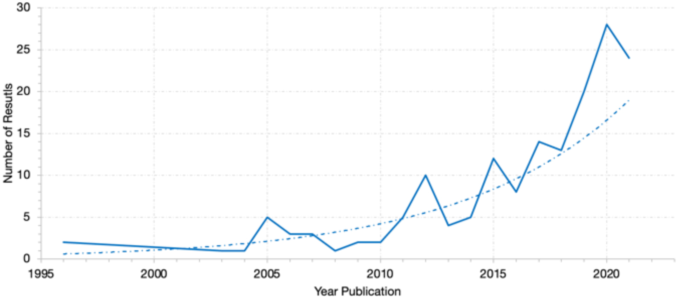
Mapping Analysis Based on the results obtained in the Scopus’ search, the two first publications appear in 1996, then a period of seven years without publications, and them from 2003, with one publication, to 2021, with 24 publications (at the time of research, November 19th 2021, a document with publication year 2022). Generally, the number of publications over the years show an upward trend, almost exponentially, on number of documents published (Figure 1).
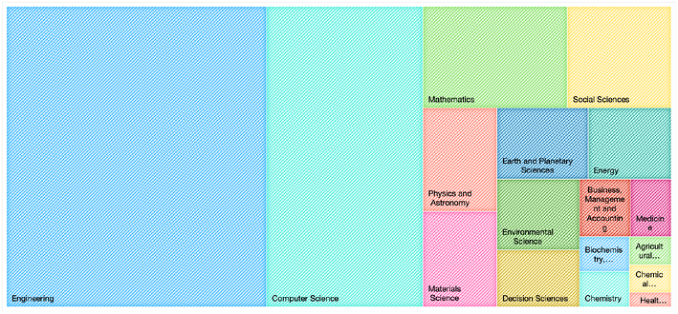
The majority of the documents published corresponds to conference paper (70%), 28% corresponding to articles and the remaining to review and book chapter. Regarding the subject areas of the publication of these documents and studies, the most significant is in engineering area (40.5%), followed by
22 Leão and Costa
Figure 1: Number of publications by year.Figure 2: Documents published by subject area.
computer sciences with 23.6%, and mathematics and social sciences areas with 7.4% and 5.3%, respectively (Figure 2).
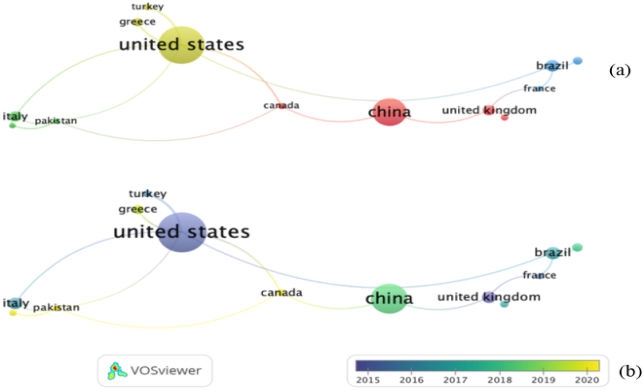
Forty-two countries were identified with at least one document. Table 1 list the top 13 countries with their documents frequencies and total link strengths defined by cluster: United Sates (USA) has the greatest number of publicati- ons (51, 32.3%), followed by China with 33 (19.5%) and Brazil and United Kingdom (UK) with 8 and 9, respectively (around 5% each). Figure 3 (a) represents the four clusters defined, where each country is represented by a ball whose size depends on the number of documents and (b) where the color depends on the year of publication. It is interesting to observe that the num- ber of documents over the years shows that European countries like Greece and Estonia and Canada, recently, start publishing information related this topic, being USA and UK the countries that started publishing.
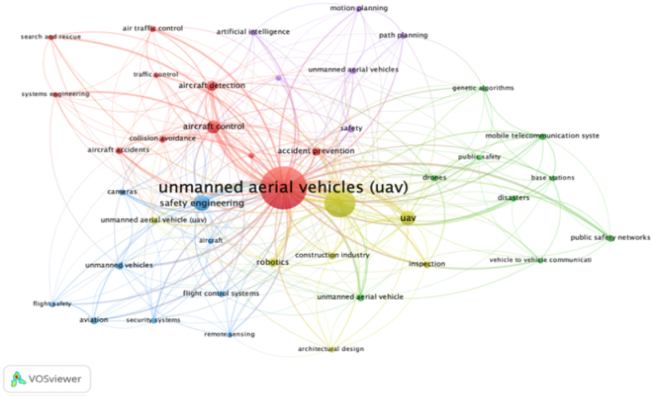
Figure 4 illustrates the network obtained for the keyword co-occurrence map based on bibliographic data. The distance between two keywords in the visualization approximately indicates the relatedness of the them in terms of co-occurrence links, meaning that, the closer two keywords are located to each other, the stronger their relatedness. Three clusters are easily identifiable
The Use of UAVs Throughout Time – A Safety Retrospective 23
Table 1. Top 13 countries documents’ frequencies, citations and total link strengths by cluster.
Table available in the original PDF paper.
Country Cluster Documents Citations Total link Strength USA Yellow 51 739 10 Greece 6 43 3 Turkey 4 62 3 China Red 33 110 2 UK 8 28 3 Canada 4 6 3 Japan 4 11 1 Brazil Blue 9 9 3 France 3 13 2 Germany 5 71 1 Estonia Green 3 7 3 Italy 8 27 3 Pakistan 3 13 3
Figure 3: Documents network analysis, by (a) frequency, (b) average publication year network.
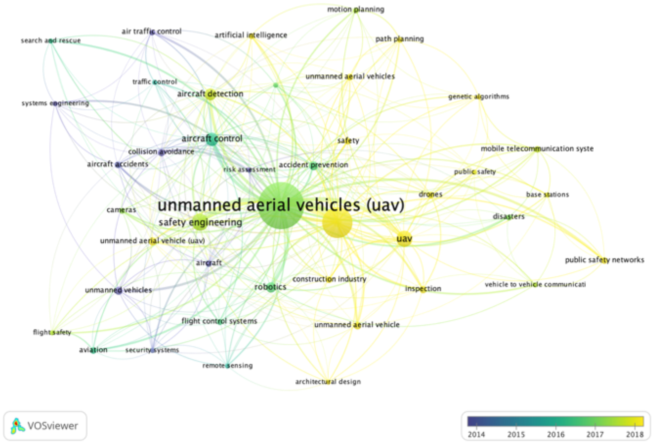
by the three colors: red for “unmanned aerial vehicles (uav)”, blue for “safety engineering”, and yellow for “antennas” and “uav”. The keyword “safety” also appears, this time alone, belonging to another cluster (purple color). Also “safety” appears associated to “flight safety”, “public safety networks” and “public safety”. It can be said that the choice of these keywords are recent, that is, after 2018 (Figure 5).
Figure 5 was designed based on the score of the keywords by average occurrence by publication year. Reading the figure from left to right, a perce- ption on the evolution of the use of words regarding UAV can be identified: at the beginning of the 2010’s more linked to aircraft accidents, air traffic
24 Leão and Costa
Figure 4: Network visualization based on keywords.
control, flight safety, collision avoidance. Then around 2018, new applica- tions emerge, including construction industry, architectural design, building information model, highway planning, project management, identifying new areas of applications of the UAVs. In parallel, new tools are identified, such as Genetic Algorithms, Monte Carlo methods and algorithms to deal with the UAVs’ system model and problem formulation, in continuation of the primary method of probabilistic uncertainty used in the 2010’s.
These results will help to refine and select the data results in order to answer the main research question of this study: “Based on scientific lite- rature, which purposes are UAVs being used for?”, and understand how it is related with “safety”.
Interpretation Based on the last, it is important to follow the documents that describes concerns regarding “Safety”. At least one work identified and related UAVs and human safety.
Jeelani and Gheisari in their work (Jeelani and Gheisari, 2021), recognize the lack of research in study the impact of working with or near UAVs on the health and safety of workers. This work contributed to UAVs-human interaction namely in the construction domain categorizing the safety risks and challenges of human workers working with UAVs. They mentioned that the lack of specific occupational safety and health regulations that govern UAV operations on construction locations could be due to the unknowledge about UAVs and the potential risks they pose to the construction workers. So, a conceptual UAV-dominant construction work context where drones and human workers work together is presented. Several risks to construction workers who interact with drones are identified:
The Use of UAVs Throughout Time – A Safety Retrospective 25
Figure 5: Overlay visualization of keywords over the years.
- physical risks, that can potentially lead to accidents or injuries arises form engineering errors (UAVs hardware or software), human error (e.g., flight planning), environmental factors and cyberattacks; - attentional costs, authors mentioned that as UAVs are relatively new to the construction environment, they can be a visual, auditory, and/or cognitive distraction for workers; and - psychological impacts, authors stated that when UAVs are used to moni- tor construction activities related, workers could experience significantly higher levels of stress.
CONCLUSION
This study is the first step to explore the tendency in the use of UAVs regar- ding to safety: “Based on scientific literature, which purposes are UAVs being used for?” Safety and UAVs are used together however more associated with safety and quality management in construction (e.g. (Pi et al., 2020)); the use of UAVs to auxiliary inspectors in particular tasks as inspection and asses- sment of dam infrastructure avoiding risks to the inspectors (Khaloo et al., 2018); development a safety-critical control that allows the UAV to follow its assigned path while detecting the attacks (Wan et al., 2020), among other examples.
This work acknowledged the need of regulation regarding occupational safety and health that rule UAV operations where they operate and the identification of the potential risks they pose workers on that environments.
26 Leão and Costa
ACKNOWLEDGMENTS
The authors would like to acknowledge support form FCT – Fundação para a Ciência e Tecnologia through the project R&D Units Project Scope: UIDB/00319/2020.
REFERENCES
van Eck, N. J. and Waltman, L. (2010) ‘Software survey: VOSviewer, a computer program for bibliometric mapping’, Scientometrics, 84(2), pp. 523–538. doi: 10.1007/s11192-009-0146-3. Jeelani, I. and Gheisari, M. (2021) ‘Safety challenges of UAV integration in con-
struction: Conceptual analysis and future research roadmap’, Safety Science, 144(August), p. 105473. doi: 10.1016/j.ssci.2021.105473. Khaloo, A. et al. (2018) ‘Utilizing UAV and 3D computer vision for visual inspection of a large gravity dam’, Frontiers in Built Environment, 4(July), pp. 1–16. doi: 10.3389/fbuil.2018.00031. Mualla, Y. et al. (2019) ‘Agent-based simulation of unmanned aerial veh- icles in civilian applications: A systematic literature review and resea- rch directions’, Future Generation Computer Systems, 100, pp. 344–364. doi: 10.1016/j.future.2019.04.051. Pi, H. et al. (2020) ‘Application of multi-rotor UAV patrol system in safety and qua-
lity management of power grid construction projects’, Proceedings - International Conference on Artificial Intelligence and Electromechanical Automation, AIEA 2020, pp. 416–419. doi: 10.1109/AIEA51086.2020.00093. Rodríguez, M. V. et al. (2021) ‘A critical review of unmanned aerial vehicles (Uavs) use in architecture and urbanism: Scientometric and bibliometric analysis’, Applied Sciences (Switzerland), 11(21). doi: 10.3390/app11219966. Rojas Viloria, D. et al. (2021) ‘Unmanned aerial vehicles/drones in vehicle rou-
ting problems: a literature review’, International Transactions in Operational Research, 28(4), pp. 1626–1657. doi: 10.1111/itor.12783. Thibbotuwawa, A. et al. (2020) ‘Unmanned aerial vehicle routing problems: A literature review’, Applied Sciences (Switzerland), 10(13). doi: 10.3390/app10134504. Wan, W. et al. (2020) ‘Safety constrained multi-uav time coordination: A bi-level
control framework in gps denied environment*’, Aiaa Aviation 2020 Forum, pp. 1–13. doi: 10.2514/6. 2020–2621.
LISTED IN THE AHFE DIGITAL BOOKSTORE CATALOGUE
Explore the complete digital volume
Human-Centered Aerospace Systems and Sustainability Applications
Read this individual research paper free through the original publisher, or explore the full digital proceedings book.
ISBN 978-1-958651-02-5
Explore this ISBN in the AHFE Bookstore ↗Listed in the July 2026 bookstore catalogue; search by ISBN to confirm current availability · Digital book purchase optional