Xiaoyu Song (2022). Method to Assist Zonal Safety Analysis for Large Civil Aircrafts. In: Human-Centered Aerospace Systems and Sustainability Applications. AHFE Open Access, vol. 26, pp. 10–15. https://doi.org/10.54941/ahfe1001428
The zonal safety analysis (ZSA) of civil aircraft is part of the safety assessment process. It is a safety analysis method related to installation, inter-system interference, and potential maintenance errors that can affect system safety. One of the traditional methods is to combine digital prototype inspection and on-board inspection. The zonal safety conduct compliance check according to design and installation guidelines , considering system equipment installation, maintenance errors, internal and external environmental changes, etc. in the divided area. Due to the low operational efficiency of digital prototype inspection and the limited visible area for on-board inspection, the ZSA efficiency of civil aircraft based on traditional methods needs to be improved. This article put forward several improvement measures for ZSA, combining with the engineering practice of the flat rear projection virtual reality laboratory. Taking a certain type of aircraft for example, the article compares the problem-finding efficiency of the new method and traditional method, and prospects the new technology that may be combined with ZSA in the future.
According to airworthiness clause, zonal safety analysis should be carried out on the design scheme of civil aircraft. In this work, the whole aircraft is usu- ally divided into dozens of zones, aircraft area safety analysis requirements, the definition and boundaries of each zone, external failure modes, instal- lation criteria are described in detail. Therefore, regional security analysis and inspection are carried out on digital mockup, physical mockup and real airplane.
As the safety and performance requirements of large civil aircraft become more and more demanding, the system functions and structures become more and more complex, and the cross-links between systems increase. Howe- ver, the development period of civil aircraft is shorter and shorter, which leads to many disadvantages of traditional regional safety analysis methods. Traditional methods are mostly carried out in the detailed design stage based on the digital mockup on the computer of engineers, which is not conducive
Method to Assist Zonal Safety Analysis for Large Civil Aircrafts 11
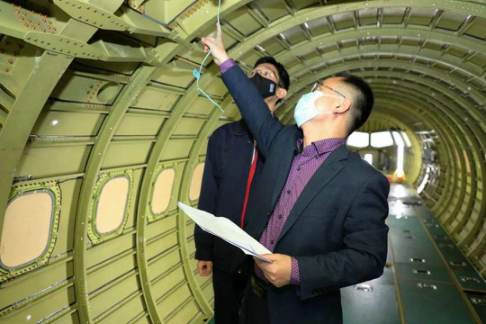
Figure 1: Zonal safety analysis on the real airplane.
to intuitive understanding of the mutual installation position relationship between real aircraft equipment and cables, resulting in low efficiency. If the inspection is carried out on the real airplane (see Figure 1), the scope of inspection is limited because a large number of areas (such as inside the wing, inside the pylon, and the interlayer of various structures) are inaccessible and invisible.
The failure of high temperature and high-speed equipment on the aircraft leads to the failure of equipment in the affected area. This kind of analysis work is limited due to the lack of automated computing tools. In the process of traditional regional safety inspection, the potential problems may not be fully exposed. For example, there is often no accurate method to determine which equipment will fail due to high temperature air leakage.
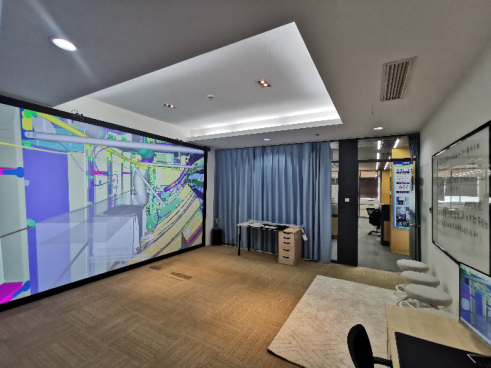
POWER-WALL VIRTUAL REALITY TECHNOLOGY Power-wall virtual reality technology can calculate and transmit two high frequency images in real time according to the position of the observer and the attitude of the head (see Figure 2). After amplification and adjustment of optical components, the images are respectively presented to the specific position of the observer’s left and right eyes. Thus the observer has the feeling of being on the “real” plane.
Further, by the virtual reality technology combined with digital mockup and simulation software, the whole process of the simulation work can be carried out from the data processing to analyze, from the whole air- plane digital mockup roaming to mechanism motion simulation, from ergonomic analysis of the real driving to assembly process simulation analysis.
Based on the above technology, the improvement of aircraft zonal safety analysis and inspection can carry out the roaming inspection of unreachable areas, quickly identifying the influence range of hazard sources, and quickly verifying the feasibility of changing the location of unsafe equipment.
12 Song
Figure 2: Application of power-wall virtual reality.
METHODS FOR CHECKING UNREACHABLE AREAS A realistic 3D virtual environment is generated for large civil aircraft by using virtual reality technology, and all areas of the aircraft can be seen by interacting with the sensor equipment. The simulation environment, visual system and simulation system are combined into one, and the operator and the aircraft virtual environment are combined with the sensor devices such as helmet display, plane projection, data gloves and data clothes. Through the interaction between the sensor device and the virtual environment, the opera- tor can obtain a variety of visual, auditory, tactile and other senses, observing the layout around the key equipment in the area you care about.
For example, the computer presents the cockpit environment of the aircraft, and the operator feels as if he is in the scene, experiencing the operation of the throttle, joystick and buttons. Or show the equipment rack, equipment and water baffle in the compact electronic and electrical equipment compartment of the aircraft, and intuitively check whether the waterproof measures of key electronic equipment in EE cabin are designed properly.
Based on the full information engineering virtual mockup model, through the real simulation of product and environment, a high degree of virtual reality simulation environment was built. The system includes a series of high- performance hardware such as three slices of DLP projector, 25000 lumens, laser optical motion capture system, roaming handle. Through man-machine interaction input, multi-channel three-dimensional display and other ways to carry out the most realistic simulation of the digital mockup. Enhance the ability of regional security inspection, evaluation and coordination through digital prototype. Inaccessible areas such as the wing body fairing, wing box section, hanger and rear accessory compartment can also be inspected.
A RAPID METHOD OF SORTING OUT THE HAZARD AREA The high pressure conduit of air management system consists of high pres- sure conduit of air source system, high pressure conduit of anti-ice system,
Method to Assist Zonal Safety Analysis for Large Civil Aircrafts 13
high pressure conduit of refrigeration component inlet and high pressure conduit of leveling system. According to the characteristics of high tempe- rature (200–250 degrees Celsius) and high pressure of the gas in the pipe, the leakage of the air inlet line will affect the failure of the surrounding equipment or structure after impact. The installation and layout of the equi- pment near the air inlet pipe should meet the safety requirements of the influence of the highest temperature in the vicinity when the air inlet pipe leaks.
However, it is difficult to quickly and accurately determine which equi- pment is likely to be hit by hot gas leaks. A jet flow model is proposed by studying the failure events of high temperature air intake lines of several civil aircraft models. That is, when the leakage of the high pressure pipe inlet air is injected from the vent of the insulation layer, its state is equivalent to tur- bulent jet flow. Its flow characteristics are shown in figure. The jet angle α is 14.5°, the vent diameter is 1 inch, and the typical jet model length is 40 inches. Taking a certain type of aircraft as an example, there are 62 possible lea- kage points of air intake pipeline in the whole aircraft. The jet model and full machine digital prototype are loaded at the leakage point. Through interference inspection, the equipment impacted by high temperature gas can be intuitively retrieved for subsequent design of protective devices or displacement.
Taking a certain type of aircraft as an example, there are 62 possible lea- kage points of air intake pipeline in the whole aircraft. The jet model and full machine digital prototype are loaded at the leakage point. Through interference inspection, the equipment impacted by high temperature gas can be intuitively retrieved for subsequent design of protective devices or displacement.
Uncontained rotor failure refers to the generation of high-speed, high- energy debris due to engine rotor damage, which is extremely energetic and considered to have ‘unlimited energy’ during analysis and can penetrate adja- cent structures, fuel tanks, fuselage, system equipment and other engine on the aircraft, posing a great risk to flight safety.
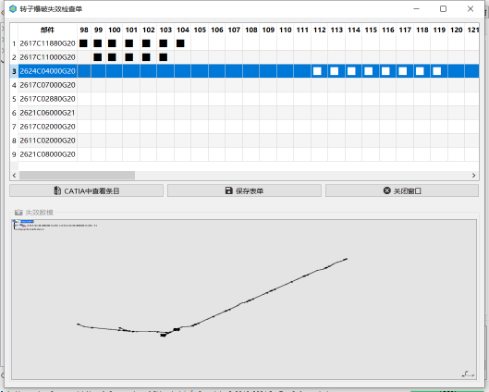
In this research, the computer program is used to automatically gene- rate the rotor machine range model and detect all the digital mockups located in the impact range. For the digital mockups in the impact range, the program automatically analyzes the impact Angle. As shown in the figure, the software performs an analysis every 1 degree to detect the digi- tal mockup in the range of 0 to 360 degrees of directional impact to facilitate the final evaluation of the entry and exit angles of the aircraft parts.
When the impact is detected, the program will give a prompt in real time, and give the number of failed parts corresponding to the impact Angle (see Figure 3). After the detection is completed, the program will summarize the total number of parts in the impact area and the impact angle range corresponding to the selected digital mockup.
This paper gives some examples to improve the efficiency of zonal safety analysis. The application of virtual reality technology improves the scope of visual field and the speed of inspection. Small failure models such as jet model are superimposed with digital mock-up to improve the speed of retrieving failed equipment. Through a large computer program, quickly generate an impact angle list of all the equipment on the aircraft that could be hit after the engine rotor is damaged and flies out.
Compared with traditional methods, these methods have improved the efficiency of problem finding and are new technology points that may be combined with ZSA in the future.
ACKNOWLEDGMENT
I would like to take this opportunity to express my deep gratitude to my supe- rvisor, Qiaojun Chi, who has offered me constructive guidance and valuable advice for this research. Besides, I wish to extend my sincere gratitude to all my colleague who have shared their points and opinions with me.
REFERENCES
Azevedo, Thiago Figueiredo, Cardoso, Raphael Calazans, Paulo Rogerio Tavares, Silva, Abraao Santos, Griza, Sandro. (2016). Analysis of turbo impeller rotor failure. David Pepley, Mary Yovanoff, Katelin Mirkin, Scarlett Miller, David Han, Jason
Moore. (2016). A Virtual Reality Haptic Robotic Simulator for Central Venous Catheterization Training, Journal of Medical Devices Volume 10 No. 3. Liang Yan, He Xu, Yuhua Deng. (2018). 3D Digital Mockup for Honeycomb Sandwich Panels of Satellites. 2018 IEEE 4th Information Technology and Mechatronics Engineering Conference (ITOEC).
Method to Assist Zonal Safety Analysis for Large Civil Aircrafts 15
Sergio Chiesa, Sabrina Corpino, Marco Fioriti, Alessandro Rougier, Nicole Viola.
(2013). Zonal Safety Analysis in Aircraft Conceptual Design: Application to SAvE Aircraft. Journal of Aerospace Engineering. Tamura, Yoichi. (2000). High temperature security system-High temperature characteristics of operational. Proceedings of the 4th Asia-Pacific-conference on Control and Measurement.
LISTED IN THE AHFE DIGITAL BOOKSTORE CATALOGUE
Explore the complete digital volume
Human-Centered Aerospace Systems and Sustainability Applications
Read this individual research paper free through the original publisher, or explore the full digital proceedings book.
ISBN 978-1-958651-02-5
Explore this ISBN in the AHFE Bookstore ↗Listed in the July 2026 bookstore catalogue; search by ISBN to confirm current availability · Digital book purchase optional