Rosa Maria Arnaldo Valdés, Victor Fernando Gómez Comendador, Maria Zamarreño, Francisco Perez Moreno, Raquel Delgado-Aguilera (2022). Aviation Human Factors Issues During and Post COVID 19. In: Human-Centered Aerospace Systems and Sustainability Applications. AHFE Open Access, vol. 26, pp. 27–34. https://doi.org/10.54941/ahfe1001431
COVID 19 has become a mayor and without precedent disruption in aviation, with a big impact in aviation front line operators, such as crews, air traffic controller and aircraft dispatchers. This new reality has generated unexperienced human factors consequences and ups and downs in the lives of these professionals. They had to deal with new environments in their personal and professional dimensions and changes in both the physical and also psychosocial conditions as a consequence of COVID -19 impacts.The complexity of restating a complex system such as global air transport affects the staff of all aviation supply chain and has the potential to generate new and emergent hazards, a different risk landscape, and new operational and safety challenges.This paper focuses on COVID-related human factors challenges for aviation professionals, how those challenges can generate hazards that jeopardize aviation safety levels, and what can be done to mitigate the derived risks.The paper revises situations faced by operators and service providers during the COVID lockdown and the reanimation of the operations, with a focus on the best practices applied by different organisations to cope with the challenges human factors derived issues while assuring continued high levels of safety as operations ramp up.The paper combines an assessment of the best practices implemented by the industry during the last two years with a classical safety risk assessment approach. The paper revised also the safety risk assessments, about COVID 19 operations-related human factors challenges, conducted by main international aviation organisation such as as the Civil Air Navigation Services Organisation (CANSO), the International Federation of Air Traffic Controllers’ Associations (IFATCA), the International Federation of Air Line Pilots’ Associations (IFALPA) and the International Air Transport Association (IATA). Appropriate resources and tools to minimize the mental health impact of COVID-19 and ensure staff well-being throughout the lockdown and recovery phases are discussed.The paper offers a better understanding of the impact that post COVID-19 operations-related challenges could have on aviation human factors; outline new biological and psycho-social hazards and risks situation and their interactions with aviation safety; and finally identify and propose appropriate mitigation measurements for those negative consequences
COVID-19 has become a mayor and without precedent disruption in avi- ation, with a big impact in aviation front line operators, such as crews, air traffic controllers and aircraft dispatchers. This new reality has genera- ted unexperienced human factors consequences and ups and downs in the lives of these professionals. They had to deal with new environments in their personal and professional dimensions, and with changes in both the physical and also psychosocial conditions as a consequence of COVID-19 impacts.
The complexity of restarting a complex system such as global air transport affects the staff of all aviation supply chain and has the potential to generate new and emergent hazards, a different risk landscape, and new operational and safety challenges.
This paper focuses on COVID-related human factors challenges for avia- tion professionals, how those challenges can generate hazards that jeopardize aviation safety levels, and what can be done to mitigate the derived risks.
The paper revises situations faced by operators and service providers during the COVID lockdown and the reanimation of the operations, with a focus on the best practices applied by different organizations to cope with the challenges and human factors derived issues, while assuring continued high levels of safety as operations ramp up.
The paper combines an assessment of the best practices implemented by the industry during the last two years with a classical safety risk assessment approach.
The paper also revised the safety risk assessments, about COVID-19 operations-related human factors challenges, conducted by main interna- tional aviation organizations such as the Civil Air Navigation Services Organization (CANSO), the International Federation of Air Traffic Con- trollers’ Associations (IFATCA), the International Federation of Air Line Pilots’ Associations (IFALPA) and the International Air Transport Associa- tion (IATA). Appropriate resources and tools to minimize the mental health impact of COVID-19 and ensure staff well-being throughout the lockdown and recovery phases are outlined.
The paper offers a better understanding of the impact that post COVID- 19 operations-related challenges could have on aviation human factors; outline new psychosocial hazards and risks situation and their interactions with aviation safety; and finally identify and propose appropriate mitigation measurements for those negative consequences.
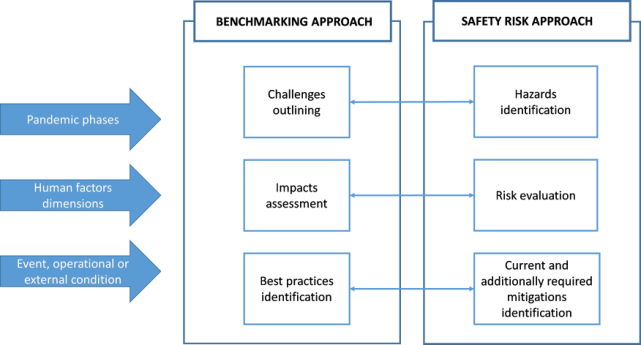
METHODLOGY The paper combines a benchmark approach focused on the assessment of the best practices implemented by the industry during the last two years with a classical safety risks assessment approach. The benchmark analysis is a bottom-up approach that grounds on the practical experience gained by the industry during the pandemic time. It analyzes the challenges faced by avi- ation as a consequence of COVID, the main human factors impact and the best practices applied to cope with them. Complementarily, the risk analy- sis is a top-down approach with a consolidated methodology to identify new and potential mitigations, that allows to enlarge the coverage of the complete assessment. It analyzes the new COVID derives hazards, evaluates the resul- tant risk and identifies current and additionally required mitigations. The combination of both methodologies is illustrated in figure 1.
HUMAN FACTORS CHALLENGES There are different human factors dimensions affected by adverse consequ- ences of the COVID-19 crisis lifecycle. Hereafter the most relevant ones are discussed and grouped into human factors related domains.
Occupational Health and Safety
The impact of varying government health requirements. Requirements for vaccinations, testing and mix of vaccinated an unvaccinated operational staff is also impacting staff and organization performances. Removal of COVID health protocols (masks, negative test requirement or social dista- nce) gradually in phases that are not necessarily aligned across regions. Keeping track of this variety of conditions is hard for dispatchers and crews.
Aviation Human Factors Issues During and Post COVID 19 29
Figure 1: Methodology of the study.
Working environment and team management. Financial damages brought cost cutting at companies that translated into staff reduction measures, loss of corporate and operational knowledge, and staff demotivation. Redistribution of work among the members of a shift, modifications of team composition, as well as loss of experienced staff and team leader- s/mentors, impact performances and level of service. Team’s dynamics have also been altered as aviation professionals have not been able to socialize. Pre-COVID-19 work patterns, assumptions and expectations may no longer be valid in the new normal. Maintaining cognitive engage- ment will be a challenge for organizations. Organizations should consider shift rotations to better balance skills and experience, in conjunction with operational measures if needed.
Long term post COVID effects on health for operational staff are still not well understood. COVID effects on cognitive ability remains unde- termined. There are risks of reinfection, other potential sickness and psychological stress.
Human performance (Drogoul & Cabon, 2021).
Constant changes in operational procedures. These will turn out into increased stress level, less effective CRM and communication, and it will damage the scheduling and rostering of aviation professionals.
Increased levels of stress and anxiety. Aviation professionals are experie- ncing increased levels of stress and anxiety due to external stressors and the different consequences of COVID (family, economy, etc.). Job uncertainty impacts on the psychosocial climate of the workplace. This affects the mental well-being of personnel performing safety-critical and non-safety- critical functions. These effects can be magnified by the loss of experienced staff in the teams, in particular loss of people who constitute a personal and professional reference inside the team. When traffic increases, avia- tion professionals can experience even more stress from the pressure of maintaining on-time performance in a new and ever-changing operating
environment. Organizations must ensure a collaborative work climate that is sensitive to the consequences of the uncertainty that COVID-related anxieties are introducing. (Laovoravit, et al., 2021)
Pandemic fatigue. The term pandemic fatigue refers to the lack of moti- vation to follow the recommended behavioral protection guidelines after such a prolonged period of the pandemic. It can cause friction in work teams, reduced morale and poor work environment. This can affect especi- ally aircrews in situations where passengers do not follow health protocols on board. All this increases stress and anxiety. It might also generate rebellious behaviors in response to long term mitigation measures, cau- sing not only drift from established COVID policies and procedures, but also from operational and safety procedures. Organizations should deve- lop strategies to maintain and revitalize supportive health protocols for both passengers and aviation professionals.
Bereavement, tiredness and fatigue can conduce to reduce reporting, tire- dness, reduction in attentiveness, loss of focus, impatience and emotional response and behaviors to stress. Additionally, frequency and volume of external distractions will also reduce focus.
Competence and training (Rajee Olaganathan, 2021)
Competence and training. In the initial phase of the pandemic, ina- ccessibility of training and the suspension of medical checks, were not considered urgent. In 2020, interim measures were settled including the extension of license validities and recurrent training. ICAO created the COVID-19 Contingency Related Differences (CCRD) system to capture any differences from ICAO Standards on certification and licensing. However, prolonged regulatory alleviations risks need to be mitigated. Additionally, long periods of low traffic pose a risk of degradation of skills.
Irregular traffic levels and operations joint with changes to workforce. Prolonged absences and low traffic levels require attention to training and competency levels, due to the potential risk of technical and non-technical skills degradation. Experience has shown that procedural knowledge and manual handling of aircraft skills are better retained and recover quickly, while some non-technical skills, such as workload management, recover more slowly. Degradation in the use of standard phraseology is sometimes underestimated.
Recurrent training, revalidation and OJT. With the pandemic, operational personnel are generally in one of the following circumstances: qualified and updated, qualified after long breaks (requiring retraining and verifi- cation) and/or not updated without recent experience in specific operating environments. It is not possible to design a "one size fits all" solution for revalidation and recurring training. On the job training (OJT) and "over the shoulder" assessments have also been affected. Low traffic, mostly with nominal situations, make difficult to manage contingency situations as operations restart. In addition, post-COVID contingency or emergency scenarios can be very different from pre-COVID.
Aviation Human Factors Issues During and Post COVID 19 31
Training environment changes, such as higher reliance on virtual trai- ning methods; training needs not adequately addressed, and observable degradation in proficiency and/or familiarity with procedures.
Work Organization and Change Management
Reduce safety staff capacity to cope with the increase of operations as air traffic levels start recovering. Reductions in staff affected pilots, dispatch- ers, and ground crews at varying levels. This might reduce the capacity to identify and address potential risk in a rapidly changing environment or even a drift in the safety culture of the organization.
Old planning methods might be no longer valid for the new operatio- nal environment. The mismatch between available resources and capacity affects very basic functions from traffic forecast up to staff/crew schedu- ling or any other resource planning. Industry needs to adapt and become more flexible. Safety assurance during recovery should consider current and future requirements and available capacity.
Over-reliance on technology and automation, in safety critical tasks, its detriment of cognitive functions.
Overwhelming changes to the operational environment impairing the capacity to manage changes and organization resilience.
Pilot, ATCO and ground staff interaction, communication and interfacing
Interactions are challenged during recovery by conflicting operational objectives and restrictions; erosional of skills and abilities, in particular language, communication and phraseology skills; reduced familiarity with specific procedures, etc…The pressure to meet time performance and the operational constrains can become dominating stressors in the interaction between operational staff.
The timely and proper maintenance of CNS systems (communications, navigation and surveillance systems).
Increased airport movements while maintaining a large number of parked aircraft (non-standard, number and location) negatively affecting airport operation and infrastructure or causing continuous change in procedures and creating new non-standard behaviors in the staff and in their intera- ction. At the same time limited resources for ground operations and higher turnaround times will also increase stress and communications issues.
Increase of wildlife risk at the airports.
RESOURCES AND TOOLS TO MITIGATE/MINIMIZE IMPACT THROUGHOUT LOCKDOWN AND RECOVERY Best practices recommended and applied by companies and organizations have been revised to identify successful strategies to address the previous challenges. Table 1 summarizes the main human factors guidelines produced during the pandemic period.
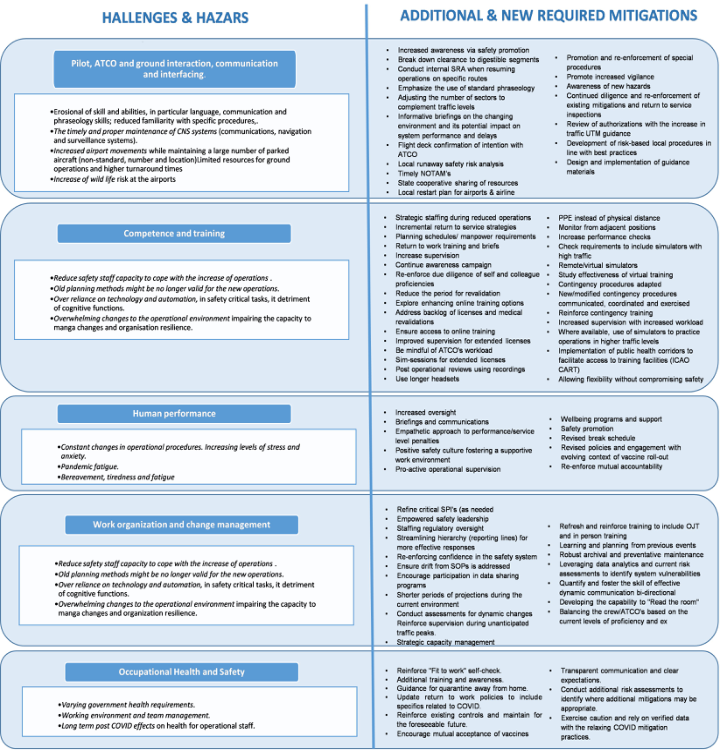
Challenges and best practices have been screened from a risk mitigation perspective, following a classical safety risk mitigation approach. Figure 2
Table 1. Main human factors guidelines produced during the pandemic period.
Table available in the original PDF paper.
Organization Guidelines IATA, IFATCA and CANSO
Joint Bulletin number 1 ‘Safely Navigating the Industry Restart’. Considerations for Navigating the Restart and Recovery of Air Traffic (IATA, AFACTA and CANSO, 2021) UK CAA
Safety Notice SN-2020/0011 Human Factors Considerati- ons for Organisations During Covid-19 Restart Activities (UK CAA, 2020)
SAFETY NOTICE SN–2020/014: Effect On Aviation Mental Health From the Covid-19 Pandemic and Return to Re-defined ‘Normal’ Flight Operations (UK CAA, 2020) Irish CAA -IAA
Aeronautical Services Advisory Memorandum (ASAM). No: 41 Issue 1 Date 10.07.20 Title Human Factors Con- siderations for Organisations During Covid-19 Restart Activities (IAA, 2021)
EASA
Review of aviation safety issues arising from the COVID- 19 Pandemic. (EASA, 2021)
Guidelines: The role of operators’ management systems in the COVID-19 recovery phase. (EASA, 2021)
Guidelines: The role of operators’ management systems in the COVID-19 recovery phase. (EASA, 2021)
Flight Safety Foundation
Guidance on Advancing COVID-19 Risk Mitigation in Air Travel. (FSF, 2021) IFATCA
COPING WITH COVID-19: A short guide on dealing with stress and anxiety for air traffic controllers. (IFACTA, 2021)
COVID-19: Guidance Material on dealing with COVID-19 in Air Navigation Facilities. (IFATCA, 2021)
COVID-19 State letters and Electronic Bulletins
ICAO (ICAO, 2020)
COVID-19 Q&As for States, Air Transport Operators and the General Public
Handbook for CAAs on the management of aviation safety risks related to COVID-19
COVID-19 Temporary Alleviations to national regulations
COVID-19 Contingency Related Differences (CCRD)
Aviation Medicine CAPSCA
COVID-19 Air Traffic Dashboard
Testing and Cross-border Risk Management Manual
Pandemic Related Recovery Courses Catalogue
iPack- Aviation Safety Risk Management related to COVID-19 for CAAs
VIRTUAL CLASSROOM- Aviation safety risk manage- ment related to COVID-19 for CAAs
WEBINAR - Management of aviation safety risks related to COVID-19 for CAAs
Aviation Human Factors Issues During and Post COVID 19 33
Figure 2: Challenges or hazards and new additional required mitigations.
shows the results of this combined analysis. It summarizes the challenges, the main risks and the new required mitigations.
CONCLUSION
The COVID-19 pandemic, in each of its stages, has affected, and continues to affect, each of the aeronautical professionals in a different way. Under- standing the short-term and long-term impact on different aspects of human factors is essential to prevent and mitigate safety risks from this unprece- dented situation. Experience shows that it is necessary to work together during recovery to understand risks and safety issues and to mitigate them appropriately.
This document provides the results of this analysis, identifying challenges and threats, assessing the derived risks, and identifying mitigations based on the best practices analyzed.
Throughout this work, the best practices implemented by the most relevant organizations related to civil aviation have been reviewed applying a double methodology that combines a classical benchmarking analysis with a risk analysis.
The study covers best practices implemented or recommended by 7 orga- nizations. Challenges and threads are grouped into 5 big human factors areas including:
Occupational Health and Safety.
Human performance.
Competence and training.
Work organization and change management.
Pilot, ATCO and ground staff interaction, communication and interfacing.
The current and new additional mitigations required have been analyzed and proposed in each of these 5 human factors areas, from the best practices applied and proposed by the analyzed organizations.
REFERENCES
Drogoul, F. & Cabon, P., 2021. Post COVID-19 Fatigue Management for ATCOs.
AHFE 2021. Advances in Safety Management and Human Performance. s.l., s.n. EASA, 2021. Guidelines: The role of operators’ management systems in the COVID-19 recovery phase, s.l.: s.n. EASA, 2021. Guidelines: The role of operators’ management systems in the
COVID-19 recovery phase, s.l.: s.n. EASA, 2021. Review of aviation safety issues arising from the COVID-19 Pandemic, s.l.: s.n. FSF, 2021. Guidance on Advancing COVID-19 Risk Mitigation in Air Travel, s.l.:
s.n. IAA, 2021. Aeronautical Services Advisory Memorandum (ASAM). No: 41 Issue 1 Date 10.07.20 Title Human Factors Considerations for Organisations During Covid-19 Restart Activities, s.l.: s.n. IATA, AFACTA and CANSO, 2021. Joint Bulletin number 1 ‘Safely Navigating
the Industry Restart’. Considerations for Navigating the, s.l.: s.n. ICAO, 2020. COVID-19 Response and Recovery Platform. [En línea] Available at: https://www.icao.int/covid/Pages/default.aspx [Último acceso: 10 February 2022]. IFACTA, 2021. COPING WITH COVID-19: A short guide on dealing with stress and anxiety for air traffic controllers, s.l.: s.n. IFATCA, 2021. COVID-19: Guidance Material on dealing with COVID-19 in Air
Navigation Facilities, s.l.: s.n. Laovoravit, V. y otros, 2021. COVID-19 on Job Insecurity and Mental Health of Thai Airways International Flight Attendants. Innovation Aviation & Aerospace Industry - International Conference . Session Safety and Energy. s.l., s.n. Rajee Olaganathan, R. A. H. A., 2021. Impact of COVID -19 on Pilot Proficiency – A
Risk Analysis. Global Journal of Engineering and Technology Advances, 06(03). UK CAA, 2020. Safety Notice SN-2020/0011 Human Factors Considerations for Organisations During, s.l.: s.n. UK CAA, 2020. SAFETY NOTICE SN–2020/014 (28 July 2020): The Effect On
Aviation Mental Health From the Covid-19, s.l.: s.n.
LISTED IN THE AHFE DIGITAL BOOKSTORE CATALOGUE
Explore the complete digital volume
Human-Centered Aerospace Systems and Sustainability Applications
Read this individual research paper free through the original publisher, or explore the full digital proceedings book.
ISBN 978-1-958651-02-5
Explore this ISBN in the AHFE Bookstore ↗Listed in the July 2026 bookstore catalogue; search by ISBN to confirm current availability · Digital book purchase optional