Human Factors/Ergonomics (HF/E) practices in aviation generally focus on the system’s functional features like human performance, human error, workload, and situation awareness, without considering the emotional aspects of the interaction. However, there is a shift from a cognitive perspective to an affective one, which concerns promoting pleasure instead of just preventing design deficiencies. While traditional human factors have focused on efficiency, usability, and safety, emerging approaches have also focused on product experience. There has been a growing interest in affect and pleasure in such areas as engineering design, psychology, neuroscience, human factors, and industrial design. This study aims to transfer these emerging approaches into aviation by determining the perceived affective qualities in a flight deck design. For this purpose, interviews were conducted with pilots by using the Repertory Grid Technique with Laddering Technique to elucidate how pilots experience a flight deck design. According to the results, 33 constructs were determined which show the qualities of attributes produced by flight deck and the affective states of pilots when these qualities are provided.
A flight deck with its controls, displays and other physical elements is where the pilot controls the air vehicle. The design of the flight deck including the whole pilot-vehicle interface, has a direct effect on pilot performa- nce, situation awareness of the pilot, pilot error, and the usability of the system. The flight deck and related pilot vehicle systems are designed to enhance the pilots’ performance through human factors considerations that aims to increase the productivity and efficiency of work, improving safety, and increasing comfort (Wickens, Gordon, & Yili, 1998). The majority of human factors research focuses on physical and cognitive aspects of human- computer interaction (Karwowski & Zhang, 2021). Physical consideretions focus on making the cockpit reachable, visible and comfortable for the inten- ded user. Cognitive considerations ensure that this physical environment with the pilot-vehicle interface increases the performance and situation awareness of the pilot, meanwhile decreases the workload and human error. Cognition focuses on information processing elements that enables human to transit the
information from the environment to a response (Wickens, Gordon, & Yili, 1998); such as perception, memory, reasoning, etc. In the updated version of human information processing proposed by Lee (2006) affect influences each stage, and the affective stimuli are processed concurrently with non-affective stimuli.
Affect (or core affect) is the basic neurophysiological state that is not refle- cted in any stimulus. When the core affect is attributed to a stimulus (that can be caused by an event, place, or product), the core affect is transformed to attributed affect (Russell, 2003). That is the “affective quality”, which cau- ses this transformation. Russell (2003) states that core affect exists within the person (a general feeling of being unpleasant), while affective quality exi- sts in the stimulus (feeling unpleasant because of an error on your phone). The perception of an object’s affective quality starts with a stimulus and remains tied and influences the subsequent reactions (Russell, 2003). Percei- ved affective quality is, on the other hand, an individual’s perception of this transformation of his/her core affect in response to a stimulus (Zhang & Li, 2005). Many researchers state that affect and cognition cannot be separated, and they conjointly and equally control the information processing (Helander & Khalid, 2012; Minsky, 2007). Norman (2004) claims that cognition and affect are in mutual effect; each system is influenced by the other. While the affective system uses affective responses like emotions, sentiments, and attitudes and makes quick responses, the cognitive system uses the decision- making process, makes analytical and slow responses. Affect influences the overall human information processing style. Compared to negative, posi- tive moods induce heuristic processing and encourage people to make faster decisions (Maire, Brochard, Kop, Dioux, & Zagar, 2017) and pay little atten- tion to details or unimportant information. Positive affect allows users to be better organized, essential for clustered work environments, and more crea- tive and more flexible in decision-making and problem-solving, essential for time-critical systems where the situation may change instantly (Isen, 2001). Positive affect also enhances cognitive flexibility, the ability to simultane- ously think about multiple issues (Murphy et al., 2003). The users’ affective state remarkably influences the performance, especially in complex systems where decision support systems have a crucial role (Hudlicka & McNeese, 2002). Besides, Moshagen et al. (2009) explored that the completion time of the tasks in highly aesthetic websites is significantly shorter than in unae- sthetic ones. Likewise, Sonderegger and Sauer (2010) acquired similar results with cell phones in that visually appealing design enables users to reduce task completion time with less error.
According to the above discussion, the cognitive system works with the affective system and they both establish a judgment (Helander & Khalid, 2012), and affect is essential for the cognition and perception process where decision-making occurs (Zhou et al., 2013), so the affective system is as important as the cognitive system.
Research related to affect generally focuces on consumer products and interface design. Affect is quite new in aviation HF/E; aesthetics and emo- tion in aviation are poorly researched, and their interaction with the crew’s
Perceived Affective Qualities in Flight Deck Design 561
performance is even less (Gannon, 2010). Human factors practices in avi- ation evaluate the cognitive effect of flight deck design by measuring the possibility of human error, the level of workload it creates, the level of situ- ation awareness, as a result, the level of performance. Based on the aviation standards (EASA Certification Specifications, MIL-STD-516 Military Stan- dards), the paramount objective of aviation human factors engineering is to make the cockpit reachable, visible and comfortable and ensure that this physical environment with the pilot-vehicle interface increases the performa- nce and situation awareness of the pilot, decreases the workload and human error. This is the entire human factors verification process. Human Factors concerns physical, cognitive, human-computer interaction, (Karwowski & Zhang, 2021) for design, without considering pilot emotions (Hancock, Pepe, & Murphy, 2005; Wickens, Gordon, & Yili, 1998). Affective qualities of the design of the flight deck remains unattended. If design causes a negative effect on the affective response of the pilots, it may have reverse effects on pilot performance and human error. The aviation industry has acknowledged the functional benefits of design (Gannon, 2010), but is still indecisive on its affective values. However, it is known that thoughts, behavior, and expe- riences can easily be impressed by emotions (Demirbilek, 2017); therefore, the design should arouse proper feelings (fun for a mobile phone or excite- ment for a sports car) for the designed task. By considering these, this paper explores perceived affective qualities in flight deck design.
METHOD
Personal constructs are the perceived representation of the world (the stimuli) of an individual. According to Personal Construct Theory (PCT), proposed by Kelly (1955), to make sense of the world around her/him, an indivi- dual gets information, evaluates it, and develops interpretations according to his/her previous experiences. While doing that, he/she has some construct- s/values that help him/her to interpret his/her experience of the world. Since the study’s goal is to elicit the constructs evoked from flight deck design, the means-end chain model (Gutman, 1982) that explains the linkage between the perceived product attributes and user values was used. Values influence the individuals’ thoughts, affect their choices, guide their behavior, beliefs, and attitudes (Feather, 1990). According to Feather (1990), values consti- tute the self-perception of an individual, and they are the clues of what the individual would cognitively choose. Values are attributed to specific events, situations, or objects. Therefore, eliciting an individual’s personal constructs can provide information about the perceived affective qualities attributed by that individual. Thus, the goal of this study is to explore the pilot’s perso- nal constructs while evaluating a flight deck design and identify the relations between these constructs.
For this study, a combination of interview methods, both Repertory Grid Technique (RGT) and laddering, were used.
RGT is a method that is based on Kelly’s personal construct theory (1955). According to Kelly, individuals perceive the world, including situations, pro- ducts, or interfaces, through bipolar similarity-dissimilarity judgments. In
562 Güne¸s and Yargın
this process, two judgments of similarity and dissimilarity are made and the person is settled down on this bipolar scale. Fallman and Waterworth (2010) state that RGT allows eliciting the interviewee’s own product experience constructs instead of the interviewer.
Laddering is an in-depth interview method that elicits higher-level abstra- ctions of constructs based on means-end theory. In this method, the intervi- ewer scrutinizes the individuals’ personal construct system to uncover their individual core values. In a typical laddering interview, first, the interviewer asks respondents to name attributes of a product. Secondly, the respondent is asked for each attribute. “Why attribute-x is important for you?”. Each answer of the second level is elaborated at the third level by asking the “Why?” question to achieve the respondent’s core values. In this way, the researcher reaches what an attribute means to the respondent in a hierarchical structure (attribute-consequence-value).
Participants In this study, participants are pilots who have flight experience in different platforms and contexts. The participants are test pilots who have previous military flight experience and flight test experience, flight test engineers who have flight experience, and civil pilots. A total of 23 pilots attended the study from various platforms as given in Table 1. In Moynihan’s (1996) RGT interview study, no new constructs could be elicited after the tenth partici- pant. For this study, interviews were conducted by 11 helicopter pilots and 12 aircraft pilots so that more than ten participants could be included from each category.
Study Setup Virtual reality glasses with an android phone, A3-colored printed images, and a voice recorder was used for the study.
Aircraft images as stimuli were shown to pilots to stimulate the flight deck experience. (Gulfstream G550, Embraer Phenom-100, Bombardier-C Series, Airbus-330, Boeing-787 Dreamliner as airplane and TAI T625, AW-139, Bell 429, AW-109, EC135 as helicopter.) These cockpits are selected in terms of their diversity in design philosophy, control type (side stick vs. lever), out- side vision, entrance type, switch types, ambiance, colors (light vs. dark),
Table 1. Participants.
Table available in the original PDF paper.
Platform Educational Background Total Number of Respondents Military Civil
14 9 23
Aircraft 5 7 12 Helicopter 9 2 11 Total Number of Respondents
Perceived Affective Qualities in Flight Deck Design 563
and forms (smooth and soft curvatures vs. sharp edges). 360-degree panora- mic views of these aircraft were shown to pilots with virtual reality glasses. A3-colored printed versions were also available during the interview.
Procedure Before starting the interview, a brief explanation of the procedure and the study’s aim were explained. The interview consisted of two steps.
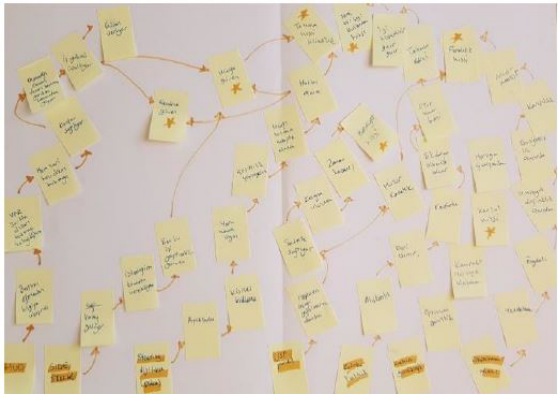
In the first step, for RGT, each pilot was shown appropriate visuals for the vehicle type s/he had been familiar with (airplane or helicopter). The tria- dic sorting (similarity between two and dissimilarity from the third one) and dyadic sorting (comparing two) approaches were used. Five different cock- pit designs were shown to pilots in terms of their proficiency. Respondents were asked to state in which way two of the three flight decks shown are the same and thereby different from the third for the triadic sorting technique, and they were asked to compare the two images for the dyadic sorting techni- que. These techniques elicit as many constructs as possible. They were asked to indicate which attributes were preferable to understand positive attribu- tes. This process continues until no attribute can be found. In the second step, attributes were questioned further by following the laddering proce- dure to understand the personal constructs behind these attributes. During the interview, the cognitive mapping method (Figure 1) was applied by the respondents that shows a hierarchical structure (Eden, 2004).
Data Analysis One hundred and eighty-six cognitive mapping protocols were reviewed in this study. In the first stage, statements that had been recorded during the interview were transcribed to the Microsoft Excel program, and the gath- ered data was coded in this program. Since the data was too dense (about twenty hours), it was impractical to use more than one coder for reliability.
Figure 1: An example of a cognitive map generated in the laddering interviews.
564 Güne¸s and Yargın
Therefore, the first author coded the data and the second author checked the coding process. Since the data gathered from the laddering interview has idiosyncratic nature, data should be reviewed by content analysis in order to group similar statements (Reynolds & Gutman, 1988).
Results
Attributes are the design components that the respondents highlighted in the interview. Consequences are the qualities presented to the pilots by the fli- ght deck, which are the functions that an attribute provides. These qualities are the hedonic qualities that focus on human affective needs and pragmatic qualities, which focus on goal-related functions like usability and efficiency (Hassenzahl, 2004). These qualities cause pilots to produce some values, which are the affective states of pilots. The values are the goals or the pilot’s needs while a function is provided. The list of the attributes, the consequences and the values are given in Table 2.
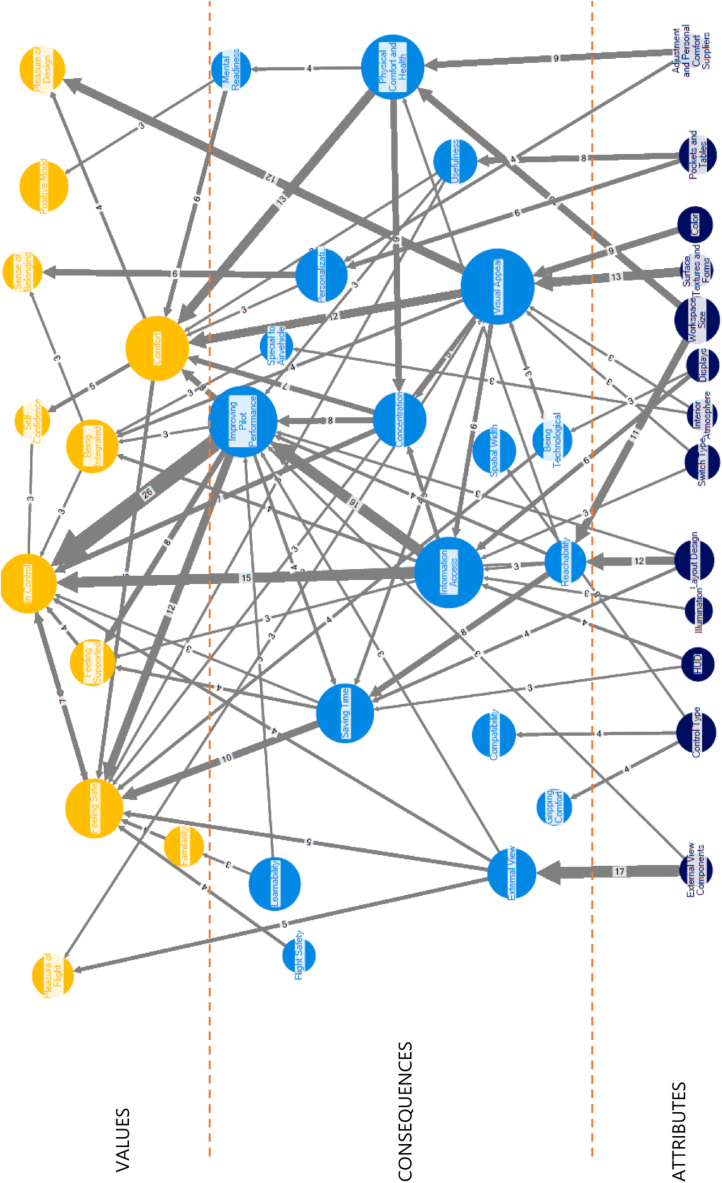
Meantime, ladders were also retrieved from cognitive mapping protocols. Ladders were used to explore the relationships between the constructs. So the laddering data was visualized to establish hierarchical relationships between the constructs. Hierarchical Value Map (HVM) is a compelling presenta- tion method to describe these relations (Reynolds & Gutman, 1988). The graphic enables the readers to see the connections clearly. The HVM is illu- strated in the Figure 2 with cut-off level 3 for a simplified view. According
Table 2. Attributes – consequences–values.
Table available in the original PDF paper.
ATTRIBUTES CONSEQUENCES VALUES
Information Accessibility Sense of Familiarity
Workspace Size Improving Pilot Performance Feeling in Control External View Components
Usefulness Embodiment
Interior Atmosphere Concentration Feeling Safe Switch Types Learnability Feeling Supported Surface, textures, and forms
Movement Pleasure of Design
Color Providing Flight Safety Comfort Layout Design Saving Time Pleasure of Flight Technology Compatibility of Control and Sense of Belonging Control Command Type Physical Comfort and Health Appreciation of Design/er Personal Comfort Suppliers
Personalization
and Adjustment Gripping Comfort Positive Mood Pockets and Tables Reachability Self Confidence Displays Extended External View Sounds of Air Vehicle Being Technological Head up Display (HUD) Illumination Visual Appeal Spatial Width Being Special to Air Vehicle Mental Readiness Design Value Encouraging Manual Flight Providing Scenic View
Perceived Affective Qualities in Flight Deck Design 565
Figure 2: HVM hierarchical value map-cutoff level-3.
566 Güne¸s and Yargın
to the HVM, there are strong interactions between the constructs. There are branched, interconnected relations in HVM instead of a one-way structure.
Self-confidence is an end construct in the network. It is affected by com- fort, feeling in control, and the sense of familiarity, but not affect any other construct. Comfort has many linkages with other constructs in the system. Comfort is mainly affected by physical comfort and health and visual appeal.It is a general feeling that representing the pilot’s feelings while doing his/her mission. It is also affected by improving pilot performance, concentra- tion, and mental readiness. Embodiment is influenced by other constructs but not influences others much. It is affected by information accessibility, impro- ving performance, visual appeal, and unique to air vehicle construct. The appreciation of design has more negligible effect on the network as it does not have a relationship with many other constructs. The pleasure of flight is relatively at the end of the ladder. The pleasure of flight is mainly influenced by the external view and visual appeal. Additionally, view and information access have an impact on the pleasure of flight. Moreover, the embodiment may produce the pleasure of flight. Sense of belonging is mainly influenced by personalization. It is also affected by physical comfort. The embodiment also produces a sense of belonging for the pilots. Feeling safe is connected with many actors in the network, is significantly affected by improving pilot performance. In addition, information accessibility has a strong influence on this construct. Feeling supported, feeling safe, embodiment, concentra- tion, saving time, and external view also influence feeling safe. The feeling in control influences feeling safe (reciprocally) and self-confidence. Feeling in control has a relationship with many other actors in the network. Impro- ving pilot performance is the most potent construct that results in feeling in control. Information access also has a remarkable influence on feeling in control. Concentration, embodiment, feeling safe, feeling supported, and external view also affect the feeling in control. The feeling of being in con- trol mostly affects the feeling safe (reciprocal relation) and self-confidence as the outcome. The pleasure of design is an end construct in the network. The pleasure of design is mainly affected by visual appeal. In addition, com- fort, positive mood, and design value may produce the pleasure of design. It may minimally influence the comfort and the pleasure of flight. Positive mood is not connected to many constructs. Positive mood is mainly affected by mental readiness, visual appeal, and physical comfort and health. It influ- ences the pleasure of design. Positive mood is mainly produced by personal comfort suppliers and arrangement, workspace size and surface, textures, and forms. Feeling supported during flight is mainly affected by improving pilot performance. It is also influenced by saving time, information acces- sibility. Feeling supported during flight has an impact on the comfort and pleasure of design. In design, feeling supported during flight is mainly produ- ced by workspace size, layout design, external view components, technology, displays, HUD, pockets and tablets, and adjustment and personal comfort suppliers. Sense of familiarity has a strong impact on feeling safe. Addi- tionally, the sense of familiarity causes feeling in control, self-confidence, positive mood, and comfort. It is affected by learnability, saving time, and embodiments.
Perceived Affective Qualities in Flight Deck Design 567
CONCLUSION
This study investigated the perceived affective qualities of a flight deck design. In these interviews, pilots were questioned about their personal construct system toward flight decks’ physical attributes. In consequence, 33 constructs were detected. These constructs were grouped into two main categories. The first group was the consequences of the physical attributes; Visual Appeal, Personalization, Improve Pilot Performance, External View, Information Access, Usefulness, Compatibility, Physical Comfort and Health, Concen- tration, Learnability, Spatial Width, Saving Time, Mental Readiness, Being Technological, Gripping Comfort, Being Special to Air Vehicle, Reachability, Flight Safety, Design Value, Manual Flight, and View. The consequences are the functions that a physical attribute provides for an individual. The other group is the values which were produced from the consequences; Comfort, Appreciation of Design/er, Embodiment, Pleasure of Flight, Sense of Belon- ging, Feeling in Control, Pleasure of Design, Feeling Safe, Positive Mood, Self-Confidence, Feeling Supported, and Sense of Familiarity. Values are the goals or the needs of pilots when a function (consequence) is provided. The constructs derived from consequences were more concrete (task-driven) than the constructs derived from the values.
The interviews showed that a specific attribute might produce various emo- tions in the pilots. A flight deck might provide a cozy environment for one pilot by wrapping him around; on the other hand, it might create a restri- ctive environment for another pilot by preventing his movements. Therefore, there is no direct link that one attribute causes one specific feeling on the pilot; each situation must be evaluated in its own context. This study provi- des which feelings were produced at the end, but it is up to the colleagues to identify the underlying causes.
ACKNOWLEDGMENT
The authors would like to acknowledge all the pilots who attended the study.
REFERENCES
Demirbilek, O., 2017. Evolution of Emotion Driven Design. In: Emotions and Affect in Human Factors and Human–Computer Interaction. San Diego: Academic Press, pp. 341–357. Eden, C., 2004. Decision Aiding-Analyzing Cognitive Maps to Help Structure
Issues or Problems. European Journal of Operational Research, Volume 15, pp. 673–686. Fallman, D. & Waterworth, J., 2010. Capturing User Experiences of Mobile Information Technology with The Repertory Grid Technique. Human Technology, 6(2), pp. 250–268. Feather, N. T., 1990. Bridging the Gap between Values and Actions. In: R. M. Sorran-
tino & E. T. Higgins, eds. Handbook of Motivation and Cognition: Foundations of Social Behavior. New York: Guilford, pp. 151–192. Gannon, A. J., 2010. Flight Deck Aesthetics and Pilot Performance: New Uncharted Seas. In: Handbook of Aviation Human Factors-Human Factors in Transporta- tion. Baco Ratton: CRC Press, pp. 382–402.
568 Güne¸s and Yargın
Gutman, J., 1982. A Means-End Chain Model Based on Consumer Categorization Processes. Journal of Marketing, Volume 46, pp. 60–72. Hancock, P. A., Pepe, A. & Murphy, L. L., 2005. Hedonomics_The Power of Positive
and Pleasurable Ergonomics. Ergonomics in Design, pp. 8–14. Hassenzahl, M., 2004. The thing and I: Understanding the Relationship between User and Product. In: Funology. Dordrecht: Kluwer Academic Publishers, pp. 31–42. Helander, M. G. & Khalid, H. M., 2012. Affective Engineering and Design. In: Hand-
book of Human Factors and Ergonomics, Fourth Edition. New Jersey: John Wiley & Sons, Inc., pp. 569–596. Hudlicka, E. & McNeese, M. D., 2002. Assessment of User Affective and Belief States for Interface Adaptation: Application to an Air Force Pilot Task. User Modeling and User-Adapted Interaction, 12(1), pp. 1–47. Isen, A. M., 2001. An Influence of Positive Affect on Decision Making in Complex
Situations. Journal of Consumer Psychology, 11(2), pp. 75–85. Karwowski, W. & Zhang, W., 2021. The Discipline of Ergonomics and Human Factors. In: G. Salvendy & W. Karwowski, eds. Handbook of Human Factors and Ergonomics. New Jersey: John Wiley & Sons, pp. 3–37. Kelly, G. A., 1955. The Psychology of Personal Constructs. New York: Norton. Lee, J. D., 2006. Affect, Attention, and Automation. In: Attention: From Theory to
Practice. New York: Oxford University Press, pp. 73–89. Maire, H. et al., 2017. Effect of Emotions in a Lexical Decision Task: A Diffusion Model Analysis. Swiss Journal of Psychology, 76(2), pp. 71–79. Minsky, M., 2007. The Emotion Machine: Commonsense Thinking, Artificial
Intelligence, and the Future of the Human Mind. New York: Simon and Shuster. Moshagen, M., Musch, J. & Göritz, A. S., 2009. A blessing, not a curse: Experimental evidence for beneficial effects of visual aesthetics on performance. Ergonomics, 52(10), pp. 1311–1320. Moynihan, T., 1996. An Inventory of Personal Constructs for Information Systems
Project Risk Researchers. Journal of Information Technology, Volume 11, pp. 359–371. Murphy, L. L., Stanney, K. & Hancock, P. A., 2003. The Effect of Affect: A Hedonomic Evaluation of Human-Computer Interaction. Santa Monica, CA, Human Factors and Ergonomics Society, pp. 764–768. Norman, D. A., 2004. Emotional design: Why do We Love (or Hate) Everyday
Things. New York: Basic Books. Reynolds, T. J. & Gutman, J., 1988. Laddering Theory, Method, Analysis, and Interpretation. Journal of Advertising Research, 28(1), pp. 11–31. Russell, J. A., 2003. Core Affect and the Psychological Construction of Emotion.
Psychological Review, 110(1), pp. 145–172. Sonderegger, A. & Sauer, J., 2010. The Influence of Design Aesthetics in Usability Testing: Effects on User Performance and Perceived Usability. Applied Ergonomics, Volume 41, pp. 403–410. Wickens, C. D., Gordon, S. E. & Yili, L., 1998. An Introduction to Human Factors
Engineering. New York: Addison-Wesley Longman, Inc.. Zhang, P. & Li, N., 2005. The Importance of Affective Quality. Communications of the ACM, 48(9), pp. 105–108. Zhou, F., Ji, Y. & Jiao, R. J., 2013. Affective and Cognitive Design for Mass Perso-
nalization: Status and Prospect. J. Intell. Manuf., Volume 24, pp. 1047–1069.
LISTED IN THE AHFE DIGITAL BOOKSTORE CATALOGUE
Explore the complete digital volume
Human Factors in Transportation
Read this individual research paper free through the original publisher, or explore the full digital proceedings book.
ISBN 978-1-958651-71-1
Explore this ISBN in the AHFE Bookstore ↗Listed in the July 2026 bookstore catalogue; search by ISBN to confirm current availability · Digital book purchase optional