Lenka Hanakova, Viktor Valenta, Aleš Řezníček, Roman Matyas, Vladimir Socha (2023). Effects of Napping on Pilot Performance: An Experimental Study. In: Human Factors in Transportation. AHFE Open Access, vol. 95, pp. 530–538. https://doi.org/10.54941/ahfe1003838
Several strategies can be employed to combat a sudden onset of fatigue. Napping is widely used as one of these strategies. Commercial airlines allow one pilot on flight deck duty to avail of a short rest period in the pilot seat while the other pilot is responsible for the aircraft control – this technique is called controlled rest. Controlled rest is considered a tool to enhance flight safety; this is based on the premise that reducing fatigue leads to an improved pilot condition in the context of cognitive and motor functions. However, this assumption has not been explored on an experimental level and is not supported by objective data. The aim of this study is to evaluate the effect of control rest on pilot performance. Ten pilots participated in the study. The experiment consisted of four experimental flights in a simulator. Two flights were flown on the first night of the experiment without a controlled rest period and several days later another two night flights were flown with a controlled rest period. Deviations from the instrument landing system guidance during the final approach phase were evaluated in terms of precision and accuracy. The analysis of flight data revealed an improvement in horizontal path tracking for flight with controlled rest; this is further supported by the evaluation of excessive deviations in 3D space. On the other hand, significant performance degradation is observed in the vertical plane for flights with controlled rest.
Research on fatigue in aviation has recently gained significant scientific atten- tion. This is one part of many efforts to increase the level of safety in routine operations. It is widely accepted that lack of proper sleep negatively affects human performance. Pilots are required to work irregular schedules, travel across time zones, and often rest during daylight hours. Duty times for air crews are highly regulated by civil aviation authorities; however, fatigue is often reported by pilots (Bourgeois-Bougrine et al., 2003).
Walker et al. (2020) notes that recent studies have begun to discover inte- ractions between the circadian system and mood regulations: mood disorders are associated with disturbed circadian clock, and further disruptions of circadian rhythm, such as night flights, exposure to artificial light, and jet lag can cause or worsen affective symptoms. Numerous countermeasures can be used to combat fatigue and/or partially protect circadian rhythm in flight.
Effects of Napping on Pilot Performance: An Experimental Study 531
Long-haul and ultra-long-haul flights are typically operated with augmented flight crew, i.e., more than minimum required number of pilots are on board, such as two pilots remain on the flight deck while additional pilots can rest in a designated flight crew rest compartment (bunk). Short-haul and medium- haul flights are usually staffed with minimum required crew of two pilots; however, one pilot is allowed to avail a short rest period in low-workload (cruise) phase of the flight in the pilot seat on the flight deck, while the other pilot is in control of the aircraft; this procedure is referred to as controlled rest.
International Civil Aviation Organization (2016) describes controlled rest as an effective tool to reduce flight crew tiredness, which should be combi- ned with other mitigation strategies such as physical activity, increased light intensity in the cockpit at appropriate times, etc. This tool cannot be used for duty time planning purposes and should only be used as a reaction to a sud- den onset of unexpected fatigue. Contrary to scheduled rest in the flight crew rest compartment, controlled rest cannot be used to increase the maximum allowable duty time.
Caldwell et al. (2009) highlights that adequate sleep in the flight crew rest compartment is one of the most important inflight countermeasures that can be implemented to combat sleep loss and circadian rhythm disruptions. Regarding controlled rest, Caldwell et al. (2009) writes: “napping is the most effective nonpharmacological technique for restoring alertness; there is an abundance of evidence that a nap taken during long periods of oth- erwise continuous wakefulness is extremely beneficial”. Similarly, Hartzler (2014) recognizes that napping can reduce subjective feelings of fatigue and improve performance and alertness. Additionally, Hartzler (2014) warns of risk associated with controlled rest, such as sleep inertia; however, it agrees that benefits outweigh potential risks. Controlled rest is widely utilized in routine operations. Hilditch et al. (2020) monitored 44 pilots on 239 flights over a two-week period and found that controlled rest was taken on 46% of the flights and was attempted on 80% of the flights. This is in agreement with the previous survey showing that 52.5% of pilots reported the use of control- led rest and also found that it was associated with lower levels of reported fatigue (Petrie, Powell and Broadbent, 2004).
Few studies have explored the effects of controlled rest experimentally. In their groundbreaking study Rosekind et al. (1994) examined the effective- ness of a planned cockpit rest period: 12 pilots in a ‘rest group’ were given a 40-minute rest opportunity and showed positive effects on vigilance per- formance and sustained attention compared to 9 pilots in a ‘no rest group’ which showed increased reaction times and variability; pilots in both groups were observed to suffer brief sleep events indicative of physiological sleepi- ness; however, the no rest group had twice as many of these events. Valk and Simons (1998) collected data on 59 pilots during flights across the Atlantic and performed measurements before and after a controlled rest period and discovered an improvement in alertness and performance of rested pilots. To our knowledge, no one has explored so far the effects of controlled rest on psychomotor activity. This study aims to experimentally verify positive effect of controlled rest on the pilot performance. This study evaluates recorded
deviations from Instrument Landing System guidance in terms of precision and accuracy.
MATERIALS AND METHODS
Participants A total of 10 subjects (22.1 ± 0.5 years), one female and nine males, par- ticipated in the overnight experiment. The total flight time of each subject was more than 100 hours (171.3 ± 19.1), and all were in a similar part of their ATPL(A) integrated training: the instrument flying phase of the trai- ning course. The subjects were students of the Czech Technical University in Prague (CTU) in the Professional Pilot Bachelor’s Degree Study Programme and were in their third year. Of the total flight time, 58.3 ± 16.5 hours were spent in instrument flying (IFR, instrument flight rules). These subjects were selected considering the effort to have as uniform a group of subjects as pos- sible, having similar theoretical and practical knowledge. All subjects were PPL license holders.
The experiment was approved by the local ethical committee (Committee for the Ethics in Research of the CTU in Prague Scientific Council, appro- val No. 0000-02/22/51903/EK ˇCVUT) and conducted in accordance with the ethical principles for medical research involving human subjects (Goodyear, Krleza-Jeric and Lemmens, 2007). All subjects were informed in advance about the experimental procedure, its potential risks and the possibility to withdraw from the experiment at any time. They confirmed this by signing an informed consent.
Experimental Setup Subjects were instructed to follow a prescribed pre-flight regimen involving the normal activity to which the individual subject was accustomed during the day. On the day of the experiment, it was necessary to avoid high stress loads and emotional strains that could cause excessive tiredness. At the same time, subjects were instructed to avoid extreme physical activities, including sports, which could affect the course of the measurement. Consumption of any food containing caffeine, etc. was prohibited. These included energy drinks, coffee, tea or chocolate. Subjects were also prohibited from consuming alcoholic beverages.
Subjects that were due to be measured that day were sent brief flight information and Jeppesen documentation for initial familiarisation with the departure point and destination. They also received information about the aircraft and its basic speeds that they should maintain.
When investigating the effect of controlled rest, subjects were asked to match the real traffic as closely as possible. This was an instrument flight, which all subjects undertook as part of their ATPL(A) integrated training at their approved training organisations. In total, subjects underwent two over- night measurements in which they were subjected to sleep deprivation. The measurements were held multiple days apart so that the second measurement was not influenced by the sleep deprivation from the first one.
Effects of Napping on Pilot Performance: An Experimental Study 533
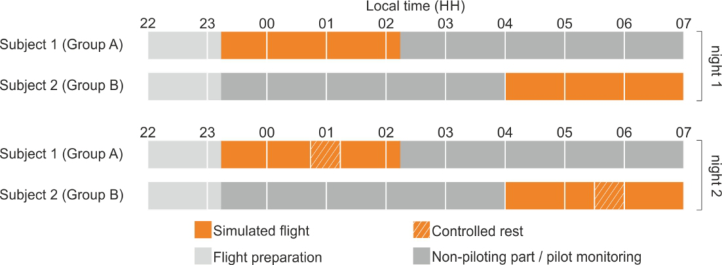
Subjects were divided into two groups, with the first group (A) performing a flight starting at 23:15 local time and landing at 02:15. The second group (B) completed a flight starting at 04:00 and landing at 07:00, see Figure 1. This experimental setup allowed the measurements to be optimised so that 2 subjects could be measured on the same night. At the same time, the flight of group B took place during the window of circadian low. Both subjects were present for the entire measurement and performed successively both roles during the night, the pilot flying and the pilot monitoring.
In measurement 2 (night 2), after 1 hour and 30 minutes of flight, a controlled rest was scheduled that lasted 30 minutes, see Figure 1. The subject was provided with earplugs, moved the seat out, placed in the recli- ned position, and initiated the controlled rest. For experimental reasons, there was no briefing with the other crew member (second subject/pilot monitoring).
The measurements were carried out on the Beechcraft Baron 58 simula- tor, which is located at the Department of Air Transport of the Faculty of Transportation Sciences of CTU. The simulator is equipped with the G1000. All subjects were familiar with the G1000 and had prior experience with the system. This equipment allows the standard flight, navigation and commu- nication instruments to be integrated into two screens, which makes it easier for the pilot to scan the instruments. This is crucial for an IFR flight. For experimental purposes, the aircraft callsign was OK-ULD, which was used during communications with air traffic controllers conducted by supervisory personnel.
In order to eliminate learning bias, subjects had a pre-experimental familia- rization session in order to be able to test the simulator’s behavior in practice, its responsiveness, reactions, cockpit ergonomics etc. in a series of several takeoffs and landings.
The two simulated flights were chosen so that they were not identical, but comparable in both time and complexity. The airports are similar in size, number of runways and STAR layout. For the measurement without controlled rest, departure from Munich Airport (EDDM) and landing at Copenhagen Airport (EKCH) were chosen. The take-off was from runway 26L, ILS approach to runway 22L. The second measurement involving
Figure 1: Measurement schedule with highlighted periods of in-flight controlled rest.
controlled rest started at Basel Airport (LFSB) and ended at Hamburg Airport (EDDH). Take-off was from runway 33, ILS approach to runway 23.
The simulated flights were performed in Microsoft Flight Simulator X (Microsoft Game Studios, Redmond, WA, USA). Data collection was perfor- med using Instructor Station™by Luis Gordo, also known as the iStation. Data were recorded at a sampling rate of 2.5 Hz.
Data Processing and Statistical Analysis For the purposes of performance evaluation in terms of accuracy and preci- sion of flight execution, the final approach phase was selected, specifically from an altitude of 2500 feet above the airport, where the flight could have been stabilized on the approach, to 200 feet above the airport, which is the minima for a Category 1 ILS, and where the subject continued to fly using visual references. This phase was chosen for two reasons, (1) the final approach segment is one of the most critical and difficult phases of the fli- ght, (2) this segment of the flight was conducted with sufficient time delay after waking from controlled rest, which ensured that performance was not affected by sleep inertia.
The data were evaluated by two different methods. In terms of accuracy and precision, the data were evaluated in terms of vertical and horizontal error (
) from the ideal trajectory. This was calculated based on knowledge of the aiming point, descent angle, runway height and observed altitude. The data was evaluated during the approach from 2500 ft AGL to 200 ft AGL. At each point in the real flight path, the error from the ideal trajectory was calculated. The mean (accuracy) and standard deviation (precision) of the vertical and horizontal errors over the monitored segment were then used for statistical analysis. The second data evaluation method used was trajectory tracking in 3D space based on the limits of the stabilised approach. That method provides the percentage of time spent outside the 3D polyhedron, which is defined specifically by the stabilised approach limits. Further details about the method are presented in our previous work (Socha et al., 2022).
Statistical evaluation was performed, given the nature of the data, by Repe- ated measures analysis of variance (rANOVA) followed by post-hoc analysis. Since the datasets do not meet the sphericity conditions, especially in the context of a small number of subjects, p-values with Greenhouse-Geisser adjustment were used. The significance level was α = 0.10.
Data processing including statistical analysis was performed in Matlab 2022a (MathWorks, Nattick, MA, USA).
RESULTS
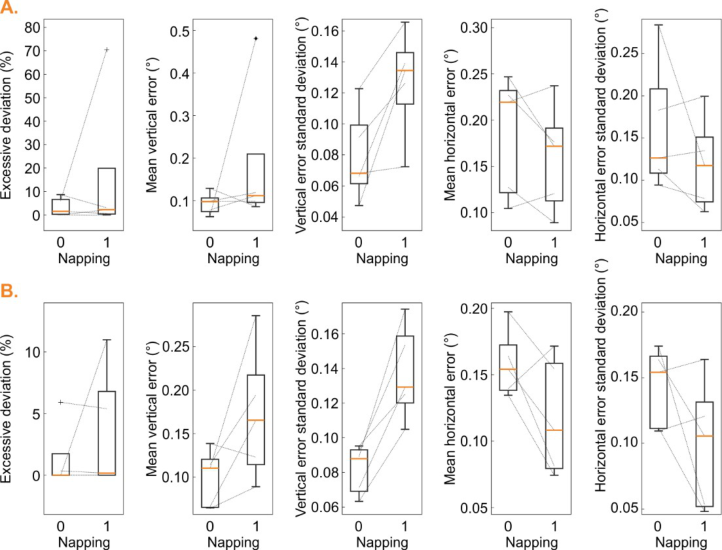
The distributions of the individual parameters for each of the observed groups from both simulated flights are presented in the form of boxplots. The results using 3D trajectory evaluation indicate a slight increase in the percentage of excessive deviations, i.e. an increase in the time spent outside the space defined by the stabilised approach limits for the flight with controlled rest. From the results it is clear that one of the subjects showed extreme values in the case of group A for the flight with controlled rest. Given the low number
Effects of Napping on Pilot Performance: An Experimental Study 535
of subjects, the above then negatively affected the data distribution. However, it is clear from the results that when this subject was neglected, Group A showed an improvement in performance for two subjects. One of the subjects showed a slight deterioration in performance. The last subject then flew both flights in the stabilised approach area. For group B, two subjects were able to fly both flights within the designated area (without excess deviation). One subject showed a performance degradation, while the other two showed a performance improvement, see Figure 2. However, the differences shown are not statistically significant since the p-value > 0.10.
In terms of the mean vertical error from the ideal trajectory, both groups, with the exception of one subject, always showed a deterioration in performa- nce. The results are further supported by the trend in the standard deviation of the vertical error (see Figure 2), and this performance decrease is stati- stically significant for both groups, p < 0.10. The opposite trend is then observed for the horizontal error, both in terms of the mean value and the standard deviation (see Figure 2). In the case of the mean value, this increase in performance is then statistically significant for Group B, as p < 0.10.
The statistical comparison of the two groups did not show any significant differences between Group A and Group B, which is also evident from the distributions of all observed parameters, see Figure 2.
Figure 2: Graphical representation of the distributions of individual observed para- meters in the form of boxplots for the group departing at 23:15 (A.) and the group departing at 04:00 (B.). The flight without controlled rest are marked as 0, flights that included controlled rest are marked as 1. Note, that in case of excessive deviation in Group B, 2 subjects preformed both flight with 0% deviation so the lines overlap.
DISCUSSION
The results indicate an opposite trend in the case of vertical and horizontal error from the ideal trajectory. Although in the case of horizontal error there is an increase in performance, both in terms of accuracy and precision, after a controlled rest, the opposite is true in the case of vertical deviation. The above may be due to several factors. Primarily, the results are likely to be negatively affected by lower pilot experience. Although an effort was made to select a group of pilots with sufficient instrument flying experience, subjects found it difficult to fly a stabilized final approach phase regardless of the given simulated flight. The results show that only 3 subjects were able to fly both flights in the area defined by the ILS approach limits. On the other hand, neglecting the outliers, it is evident that a larger proportion of subjects spent less time outside the restricted area during the controlled rest flight, i.e., increased performance can be inferred. Such results are then supported by just the horizontal error indicating an increase in performance for the majority of subjects in the case of controlled rest flight. Taking into account the vertical error, it can then be concluded that the results are ambiguous, although taking into account the 3D evaluation, a rather slight increase in performance in the overall evaluation can be assumed. Based on discussions with the pilots, i.e. some form of subjective evaluation, there was a consensus amongst these on the positive benefits of short rest on their subjectively perceived condition.
The recommendation and use of controlled rest from ICAO along with other organisations is evident and based on its evaluation through questionnaire-based subjective methods. This recommendation is also addressed by the U.S. Air Force, which describes it as a means to increase cockpit alertness (Caldwell et al., 2009). A description of controlled rest as a countermeasure to possible fatigue on board is described by Hilditch et al. (2020), including a description of the positive effects on an individual’s performance. In our study, this positive effect was only confirmed for the description of horizontal plane deviations, which is partially supported by the results of the 3D evaluation. However, it is essential to take into account that a complex performance is required to land safely. The closer the pilot is to the runway, the more demands are placed on the accuracy of the flight, especially in the vertical plane, with respect to obstacles, so that the landing is performed safely. It is important to note that most of the landings evalua- ted should not be performed in real operation. However, as part of the study, subjects were instructed to complete the landing in all cases. This may also have influenced the results, as well as the fact that the simulated flight did not physically endanger the subjects’ health and life, which again may have had some influence on the results.
Statistical analysis then revealed no significant differences between flights in most cases. However, it should be noted that the statistical analysis is undoubtedly affected by the low number of subjects.
Although the study was designed as a pilot from the beginning, it was anticipated that a larger sample of subjects would be used. Unfortunately, in the context of technical difficulties with the simulator and the limited time available to conduct a time- and personnel-intensive experiment, it was not
Effects of Napping on Pilot Performance: An Experimental Study 537
possible to conduct more flights. At the same time, it is clear that the issue of controlled rest needs further attention, given the lack of evidence on its effect on performance.
CONCLUSION
The concept of controlled rest is based on the premise that reducing fatigue leads to an improved pilot condition in the context of cognitive and motor function. Thus, the assumption is that such has a positive effect on the safe conduct of flight. However, the current state-of-the-art analysis shows that there are no studies that explicitly address this issue on an experimental level, and the assumed positive effect of controlled rest on pilot performance is not supported by objective data. Therefore, the aim of this study was to evaluate the effect of controlled rest on pilot performance. For the purpose of the study, an experiment involving four simulated flights was designed. Each subject participated in two overnight measurements, one consisting of a flight without controlled rest and the other consisting of a flight with controlled rest.
The results indicate an improvement in performance based on horizontal error, which is further partially supported by the trajectory evaluation in 3D space. On the other hand, a significant performance degradation is observed in the vertical plane.
However, the study is limited by the relatively small number of subjects; although the subjects completed a familiarization session, this may not have been sufficient and ability to manually control the aircraft could have been limited. On the other hand, however, it the response of each subject is cle- arly strongly individual, but a slight improvement in performance prevails, considering the larger proportion of subjects in the 3D evaluation and the horizontal errors that showed an improvement.
It is clear that the topic of controlled rest and its effect on performance is still receiving little attention and should be further addressed in the future, as this may contribute to efforts to improve air transport safety. Although the study does not present completely uniform results, it is a unique study in terms of methodology and the findings will serve as a knowledge base for follow-up experiments.
ACKNOWLEDGEMENT
This research was supported by Technology Agency of the Czech Republic, Grant no. CK02000321.
REFERENCES
Bourgeois-Bougrine, S., Carbon, P., Gounelle, C., Mollard, R., Coblentz, A. (2003).
Perceived fatigue for short-and long-haul flights: a survey of 739 airline pilots, AVIATION, SPACE, AND ENVIRONMENTAL MEDICINE Volume 74 No. 10. Caldwell, J. A., Mallis, M. M., Caldwell, J. L., Paul, M. A., Miller, J. C. and Neri, D. F. (2009). Fatigue countermeasures in aviation, AVIATION, SPACE, AND ENVIRONMENTAL MEDICINE Volume 80, No. 1.
Goodyear, M. D., Krleza-Jeric, K., Lemmens, T. (2007). The declaration of Helsinki, BMJ Volume 335 No. 7621. Hartzler, B. M. (2014). Fatigue on the flight deck: the consequences of sleep loss and
the benefits of napping, ACCIDENT ANALYSIS & PREVENTION Volume 62. Hilditch, C. J., Arsintescu, L., Gregory, K. B., Flynn-Evans, E. E. (2020). Mitigating fatigue on the flight deck: how is controlled rest used in practice?, CHRONOBIOLOGY INTERNATIONAL Volume 37 No. 9–10. International Civil Aviation Organization (ICAO). (2016) Doc. 9966: Manual for
the Oversight of Fatigue Management Approaches. Montreál: International Civil Aviation Organisation. ICAO Websites: https://www.icao.int/safety/fatiguemanag ement/ FRMS%20Tools/Doc%209966. FRMS.2016%20Edition.en.pdf Petrie, K. J., Powell, D., Broadbent, E. (2004). Fatigue self-management strategies and reported fatigue in international pilots. ERGONOMICS Volume 47 No. 5. Rosekind, M. R., Gander, P. H., Miller, D. L., Gregory, K. B., Smith, R. M., Weldon,
K. J., Co, E. L., McNally, K. L., Lebacqz, J. V. (1994). Fatigue in operational settings: examples from the aviation environment, HUMAN FACTORS Volume 36 No. 2. Socha, V., Hanáková, L., Weiss, J., Matyáš, R., Karapetjan, L., Pilmannová, T., Kušmírek, S. (2022). The influence of fatigue on an instrument approach, TRANSPORTATION RESEARCH PROCEDIA Volume 65. Valk, P. J. L., Simons, M. (1998). Pros and cons of strategic napping on long haul
flights. Neuilly-sur-Seine, France: AGARD-CP-599, NATO-AGARD. Walker, W. H., Walton, J. C., DeVries, A. C., Nelson, R. J. (2020). Circadian rhythm disruption and mental health, TRANSLATIONAL PSYCHIATRY Volume 10 No. 1.
LISTED IN THE AHFE DIGITAL BOOKSTORE CATALOGUE
Explore the complete digital volume
Human Factors in Transportation
Read this individual research paper free through the original publisher, or explore the full digital proceedings book.
ISBN 978-1-958651-71-1
Explore this ISBN in the AHFE Bookstore ↗Listed in the July 2026 bookstore catalogue; search by ISBN to confirm current availability · Digital book purchase optional