Ursa Katharina Johanna Nagler, Peer Manske, Pierre Sachse, Marco Michael Nitzschner, Markus Martini, Marco Furtner (2021). VOD-CA – Testing a Velocity-Obstacle based Display for Collision Avoidance in Aviation. In: Advances in Human Aspects of Transportation: Part I. AHFE Open Access, vol. 15. https://doi.org/10.54941/ahfe100643
Aircraft separation and systems for its support are one of the most important fields in aviation research. ACAS/TCAS gives an evidence of other aircraft around, but it does not show how other airplanes will fly regarding the ownship. A Velocity-Obstacle based Display for Collision Avoidance (VOD-CA) shall assist pilots to avoid conflicts by recognizing them early. Because there is velocity space represented but without spatial reference, potential problems in handling could occur. For that reason, VOD-CA and its comprehension were tested. We linked the understanding of VOD-CA to common measures of intelligence. It is assumed that spatial thinking might play a role, because even though velocity space is different to the familiar areal space, it might still require similar abilities to comprehend. Furthermore, we hypothesized that numerical memory is linked to the understanding, because there are several numbers shown on the display, which are important to understand the information given. Besides, we thought that there will be an interaction with visual-spatial intelligence because of the type of representation. While some expected interactions were observed there was no evidence that spatial thinking is neither helpful nor obstructive in understanding velocity space. Most participants could handle VOD-CA well and resolved potential conflicts before they occurred.
Since the early days of aviation, there are several ideas to ensure that aircraft are prevented from accidents. The ACAS/TCAS system - a system for collision avoidance- was introduced to civil aviation to assist converging airplanes to deconflict by climbing and descending contrarily. An additional display shows other aircraft's positions around but without displaying their headings and speeds. Although this system is sufficient for a temporary awareness of the current situation, it does not feature dynamic aspects of intruders and pilots' awareness of future situations. Until today, there is no software that depicts the future route (trajectory) of another plane and its separation zone. VOD-CA has the aim to support situation awareness about future conflicts. But because it is not a
display pilots are used to, it is questionable whether participants can handle it well. Therefore, the aim of the present study was to determine skills which could be helpful or obstructive to understand the information VOD-CA provides.
THEORETICAL BACKGROUND Velocity-Obstacle based Display for Collision Avoidance (VOD-CA)
In aviation, there are certain safety standards to avoid conflicts. Therefore aircraft are separated from each other by defined lateral and vertical distances (International Civil Aviation Organization (IACO), 1996). A conflict occurs when two or more aircraft converge closer than the mandatory minimum of separation. Thus, sufficient separation between airplanes must be ensured for safety reasons. While TCAS supports vertical deconflicting only, there are concepts for lateral and also early deconflicting. Such a concept could be more efficient and more economic, due to less kerosene consumption. The basic concept of VOD-CA is to display several possible directions and speeds, which can be chosen without risking a separation loss. VOD-CA operates in the velocity space to display the vectors of speed and direction of the ownship and other aircraft which are depicted by triangular shapes. These triangles, called velocity-obstacles, represent areas within the velocity space which must not be chosen for safe separation.
In an early study Brooks (1982) used velocity vectors for vehicle motion in the presence of obstacles. His aim was to show every velocity which could be chosen to solve a path-finding-problem. These velocities were represented as cones. Today, there are different concepts using this basic idea for aviation displays (Peinecke, Uijt de Haag, Meysel, Duan, Küppers, & Beernink, 2013). To support pilots' situation awareness, displays should show which velocities can be chosen, and those which must not, because of other aircraft's velocity obstacles (including their separation zones). Under the assumption that other aircraft keep their velocities (tracks and speeds), these these displays show safe and unsafe velocities for the ownship not only for the present state but also in the future.
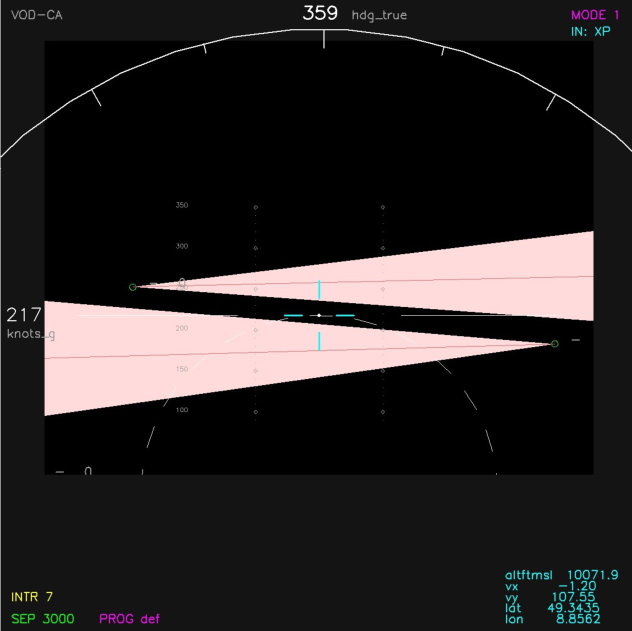
There are different approaches to build an aviation display (Peinecke et al., 2013). One example is the SVE Display, which was developed by the Delft University of Technology (Van Dam, Mulder, & van Paassen, 2009). The VOD- CA display (Velocity-Obstacle based Display for Collision Avoidance) used in the current work was developed by the German Aerospace Center. The advantage of this display is the absence of spatial hints and spatial relations, like there are in the SVE Display. See Figure 1 for an exemplary situation shown by VOD-CA. As can be seen, own speed is displayed on the middle left side, track is shown at the top and the velocities of other airplanes appear as a green dot, while the turquoise cross marks the own velocity. As mentioned before, velocity-obstacles are represented as pink triangles which must be avoided. The display features lateral deconflicting. Relative altitudes of other aircraft are represented as white numbers next to the green dots.
Figure 1: VOD-CA
This representation offers the option to resolve conflicts laterally, because it shows which velocity should be chosen to avoid a conflict. In comparison, TCAS supports vertical deconflicting only. VOD-CA as an additional system increases options for deconflicting and makes these more efficient. Further, VOD-CA enables the pilot to deconflict early, even before he spots other aircraft visually. Nonetheless, it must be tested whether participants can handle this type of representation or not.
Understanding Velocity Space In everyday life, one has to distinguish between important and irrelevant information. Spatial thinking is one of the skills needed, to make this distinction. It is essential for everyday activities, e.g. finding the way to a certain building or grabbing something from a shelf. Therefore, one might have problems in understanding velocity space since it is not applied in everyday life and therefore velocity space could possibly be confused with local spatial space.
There is no such concept as “understanding of velocity space” in psychology except for spatial thinking. We view “understanding velocity space” as an ability to operate mentally in velocity-space, while understanding what happens and being able to apply velocity space. Thus, it should be investigated whether understanding velocity space is an inherent ability or an acquired skill. Although it is proven that participants can avoid conflicts by using VOD-CA (Manske, Meysel, & Boos, 2013), it has not been proven, if and in which degree they understand velocity space. The question remaining is which concepts in psychology would be helpful in understanding velocity space?
The Present Study Like outlined above, participants avoided conflicts using VOD-CA, but it is unclear whether they understood velocity space. In the current study we linked common measures of intelligence to the understanding of velocity space. Since different displays for collision avoidance are based on a spatial visualization we examined whether spatial thinking plays a role in understanding VOD-CA and the velocity space. Furthermore, we determined skills helping to understand velocity space. Investigating these findings may shed further light upon the use of velocity- obstacle based displays.
This study included five hypotheses. First, a high level of spatial thinking might be helpful to understand velocity space, because one is able to imagine in which constellations other airplanes fly regarding the ownship. Second, spatial thinking could be obstructive, because there are some cues represented on VOD-CA which can be confused with spatial cues. For example, the green dots might be confused with the relative spatial position of an aircraft. Hence, we hypothesized that spatial thinking plays a role in understanding velocity space. There are several numbers represented on the display like heading, own speed, speed of other planes etc. These numbers are crucial for flight for a proper flight performance. We hypothesized that there is a relation between numerical memory and understanding velocity space. Due to the fact that the display is represented graphical and read that way as well, it could be helpful to perform well in processing and remembering geometric figures. Moreover, participants with higher visual-spatial intelligence may adapt to the new display better than those with lower results. Therefore, we hypothesized that there is a relation between visual-spatial intelligence and the understanding of velocity space. This is an additional reason to build the fourth hypothesis: We also hypothesized that understanding velocity space is linked to visual-spatial memory. As mentioned, processing the displayed geometric figures is important to assess the actual situation and to understand whether there will be a conflict with an intruder aircraft or not. The last hypothesis considered if there is a relation between visual-spatial reasoning and understanding velocity space.
METHODS AND PROCEDURE
Methods
Participants The study was conducted with twenty four participants, 6 women and 18 men. The average age was 23.92 (SD = 3.57) and the average flight simulation experience was 357.38 hours (SD = 1399.07). The participants were mostly students from the Technical University of Brunswick, Germany. Sufficient German language skills and some experience in flying a flight simulator were required. For their effort, the participants received 15 Euros.
Tasks Spatial thinking was tested with the “3-D-Würfel-Test” (Gittler, 1990). In this task participants had to rotate a cube mentally and pick the right answer out of a selection of seven others. There was no time limit. Figural and numerical intelligence.We applied the Berlin Intelligence Structure (BIS) test, version 4 (Jäger, Süβ, & Beauducel, 1997). The test consists of a large number of different task types which are varied on content (verbal, numerical, and visual-spatial) and functional dimension (reasoning, creativity, memory, and speed). In our study we focused on visual-spatial intelligence, visual-spatial memory, visual-spatial reasoning and numerical memory. Visual-spatial intelligence is build up by visual-spatial memory and visual-spatial reasoning. The subtests of visual-spatial memory are “Orientierungsgedächtnis” (remember certain buildings on a map), “Wege-Erinnern” (remember a way through geometric figures and draw it), and “Firmen-Zeichen” (remember a sign with its content). In addition, the subtests of visual-spatial reasoning are “Analogien” (analogy of two geometric figures), “Charkow” (the task is to complete a pattern), “Bongard” (search a picture which fits to six others), “Figuren-Auswahl” (select two pieces which build a presented figure), and “Abwicklung” (select a figure which is built by a flat pattern). Numerical memory is made up by “Zahlen-Paare” (remember twelve pair of numbers), “Zweistellige Zahlen” (remember sixteen binary numbers), and “Zahlen-Wiedererkennen“(recognize nine numbers in sixty-six numbers).
Understanding of VOD-CA was evaluated in two ways. First, we evaluated the data of the participants’ flight simulation performance. The participants flew three tutorials and six scenarios in a flight simulator with VOD-CA.
The task was to fly north and to avoid conflicts, but avoiding conflicts was first priority. Every part of the simulation was tested before (Manske et al., 2013) and each scenario was ended after resolving all conflicts. We focused on four variables: first, the average time spent in conflict, second, the average separation loss itself, third, the average number of conflicts and fourth, the average over all scenarios of the closest point of approach. The software of the simulation was X-Plane10 ® and the flight simulator itself was produced by Saitek (Pro Flight Yoke System). Second, participants had to complete a questionnaire test their understanding of velocity space (Cronbach’s alpha = 0.92). The questionnaire consisted of two parts: the first part consisted out of multiple choice questions about several pictures of VOD-CA. In the second part participants had to answer a set of open questions which were evaluated by three experts.
Procedure First, the participants had to do the BIS 4 (Jäger et al., 1997). Second, the “3-D-Würfeltest” (Gittler, 1990) was executed. Afterwards, there was a short instructive presentation about VOD-CA and its functions. The participants had to prove their understanding in the first three tutorials of the simulation with additional hints given by the instructor. Thereafter, the participants flew the six testing scenarios without a comment of the instructor. Finally, they had to fill out the questionnaire and demographic data.
RESULTS All variables were distributed normally. Intercorrelations among all variables can be found in Table 1.
Spatial thinking. We found no significant relation between the “3-D-Würfeltest” and duration of conflict (r = -.36, p > .09), duration of separation loss (r = -.12, p > .58), number of conflicts (r = -.40, p > .05), closest points of approach (r = .05, p > .81) or the questionnaire (r = .27, p > .21).
Numerical memory. Furthermore, numerical memory was not related to duration of conflict (r = .07, p > .75), duration of separation loss (r = -.19, p > .38), number of conflicts (r = -.09, p > .68), closest points of approach (r = -.33, p > .11) and the questionnaire (r = .22, p > .31).
Visual-spatial intelligence. We found no significant correlation with visual-spatial intelligence and duration of conflict (r = -.25, p > .24), duration of separation loss (r = .04, p > .85), closest points of approach (r = .01, p > .65) or the questionnaire (r = .20, p > .35). However, there was a strong negative relation between visual-spatial intelligence and number of conflicts (r = -.54, p < .01).
Visual-spatial memory. Moreover, there is no significant relation between visual-spatial memory and duration of conflict (r = -.28, p > .18), duration of separation loss (r = -.01, p > .97), closest points of approach (r = .01, p > .97) or the questionnaire (r = .09, p > .67). However, there was a significant relation with number of conflicts (r = -.46, p < .03) as well.
Visual-spatial reasoning. Duration of conflict (r = .11, p > .62) was not related to visual-spatial reasoning, like duration of separation loss (r = .08, p > .70), closest points of approach (r = .17, p > .44) and the questionnaire (r = .25, p > .24). There was a significant finding of visual-spatial reasoning with number of conflicts (r = -.43, p < .04).
Table 1: Intercorrelations among all variables
Table available in the original PDF paper.
3DW VM VR VI NM Con_G Seploss_G N_G CPA_G Q 3DW .31 .35 .40 .21 -.36 -.12 -.40 .05 .27
Q .27 .09 .25 .20 .22 -.37 .21 -.18 .00 Notes: 3DW = 3-D-Würfeltest; VM = visual-spatial memory; VR = visual-spatial reasoning; VI = visual-spatial Intelligence (global); NM = numerical memory; Con_G = average of the duration of conflicts over all scenarios; Seploss_G = average of all separation losses over all scenarios; N_G = average of all numbers of conflicts over all scenarios; CPA_G = average of each closest points of approach over all scenarios; Q = score of the questionnaire
Equation reproduced from the original PDF.
https://openaccess.cms-conferences.org/#/publications/book/978-1-4951-2097-8 Human Aspects of Transportation I (2021)
CONCLUSIONS
The present study examined the relation between spatial thinking, visual-spatial intelligence and the understanding of velocity space. We found a link between visual-spatial intelligence, visual-spatial memory and visual-spatial reasoning while there was no intercorrelation with spatial thinking or numerical memory. However, only the flight data variable “number of conflicts” showed results with visual-spatial memory, visual-spatial reasoning and visual- spatial intelligence, while duration of conflict, duration of separation loss, closest point of approach and the questionnaire showed no such findings. The questionnaire and the flight data did not interact. In addition, there was no effect with any of the other measures and the questionnaire. The missing effect with the questionnaire might lead to the conclusion that understanding how to avoid potential conflicts with VOD-CA and acting accordingly does not mandatorily involve complete comprehension of the display. This would mean that VOD-CA can be applied easily, although it shows an unfamiliar space. There was only an effect for number of conflicts, which could be explained by the fact that some participants accepted temporary conflicts to resolve the situation long-term and avoid further conflicts. Therefore, they passed conflicting velocity space (represented as triangles) to reach safe space again. This could be the explanation why we did not find differences in the closest point of approach, duration of separation loss and duration of conflict determined.
We found no correlation of spatial thinking and the understanding of velocity space in the flight data. Participants did not seem to confuse velocity space with surrounding space, as assumed. This could be because on the one hand, participants were not confused with the type of representation and did not messed it up as a spatial display, e.g. interpreting the green dots as an aircraft or the cross as own, actual, spatial position. On the other hand, spatial thinking was not needed for the task. This could lead to the conclusion that spatial thinking – as known in psychological research – is a non-related skill and not applicable to explain the comprehension of velocity space. Furthermore, there was no connection between numerical memory and understanding of velocity space (flight data). Depending on the number of other planes (X), there were only 3 + X relevant numbers in our experimental design. This numbers did not seem to be challenging to remember and process. This might be the reason, why we did not find an interaction. In comparison, we found a strong, negative correlation with visual-spatial intelligence and number of conflicts. The better participants performed in the figural test, the less conflicts they experienced. This could be explained by decent perception of the conflicting triangles. Additionally, participants with higher visual- spatial intelligence could remember the instructive presentation better. This finding emphasizes, that the performance is best, when visual-spatial memory and visual-spatial reasoning are high. That is because visual- spatial intelligence is build up by those two factors, which seem to be important for understanding velocity space. Additionally, there was a significant link between visual-spatial memory and understanding of velocity space, which can also be related to the better recall of the instructions. Furthermore, there was a relation of number of conflicts and visual-spatial reasoning. Participants who process geometric figures better might also anticipate the results of their flight behavior properly.
It is important to mention that participants had different levels of flight simulator experience. This may have led to different performances because participants who know better how to fly, adapted to the simulation quickly. Moreover, the whole study took about two hours. Because the intelligence test and the test for spatial thinking were done first, it may have had an effect on concentration. This could have reduced the performance in flying and the questionnaire.
In sum, VOD-CA represents a great solution for lateral deconflicting. All participants were able to handle the display properly and intuitively (see also Manske et al., 2013). Even when the participants did not comprehend the display entirely, they used it correctly. Based on our findings, we assume no connection with spatial thinking: neither a positive nor a negative one. This makes VOD-CA an applicable display in aviation for everyone to use, because no complex skills seem to be required. Future investigations will show more options and limitations of VOD-CA. The investigation of VOD-CA and TCAS in comparison might for example show advantages and disadvantages of both systems. Furthermore, it should be tested, how participants can handle the two systems, VOD- CA and TCAS, at the same time. Although VOD-CA is a relatively new display concept for collision avoidance and has to be tested sophisticatedly. It seems to become clear that VOD-CA has great potential (providing the pilot with additional information to avoid conflicts in flight) seems to be easy to handle. It could be a serious supplement to conventional displays in aviation in near future.
REFERENCES
Brooks, R. A. (1982). Solving the Find-Path Problem by Good Representation of Free Space. In: Proceedings of 2nd Annual Conf. on Artificial Intelligence, pp. 381-386. Gittler, G. (1990). Drei-dimensionaler Würfeltest (3DW). Ein Rasch-skalierter Test zur Messung des räumlichen
Vorstellungsvermögens. Weinheim: Beltz. International Civil Aviation Organization. (1996). Procedures for Air Navigation Services: Rules of the Air and Air Traffic Services. pp. 37-57. Jäger, A. O., Süß H.-M., & Beauducel, A. (1997). Berliner Intelligenzstruktur-Test: Form 4. Göttingen: Hogrefe. Manske, P., Meysel, F. & Boos, M. (2013). VOD-CA - Assisting Human Flight Performance and Situation Awareness in Lateral
Deconflicting. Proceedings of the Human Factors and Ergonomics Society Europe Chapter Annual Meeting. Turin. In press. Peinecke, N., Uijt de Haag, M., Meysel, F., Duan, P., Küppers, R., & Beernink, B. (2013). Testing a collision avoidance display with high-precision navigation. In D. D. Desjardins, and K. R. Sarma (Eds.) Proc. SPIE 8736, Display Technologies and Applications for Defense, Security, and Avionics VII. Van Dam, S. B. J., Mulder, M., & van Paassen, M. M. (2009). The use of intent information in an airborne self-separation
assistance display design. In: AIAA Guidance, Navigation, and Control Conference.
LISTED IN THE AHFE DIGITAL BOOKSTORE CATALOGUE
Explore the complete digital volume
Advances in Human Aspects of Transportation: Part I
Read this individual research paper free through the original publisher, or explore the full digital proceedings book.
ISBN 978-1-4951-2097-8
Explore this ISBN in the AHFE Bookstore ↗Listed in the July 2026 bookstore catalogue; search by ISBN to confirm current availability · Digital book purchase optional