Rui Ribeiro, Celina Leão, Susana Costa, Vinícius Silva (2025). Ergonomic Evaluation Methods for Hand Exoskeleton Prototypes: A Scoping Study. In: Intelligent Human Systems Integration (IHSI 2025): Integrating People and Intelligent Systems. AHFE Open Access, vol. 160, pp. 658–667. https://doi.org/10.54941/ahfe1005872
Hand function is essential for daily activities, but neurological, muscular, and environmental limitations can impede hand mobility. Robotic hand exoskeletons offer promising assistance for these impairments, though a standardised evaluation method for their effectiveness is lacking. This study addresses this gap by conducting a scoping review to explore current ergonomic evaluation methods for hand exoskeleton prototypes. The primary objective is to identify and analyse the tests used to assess technical performance and user experience, aiming to establish a comprehensive framework for future assessments. A research question guided the research: “What ergonomic evaluation tests are applied to assess the performance and effectiveness of hand exoskeleton prototypes for assisting with daily tasks?” The review analysed diverse evaluation methods, including physiological, kinematic, and kinetic metrics, alongside subjective user surveys. Usability assessments evaluate safety, comfort, and overall experience, while biomechanical testing explores muscle activity and range of motion, with electromyography (EMG) used to compare muscle activity with and without exoskeleton support. The study emphasises the need for a comprehensive and standardised approach to evaluate hand exoskeletons, integrating technical performance and user experience metrics to ensure effective and user-friendly designs.
Hand function is a fundamental aspect of daily living activities (ADLs). With its unique combination of strength, dexterity, and precision, the human hand is essential for performing a wide range of activities that require fine motor skills. The loss of hand function can significantly impact a person’s quality of life and independence (Lee and Jung, 2015). Notably, 27% of the EU population over the age of 16 has some kind of disability, which can include impairments in hand function (“Disability in the EU: facts and figures - Consilium,” 2022).
Significant advances have been made in assistive technology to aid or enhance hand function. Conceived for this purpose, hand exoskeletons are wearable physical human-robot interfaces (HRIs) that work by either augmenting the strength and dexterity of the hand or by enabling movement
Ergonomic Evaluation Methods for Hand Exoskeleton Prototypes: A Scoping Study 659
in cases where muscle function is impaired (Lee and Jung, 2015). Research indicates that such devices can accelerate recovery and enhance the capability to perform daily tasks in patients with chronic conditions (Babiˇc et al., 2021). However, despite their advances, a standardised method for evaluating their effectiveness remains elusive. This gap in the assessment process can hinder the development and refinement of exoskeletons tailored to individual needs. To address this shortcoming, this study conducts a scoping study to explore the current landscape of ergonomic evaluation methods used to assess hand exoskeleton prototypes. The primary objective is to identify and analyse the range of tests employed to evaluate both the technical performance and user experience of these devices.
To guide this investigation, a research question (RQ) was formulated: “What ergonomic evaluation tests are applied to assess the performance and effectiveness of hand exoskeleton prototypes in assisting with daily tasks?”. This RQ seeks to uncover the variety of methodologies used to validate the functionality and user satisfaction associated with these devices, highlighting the critical role of ergonomic assessment in the development of hand exoskeletons.
To support this review, a thorough search was conducted in the Scopus database using a carefully chosen set of keywords. Additionally, search outputs from Elicit were integrated, combining the strengths of both databases to conduct an extensive review. This dual-database approach leverages the strengths of both databases for a more comprehensive review.
This paper is structured in key sections: it begins with an introduction, followed by a methodology detailing the scoping review process, to which the presentation and discussion of the results succeed, and it concludes with a comprehensive summary of the findings and future research directions.
METHODOLOGY
The method chosen to address the study’s main objective was the scoping review (SR; Mak and Thomas, 2022). A scoping review was used, since the present study is an exploratory study that seeks to identify terminologies and core/key concepts, about the development of hand exoskeleton prototypes, describing the variety of tests employed to evaluate both the technical performance and the user experience, allowing to establish a comprehensive framework for future assessments. The Preferred Reporting Items for Systematic Reviews and Meta-Analyses for Scoping Reviews (PRISMA-ScR) checklist and flow diagram were used, ensuring clarity and transparency in reporting (Tricco et al., 2018).
This study followed the subsequent five stages: (1) Identifying the research question; (2) Identifying relevant studies; (3) Study selection; (4) Charting the data; and (5) Collating, summarising, and reporting the results.
The review was conducted by a research team of 4 members: one responsible for defining the methodology, and three coordinators — two with expertise in engineering electronics and one with knowledge in human factors.
To be included in the review, papers needed to measure or focus on specific dimensions of ergonomic evaluation for hand exoskeleton prototypes, such as technical performance, user experience, physiological, kinematic, and kinetic metrics. Peer-reviewed journal papers were included if the following criteria were met: written in English, involved human participants and, described a method for evaluating the performance and effectiveness of hand exoskeletons in assisting with ADLs.
Papers were excluded if they did not fit into the conceptual framework of the study, focused on non-ergonomic aspects, or did not involve the use of hand exoskeletons. Studies addressing both patient and caregiver perspectives on the use of hand exoskeletons were also included. Initially, the study’s timeframe for the publication date was the last 20 years, in order to identify the evolution of the topic and detect changes over time. However, a significant trend and a peak in the number of publications were observed in the last five years. Thus, a timeframe was imposed from 2019 to June 1st, 2024.
In this study, as the first approach, the Elicit platform was used based on our research question RQ. Elicit facilitated the synthesis of existing literature and helped identify key concepts and gaps in current research (Whitfield and Hofmann, 2023). Following this, a comprehensive search using the Scopus database was conducted, applying a set of carefully selected keywords including “hand exoskeleton”, “ergonomic evaluation,”“technical performance”, “user experience”, “physiological metrics”, and “kinematic analysis”. With the addition of more technical words and concepts including “EMG”, “Vision”, and “Electromyography”. By combining the insights gained from Elicit with the extensive data available in Scopus, a thorough understanding of the existing evaluation methods was developed. This procedure not only ensured a robust literature review, but also helped to identify emerging trends, common methodologies, and potential areas for future research, ultimately contributing to a comprehensive framework for assessing hand exoskeletons.
For charting and visualizing the bibliometric data, the VOSviewer software (http://www.vosviewer.com) was used to classify, summarize, and describe the results (van Eck and Waltman, 2014).
Scopus Search Strategy The systematic review was conducted using the Scopus database to encompass all published studies considering the Title, Abstract, and Keyword fields with the subsequent pattern of keyword fields:
TITLE-ABS-KEY [(“hand exoskeleton”* OR “hand exosuit”*)] AND [(“ergonomic evaluation” OR “technical performance” OR “user experience” OR “physiological metrics” OR “kinematic analysis” OR
“EMG” OR “Vision” OR “Electromyography”)] The use of the character “*”allows for finding words with the same stems. The search covered various types of publications (Article, Proceeding Paper, and Book Chapter) with, initially, a timeframe of the last 20 years. The
Ergonomic Evaluation Methods for Hand Exoskeleton Prototypes: A Scoping Study 661
inclusion criteria considered conference papers, articles, and book chapters, written in English. Exclusion criteria applied to documents in languages other than English and those that were not accessible to review.
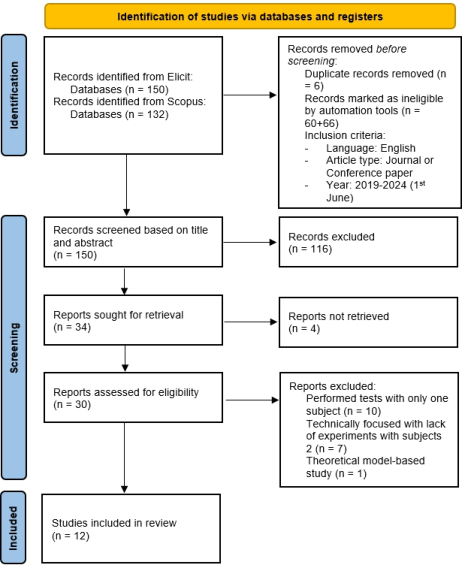
Data Collection and Analysis The search was performed on Jun 1st, 2024, and resulted in 282 documents (Figure 1). After removing duplicates and books, the number of documents was reduced to 276. After that, 127 documents were considered out of topic, that is, documents marked as ineligible by automation tools for not being written in English, and not within the last 5 years timeframe. The remaining 150 documents were screened based on title and abstract, and a total of 116 were excluded since the main topic of research was not focused on hand exoskeleton, or instead it was focused on the development of the prototype and algorithms to control the device. Additionally, the documents that did not cover or lacked evaluation tests with participants were removed. From the remaining 34, 4 documents were not considered, as it was not possible to access the full version.
Figure 1: PRISMA 2020 flow diagram for the systematic literature review. Adapted from Tricco et al. (2018).
The final literature search strategy resulted in 30 documents. The factor that weighed for inclusion in the analysis was the existence of evaluation tests being performed with more than one participant, to assess the technical performance and usability. One author initially screened all the 30 records.
These were used for the initial analysis with VOSViewer. Some of these records were further discussed among all authors. Initially, the authors reviewed the documents independently, and, afterwards, compared and confirmed their findings together.
Any disagreements were discussed and resolved through mutual consensus. Papers focusing purely on the development of the prototype or only conducting preliminary tests were excluded. Examples of excluded documents refer to research where evaluation tests were performed with only one participant, where the tests were conducted using a 3D-printed human hand dummy, or where previous datasets were used to technically validate the prototype in terms of the efficacy of the control algorithm, offering very incipient preliminary results.
The selection process led to 12 papers being included in the review. These papers were independently assessed by all authors and subsequently discussed collectively. During the data collection phase, the authors summarised each paper’s main research, the evaluation tests conducted, the participants involved, and the main findings (Figure 1).
RESULTS AND DISCUSSION
This section presents the findings from the comprehensive descriptive analysis conducted on all 282 documents included in the research. This initial overview was essential in selecting a subset of documents for subsequent in-depth critical analysis.
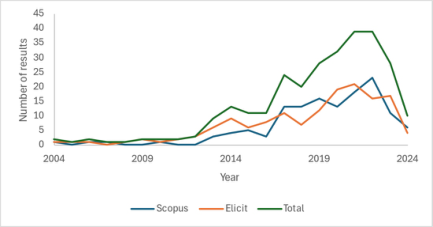
Mapping Analysis The initial results of both databases were mapped by the number of publications per year considering the last 20 years (Figure 2). The number of publications has generally trended upward over the years, with noticeable fluctuations and periods of heightened productivity, particularly between 2019 and 2023. This observation led to the inclusion of a specific timeframe for the study, focusing on the last five years, from 2019 to June 1, 2024. This time window is justified by the apparent increase and subsequent high activity in research during these years, which may provide the most relevant and recent advancements in the field, reflecting the current state and recent trends in ergonomic evaluation practices.
Figure 2: Number of publications per database and total by year.
Ergonomic Evaluation Methods for Hand Exoskeleton Prototypes: A Scoping Study 663
After the initial screening, a co-occurrence analysis was performed with the remaining 30 articles.
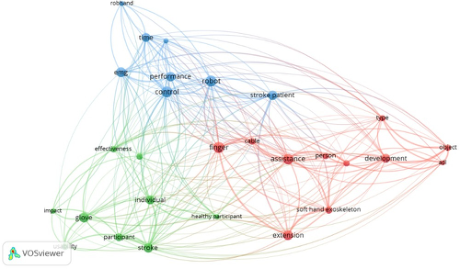
Figure 3 illustrates the network obtained for the keyword co-occurrence map, which can help identify trends, being helpful for further development in this research domain.
Figure 3: Network visualization based on occurrence.
This network was constructed based on 1197 keywords, subsequently reduced to 48 by defining a minimum occurrence threshold of 5 for each keyword. The three clusters obtained are distinguishable by their colours (red, green, and blue). These clusters indicate a comprehensive scope of research within hand exoskeletons, ranging from their design and development (red) to their practical applications and impact on users (green), as well as their technical performance and control mechanisms (blue). This suggests a multidisciplinary approach to improving these devices, with studies focused on enhancing design, user experience, and performance efficiency.
Based on the comprehensive insights derived from the three clusters, the research scope was refined, selectively narrowing down the analysis to 12 papers that best represent the critical themes and findings. Table 1 summarises the evaluation tests conducted and the main results.
Table 1. Papers’ main results and evaluation of tests conducted.
Table available in the original PDF paper.
Main Results
Citation Prototype Description
Participants Evaluation Tests Conducted
(Ibrahim et al., 2024)
Ironhand 2.0 Exoskeleton: 6 lbs total weight, up to 16 N force per finger.
Participants Evaluation Tests Conducted Healthy individuals and stroke survivors.
(Chen et al., 2021) Biomimetic tendon-driven soft exoskeleton, based on musculoskeletal principles.
Comparison with traditional designs, User experience evaluation through functional tasks and comfort assessments. Use of a motion capture device to compare finger extension motion between healthy and patients.
2 paediatric patients, 4 able-bodied adults
Effective mimicry of natural finger movements, improved comfort and coordination. When comparing healthy and patient, similar trajectories and angular couplings with the human voluntary extension were shown. (Tran et al., 2023) Soft robotic assistive exoskeleton, tendon-driven, 5 degrees of freedom.
Mixed results; some improvements in able-bodied subjects but inconsistent benefits for impaired participants.
Technical performance (pinch force by using EMG, perturbation resistance). User experience (questionnaires: CUE1, QUEST2, OPUS–SM3), physiological and kinetic metrics.
2 participants: one subject with chronic stroke and another with spinal cord injury (SCI).
(Bützer et al., 2021) Soft hand exoskeleton with remote actuation, customizable designs. Covers four major grasp types for daily activities.
Mechanical evaluations (range of motion, fingertip force), User tests (comfort, usability) through questionnaires and with the standardised functional assessment ARAT4
Exoskeleton met technical performance requirements and showed immediate functional improvements in grasping tasks for SCI subject. Positive user feedback on design and usability.
(with and without the exoskeleton).
2 chronic cervical SCI patients.
(Nazari et al., 2021) Motorized, lightweight, wearable hand exoskeleton.
Exoskeleton improved users’ ability to perform daily tasks involving grasping.
Technical performance (ROM5, fingertip force), User experience (ADL tasks), Effectiveness in daily tasks (object grasping ability).
(SERBEST and ELDO ˘GAN, 2021)
Hand exoskeleton with cable and spring mechanism.
Both unimpaired individuals (8) and hemiplegic hand patients (3).
Effective for passive exercises, suitable for home use, potential for commercialization due to low cost and good user feedback.
ROM5 evaluation. Ergonomics evaluation through wearability, suitability for individual use, weight and the Volume on the hand. User feedback (Continued)
Ergonomic Evaluation Methods for Hand Exoskeleton Prototypes: A Scoping Study 665
Table 1. Continued
Table available in the original PDF paper.
Main Results
Citation Prototype Description
Participants Evaluation Tests Conducted
(Sandison et al., 2020)
5 chronic stroke patients.
Hand exoskeleton with Android app integration, motorized for finger flexion/extension
Technical performance (grip force tracking), user feedback (survey from stroke patients), and usability (Android app functionality).
No significant changes in manual function; high safety and user satisfaction noted.
4 stroke patients. Manual function tests (Grip, pinch, others), safety assessments, user satisfaction surveys (QUEST2 2.0).
Effective control and performance of the device, positive user feedback on comfort and usability, supportive Android app for engaging therapy at home. (Barria et al., 2023) RobHand Exoskeleton: Direct-driven, under-actuated serial four-bar linkage mechanism.
14 occupational therapists that experimented the prototype.
Usability (SUS6, qualitative feedback), utility (alignment with neuroplasticity, treatment intensity).
(Piseru et al., 2022) Soft robotic glove, motorized for independent finger movements, designed for stroke rehabilitation.
Moderate-to-good usability with a SUS score of 63.75. Positive anticipation for increasing treatment intensity and neuroplasticity alignment. (Jackson and Abdullah, 2023)
12 healthy volunteers; 21 stroke patients.
Mechatronic glove with FES and sensorial feedback for stroke rehabilitation.
Functional testing with healthy volunteers; Clinical effectiveness testing with stroke patients. Motor performance and quality of movement using Fugl-Meyer7 scale.
30 healthy individuals.
Positive usability feedback from volunteers; Significant motor function improvements in stroke patients as per Fugl-Meyer scores. (Maldonado- Mejía et al., 2023)
Sensor reliability and repeatability, user comfort survey.
Soft exoskeleton robotic hand training device with pneumatic airbag actuators and sensors.
High performance in maintaining grasp, positive user feedback.
High comfort levels reported, reliable sensor performance, device deemed safe and effective for potential clinical use. (Proulx et al., 2023) Fabric-based soft hand exoskeleton with textile-based actuation.
10 healthy users. AHAP8 for grasping types, standard tests for rehabilitation (BBT9 and JTHFT10), user satisfaction questionnaire (QUEST2).
1Capabilities of Upper Extremities Questionnaire (CUE); 2Quebec User Evaluation of Satisfaction with Assistive Technology (QUEST); 3Orthotics Prosthetics User Survey—Satisfaction module (OPUS-SM); 4Action Research Arm Test (ARAT), 5Range Of Motion Test (ROM); 6System Usability Scale (SUS); 7Fugl-Meyer – Scale for Motor Performance; 8Anthropomorphic Hand Assessment Protocol (AHAP); 9Box and Blocks Test (BBT); 10Jebsen Taylor Hand Function Test (JTHFT).
DISCUSSION
Analysing the summarised studies in Table 1, a trend emerges where most investigations prioritise evaluating the technical performance of hand exoskeleton prototypes. These assessments typically measure force, kinematics, and physiological metrics, providing a comprehensive understanding of each prototype’s capabilities under various conditions. Notably, studies such as those by Ibrahim et al. (2024) and Tran et al. (2023) use EMG sensors to compare muscle activation between actuated and under- actuated states, revealing critical insights into the biomechanical advantages offered by the exoskeletons. Additionally, motion capture systems are applied to analyse kinematic data, further enriching our understanding of the device’s functionality in mimicking natural human movements Chen et al. (2021).
Regarding usability, while most studies deploy author-created questionnaires to gauge user experience, a select few integrate established standard questionnaires like QUEST, CUE, and OPUS, offering a more robust validation of user satisfaction and ergonomic integration. For instance, Tran et al. (2023) and Barria et al. (2023) use these standardised tools, providing a more reliable assessment of user feedback when compared to ad-hoc surveys.
Interestingly, while many studies test prototypes across various hand movements and grips, only a handful adopt standardised protocols like the AHAP or functional tests like the BBT for a more objective evaluation of the prototypes. Proulx et al. (2023) exemplify this approach by incorporating AHAP with BBT and JTHFT, setting a benchmark in evaluating the practical utility and effectiveness of hand exoskeletons in real-world applications.
CONCLUSION
This scoping review systematically mapped the evaluation methods used to assess hand exoskeleton prototypes, uncovering a critical gap in standardisation efforts in this field. Reviewing 282 documents and narrowing the focus to 12 pivotal studies, allowed to identify diverse ergonomic evaluation tests applied to gauge both technical performance and user experience. These tests range from biomechanical assessments using EMG to analyse muscle activity and motion capture for kinematics to user feedback collected, through standardised questionnaires like QUEST and CUE.
These findings indicate that a combination of advanced technical assessments and subjective user feedback is essential for evaluating the effectiveness of hand exoskeletons in assisting with daily tasks. Integrating these methodologies helps assess functionality and user satisfaction key factors, pointing towards the need for standardised evaluation practices to advance the field.
Future research should aim at establishing a comprehensive framework for ergonomic evaluation that integrates both objective biomechanical data and subjective user perceptions. Such a framework would ensure thorough assessments and guide the development of hand exoskeletons that are finely tuned to user needs, ultimately improving daily living for individuals with hand impairments through enhanced device functionality and user-friendly designs.
Ergonomic Evaluation Methods for Hand Exoskeleton Prototypes: A Scoping Study 667
ACKNOWLEDGMENT
The authors would like to acknowledge support form FCT – Fundação para a Ciência e Tecnologia thought the project R&D Units Project Scope: UIDB/00319/2020.
REFERENCES
Babiˇc, J., Laffranchi, M., Tessari, F., Verstraten, T., Novak, D., Šarabon, N., Ugurlu, B., Peternel, L., Torricelli, D., Veneman, J. F., 2021. Challenges and solutions for application and wider adoption of wearable robots. Wearable Technologies. Barria, P., Riquelme, M., Reppich, H., Cisnal, A., Fraile, J. C., Pérez-Turiel, J.,
Sierra, D., Aguilar, R., Andrade, A., Nuñez-Espinosa, C., 2023. Front Robot AI 10. Bützer, T., Lambercy, O., Arata, J., Gassert, R., 2021. Soft Robot 8, 128–143. Chen, W., Li, G., Li, N., Wang, W., Yu, P., Liu, L., 2021. A Biomimetic Tendondriven Soft Hand Exoskeleton for Finger Extension based on Musculoskeletal and Biomechanical Principles, in: 2021 IEEE International Conference on Robotics and Biomimetics, ROBIO 2021. Institute of Electrical and Electronics Engineers Inc., pp. 1246–1251. Disability in the EU: facts and figures - Consilium [WWW Document], 2022. URL: https://www.consilium.europa.eu/en/infographics/disability-eu-facts- figures/ (accessed 6.1.24). van Eck, N. J., Waltman, L., 2014. Visualizing Bibliometric Networks, in: Measuring
Scholarly Impact. Ibrahim, A., Okpala, I., Nnaji, C., Akanmu, A., 2024. J Safety Res. Jackson, G., Abdullah, H. A., 2023. Sensors (Basel) 23. Lee, K. S., Jung, M. C., 2015. Ergonomic evaluation of biomechanical hand function.
Saf Health Work. Mak, S., Thomas, A., 2022. J Grad Med Educ 14. Maldonado-Mejía, J. C., Múnera, M., Diaz, C. A. R., Wurdemann, H., Moazen, M., Pontes, M. J., Vieira Segatto, M. E., Monteiro, M. E., Cifuentes, C. A., 2023. Front Neurorobot 17. Nazari, V., Pouladian, M., Zheng, Y. P., Alam, M., 2021. Sensors 21. Piseru, E. A., Piseru, T., Poboroniuc, M. S., Ionascu, R., Roman, A. I., Ignat, B.,
Grosu, C., 2022. Clinical Evaluation of a New Mechatronic Glove for Hand Rehabilitation, in: 2022 10th E-Health and Bioengineering Conference, EHB 2022. Institute of Electrical and Electronics Engineers Inc. Proulx, C. E., Higgins, J., Gagnon, D. H., 2023. Disabil Rehabil Assist Technol 18, 953–962. Sandison, M., Phan, K., Casas, R., Nguyen, L., Lum, M., Pergami-Peries, M.,
Lum, P. S., 2020. HandMATE: Wearable Robotic Hand Exoskeleton and Integrated Android App for at Home Stroke Rehabilitation, in: Proceedings of the Annual International Conference of the IEEE Engineering in Medicine and Biology Society, EMBS. Institute of Electrical and Electronics Engineers Inc., pp. 4867–4872. SERBEST, K., ELDO ˘GAN, O., 2021. Politeknik Dergisi 24, 305–314. Tran, P., Elliott, D., Herrin, K., Desai, J. P., 2023. Biomed Eng Lett 13, 485–494. Tricco, A. C., Lillie, E., Zarin, W., O’Brien, K. K., Colquhoun, H., Levac, D., Moher, D., Peters, M. D. J., Horsley, T., Weeks, L., Hempel, S., Akl, E. A., Chang, C., McGowan, J., Stewart, L., Hartling, L., Aldcroft, A., Wilson, M. G., Garritty, C., Lewin, S., Godfrey, C. M., MacDonald, M. T., Langlois, E. V., Soares-Weiser, K., Moriarty, J., Clifford, T., Tunçalp, Ö., Straus, S. E., 2018. PRISMA extension for scoping reviews (PRISMA-ScR): Checklist and explanation. Ann Intern Med. Whitfield, S., Hofmann, M. A., 2023. Public Services Quarterly 19.
LISTED IN THE AHFE DIGITAL BOOKSTORE CATALOGUE
Explore the complete digital volume
Intelligent Human Systems Integration (IHSI 2025): Integrating People and Intelligent Systems
Read this individual research paper free through the original publisher, or explore the full digital proceedings book.
ISBN 978-1-964867-36-6
Explore this ISBN in the AHFE Bookstore ↗Listed in the July 2026 bookstore catalogue; search by ISBN to confirm current availability · Digital book purchase optional