Sergio Barile, Clara Bassano, Paolo Piciocchi, Pietro Vito, James Clinton Spohrer (2022). Algorithms and Human Creativity: Threats or Opportunities?A Literature Review. In: The Human Side of Service Engineering. AHFE Open Access, vol. 62, pp. 237–249. https://doi.org/10.54941/ahfe1002563
We explore the move from a mechanical vision of Artificial Intelligence (AI) to a systemic vision of Intelligence Augmentation (IA) (Barile et al., 2018, 2019, 2020, 2021; Navarrini, 2020; Chiriatti, 2019). AI assumes the role of empowered intelligence (IA) as it is capable of expressing a capacity for modeling integration of experiences, knowledge and emotions in conditions of strong uncertainty (Barile et al., 2021; Hagel, 2021). But in a world where the nature of machine learning is changing so rapidly, does technology empower or annihilate creativity? The aim of the paper is to draw attention to the impact that disruptive technology has on human creative processes. How might progress in AI affect Human Creativity (HC)? We propose a literature review to better understand both trends and gaps.Keywords: AI, Human Creativity, Viable Systems Approach (VSA).
Creativity is one of the intellectual hallmarks of Homo Sapiens (Boden, 1990; Cristofori et al., 2018; De Bono, 1970; Eysenck, 1995; Kaufman and Sternberg (eds.), 2019). Human creative processes are being amplified and enhanced via Artificial Intelligence (AI) progress. The dream of repro- ducing the characteristics of the human mind is very ancient, and is a goal that appears ever closer (Getzels and Csikszentmihalyi, 1976; Flores and Kor- sten, 2016). However, will AI progress ultimately flatten and/or atrophy the creativity, imagination and humanism of life itself? (Gobet and Sala, 2019; Bassano et al., 2020; 2021).
The paper is organized as follows: first we clarify the virtuous circular process linking creativity and innovation and the role of AI. Second, we illu- strate our methodological approach for the literature review and use of the interpretative perspective of the Viable Systems Approach (VSA)’s Informa- tion Variety Model (IVM), highlighting the shift from Artificial Intelligence (AI) to Intelligence Augmentation (IA) (Barile et al., 2018, 2019, 2020, 2021; Navarrini, 2020; Chiriatti, 2019). Finally, we discuss future implications.
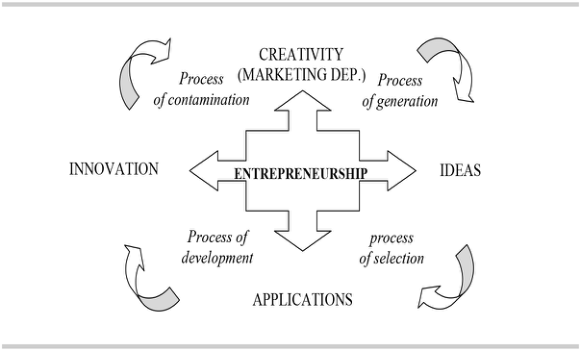
Figure 1: The virtuous circular process between creativity and innovation (Adapted from Piciocchi et al., 2009).
INNOVATION, HUMAN CREATIVITY AND THE SHIFT FROM ARTIFICIAL INTELLIGENCE (AI) TO INTELLIGENCE AUGEMENTATION (IA) Today business sustainability implies a “cognitive differential” with innova- tion and creativity as the engines for reaching viability and competitiveness. As previous studies state (Piciocchi et al., 2011; Bassano et al., 2017; Piciocchi and Bassano, 2021):
- “innovation” expresses the entrepreneurial capability to “exploit routi- nes”; such routines have in itself the characters of innovation because their modification produces an “intelligent” recombination of existing practices; - “creativity”, instead, allows the entrepreneur to renew routines to obtain, in a planned way, more consonance with the variety and the variability of the context. In this sense, creativity is the capability to join existing elements in new connections, that could be useful (Poincarè, 1905).
According to our perspective, “creativity” and “innovation” are closely related. Creativity would represent the input and the innovation the output (Vicari, 1998). The following Fig. 1 shows the virtuous circular process lin- king creativity and innovation. If the technological environment “suggests” the activation of the innovation process, then, within the firm, the creativity induces innovative methods in routine and in output (Bassano and Piciocchi, 2021; Piciocchi et al., 2011). Obviously, the model is simplified; the relationship between creativity and innovation must be considered in terms of circular causality and not sim- ply in terms of linear causality (Piciocchi et al, 2011; Pantano et al., 2018). The problem is the ability of the organization to exploit the virtuous circle of creativity-innovation to reach sustainable differential performance con- sistent with the competitive strategy, business model, product, service and
Algorithm and Human Creativity: Threats or Opportunity? A Literature Review 239
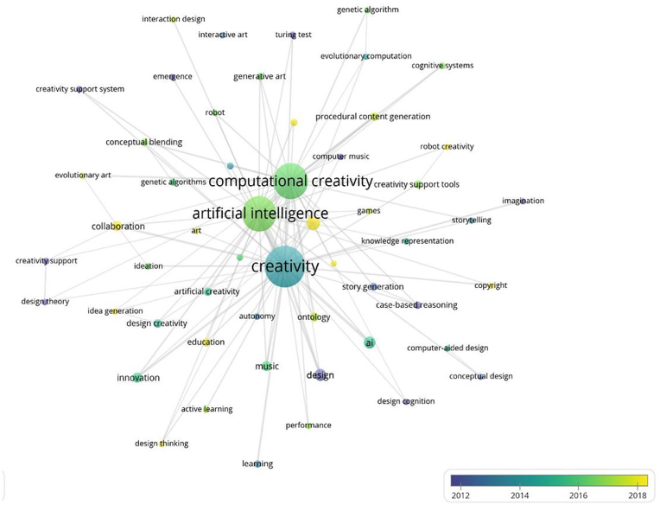
Figure 2: Author Keywords co-occurrence (Adapted from Vosviewer, developed by van Eck and Waltman, 2010).
processes. To this end, we want to draw the attention on the positive effect of technology in itself (as shown in Figure 1), helping the exploitation of the virtuous circular process between creativity and innovation (Bassano et al., 2018). According to recent studies (Barile et al., 2018, 2019, 2020, 2021; Bassano et al., 2020; Navarrini, 2020; Chiriatti, 2019), AI assumes the mea- ning and role of autonomous and empowered intelligence (IA) as it is capable of expressing a capacity for modeling integration of experiences, knowledge and emotions that produce further knowledge and enhanced cognitive vari- ety: data, interpretative schemes and value categories enhanced for the search for optimizing solutions in conditions of strong uncertainty (Barile et al., 2021; Hagel, 2021). In other words, from the VSA perspective, the firm is viable when it is able to build and improve its own creative cognitive capital. Thanks to the appli- cation of AI to decision-making processes, the so-called IA effect is capable of generating sustainable differential value, difficult to reproduce and imitate (Barile et al., 2021).
METHODS AND MATERIALS The VOSviewer Software for the Literature Review
We used a bibliometric approach to carry out our analysis. Following the guidelines of established protocols (Donthu et al., 2021; Paul et al., 2021), we have defined the search mechanism to be used to source the references
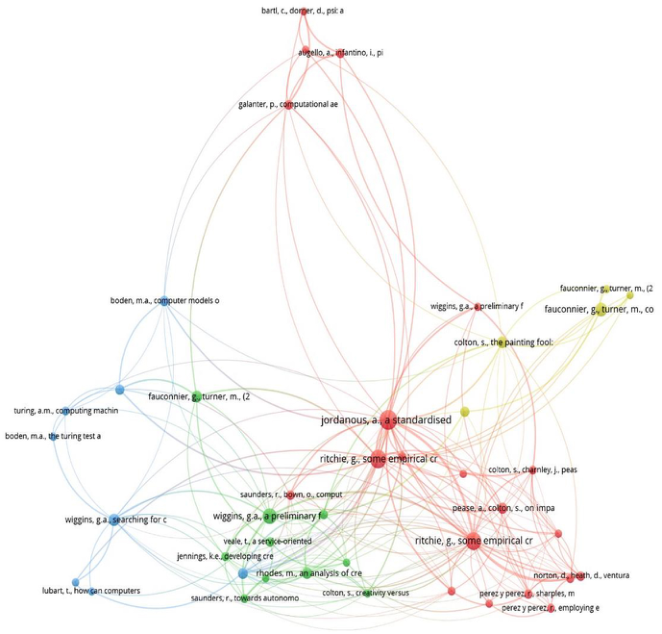
Figure 3: Co-citation analysis (Adapted from Vosviewer, developed by van Eck and Waltman, 2010).
responding to our Research questions: How may AI affect Human Creati- vity (HC)? Does technology empower or annihilate creativity? To achieve this, we have first examined the results obtained from Scopus through the query: (KEY (“creativity”) AND KEY (“artificial intelligence” OR ai)) AND (LIMIT-TO (LANGUAGE, “English”)). We obtained 850 documents (up until February 2022).
After exporting the references data, we have conducted a preliminary bibli- ometric analysis through VOSviewer, developed by van Eck and Waltman (2010). To study the development of the field, we have evaluated the co- occurrence of author keywords in our database, presented in Figure 2 in chronological visualization, ranging from blue (older keywords in the field) to yellow (more recent fields).
From this preliminary analysis, we could observe how the older concepts (e.g., computer generated music, story generation, design and autonomy, etc.) give way to newer concepts (e.g., machine learning, human-AI collaboration, deep learning, procedural generated content, and robot creativity). Starting from these results, we have then carried out a second review through the co- citation analysis technique to reconstruct the “ancestry”, in terms of cited references, of the field (Figure 3).
Algorithm and Human Creativity: Threats or Opportunity? A Literature Review 241
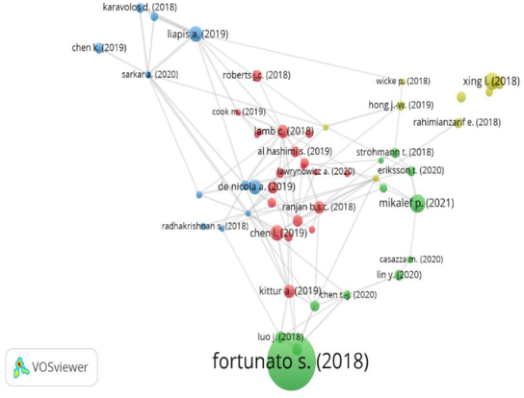
Figure 4: Bibliographic coupling (Adapted from Vosviewer, developed by van Eck and Waltman, 2010).
We find Turing’s seminal and revolutionary work “Computing Machi- nery and Intelligence” (1950) (opening with the paragraph famously titled The Imitation Game), which introduced to the general public the concept of the Turing test, a test to measure a machine’s ability to exhibit intelligent behaviour equivalent to that of a human. The Author assess the topic of creativity in an effort to invalidate the objections affirming that a machine can never ‘take by surprise’, concluding that “appreciation of something as surprising requires as much of a ‘creative mental act’ whether the surprising event originates from a man, a book, a machine or anything else”. We also find Rhodes’ “An Analysis of Creativity” (1961), in which the Author inve- stigates the nature of the creative process and how ideas can be distinguished, inviting to always engage to identify the factors associated with the creative process. In their anticipatory work, Bartl et al. (1993) explored the role of emotions in cognitive and motivational processes and interactions, proposing a formalized computational architecture of human psychological processes, while Fauconnier and Turner (1998) argue that creativity is possible by vir- tue of the competition of optimality principles (integration, topology, web of appropriate connections and good reason) and the power of blending to accommodate them. Ritchie (2007) approached computational creativity taking into account the artefacts produced through computational means, mainly novelty, quality and typicality. Jordanous (2012) proposes a three- step Standardised Procedure for Evaluating Creative Systems demonstrated through a comparative case study. More recently some extra considerations were revisited as part of the older four Ps framework for creativity evalua- tion (Jordanous, 2016). According to the four Ps, the creative producer (i.e., the computer software or indeed the human programmer) and the press (i.e., the environment in which a creative act takes place) should also be added to the product and process criteria for a more comprehensive assessment of
CLUSTER 1.
köbis n. (2021) artificial intelligence versus maya angelou: experimental evidence that people cannot differentiate ai-generated from human-written poetry yang l.-c. (2020) on the evaluation of generative models in music ragot m. (2020) ai-generated vs. human artworks. a perception bias towards artificial intelligence? sekiguchi k. (2020) creative ai: a new avenue for the semantic web?
organic and dynamic tool for use with knowledge base of ai ethics for promoting engineers’ practice of ethical ai design ławrynowicz a. (2020) pini a. (2019) ai inspired recipes: designing computationally creative food combos chen l. (2019) an artificial intelligence based data-driven approach for design ideation gómez de silva garza a. (2019)
an introduction to and comparison of computational creativity and design computing al hashimi s. (2019)
the effectiveness of social media and multimedia-based pedagogy in enhancing creativity among art, design, and digital media students cook m. (2019) framing in computational creativity - a survey and taxonomy hämäläinen m. (2019)
modelling the socialization of creative agents in a master-apprentice setting: the case of movie title puns varshney l.r. (2019)
a big data approach to computational creativity: the curious case of chef watson kittur a. (2019) scaling up analogical innovation with crowds and ai tatar k. (2019) musical agents: a typology and state of the art towards musical metacreation ranjan b.s.c. (2018)
a systematic approach to assessing novelty, requirement satisfaction, and creativity lamb c. (2018) evaluating computational creativity: an interdisciplinary tutorial mccaffrey t. (2018) the computational creativity continuum
an approach to human-machine collaboration in innovation pérez y pérez r. (2018) karimi p. (2018) evaluating creativity in computational co-creative systems roberts j.c. (2018)
the explanatory visualization framework: an active learning framework for teaching creative computing using explanatory visualizations
computational creativity. In a similar but different fashion, Boden vastly con- tributes to the literature on the different types and definitions of creativity and novelty, recognizing the existence of a ‘psychological novelty’ when the idea is new for the person who generated it (Boden, 2009). Differently, the Author acknowledges an idea as ‘historically novel’ if it never appeared in history before (Boden, 2009); as well as in her breakdown of creativity in its two components of “exploratory creativity”, which searches within the
Algorithm and Human Creativity: Threats or Opportunity? A Literature Review 243 CLUSTER 2.
mikalef p. (2021) artificial intelligence capability: conceptualization, measurement calibration, and empirical study on its impact on organizational creativity and firm performance
machine learning-based design concept evaluation
chen t.-j. (2020) investigating a mixed-initiative workflow for digital mind-mapping eriksson t. (2020) think with me, or think for me? on the future role of artificial intelligence in marketing strategy formulation lin y. (2020) it is your turn: collaborative ideation with a co-creative robot through sketch casazza m. (2020) a playwriting technique to engage on a shared reflective enquiry about the social sustainability of robotization and artificial intelligence camburn b. (2020)
science of science
he y. (2019) mining and representing the concept space of existing ideas for directed ideation xu x. (2019) are emotionally intelligent people more creative? a meta-analysis of the emotional intelligence-creativity link cautela c. (2019) the impact of artificial intelligence on design thinking practice: insights from the ecosystem of startups luo j. (2018) design opportunity conception using the total technology space map fortunato s. (2018) strohmann t. (2018) virtual moderation assistance: creating design guidelines for virtual assistants supporting creative workshops
space, and “transformational creativity”, which involves expanding the space by breaking one or more of the defining characteristics and creating a new conceptual space (Boden, 1990).
We have conducted a third analysis employing the bibliographic coupling technique to the references published in the last five years (2018-onward). The results of the analysis are presented in Figure 4.
We were able to distinguish four different clusters, each pertaining to a dif- ferent stream of research on the topic: cluster 1 (red) focuses on AI-generated art, poetry, music and even cooking recipes, and whether they differ or not from human generated ones; cluster 2 (green) focuses on the impact of mach- ine learning in the field of creativity of AI; cluster 3 (blue) focuses on game and scenario design and simulation; cluster 4 (yellow) on labor solutions and research.
We reconnect to the interpretative perspective of the Viable Systems Appro- ach (VSA), and in particular the Information Variety Model (IVM), as a possible bridge to fill the gap explaining the transition from a mechanical
CLUSTER 3.
sarkar a. (2020) towards game design via creative machine learning (gdcml) tang y.-c. (2019) a review of design intelligence: progress, problems, and challenges chen k. (2019) the effect of explicit structure encoding of deep neural networks for symbolic music generation liapis a. (2019) orchestrating game generation de nicola a. (2019)
creative design of emergency management scenarios driven by semantics: an application to smart cities xiao p. (2019) conceptual representations for computational concept creation blair a. (2019) adversarial evolution and deep learning – how does an artist play with our visual system? karavolos d. (2018)
using a surrogate model of gameplay for automated level design cherti m. (2018) out-of-class novelty GENERATION: an experimental foundation cook m. (2018) redesigning computationally creative systems for continuous creation radhakrishnan s. (2018)
creative intelligence – automating car design studio with generative adversarial networks (gan)
CLUSTER 4.
ogbeibu s. (2021) leveraging stara competencies and green creativity to boost green organisational innovative evidence: a praxis for sustainable development loftus t.j. (2020) intelligent, autonomous machines in surgery cha y. (2020) compensating for the loss of human distinctiveness: the use of social creativity under human–machine comparisons hammershøj l.g. (2019)
the new division of labor between human and machine and its educational implications hong j.-w. (2019) artificial intelligence, artists, and art: attitudes toward artwork produced by humans vs. artificial intelligence townsend d.m. (2019)
entrepreneurial action, creativity, & judgment in the age of artificial intelligence daniele a. (2019) ai + art = human sääksjärvi m. (2018)
creativity and meaning: including meaning as a component of creative solutions xing l. (2018) artificial intelligence will soon change the landscape of medical physics research and practice rahimianzarif e. (2018)
designing integrated management criteria of creative ideation based on fuzzy delphi analytical hierarchy process wicke p. (2018) storytelling by a show of hands: a framework for interactive embodied storytelling in robotic agents
Algorithm and Human Creativity: Threats or Opportunity? A Literature Review 245
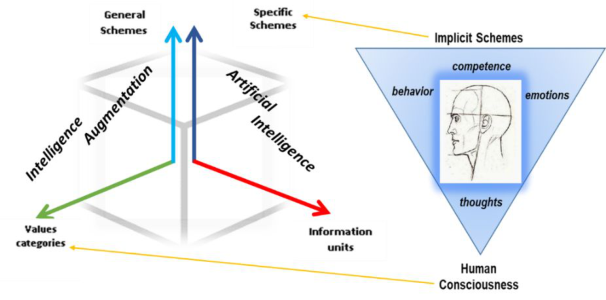
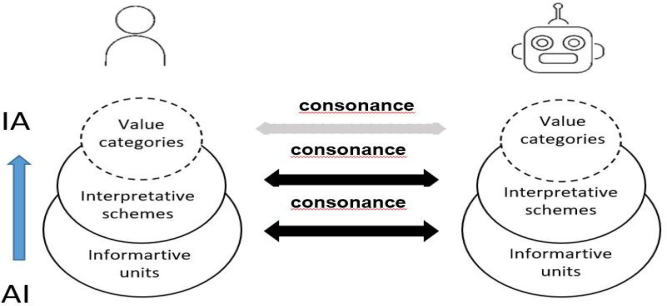
Figure 5: Implicit vs specific vs general schemes - authors’ elaboration from Barile, Di Nauta and Iandolo 2016. www.asvsa.org.Figure 6: Interactions between consonant viable system entity interpreted as informa- tion variety (Adapted from Bassano et al., 2020).
vision of Artificial Intelligence (AI) – to a systemic complementary vision consistent with an interpretation of the new concept of Intelligence Augmen- tation (IA) (Barile et al., 2019; 2020; 2021; Bassano et al. 2020, 2021).
The VSA Interpretative Model Today, creativity is mandatory. The creative moment does not correspond to the simple intuition, but to a process of abduction (Pierce et al., 1965), that emerges from the variety of knowledge owned by an individual and/or organization (Barile, 2006). According to the Viable System Approach (VSA) the firm is viable when it is able to build and improve its creative cognitive capital (Piciocchi et al, 2011). The competitiveness of the firm increasingly depends on (AI) and its application to the cognitive and decisional processes to generate (IA).
The moment of creative generation is significantly fueled by internal pro- cesses of self-reflection, autonomous recombining of what we call viable
system variety…”most striking at first is this appearance of sudden illumina- tion, a manifest sign of long, unconscious prior work” (Poincarè, 1929:388). The peculiarity of the creative process that we would like to underline is the nature of the activation of the creative moment, which can be defined not as “intuition or insight” in the common sense of the terms, but as abduction, in the sense defined by Barile in line with Aristotelian thought: a creative moment emerges not “ex novo”, but from previous sets of knowledge – i.e. variety – embedded in the organization (Johnson-Laird, 1993; Barile, 2009). These conceptual elements are stratified at several levels of depth: the infor- mation units are to be found at the most superficial level, while what we call value categories are the deepest level and the interpretative schemes (impli- cit, specific, general) are somewhere in the middle (Barile et al., 2019; 2020; 2021; Bassano et al. 2020, 2021). The framing of these elementes at three levels defines the variety of the via- ble system. Considering that the application of (AI) to the decisional making processes leads to the (IA) of the system, the assessment of the degree of consonance implies comparing the respective sets of varieties of interacting entities as represented in Figure 6.
To explore the relationship between AI and Human Creativity, we assume that:
1) AI can empower the interpretative schemes’ understanding potential. 2) IA enriches value categories (re-humanization process of intelligence). 3) Intuition enriches cognitive variety and variability. 4) Abduction refers to machines and so to technology in itself (AI).
CONCLUSION
The integration of advancing AI capabilities in business and societal systems cannot be ignored (Pakkala and Spohrer, 2019; Spohrer, 2020). Ultimately, we must answer the question: in a world where the nature of machine learning for AI is changing so rapidly, does technology empower or annihilate crea- tivity? Does progress in subtle ways sacrifice human imagination (Plucker, and Makel, 2010; Zeng, Proctor, and Salvendy, 2011). This paper combined a bibliographic analysis with a Viable Systems Approach (VSA) to explore trends and gaps. Much work remains to be done.
REFERENCES
Barile, S.; Bassano, C.; Piciocchi, P.; Saviano, M.; Spohrer, J. C (2021). Empowering value co-creation in the digital age. DOI:10.1108/JBIM-12-2019-0553. pp. 1–14. In The Journal of Business & Industrial Marketing - ISSN:0885-8624. Barile, S., Bassano, C., Lettieri, M., Piciocchi P., Saviano, M. (2020). “Intelligence
Augmentation (IA) in Complex Decision Making: a New View of the VSA concept of Relevance, Spohrer, J.C, Leitner, C. (Ed.s), AHFE 2020, Advances in Intelligent Systems and Computing (AISC), Vol. 1208, Springer Nature AG, part of Springer Nature, Switzerland, pp. 1–8 https://doi.org/10.1007/978-3-030-51057-2_35. Barile, S., Bassano, C., Spohrer, J.C., Piciocchi, P., Pietronudo, M.C. Saviano, M.
(2019). “AI & Value Co-creation: An Integrated VSA and SS Perspective”, paper presented at the AIRSI 2019 Conference, Zaragoza, July 6–8.
Algorithm and Human Creativity: Threats or Opportunity? A Literature Review 247
Barile, S., Ferretti, M., Bassano, C., Piciocchi, P., Spohrer, J. Pietronudo, M.C. (2018).
“From Smart to Wise Systems: shifting from Artificial Intelligence (AI) to Intellige- nce Augmentation (IA)”, poster presented at the First in International Workshop on Opentech AI in Helsinki, March 13–14. Barile, S., Piciocchi, P., Bassano, C., Spohrer, J.C. and Pietronudo, M.C. (2019). “Redefining the role of artificial intelligence in wiser service systems”, in Kacprzyk, J. (Ed.s.), Advances in Intelligent Systems and Computing (AISC), Vol. 787, Springer International Publishing AG, part of Springer Nature, Switzerland, pp. 159–170. ISSN 2194-5357 - ISBN 978-3-319-94229-2 - eBook. Bartl, C., Dorner, D. (1998). “PSI: A theory of the integration of cognition, emo-
tion and motivation”. Proceedings of the 2nd European conference on cognitive modelling, pp. 66–73. dtic document. Bassano, C.; Barile, S.; Piciocchi, P.; Saviano, M.; Spohrer, J. C. (2021). “Exploring New Digital Age Challenges” in C. Leitner, W. Ganz, D. Satterfield, C. Bas- sano (Ed.s.), AHFE 2021, Advances in The Human Side of Service Engineering - ISBN:978-3-030-80840-2 vol. 266 (Lectures Notes in Network and Systems), pp. 57–66. DOI:10.1007/978-3-030-80840-2_6. Bassano, C., Piciocchi, P. (2021) “Creativity, Interactive Marketing and Commu-
nication in Italian Jewellery Districts” in Pantano. Creativity and Marketing: The Fuel for Success. pp. 33–50, ISBN:978-1-80071-330-7 DOI:10.1108/978-1- 80071-330-720211003. Bassano, C., Barile, S., Saviano, M., Cosimato, S., Pietronudo, M.C. (2020). “AI technologies & value co-creation in a luxury context”, paper presented at the 53th Hawaii International Conference on Systems Sciences (HICSS), January-7, available at: http://scholarspace.manoa.hawaii.edu. Bassano, C., Piciocchi, P., Spohrer, J.C., Pietronudo, MC. (2018). “Managing value
co-creation in consumer service systems within smart retail settings”, Journal of retailing and consumer services, Vol. 45, November, pp. 190–197. Bassano, C., Gaeta, M., Piciocchi, P., Spohrer, J.C. (2017), “Learning the Models of Customer Behavior: From Television Advertising to Online Marketing”, Interna- tional Journal of Electronic Commerce, Special Issue, Volume 21, Issue 4 Smart Interaction with Consumers: from co-creation to smart partnership (Autmn), 2017, pp. 572–604 ISSN: 1086-4415. Boden, M. (1990). The creative mind. (New York: BasicBooks). Boden, M.A. (2009). “Computer Models of Creativity”. AI Magazine, 30(3), 23.
doi:10.1609/aimag.v30i3.2254. Boden, M. A. (2010). “The Turing test and artistic creativity”. Kybernetes, 39(3), 409–413. doi:10.1108/03684921011036132 Bregman, R. (2021). Humankind: A Hopeful History. NY: Little, Brown and
Company. Chesbrough, H. (2020). Open Innovation Results: Going Beyond the Hype and Getting Down to Business. UK: Oxford University Press. Chiriatti, M. (2019). Humanless. L’algoritma egoista, Hoepli. Cristofori, I., Salvi, C., Beeman, M., and Grafman, J. (2018). The effects of expected
reward on creative problem solving. Cogn. Affect. Behav. Neurosci. 18, 925–931. doi: 10.3758/s13415-018-0613-5 De Bono, E. (1970). Lateral thinking: Creativity step by step. (New York: Harper & Row). Donthu, N., Kumar, S., Mukherjee, D., Pandey, N., Lim, W. M. (2021). “How to
conduct a bibliometric analysis: An overview and guidelines”. Journal of Business Research, 133, 285–296. doi:10.1016/j.jbusres.2021.04.070.
Eysenck, H.J. (1995). Genius: The natural history of creativity. (New York: Cambridge University Press). Fauconnier, G., Turner, M. (2002). The Way We Think: Conceptual Blending and the
Mind”s Hidden Complexities. Basic Books. Ferrucci, D.A. (2012). Introduction to “This is Watson”. IBM J. Res. Dev. 56, 1:1– 1:15. doi: 10.1147/JRD.2012.2184356. Flores, E., Korsten, B. (2016). The Next Rembrandt. Available at: http://www.next
rembrandt.com/ (Accessed September 08, 2018). Getzels, J. W., Csikszentmihalyi, M. (1976). The Creative vision: A longitudinal study of problem finding in art. (New York: John Wiley & Sons). Gobet, F., Sala, G. (2019) How Artificial Intelligence Can Help Us Understand
Human Creativity. Front. Psychol. 10:1401. doi: 10.3389/fpsyg.2019.01401. Gobet, F., Snyder, A., Bossomaier, T., Harre, M. (2014). Designing a “better” brain: insights from experts and savants. Front. Psychol. 5:470. doi: 10.3389/fpsyg.2014.00470 Hagel, J. (2021) The Journey Beyond Fear: Leverage the Three Pillars of Positivity
to Build Your Success. NY: McGraw-Hill Education. Jordanous, A. (2012). “A Standardised Procedure for Evaluating Creative Systems: Computational Creativity Evaluation Based on What it is to be Creative”. Cognitive Computation, 4(3), 246–279. doi:10.1007/s12559-012-9156-1 Jordanous, A. (2016). “Four PPPPerspectives on computational creati- vity in theory and in practice”. Connection Science, 28(2), 194–216. doi:10.1080/09540091.2016.1151860. Kaufman, J.C., Sternberg, R.J. (eds.) (2019). The Cambridge handbook of creativity.
(Cambridge: Cambridge University Press). Mazzucato, M. (2021). Mission Economy: A Moonshot Guide to Changing Capitalism. NY: Harper Business. Navarrini, F. (2020). “Do we need boards at all?”: prospettive di intelligenza arti-
ficiale nei consigli d’amministrazione. Corporate Governance and Research & Development Studies - Open Access, (1). https://doi.org/10.3280/cgrds1-2019o a8423. Newell, A., Shaw, J.C., Simon, H.A. (1958). Elements of a theory of human problem solving. Psychol. Rev. 65, 151–166. doi: 10.1037/h0048495. Newell, A., Shaw, J.C., Simon, H.A. (1962). “The process of creative thinking”
in Contemporary approaches to creative thinking. Vol. 3, eds. H. E. Gruber, G. Terrell, and Werheimer (New York: Atherton Press), 63–119. Pantano, E., Bassano, C., Constantinos-Vasilios Priporas (2018). Technology and Innovation Marketing, Routledge, Taylor & Francis Group, London, pp. 1–130. ISBN: 978-1-138-32315-5 (hbk) ISBN: 978-1-138-32317-9 (pbk) ISBN: 978-0- 429-45156-0 (eBook) Paul, J., Lim, W. M., O’Cass, A., Hao, A. W., Bresciani, S. (2021). “Scientific procedu-
res and rationales for systematic literature reviews (SPAR-4-SLR)”. International Journal of Consumer Studies, 45(4). doi:10.1111/ijcs.12695 Peirce, C. S., Hartshorne, C., Weiss, P., Burks, A. W. (1965). ”Collected papers of Charles Sanders Peirce”. Cambridge, Mass: Belknap Press of Harvard University Press. Piciocchi, P., Saviano M., Bassano, C. (2011) “Network Creativity to Reduce Stra-
tegic Ambiguity in Turbulent Environments: a Viable Systems Approach (vSa)” in: Barile, Bassano, Calabrese, Confetto, Di Nauta, Piciocchi, Polese, Saviano, Siano, Siglioccolo, Vollero (Ed.s.), Contributions to theorethical and practi- cal advances in management. A Viable Systems Approach (VSA), pp. 113–137, Avellino:International Printing Srl Editore, ISBN: 9788878680104.
Algorithm and Human Creativity: Threats or Opportunity? A Literature Review 249
Plucker, J.A., Makel, M.C. (2010). “Assessment of creativity” in The Cambridge handbook of creativity. eds. J. C. Kaufman and R. J. Sternberg (Cambridge: Cambridge University Press), 48–73. Rhodes, M. (1961). “An Analysis of Creativity”, The Phi Delta Kappan, Vol. 42, No.
7 (Apr., 1961), pp. 305–310. Ritchie, G. (2007). “Some Empirical Criteria for Attributing Creativity to a Computer Program”. Minds and Machines, 17(1), 67–99. doi:10.1007/s11023-007- 9066-2. Silvia, P. J. (2015). Intelligence and Creativity Are Pretty Similar After All. Educatio-
nal Psychology Review, 27(4), 599–606. doi:10.1007/s10648-015-9299-1 Spohrer, J. (2020). Service Innovation Roadmaps and Responsible Entities Learning.
IESS 2.1 2020 Conference. https://doi.org/10.1051/itmconf/20213801001. Pakkala, D., Spohrer, J. (2019). Digital Service: Technological Agency in Service Systems. In: Proceedings of the 52th Hawaii International Conference on Systems Sciences, scholarspace.manoa.hawaii.edu.. Turing, A.M. (1950). ”I.—COMPUTING MACHINERY AND INTELLIGENCE”.
Mind, LIX(236), 433–460. doi:10.1093/mind/lix.236.433 Van Eck, N. J., Waltman, L. (2009). Software survey: VOSviewer, a computer program for bibliometric mapping. Scientometrics, 84(2), 523–538. doi:10.1007/s11192-009-0146-3. Zeng, L., Proctor, R.W., Salvendy, G. (2011). Can traditional divergent thinking tests
be trusted in measuring and predicting real-world creativity? Creat. Res. J. 23, 24–37. doi: 10.1080/10400419.2011.545713.
LISTED IN THE AHFE DIGITAL BOOKSTORE CATALOGUE
Explore the complete digital volume
The Human Side of Service Engineering
Read this individual research paper free through the original publisher, or explore the full digital proceedings book.
ISBN 978-1-958651-38-4
Explore this ISBN in the AHFE Bookstore ↗Listed in the July 2026 bookstore catalogue; search by ISBN to confirm current availability · Digital book purchase optional