Jin-Gu Pan, Wen-Tai Hsieh (2019). Social Influence Tagging as a Service for Brand Marketing. In: Advances in The Human Side of Service Engineering. AHFE Open Access, vol. 8. https://doi.org/10.54941/ahfe100247
Oppose to the strategy of maximizing the spread of commercial advertising though/within the members of a social network, the key issue for the most firms in brand marketing should be targeting the set of individuals who may consume with higher possibility under the inevitable budget constraint. In this research we introduce a prediction framework for “precision targeting” based on the concepts of information cascades and the effects of the consumer conformity. That is, the goal of this framework is to investigate the processes to detect the influencers with higher purchasing possibility in the coming time period. Given the difficulties of data collecting and analyzing, this so called “Social Influence Tagging” can thus be as a service for all the brands for marketing strategy.
In recent years, with the popularization of social networking sites (SNS), such as Facebook, LinkedIn, and Twitter, a new method of communicating arises in our daily life. More than a billion people use these SNS for creating, sharing, and discussing not only various contents but also their own daily experiences by sharing text, photos, or videos to their friends or even strangers with similar interest.
From the perspective of Sociology, SNS enable the users to present themselves as well as to establish new relationships or maintain the existing ones with others within a social group in real life. On the other hand, information transferring by the interactions within the SNS users conducts a new media channel, as known as “social media”. In brand marketing, users (especially the clients) on SNS have easy access to direct communication by posting their experience about specific products or services their have purchased, such that their friends (or perhaps the “potential” clients in the future) are now more easily influenced when having had read it. This powerful form of influence is known as a new sort of “word-of-mouth (WOM)”, which is defined as the informal communications directed at other ones about characteristics of the products/services and/or their producers/providers. Messages by social WOM are much different from those directly by the brands who have a vested interest in selling profits, because the opinions and suggestions from the clients, especially the ones who are ours friends, are much reliable when making our own purchasing decisions (Gibs and Bruich, 2010; Hoffman and Fordor, 2010; Kietzmann et al, 2011).
The marketing effect by social WOM has been widely discussed and is now top of the agenda for many business strategies (Piskorski, 2011). There are various works from the perspective of Social Network Analysis (SNA), which focus on defining the relationships and interactions among the nodes (social members) within a network and developing algorithms for information transferred along with the edges (Pan and Lin, 2011; Rad and Benyoucef, 2011). Moreover there has been considerable research to identifying the influential nodes, selecting an initial node set with maximum influences given different mathematical models, or constructing the underlying diffusion path by theoretical assumptions and simulation methodologies (Richardson and Domingos, 2002; Kempe et al., 2003). Nowadays, marketers as well as decision makers are still trying to identify ways in which firms can make profitable use of social WOM.
In fact, on each SNS, all the interactions between/among users (or actually the “accounts”) can be stored as digital data and thus this huge stock of “behavioral data” helps us to understand the communication processes more precisely (Burgess and Bruns, 2012; Manovich, 2012). Therefore, oppose to the strategy of maximizing the spread of commercial advertising though/within the users of a SNS, the key issue for all the firms in brand marketing should be identifying the set of ones who may consume with higher possibility under the inevitable budget constraint, when the social data is available.
In this paper we introduce an analysis framework for “precision targeting” based on the concepts of information cascades and the effects of the consumer conformity. That is, the goal of this framework is to investigate the process that a firm can detect not only the influencers but also the potential consumers who may be influenced by his/her friends’ information shared on the SNS, thus employ the strategies directly to the ones with higher purchasing possibility in the coming time period. This “tagging” mechanism can be a specific kind of service for brand marketing when the behavioral data described above is available.
EFFCETIVE INFORMATION AND EXPERIENCE SHARING Information Cascade
By utilizing SNS, the advertising about products/service and even the brand image can be transferred to the users who may be the potential clients. On the other side, not only the discussions among existing clients, but also the firms can interact with them for feedbacks. Researches in different disciplines are interested in how information is spread among these users. There has been growing discussion in understanding this raising phenomenon in information transferring/diffusion and influence on the users’ behaviors on SNS. However, most important of all, only the effective information transferring/diffusing, by which further consumptions may occur, is valuable when making brand marketing.
The phenomenon of effective information diffusion within a social network is known as information cascade or propagation. The modifications of purchasing decisions after reading specific information from SNS can be defined as one type of “informational social influence” discussed by Deutsch and Gerard (1955) and Bearden et al (1986). Many literatures about information cascade focus on the models to simulate information transferring and are evaluated by certain characteristics of specific measures of “spreading”. For example, researches focus on the issue of “influence maximization,” that is to find a small subset of nodes (SNS users), as known as influential users or opinion leaders, in the social network that could make the largest “impressions” among the social members (Valente and Davis, 1999; Kempe et al., 2003; Chen et al., 2009).
There has been growing interest in understanding the information cascades among the members on SNS, especially based from the concepts of epidemics. Consider a situation where some nodes (clients) are initially “infected” with a disease (information or advertisement), spread it to each of their neighbors (friends) and then those neighbors (friends) spread it to their own neighbors (friends of friends), and so forth. The key issues what CDC and health- related boards care about are the ones who are not only susceptible but also infected by which kind of pathogen (contents or descriptions) for such a high spread. In brand marketing, tagging such content and the ones, including infected and may-be infected, are therefore more important than just advertisement-spreading maximization. However a general evaluation mechanism for connecting information cascade and further purchasing/consumption behaviors is still lacking. That is, under the budget constraint, a brand should focus on the issue of finding out the potential clients who may purchase the products/services in some day and trigger the “consumer conformity” in a social network.
Consumer Conformity For all the firms in brand marketing, WOM on SNS has a significant impact on the process of purchasing decision- making. It is clear that SNS plays a fundamental role as a medium for the spread of not only the information but also the influence among its users. That is, in the perspective of Social Psychology and Network Economics, individual actions and, in turn, aggregate outcomes are in large part determined by the interaction structure between heterogeneous economic agents, i.e. the individual behavior may be affected by his/her friends on SNS. This network-based social influence, noted as “embeddedness”, has already been introduced by Granovetter (1985) and supported the discussions in new Economic Sociology substantially. After the raising of SNS, however, subsequent research suggests that this informational aspect of social influence may also change the others’ consumption behaviors when engaging in WOM to satisfy their personal information needs when making purchasing decisions. “Consumer conformity” form SNS is thus defined as compliance with group norm, susceptibility to group influence, and behavioral changes in purchasing decisions sue to reference SNS friends/ group (Park and Feinberg, 2010).
In other words, (potential) clients may decide whether or not to purchase a specific product or service based not only on their own preference but also the previous decisions of their friends or the ones with similar interest on SNS. When effective information cascade occurs, the previous experience may cause the following conformity (purchasing behaviors) of his/her friends on SNS. Indentifying these potential customers is significant in brand marketing.
FRAMEWORK FOR SOCIAL INFLUENCE TAGGING For every SNS as digital Internet platforms, all the “behavioral data” that firms can collect is divided into to “private data” and “public data”. Take Facebook for instance, only the interactions on a Page are public (readable) when any registered users/accounts logs in. All the interactions on “the Wall” are private and can be collected only when the firm is authorized. By Graph API provided by Facebook, every firm can extract and obtain the records about the interactions as well as contents by the Facebook users, including post and reply (Like, Comment, and Share), on specific Pages. From another side of Web crawling, all the comments or discussions on the Webs can also be collected as the descriptions or opinions about the products from the point of clients’ view.
The framework of social influence tagging introduced in this paper can therefore constructed as follows:
1. WOM Collection and Classification
First of all, for every product/service for promotions, a Product Feature Concept Space (PFCS) is built up to include various keywords, descriptions, or characteristics identified appropriately to reflect the “image” or “impression” of what the clients recognize about the product. Moreover, by collecting all the available data of social WOM on SNS or discussions on Web, all the text will be analyzed by phasing or syntactic analysis to match the factors illustrated in PFCS. Finally all comments or texts are segmented and then classified into “Tags” relating to how the clients evaluate this product. Figure 1 shows the process of identification and Figure 2 shows an example of tagging after comment classification from the discussions about a milk powder brand.
Comments Classification
Product Feature
Product Feature Concept Generator
Concept Space
Figure 1. The Process of Comment Classification
Figure available in the original PDF paper.
Positive tags 口感不錯(546) 包裝不錯哦(341) 日期新鮮(5) 份量足(2)
整體感覺不錯(103) 性價比很高(22)
顆粒飽滿均勻(1)
Classification
Free Format Text
Negative Tags 性價比一般(8) 包裝一般(7) 香味一般(5) 份量一般(3)
顆粒一般(1) 質量一般般(1) 新鮮度一般(1)
Figure 2. Tagging from Comment Classification.
2. Influencer Identification
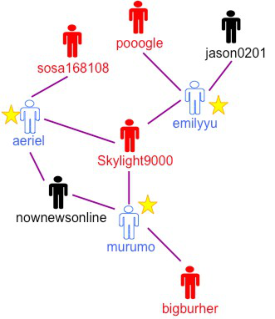
Given the “Tags” descripted above, the users or perhaps the clients who posted or commented messages including these tags could be detected. By comparing all the (public or private) data collected from SNS, the influencers with numerous posts/comments (in public data) or his/her own friends (in private data), and of course, with higher evaluations about the product, could be identified and tagged.
Figure 3. Influencers Tagging and Network Topology.
3. Potential Clients Detecting
Given a set of information cascade models based on the concepts of epidemic research, such as Independent Cascade Model (ICM), Linear Threshold Model (LTM), Susceptible-Infected-Recovered Model (SIR), Susceptible- Infected- Susceptible (SIS) Model, and so on, a evaluation mechanism is applied to find out the potential clients, who may have had been infected by the information posted/commented by tagged influencers. Take LTM for example, it is presumed that a user (potential client) is infected or influenced by each neighbor according to a probability. When he/she replies to multiple posts/comments, the influence effect (pathogen) is accumulated. After it exceeds the threshold, he/she would make the purchasing decision in the coming time period with high probability (i.e. he/she is indeed infected). By the estimated “level of threshold” the potential clients is determined and thus tagged.
Take Figure 3 for example. Given the tagged influencers, the interactions of these clients with others users of specific Pages (in public data) or with his/her friends (in private data) can be illustrated. The asterisked users (or friends) may be the potential clients who have had been infected over the threshold (say three times) based on the LTM model.
Figure 4. Potential Clients Tagging.
CONCLUSIONS
Nowadays consumers increasingly depend on the experiences, reviews, and suggestions shared on SNS, on which most of the firms believe that appropriate marketing strategies will facilitate the social WOM. In this research we introduce a framework of “social influence tagging” based on the concepts of information cascades and the effects of the consumer conformity. By tagging the comments, influencers and the potential clients on SNS sequentially, “precision targeting” is executable when the “behavioral data” are available.
However, even all the interactions could be recorded as data for further brand marketing, because there is a huge amount of Web discussions, Facebook Pages as well as SNS data, and the verifications of quantity analysis with mathematical modeling depends on significantly computing utilities, most of the firms can not directly collect all the data and thus apply to identify influencers as well as potential clients. Given the difficulties of data collecting and analyzing, this so called “Social Influence Tagging” can thus be as a service for all the brands for effective marketing strategy, by which to increase the consumption possibility of these potential clients.
REFERENCES
Bearden, W. O., Calcich, S. E. Netemeyer, R. G. and Teel, J. E. (1986), “An Exploratory Investigation of Consumer Innovativeness and Interpersonal Influence”, ADVANCES IN CONSUMER RESEARCH Volume 13 No.1, 77-82. Burgess, J. and Bruns, A. (2012), “Twitter Archives and the Challenges of ‘Big Social Data’ for Media and Communication
Research” M/C JOURNAL, Volume 15 No. 5. Chen, W., Wang, Y., and Yang, S. (2009), “Efficient Influence Maximization in Social Networks”, in: the Proceeding of the 15th ACM SIGKDD International Conference on Knowledge Discovery and Data Mining, Paris, France, Jun. 28- Jul. 1, 2009. Deutsch, M. and Gerard, H. (1955), “A Study of Normative and Informational Social Influences upon Individual Judgment”,
JOURNAL OF ABNORMAL SOCIAL PSYCHOLOGY Volume 51 No. 3, 629-636. Gibs, J. and Bruich, S. (2010), Advertising Effectiveness: Understanding the Value of a Social Media Impression, Research Report, Nielsen and Facebook. Granovetter, M. (1985), “Economic Action and Social Structure: The Problem of Embeddedness”, AMERICAN JOURNAL OF
SOCIOLOGY Volume 91 No. 3, 481-510.
Hoffman, D. L. and Fordor, M. (2010), “Can You Measure the ROI of Your Social Media Marketing?” MIT SLOAN MANAGEMENT REVIEW Volume 52 No. 1, 40-50. Kempe, D., Kleinberg, J., and Tardos, E. (2003), “Maximizing the Spread of Influence through a Social Network”, in: the
Proceedings of the 9th ACM SIGKDD International Conference on Knowledge Discovery and Data Mining, Aug. 24-27, 2003, Washington D.C., 137-146. Kietzmann, J. H., Hermkens, K., McCarthy, I. P., and Silvestre, B. S. (2011) “Social Media? Get Series! Understanding the Functional Building Blocks of Social Media”, BUSINESS HORIZONS VOLUME 54 No.3, 241-251. Manovich, L. (2012), “Trending: The Promises and the Challenges of Big Social Data”, in: Debates in the Digital Humanities,
Gold, Matthew K. (Ed.)., Twin Cities: The University of Minnesota Press. Pan, J.-G. and Lin, Y.-F. (2011) “Reconsidering the Marketing Strategies over Social Network- On the Perspective of Network Topology”, in: the Proceeding of International Joint Conference on Service Science 2011 (IJCSS 2011), May 25-27, Taipei, Taiwan. Park, J. K. and Feinberg, R. (2010) “E-formity: Consumer Conformity Behavior in Virtual Communities”, JOURNAL OF
RESEARCH IN INTERACTIVE MARKETING Volume 4 No. 3, 197-213. Piskorski, M. J. (2011), “Social Strategies that Work”, HARVARD BUSINESS REVIEW Volume 89 No.11, 116-122. Richardson, M. and Domingos, P. (2002), “Mining Knowledge-Sharing Sites for Viral Marketing,” in: the Proceedings of the 8th International Conference on Knowledge Discovery and Data Mining Edmonton, Canada, ACM Press, 61-70. Rad, A. A. and Benyoucef, M. (2011), “A Model for Understanding Social Commerce”, JOURNAL OF INFORMATION
SYSTEMS APPLIED RESEARCH Volume 4 No. 2, 63-73. Valente, T. and Davis, R. (1999), “Accelerating the Diffusion of Innovations Using Opinion Leaders”, ANNALS OF THE AMERICAN ACADEMY OF POLITICAL AND SOCIAL SCIENCE Volume 566 No. 1, 55-67.
ACKNOWLEDGE This study is conducted under the “Social Intelligence Analysis Service Platform (2/4)” of the Institute for Information Industry which is subsidized by the Ministry of Economy Affairs of the Republic of China.
LISTED IN THE AHFE DIGITAL BOOKSTORE CATALOGUE
Explore the complete digital volume
Advances in The Human Side of Service Engineering
Read this individual research paper free through the original publisher, or explore the full digital proceedings book.
ISBN 978-1-4951-2091-6
Explore this ISBN in the AHFE Bookstore ↗Listed in the July 2026 bookstore catalogue; search by ISBN to confirm current availability · Digital book purchase optional