Uwe Reischl, Ron Oberleitner (2021). Telehealth Technology Enabling Medication Management of Children with Autism. In: Advances in Human Aspects of Healthcare. AHFE Open Access, vol. 13. https://doi.org/10.54941/ahfe100511
To assist healthcare providers in the management of autism symptoms, a new smartphone application was developed that now allows physicians to observe patient behaviors between office visits, and allows physicians to manage a patient’s medication based on the severity and dynamics of the symptoms observed. A technology evaluation was conducted to determine ease of use of the smartphone application by two physicians and three caregivers of autism patients. The results showed that the new smartphone application is able to assist the physician in monitoring patients with an autism spectrum disorder more accurately than when using subjective reports provided by caregivers during office visits. The smartphone application technology demonstrated a potential new way to help both caregivers and physicians in improving medication management for children with autism.
Approximately 1 in 88 children in the United States are being diagnosed with the Autism Spectrum Disorder (ASD). Autism is a neurodevelopmental disorder that carries with it lifelong physical, emotional, and behavioral consequences. Early diagnosis and treatment can help reduce the severity of the symptoms. To assist healthcare providers in the management of the autism symptoms, a new smartphone application was developed that allows physicians to observe patient behaviors between office visits, and to manage the patient’s medication based on the information observed.
The project development was structured to build and evaluate a telehealth system which can improve the medication management of autism patients remotely. A mobile application was built for caregivers and parents to record video data of specific behaviors that were exhibited by the autistic child. After recording, the video data was sent via a HIPAA compliant server to a web interface for a clinician to review and annotate. The system’s perceived usefulness in the treatment and ongoing medication management of patients with autism was evaluated. The parents and caregiver reported that the videos of specific autism related behaviors provided accurate depictions of the child’s true mental health status. The physicians indicated that the video data were helpful in assessing the patient’s medication status. Overall, the study showed that the use of this new system will be able to improve access to healthcare by enabling the physician to see the patient’s true health status in the child’s natural (home) environment and to provide a method of secure communication between the physician and the caregiver, or parents of children with autism. The telehealth technology bridges the healthcare gap between office visits which may ultimately reduce the need for frequent face-to-face meetings while not reducing the quality of care.
SYSTEM DESIGN The application of telehealth technologies to autism symptom assessment and management has been explored by researchers over a number of years (ADDM, 2006; Terry, 2009; Boisvert, 2010). The design of our store-and- forward telehealth platform which facilitates communication between caregivers and physicians is founded on this research. The current telehealth system interface consists of an IOS smartphone application that allows the parents and caregivers to share with the child’s physician a video record that includes illustrations of specific autism behaviors that the physician requested in order to assess a child’s well-being and to determine whether or not the medications prescribed were effective. Video clips of problem behaviors, also called “target symptoms,” included signs of aggression, obsessive compulsive behaviors, signs of disorientation, etc. Also, video clips of positive behaviors observed during exposure to various environments, both inside and outside the home, were also included. After parents and caregivers uploaded these video clips onto a customized web server, the physician was then notified that such video clips were available for review.
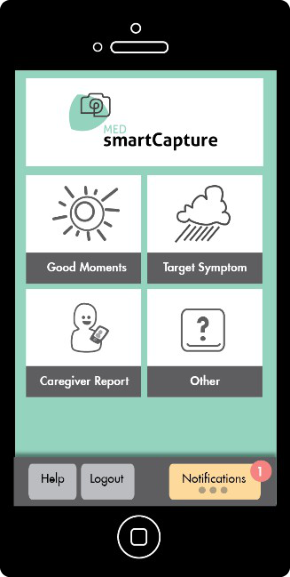
The screen of the smartphone application is illustrated in Figure 1. The screen is divided into four quadrants. The quadrant titled “Good Moments” is pressed when the parent or caregiver records behaviors that illustrate a child’s improved behaviors. The video clips are then stored on the server under this category title. The quadrant titled “Target Symptoms” is pressed when the parent or caregiver records problem behaviors that may be addressed by the use of medication and may be important to the physician to determine if a modification to the prescription medications is needed. Again, these video clips are stored on the server under this category title. The quadrant titled “Caregiver Report” allows the parents or caregivers to capture video clips of themselves to verbally communicate with the physician about issues related to video clips submitted earlier under various categories. Again, these video clips are stored on the server under the specific category title. The quadrant titled “Other” allows the parents or caregivers to submit video clips that would not otherwise fit into any of the quadrant categories. If a physician wishes to requests additional information from a parent or caregiver, the physician can then send a secure email message to the parent or caregiver and a notification of such an email message appears on the lower right-hand corner of the screen titled “Notification”.
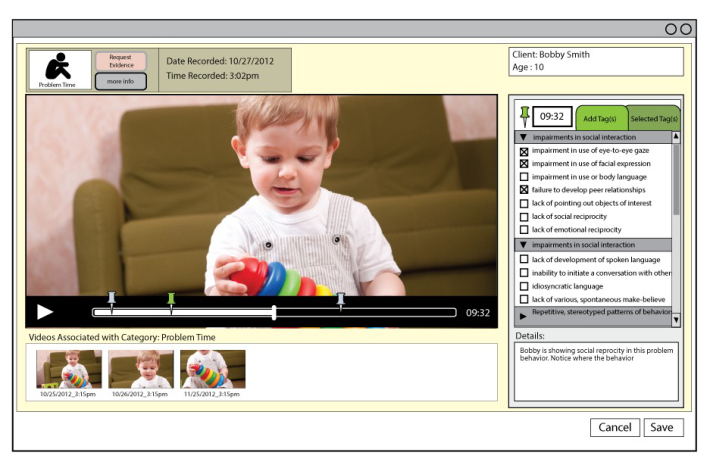
Figure 1. Illustration of MedSmartCapture™ smartphone application screen After video clips are uploaded to the server, the physicians will be able to review a child’s symptoms, “tag” relevant behaviors, and annotate the events using the menu provided These “tags” also allow the physician to mark events for additional scrutiny and annotation at a later time. This becomes useful when documenting changes in a child’s behavior over time. A typical video data display is illustrated in Figure 2.Figure 2. Illustration of typical video data display including event “tags” (shown on right side of the screen) and event annotations displayed on the bottom right side of the screen.
METHODS
A three month case-study evaluation was conducted including two physicians, one caregiver, and two parents of children with autism. The clinicians “prescribed” the use of the smartphone application with explicit instructions on what and when to capture video data. The caregiver and parent shared the recorded behaviors and uploaded them via the HIPAA conforming server to the clinicians. The clinicians then reviewed and annotated the events of interest for later review, sending text messages to the family if further video documentation was required.
RESULTS
The physicians and two parents, as well as the non-parent caregiver, completed the 3-month technology evaluation program. All features of the smartphone application and server-based information management system were utilized during this time period. The parents as well as the caregiver shared key video data multiple times that allowed the physicians to assess the child’s health status in a timely manner. “Good Moments”, “Target Symptoms”, and “Caregiver Reports” were reviewed by the physicians to evaluate the need for changes in medication management. As a result of the data shared, medication regimen was changed for one child.
The following general feedback was provided by the parents and caregiver: o The technology was very helpful in communicating with the physician between office visits o The technology helped document accurately the child’s “true” health status o The smartphone screen quadrants simplified the understanding and use of the technology
The following general feedback was provided by the physicians: o The video clips submitted by the parents and caregiver provided an accurate depiction of the health status of the children with autism o The video clips provided by the parents and care giver were helpful in determining the effectiveness of the medication used in managing the symptoms of the children o The smartphone telehealth technology provided a good communication link between parents / caregivers and physicians
CONCLUSIONS
Feedback obtained in this study was positive and suggests that the smartphone application described here can be incorporated easily into the medication management of autism. This technology may also represent a breakthrough in the management of autism using telemedicine. Additional recommendations include developing a method of integrating the data from the application into an electronic health record system that will allow a clinician to track clinic notes and medication lists, and to facilitate data collection for pharmaceutical trials. The use and value of this system will likely increase as the level of stress experienced by parents and caregivers increases. One of the physicians reported that “user compliance is greater when parents and caregivers are in distress observing their child’s autism symptoms.”
REFERENCES
ADDM, (2006), Autism and Developmental Disabilities Monitoring Network, “Prevalence of autism spectrum disorders” MMWR Surveillance Summaries, 58(10), pp. 1-20. Boisvert, M., Lang, R., Andrianopoulus, M., & Boscardin, M.L (2010). “Telepractice in the assessment and
treatment of individuals with autism spectrum disorders: A systematic review.” Developmental Neurorehabilitation, 13(6), pp. 423-432. Terry, M. (2009). “Telemedicine and Autism: Researchers and Clinicians Are Just Starting to Consider Telemedicine Applications for the Diagnosis and Treatment of Autism.” Telemedicine and e-Health, 15(5). pp. 416-419.
LISTED IN THE AHFE DIGITAL BOOKSTORE CATALOGUE
Explore the complete digital volume
Advances in Human Aspects of Healthcare
Read this individual research paper free through the original publisher, or explore the full digital proceedings book.
ISBN 978-1-4951-2093-0
Explore this ISBN in the AHFE Bookstore ↗Listed in the July 2026 bookstore catalogue; search by ISBN to confirm current availability · Digital book purchase optional