Katie Potts, Phillip Smith, Mohammed Bahja (2025). Virtual Reality Sensory Rooms: A Tool to Reduce Anxiety in Autistic Adults. In: Human Interaction and Emerging Technologies (IHIET 2025). AHFE Open Access, vol. 197, pp. 262–271. https://doi.org/10.54941/ahfe1006719
With the current rise in autism diagnoses and the resultant strain on mental health services, it has become increasingly necessary to consider anxiety management techniques for autistic adults that are not reliant on a large amount of resources, both financial and physical. Furthermore, the current increase in availability of virtual reality headsets on the commercial market brings increased interest in applications for virtual reality for purposes beyond gaming. Previous success has been shown by other researchers in the use of virtual reality sensory rooms to reduce anxiety in patients of residential facilities, however these studies were not solely focussed on autism, and focussed on those in a residential setting. As such, it was deemed important to focus on autistic participants and examine the effectiveness of such a program for autistic adults who are not in the position to require residential care facilities. Therefore this work aims to explore the effectiveness of an emulated sensory room in virtual reality by examining the STAI data and heart rate data of a 29 person study.
Increasingly, studies have been done to identify uses of virtual reality to help with various issues caused by autistic spectrum disorder and other developmental disabilities. Given the benefits of commercially available headsets in that they can be used with far less financial layout than sensory rooms, and require less space to use, it has been decided to examine whether such a program would be beneficial for reducing the anxiety of autistic adults with low support needs.
Therefore a study with 29 participants has been carried out to determine the effectiveness of an emulated sensory room developed for virtual reality in reducing anxiety. Both the heart rate data and self-report questionnaire data demonstrate statistically significant decreases in anxiety. This paper also examines the idea of telepresence and immersion, and how that may contribute to the benefits that this tool has on anxiety reduction. This paper also compares these values to sensory processing profiles to explore the lack of correlation.
Virtual Reality Sensory Rooms: A Tool to Reduce Anxiety in Autistic Adults 263
LITERATURE REVIEW
Dunn’s Model and Sensory Theory Dunn’s Model suggests that a person’s ability to process sensory stimulus (the information taken in by the body when experiencing a sense) can be understood on two axes - their threshold for sensory stimuli and their activity level, or the willingness they have to act when the sensory stimuli around them does not match their threshold (Dunn, 2007). The threshold is someone’s capacity to take in and process sensory stimuli, with a high threshold indicating increased ability at the cost of understimulation and a low theshold indicating a lower ability causing risk of overstimulation. The activity level is the range of how likely it is that a person will act on the sensory stimuli around them not meeting their needs, with the higher the value increasing the likelihood.
With these two axes, four quadrants have been recognised for sensory processing. These are sensory seeking (high threshold, high activity), low registration (high threshold, low activity), sensory avoidance (low threshold, high activity) and sensory adversion (low threshold, low activity). These quadrants have been measured as part of this study as to test the theorem that sensory processing threshold and activity level influences the ability of a virtual sensory room to reduce anxiety.
Anxiety For the purposes of this paper, the state-trait model of anxiety has been used, with the focus being on state anxiety, with trait anxiety being more valuable in the context of it being a variable that affects state anxiety (Endler and Kocovski, 2001). State anxiety is the anxiety felt by a person as a present emotion, as compared to trait anxiety which is the average anxiety felt by a person due to their personality.
Autistic adults are more likely to have comorbid anxiety disorders than the average population (Nimmo-Smith et al., 2020), which is why there is interest in methods that can be used to reduce anxiety in autistic people. Furthermore, there is a known link between both sensory sensitivity and sensory avoidance and increased amounts of state anxiety, which encourages this examination.
Sensory Rooms and Their VR Emulation The original work written on sensory rooms is based on Dutch research about leisure for those with profound disabilities (Patterson, 2004). It presents sensory rooms as 2 a potential method for them to engage with casual leisure - leisure where the sole value is intrisinic pleasure, rather than leisure that also provided mental or physical stimulation for if they are unable to engage with traditional methods for that kind of leisure. They are designed to provide sensory immersion to cause this form of leisure to occur.
The previous work done on emulating sensory rooms in virtual reality has been the work done by Mills et al. (2023) who have looked at the effectiveness of emulating sensory rooms for a population of adults with neurodevelopmental disabilities in a residential facility. This work is valuable
as it demonstrates the overall ability of an emulated sensory room to decrease anxiety in a disabled population.
Telepresence and Immersion Telepresence and immersion are two linked but different concepts that relate to virtual reality as they discuss the way that virtual reality separates the user from their regular life (Draper, Kaber and Usher, 1998). Both are important to understand why it was believed and proven that emulation of sensory rooms would have a positive effect on users. For the purposes of this paper, the experimental definition of telepresence is used, that being the idea that telepresence is the ability of a program to make the user feel physically present in the space formed by the program, as opposed to the actual room they are in. Immersion has only one definition in this context, that being the ability of a program to control the sensory stimulus experienced by the user.
METHODOLOGY
Software and Hardware Used The program in use for this study is a sensory room program designed for the purpose, which was designed through a process of evaluating sensory room elements and determining their ability to be emulated in a virtual reality context (Potts, Bahja and Smith, 2023) for the purposes of carrying out this experiment. This program is ran on an Oculus Quest 2 headset using the standard controller hardware.
Questionnaires Chosen To measure the anxiety of participants, the State part of the State/Trait Anxiety Index is used (which will henceforth be referred to as the STAI questionnaire). This is being used as it is one of the most used questionnaires for measuring anxiety. The trait anxiety was considered to be less relevant due to the within-participants nature of the study. This data is collected as a core part of calculating the anxiety difference induced by use of the program.
For the measurement of the sensory profiles, the Adult/Adolescent Sensory Profile has been used. This is due to it being the most well-regarded questionnaire for the purpose of calculating how strong each of the four quadrants are for participants. These are measured to be able to figure out whether sensory profiles have an impact on the effectiveness of the program.
Heart Rate Collection The heart rate is collected using a Polar Flow heart rate monitor worn around the chest and gathered using the Polar Flow app. The choice to use a chest monitor despite the potential sensory issues is due to chest heart rate monitors in general having higher rates of accuracy than those worn on the wrist (Wang et al., 2007).
The choice to measure heart rate data in addition to getting measurements from questionnaires is due to concerns that alexithymia may reduce the effectiveness of solely looking at self-reported data. As alexithymia is a
Virtual Reality Sensory Rooms: A Tool to Reduce Anxiety in Autistic Adults 265
known symptom of autism (Ferguson, Preece and Schwitzer, 2023), it is a known consideration during the design of the experiment. It meant that while deciding hypotheses there were concerns that the STAI data may not fully account for the emotions of participants due to this symptom, however the corroboration of data demonstrates this to not be the case.
Participant Information There are 29 participants, one of whom it is necessary to reject their STAI data due to researcher error preventing them from completing the required questionnaires, and another for whom no heart rate data is available due to hardware limitations. There are 29 participants as use of the G*Power tool to carry out power analysis determines that 28 participants are necessary to ensure statistical significance, and then another participant is included to ensure a statistically significant number of results despite the issues with data collection.
There are two major methods used for participant recruitment. The first method is through Autistica’s email newsletters, and the second is through informal recruitment of university students through postering and word of mouth, both in person and on online spaces for university students.
RESULTS
STAI Data
Table 1 displays the STAI scores for the state anxiety of the participants before and after using the sensory room. The change in anxiety for each participant was calculated by subtracting the initial anxiety from the anxiety after use of the sensory room program, meaning that negative values demonstrates a decrease in anxiety. After this the average of these values are calculated to be −4.892857143. This is then divided by the range of values for the STAI questionnaire (60), which has a percentage change in anxiety of −8.154761905%. This demonstrates that there is a reduction of anxiety for the participants.
Table 1: Values gotten from the STAI state anxiety scores before and after using the virtual reality program.
The calculated value of a paired student t-test for this data is −2.79, which demonstrates statistical significance within 0.995 confidence, which means it is possible to reject the null hypothesis and accept the alternate hypothesis that the virtual sensory room has a statistically significant effect on the anxiety of autistic people.
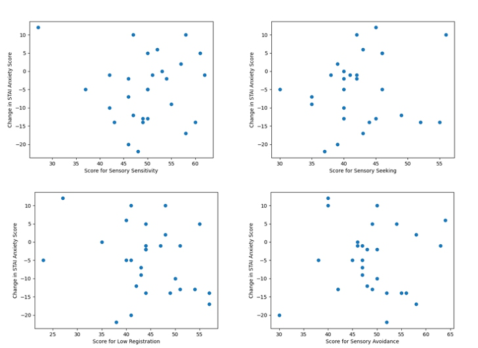
Correlation Between STAI and AASP Data Calculation of the AASP sensory profiles demonstrate a limited range of values for the sensory quadrants of the participants. By the classification in the AASP, no participants are more sensory seeking than the average, with 42.8% of participants being in the average range for sensory seeking behaviour and all others being either below or far below average in this quadrant. Inversely, for every other quadrant, there were no participants who demonstrated lower than average ranking in those quadrants. Nevertheless, the values are graphically plotted against the STAI state anxiety scores to see if there is correlation.
Ultimately graphical analysis demonstrated no correlation between STAI and AASP scores. This can be seen in the four graphs presented in Figure 1.
Heart Rate Data An overall least means squares regression carried out on the heart rate data gathered through the experiment comparing it to time indicates a −0.0029 BPS reduction over the course of the experiment, with a t-value of −35.063, indicating a strong statistical significance. There is notable comparison between the F-statistic of 1229 and the R-statistic of 0.023, indicating time is not the leading factor affecting heart rate, which leads to the conclusion the program is the major factor.
Virtual Reality Sensory Rooms: A Tool to Reduce Anxiety in Autistic Adults 267
Figure 1: The graphs demonstrating lack of corrleation between AASP and STAI data.
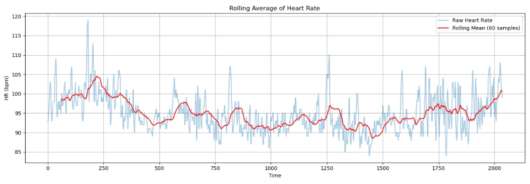
The strong autocorrelation implied by a Durbin-Watson value of 0.017 indicated that there was a lack of independence. Therefore to get more understanding of the overall data, a rolling average of the heart rate can be seen in Figure 2. The precise timings of activities in this rolling mean cannot be precisely defined, partly due to the lack of recording of timings and partly due to the difference in timing between participants due to external factors such as the processing speed of individual participants and the decision of multiple participants to end use of the program early due to issues of motion sickness. The general trend however indicates an increase in heart rate during the period when the stroop test is being carried out, followed by a sharp decrease when the headset is put on. There are peaks of increase in heartrate throughout, presumably as a result of people choosing to end using the program for reasons of motion sickness, however even with these peaks there is no return the prior level before the stroop test until the end of the experiment, and at no point does the heart rate rise to the point of heightened anxiety. There is also the consideration that the heart rate at the end of the program will be affected by manual interference with the heart rate monitor as it is removed.
Figure 2: The rolling means of the heart rate of participants.
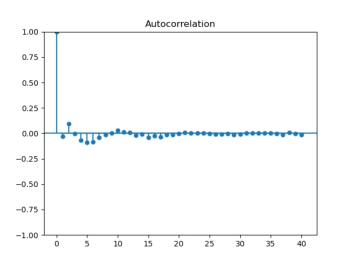
In addition, an ARIMA(1,1,1) model of the heart rate differentiates out the linear trend indicated by the least means regression. This is indicated as appropriate by carrying out a ACF and PACF plot, which demonstrates a sharp cut off after lag 1 (with the ACF visible in Figure 3). The minimal residual auto-correction indicates that this model would be the most beneficial to use.
Furthermore, the mean of the differentiated heart data of the ARIMA model is −5.65 × 10⁻⁵, with the low value indicating a successful differentiating process. It also indicates a negibible downwards trend in terms of heart rate, but not one that is significant. The AR(1) coefficient value was 0.5118, indicating a short term increase in heart rate, as opposed to the longer term trend of decreasing heart rate demonstrated by the linear model and the rolling average. The MA(1) coeffcient of −0.3703 indicated a tendency for 37% of the previous period’s error to carry over in an inverse direction, which means that there is a tendency to partial correction.
Figure 3: The ACF plot for heart rate data.
DISCUSSION
Changes in Anxiety As mentioned, the STAI data demonstrates a statistically significant decrease in anxiety after use of the program. There are two strong theories as to what may cause this to occur, one linked to sensory theory, one linked to the concept of immersion and telepresence.
The theory backed by sensory theory is the idea that the participants could engage in activities that matched their sensory profiles. This idea is linked to the concept of immersion, and the fact that the virtual reality headset allows for the sensory stimuli experienced by the user to be entirely controlled by the program. In doing so, it causes the user to only have the stimulus given by the program, which was designed for sensory needs.
The theory backed by the concept of casual leisure is the idea that the anxiety reduction was caused by the ability to engage with casual leisure, and the time to engage with activities that were not necessarily designed to have a goal, but simply to be enjoyed by the user. This theory is linked to
Virtual Reality Sensory Rooms: A Tool to Reduce Anxiety in Autistic Adults 269
the concept of telepresence. By making the user believe they are in a different space, it therefore induces the user to focus on the casual leisure and not on other matters.
Lack of Correlation to Sensory Profiles The fact that there is no correlation between sensory profiles and outcomes with regards to anxiety does not inherently dismiss the idea that the benefits to anxiety are based in sensory processing. This is because the participants were not required to engage in particular activities when using the program, and thus it is likely that they have defaulted to using parts of the program that meet their particular sensory needs and avoided those which have a negative impact given their sensory profile, causing it to have no effect on their reduced anxiety. Further study would need to be done to isolate sensory elements to determine whether this is the case.
There is also the consideration that the range of results on the AASP test were relatively limited compared to the potential range of values. This means that it may be that with a wider range of values, there would be more of a correlation.
Heart Rate Data Overall, the heart rate data comes to a very similar conclusion that the STAI data does, which indicates that during use of the program the program causes a decrease in anxiety, which can be determined because lower heart rate is linked to lower anxiety through the proof of the inverse that higher heart rates are linked to increased anxiety (Trotman et al., 2019). This means that the physiological evidence supports the self-reported data that the program is an effective too for the reduction of anxiety. Another point that indicates this is the rise at the beginning of the rolling average, which demonstrates a rise in heart rate while participants carried out an activity known to cause an increase in anxiety without any increase in motion.
It is also important to consider the values after the end of using the program, as while there is a increase in heart rate values, it still stays below the starting anxiety values. While the ANOVA demonstrates a likelihood of continuation of increasing values, that is affected by the potential effects of removal of the heart rate monitor.
The rises in heart rate have multiple causes that do need to be considered, as they are not necessarily a demonstration of an increase in anxiety. As this is a new space for the user, there is the consideration that the surprise caused by learning the functionality of parts of the program would contribute to the heart rate, as well as the physical act of engaging with the program if they choose to engage in activities such as throwing objects. Thus the general trend is overall optimistic with regards to effectiveness.
Further Work This work focussed on the ability of the program to reduce anxiety when the participant was in an unfamiliar environment, which was a benefit as it naturally contributed to the initial anxiety levels to aid with measuring
anxiety reduction. However now that the evidence demonstrates this works, there is also value in examining it as a tool used in the person’s own space. This would also make it viable to examine the long term benefits, which would be valuable to explore now that there is evidence of short term benefits showing its feasibility.
Most of the recruitment methods for participants were such that they coincidentally selected for university students, which did cause biases in the participant demographics that match biases in the demographics of students. This bias led to a majority of participants generally being in the traditional age range for university students (18–21) and having achieved at least A- Levels, and so would be adept with technology. As such there is value in doing further work that deliberately targets older populations to determine whether the effectiveness of the tool is tied to the technological literacy of the participant, particularly technical literacy linked to virtual reality.
CONCLUSION
This study has been the first step of discovering the way that emulating sensory rooms can be beneficial for reducing anxiety in autistic adults. It has demonstrated a statically significant reduction in self reported anxiety measures, and produced heart rate data that demonstrates a reduction in anxiety during the use of the program and in the short term period after using the program. This positive outcome demonstrates that further research in this area would likely produce positive outcomes in the area of anxiety reduction for autistic adults.
ACKNOWLEDGMENT
The authors would like to acknowledge the Ramsey Fund for providing funds to acquire the Oculus Quest 2 hardware and the questionnaires used throughout the study. They would also like to thank Autistica and various Guild of Student Societies, those being Computer Science Society, VR Society, SANDAM and LARP Society for allowing use of their online resources for the purposes of advertising this study. In addition, they would like to thank the VRLab in the School of Psychology, University of Birmingham for access to space to carry out this study.
This study has been ethically approved by the Science, Technology, Engineering and Mathematics Committee of the University of Birmingham.
REFERENCES
Draper, J. V., Kaber, D. B. and Usher, J. M. (1998) ‘Telepresence’, Human factors, 40(3), pp. 354–375. Dunn, W. (2007) ‘Supporting Children to Participate Successfully in Everyday Life
by Using Sensory Processing Knowledge’, Infants & Young Children, 20(2), p. 84. Available at: https://doi.org/10.1097/01. IYC.0000264477.05076.5d. Endler, N. S. and Kocovski, N. L. (2001) ‘State and trait anxiety revisited’, Journal of anxiety disorders, 15(3), pp. 231–245. Ferguson, C. J., Preece, D. A. and Schweitzer, R. D. (2023) ‘Alexithymia in autism
spectrum disorder’, Australian Psychologist, 58(2), pp. 131–137.
Virtual Reality Sensory Rooms: A Tool to Reduce Anxiety in Autistic Adults 271
Mills, C. J. et al. (2023) ‘Evaluating a virtual reality sensory room for adults with disabilities’, Scientific reports, 13(1), p. 495. Nimmo-Smith, V. et al. (2020) ‘Anxiety disorders in adults with autism spectrum
disorder: A population-based study’, Journal of autism and developmental disorders, 50, pp. 308–318. Patterson, I. (2004) ‘Snoezelen as a casual leisure activity for people with a developmental disability’, Therapeutic Recreation Journal, 38(3), pp. 289–300. Potts, K., Bahja, M. and Smith, P. (2023) ‘Exploring the Potential of Virtual Reality
Sensory Rooms’. Trotman, G. P. et al. (2019) ‘Associations between heart rate, perceived heart rate, and anxiety during acute psychological stress’, Anxiety, Stress, & Coping, 32(6), pp. 711–727. Wang, R. et al. (2017) ‘Accuracy of wrist-worn heart rate monitors’, Jama cardiology,
2(1), pp. 104–106.
LISTED IN THE AHFE DIGITAL BOOKSTORE CATALOGUE
Explore the complete digital volume
Human Interaction and Emerging Technologies (IHIET 2025)
Read this individual research paper free through the original publisher, or explore the full digital proceedings book.
ISBN 978-1-964867-73-1
Explore this ISBN in the AHFE Bookstore ↗Listed in the July 2026 bookstore catalogue; search by ISBN to confirm current availability · Digital book purchase optional