Yoshiro Imai, Eiichi Miyazaki, Hiroshi Kamano (2021). Development of an e-Healthcare System for University Students. In: Advances in Human Aspects of Healthcare. AHFE Open Access, vol. 13. https://doi.org/10.54941/ahfe100516
*Engineering Graduate School of Engineering, **Faculty of Education, ***University Health Center, Kagawa University, 2217-20 Hayashi-cho Takamatsu 761-0396 Japan ↗
An e-Healthcare system with IC card authentication, automatic health screening subsystem and Web-based health information monitoring, has been designed and implemented for university health education. It is a prototype of private Cloud service of e-Healthcare for university students which can obtain their health records from physical measuring devices with their IC card-based authentication, manage their health data in suitable database, investigate such data from viewpoint of doctors/nurses and provide such information for self-healthcare controlling through Web-DB service. This paper presents an organization of the above e-Healthcare system, demonstrates its real usages in university health education and describes its brief evaluation and expanding plan through practical applications.
People of the world have own natural rights to live their healthy lives. They have been interesting in their situations of health and nowadays almost all of them are longing for their healthy environment more strongly than ever before. Doctors always point out that people need to keep their healthy lives if they do not want to be ill and sick. It is very important for everyone to maintain his/her living environment at the healthy level. In other words, everyone wants to have some facilities to monitor his/her healthy level and needs some visualizing tools to recognize whether his/her healthy level becomes good or not.
In every higher education and/or university, even in Japan, of course, its staffs and administration must provide health education and equip health-managing environment for its students. Because it is important for current students to spend their university lives in good condition, and for external society including their family to welcome the relevant students as its up-and-coming persons. Strictly speaking, however, universities have faced to some problems to be resolved in order to provide efficient health education and they are/have been suffering from the lack of staffs and facilities to manage health keeping environment for their students.
An approach of e-Healthcare seems to be one of the most effective and efficient solutions to improve such environment of health education with the above lack of staffs and facilities in universities as well as in general societies. This approach may be able to provide a powerful strategy to equip so-called "Ubiquitous Healthcare Service" where users can always connect to the information server, monitor their health information in it and obtain suitable advises and instructions for their health management.
This paper describes our e-Healthcare system for university students with IC card authentication, automatic health screening subsystem and Web-based health information monitoring. First of all, the next section introduces some related works for the sake of comparison and coordination of our study with the state-of-the-art in the same domain. The third section shows configuration of a newly-developed e-Healthcare system and illustrates some details of the system and its facilities. The fourth section demonstrates its real application in our university, explains some brief evaluation of our e-Healthcare system and reports our challenge to expand our system to be hopefully over- grounded in the future market. Finally, the last section concludes our summaries for the perspective study and shows acknowledgements and some useful references.
RELATED WORKS e-Healthcare related works
B.W. Trevor Rohm of Brigham Young University and his son in (Rohm and Rohm Jr., 2002) described "Abstract A vision of the e-healthcare era is developed using scenarios from today and for the future. The future of e-healthcare is based on empowering individual patients with current information about diagnosis and treatment for personal decision-making about their health without ever visiting a healthcare facility. Empowering the patients is made possible with a futuristic personal medical device (PMD)." And they added "The PMD is a `black box', which works in conjunction with the internet and locally stores expert system programs. The PMD has various accessories available to help with diagnosis besides voice and image capabilities."
Patrick C. K. Hung of University of Ontario Institute of Technology (UOIT) described in (Hung, 2005) "Information privacy is usually concerned with the confidentiality of personal identifiable information (PII) and protected health information (PHI) such as electronic medical records. Thus, the information access control mechanism for e- Healthcare services must be embedded with privacy-enhancing technologies.".
A. Mukherjee and J. McGinnis of Montclair State University categorized and explained `e-Healthcare' in paper article(Mukherjee and McGinnis, 2007). And they presented the state-of-the-art to identify key themes in research on e-healthcare. They pointed out "E-healthcare is contributing to the explosive growth within this industry by utilizing the internet and all its capabilities to support its stakeholders with information searches and communication processes. A review of the literature in the marketing and management of e-healthcare was conducted to determine the major themes pertinent to e-healthcare research as well as the commonalities and differences within these themes. Based on the literature review, the five major themes of e-healthcare research identified are: cost savings; virtual networking; electronic medical records; source credibility and privacy concerns; and physician-patient relationships. E-healthcare systems enable firms to improve efficiency, to reduce costs, and to facilitate the coordination of care across multiple facilities."
Ubiquitous Services of e-Healthcare Nowadays, e-Healthcare has been tightly connected with ubiquitous computing services. Especially, mobile computing is a key technology to realize e-Healthcare system effectively and efficiently. The below papers are discussing about relations and connections between mobile computing and know-how of construction of e- Healthcare system.
Zhuoqun Li and his supervisors of University of Plymouth described at the relevant conference on Computational Intelligence in Medicine and Healthcare (Li et.al., 2005) "The growing availability of networked mobile devices has created a vast collective potential of unexploited resources. Grid computing with its model of coordinated resource sharing may provide a way to utilize such resources that are normally distributed throughout a mobile ad-hoc network." They also discussed the general challenges in implementing Grid functionalities (e.g. service discovery, job scheduling and Quality of Service (QoS) provisioning) in the mobile environment and the specific issues had arisen from realistic application scenarios, i.e. the e-healthcare emergency.
Min Chen and his co-researchers of Seoul National University described in (Chen et.al., 2010) "Radio frequency Human Aspects of Healthcare (2021) identification technology has received an increasing amount of attention in the past few years as an important emerging technology. To address this challenging issue, we propose an evolution to second-generation RFID systems characterized by the introduction of encoded rules that are dynamically stored in RFID tags. This novel approach facilitates the systems' operation to perform actions on demand for different objects in different situations, and enables improved scalability. Based on 2G-RFID-Sys, we propose a novel e-healthcare management system, and explain how it can be employed to leverage the effectiveness of existing ones. It is foreseeable that the flexibility and scalability of 2G-RFID-Sys will support more automatic and intelligent applications in the future."
Design Concept based on Previous Related Works We have designed our new e-Healthcare system based on not only facing problems to be resolved in our university but also the above previously announced in the public journals and conference papers described in the above subsections. Our design concepts are summarized as follows, the former are our original design concepts introduced from existing problems at the routine physical examination for students in our university. Namely,
• Reduction of time-consuming tasks and frequently occurred human-errors.
• Avoidance of paper-oriented information exchanging and sharing.
• Applicability of newly designed system to Health Education in our university.
• Usage of IC card-based Student Identification for user authentication.
And the latter ones are added through investigation of previous related works in the public papers. Namely, [Equation or mathematical symbol available in the original paper PDF] Utilization of Mobile Computing technologies including Wireless LAN, 3G/GSM telephone communication and others for position-independent services.
• Employment of suitable "Electronic Medical Records" and/or "Personal Health(care) Records" for seamless healthcare services.
• Capability of newly designed system as so-called Ubiquitous Services or Cloud Services in order to provide effective healthcare environment.
CONFIGURATION OF E-HEALTHCARE SYSTEM Overview of our e-Healthcare System
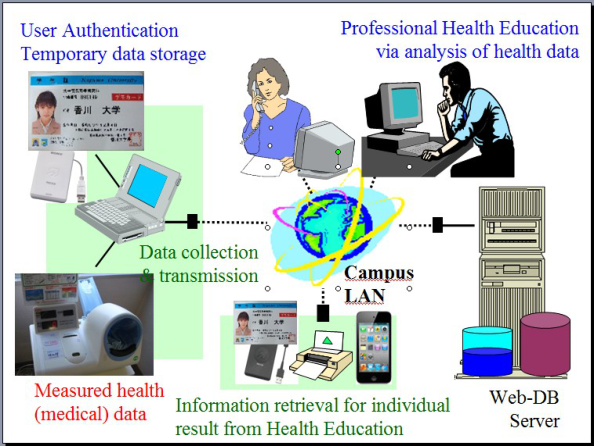
Figure 1 shows a conceptual configuration of our e-Healthcare System in order to resolve existing problems at the routine physical examination for students in our university. Its characteristics are summarized as follows; [Equation or mathematical symbol available in the original paper PDF] User(Examinee) authentication with IC card-based student ID for simplification of Examinee checking.
• Automatic data obtaining of physical measuring devices into personal computers in order to reduce time- consuming tasks of paper-based data recording.
• Temporary data storage with IC card for the routine physical examination in not-networked environment.
• Equipment of database for individual healthcare record and health monitoring through campus network.
• Professional health education by university doctors and/or nurses through analysis of medical records from the routine physical examination.
• Information retrieval of medical records from Web-based monitoring with user authentication.
At the IEEE International Conference on Services Computing(SCC2007) held in Lisbon in 2007, F. Kart and co- researchers of University of California, Santa Barbara described "Large-scale distributed systems, such as e- healthcare systems, are difficult to develop due to their complex and decentralized nature (Kart et.al., 2007). The service oriented architecture facilitates the development of such systems by supporting modular design, application integration and interoperation, and software reuse. With open standards, such as XML, SOAP, WSDL and UDDI, the service oriented architecture supports interoperability between services operating on different platforms and between applications implemented in different programming languages." They mentioned in other article(Kart et.al., 2008) of IT Professional (March-April 2008) "Medical monitoring devices worn by the patient, and frequent electronic communication between the patient and a nurse, can ensure that the prescribed treatment is being followed and that the patient is making good progress. The e-healthcare system can be readily extended to other healthcare professionals, including medical technicians who perform and report tests and analyses requested by physicians."
Their studies and results have provided some good ideas and comprehensive strategy for us to develop and improve our e-Healthcare system and simultaneously taught us how to select several kinds of technologies for implementation of effective e-Healthcare system for our demand of university. We do not employ such open standards described in the above papers but we recognize that it is very important to design our system with modular system architecture /programming and utilize standards of protocols and data formats. So our system can have expandability not only to connect with other systems but also to adapt for several kinds of users with interoperability.
Figure 1. Conceptual Configuration of an e-Healthcare System (previously annunciated in (Imai et.al., 2011)) Sub-systems and facilities of our e-Healthcare System
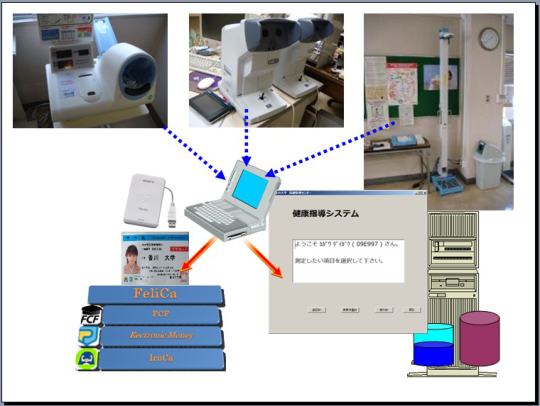
For example, at first, we introduce a dedicated subsystem including physical measuring devices, IC card reader/writer and personal computer (PC) for controlling. Figure 2 shows a typical dedicated sub-system with a blood pressure monitoring device and vision analyzer as physical measuring device. Controlling PC in Figure 2 has connectivity with the above devices and IC card reader/writer so that user authentication and data acquisition can be realized in the following steps;
1) Placing IC card of Examinee on the IC card reader connected to PC.
2) Authenticating ID of Examinee from IC card and obtaining his/her relevant information.
3) Acquiring data from physical measuring device connected to PC.
4) Combining measured data and regarding information of Examinee into the formatted record with time-stamping.
5) Storing the above time-stamped record in IC card if the PC for physical examination is not connected with network environment.
6) Database server can collect such records of PC or IC card into its storage through network environment.
Figure 2. Dedicated Sub-system of Physical Measuring Device, IC card Reader/Writer and Personal Computer We have already developed a mechanism to build dedicated sub-systems in order to interface several measuring devices such as a blood pressure monitoring device, vision analyzer and other devices to take height and weight [9]. So we will be able to expand the above samples into other types of dedicated sub-system relatively easily for other kinds of physical measuring devices.
Secondly, we explain another facility of our e-Healthcare system to realize health monitoring for database server through campus network in university. Figure 3 shows a scheme of health monitoring or health information retrieval for database by university doctor through campus LAN.
Figure 3. Health monitoring for Database through campus network
Figure available in the original PDF paper.
The dedicated sub-system of our e-Healthcare system described above can accumulate the formatted record combined with measured data and regarding information of Examinee with time-stamping. So every student (i.e. Examinee) has his/her health records in database with when-where information about the routine physical examination or periodical health checking. Not only the relevant students themselves but also university doctors/nurses can investigate or trace the history/changes of health information in time series.
The relevant facility of our system can generate some kinds of graph based on time-series analysis in order to illustrate the history/changes of health information. Of course, university doctors/nurses can relatively easily perform their professional medical suggestions and/or judgments for some specified students by means of the above facility. Moreover, students will be able to retrieve their health information from database and understand the according history/changes of such information even by themselves.
One of the merits of employing graphical interface for retrieval of health information is to find out an specific change of health information with irregularity efficiently even at glance. Students can recognize such a case very easily through our e-Healthcare system by themselves and then consult their university doctors and/or nurses with their evidences from our system. Doctors and/or nurses in university also can perform periodical monitoring for graphical retrieving results. They will send some e-mail and other communication to the relevant student about his/her health situation.
With our e-Healthcare system, the above Health Education of university will be introduced and managed effectively and efficiently. The next section will demonstrates its real application in our university, explains some brief evaluation of our e-Healthcare system and reports our challenge to expand our system to be over-ground in the future market.
APPLICATION OF E-HEALTHCARE SYSTEM, ITS BRIEF EVALUATION AND ITS EXPANDING PLAN Real Application of e-Healthcare system in the routine physical examination
We call dedicated sub-system of our e-Healthcare system "Automatic Health Screening System" for student Health Education in Kagawa University (Miyazaki et.al., 2012). Left-bottom photo of Figure 4 shows one of our dedicated sub-systems in our prototype of e-Healthcare system used in the real routine physical examination in 2011.
Figure 4. Photos of the Routine Physical Examination in 2011 with a prototype of our e-Healthcare system We have already applied dedicated sub-system of our e-Healthcare system described in the previous section to the real routine physical examination since 2011. In the case of Figure 4 , we could not prepare any networked environment for the routine physical examination so that all the dedicated sub-systems of our e-Healthcare system had never connected to the campus LAN and the Database information server. Under such condition, our dedicated sub-systems must choose the following procedures; namely combining information about IC card of examinee and measured data acquired from the according physical measuring devices and storing such information into the relevant IC card for each examinee during the routine physical examination.
Figure available in the original PDF paper.
Brief Evaluation and Expanding Plan of e-Healthcare System From the viewpoint of applying our e-Healthcare system to the real task, the system can provide time-saving operations and precise computation of measuring students' health information. With our system, our university has enjoyed the above results because the system can reduce total time to perform the routine physical examination and avoid frequently-occurred human errors during physical examination.
Our university can also obtain some effects of introducing our e-Healthcare system into practical situation within university tasks which include the routine physical examination and useful Health Education. Now, we are going to apply some external budgets in order to bring our e-Healthcare system to the mainstream of university-outside. An alliance between university project team and brighter venture company has begun to challenge for national funds for the sake of making our system overground.
We must brush up our system into more applicable and more tightly secure one. The former is very important because the system has expandability, while the latter must be unavoidable in the health and medical domains where there are the most values in privacy, smoothly changed and improved for the above requests from the rising market near future, because it has modularity and expandability introduced in the paper.
CONCLUSIONS
This paper describes our e-Healthcare system for Student Health Education in Kagawa University. With our system, not only students can receive efficient Health Education but also doctors/nurses can provide fruitful medical suggestion and/or judgment through health monitoring. The routine physical examination can be improved into reduction of time-consuming tasks as well as avoidance of frequently-occurred human errors.
Characteristics of our e-Healthcare system are summarized as follows; (1) Employment of modular system architecture for easy maintenance, effective interoperability and system expandability:
Our e-Healthcare system includes a dedicated subsystem with some kinds of physical measuring devices, IC card reader/writer and controlling PC(s), a Database information server and some facilities for user-side health monitoring and retrieving. Each dedicated subsystem can be relatively easily tailored for other kinds of physical measuring devices. An additional facility can be built into the system for the sake of system expansion.
(2) Utilization of student IC card for user identification: It is a good idea to employ student IC card for user(i.e. examinee) identification during physical examination. With such IC card-based identification, our e-healthcare system can reduce and shorten total mount of time to register and authenticate examinees for physical screening test.
(3) Realization of mechanism to interface between measuring devices and computers: In order to build some kinds of interfaces between physical measuring devices and controlling PC in dedicated sub- system, it must be done to connect device into computer’s IO ports such as USB, write specific software for interrupts just like drivers and manipulate such devices by the controlling PC. With automatic control of measuring devices by such PC, our e-Healthcare system can avoid probabilistically happened human errors as well as writing mistake of measured data.
(4) Visualization of history/changes of health information in time series: The specific facility of our system can generate graphic information based on time-series analysis in order to illustrate the history/changes of health information. Doctors/nurses of university can relatively easily perform their professional medical suggestions and/or judgments by means of such a facility. Students can also recognize graphical history/changes of their health information.
REFERENCES
Chen, M. et al.(2010), "A 2G-RFID-based e-healthcare system", IEEE Wireless Communications, Vol.17, No.1, pp.
37–43 Hung, P.C.K. (2005), "Towards a Privacy Access Control Model for e-Healthcare Services", Third Annual Conference on Privacy, Security and Trust(PST2005), 4 pages Imai,Y., Hori,Y., Kamano,H., Mori,T., Miyazaki,E. and Takai,T.(2011), "A Trial Design of e-Healthcare
Management Scheme with IC-Based Student ID Card, Automatic Health Examination System and Campus Information Network", International Conference on Digital Information and Communication Technology and its Applications (DICTAP 2011), Part I, CCIS 166, pp. 728-740 Kart, F. et al.(2007), "A Distributed e-Healthcare System Based on the Service Oriented Architecture", IEEE International Conference on Services Computing(SCC 2007), pp. 652–659 Kart, F. et al.(2008), "Building a Distributed E-Healthcare System Using SOA", IT Professional, Vol.10, No.2, pp.
24–30 Li, Z., Sun,L., Ifeachor, E.C. (2005), "Challenges of Mobile adhoc Grids and their Applications in e-Healthcare", 2nd International Conference on Computational Intelligence in Medicine and Healthcare(CIMED2005), 8 pages Miyazaki,E., Kamano,H., Yamakata,D., Imai,Y., Hori,Y.(2012) "Development of an Automatic Health Screening
System for Student Health Education of University", 2nd International Conference on Digital Information and Communication Technology and its Applications (DICTAP 2012), pp. 421-427 Mukherjee, A. and McGinnis, J.(2007), "E-healthcare: an analysis of key themes in research", International Journal of Pharmaceutical and Healthcare Marketing, Vol.1, No.4, pp. 349–363 Rohm, B.W.T. and Rohm, C.E.T. (2002), "A vision of the e-healthcare era", International Journal of Healthcare
Technology and Management, Vol.4, No.1-2, pp. 87–92
LISTED IN THE AHFE DIGITAL BOOKSTORE CATALOGUE
Explore the complete digital volume
Advances in Human Aspects of Healthcare
Read this individual research paper free through the original publisher, or explore the full digital proceedings book.
ISBN 978-1-4951-2093-0
Explore this ISBN in the AHFE Bookstore ↗Listed in the July 2026 bookstore catalogue; search by ISBN to confirm current availability · Digital book purchase optional