Elly M. Waaijer (2021). Cen / ISO Technical Report (TR) 12296 - 2013 Ergonomics, Manual Handling of People in the Healthcare Sector International Consensus. In: Advances in Human Aspects of Healthcare. AHFE Open Access, vol. 13. https://doi.org/10.54941/ahfe100479
In 2012 a new ISO Technical Report (TR) 12296) was published, this TR was endorsed by CEN in July 2013. A working group of specialists have been working on this document for a period of more then 3 years. The working group was formed under the responsibility of Technical Committee ISO/TC 159, Ergonomics, Subcommittee SC3, Anthropometry and Biomechanics, representing 23 participating and 12 observing countries. Previous ISO standards and TR’s have had too little attention for the specific problems of patient handling in health care. ISO 11228 parts 1-2-3 address ergonomics and manual handling in general. ISO 11228 part 1 considers in an Annex in short the aspects of manual handling of living persons. The new TR is therefore intended to be a tool for assisting with the application of this series in the context of the healthcare sector. Its main goals are to improve caregivers' working conditions by decreasing biomechanical overload risk, thus limiting work-related illness and injury, as well as the consequent costs and absenteeism, and to account for patients' care quality, safety, dignity and privacy as regards their needs, including specific personal care and hygiene. The work was mainly done in a close cooperation with a scientific group called EPPHE (European Panel on Patient Handling Ergonomics). Members of this group have been working on the TR and have also been available to support ideas, provide materials and additional resources to assist in the development of the TR. EPPHE was formed in 2004 from a collaboration of Experts from the IEA Technical Committees on Healthcare Ergonomics and Musculoskeletal Disorders. (Hignett 2014). The final consensus document includes 6 Annexes with additional information and tools regarding:Risk Assessment and Risk EvaluationOrganizational aspects of patient handling interventionsAids and EquipmentBuildings and EnvironmentStaff education and trainingThe evaluation of intervention effectiveness
ISO is a worldwide federation of national standards bodies with technical committees to prepare draft International Standards. In addition to standards Technical Committees can also publish Technical Reports; these are informative documents, which are available in at least one of the official languages. A majority vote of the committee members dictates whether the information is to be published as a TR. There is no obligation for individual members to implement a Technical Report (TR) so conflicting national standards may continue to exist. Nevertheless the interest and influence has been recognised over the last two years after publication in several countries.
National and international statistics provide evidence that healthcare staff is subject to some of the highest risks of musculoskeletal disorders (particular for the spine and shoulder), as compared with other jobs. An ergonomic approach can have a significant impact on reducing risk from manual patient handling. (CEN/ISO TR 12296-2013).
In the years 2003-2007, ISO has produced specific ergonomic standards (ISO 1128 series) addressing manual handling in the general manufacturing sectors. However, these standards do not fully cover aspects of manual handling when applied for living persons. That is why the decision was taken by ISO, in agreement with the European Nomalisation Agency (CEN) to form a working group to create a TR dedicated to the healthcare industry.
The European Panel on Patient Handling Ergonomics (EPPHE) was formed in 2004 as a collaboration of experts from the International Ergonomics Association (IEA) Technical Committees on Healthcare Ergonomics (HETC9) and Musculoskeletal Disorders (TC13) with representation from 13 EU countries (Denmark, Finland, France, Germany, Greece, Ireland, Italy, Netherlands, Poland, Portugal, Sweden, Switzerland and United Kingdom).
A team of patient handling / ergonomic experts (all EPPHE members) has been working from 2009-2012 to collect all relevant information, to discuss the content and its relevance for the TR and to write the TR and its annexes. This work was carried out under the responsibility of ISO/TC 159/SC 3/WG 4 Human physical strength – Manual handling and force limits; representing 23 participating countries and 12 observing countries. The other EPPHE members heavily supported the working group.
The scope of the TR was to provide an overview and guidance for assessing the problems and risks associated with manual handling in the healthcare sector, and for implementing safe patient handling policies in hospitals and long- term care facilities, such as nursing homes and care facilities for handicapped people. The recommendations presented in the TR give an overview of evidence based methods allowing the identification of hazards, an estimation of the risks associated with manual patient handling and the application of solutions.
Its main goals are
To improve caregivers’ working conditions by decreasing biomechanical overload risk, thus limiting work related illness and injury, as well as the consequent costs and absenteeism, and
To account for patients’ care quality, safety, dignity and privacy as regards their needs, including specific personal care and hygiene (CEN/ISO TR 12296-2013)
TR RECOMMENDATIONS The TR recommendations start with the description of two risk assessment models, since risk assessment is one of the pillars of preventive strategies.
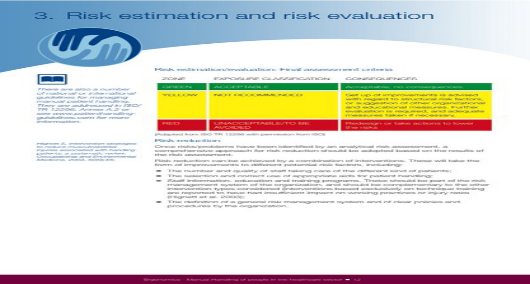
(Illustrations from Ergonomics; Manual Handling of People in the Healthcare Sector An edited summary of ISO Technical Report 12296, 2012) In annex A of the TR an extensive list of evidence based risk assessment tools are described, with its main characteristics. It also includes an overview of national guidelines for managing manual patient handling. It is recognised that the risk assessments and the relevant connected national guidelines are not always easy to compare. To give the reader a good overview of the importance and application of some of the given tools a scenario is described and analysed with four different tools; the Dortmund approach (Germany), MAPO (Italy), PTAI (Finland) and the Til Thermometer (Lift Thermometer) / Beleids Spiegel (Policy Mirror) (Netherlands). These tools are developed in the mentioned countries, but in the meantime used and validated in several other countries too. In common these tools are using the same outcome principles shown in figure 3.
Figure 3. Risk estimation / evaluation: final assessment criteria
In annex B the organisational aspects of patient handling intervention are extensively described. The annex concludes with the following statement: “It is essential that management at all levels of an organisation show commitment and structures that allow the appropriate human, time, financial and physical recourses to be available to reduce the potential losses from patient handling tasks”. Appropriate staff and staff structures varies, an overview is given of these different approaches; staff to patient ratio, lifting teams, patient handling advisor, peer leaders / ergo coaches and occupational health management services.
Annex C provides a detailed summary of aids and equipment with its features, benefits and limitations while implementing in a safe patient handling environment followed by several standards to select the correct aid / equipment and procedures for aid selection. Using the patients’ mobility as a selection tool for individual use and the numbers of aids available on ward and facility level is described in detail. The provision of the number of equipment differences per approach / country; these guidelines can be used in future definition of investments and space requirements to use and store the equipment in situ. Training of the appropriate usage of equipment is of great importance while implementing safe patient handling and is described in detail in annex E.
Annex D gives a good overview of all literature and space requirements for different health settings and usage of equipment. A serious difference in space requirements is seen in the literature and needs future research for the design of ergonomic healthcare environments.
Besides the product training needs, annex E has a strong focus on the need to make training a part of the risk management system of the organisation. Using training passports as a basic tool for structured management of classroom and on the job training has shown good effects in the described approaches. It is of great importance to monitor the effectiveness of training.
Finally the importance of the evaluation of intervention effectiveness is described in annex F. It is important to measure the effect on organisational, staff and patient outcomes. Data collection based on the following items can support the implementation of multi-factorial patient handling interventions: safety culture, MS health measures, compliance / competence, absence of staff, quality of care, incident and accidents, mental stress and strain, patient condition, patient perception, MSD exposure measures, patient injuries, financial measures.
CONCLUSION/DISCUSSION The TR has been out now for a period of two years. The impact differs per country, the awareness of the content and the value is still limited, but interest is coming from different, sometimes-unexpected angles. Development of new assessment / implementation tools goes on, the TR has given these developments an extra boost to further develop a safe care environment both for the caregivers and the patients where good quality of care can provided now and in the future.
REFERENCES
CEN/ISO TR 12296-2013 Ergonomics – Manual Handling of People in the Healthcare sector (ISO/TR 12296:2012. Ergonomics; Manual Handling of People in the Healthcare Sector, an edited summary of ISO Technical Report 12296 (2012), Opencity Limited. Hignett, S., Fray, M., Battevi, N., Occhipinti, E., Menoni, O., Tamminen-Peter, L., Waaijer, E.M., Knibbe, J.J., Jager, M., (2014)
International consensus on manual handling of people in the healthcare sector: Technical report ISO/TR 12296, International Journal of Industrial Ergonomics 44, 191-194.
LISTED IN THE AHFE DIGITAL BOOKSTORE CATALOGUE
Explore the complete digital volume
Advances in Human Aspects of Healthcare
Read this individual research paper free through the original publisher, or explore the full digital proceedings book.
ISBN 978-1-4951-2093-0
Explore this ISBN in the AHFE Bookstore ↗Listed in the July 2026 bookstore catalogue; search by ISBN to confirm current availability · Digital book purchase optional