Nadine Matton, Pierre Paubel, Julien Cegarra, Eric Raufaste (2019). Resource Allocation Strategies in Multitasking after Switch in Task Priorities. In: Advances in Cognitive Engineering and Neuroergonomics. AHFE Open Access, vol. 7. https://doi.org/10.54941/ahfe100229
People often have to manage multiple tasks simultaneously or, more precisely, concurrently. In such situations, one has to allocate efficiently ones resources in order to attend to each subtask in a relevant order and proportion. Moreover, such resource repartition is usually not rigid. Indeed, people should ideally adapt their resource allocation flexibly to each particular context. For example, a pilot has to adapt his resource allocation strategy among the different cockpit instruments depending on the flight phase (e.g., take-off, cruise or landing). The present paper investigated the adaptation of resource allocation strategies to changing priorities. More precisely, 20 participants took the priority management test of the current ENAC pilot selection process with an eye tracking technology. In this test, four subtasks have to be performed concurrently with two conditions of assigned priorities: equal-priority and differential-priority (with two “low-priority” and two “high-priority subtasks). Results highlighted large individual differences of performance in the differential priority stage that could be related to a strategy of abandoning specifically one low-priority subtask. So, designating one subtask as being less important involves the risk that people neglect it completely, especially for those who have the most difficulties in multitasking.
As a task becomes more complex and demanding, one is less able to attend to everything and one has to divide one’s attention efficiently. Nowadays, many work environments require management of concurrent subtasks and conflicting priorities. Concurrent multitasking refers to frequent task switching (roughly every second or less)-- as opposed to sequential multitasking where a person does one task during several seconds or minutes or hours before switching tasks (Salvucci & Taatgen, 2011). For example, pilots must simultaneously fly the aircraft, monitor automated systems, react to changes in the environment and maintain information in working memory (communications, mental calculations…). Moreover, subtasks priorities may vary across time (e.g., priorities change over flight phases) and people may have to adapt their resource allocation strategies accordingly. Student pilots must for instance learn to adapt their visual scanning strategy over the various cockpit instruments, depending on the type of flying manoeuvre (e.g., scanning the airspeed indicator more frequently during a change of altitude rather than during a change of heading only). The present paper proposes to explore the individual differences in resource allocation strategies during concurrent multitasking with switching task priorities.
Concurrent multitasking A number of attention resource theories have been developed to explain concurrent multitasking performance and limitations (see Meyer and Kieras (1997) for an historical overview and Salvucci and Taatgen (2008) for a recent computational model). Research on concurrent multitasking has been traditionally focused on potential interference effects of one task on another with performance degradation on the primary task. In particular, interference is observed when two or more concurrent tasks require the same resource simultaneously (e.g, Wickens, 2008). For example in the aeronautical context, pilot performance was compared when receiving traffic and flight information through their auditory or visual channels (Wickens et al., 2003). Results showed that pilot performance were not significantly different with both channels when traffic level was low. However, at higher traffic levels, performance on vertical tracking was worse with the visual channel than with the auditory channel, suggesting a conflict between two tasks requiring visual resources. Applied objectives of such studies are related to the choice of appropriate modality for presenting information in multitasking environements. However, most of multitasking studies highlighted the large individual differences in performance (e.g., Watson and Strayer, 2010). Moreover, previous research has shown that people were able to modify their attention allocation strategy depending on task emphasis (Wang, Proctor and Pick, 2007). Here, we investigated variations in resource allocation strategies in multitasking when task priorities are explicitly switched.
Priority switching Among the various paradigms used to study attention sharing, the variable priority paradigm has been used to examine allocation control. In this paradigm, differential priorities are assigned to the subcomponents of the task and subjects are required to comply with them. Results of such studies revealed for example that varying the priorities could be beneficial for attention sharing training (Gopher, Weil & Siegel, 1989; Kramer, Larish and Strayer, 1995). Indeed, when subtask priorities are explicitly instructed, the whole task is not simplified. On the contrary, in addition to equal-priority multitasking demands, subjects have also to adapt their allocation of attention to comply with the assigned priorities. Thus greater attentional control would be required in a differential-priority condition. Recently, Morgan et al. (2013) defined adaptability as the ability to adapt to changing task constraints (change in task difficulty for example). These authors established that adaptability and multitasking ability, defined as the performance at a medium level of difficulty, would be overlapping but separate cognitive constructs. In the same vein, Hambrick et al. (2010) compared multitasking performance in two conditions, a baseline condition (relatively easy and with emphasis on one subtask out of four) and an emergency condition (more difficult and with emphasis on three tasks out of four). Again, performance in these two conditions correlated significantly, although not as much as within the same condition.
Objectives Our aim was to explore individual differences in performance and resource allocation strategies in a multitasking situation when subtask priorities change.
METHOD
Participants Twenty participants performed a computer-based task that was used for the assessment of multitasking ability at the ENAC pilot selection. In order to observe individual performance differences, we contrasted ten pilot students (who had been selected based on their performance at this test) and ten psychology students (new to the task). Pilot students were mostly male (80%) and all aged between 19 and 24 (M=21.4 yrs). Psychology students were mostly male (60%) and all aged between 22 and 29 years (M=25.5 yrs).
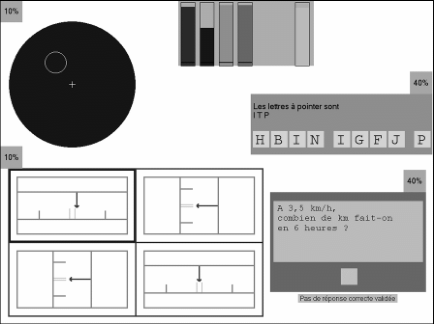
The Priority Management Task The Priority Management Task consisted in the simultaneous completion of four subtasks and was organized in six successive four-minute stages. During the first four stages, the subtasks were successively added (from only one subtask at the first stage to four subtasks at the fourth stage) in order to familiarize the participants gradually with the management of the four tasks. The subtasks were chosen to correspond to some of the pilots’ activities: tracking, monitoring, detecting targets and calculating. All the characteristics of the subtasks were exactly the same for each participant. The tracking task consisted in keeping a cross positioned in a moving circle through a first joystick. The circle moved each 10s. The monitoring task consisted in maintaining the level of four gauges inside an interval by using the second joystick. Each 15s one of the gauges deviated from its position. The detection task consisted in presenting a block of nine letters. The participants had to detect the presence of three target letters (that varied from stage to stage). They had to push as quickly as possible on one of nine keyboard keys when a target letter appeared in the corresponding zone. A new block of letters was presented each 15s. The mental calculation consisted in simple arithmetic problems (e.g., deducing a distance from speed and time). The participants had to type the numeric answer as quickly as possible and a new problem was presented each 15s. For each subtask, the instantaneous performance level was displayed through a corresponding gauge at the top center of the screen. During stages S4 to S6, participants had to manage the four subtasks simultaneously:
At Stage S4 the four subtasks were equally important (through explicit instruction and a reminder of the percentages of importance during the whole four-minute stage, see Figure 1, left panel). A global performance gauge on the right of the subtasks performance gauges represented instantaneous global performance (detailed at the performance measurements subsection).
During Stage S5, participants were instructed that two subtasks were more important than the two others and that they had to comply with these assigned priorities. However, they were also explicitly instructed not to neglect the low-priority subtasks. The assigned priorities were again presented during the whole stage (see Figure 1, right panel). The choice had been made to put the emphasis on the two “less salient” tasks (letter detection and mental calculation), as they were supposed to capture less attention than the two other tasks (tracking and monitoring) which comprised moving targets (e.g., McLeod, Driver & Crisp, 1998). So, during Stage S5, monitoring and tracking were “low-priority” subtasks whereas detecting and calculating were “high-priority” subtasks.
At Stage S6, the four subtasks were equally important, as at Stage 4.
Figure 1. Screenshot of an equal-priority stage, S4 or S6 (left panel) and of a differential-priority stage, S5 (right panel). T for tracking, M for monitoring, D for detection and C for calculation subtask. P for performance gauges. Percentages represent the relative importance of each subtask for the computation of the global performance.
Performance measurements Performance was measured continuously (each 100 ms) for each of the subtasks and ranged from 0 (min) to 100 (max). Performance of the tracking subtask was proportional to the distance between the cross and the edge of the target circle. Performance of the monitoring subtask was proportional to the distance between each gauge level and corresponding target interval. Moreover, the performance was set to zero if the gauge level went beyond a 60% tolerance interval. Performance of the detection and of the mental calculation subtasks followed the same following principle: The performance started at 100 when the block of letters or the arithmetic problem was presented. Then the performance gradually fell until the correct answer was keyed in. If a wrong answer was supplied, performance was even more decreased. Finally, the four subtask-performances were also continuously aggregated into a global performance index. The global performance corresponded to a weighted mean of the four subtask performances. The weights corresponded to the percentages of importance assigned to each subtask. Moreover, there was a threshold (5%) defined for each subtask under which the global performance fell to zero. So, applicants had to perform the four subtasks as quickly as possible in order to avoid any of the individual subtask performances falling under the threshold. This threshold rule was also applied at the differential-priority stage (S5) and this was explicitly instructed to the applicants.
Eye tracking Eye movements were recorded using an EyeLink 1000 desktop eye tracker (SR Research Ltd., Mississauga, Ontario, Canada). This eye tracker possesses a spatial accuracy greater than 0.5° and a 0.01°spatial resolution. The sampling rate was set to 1000Hz. The camera was placed at a distance of 20cm from the screen and the eye-camera distance was 60cm. A chin and forehead rest was used to maintain these distances and to avoid heads movements. We used a display screen DELL 19’’ with a refresh rate of 75 Hz and a resolution of 1024x768 pixels. All eye tracking data were extracted using the SR Research default algorithm. Simulation room enlightenment was maintained constant.
RESULTS
Performances
On average, global performance (see Table 1) decreased after task priority switching switched from “25-25-25- 25” to “10-10-40-40” (M=-11.8, sd=16.3) with average performance decreasing on less important subtasks (M=- 16.8, sd=13.5 for the monitoring task and M=-12.1, sd=19.1 for the tracking task) and average performance increasing on more important subtasks (M=+6.3, sd=6.8 for the detection task and M=+4.3, sd=6.1 for the calculation task). However, large individual differences were observed for in the amount of performance variation.
Table 1: Performance at each subtask and global performance for stages 4 (“25-25-25-25”), 5 (“10-10-40-40”) and 6 (“25-25-25-25”)
4 72.75 16.26 42.38 90.98 5 60.95 28.51 0.95 89.28 6 75.74 13.96 45.87 91.36 Note: Performances range from 0 (min) to 100 (max)
Eye Movements Analysis of change of in AOI repartition (see Table 2) revealed that most participants did not (or only slightly) reallocate resources after switch in subtasks priorities (mean variations in proportions of eye fixations in each AOI were M=-5%, M=-1%, M=-3%, M=-2%, for the four subtasks). The only significant difference in proportion of eye fixations concerned the monitoring task (t(19)=-2.41, p=.03), with an average decrease in resource allocation when this subtask was instructed as less important. One could question why the decrease in proportion of eye fixations was not significant for the second subtask labelled as “low-priority” (tracking). One interpretation could be related to the rather low cognitive effort required by this subtask. Indeed, in the equal-priority stages, among the four subtasks, the tracking subtask required the lowest proportion of eye fixations. Therefore, the decrease in proportion of eye fixations was logically smaller.
Ultimately, performance at the differential-priority stage was statistically related to the difference of proportion of eye fixations at the monitoring subtask (r(18)=-.71, p<.001). Indeed, those participants who neglected most the monitoring subtask had the poorest performance at stage 5 (see Figure 2). Interestingly, when priorities switched from “10-10-40-40” to “25-25-25-25”, these participants had far better global performances (from 0.95 to 45.9, from 0.95 to 65.3 and from 15.7 to 63.0 for the three participants who neglected most the monitoring subtask at S5), while still corresponding to global medium performances. Thus, the participants who sacrificed the monitoring subtask excessively were also those who had the most difficulties in multitasking.
Table 2: Proportion of AOI repartition in each subtask for stages 4 (“25-25-25-25”), 5 (“10-10-40-40”) and 6 (“25-25-25-25”)
-25 -30 -20 -10 0 Eye fixation proportion difference for monitoring task after change in priorities
Figure 2. Plot of global performance at differential priority stage ("10-10-40-40") against eye fixation proportion difference for the monitoring task between equal priority ("25-25-25-25") and differential priority "10-10-40-40" stages.
Figure available in the original PDF paper.
Our findings were consistent with those of Bellenkes et al (1997) who compared experts and novices in piloting. They found that, contrary to novices, experts devoted time not only to looking at the relevant flight instrument following the instructions, but also to the other instruments. Moreover, experts were more flexible in how they allocated their attention according to the instructions.
CONCLUSIONS
In conclusion, the good performers’ strategy consisted in allocating attention both to the most and the less important subtasks in order to maximize global performance. Indeed, they probably had sufficient resources after managing the most important tasks. The strategy of the poorest performers consisted in focusing on the more important subtasks while sacrificing the less important subtasks. Interestingly, in the equal-weight conditions these poor performers were able to manage the four tasks, although the performances were medium. So, emphasis on specific subtask importance during multitasking may lead to abandoning the less important tasks, especially for those people who are more easily overloaded. This is crucial for the efficiency of crew decisions as shown by Orasanu and Fischer (1997).
REFERENCES
Bellenkes, A.H., Wickens, C.D., Kramer, A.F. (1997) Visual Scanning and Pilot Expertise: the Role of Attentional Flexibility and Mental Model Development. Aviation, Space and Environmental Medicine, 68, 569-579. Hambrick, D. Z., Oswald, F. L., Darowski, E. S., Rench, T. A., & Brou, R. (2010). Predictors of multitasking performance in a
synthetic work paradigm. Applied Cognitive Psychology, 24, 1149-1167. Kramer, A. F., Larish, J. F., & Strayer, D. L. (1995) Training for attentional control in dual task settings: A comparison of young and old adults. Journal of Experimental Psychology: Applied, 1, 50. Meyer, D. E., & Kieras, D. E. (1997) A computational theory of executive cognitive processes and multiple-task performance:
Part I. Basic mechanisms. Psychological review, 104, 3. McLeod, P., Driver, J., Crisp, J. (1998). Visual search for a conjunction of movement and form is parallel. Nature, 332, 154-155. Morgan, B., D’Mello, S., Fike, K., Abbott, R., Haass, M., Tamplin, (2013). A. Individual differences in multitasking ability and adaptability. Human Factors, 55, 776-788. Orasanu, J., & Fischer, U. (1997). Finding decisions in natural environments: The view from the cockpit. Naturalistic decision making, 343-357. Salvucci, D. D., & Taatgen, N. A. (2008). Threaded cognition: an integrated theory of concurrent multitasking. Psychological
review, 115, 101. Salvucci, D. D., & Taatgen, N. A. (2010). The multitasking mind. Oxford University Press. Wang, D. Y. D., Proctor, R. W., & Pick, D. F. (2007). Acquisition and transfer of attention allocation strategies in a multiple-task work environment. Human Factors: The Journal of the Human Factors and Ergonomics Society, 49, 995-1004. Watson, J. M., & Strayer, D. L. (2010). Supertaskers: Profiles in extraordinary multitasking ability. Psychonomic Bulletin & Review, 17, 479-485. Wickens, C. D., Goh, J., Helleberg, J., Horrey, W. J., & Talleur, D. A. (2003). Attentional models of multitask pilot performance using advanced display technology. Human Factors: The Journal of the Human Factors and Ergonomics Society, 45, 360-380. Wickens, C. D. (2208). Multiple resources and mental workload. Human Factors: The Journal of the Human Factors and
Ergonomics Society ,50, 449-455.
LISTED IN THE AHFE DIGITAL BOOKSTORE CATALOGUE
Explore the complete digital volume
Advances in Cognitive Engineering and Neuroergonomics
Read this individual research paper free through the original publisher, or explore the full digital proceedings book.
ISBN 978-1-4951-2101-2
Explore this ISBN in the AHFE Bookstore ↗Listed in the July 2026 bookstore catalogue; search by ISBN to confirm current availability · Digital book purchase optional