The problem of physical inactivity, caused by both lifestyle and work-related factors, is affecting an ever greater number of the office-based workforce. In addition to this, physical inactivity has been associated with an increased risk for various chronic diseases as well as various musculoskeletal disorders. As the majority of an individual’s time is spent at work, a means of introducing more activity into the workplace environment would appear to provide potentially the most effective solution. One of these potential solutions is that of dynamic workstations. In a controlled laboratory setting, the biomechanical, physiological, subjective and performance effects of two dynamic workstations were contrasted against two more conventional workstations. Measures assessed included physical activity and percent of heart rate reserve. The performance of basic computer and office tasks was assessed using a standardized battery of tasks included a typing task, a reading task, a telephone task, a task examining mouse dexterity and a set of cognitive tasks. The set of cognitive tasks included two reaction tasks, a memory test and an Erikson flanker test. To determine the acceptability of these workstations, subjective experiences of the participants were recorded using a questionnaire.
In Europe more than 40% of all employees predominantly work at computer or visual display unit (VDU) workstations (Parent-Thirion et al., 2007), with many of these office workers sitting for extended periods of time statically without effective breaks and without sufficient movements. Office work, which as a result of static and prolonged sitting postures at VDU workstations, can therefore result in negligible circulatory demands and low muscular activity (Klucharev et al., 2000; Hjortskov et al., 2004). This physical inactivity at work is further exacerbated by various lifestyle factors and is becoming a growing problem that affects an increasing percentage of the workforce as a result of increasing industrialization (Haskell et al., 2007; Straker and Matthiassen, 2009). The implications associated with permanent low levels of physical activity include both short-term health effects, such as a loss in physical capacity (US Surgeon, 1996), and long-term health effects (Straker and Matthiassen, 2009) such as an increased risk of developing chronic diseases such as cardiovascular disorders (Thorp et al., 2010), type II diabetes (USDHHS, 2008) and musculoskeletal disorders (Sjøgaard and Jensen, 2006).
In addition to negating the harmful effects of inactivity, physical activity has also been associated with health improvements such as increasing metabolism, muscle activation, (Straker and Matthiassen, 2009), lowering blood pressure, and decreasing the risk of developing numerous chronic diseases such as coronary heart disease (USDHHS, 2008). But these negative effects of inactivity as a result of office work are difficult to compensate sufficiently by only increasing activity during non-working hours (Ekblom-Bak et al., 2010). It is necessary to find suitable means of introducing more physical activity into the workplace environment that goes beyond the minimum activity demands at the workplace such as taking the stairs (Levine and Miller, 2007).
Various studies have investigated different seating concepts aimed at introducing more dynamic components into sitting and therefore negate the negative effects of static postures and physical inactivity (Ellegast et al., 2012a; Stranden, 2000; Robertson et al., 2013; Pronk et al., 2012; Starker et al., 2013), but to date these seating concepts have not yielded significant results in a change in muscle activation (O’Sullivan et al., 2013, Wittig, 2000; van Dieen et al, 2001; Ellegast et al., 2012a) or physical activity (Ellegast et al., 2012a) in comparison to their more static counterparts. An alternative concept that has been developed to promote more activity during working hours is that of dynamic workstations. These stations combine a computer workstation with physical activity for example in the form of walking or cycling (e.g. Carr et al., 2011; Levine and Miller, 2007). This concept has recently gained increased interest with more models of dynamic workstations becoming available on the commercial market. Recent research has shown that dynamic workstations have benefits such as increasing energy expenditure (Levine and Miller, 2007), improving musculoskeletal health (Straker and Mathiassen, 2009) and reducing stress (Thompson et al., 2008). The full extent of the associated health benefits, the effect on task performance and the subjective reaction to these workstations have still not been comprehensively investigated, all of which are necessary to allow for a smooth implementation into the work environment. This paper aimed at addressing elements of the quantity of physical activity these dynamic workstations may cause, their effect on task performance and the subjective experience of the users.
METHODS
Participants and experimental design Twelve healthy participants, 6 males and 6 females, all who predominantly perform computer-based tasks as the main component of their work, volunteered. The participant group had a mean age of 38.7 years (±11.4 years), a mean height of 171.3 cm (±8.8 cm) and a mean weight of 75.0 kg (±15.4 kg). Participants with any health problems were excluded.
A randomized repeated measures design was selected to assess the effect of six different workstation conditions on task performance, physiological and biomechanical and subjective experience. For the six different work conditions, two conventional workstations, namely a standing and a seated workstation, and two different dynamic workstations each at two different intensities were selected. After an adaptation phase, each participant was required to complete a set of standardized tasks, described in detail below, for each workstation condition. The order of the workstation conditions and tasks was randomized for each participant.
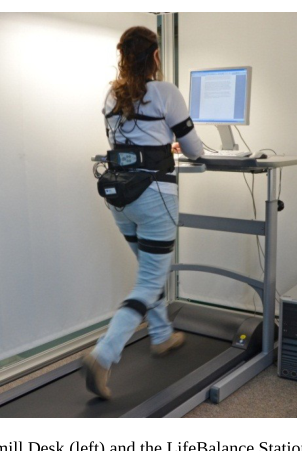
Workstations The two dynamic workstations assessed included a treadmill desk that formed the walkstation condition and a recumbent elliptic trainer. The two more conventional workstations selected were a seated and standing station, which due to similarities in elicited posture, provided a conventional counterpart for each dynamic workstation. The walkstation comprised of the Treadmill Desk TR1200-DT5 by LifeSpan and was assessed at a speed of 0.6 km/h and 2.5 km/h. The recumbent elliptic trainer station comprised of the LifeBalance Station by RightAngle and was assessed at an intensity level of 4 (9 Watts) and 12 (17 Watts), both at 40 RPM. The two dynamic workstations are depicted in figure 1 in addition to the laboratory set-up with a participant wearing the CUELA (Ellegast et al., 2012b) and an EMG system.
Figure 1. The Treadmill Desk (left) and the LifeBalance Station (right) in the laboratory set-up with a participant wearing the data capturing equipment
Assessment of Physical Activity and Heart Rate Precise posture analysis and quantification of the physical activity was assessed and determined with the expert measurement system CUELA (Ellegast et al., 2012b). This person-centered measuring system consists of thirteen inertial motion sensors (3D accelerometers and gyroscopes) as well as a miniature data storage unit attached to the participant. The sensors were positioned on the head, at the thoracic spine (Th3), lumbar spine (L5/S1), the wrists, the upper arm, the thighs and lower legs. From the measured signals (sampling rate: 50 Hz) joint angles and physical activity intensities (PAI) are calculated. The PAI were determined using the kinematic data from the sensors by calculating a sliding standard deviation of the high-passed filtered vector magnitude of the 3D acceleration signals with a time window of 1 second (Weber et al., 2009). A whole body PAI (PAItotal) was calculated by combining the measured segment activities according to the segment mass distribution assumed in biomechanical models such as by Winter (1990). The physical activity values obtained have been presented as a percentage of the gravitational force (%g=100*g) in the form of percentiles (50th and 95th percentile) to show the degree of acceleration.
Heart rate was selected as the indicator to determine the strain elicited by the different workstations and was recorded throughout testing using the Polar WearLink sensor and monitor model RS400. The sampling frequency was set to 1 Hz. To normalize the heart rate data, all results presented were calculated as per cent of heart rate reserve (%HRR) (ACSM’s guidelines, 2010). A resting heart value was recorded over a period of 5 minutes in a prone position prior to the start of testing and the maximum heart rate was calculated using the age-predicted heart rate maximum as proposed by Gellish et al. (2007).
Assessment of Task Performance The set of tasks selected was aimed at simulating basic office tasks and included five different tasks with various subtasks. Each task aimed at testing a different skill usually required by most VDU workstations and the battery of tasks included a typing task, a reading task, a telephone task, a mouse dexterity task and a set of computer-based cognitive tasks. The content selected for the typing, reading and telephone tasks were set so that the difficulty level was approximately standardized and no content was repeated between the workstations for one participant. Each of these tasks had a set duration of five minutes. The reading task had on average every 100 words a character rotation, and the performance criteria assessed included the number of correctly identified errors and number of characters read. For the typing task, the participants were required to copy a text from a window in the top half of the computer screen to a word document situated in the bottom half of the screen and was assessed for both speed and accuracy. The telephone task was aimed at assessing the effect that the dynamic workstations would have on speech quality and was assessed by the number of words spoken and the number of errors made in the repetition of the spoken text. The subjective quality of the spoken text was rated using the MOS scale (Gu et al., 2005). The mouse dexterity test, based on Fitts Law (Fitts, 1954), consisted of two different tasks, namely one with a randomized stimulus (“Random Circles”) and the second one with a predefined response pattern (“Multi-direction”). The battery of cognitive tasks consisted of a Go/No go association task (Nosek and Banaji, 2001), a subitizing task (Simon et al., 1993), an Eriksen
Flanker Test (Eriksen and Eriksen, 1974), and a memory task. For the mouse dexterity task and each of the cognitive tasks, accuracy scores and reaction times were recorded.
Assessment of Subjective Experience Subjective experience was assessed using several questionnaires, applied prior to the start of the testing session and then again before and after the direct use of each workstation, as well as at the end of the entire testing session. The questionnaire at the start of the testing session was used to collect basic anthropometric data, physical activity habits, as well as work-related factors such as working hours, main work tasks and VDU use. In addition to this expectations regarding the dynamic workstations were documented. The questionnaire applied before and after direct use of the dynamic workstations assessed bodily discomfort using the Local Perceived Discomfort scale and subjective opinion regarding the effect of the workstation on posture and on performance of the conducted tasks using Likert scales. In addition to this, questions pertaining to usability, acceptance and additional aspects regarding dynamic workstation implementation were included. At the end of the testing session a questionnaire with open- ended questions with regards to preferences of the tested workstations and questions pertaining to suitability and implementation factors of the workstations were asked. The results of the comfort, discomfort and productivity scores obtained from the questionnaire by combining and averaging the scores for the content-related questions will be included in this paper.
Data Processing and Statistical Analysis ANOVAs for repeated measures (General Linear Model, GLM) were performed in order to determine the significance (p < 0.05) of the effect of the workstation condition (6 conditions) on the physical activity parameters, the task performance parameters and the questionnaire scores using the conventional sitting condition as the reference condition. Where required, post-hoc multiple comparisons were performed and to counteract the problem resulting from multiple comparisons, a Bonferroni correction was applied. Additionally for the parameters pertaining to physical activity (PAItotal and %HRR) the interaction effect of condition and task (condition x task) was also assessed and due to similarities in posture, the conventional standing condition was additionally tested for significances compared to the low and high intensity conditions on the walkstation. SPSS Statistics (Version 20) was used for the statistical analysis.
RESULTS
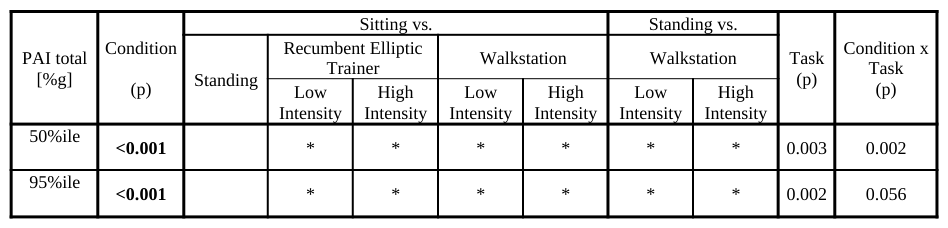
Physical Activity and Heart Rate Significant effects (p-value <0.001) on the resulting whole body physical activity (PAItotal) both for the 50th and 95th
percentile were determined for all the dynamic workstations. The inferential statistical results of the PAI total scores are presented in table 1 and the descriptive results are presented in table 2. In comparison to the sitting workstation condition, all workstations tested except the conventional standing workstation resulted in an increase in physical activity. Similarly for the two walkstation conditions in comparison to the conventional standing workstation, obtained significantly higher PAItotal values. The factor task showed a significant effect on both the 50th and 95th percentile of the PAItotal values and the interaction factor was significant for the 50th percentile.
Table 1: Statistical results of condition, task and the interaction effects with the post hoc comparisons for physical activity intensities (PAItotal) values for the 12 participants for all tested conditions. *Significant effects (p<= 0.05)
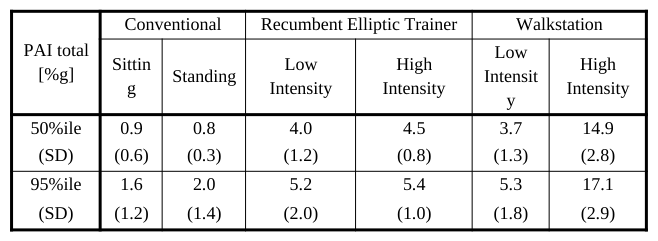
The highest amount of physical activity was achieved at the walkstation at the high intensity condition, with the 50th percentile of the PAItotal value at 14.9 %g (±2.8 %g). This was followed by the recumbent elliptic trainer at the high intensity condition, with the 50th percentile of the PAItotal value at 4.5 %g (±0.8 %g). When compared to the conventional sitting workstation theses dynamic workstations yielded a 16.6 and 4.4 fold increase respectively in the mean 50th percentile values.
Table 2: Mean values and standard deviation (SD) of the 50th and 95th percentiles for the PAItotal values for the 12 participants for all tested conditions.
The mean %HRR was significantly affected by the condition (p-value <0.001) and the statistical results of condition, task and interaction effects with post hoc comparisons are presented in table 3. Post-hoc comparisons revealed that the recumbent elliptic trainer at the high intensity condition and both of the intensity conditions at the walkstation conditions yielded a significant increase, when compared to the conventional sitting condition. In comparison to the conventional standing condition, neither of the two walkstation conditions yielded a significant change in %HRR. The effect of task on mean %HRR and the interaction factor were not significant.
Table 3: Statistical results of condition, task and the interaction effects with post hoc comparisons for mean percentage of heart rate reserve (%HRR) for the 12 participants for all tested conditions. *Significant effects (p<= 0.05)
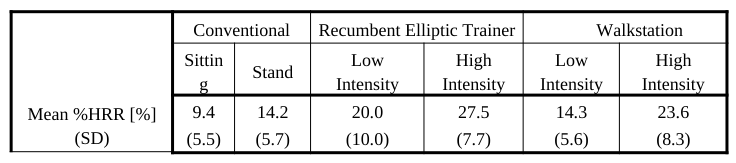
The lowest mean %HRR was measured at the conventional sitting condition at 9.4% (±5.5), and the highest mean %HRR were measured at the recumbent elliptic trainer for the high intensity condition at 27.5% (±7.7). When compared to the conventional sitting workstation, the recumbent elliptic trainer resulted in an increase of 2.1 and 2.9 fold at the low and high intensity conditions respectively and the walkstation yielded a 1.5 and 2.5 fold increase for the low and high intensity conditions respectively. The mean %HRR results are featured in table 4.
Table 4: Mean absolute heart rate (standard deviation) and mean percentage of heart rate reserve (%HRR) for the 12 participants for all tested conditions.
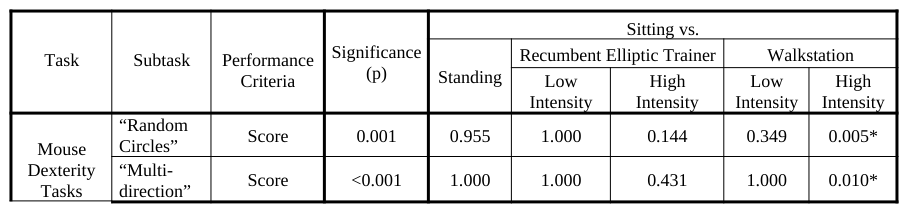
Task Performance Task performance was evaluated for the conventional standing workstation and the four dynamic workstation conditions against the conventional sitting condition. This comparison with the conventional sitting condition was used then to determine statistical differences using a general linear model. Of the five tasks selected, only one type of task yielded significant effects with regards to task performance. Additionally both subtasks of this task, namely the mouse dexterity task, yielded significant effects in task performance. The statistical results are featured in table 5.
Table 5: Statistical results with post hoc comparisons for the task performance criteria that were significantly affected when compared to the performance obtained at the sitting workstation. *Significant effects (p<= 0.05)
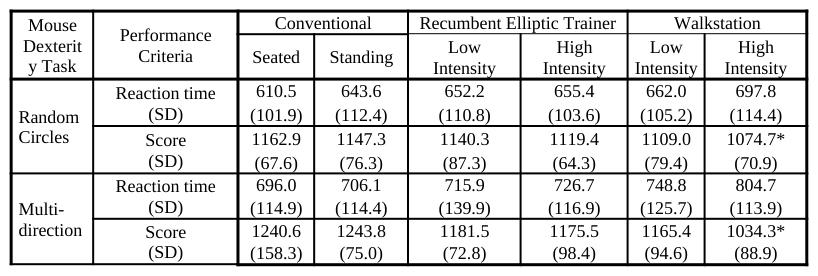
The descriptive results for the reaction time and score obtained for the two mouse dexterity subtasks for each workstation condition are depicted in table 6. For both of the mouse dexterity tasks, the fastest mean reaction time was for the seated workstation, with 610.5ms (±101.9) and 696.0ms (±114.9) for the task “Random Circles” and “Multi-direction” respectively. Descriptively, the slowest mean reaction time was recorded for the walkstation at the high intensity condition, with 804.7ms (±113.9) and 697.8ms (±114.4) for the task “Multi-direction” and “Random Circles” respectively. None of the dynamic workstations in comparison to the sitting workstation had a statistical effect on reaction time of this task. With regards to the score obtained for the “Random Circles” subtask, similarly to the reaction time, the highest score obtained was for the seated workstation, with a score of 1162.9 (±67.6). For the task “Multi-direction” the highest score obtained was for the standing workstation, with a score of 1243.8 (±75.0). The lowest score mean reaction time was recorded for the walkstation at the high intensity condition, with a score of 1074.7ms (±70.9) and 1034.3ms (±88.9) for the task “Random Circles” and “Multi-direction” respectively. The deterioration of score for both mouse dexterity subtasks at the walkstation for the high intensity condition was the only significant effect on task performance.
Table 6: Mean reaction time (ms) and score for the two mouse dexterity tasks for each of the workstation conditions (Standard deviation). *Significant effects (p<= 0.05) in comparison to the sitting workstation.
Despite no further significant findings in the performance of the remaining tasks, the results will be described briefly to allow for a more comprehensive discussion of the potential implications with regards to task performance at dynamic workstations. For the task “Reading”, speed (the number of characters read) and accuracy (the number of correctly identified characters) was assessed. As figure 2 depicts minimal differences in reading speed and accuracy were noted between the different workstations. The number characters read ranged from 6556 characters (±3303.7) to 7070 characters (±3612.4). The number of correctly identified errors ranged from 70.5% (±22.5) to 84.4% (±17.1).
Figure 2. The mean number of characters read and the percent of errors correctly identified for the reading task for each of the workstation conditions (Standard Deviation).
Figure available in the original PDF paper.
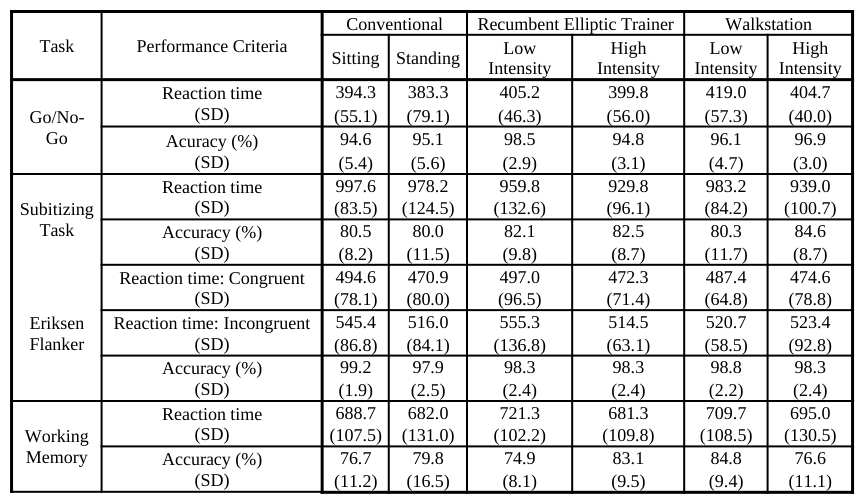
The descriptive mean results for reaction time and accuracy for each of the cognitive tasks for each workstation condition are depicted in table 7. The mean reaction time for the Go/No-go task for each of the workstations was between 383.3ms (±79.1) and 419.0ms (±57.3). With regards to accuracy, the score ranged between 94.6% (±5.4) and 98.5% (±2.9%). For the subitizing task, the mean reaction time ranged between 929.8ms (±96.1) and 997.6ms (±83.5), and the accuracy score 80.0% (±11.5) and 84.6% (±8.7). For the Erikson Flanker test, for all workstations the mean congruent reaction time was less than the mean incongruent reaction time. The range of the reaction time was 470.9ms (±80.0) to 497.0ms (±96.5) for the congruent task and 514.5ms (±63.1) to 555.3ms (±136.8) for the incongruent task. The accuracy of the Eriksen Flanker task ranged between 97.9% (±2.5) and 99.2% (±1.9). The accuracy for this task also had the smallest standard deviations for the workstations compared to the standard deviations for the accuracy of the other tasks. The mean reaction time for the memory test was between 681.3ms (±109.8) and 721.3ms (±102.2). The percent of correct responses was between 74.9% (±8.1) and 84.8% (±9.4).
Table 7: Mean reaction time (ms) and accuracy score (%) for all the cognitive tasks for each of the workstation conditions. (Standard deviation)
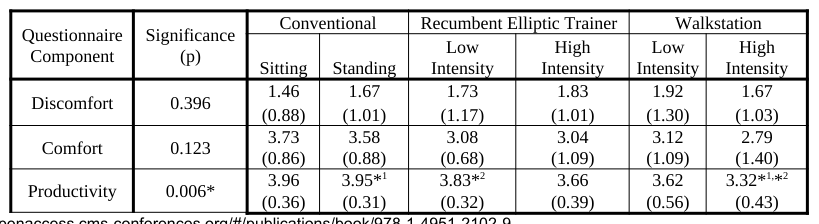
Subjective Experience Subjective experience was assessed using combined scores obtained for the categories comfort, discomfort, and productivity. The scores ranged from 1 to 7, with 1 being no discomfort and 7 being extreme discomfort for the discomfort questionnaire component, and for the comfort and productivity questionnaire components, a score of 1 was regarded as being the most negative score and 7 the most positive score. These scores were statistically compared between the different workstation and of the four categories, only the productivity score was significantly different (p-value: 0.006). Based on the post-hoc multiple comparisons, the productivity score was only significantly different for the walkstation at the high intensity condition compared to the conventional standing workstation (p- value: 0.027) and for the walkstation at the high intensity condition compared to the recumbent elliptic trainer at the low intensity condition (p-value: 0.016). The walkstation at the high intensity condition received lower productivity scores (3.32 ±0.43) when compared to the conventional standing workstation (3.95 ±0.31) and recumbent elliptic trainer at the low intensity condition (3.83 ±0.32). The statistical results and the mean scores calculated for each questionnaire component are featured in table 8. Based on the results in the table, all the workstations were classified as having low discomfort scores. Pertaining to the comfort questionnaire component, all workstations had a fairly neutral score that lay between 2.79 (±1.40) and 3.73 (±0.86) for the comfort score.
Table 8: Mean values and standard deviation (SD) of the Questionnaire scores pertaining to discomfort, comfort and productivity for the 12 participants for all tested conditions including the statistical results of the comparison of the scores obtained for the sitting workstation. *Significant effects (p<= 0.05)
DISCUSSION
This research aimed at investigating and comparing the biomechanical, physiological effects, task performance and subjective experience of dynamic workstations contrasted against more conventional workstations. Based on the results, significant alterations in physical activity and heart rate were found, while negative effects on task performance and subjective experience were more limited.
The physical activity intensities and percent of heart rate reserve significantly increased as a result of these workstations. Additionally the heart rate data showed that the dynamic workstations elicit a significantly higher heart rate in comparison to the conventional sitting workstation, with the tested conditions being rated as very light intensity exercise as the elicited %HRR was below 30% (US Surgeon, 1996). A higher exercise intensity using these workstations could not be reached as they have been specifically designed to allow for light intensity exercise, and have speed and resistance limitations deliberately set. Based on these results and these design specifications, using these dynamic workstations it would not be possible to obtain the ASCM guideline of a minimum of 30 minutes of moderate activity five days a week (ASCM, 2010). But as even all of the dynamic conditions assessed elicited significant increases in physical activity and three of the four dynamic conditions elicited significant increases in %HRR, this suggests that these workstations may have positive health implications as evidence suggests that any amount of physical activity and movement can lead to health benefits (USDHHS, 2008; Thompson et al., 2008; Levine and Miller, 2007). The benefits from activity are not only dependent on the intensity but also on the individual, and therefore some individuals may profit in terms of positive health effects more from these workstations in comparison to others. An example of this would be that deconditioned individuals through low intensity exercise might become more active (Haskel et al., 2007; USDHHS, 2008).
For these workstations to be a viable option in the work environment, their effect on task performance is an important consideration. Available literature provides contradicting information regarding the effect of moderate and acute exercise on basic cognitive processes (Straker et al., 2009; Tomporowski, 2003). This study focused on a group of basic tasks which contribute in some form to daily office work. Significant alterations in task performance were found for only one task of the five assessed, namely the mouse dexterity task, when compared to the task performance for the conventional sitting workstation. Deterioration in the score obtained while using the walkstation at the high intensity condition can be potentially attributed to biomechanical factors. During walking, specifically at the higher speed condition, the individual was less stable as a result of the small movements of the upper trunk produced during walking (Winter, 1995), and despite supporting the upper limbs on the treadmill desk, the upper limb fine motor movements were affected and consequently the accuracy was impaired. As none of the other task performance criteria for the other tasks was significantly affected, one can conclude with caution that it may be possible to perform basic office tasks while using these dynamic workstations. However, further research is warranted to determine the effect of these workstations on more complex tasks in a field-based setting.
A final crucial aspect to whether dynamic workstations really are an option for the work environment in the future is the subjective opinion specifically regarding discomfort, comfort and productivity. Subjective experience assessed in this study found only very limited significant differences and this was pertaining to the productivity of the walkstation for the high intensity condition. This negative assessment of one’s own productivity at this station was minimally reflected in the decrease in the performance results of the mouse dexterity task at this station. The subjective experience results specifically pertaining to productivity are limited to this specific test situation as it would be expected that as the tasks increase in complexity, the subjective opinion of one’s own productive as effected by dynamic workstations would also be altered. No significant differences were determined for the comfort and discomfort scores when compared to a conventional sitting workstation, and this may have positive implications for introducing these workstations in the work environment. However the limitation of the duration of the testing session needs to be considered and additional studies pertaining to the long-term use of these workstations is required.
CONCLUSIONS
To conclude, the dynamic workstations tested showed significant increases in physical activity in comparison to sitting and in some cases the standing workstations. Additionally only limited tasks were significantly negatively affected by the workstations and only limited negative subjective experiences were determined. These results tend to suggest that dynamic workstations really may be a viable option to increasing physical activity in the workplace to an extent that may yield health benefits. Numerous studies have shown that physical activity not only promotes physical health but may also be associated with long term positive effects on cognitive ability. This further highlights the need to incorporate physical activity more in everyday life, specifically working life. Additionally regarding long-term aspects the employer may also benefit from these workstations by having a healthier workforce. Further studies are required to determine the exact extent of the health benefits and the suitability in the work environment in addition to determining which tasks and occupations are best suited for these workstations. Furthermore a trade-off may need to be accepted between the potential benefits of these workstations and the “adaptation phase” regarding task performance and therefore research regarding the duration of adaptation required for performance and social acceptance is necessary.
ACKNOWLEDGEMENTS
This project was initiated by IFA and TNO and funded by the German Social Accident Insurance (DGUV). The authors are grateful to Britta Weber and Marjolein Douwes for their help and support, to Ingo Hermanns for his technical support and to Katharina Kirschner for her help with data collection and analysis.
REFERENCES
American College of Sports Medicine (2010), “Guidelines for Exercise Testing and Prescription”, Baltimore: Lippincott, Williams & Wilkins. Carr, L.J., Walaska, K.A., Marcus, B.H. (2010), “Feasibility of a portable pedal exercise machine for reducing sedentary time in
the workplace”, British Journal of Sports Medicine, Volume 46 No. 6. Ekblom-Bak, E., Hellénius, M.-L., Ekblom, B. (2010), “Are we facing a new paradigm of inactivity physiology?”, British Journal of Sports Medicine Online, February. Ellegast, R. P., Kraft, K., Groenesteijn, L., Krause, F., Berger, H., Vink, P. (2012a), “Comparison of four specific dynamic office
chairs with a conventional office chair: impact upon muscle activation, physical activity and posture”, Applied Ergonomics Volume 43. Ellegast R., Weber B., Mahlberg R. (2012b), “Method inventory for assessment of physical activity at VDU workplaces”, Work Volume 41. Eriksen, B.A., Eriksen, E.W. (1974), “Effects of noise letters upon the identification of a target letter in a nonsearch task”,
Perception & Psychophysics, Volume 16 No. 1. Fitts, P.M. (1954), “The information capacity of the human motor system in controlling the amplitude of movement”, Journal of Experimental Psychology, Volume 47 No.6. Gellish, R. L., Goslin, B. R., Olson, R. E., McDonald, A., Russi, G. D., Moudgil, V.K. (2007), “Longitudinal modeling of the
relationship between age and maximal heart rate”, Medicine & Science in Sports & Exercise, Volume 39 No.5. Gu, L., Harris, J.G., Shrivatav, R., Sapienza C. (2005), “Disordered speech assessment using automatic methods based on quantitative measures”, EURASIP Journal on Applied Signal Processing, Volume 9. Haskell, W.L., Lee, I.M., Pate, R.R., Powell, K.E., Blair, S.N. (2007), “Physical Activity and Public Health: Updated
Recommendation for Adults from the American College of Sports Medicine and the American Heart Association”, Medicine and Science in Sports and Exercise, Volume 39 No. 8. Hjortskov, N., Rissén, D., Blangsted, A.K., Fallentin, N., Lundberg, U., Sjøgaard, K. (2004), “The effect of mental stress on heart rate variability and blood pressure during computer work”, European Journal of Applied Physiology, Volume 92. Klucharev, V., Lyskov, E., Sandström, M., Hansson Mild, K. (2000), “Monitor jitter and human-computer Interaction”,
Displays, Volume 21 No.5. Levine, J.A., Miller, J.M. (2007), “The energy expenditure of using a “walk-and-work” desk for office workers with obesity”, British Journal of Sports Medicine, Volume 41. Nosek, B. A., Banaji, M. R. (2001), “The go/no-go association task”, Social Cognition, Volume 19 No. 6. O'Sullivan, K., O’Sullivan, P., O’Keeffe, M., O’Sullivan, L., Dankaerts, W. (2013), “The effect of dynamic sitting on trunk
muscle activation: A systematic review” Applied Ergonomics, Volume 44. Parent-Thirion, A., Fernández, M.E., Hurley, J., Vermeylen, G. (2007) “Fourth European Working Conditions Survey.”
European Foundation for the Improvement of Living and Working Conditions, Dublin Pronk, N.P., Katz, A.S., Lowry, M., Payfer, J.R. (2012), “Reducing Occupational Sitting Time and Improving Worker Health: The Take-a-Stand Project”, Preventing Chronic Disease, Volume 9, DOI: http://dx.doi.org/10.5888.pcd9.110323. Robertson M. M., Ciriello V.M., Garabet, A.M. (2013), “Office ergonomics training and a sit-stand workstation: Effects on
musculoskeletal and visual symptoms and performance of office workers”, Applied Ergonomics Volume 44. Simon, T., Cabrera, A., Kliegl, R. (1993), “A new approach to the study of subitizing as distinct enumeration.” In: 15th Annual conference of the Cognitive Science Society, June 18 to 21, 1993; Institute of Cognitive Science, Erlbaum. pp. 929-934 Sjøgaard, G., Jensen, B.R. (2006), “Low-level static exertions.” In: Fundamentals and assessment fools for occupational ergonomics, Taylor & Francis, CRC Press, Boca Raton U.S.A., Marras, W.S. (Ed.). pp. 14/1-14/13 Starker, L., Abbott, R.A., Heiden, M., Mathiassen, S.E., Toomingas, A. (2013), “Sit-stand desks in call centers: Associations of use and ergonomics awareness with sedentary behaviour”, Applied Ergonomics, Volume 44. Straker, L., Levine, J., Campbell, A. (2009), “The effects of walking and cycling computer workstations on keyboard and mouse performance”, Human Factors: The Journal of the Human Factors and Ergonomics Society, Volume 51. Straker, L., Mathiassen, S. E. (2009), “Increased physical workloads in modern work – a necessity for better health and performance”, Ergonomics Volume 52 No.10. Stranden, E. (2000), “Dynamic leg volume changes when sitting in a locked and free floating tilt office chair”, Ergonomics,
Volume 43 No. 3. Thompson, W.G., Foster, R.C., Eide, D.S., Levine, J.A. (2008), “Feasibility of a walking workstation to increase daily walking”, British Journal of Sports Medicine, Volume 42 No.3. Thorp A. A., Healy G. N, Owen N., Salmon J., Ball K., Shaw J. E., Zimmet P. Z., Dunstan D. W. (2010), “ Deleterious
Associations of Sitting Time and Television Viewing Time With Cardiometabolic Risk Biomarkers: Australian Diabetes, Obesity and Lifestyle(AusDiab) study 2004-2005” Diabetes Care, Volume 33 No. 2. Tomporowski, P. D. (2003), “Effects of acute bouts of exercise on cognition”, Acta Psychologica, Volume 112 US Department of Health and Human Services. (1996) “Physical Activity and Health: A Report of the Surgeon General” Atlanta, Georgia: U.S. Department of Health and Human Services, Centers for Disease Control and Prevention, National Center for Chronic Disease Prevention and Health Promotion. U.S. Department of Health and Human Services, (2008) “Physical Activity Guidelines for Americans.”
http://www.health.gov/paguidelines/guidelines (last visited: 10/10/2012) Van Dieën, J. H., De Looze, M. P., Hermans, V. (2001), “Effects of dynamic office chairs on trunk kinematics, trunk extensor EMG and spinal shrinkage” Ergonomics Volume 44 No.7. Weber, B., Hermanns, I., Ellegast, R., Kleinert, J. (2009), “A person-centered measurement system for quantification of physical
activity and energy expenditure at workplaces” In: Ergonomics and Health Aspects, HCII 2009. Berlin: Springer; Karsh B- T (Ed.) pp. 121-130. Winter, D. A. (1995), “Human balance and posture control during standing and walking.” Gait and Posture, Volume 3. Wittig, T., (2000), “Ergonomische Untersuchung alternativer Büro- und Bildschirmarbeitsplatzkonzepte.“ 1. Auflage.
Wirtschaftsverlag NW Verlag für neue Wissenschaft GmbH, Bremerhaven. (Schriftenreihe der Bundesanstalt für Arbeitsschutz und Arbeitsmedizin: Forschungsbericht, Fb 878)
LISTED IN THE AHFE DIGITAL BOOKSTORE CATALOGUE
Explore the complete digital volume
Advances in Social and Organizational Factors
Read this individual research paper free through the original publisher, or explore the full digital proceedings book.
ISBN 978-1-4951-2102-9
Explore this ISBN in the AHFE Bookstore ↗Listed in the July 2026 bookstore catalogue; search by ISBN to confirm current availability · Digital book purchase optional