Leszek Pacholski (2020). Macroergonomic Premises for Organizational Innovations in Business Corporations. In: Advances in Social and Organizational Factors. AHFE Open Access, vol. 9. https://doi.org/10.54941/ahfe100326
The paper discusses the issue of so-called multiagent systems ergonomics. This approach is addressed for organization structures that combine human societies and the organization and technological component. Such multiagent systems, called macroergonomic systems, concern only the internal organization of the enterprise. However, they can also enclose structural business conglomerates of groups of many enterprises. These systems, represented by modern business corporations, can have not only an organized functional form, but also a form of composite network relations, hybrid, or even (seemly chaotic) swarm. The macroergonomic interpretation of the functioning of modern business corporations shows the particular role of the Human Factor, represented by White and Blue Collars, which have the innovative, who have the innovative technology and innovative managerial solutions, social and business objectives. The article shows a case study of organizational innovations in two Polish business corporations in order to form a three-stage sequence of such events, enclosing: classic innovations, a so-called “new wave” and “creating a proposal for the buyer”. Conclusions of the paper present the idea of “macroergonomic organizational innovations’ matrix”. Such matrix can be treated as a theoretical generalization of the problem of implementing macroergonomic innovative solutions. These solutions have been illustrated in a form of two models: process and structural innovations. Each of them can be realized in two variants of events: endogenic and exogenous.
In the dichotomous division of the contemporary knowledge on science and technology, ergonomics could be placed in the second mentioned area, because we call it Ergonomics or Human Factors Engineering or Human Factors in Engineering. Ergonomics works not on knowledge acquisition about what is, but rather on forming engineering solutions, that does not exist yet (Marras, Karwowski, Smith and Pacholski, 1993).
It is obvious that Aristotelian dichotomisms (science vs. technology) are some sort of classified simplification of the real world dominated by dispersion. Hence, science and technology often operate on the same field. Science enters into creative processes of practical implementation of own discoveries and evolves in a fuzzy way into the sphere of technology. The same happens in the opposite direction: the process of technological, organizational and constructional progress allows technology discovering (cognition) new phenomena, for which it solves appearing problems and, in the same time, feeds the sphere of science. Such situation can be observed for year on the ground of the modern ergonomics, which, as a field of knowledge with a contextual character, constitutes an almost demonstrative example of the clash of “enchantments of the pure science” and “temptations of the obtuse utilitarianism”. The character of scientific research in the area of ergonomics does not characterize with typical features of science; cognitive processes have usually a quasi- empirical character. Cognitive research within ergonomics focus on creating methods for solving problems that result from the phenomena that is already well known but too complicated to find an accurate scientific solution of issues related to it. Today’s ergonomics focuses mainly on solving problems, using both knowledge and experience and intuition. Ergonomics must be often featured by a technological pragmatism, which results from the necessity of finding solutions before science fully explains some phenomena (Pacholski, 1986). MODERN MACROERGONOMIC STRUCTURES
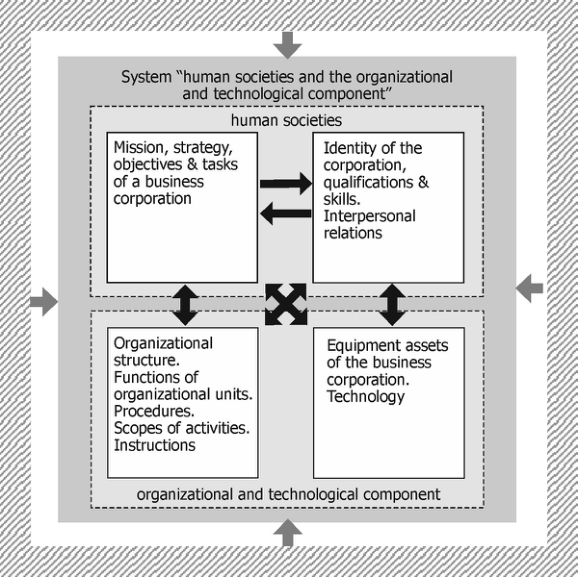
In seventies of the last century, the author of this article made an attempt of universal defining the subject of the research and ergonomic applications. He has determined this subject as a relation (system, network, hybrid) combining human societies and the organizational and technological component (see Figure 1). In his works from the mentioned period and further (which concerned ergonomics of industrial manufacturing processes), the author consequently named this relation a Multiagent Manufacturing System (Pacholski, 1977), (Pacholski and Jasiak, 1998), (Pacholski, 1998). This approach has a universal character because in both encloses man–machine unit or man-machine interface technology systems (reduced to the unitary form) and overall organization-machines technology. In eighties H.W. Hendrick called these interfaces macreoergonomic systems (from the third generation ergonomics) (Pacholski, 2009).
Figure 1. Model of the system “human societies and the organizational and technological component”
If to treat historically the problem of the subject of research and ergonomic applications, then, according to the universal proposal presented before, one could say about four stages of the evolution of this interface. The first stage would refer to pre-industrial societies and the technological and organizational component in form of methods and tools for hunting or simple agricultural techniques and tools. The second stage encloses industrial societies, which have machines, energy and electronics on their disposure. The modern, third stage, information societies use computer networks and new media. The further, fourth stage might refer to creative and empathic societies and to the technological and organizational component in form of nanotechnology applications and of artificial intelligence (Pacholski, 2006), (Pacholski, and Mateja, 2010).
Current technological-organizational "partners" of human communities can be also identified more precisely on the basis of the concept of economic cycles. These “partners” usually have the form of following so-called “fundamental innovations” (the steam machine and railways, the electricity and the internal-combustion engine, aviation, energetics and electronics, computer networks, pro-ecologic solutions, artificial intelligence and nanotechnology). These innovations, constituting the technological and organizational reaction to the evolution (into the humanocentric direction) of “social imperatives and needs” (like improving the efficiency of work and trade, the availability and mobility of assets, increase if the standard of life, energy networks, travelling, ecology, knowledge networks, psychological and social fitness, human health and quality of life) .
Today’s multiagent macroergonomic systems (linking societies and the technological and organizational component) concern the internal organization, but they can also enclose structural business conglomerations of groups of many enterprises. These systems, represented by modern business corporations, have an ordered functional form, but they also can be network complex interrelation, hybrid or chaotic connections. The macroergonomic interpretation of the functioning of such corporations focuses on the particular role of their “essence”, which is a composition of human communities with their technological innovation and innovative managerial solutions, social and business objectives (Pacholski, and Trzcieliński, 2007), (Pacholski, and Jasiak, 2011).
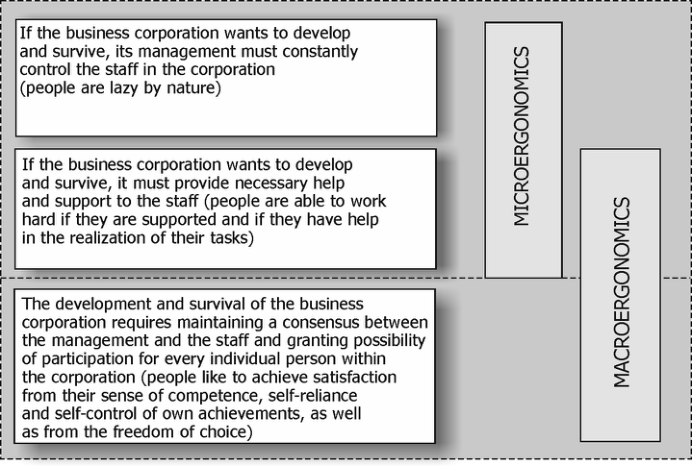
The modern period of transition into the fifth or even sixth economic cycle is characterized with a radical change of contemporary “human component”: cohesive, structurally complete and ordered, which constitutes the subject of ergonomics. The figure number 2 shows the evolution of human societies’ behavior within macroergonomic systems of modern business corporations (see Figure 2).
Figure 2. Evolution of the behavior of human societies in modern business corporations
Democracy and market freedom have caused that societies where fascinated by the concept of the network, but next they started protesting the functional, structurized order. Today, democracy and market are ruled by the research of the “buyer”. Societies leave traditional hierarchies and authorities in favor of a so-called „guru”, who does not have to convince us, he only needs to be popular. There is chaos appearing within the “human factor: of ergonomics. The contemporary, “pro-society” order of the organization is being replaced by a formation called a “swarm”. Modern ergonomics has been forced to transfer observations from the world of life beings (evolution algorithms and neuronal networks, behaviorism taken from bees, ants or other swarms) to the ground of ergonomic methodology of research and applications, in order to find the key for survival and to the development of such syncretic solution of own corporative multiagent systems (Pacholski, 2012).
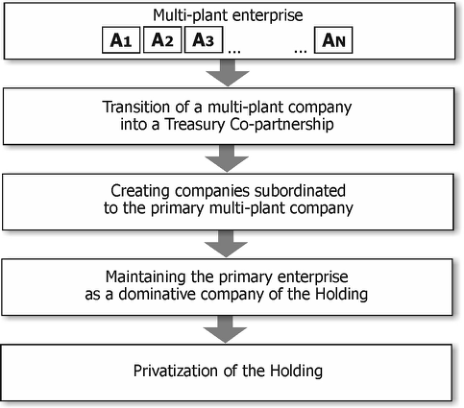
Today, structural business conglomerations of gathered modern macroergonomic systems evolve do the form of a corporation. This process can have a form of reengineering (Business Process Reengineering). Organization of the corporate type (where people with the technique, structural solutions and objectives of the organization in their disposal) can be confronted to organizations of the company type, where the substantial component is the non-human element (like the capital). The formation of business corporations is based on cooperation between organizations, which leads to the synergy effect as a result of: sharing assets (especially the expensive or hard to reach ones), integrating actions on different levels of the chain of values and reinforcing the market position. In the Polish economic reality, one can fins following typical formal solutions for business corporations: holding, consortia and economic clusters. A holding means an organization that gathers various legally independent economic organizations (units) with more or less distinct connections, while one of these units has a dominative position in this combination and it subordinates other organizations. The essence of a holding is that it is managed by one organization over other units and controlling the activity with use of capital or personal dependencies. A holding is a form of capital accumulation (Pacholski, and Piotrowski, 2008). The accumulation can take place by takeovers of weaker enterprises, first in own sector and familiar branches, next – in other areas of economy. Intentional differing parent company and its subsidiaries, independent from the legal point of view, yet economically dependent, is another way. Dependencies between the parent company and its subsidiaries have a tree structure and they can be largely developed. It is accepted to state that one deal with a holding, when the parent company own more than a half of the share capital. According to the criterion of the method of arise, one distinguish holding that were formed in result of a distinction of companies, join of enterprises and incurred on the basis of multiagent enterprises (see Figure 3).
Figure 3. Process of development of the business holding company on the basis of the multiagent enterprise
A business consortium is a corporation created on basis of a contract between economical units, which undertake to aspire together for achieving the determined economic purpose. The consortium does not have to have a determined organizational structure. It does not have to have own capital, selected from the capital of its participants. A consortium does not have to be registered anywhere. The only document confirming the fact that it exists is the contract signed by its members. Signing the contract does not take economic, neither legal independency from consortium’s participants. The contract covenants to a positive, mutual operation for achieving the assumed objective.
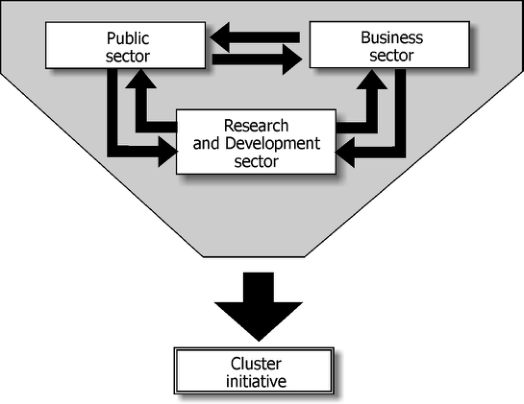
Figure 4. Model of trilateral reports within the business cluster
A business cluster is a geographical gathering of organizations (mainly small and medium units) that operate in similar sectors, and their suppliers and other organizations (universities or centers of research and development), which are competitors and cooperates in the manufacturing (or service) process and in the chain of values in the same time, between which one can observe network relations (based on trust and cooperation), for which the participation in the cluster represents an important factor affecting their individual competitiveness. Economic clusters have enlarged into trilateral relations (particularly on the level of regions) from contemporary bilateral relations between science and the public sector, science and business, business and public sector. A model of such trilateral connections is called in the literature a triple helix because three areas cooperate on a basis of a specific alliance for the purpose of preparing and implementing innovative solutions (see Figure 4). Economic clusters are open groups. Each participant can enter or go out in any moment. Usually, they have a local leader accepted by all members of the cluster (Pacholski, Trzcieliński and Wyrwicka, 2011).
RECAPITULATION OF TWO CASSES OF INNOVATION The example of macroergonomic innovation in two Polish business corporations (the shipbuilding holding company and the cluster of the electronics industry) illustrates the author’s attempt of characterizing macreoergonomic organization premises of innovative ventures in business corporations. These operations, examined from the point of view of the time horizon, form a certain type of a three-stage sequence. It starts usually from innovations from the technical and economic range of improving the work process and which take from the classics of the contemporary management (Taylor method, Le Chatelier law, H. Fayol’s rules, ideas of M.Weber, etc.). Innovations resulting from the system approach and of concept of the organizational game and the theory of the functional organizational balance are a continuation of this movement (system theory of organization, operational research, economic cybernetics).
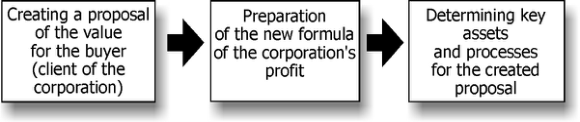
The second stage of this sequence encloses reaching experience and achievements of authors of the so-called “New wave” (K. Matsushita, H. S. Geneen, B. Hewlett, D. Packard, R. Kroc, T. Watson, R. McPherson, L. Iacocca, J. Sculley, S. Jobs and S. Woźniak). Basic macroergonomic organizational innovations of two Polish corporations mentioned before were connected with using following eight “new wave” features of most efficient enterprises: obsessive operating, close and direct contact with the client, autonomy and entrepreneurship, efficiency of people, focus on values, professionalism of action, little staff, straight structure, formal and informal organizational forms co-existing within one structure. The third aspect of organizational innovations implemented both in the shipbuilding holding mentioned before and the cluster of the electronics industry was based on concepts of redefinition of key assets and processes and on preparing a new formula of profits on the basis of the “formation of a proposal of value for a buyer” (see Figure 5). Similar ideas are rather popular today in the group of corporations from B.R.I.C. countries (Brazil, Russia, Indie and China).
Figure 5. The method of creating new business models for B.R.I.C. corporations
The three-stage sequence of organizational operations for innovation has directed today’s corporation to the issue of the “human factor” (which determines the business success) within the macroergonomic relation combining societies with the technological and organizational component. The context of knowledge-based economy and models of a so-called “intelligent corporation” opened entrepreneurs to the importance of such social ergonomics aspects, as: morality, professional competences and social intelligence of the worker, fulfilling his social needs (membership and a recognition needs) content from the situation at work, friendly approach to matters of subordinates.
There has been an attempt to implement Workgroup Computing, Task Management, Process Modelling, Business Process Reengineering within frames of organizational systems and work distribution in both transformed corporations. It has been also used such procedures, like flattening the management structure Leadership, implementation of the intranet and the internet, decision support systems, with special consideration of solutions based on expert system techniques. Also process solutions were innovated, for example Total Quality Management,
Concurrent Engineering, Total Production Maintenance and the entire group of pro-qualitative standards - International Standards Organization, which refer to the production, occupational safety and environmental ecological protection. The first presented business corporation (shipbuilding holding) took also attempts of external cooperation or fusion, business takeovers or strategic alliances.
CONCLUSIONS
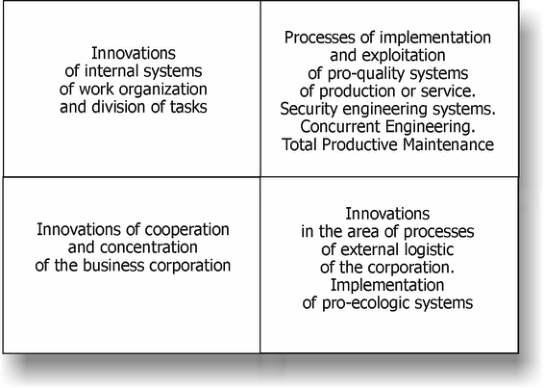
Processes of organizational innovation proceeded in two business corporations concerned relations combining the human community and the technological and organizational component. Thus, they had an explicit macroergonomic character, specific for the movement of the modern ergonomics, called social ergonomics. From the other hand - in the managerial sense, these processes could be enclosed to a structural or procedural aspect of the functioning of the corporation. These aspects can constitute the basis for the creation of a generalized matrix model of organizational macroergonomic innovations. Both mentioned aspects are classified as those, which refer the “insight” of the corporation, or which might concern “the game with the environment” (see Figure 6).
An “innovation game with the environment” can be presented on the example of cooperation initiatives and concentration ventures. The cooperation of small business forming the structure of the cluster for the company of the electronics industry can be a good example of a cooperative innovation. In this scope, the shipbuilding holding was realizing strategic alliances. It was also interested in strategic alliances and fusions, and takeovers of other business units.
In the procedural scope, the innovative game with the environment of the business corporation can be directed on the “new wave’s” obsession of being active and on the close and direct contact with the client, ideas of B.R.I.C.: “forming a proposal of a value for the buyer”, logistic supply chain management, ideas of Just in Time and KANBAN.
Structural internal innovations of organization systems and work distribution consist in using principles of the classics of technical and organizational improvement of work and on system theory of the organization, operational research and economic cybernetics. The management of business corporations can use fragments of the New Wave concept in form of premises for the efficiency, like: the autonomy and the entrepreneurship, little staff and a straight structure, formal and informal organizational forms co-existing within one structure. One can implement also modern Workflow systems as a source of Workgroup Computing, Task Management, Process Modelling and Business Process Reengineering. It is suggested to make attempts of implementing expert systems, Decision Support Systems and organizing teamwork in accordance to the idea of Leadership. It seems necessary to implement today Internet and Intranet networks, essential for needs of the modern organization (Pacholski, Cempel and Pawlewski, 2009).
One can enlist following process solutions to the process aspect of the “internal functioning” of the corporation: Total Quality Management, Concurrent Engineering, Total Production Maintenance and the entire group of pro- qualitative standards - International Standards Organization, which refers to the area of production, occupational safety and environmental ecological protection. Practical applications of the idea of the organizational game and the theory of the functional organizational balance and concepts taken from the “new wave” authors: efficiency, close and direct contact with the client, autonomy and entrepreneurship, efficiency of people, focus on values, professionalism of action.
REFERENCES
Marras, W.M., Karwowski W., Smith J.L., Pacholski L.,(Ed.). (1993), “The Ergonomics of Manual Work”, Taylor & Francis. Pacholski L., (1977), „Methodology of Ergonomic Diagnosing in the Enterprice”, serie: Dissertations, No 81, Publishing House of Poznan University of Technology. (in Polish). Pacholski L., (1986), “An Application of Fuzzy Methods in the Complex Ergonomics Diagnostics of Industrial Production
Systems”, in: “Applications of Fuzzy Set Theory in Human Factors” Karwowski W., Mittal A., (Ed.). pp. 211 – 225, ELSEVIER. Pacholski L.M., Jasiak A.E., (1998), “Macroergonomic Effects of Rapid Economic Renewal”, in: “Global Ergonomics”, Scott P.A., Bridger R.S., Charteris J., (Ed.). pp. 855 – 858, ELSEVIER. Pacholski L.M., (1998), “Fuzzy Logic Application in Ergonomic Renewal of Multiagent Manufacturing Systems”,
CYBERNETICS AND SYSTEMS Volume 29, pp. 715 – 728, Taylor & Francis. Pacholski L.M., (2006), “Ergonomic Issues of the Neural Integrated Human-Computer Interaction”, CYBERNETICS AND SYSTEMS, Volume 37, pp. 219– 228, Taylor & Francis. Pacholski L.M., Trzcieliński S., (Ed.), (2007), “Ergonomics in Contemporary Enterprise, Agility and Hybrid Automation”, IEA
Press, Madison, WI. Pacholski L., Piotrowski K., (2008), “Political Ergonomics, Macroergonomic Battles”, HUMAN FACTORS AND ERGONOMICS IN MANUFACTURING, Volume 18(5), pp. 515-524, Wiley-Blackwell. Pacholski L., Cempel W., Pawlewski P., (2009), “Reengineering”. Publishing House of Poznan University of Technology. (in
Polish). Pacholski L., (Ed.), (2009), “Macroergonomics vs social ergonomics”, serie: Monographs, Publishing House of Poznan University of Technology. Pacholski L., Mateja B., (2010), “Macroergonomic Development of Industrial Production Processes”, in: “Advances in
Occupational, Social and Organizational Ergonomics”, Salvendy G. (Ed.) pp. 802-812, CRC Press/ Taylor and Francis. Pacholski L., Trzcieliński S., Wyrwicka M., (2011), “Clustered Macroergonomic Structures”, HUMAN FACTORS AND ERGONOMICS IN MANUFACTURING & SERVICE INDUSTRIES, Volume 21(2), pp. 147-155, Wiley-Blackwell. Pacholski L., Jasiak A., (2011), „Makroergonomics”, Publishing House of Poznan University of Technology. Pacholski L., (2012), “Human Factors and Well-balanced Improvement of Engineering”; in: “Advances in Social and
Organizational Factors”, Vink P. [Ed.], Chapter 31, pp. 288-297, Taylor and Francis.
LISTED IN THE AHFE DIGITAL BOOKSTORE CATALOGUE
Explore the complete digital volume
Advances in Social and Organizational Factors
Read this individual research paper free through the original publisher, or explore the full digital proceedings book.
ISBN 978-1-4951-2102-9
Explore this ISBN in the AHFE Bookstore ↗Listed in the July 2026 bookstore catalogue; search by ISBN to confirm current availability · Digital book purchase optional