Isabela Xavier Barbalho Bezerra, Ricardo José Matos de Carvalho, Pedro Lima e Silva, Rodolfo Fernando Carvalho Vieira, Tatiane Emanuele Brito de Oliveira (2020). Management with Ergonomic Indicators: A Conception of Indicators System for Performance to the Industry of Construction from the Workers Perception. In: Advances in Social and Organizational Factors. AHFE Open Access, vol. 9. https://doi.org/10.54941/ahfe100332
The main systems available for evaluating the performance of organizations, including the construction industry, leave out many aspects regarding the scope of Ergonomics and Environmental Sustainability. This gap imposes a partial understanding by organizations on their actual performance, compromising their strategies, efficiency, longevity and survival. This article aims at proposing a System of Performance Indicators for the Construction Industry, from the perception that professionals in this industry have on the indicators. This System, built from the Ergonomics approach, integrates the production, health, safety and sustainability criteria, aiming at assisting managers in making decisions. From a bibliographical research 62 (sixty two) indicators were identified. These indicators were classified into 9 (nine) categories, forming a system of indicators. All indicators composing this system underwent validation of 13 (thirteen) groups of professionals working in the construction industry. The proposed system of indicators aims at meeting the attention demand for workers, including indicators of occupational health and safety, and environmental management. It is expected that, consequently, this system can contribute to the development of maturity and organizational culture in construction, as the system expands and integrates the elements of productive efficiency to be measured and improved.
The area of Construction, according to Brazilian curricular references (2000) covers all activities of work production. The activities included in this area are related to planning and design, implementation, maintenance and restoration of works on different segments such as buildings, roads, ports, airports, navigation canals, tunnels, building facilities, sanitation works, foundations and land in general, leaving out activities related to operations such as the operation and management of transportation systems, the operation of water treatment plants, dams etc.
Construction is a sector of the economy that has its own characteristics and needs tools adapted to its reality. Ergonomics uses methods and instruments that allow clarification and demonstration of the actual acting of the organization for performance, health, safety and comfort.
Indicators and systems of indicators are used by organizations to monitor organizational performance and assist managers in decision making in order to improve organizational efficiency. Kaplan and Norton (1997) state that a "measurement system strongly affects the behavior of people within and outside the company." For these authors, the survival and prosperity of companies in the information era requires the use of systems of management and performance measurement derived from their strategies and capabilities (KAPLAN and NORTON, 1997).
CONSTRUCTION INDUSTRY The construction sector was in the center of the American crisis that erupted in late 2008, but the global economic recession has had little impact on infrastructure plans in developing countries like Brazil. (MONTEIRO FILHA et al, 2010).
In Brazil investments in the construction industry are still urgent and necessary, because of the deficit in habitation. Although in recent years there have been signs of reducing the housing deficit, Brazil still has a lag of more than 5 million homes, according to information released by the Institute for Applied Economic Research-IPEA (2013).
The performance of the construction sector in Brazil in 2010 followed the national trend, with growth rate of 11.6%, the best performance in 24 years, according to the Gross Domestic Product - GDP - by sector. Until 2003, the scenario of Brazilian construction experienced a period of instability, characterized by a lack of incentive, by the timid availability of resources and a negligible presence of real estate financing. Since 2004, the industry began to show signs of growth, with increased investments in infrastructure and housing units (DIEESE, 2011).
In 2009 the country adopted several measures for the construction sector that contributed to the recovery of the economy, among them the tax exemption of some building materials, the expansion of credit for housing, notably the "Minha Casa, Minha Vida" program, and increased resources for the Growth Acceleration Program-PAC (MONTEIRO FILHA et al, 2010).
In Europe the awareness about sustainability on the part of public and private clients has required construction companies some regulations in this area. Health and safety factors have also exerted pressure on the productive processes of the European construction companies, as well as the search for greater efficiency. As stated Monteiro Filha et al (2009), "in general, it can be said that quality improvement is possible thanks to the use of planning in the construction stages, considering the availability of materials, equipment and manpower."
The Brazilian labor market of the construction industry still admits unskilled workers. Hauagge (2010) states that it was expected that the heating in construction until the year 2016 developed along with the qualification of manpower, but what occurs in Brazilian reality is "a huge gap between the growth of supply and demand."
The Construction industry is one of the fastest growing in Brazil. This is mainly due to government-funded projects. The works of the Growth Acceleration Program (PAC), the 2014 FIFA World Cup and the 2016 Olympics will be responsible for this growth in the coming years. (PORTAL BRASIL, 2011).
DESIGN METHODOLOGY OF THE SYSTEM OF PERFORMANCE INDICATORS The technical and scientific literature lacks specific Ergonomics indicators and there isn’t a system of Ergonomics indicators to evaluate the performance of construction organizations. "Ergonomics appears as a prominent factor, however we can see that the conceptual barrier to the practical has not yet been transposed" (NOGUEIRA, 2002). Companies still do not know exactly how to act when it comes to ergonomics. "For ergonomic practices to find shelter in organizations, in the form of systematic practice, it is fundamentally necessary to identify and define 'ergonomic indicators'" (NOGUEIRA, 2002).
The ergonomic study permeates all stages of production and acts in accordance with all of them, seeking above all health, safety and satisfaction of workers, resulting in process efficiency (IIDA, 2005).
Vidal (2008) summarizes the definitions of Ergonomics as follows: the various definitions of Ergonomics established by several authors swarm around its object, work activity, and towards its goal, the positive transformation of the work situation; the components of its scope are influent - technical factors (hardware, software, maintenance), human factors (ability and physical and mental limits of the individual), environmental factors (lighting, acoustics, ventilation, air quality) and social factors (work organization, communications, pauses and stops) - and considered as determining or intervening of work activity.
Ergonomics professionals should have the competence to "plan, design and evaluate tasks, jobs, products, organizations, environments and systems in order to make them compatible with the needs, abilities and limitations of people" (IEA, 2000).
Ergonomics or Human Factors aims at performance and well-being jointly, in terms of results to be achieved (DUL et al, 2012). "Ergonomics (or human factors) is the scientific discipline concerned with the understanding of interactions among humans and other elements of a system, and the profession that applies theory, principles, data and methods in the development of projects that aim at optimizing human well-being and overall system performance" (IEA, 2012).
Stage 1: Bibliographical Research The development of this system of indicators began with a literature review on the topic. We intended at this stage to meet the performance indicators cited in bibliographies, to clearly define the scenario in which performance indicators are included, who are the main authors dealing with the subject and which are the best known and used systems in Construction. Furthermore, we sought to identify, among the set of indicators found, indicators of Ergonomics and, specifically, to identify systems of indicators to evaluate the ergonomic performance in Construction companies. No indicators or system of indicators of this nature were found.
The initial idea was to develop a system of indicators which combined the practical objectives of Ergonomics in order that the indicators be fully useful, practical and applicable to the construction industry.
We searched for bibliographies that presented indicators or system of indicators which aimed at measuring the quality of work life, health and work safety, productivity, quality production, and environmental sustainability which were accessible and validated in real situations.
We also researched bibliographies that addressed the conceptual and theoretical aspects of performance indicators and also presented methods of developing indicators or system of indicators that would help develop the system of indicators proposed here.
The present system of Ergonomics indicators was developed from the following bibliography:
The System of Indicators of Quality and Productivity in Civil Construction – SISIND (COSTA, 2003);
The System of Performance Indicators for the Management of Production in Residential Buildings Enterprises (NAVARRO, 2005);
The Regulatory Standard from Ministry of Labor n. 18 - NR-18 (Conditions and Work Environment in Construction Industry) (MTE, 2012);
The Regulatory Standard from Ministry of Labor n. 17 - NR-17 (Ergonomics) (MTE, 2012);
Ergonomic Costs established by studies in Macroergonomics (HENDRICK and KLEINER, 2006);
Ergonomic Indicators proposed by Nogueira (2002);
Scales of Measurements for Organizational Behavior (SIQUEIRA, 2008);
Indicators of Competence Management (CARDOSO, 2002);
Gross National Happiness (FIB, 1972);
Indicators of Life Quality at Work (LIMONGI-FRANÇA, 1996);
Brazilian Standard n. 14280:2000: Registration of accident at work - Procedure and classification, from the Brazilian Association of Technical Norms (ABNT, 2001);
OHSAS 18001 (2007) - Occupational Health and Safety Management Systems;
Indicators of Safety at Work (BARKOKÉBAS JÚNIOR et al, 2006);
Global Reporting Initiative (GRI, 2010);
Balanced Scorecard (KAPLAN and NORTON, 1997).
Brazilian Program for Habitat Quality and Productivity - PBQP-H (BRASIL, 2005).
Stage 2: Research on Perception along professionals of the Construction Industry All indicators that composed this system were submitted to the validation of 13 (thirteen) professional groups acting in the Construction Industry, as follows: Work Managements; Tax Auditors of the Ministry of Labor and Employment; Professors in Civil Engineering; Civil Engineers; Entrepreneurs; Consultants; Representatives of the Regional Council of Engineering and Architecture of Rio Grande do Norte; Ergonomists; Professionals of Specialized Service in Safety Engineering and Medicine at Work-SESMT; Workers in Construction; Representative of the Union of Construction Industry of Rio Grande do Norte-SINDUCON/RN; Representative of the Intermunicipal Union of Workers in the Construction Industry, Loads, Assembly, Equipment and Related of Rio Grande do Norte-SINTRACOMP/RN; Other professionals in Construction.
The following questions were asked to these professionals: a) whether they were using these indicators, b) if they would use them, and c) what degree of importance (Very Important, Important, Undecided, Not very important or Unimportant) they attributed to the information these indicators offered. From the responses, the indicators that would be part of the proposed system, the ones in need of some modification and those that would be excluded from the proposed system of indicators were defined.
RESULTS
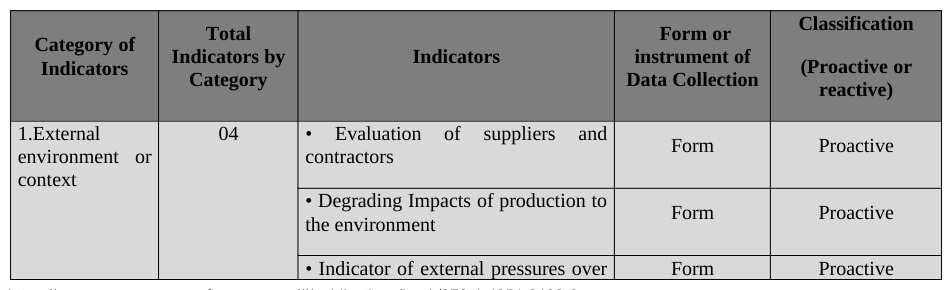
The Bibliographical Research the identification of 62 (sixty two) indicators, which were classified into nine (9) categories (column 1), outlining a system of indicators to measure Ergonomics organizational performance, as shown in Table 1 (Bezerra, 2010). As you can see, each of the 9 categories of indicators is associated with a set of indicators (column 2) correlates. Each indicator is given a name (column 3), has a specific tool for collecting data (column 4) and characterized as to their type, in proactive and reactive (column 5).The literature allowed the identification of 62 (sixty two) indicators, which were classified into nine (9) categories (column 1), outlining a system of indicators to measure Ergonomics organizational performance, as shown in Table 1 (Bezerra, 2010). As you can see, each of the 9 categories of indicators is associated with a set of indicators (column 2) correlates. Each indicator is given a name (column 3), has a specific tool for collecting data (column 4) and characterized as to their type, in proactive and reactive (column 5).
Table 1: Indicators arising from stage Bibliographical Research (Bezerra, 2010).
The system of Ergonomics indicators developed from the literary review was predominantly constituted by 33 proactive indicators (53.23%) and 29 reactive indicators (46.77%).
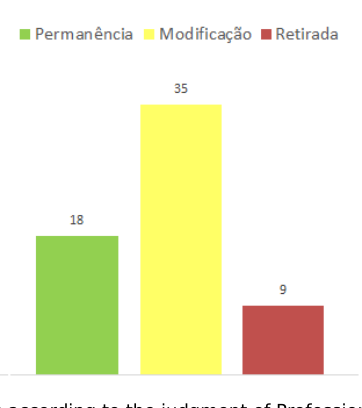
Among the 62 indicators generated, we found in the responses of the professionals surveyed that most systematized indicators (35 or 56.4%) needed modification, 9 indicators (14.5%) had no interest to these professionals and hence were excluded from the system developed, and 18 indicators (29%) were accepted and considered relevant and should remain in the system, as can be seen in Figure 1.
Figure 1: Quantity of indicators according to the judgment of Professional Groups (Group of Extension and Research in Ergonomics-GREPE/UFRN).
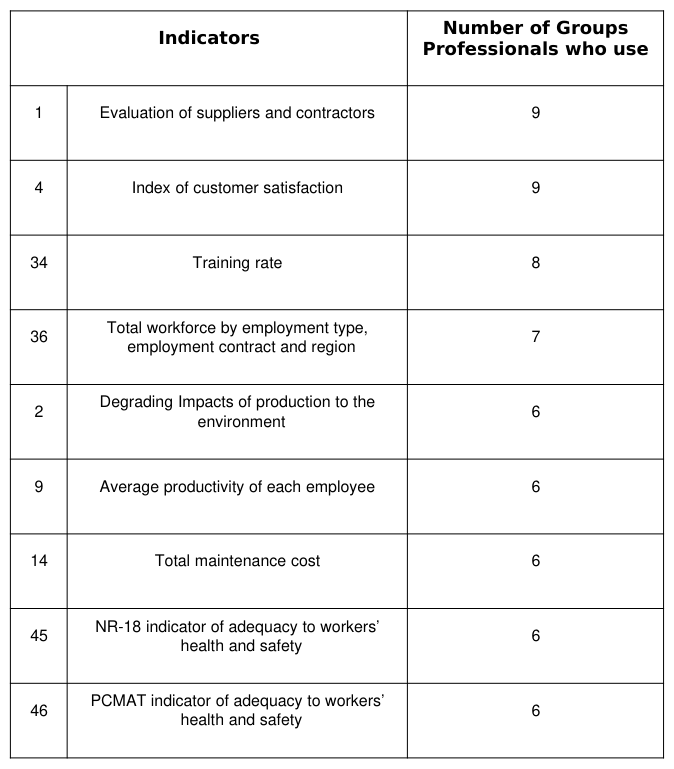
Table 2 below shows the indicators used by most professionals surveyed and the number of professional groups that use them.
Table 2: Indicators used by more professional group surveyed Indicators Number of Groups Professionals who use
All indicators from the system of Ergonomics indicators arising from the literature, shown in table 1, are used by at least 1 (one) group of professionals surveyed. The least used indicators are the indicator #35 (Total investments in Ergonomics actions) and indicator #43 (Incidence of unsafe acts by man hour worked). Among the 62 (sixty-two) indicators identified in the literature, only 18 (eighteen) indicators had the approval of the professionals surveyed and are divided into 8 (eight) categories and not the 9 (nine) categories of the initial research, because the category "Furniture of work sites" was the only one that had no representation in this selection.
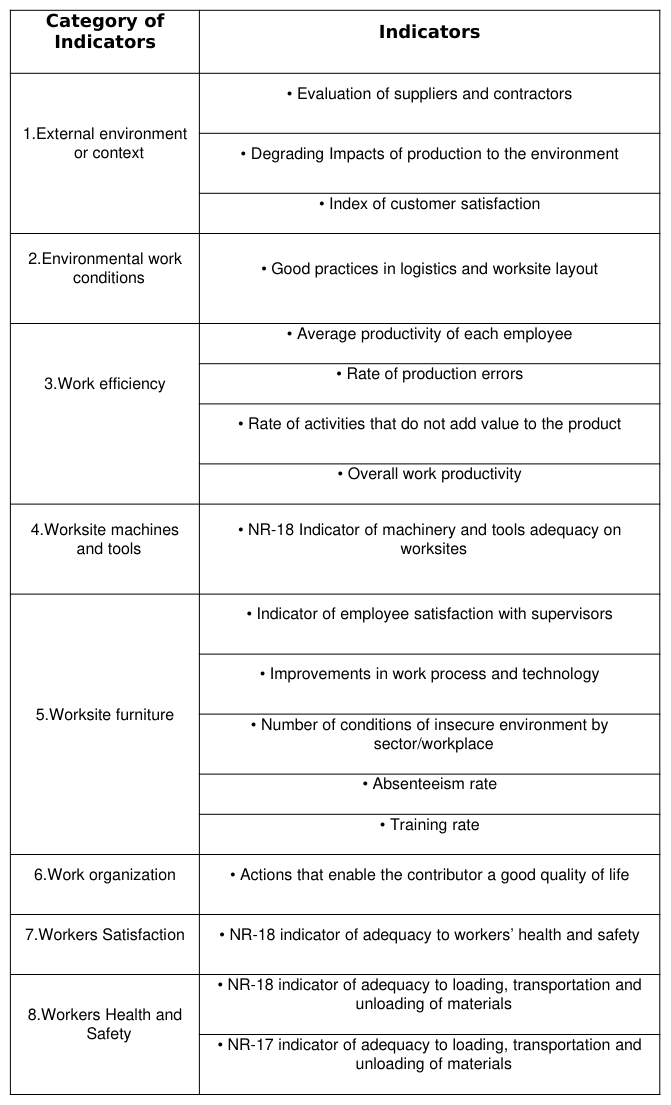
Table 3, below, shows the category of indicators, with eighteen (18) indicators selected by professional groups surveyed.
Table 3: Selected by professional groups surveyed indicators Category of Indicators Indicators
We observed that only 1 indicator (5%) of the “Health and Safety of Workers” category was selected by the professionals surveyed.
CONCLUSIONS
The most accepted indicators are in the category "External environment or context", suggesting that professionals who relate to the construction industry privilege the analysis of the environment and context in which they operate, business competitors, customers, market scenarios, their weaknesses, their strengths and potential growth or weakening before the market.
The category containing the largest amount of less approved indicators by the industry professionals was "health and safety of workers", even though this is the category with the highest number of indicators (19), as shown in table 1, referring to the stage of literature review. The higher rejection of these indicators occurred, according to the people surveyed, due to the apparent difficulty of performing data collection to feed the indicators.
Many professionals stated that the information generated by these indicators was dispensable for the company management and that the information provided by these indicators would not help them in any important decision making.
We conclude, therefore: a) there is a preference and overvaluation of productivity indicators by most professionals; b) the safety and health of workers are not sufficiently considered in the principles and management tools and in the organizational culture; c) there is a notion that people are not part of the productive system; d) that accidents and occupational diseases are not considered production and performance factors, nor their reduction constitutes a real factor of production and strategic value.
As a corollary, the preference of the professionals surveyed by the indicators of productivity suggests a kind of culture focused on performance evaluation, which often favors the stimulus to activities with a high work rate, increasing the risk and the probability of accidents, diseases, fatigue, rework, paradoxically becoming factors of productive inefficiency.
We defend the idea that a system of indicators for organizational performance should integrate social and technical factors, integrally, i.e., performance and human factors.
REFERENCES
Associação Brasileira de Normas Técnicas (ABNT). NBR 14280: Cadastro de acidente de trabalho – Procedimento e classificação. Rio de Janeiro, 2001. Barkokébas Junior, Béda et al. Indicadores de Segurança do Trabalho para Direcionamento do Sistema de Gestão de Segurança
e Saúde no Trabalho. In: ENCONTRO NACIONAL DE ENGENHARIA DE PRODUÇÃO, 26. Fortaleza, CE. Anais eletrônicos... Fortaleza: UFC, 2006. Website: <http://www.abepro.org.br/biblioteca/ENEGEP2006_TR500336_8432.pdf>. Acesso em 04 jun. 2010. Bezerra, Isabela Xavier Barbalho. Proposta de um sistema de indicadores para avaliar o desempenho em Ergonomia das empresas de grande porte da construção de edifícios. (Monografia). Natal, 2010. 88p. Brasil, Ministério da Educação. SECRETARIA DE EDUCAÇÃO MÉDIA E TECNOLÓGICA. Educação Profissional:
Referências curriculares nacionais da educação profissional: referenciais curriculares nacionais da educação profissional de nível técnico. Área profissional: Construção Civil. Brasília: Ministério da Educação, 2000. Brasil. Ministério das Cidades. PBQP-HABITAT. Sistema de Avaliação da Conformidade de Empresas de Serviços e Obras da Construção Civil – SiAC. Brasília, DF, 2005. British Standart Instituition. Occupation health and safety management systems – Specification– BSI OHSAS 18001. London,
2001. Cardoso, Vinícius Carvalho et al. Indicadores para gestão de competências: uma abordagem baseada em processos. Website: <http://www.gpi.ufrj.br/pdfs/artigos/Cardoso,%20Macieira,%20Jesus,%20Lengler%20-%20Indicadores%20para %20Gestao%20de%20Competencias%20-%20XXII%20ENEGEP%20-%202002.pdf>. Acesso em 04 jun. 2010. Centro de Estudos em Sustentabilidade da EAESP. Relatórios GRI de Sustentabilidade. Website: <http://ces.fgvsp.br/gvces/index.php?page=Conteudo&id=33>. Acesso em: 24 set. 10. Costa, Dayana Bastos. Diretrizes para a concepção, implementação e uso de sistemas de indicadores de desempenho para
empresas de Construção Civil. 2003. 174 f. Dissertação (Mestrado em Engenharia) – Programa de Pós- Graduação em Engenharia Civil, Universidade Federal do Rio Grande do Sul, Porto Alegre, 2003.
DIEESE. Anuário dos trabalhadores: 2010/2011. Departamento Intersindical de Estatística e Estudos Socioeconômicos. 11.ed.
São Paulo: DIEESE, 2011. Dul, J.; Bruder, R.; Buckle, P.; Carayon, P.. A strategy for human factors/ergonomics: developing the discipline and profession.
Ergonomics. DOI: 10.1080/00140139.2012.661087. New York: Taylor & Francis, 2012. FRANÇA, Ana Cristina Limongi. Indicadores empresariais de qualidade de vida no trabalho: esforço empresarial e satisfação dos empregados no ambiente de manufaturas com certificação ISO 9000. 1996, 355 p. Tese (Doutorado em Administração) – Faculdade de Economia, Administração e Contabilidade, Universidade de São Paulo, São Paulo, 1996. Furtado, Bernardo Alves; Lima Neto, Vicente Correia; Krause, Cleandro. Estimativas do déficit habitacional brasileiro (2007-
2011) por municípios (2010). Nota Técnica do IPEA, Nº 01, 20 p., 2013. Hendrick, Hal W.; Kleiner, Brian M. Macroergonomia: uma introdução aos projetos de sistemas de trabalho. Rio de Janeiro: Virtual Científica, 2006. 167 p. IEA. What is Ergonomics. Website: <http://www.iea.cc/browse.php?contID=what_is_ergonomics>. Acesso em: 02 jun. 2010. Iida, Itiro. Ergonomia: projeto e produção. 2. ed. rev. ampl. São Paulo: Edgard Blucher, 2005. 616 p. Kaplan, Robert S.; Norton, David P. A estratégia em ação: balanced socorecard. Rio de Janeiro: Elsevier, 1997. 348 p. Monteiro
Filha et al, 2010) MTE. Portaria GM nº 3.214, de 08.06.78, do Ministério do Trabalho e Emprego: Norma Regulamentadora NR 17 (Ergonomia).
Segurança e Medicina do Trabalho. Editora: Atlas. 70 ed. São Paulo, 2012. MTE. Portaria GM nº 3.214, de 08.06.78, do Ministério do Trabalho e Emprego: Norma Regulamentadora NR 18 (Condições e meio ambiente de trabalho na indústria da construção). Segurança e Medicina do Trabalho. Editora: Atlas. 70 ed. São Paulo, 2012. Navarro, Gustavo Pedroso. Proposta de sistema de indicadores de desempenho para a gestão da produção em empreendimentos
de edificações residenciais. 2005, 163 p. Dissertação (Mestrado em Engenharia) – Escola de Engenharia, Universidade Federal do Rio Grande do Sul, Porto Alegre, 2005. Nogueira, Francisco Eugenio. A importância de indicadores ergonômicos nos prêmios de qualidade. Revista Ação Ergonômica, v. 1, n. 3, p. 65-71, 2002. Website: <artigocientifico.com.br/uploads/artc_1147808851_58.doc>. Acesso em 02 jun. 2010. Portal Brasil. Construção civil prevê crescimento acima do PIB brasileiro em 2011. Brasília, 2011. Website: <http://www.brasil.gov.br/noticias/arquivos/2011/02/11/construcao-civil-espera-crescer-mais-que-o-pib-brasileiro-este- ano-diz-cbic>. Acesso em: 26 mai 2011. Siqueira, Mirlene Maria Matias (Org.). Medidas do comportamento organizacional: ferramentas de diagnóstico e de gestão.
Porto Alegre: Artmed, 2008. 344 p. V Conferência Nacional da Felidade Interna Bruta. O que é FIB? Website: <http://www.visaofuturo.org.br/pdfs2/O%20Que %20é%20o%20FIB%20-%20pdf.pdf>. Acesso em 20 nov. 2010. Vidal, Mario Cesar; CARVALHO, Paulo Victor Rodrigues de. Ergonomia cognitiva: raciocínio e decisão no trabalho. Rio de
Janeiro: Virtual Científica, 2008. 192 p.
LISTED IN THE AHFE DIGITAL BOOKSTORE CATALOGUE
Explore the complete digital volume
Advances in Social and Organizational Factors
Read this individual research paper free through the original publisher, or explore the full digital proceedings book.
ISBN 978-1-4951-2102-9
Explore this ISBN in the AHFE Bookstore ↗Listed in the July 2026 bookstore catalogue; search by ISBN to confirm current availability · Digital book purchase optional