Eun Young Lee, Min Kyu Kim, Min Young Yang, Yoon Seok Chang (2020). A Study on the Human Factors for an Advanced Picking Station. In: Advances in The Ergonomics in Manufacturing: Managing the Enterprise of the Future. AHFE Open Access, vol. 12. https://doi.org/10.54941/ahfe100446
Picking activities are usually repetitive and backbreaking physically. Awkward postures can result in muscle fatigue and injuries. For these reasons, Goods to Destination System(GDS) was developed in order to improve traditional picking devices. But there have been almost no researches on the design of picking station considering human factors. Thus we performed picking tests in-person and did descriptive survey with 30 people to study the impact of picking station design on the worker’s human factors. Among 30 people, 10 people participated Electromyograph(EMG) test for proving subjective results. As a result, in case of the LED indicator location of DPS 66% of participants felt comfortable when the LED was located between the waist level and the eye level while in case of button location of DPS, 70% of participants felt comfortable when the button was located at waist level. Moreover, the higher the angle of picking station was, the more participants felt comfortable. Lastly, most participants felt comfortable when tote was placed 5-10cm higher than general work station. This study shows various options for designing picking station. We believe that this research will provide a good guideline for picking station design which could lead to increase in productivity and workers’ convenience.
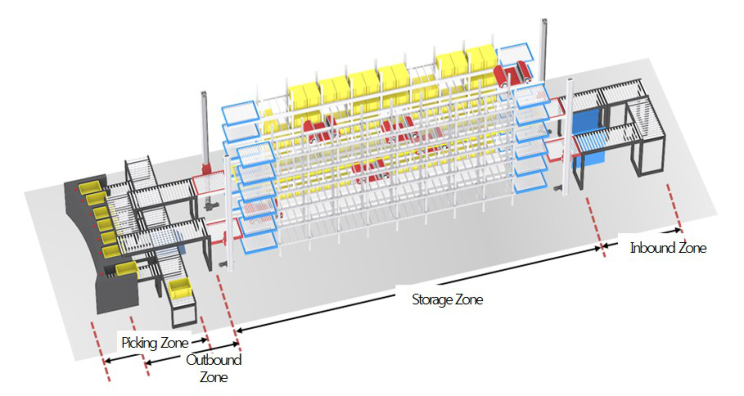
As market grows up, human factors issues arise in products and in production as well. One should consider human factors for the workers during the production process (Capodaglio et al., 1997). Also the product itself should be designed considering the human factors for users/consumers. Hence it is essential to integrate their needs and the human factors while designing both consumer and industrial products (Prakash et al., 2013; Fogliatto et al., 2003). The order picking activities in distribution center are mainly sorting and arrangement works classified by destinations in accordance with customer’s request. The activities consist of lifting, moving, picking, putting, packing and other works basically. Although these activities are very simple and easy, most of works are usually repetitive and physically demanding. Execution of such works in awkward postures can strain worker’s body parts and cause fatigue, injuries or severe cases permanent disabilities. Moreover, as the demand for multi-variety and light-weight product increases, it became hard for machine to deal with such product. In addition, there is no machine as flexible as a human being, which is the reason why manual handling will continue to exist (Rosecrance et al., 2005). Systems that depend on human operators are particularly vulnerable to problems associated with worker health, production, quality and increased training and absenteeism costs (Kasvi et al., 2000). Thus the design of picking station for human operators must be considered human factors. Especially, the flexibility for changing postures (e.g. adjustable work station) should be supported within the work station (Jacobs and Bettencourt, 1995). Adjustable work stations allow individuals to change postures they want (Straker et al., 1997a). Therefore an adjustable picking station can contribute to a variety of convenient working postures for the workers (Diederich and Stewart, 1997). In this paper, we introduce an advanced picking station which has been developed in the project called development of smart material handling machine funded by Ministry of Land, Infrastructure and Transport of Korea from 2013 to 2016. The advanced picking station is a module of Goods to Destination System as in figure. The station consists of touch personal computers, digital picking system (DPS), barcode/RFID system, printer, picking desk, totes in/out part, several buttons, laser system and other optional systems.
Figure 1. Goods to Destination System (Korea Aerospace University, 2013)
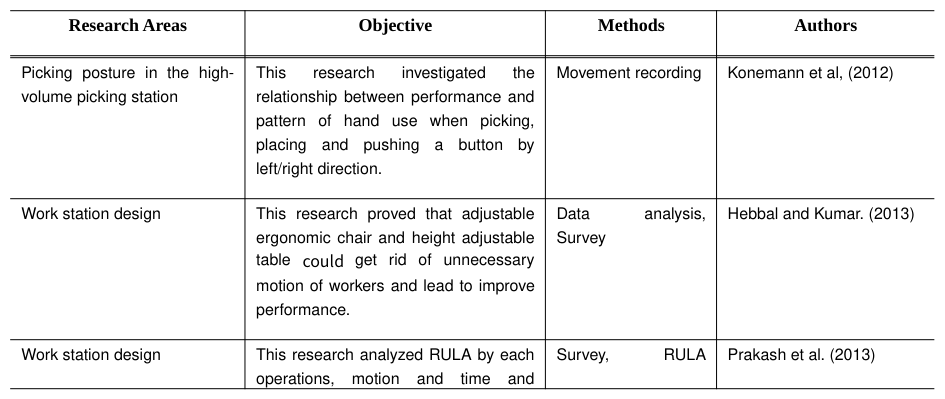
RELEVANT RESEARCH There have been many researches in work desk or work station considering human factors, order picking system and risk assessment methods as in Table 1.
Table 1: Literature review
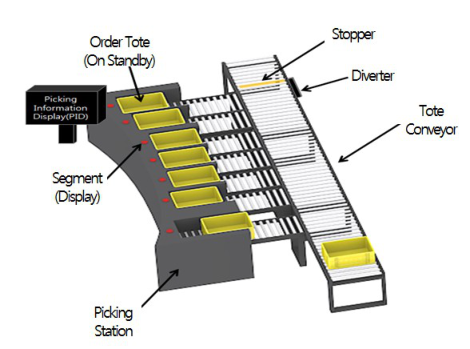
But we could not find other studies on design of advanced picking station to solve fundamental problem. The GDS picking station is different from general work station or work desk in traditional production field (figure 2). For example, operators can do their works without equipment such as digital picking indicator and computer in traditional production field. But in case of picking station, operators should work with the aid of many devices and built in tote box unlike general work station. To reduce errors during the operation, workers have to do their tasks with visual display (i.e. to check how many items they have to pick) and have to confirm the completion of each task by pressing a button. So it is important to design picking station much different from the conventional work station. From this perspective, the GDS picking station has been designed for eliminating uncomfortable postures like bending waist, sitting down. But there is need to study the location of digital picking indicator, the height of picking station and the angle of picking station in order to find comfortable configuration for workers. For this reason, we studied the human factors on the advanced picking stations of Goods to Destination System (GDS) which considers work efficiency and convenience. Thus the goal of this research is to search proper configurations of picking station which helps operators to do their work comfortably. If we can adjust picking station flexibly considering each worker’s human factors with the aid of identification technology such as RFID or finger print, it will lead to increase in productivity and workers’ convenience.
Figure 2. GDS picking station (Korea Aerospace University, 2013)
METHODS
We applied electromyography (EMG) for analysis, distributed questionnaire and interviewed individuals after experiment. The experiments were performed to investigate the proper digital picking indicator location, height and angle of picking station. After experiment, we compared results between EMG, questionnaire and interview. In order to test work efficiency and convenience in picking activities, we developed 5 mockups of horizontal and vertical form of picking desk (figure 3). The height and angle of picking desk were adjustable from 60cm to 110cm and from 0° to 30° each to study proper height and angle considering workers’ personal body sizes. Tote box size was 600mm*400mm*240mm.
Figure 3. Mockups of picking station
Figure available in the original PDF paper.
We studied picking tasks in-person and did descriptive survey with 30 people considering various body sizes and ages. Before we start experiment we collected general information of participant (e.g. name, sex, age) and measured height, arm length, leg length. Each participant was asked whether he or she had any physical discomfort or not before the experiment in order to minimize any prior condition that might affect the experimental result. Participants who expressed any physical discomfort were excluded from this experiment. Experiment progressed several times.
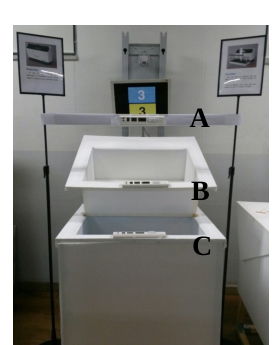
DPS helps workers to identify the location of items to be picked in the storage area and the number of the items to be picked through digital picking indicator simultaneously (figure 4). DPS is also used to confirm a job completion by pressing a button. In the first step, the participants were asked to answer when they felt comfortable with three different configurations of digital picking indicator which are at eye level, at between the eye level and the waist level and at waist level.
Figure 4. Digital Picking Indicator (DPI)
Figure available in the original PDF paper.
After experiment, we disposed the digital picking indicators at comfortable locations following the experimental result.
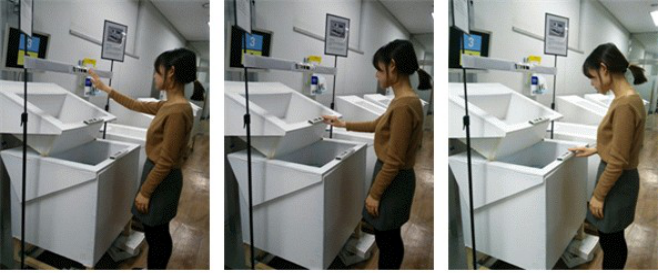
Figure 5. Experiment on the location of DPS
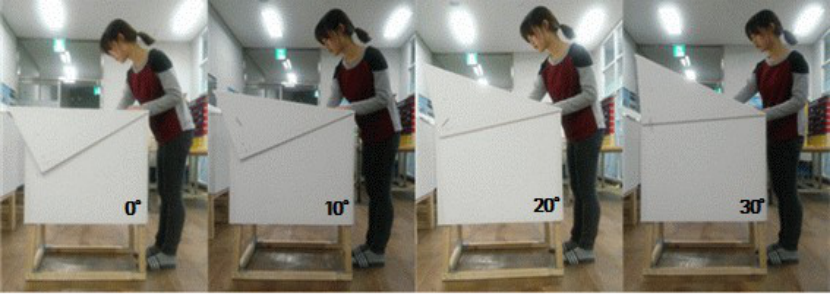
In the second step, we tested different angles of DPS (e.g. 0°, 5°, 10°, 15°, 20°, 25°, 30°) to find comfortable angle. Considering participants’ input after this experiment, picking station was fixed with a proper angle we found (20 °)
.
Figure 6. Experiment on the angle of picking station (0°, 10°, 20°, 30°)
In the third step, the participants were asked to pick various items from a tote and move items to other tote for 2 minutes and rest for a minute per each height. During this experiment we found that the most participants felt comfortable with higher height than recommended height without musculoskeletal fatigue. In order to figure out the most comfortable height for worker, we experimented four different configurations per each person (i.e. 5cm lower, recommended, 5cm higher, 10cm higher). We provided questionnaire to each participant to find which height is most comfortable among four different heights of picking station. During experiment, they were asked to answer with 5-point Likert scale (i.e. ranged from ‘1’ as ‘extremely uncomfortable’ to ‘5’ as ‘extremely comfortable’) how much they felt uncomfortable or comfortable by five parts of body: neck and shoulder; arms; wrist; waist; and legs.
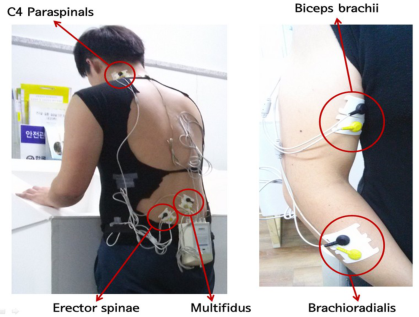
Lastly for more objective validity we did an in-depth study into height and angle of picking station through a surface electromyography (EMG) test. EMG signal is an electric signal occurred at muscular contraction. Collected EMG is suitable after special signal processing. In many EMG signal processing methods of analysis, Time Domain analysis and Frequency Domain analysis are used commonly. Among, Rectified Signal, Integration Value, Root Mean Square (RMS) in Time Domain, we choose Root Mean Square (RMS) as a method of analysis for our research. The test was given to a random sample of 10 people among 30 people with proper height and their most preferred height of picking station. In order to prove whether their preferred height is reasonable or not considering muscles utilization, we attached a surface electrode to five parts of body (i.e. C4 Paraspinals, Erector spinae, Multifidus, Biceps brachii and Brachioradialis) based on the recommended parts from SENIAM (www.seniam.org).
Figure 7. Electrode attachment location Figure 8. Experiment on EMG
The participants were asked to pick items in picking tote and move to other tote per each height for picking system as they did before. They performed a series of picking activities for 2 minutes 35 seconds with beeper sound per 3 seconds for reducing errors. Per each height, experiment lasted 30 minutes to 40minutes. We analyzed data to compare muscles utilizations of proper height and their most preferred height, respectively.
RESULTS
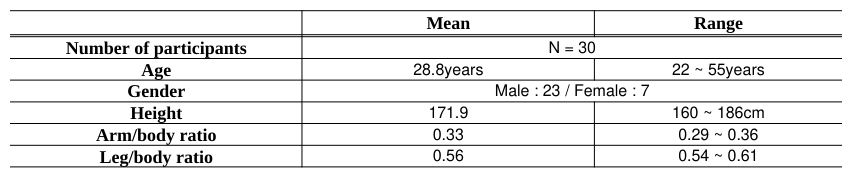
General Information Among 30 participants, 23 participants were male and 7 participants were female: age ranged from 22 to 55years with the mean age of 28.8years. Mean height of participants was 171.9cm, with the range from 160 to 186cm. General information of participants is shown in the table below.
Table 2: General information of participants Mean Range Number of participants N = 30 Age 28.8years 22 ~ 55years Gender Male : 23 / Female : 7 Height 171.9 160 ~ 186cm Arm/body ratio 0.33 0.29 ~ 0.36 Leg/body ratio 0.56 0.54 ~ 0.61
Location of Digital Picking Indicator Digital Picking System (DPS) provides information like the number of items to be picked through LED and allows workers to confirm task completion by pressing a button. According to the literature reviews, Wickens (2004) reported the normal line of sight is the preferred line of sight when the eyes are at comfortable position. Many researchers recommended that the line of sight level should be about 10° to 15° below the horizontal plane or eye level as seen from figure 9. Kroemer and Hill (1986) reported that the preferred direction of gaze is 29° below the horizontal plane for seated operators. However, several researches showed different results. Therefore visual displays should be placed with the preferred line of sight considering field characteristics. Das (1996) found that the best zone where workers feel most comfortable is at the elbow level in a horizontal plane, which should not exceed the maximum reach limit.
A
B C
Figure 9. The normal line of sight (Wickens et al, 2004) Figure 10. Configuration of DPS
In this survey, 33% of participants responded that they felt most comfortable at eye level (A) in terms of seeing. 66% of them felt comfortable at the middle position between eye level and waist level (B) and nobody selected waist level (C). Meanwhile, in case of a button position, eye level (A) was not selected. But 30% of participants responded that they felt comfortable at the middle position between eye level and waist level (B) and 70% of them preferred waist level (C).
Table 3: Survey results on location of DPS by seeing and pressing LED location for visual order check (i.e.
The reason why most of participants selected B for LED and C for completion button can be explained as follows: generally, most of operations are performed at waist level because of the nature of order picking activities in GDS. Because of such work nature, their sight had been stayed at the place where items were handled during the experiment. When LED was at waist level, they had to bend their neck too much to see LED display, which caused muscle fatigue. In this regard, they felt that A (i.e. display at eye level) and C (i.e. display at waist level) were inconvenient. And they choose B (i.e. LED location which is between eye and waist level). For button location, most of them felt comfortable at waist level (i.e. location C), because they could press a button immediately after putting items to the tote, without reaching beyond the best zone. Our result on the button location was the same as researches in the literature review (i.e. it was convenient to work in best zone). But in LED location for visual order check, participants felt comfortable at the middle between eye level and waist level (B) unlike literature review that reported 10° to 15° or 29° below horizontal plane was proper as line of sight.
An Angle of Picking Station According to the literature reviews, Ki (2006) mentioned the dimension of a stand-up worktable. In case of a stand- up work, they recommended that worktable with an angle of 15° is more proper and ergonomic. From that, we deduced a proper angle for convenience of worker in picking station. We also tested different angles of picking station. Most participants felt muscle fatigue when the angle of picking station was low, since they had to bend their neck and waist for picking activities. From our experiment, we found that an angle of 30° was most comfortable because they could work more efficiently with lower fatigue in neck and waist. However, when the angle was 30° some items were flows on slopes due to gravity, we decided to set the angle as 20 ° after test. In real world application, it is recommended to set up the angle of picking station considering product shape, size and materials with operators’ human factors.
Table 4: Survey results on angle of picking station 0° 10° 20° 30° Numb of people who choose this position 0 0 7 23
The Height of Picking Station Grandjean (1988) and Del Rio Vilas (2013) recommended the work surface height for standing work as 85-90cm for women and 90-95cm for men, respectively. Based on his research, we made a following table and did experiment with recommended height.
Table 5: Recommended height
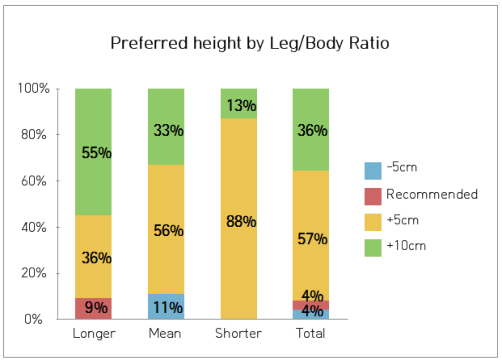
Figure 11 shows the result of preferred height considering leg/body ratio of participants. 2 of 30 participants who didn’t feel differences among heights were excluded for comparison. A high proportion of participants reported comfort when the height of work space is higher than the commended height: 57% of participant preferred 5cm higher than the recommended height and 36% of participant preferred 10cm higher than recommended height, respectively. Only 4% of participants preferred the recommended height and the 5cm lower height respectively. Also this study showed the correlation between the leg/body ratio and preferred height. 55% of participants with longer legs than Mean (i.e. 0.56) responded that they felt comfortable with the height of 10cm higher than the recommended height. And 36% of them felt comfortable with 5cm higher. Meanwhile 56% and 33% of participants with average legs ratio preferred 5cm higher, 10cm higher respectively. 88% and 13% of participants with shorter legs than Mean preferred 5cm higher, 10cm higher respectively. This result demonstrated that the workspace of higher height than general work station was preferred by participants and the participant with the higher leg/body ratio, preferred higher height as well. But we could not find any relation between leg/body ratio and uncomfortable body part.
Figure 11. Preferred height by Leg/Body Ratio
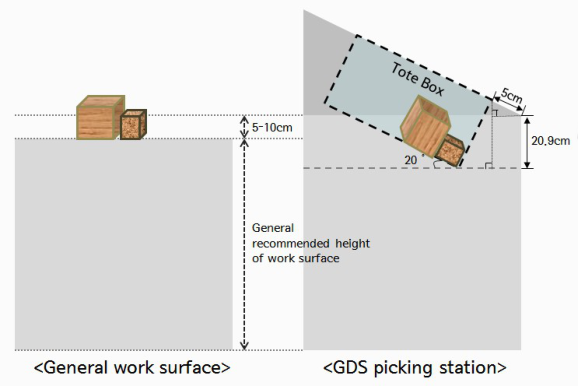
As in the figure 12, the height from the surface of picking station to the bottom of tote box was 20.9cm when tote box was 20° slanted. But most participants preferred a height with 5~10 cm higher than the height of general work surface. (Participants preferred 5-10cm higher than general work surface height)
Figure 12. Comparison between general work surface and GDS picking station
Electromyograph(EMG) Analysis
In this research, we used analysis software, Telescan (LAXTHA, 2013). We analyzed muscle activity using Root Mean Square (RMS) converting from analog signal to digital form. A mathematical formula of RMS is as follows:
(1)
This kind of RMS analysis is more suitable for the analysis of external load, the analysis of muscle than fatigue analysis of muscle (Lee, 2011).
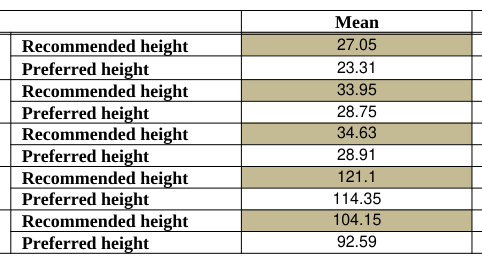
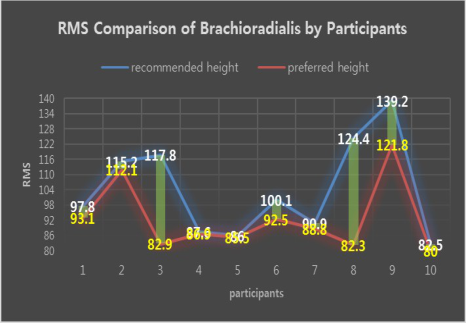
The table 6 shows the comparison of Mean and Range of muscle activity classified according to the muscles (C4 Paraspinals, Erector spinae, Multifidus, Biceps brachii, Brachioradialis) considering recommended and preferred height. There are wide ranges of value according to participants’ feature. But the values for recommended height were much higher than those of preferred height in all parts. It means that participants used their muscles more and they felt more tired with the recommended height than preferred height. The figures show that RMS value of recommended height is higher than preferred height. Although RMS value of 2 participants with preferred height is higher in Biceps brachii, it is obvious that participants with preferred height felt more comfortable from the macroscopic viewpoint.
Table 6: Mean and Range of RMS value by muscles Mean Range C4 Paraspinals Recommended height 27.05 24.1 ~ 31 Preferred height 23.31 19.4 ~ 26.7 Erector spinae Recommended height 33.95 21.8 ~ 59.1 Preferred height 28.75 16.7 ~ 49.4 Multifidus Recommended height 34.63 25.6 ~ 44.4 Preferred height 28.91 20.4 ~ 41.1 Biceps brachii Recommended height 121.1 61.2 ~ 165.1 Preferred height 114.35 60.3 ~ 163.1 Brachioradialis Recommended height 104.15 82.5 ~ 139.2 Preferred height 92.59 80 ~ 121.8Figure 13. RMS Comparison by muscles
From this experiment, it is considered that the results from subjective survey are reliable. As a summary participants felt comfortable with higher than recommended height of general work station. Consequentially, it is not always proper to design picking station according to the standards of general work station or work desk.
CONCLUSIONS
This research has gained valuable information on the picking station considering workers’ human factors: [Equation or mathematical symbol available in the original paper PDF] It is hard to apply normal line of sight to DPS based on prior researches. Because tasks are done at waist level from the nature of picking station, we recommend that visual display should be located at the middle of eye level and waist level and that button should be located at waist level.
• The higher the angle of picking station, the more workers feel comfortable. But the angle of picking station should be designed between 20° and 30° with the careful consideration on the sliding effect.
• GDS picking station should be designed with 5-10cm higher height than recommended height of general work desk. But the difference can occur according to leg/body ratio. Adjustable system could improve work efficiency and solve fatigue issue.
We believe that the picking station which is designed based on this research could help operators to work comfortably.
ACKNOWLEDGMENT
This research was funded by the project “Light weight material handling machine development for improving logistics work efficiency” (13PTSI-C065358-01-000000) of Korea Agency for Infrastructure Technology Advancement, Ministry of Land, Infrastructure and Transport of Korea.
REFERENCES
Bosch, T., de Looze, M. P., & Ten Hoor, M. C. (2008), “Sustained performance and workload in order picking”, In B.Helgadottir (Ed.), NES 2008 Abstracts: Ergonomics is a lifestyle, pp.77-78, Reykjavik: Gutenberg. Capodaglio, P., Capodaglio, E. M., & Bazzini, G. (1997), “A field methodology for ergonomic analysis in occupational manual
materials handling”, Applied Ergonomics, Volume 28 No 3, pp.203-208. Dallari, F., Marchet, G., & Melacini, M. (2009), “Design of Order Picking System”, International Journal of Advance
Manufacturing Technology, Volume 42 No.1-2, pp.1-12. Das, B., & Sengupta, A. K. (1996), “Industrial Workstation Design: A Systematic Ergonomics Approach”, Applied Ergonomics, Volume 27 No.3, pp.157-163 Del Rio Vilas, D., Longo, F., & Monteil, N. R. (2013), “A general framework for the manufacturing workstation design
optimization: a combined ergonomic and operational approach”, Simulation, Volume 89 No 3, pp.306-329. Diederich, J., & Stewart, M. (1997), “Laptop computers: flexibility vs. disability”, In Occupational Therapy Australia, 19th National Conference, Perth, Western Australia, Volume 2, pp.211-214. Fogliatto, F. S., & Guimaraes, L. (2003), “User-oriented method for selecting workstation components”, International Journal of
Industrial Ergonomics, Volume 33 No 2, pp.133-147. Grandjean, E. (1988), “Fitting the task to the man”, London: Taylor & Francis. Hebbal, S., & Kumar, A. (2013), “Ergonomics evaluation of low cost adjustable workstation for assembly operation”, International Journal of Mechanical and Industrial Engineering, Volume 3, pp.41-46. Kasvi, J. J. J., Vartiainen, M., Pulkkis, A., & Nieminen, M. (2000), “The role of information support systems in the joint
efficiency”, Internal Project Presentation Kroemer, K. H., & Hill, S. G. (1986), “Preferred line of sight”, Ergonomics, Volume 29 No 9, pp.1129-1134. Laxtha incorporation (2003), Telescan version 3.06, www.laxtha.com Lee, M. H. (2011), “A Study for the Effects of Lifting Position, Age and Gender on Maximum Lifting Strength”, Knee, Volume 6 No 98, pp.6-52. Lee, S. H. (2014), “A study on the Comparison of Efficiency with the Layout of Picking Station” (Master’s dissertation, Korea
Aerospace University). Li, G., & Buckle, P. (1999), “Current techniques for assessing physical exposure to work-related musculoskeletal risks with emphasis on posture-based methods”, Ergonomics, Volume 42 No.5, pp.674-695 Prakash, R. A., Arun, B. S., Narayanan, N., & Yeshwanth, V. (2013), “Design of workplace for the assembly of monoblock
pump”, International Journal of Research in Engineering and Technology, Volume 2, pp.349-355. Rosecrance, J., Douphrate, D., & Cross, S. (2005), “Integration of participatory ergonomics and lean manufacturing. A model and case study”, Human factors in organizational design and management, Volume 6, pp.437-442. SENIAM Project (2013), www.seniam.org Straker, L., Jones, K., & Miller, J. (1997a), “A comparison of the postures assumed when using laptop computers and desktop
computers”, Applied Ergonomics, Volume 28 No 4, pp.263-268. Wickens, C. D., Gordon S. E., & Liu, Y. (2004), “Human Factors Engineering”, Pearson Education, New Jersey.
LISTED IN THE AHFE DIGITAL BOOKSTORE CATALOGUE
Explore the complete digital volume
Advances in The Ergonomics in Manufacturing: Managing the Enterprise of the Future
Read this individual research paper free through the original publisher, or explore the full digital proceedings book.
ISBN 978-1-4951-2103-6
Explore this ISBN in the AHFE Bookstore ↗Listed in the July 2026 bookstore catalogue; search by ISBN to confirm current availability · Digital book purchase optional