Janusz Rymaniak (2020). Capability, Profit or Waste? Organizational and Economic Dilemma Criteria for Measuring the Effectiveness of Enterprises. In: Advances in The Ergonomics in Manufacturing: Managing the Enterprise of the Future. AHFE Open Access, vol. 12. https://doi.org/10.54941/ahfe100448
The paper presents a literature review on enterprise efficiency. It is argued that the economic efficiency perspective needs to be broadened with organizational dimensions of evaluation. The paper presents an evolution of economic criteria from the market-based to the organizational and resources-related ones. The relations between organizational and economic criteria are discussed. In the final part of the paper, praxeological criteria for enterprise effectiveness are presented. The Author taps into the research output of Polish researchers such as: Adamiecki (organization and management), Lange (economics) and Kotarbiński (praxeology).
The idea of the black-box mechanism is often referred to in the economics literature. From a macroeconomic perspective, it is explained as the difference between the amount of money “put in” by investors before the production process, and the greater amounts “taken out” afterwards in the form of profit or interest. The goal is making money by investors, i.e. obtaining return from invested capital. Investors, i.e. banks, shareholders or their representatives (business executives) make decisions on investing in production resources and labor that it is necessary to combine in production processes. As a result, products and services are created, and selling them should bring financial means that are significantly greater than those offered for purchases necessary to start the production cycle. The obtained means must secure any debt repayment (both principal and interest), the operations costs (purchasing, production and other) as well as profit being the return for the invested capital.
Thus, the processes have two dimensions: economic (purchase prices and operating costs in the course of production cycle, establishing selling prices for the products and services offered), and organizational (the method and cost of combining the resources). The very process of converting the input elements into the effects offered (output elements) constitutes a firm’s black-box. The black-box is a hypothetical engineering device which is used to make a given product, however, at the designing and planning stage nobody is interested in how the product is made, i.e. how the box operates. It is presumed that the desired effect is obtained when appropriate elements have been fed into the box (Robbins 2009).
The contemplated issues lead to formulating the following research questions:
1) What are the bases of the economic mechanism, i.e. why are firms described as black-boxes?
2) How can we unpack black-boxes, i.e. what criteria and research dimensions are used in theory and practice to rationalize the operation of the firm’s black-box internal mechanism? 3) What are the proposals for adjusting the firm’s evaluation in accordance with contemporary economic and social requirements, and how does it affect the changes to the evaluation mechanism?
A FIRM AS A FORM OF BUSINESS ACTIVITY The meaning of a firm
In the literature of social sciences, a firm is specified as a separated unit. The three major kinds of separation are: legal, economic and organizational. The legal separation is related to formal issues, such as establishing the business name, statute and form of assets ownership in legal registration documentation. The economic separation specifies the range of administering own or entrusted assets. And lastly, organizational separation consists in specifying the internal structure and the authorities (management). Thus understood firm is one of various types of organizations. In a systemic approach, we can separate labor and production resources (technology and people) that are organized around a purpose (goals and mission) and legitimized by way of organizing (the firm’s structure). Using the separation aspect to describe the nature of a firm means that there is some point of reference, from which something may be separated. That point of reference will be, in a broad sense, the environment, classified as spatial, social, institutional, political etc. environment, which is characterized by globalization, diversity, instability and complexity (Koźmiński 2006).
Meanwhile, a firm is an entity that works for the benefit of the environment. This is because thus specified firm implements its goals on the market in the form of production and sale of goods and services, which is prerequisite to obtain return of the financial means invested in the production and the business itself. A firm’s business activity is not a one-off cycle, but a relatively durable, long-term and recurring mechanism of action. Only then can we name it an organized business activity. Changes to the external conditions, technical progress and civilization transformations also affect the evolution and development of business entity forms. It is especially the process-based approach and the network nature of the organization of activity, as well as development of virtual organizations that lead to changes in firms’ operation determinants. Lack of physical form of a firm and separating the resources from the organization give rise to new forms of activity and force new solutions in company management (Suszyński 2007). These include for example internally and externally flexible firms (Krupski 2008; Rymaniak 2012; Jain et al. 2013), process-oriented firms (Grajewski 2007; Skrzypek, Hofman 2010), or agile firms (Trzcieliński 2005; Cummins 2008). Their level of adaptivity to the turbulent and dynamically changing environment facilitates modular modelling of processes and structures (Rymaniak 2013).
The complexity of the development leads to many research dimensions regarding firms, allowing to distinguish many models and at least 28 theories of the firm. In the economic dimension, firms are considered to be: “… relatively long-lasting institutions and organizations in an economy – that take various legal forms in different countries and economic periods, particularly in terms of ownership – which due to their numerous disclosed and potential capabilities (goals) provide households with higher, long-lasting performance of their human, material, financial, intellectual, social capitals, compared to what they would be able to achieve by way of their own (Aristotle’s) domestic economy in any market, state-run or mixed economies” (Noga 2009). Some researchers focusing on the problem state that adequate economics of the firm should be historically relevant. The terms “adequate” and “relevant” imply, in the current context, that theoretical frameworks allow explanation of historical developments rather than a rationalization of these developments (Dietrich and Krafft 2008). They suggest that we can really understand the firm only by taking account of governance structure benefits as well as costs. “…The ‘benefits’ encompass what is called here the theory of the firm with a focus on external issues and the ‘costs’ of the economics of the firm with a focus on internal issues. More recently a framework was introduced to help analyze development of firms, and specifically vertical integration, based on creating links between technical and organizational aspects of the firm. They suggest that it is a truism that real firms are both technical and institutional entities. In reality, the firm is obviously a technical unit, namely a unit that transforms factor inputs into output. This is originally where the theory of the firm starts from analyzing the impact of production and costs functions with demand on the market. Equally, the firm is also an institutional unit, requiring that one pays attention to its basic definition, its identity, its structure and boundaries which have become the usual playground of the economics of the firm” (Dietrich and Krafft 2012).
The techno- functional perspective views the firm as a black-box that transforms factor inputs into outputs. This perspective involves how production and cost functions interact with demand on the market, i.e. the emphasis is on technical matters and how firms function in the context of the market; hence the techno-functional appellation used here. The both institutional and techno-functional perspectives are useful because they allow us to answer different sets of questions (Dietrich 2007). However, they do not explain the phenomenon of the firm. They do not provide an answer to the question: what are firms? (Lockett, Thompson and Morgenstern 2009, Kasiewicz 2004). This requires an attempt to specify an outline of organizational and economic reasons for origination of this form of human activity.
Organizational reasons for establishing firms According to Koskela, Sacks and Rooke (2012), the history of the economic development can naturally be divided into a number of periods: nascence up to the end of the 18th century, emergence of the classical notion in the 19th century, flourishing during scientific management, decline starting in the second quarter of the 20th century, and re- emergence in the last quarter of that century. Mass-scale establishment of firms being organizational forms accompanied the emergence of industrial production, i.e. the Scientific Management period. Firms very quickly replaced pre-industrial manufactures, workshops and households, and became the basic organizational form of business. Firms’ formation derived from a possibility to implement technical inventions, including especially propulsion for machines and devices.
The beginnings pertain to the pre-industrial phase, i.e. the first two periods. The revolution in the textile industry in 18th and 19th century can serve as an example. Until that time, raw materials and machines (looms and spinning wheels) were entrusted to home weavers and drapers. Thus, the putting-out system was developed, via increasing the control over deadlines, quantities and quality. The changes were initiated with regard to raw materials, when own production of cotton was developed, and considerable prohibitive duties were imposed on imported Indian percale that was popular in England. A successive implementation of machines and equipment began: Kay’s flying shuttle (1733), Hargreaves’ Spinning Jenny (1770), Arkwright’s water frame, and finally in 1779 Crompton’s Spinning Mule. By means of the Spinning Mule, one worker was able to operate more than a thousand spindles at a time. Another aspect was applying steam propulsion to machines. Technical progress led to changes in technology, which due to the innovative machines resulted in a 2400% increase in efficiency compared to a hand spinning wheel which became obsolete within 10 years (Robbins 2009). Development of railway and sea transport gave access to and lowered prices of raw materials. The described changes enabled insourcing, i.e. physical, spatial and organizational expansion of factories, due to concentration of many functions of the production process, from preparing crude wool or cotton through spinning and weaving up to the final processing. Mechanization, however, makes development capital-intensive due to high prices of machines and equipment. This hindered the fast growth of the number of firms and was the main obstacle to development of all industries, including the one being discussed here.
The outlined case of the textile industry indicates the significance of solving the complexity problem resulting from the need to apply and effectively use innovative machines and equipment. Practitioners - engineers, and also some few theoreticians - attempted to solve the practical problems (Emiliani and Seymour 2011). The practitioners focused on how to optimize the use of machines and equipment, and the steel industry became the testing ground (Taylor 1926, Adamiecki 1909, 1925). Taylor conducted experiments, e.g. with loading shovels, created workload standards that were sums of worktimes of the best workers, developed the principles of assigning workers to particular jobs, introduced a functional system of team management (specialization of foremen in managerial functions) and a differentiated the remuneration system depending on the job. Adamiecki developed and applied graphic systems of synchronization and coordination of machines and equipment operation time in rolling mills. He attempted to eliminate vast amounts of work time losses resulting from mismatched capacities of machines and equipment. He created the law of harmony in management, comprising harmony of choice, doing and spirit. Work process accelerated following the introduction of Ford’s assembly line, which led to further substantial increments in production quantity and quality. An assembly line running at a speed of 2 meters per hour resulted in a decrease in car assembly time by 800% (from 12 to 1.5 hours) as well as in a considerable level of work specialization.
That was the dawn of mass production indispensable for our civilization development. Observation, experiment and experience, supported by different measurement methods, including the time and motion study and graphical methodology (Adamiecki, Gantt, Gilbreth etc.), form the “scientific bases of management”.
Economic reasons for establishing firms While the actions of Taylor and other researchers were of vertical and organizational nature related to standardizing, designing and implementing different solutions in factory production development, Smith’s concepts were horizontal and related to labor activity, its simplification and specialization (Ishii 2013). The foundation of work- based structure is striving for continuous separation of sets of simple tasks, or even single, homogeneous and simple tasks. When they are separated to form a worker’s scope of duties, it leads to perfecting the skills and increased excellence, and consequently an increase in efficiency. The additional benefit is the time saved on eliminating the need to switch from one job to another, and also inventions are easier when it comes to machines and equipment involving simple tasks (Smith 2007). Although theoreticians pointed out that Smith was many a time inconsistent in his thinking, (Galbraith 1987), the concept of “power of productive work” and the results obtained following enhancement of labor division created the theoretical foundations for firms development.
The technical and technological determinants related to the introduction of machines and equipment were not the only ones in the evolution process. Labor division, necessary to obtain profit from invested capital, required spatial concentration of all the production assets. It resulted in new kinds of professions and specializations, which went more and more beyond the hunting and gathering, agriculture and other traditional types of “wood and iron” work. The effects of specialization resulting in substantial efficiency leaps leading to increased revenues were possible due to the concentration in time and space. That totality of operations was ensured by the “factory regime” (Burawoy 2003).
The aforementioned aspects meant only the consensus between the historically developed “base and superstructure”, i.e. household, manor farm, property rights, and the requirements of the factory system. The economic mechanism, including the market mechanism, was left in the “open space economy” i.e. the manor convention. In this convention the economy was volume-based, i.e. the amounts of production results (produce of agriculture, animal husbandry, horticulture, distilling, sugar production, smithery, etc.) ensured self-sufficiency, and any excess amounts were sold. Although the business nature changed to intensive, as proceeds from sale became the basis and essence of firms’ existence, the mechanism allowing no responsibility of owners for their firms was not changed.
That brings back the discussion on fundamental economic categories. The authors engaged in summarizing the historical acquis point out that despite the difficulties with waste encountered at the beginning of the 20th century, the notion of waste as well as the approach to it were abandoned. Six reasons for that are enumerated in the relevant literature. First, the intellectual and social atmosphere grew to demand a separation of moral considerations and instrumental rationality, of theological and secular arguments; thus the intrinsic understanding of waste was rejected. Secondly, according to Walras’ recognized economic concept a firm is a „black-box” where waste is not visible at all. Thirdly, in the conditions of shortage economy and assumptions of rational decisions made by economic agents, introducing a category of waste undermined the underlying assumptions of the concept. Fourthly, shifting the emphasis to behavioral issues resulted in ignoring waste. Fifthly, mass production induced by electrification as well as technical and organizational innovations decreased the need to reduce waste. Sixthly, the need to reduce waste was identified with the times of economic recession and depression (Koskela et al. 2013). Nevertheless, it seems that two other factors were decisive. Since management became a specialized function, resulting in separation of administration and ownership, hired managers were not interested in detailed accounting for their managerial activities. Moreover, mass production introduced significant changes in social science approaches. The “shortage” science was replaced with “development” science. In economic, psychological (e.g. motivation) or sociological concepts it was more important to search for development factors, and scalar measurement meant that each phenomenon was at a certain level of development - some of them closer to zero, some other closer to 100%.
The practical need to compete with the American automotive industry contributed to the emergence of the only comprehensive economic and organizational system focused on waste reduction: the Toyota system (Fujimoto 2012, Pheng and Shang 2011). The system distinguishes seven areas of waste: Transportation, Inventory, Motion, Waiting, Over-procession, Over-production, Defects (Imai 2006). The foundational notion of the Toyota system is systematic and continuous reduction of those factors, with active participation of employees. Solutions are also searched for outside the automotive industry, for instance in the construction industry or even some kinds of service sectors (Koskenvesa et al 2010, Stone 2012). The Toyota system involves rationalization activities at all levels, where essential importance is given to the level of job positions and work teams being the fundamental executive links.
CONCEPTUAL FRAMEWORK OF MEASURING THE ECONOMIC EFFICIENCY OF ENTERPRISES Structure of the underlying assumptions
The presented proposal of research methodology is an attempt at combining the economic criteria of the hitherto mechanism of the firm with the organizational criteria, which leads to the actual rationalization of management (see Figure 1).
The upper part of the diagram was adapted from the concept of Adamiecki (1909, 1925). The founder of the Polish school of management and organization presented the correlation between the production volume, the cost, sales value and time. He formulated the correlations on the basis of the assumptions of the classical theory of the firm, i.e. he assumed there were no changes to other factors affecting the analyzed categories, such as e.g. raw materials prices, their quality, labor conditions, condition of machines and equipment, the supply and demand balance, etc. The horizontal axis (OX) shows the production volume obtained per unit of time (p), whereas the vertical axis (OY) presents proceeds from selling the production (s). Adamiecki put two curves in this coordinate system: production (AB) and sales proceeds (OS), which he called the realizable value. Based on the previously done research he established that there is always some amount of costs incurred by the firm on account of its functioning, even without production (i.e. fixed costs). These costs are shown in the coordinate system, as the starting point of the production curve is placed at point A.
Adamiecki pointed out the existence of two points which he called the first and the second critical production. The first critical production is marked as K1, i.e. the first intersection of AB and OS axes. The production per unit of time exceeds minimum po. Then the firm is profitable. The second intersection of the realizable value curve and the cost curve is at points K2 and K3. It is shown by production volume p1, and it shows the greatest distance between the cost curve and the sale curve. Exceeding the point indicates a fall in unit prices and market saturation (Adamiecki 1909, 1925).
It is not the purpose of this article to outline the concept of the classical economic approach. The approach constitutes the basis for formulating own concept, since Adamiecki indicated the main economic and organizational dilemma of the black-box, i.e. WASTE. It is graphically illustrated by the areas (cbK2) and also (K2K4d) and the dilation area between AB and OS axes from “de” segment). In other words, there is only one production volume per unit of time (pg), for which maximum sale is possible (Smax) without incurring the cost of waste, as the total production involves only the justified costs (ab), and the waste cost (bc) is zero. Waste is thus minimized at the moment of achieving the maximum useful effect per unit of expenditure incurred in a given time. Thus, a firm maximizes its business activity profitability (Banaszyk 2003).
Simultaneously, the Author indicates three theoretical ways to increase the firm’s PROFIT. Firstly, he proposes sales price maximization, which will move the OS curve upwards. Secondly, he suggests lowering own costs represented by AB cost curve. The third way provided by the Author is increasing production per unit of time, i.e. intensity of using the assets. He calls the latter variant “economizing the time”, as it consists in better synchronization of selection and use of machines and equipment, in a broader analysis – a cost stream (Adamiecki 1925).
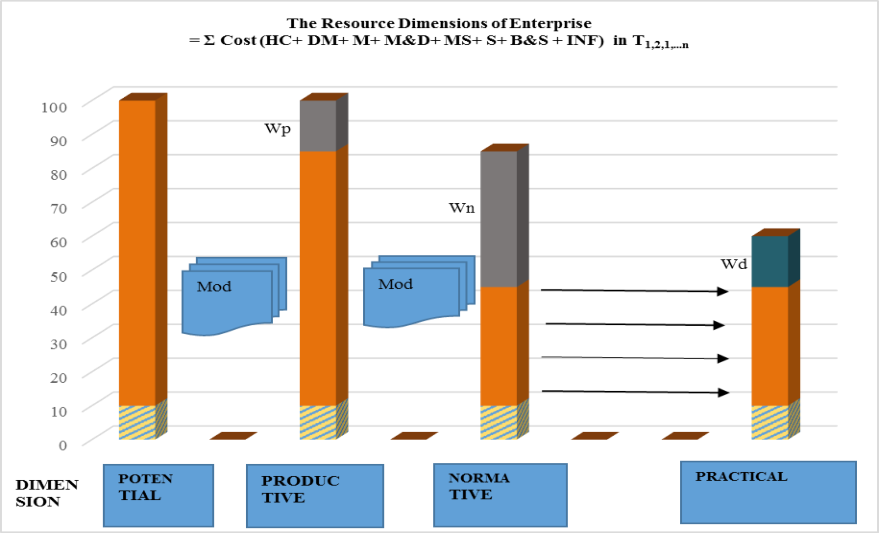
The research subject in the presented concept is the resources the firm has at its disposal. These include raw materials, materials, semi-finished products, human capital, machines, equipment, structures, buildings, information, utilities (infrastructural support such as water, electric power, technical gases, waste and waste disposal, etc.) as well as financial capital (Rymaniak 2011). The economic mechanism consists in adapting and developing RBV (Resource Based-View), which initiated the research on the significance of resources for business development (Penrose 1959). Also, theoretical aspects of the resources conversion have been presented (Rymaniak 2012a). The operationalization as presented in this article consists in the need to measure four dimensions of resources (bottom part – see Figure 1), which each time must be done simultaneously.
The POTENTIAL dimension stands for the cost of all active resources held by the firm. Active resources constitute the cost of all resources held by the firm and/or being at the firm’s disposal. However, the category does not include resources periodically excluded from the firm’s records, which do not create costs in a given period, e.g. machines, buildings and structures that are not being depreciated, even though other costs, such as costs of technical inspections, renovations or approvals regarding those facilities are still considered normative costs.
“Black- box of Enterprises
Where:
modularity execution of the contract fixed costs
Figure 1. The Conceptual Framework for Researching Enterprise Efficiency (coordinate system adapted from Adamiecki 1909)Table 1: The Method of Optimization in Praxeological View as ± Δ Relations between EFFECT and COST
(adapted from Kotarbinski 1969)
The second dimension is the PRODUCTIVE one. It covers all the kinds of resources which may be used in a given time, in possible configurations of modules, for the purposes of contracts implementation. The dimension thus constitutes the actual, current production capability of the firm.
The third dimension – NORMATIVE – shows the value of costs specified by means of resource consumption norms, applicable to the contracts being implemented. In other words, the economic level of optimal use of resources is specified, which is acceptable in the firm’s existing organizational and economic conditions. This dimension does not serve the purpose of price calculation needed for the marketed products, where simplified conversion factors are used. It rather serves the purpose of constructing an economic model of contracts implementation, necessary for achieving the presumed economic parameters of execution. It is therefore indispensable in operations management.
The fourth dimension is the PRACTICAL one. It shows the actual values of resources used (up) in the contract implementation.
The tool applied in specifying the ways of resources combination are the modules. The modularity process is described as combining the resources in permanent or periodic sets that constitute the links of the work flow. Depending on the solutions applied, departmental organizational forms are adopted (work cells, work stations, organizational units, etc.) or periodical solutions which most often take the form of teams. In the contemplated concept, it is taken under consideration whether modules should be applied as the tools of organization of internal operations. This results from the process approach. The main field of application included the modules being the basis for outsourcing. Rather than choosing vertical integration, with its reliance on hierarchical control, or a fully modularized arrangement, with its focus on contracts and minimal communication, some organizations occupy an intermediate realm. In this middle space, partners are not part of the same firm, but nor is communication as formalized and minimal as in full modularity (Gentry and Elms 2009).
The last structural element of the concept is the contracts. The contracts are represented by arrows, which show the dynamic nature of their implementation. It must be assumed that depending on the adopted time frame for research or identification of the actual situation (e.g. month, week, day, hour), the methodology will make it possible to capture the LIVE situation, i.e. to display the current state of affairs regarding the level and effectiveness of resources utilization.
Measurement methodology The discussed concept requires development of integrated systems of data measurement and record, which go beyond the measurement methods and tools most often used, including the scope of use of methods like ERP or SAP. Today, the survival of major and others corporations is challenged by a world-wide marketplace, international operations, outsourcing, global communities, a changing workforce, security threats, business continuity, web visibility, and customer expectations. Enterprises must constantly adapt or they will be unable to compete. Therefore, the element of key importance for agility and flexibility of big companies – and more and more often also the small and medium enterprises on local markets – is the records and ability to make use of it by way of IT (Cummins 2008).
In the proposed methodology, costs are measured and accounted for in three areas. The first one concerns the costs of creating and holding the resources. The subject of measurement and analysis is the structure of costs, classified by type, of the resources, and also the relation between the costs of contract-related resources and out-of-contract resources. In the latter case, it means checking the correspondence between the amount of resources that may be utilized in implementing the existing contracts, and the costs of resources that are not used at the existing contracts level. This regards both the overnormative resources (too many resources in relation to the contracts) and redundant resources that are unlikely to be used for the purposes of the existing kinds of contracts. Two fundamental issues must be resolved here. The first issue pertains to accounting for the resources purchased in large amounts due to economic reasons, e.g. flour for a bakery or soda for glassworks. This is connected with the other issue, namely the norms for inventory volumes, especially the buffer stock. It pertains mainly to “input” stocks (raw materials, materials, human capital, etc.). Similar mechanisms regard the black-box and “output” inventory (stocks of goods, some kinds of services, excessive production capacity of machines and equipment, etc.). Specifying the correct volume of financial means frozen in the form of inventory is a matter of correct relations between the market availability, delivery times and the firm’s financial possibilities. It therefore depends on the risk management skills with regard to resources, and especially the working assets.
The second area concerns the costs of using (up) the resources. Here the analysis focuses on the intra-resource costs, inter-resource and intermodular costs (Rymaniak 2013). The intra-resource relations specify the type- and quality-related criteria for selecting the right resources for the modules, i.e. the problem of resources substitution and complementarity. The inter-resource relations display the phenomena of integration, variability and stabilization. They reflect the flexibility level of the resources configuration. The intermodular relations, in turn, address the issues of cooperation, sequentiality or parallelisation as well as core multimodularity, i.e. the scale of possibilities to apply the module in various phases or/and processes of production (Rymaniak 2012b).
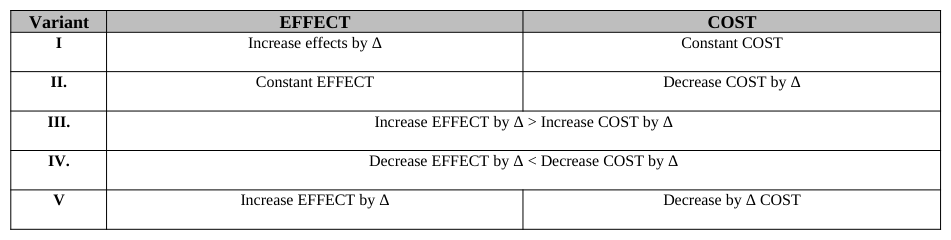
The areas outlined above display a larger scale of possibilities to rationalize investment, allocation/ relocation and using (up) resources in operation, compared to the approach of Taylor, Adamiecki and other researchers. The detailed analyses and the resulting praxeological approach methodology show five variants of economization of operations, i.e. results in the EFFECT/ COST relation (see Table 1). From Kotarbiński’s perspective, the first two variants constitute adaptation of economic principles. The first variant consists in an increase in effects at the same costs level, whereas the second variant is a decrease in value of costs, at the constant level of effects. The presented variants are an adaptation of, respectively, the efficiency principle (the first one) and the economizing principle (the second one) as the constituents of the rational management principle (Lange 1975). The third and fourth variants are based on the difference in growth (decrease) in effects and costs value. These variants are most often used in practice, since most measures that improve effects are also connected with the need to incur additional expenditure. In the same manner, economizing the costs results in decreasing the effects. Thus the variants result from growth dynamics and a decrease in effects and costs. It is only the fifth variant that refers to the original manner of the theoretical interpretation. It indicates the concepts of maximizing the effects while decreasing the expenditure, which are the most difficult concepts to implement in reality. Compared to the period when the classical authors’ research was done, the theoretical concept development in time can be seen.
The third area pertains to the resultant costs of the dimensions shown in Figure 1. It is proposed that the fundamental relations be analyzed.
The system of relations measures the level of possibilities to utilize the resources held by the firm, determined by technical preparedness of the resources and their applicability. It determines the actual state of the potential utilization of production capacities, i.e. the resources effectiveness. It refers to the dynamic capabilities which may help firms to avoid developing core rigidities which inhibit development, generate inertia and stifle innovation. Core rigidities are the flipside of VRIN resources: they are resources that used to be valuable but have become obsolete and inhibit the development of the firm. In other words, they are resources that have not been appropriately adapted, upgraded or restructured through dynamic capabilities (Ambrosini and Bowman 2009). The area marked Wp illustrates the volume of inactive (ineffective) resources (see Figure 1).
(1)
The relation discussed here measures the level of optimal, norm-compliant, desired level of resources indispensable for implementing the existing contracts (marked with arrows in Fig. 1). That means that the remaining part of resources making up the current production capacity level will not be used. The volume of unused (from the point of view of the norms, i.e. potentially available) resources is illustrated by the area Wn shown as the extension of the NORMATIVE dimension (see Figure 1).
(2)
The third relation specifies the actual level of the firm’s efficiency in using the resources. “1” will be an efficient result, which takes place when the values of NORMATIVE and PRACTICAL are the same. The most common situation is when the actual use of resources is greater than the assumed norms. This is shown by area Wd in Figure 1.
The methodology makes it possible to compute the total value and different level of WASTE. This is done in the equation:
Equation reproduced from the original PDF.
It makes it possible to calculate the firm’s effectiveness levels via sets of indicators referring WASTE total level and constituents to revenues, different costs and profit levels, etc. Thus, via the proposed aggregates of data it is possible to assess, on a current basis, the firm management quality, including also its capabilities and dynamic capabilities, or the skills of its managers to make use of the held resources potential.
CONCLUSIONS
This article presents a theoretical concept that takes into account the internal (structural) dimensions of a firm as well as the external, synthetic positioning of the financial result (profit) as the criteria of a firm’s economic effectiveness. It refers to the creative extension of the Resource Based-View concept (Penrose 1959) as a mechanism of firms establishing and functioning. In that perspective, aggregates inform us on the scope of indispensability and efficiency of the held resources (1) in terms of their technology and type, the level of needs connected with existing contracts (2), and the level of the firm’s efficiency measured by the compliance of actual use of resources with the norms (3). They also monitor the level of fixed costs (Kmin), and also the production processes. Therefore, it may be stated that the proposal is both process-related (Grajewski 2007, Skrzypek and Hofman 2010) and systemic (Saurin et al 2013).
The dilemma WASTE or PROFIT is back – especially in the context of resource management – as a research problem (Bridoux et al 2013). Taking WASTE into account in the criteria for effectiveness assessment justifies development of other categories connected with the possibilities to reduce the phenomenon. These categories include CAPABILITY, elaborated in organization and management sciences. One of the most important developments in the field of management in the last 15 years has been the increased attention given to the concept of organizational capability denoting the firm-specific as well as time- and space-contingent ability to perform a particular productive activity. Two decades later we have come to take the heterogeneity of organizations and their capabilities as given – at least within the field of management (Helfat 2003) as opposed to economics (Jacobides and Winter 2010). The dynamic capabilities category has been defined as “the capacity to renew competencies so as to achieve congruence with the changing business environment” by “adapting, integrating, and reconfiguring internal and external organizational skills, resources, and functional competencies” (Teece et al. 1997). More recently, Helfat defined a dynamic capability as “the capacity of an organization to purposefully create, extend or modify its resource base” (Helfat and Peteraf 2009).
As a matter of fact, the CAPABILITY category is not in opposition to economy. In the context of methods to combine resources (the classical approach) or managerial skills (the dynamic approach) the category is focused on the use of resources, which means reduction of WASTE. The combined application of the criteria makes it possible to “unpack the firm's black-box” and conduct an advance study of economic organization (Grandori 2013).
Additional, practical benefits are the emerging changes in management criteria and methods. Changes are needed in the management mechanism (Koskela 2011). The possibilities of current planning and making decisions in a LIVE version change not only the essence of management, but also – and radically – the requirements regarding the managerial skills and accounting for firms’ financial results. For example, if a firm makes a profit of EUR
4,000,000; has resources potentially allowing to make EUR 9,000,000; at the PRACTICAL level it used up an overnormative amount of EUR 500,000; in one of the last 5 years made a profit of EUR 7,500,000, the following accounting questions arise: - is the manager efficient? (4,000,000 profit). - why did the company decrease the level to 53% of the competitive advantage ? (4,000,000/7,500,000) - why did the company use its resources only in 44%, in view of the result? (4,000,000/9,000,000) - why did the firm decrease the profit by 12.5%, using overnormative resources Wd ? (500,000) The aforementioned questions (and there are more of them in the light of the presented concept) indicate how ”the black-box unpacking” turns an efficient and competent manager with a 4,000,000 profit (today’s economic positioning on the market with the firm’s financial result) into a hardly efficient manager with an organization slack, a high level of redundant costs and decreasing the firm’s competitiveness on the market. The presented case study confirms the applicability of the presented concept.
REFERENCES
Adamiecki, K. (1909), “Metoda wykreślna organizowania pracy zbiorowej w walcowniach”, reprint in: K. Adamiecki, (1985), “O nauce organizacji. Wybór pism”, Heidrich, Z. (Ed.), TNOiK, PWE, Warszawa, pp. 59-106 Adamiecki, K. (1925), „Naukowa organizacja pracy. Pierwszy zjazd Polski 1924”, Komitet Wykonawczy Zrzeszeń Naukowej
Organizacji Pracy w Polsce, Warszawa, pp.45-72, reprint in: K. Adamiecki, (1985), “O nauce organizacji. Wybór pism”, Heidrich, Z. (Ed.), TNOiK, PWE, Warszawa, pp. 179-204 Ambrosini, V., Bowman, C., (2009), „What are dynamic capabilities and are they a useful construct in strategic management?”, International Journal of Management Reviews, Volume 11, Issue 1, pp. 29–49 Banaszyk P. (2003), “Cele przedsiębiorstwa w świetle wiedzy współczesnej i w poglądach klasyków”, in: Współczesne
interpretacje dorobku klasyków nauki o zarządzaniu, Banaszyk, P. (Ed.), Wydawnictwo Akademii Ekonomicznej w Poznaniu, Poznań, pp. 11-26 Bridoux, F, Smith, K.G., Grimm, C.M., (2013), „The Management of Resources: Temporal Effects of Different Types of Actions on Performance”, Journal of Management, Volume 39, No. 4, pp. 928-957 Burawoy, M., (2003), „Manufacturing consent: Changes in the Labor Processes Under Market Capitalism” in: The Sociology of
Organizations: Classic, Contemporary, and Critical Readings, Handel, M.J. (Ed,), Sage Publications, Inc., Thousand Oaks, California, USA, pp. 170-180 Cummins, F. (2008), „Building the Agile Enterprise With SOA, BPM and MBM”, Morgan Kaufmann; Elsevier Science Dietrich, M. (2007), “The Nature of the firm revisited”, in: Economics of the firm. Analysis, evolution, history. Dietrich, M.
(Ed.) Studies in Global Competitions Series, Routledge, pp. 19-42 Dietrich, M., Krafft J. (2008), ,,Towards an Historically Relevant Economics of the Firm”, in: Varietes of Capitalism and New Institutionals Deal, Regulations, Welfare and New Economy, Elsner, W., Hanappi, M., (Eds.), Edward Elgar, Cheltenham UK and Northampton, MA, USA, pp. 103-121 Dietrich, M., Krafft J. (2012), “Economics and theory of the firm”, in: Handbook on the Economics and Theory of the Firm,
Dietrich, M., Krafft J. (Eds.), Edward Elgar Publishing Limited, Cheltenham, pp. 3-28 “Elastycznośc organizacji”, Krupski,. R. (2008), Wydawnictwo Uniwersytetu Ekonomicznego we Wrocławiu, Wrocław Emiliani, M.L., Seymour, P.J. (2011), “Frank George Woollard: forgotten pioneer of flow production”, Journal of Management History, Volume 17, No. 1, pp. 66-87 Fujimoto, T., (2012), “The Evolution of Production Systems: Exploring the Sources of Toyota’s Competitiveness”, Annals of
Business Administrative Science, Volume 11, pp. 25–44 Galbraith, J.K., (1987), “Economics in perspective. A Critical History”, Houghton Miffin Co., Boston, USA Gentry, R.J., Elms, H., (2009), „Firm Partial Modularity and Performance in the Electronic Manufacturing Services Industry”, Industry and Innovation, Volume 16, No. 6, pp. 575–592 Grajewski, P. (2007), ”Organizacja procesowa”, Polskie Wydawnictwo Ekonomiczne, Warszawa Handbook of Economic Organization: Integrating Economic and Organization Theory (2013), Grandori, A. (Ed.), Edward Elgar
Publishing Limited, Cheltenham, UK Helfat, C.E., Peteraf, M.A., (2009), „Understanding dynamic capabilities: progress along a developmental path”, Strategic Organization, Volume 7, No. 1, pp. 91-102 Imai, M., (2006), „Gemba Kaizen”, Wydawnictwo MT Biznes, Warszawa Ishii, K., (2013), „A production research to create new value of business output”, International Journal of Production Research,
Volume 51, Issue 23–24, pp. 7313–7328 Jacobides, M.G., Winter, S.G. (2010), „Understanding Capabilities: Structure, Agency and Evolution”, Conference "Opening Up Innovation: Strategy, Organization and Technology" at Imperial College London Business School, June 16 - 18, Jain, A., Jain, P.K., Chan, F.T.S., Singh, S. (2013), “A review on manufacturing flexibility”, International Journal of Production
Research, Volume 51, No. 19, pp. 5946-5970 Kasiewicz, S. (2004), “Przesłanki i cel tworzenia przedsiębiorstwa. Zasoby przedsiębiorstwa i ich wykorzystanie”, in: Teoria przedsiębiorstwa. Wybrane zagadnienia, Kasiewicz, S., Możaryn, H. (Eds.), Szkoła Główna Handlowa, Warszawa, pp. 9- 92
Koskela, L. (2011), „Fifty years of irrelevance: the wild goose chase of management science”, in: Proceedings of 19th Annual Conference of the International Group for Lean Construction (IGLC19), July 13 – 15, 2011, Lima, Peru. Rooke J., Dave, B. (Eds.), pp. 85 – 96 Koskela, L., Sacks, R.J., Rooke, J. (2012), „A Brief History of the Concept of Waste in Production”, in: Proceedings 20th Annual
Conference of the International Group on Lean Construction : are We Near a Tipping Point? (IGLC20)), San Diego, CA, USA, July 18th-20th, Tommelein I.D., Pasquire C.L. (Eds.), Montezume Publishing Koskenvesa, A, Koskela, L.J., Tolonen, T.,Sahlsted, S., (2010), „Waste and labor productivity in production planning case Finnish construction industry”, in: Proceedings 18th Annual Conference of the International Group for Lean Construction (IGLC 18), Haifa, Israel, July 14-16, 2010, pp. 477-486 Kotarbinski, T., (1969), “Traktat o dobrej robocie”, 4th edition., Zakład Narodowy im. Ossolińskich, Wrocław Koźmiński, A.K. (2006), “Organizacja”, in: Zarządzanie. Teoria i praktyka, Koźmiński, A.K., Piotrowski, J. (Eds.), 5th ed.,
Wydawnictwo Naukowe PWN, Warszawa, pp. 17-43 Lange, O. (1975), „Ekonomia polityczna”, Państwowe Wydawnictwo Ekonomiczne, Warszawa Lockett, A.S., Thompson, S., Morgenstern U., (2009), „The development of the resource-based view of the firm : a critical appraisal”, International Journal of Management Reviews, Volume 11, Issue 1, pp. 9-28 Noga, A. (2009), „Teorie przedsiębiorstw”, Polskie Wydawnictwo Ekonomiczne, Warszawa Penrose, E.T. (1959), „The Theory of the Growth of the Firm”, Third edition, Oxford University Press, Oxford Pheng, L.S., Shang G., (2011), "Bridging Western management theories and Japanese management practices: case of the Toyota
Way model", Emerald Emerging Markets Case Studies, Volume 1, No. 1, pp. 1-20 Przedsiębiorstwo. Wartość, Zarządzanie (2007), Suszyński, C. (Ed.), Polskie Wydawnictwo Ekonomiczne, Warszawa Robbins, R,H, (2009), “Globalne problemy a kultura kapitalizmu”, 3th ed., Wydawnictwo Pro Publico, Poznań Rymaniak, J. (2012a), “Work in organization: key factors of the reistic approach”, in: Advances in Social and Organizational Factors, Vink, P. (Ed.), CRC Press, Taylor & Francis Group, Roca Baton, FL, USA, pp. 562-572 Rymaniak, J., (2012b), ”Elastyczność jako wymiar reistycznej koncepcji pracy”, in: Sukces w zarządzaniu kadrami. Elastyczność
w zarządzaniu kapitałem ludzkim. Tom 2. Problemy zarządczo- psychologiczne, Witkowski St. A., Stor M. (Eds.), Prace Naukowe Uniwersytetu Ekonomicznego we Wrocławiu. Zeszyt nr 249, Wydawnictwo Uniwersytetu Ekonomicznego we Wrocławiu, Wrocław, pp.36-44 Rymaniak, J. (2013), “Segmentacja modułowa procesów w organizacji – model teoretyczny i wymiary ekonomiczne”, in: Nowe koncepcje w zarządzaniu organizacją wobec wyzwań otoczenia, Boguszewicz- Kreft M., Rozkwitalska M. (Eds.), Prace Naukowe Wyższej Szkoły Bankowej w Gdańsku, Tom 22/2013, CeDeWu, Warszawa, pp. 59-70 Saurin, T.A., Rooke, J., Koskela, L. (2013), “A complex systems theory perspective of lean production”, International Journal of
Production Research, Volume 51, No. 19, pp. 5824–5838 Skrzypek, E., Hofman, M., (2010), „Zarządzanie procesami w przedsiębiorstwie. Identyfikowanie, pomiar, usprawnianie”, Oficyna a Wolters Kluwer business, Warszawa Smith, A. (2007), „Badania nad naturą i przyczynami bogactwa narodów”, Wydawnictwo Naukowe PWN, Warszawa Stone, KB. (2012), „Four decades of lean: a systematic literature review”, International Journal of Lean Six Sigma, Volume 3,
No. 2, pp. 112-132 Taylor, F.W. (1926), „Zarzadzanie warsztatem wytwórczym (Shop management)”, Księgarnia Wł. Wilak, Poznań Teece, D.J., Pisano, G., Shuen, A., (1997), „Dynamic Capabilities and Strategic Management”, Strategic Management Journal, Vol. 18, No. 7, pp. 509-533 Trzcieliński, S. (2005), „Modele zwinności przedsiębiorstwa”, in: Nowoczesne Przedsiębiorstwo, Trzcieliński, S. (Ed.), Instytut
Inżynierii Zarządzania, Politechnika Poznańska, Poznań, pp. 11-23
LISTED IN THE AHFE DIGITAL BOOKSTORE CATALOGUE
Explore the complete digital volume
Advances in The Ergonomics in Manufacturing: Managing the Enterprise of the Future
Read this individual research paper free through the original publisher, or explore the full digital proceedings book.
ISBN 978-1-4951-2103-6
Explore this ISBN in the AHFE Bookstore ↗Listed in the July 2026 bookstore catalogue; search by ISBN to confirm current availability · Digital book purchase optional