Sheng-Hann, Li, Sheue-Ling Hwang (2020). The Effect of Auditory Feedback on Websites Users Perception. In: Advances in The Ergonomics in Manufacturing: Managing the Enterprise of the Future. AHFE Open Access, vol. 12. https://doi.org/10.54941/ahfe100450
In this investigation, we design a website named UN.com that has three scenes and with different numbers of auditory feedback. An experiment was designed to explore the application of auditory feedback. The better situation to use auditory feedback has been found out. We found a significant correlation between auditory feedback and website usability. Too many auditory feedbacks may cause negative effect. The result may provide web designer some suggestion on auditory feedback to prevent negative effects.
Often, the only feedback that the user receives in website is visual feedback. In comparison with visual feedback, for which there have been many empirical studies, exploration of sound has been slower but the use of sound at the website is becoming increasingly popular due to the potential benefits it offers. Research is now showing that sound combined with graphics can significantly improve usability by taking advantage of our natural ability to share tasks across sensory modalities (Alty,1995; Brewster et al,1995).
When sound is used to provide feedback in a user interface, the type of sound used is important in maximizing its effectiveness and minimizing its annoyance. Two classes of sounds auditory feedback and earcons have been proposed as auditory icons. (Brewster, Wright, & Edwards,1993). It can be used to present information unavailable on a visual display, such as mode information or confirmed information. However, to date, there has been relatively few research conducted on the relationship between auditory feedback and situations. When giving unnecessary feedback, the auditory feedback becomes noise that distracts the user from the task. Brewster & Cockburn (2005) found that inappropriate use of modalities can increase selection times, but no clear direction has emerged to suggest how to avoid auditory feedback become noise in some specific situations.
To ensure that auditory feedback best meet the constantly changing web interface needs and the needs of users, assessment must be carried out to ascertagin the real needs of users. Most researches on auditory feedback have focused on the individual difference and how to use auditory feedback in user interface. However, auditory feedback may not always well-designed in some situations. The major purpose of this study was to investigate the role of situation in auditory feedback. The results may provide designers on presenting negative effect on auditory feedback
BACKGROUND
Earcons Battner et al. (1989) defined earcons as a non-verbal audio messages that provide information to the user about some computer object and operation, or feedback to the user about computer entities. Earcons are brief musical melodies consisting of a few notes whose timbre, intensity, tempo and register are manipulated systematically. Sumikawa (1985) suggests a number of rules for designing earcons. For easy comprehension and memorization, earcons must be short and simple, easily distinguishable from other earcons, and convey only one meaning.
To design a set of earcons to sonify an interface depends on the interface and the function of the system. This set of guideline will allow designers to use earcons effectively. The earcons will communicate their information effectively and be recognizable by users easily. These guidelines are outlined below: Timbre:Using timbres with multiple harmonics, it could helps perception and can avoid masking, simple tones such
as square waves or sinewaves are not effective. Using multiple timbres per earcon may confer advantages when using compound earcons (Brewster,1994).
Register: If listeners should make absolute judgments, then the register should not be used (Barfield, 1991). Large different (two or three octaves) give better recall, much smaller differences can be used if relative judgments are to be made (Brewster, 1995).
Pitch: Complex intra-earcon pitch structures are effective in differentiating earcons if used along with rhythm or another parameter (Patterson, 1982).
Rhythm: Make rhythms as different as possible. Putting different numbers of notes in each rhythm is very effective (Brewster, 1994).
Auditory Icons Gver (1990) calls auditory icons is sound that we hear every day. For example, when we delete a computer file, we might hear the sound like object crashing into a wastebasket, selecting an object might sound like touching it and moving an object might make a scraping sound. Objects can sound like what they look like: windows can sound like glass surfaces, files can sound like solid objects being tapped or scraped. The strategy of creating auditory icons by mapping sound-producing events to events in the computer has many useful features. It allows the creation of parameterized auditory icons that convey rich multidimensional information. Auditory icons have the advantage of being immediately understood by the user without learning or memorization. According to the guidelines, the basic steps for auditory icons design are (Mynatt, 1994):
i. Choose every day sounds that have a wide bandwidth and length, intensity and quality could control. ii. Using free-form answers to evaluate the identifiability of the auditory icons. iii. Evaluate the learnability of the auditory icons that are not easily to know. iv. Test possible conceptual mappings for the auditory icons. Evaluate possible sets of auditory icons for potential problems with masking, discriminability and conflicting mappings. v. Conduct usability experiments with interfaces using the derived auditory icons.
Background Music Music plays an important role in our life. Some people like to listen music while working, because they think it could improve their efficiency. Yi-Nuo(2012) suggest that, if background music is played in the work environment, music without lyrics is preferable because songs with lyrics are likely to reduce worker attention and performance. Retailers use background music in order to enhance the atmosphere of their stores. Some studies suggested that background music was a tool for increasing sales and enhancing positive attitudes toward the store (Jean-Charles et al., 2001). Most of the studies are focused on the effect of different types of the music, and there are some suggestions to design adequate background music as follow.
i. Background music with lyrics could reduce worker efficiency, and the work environments should use background music without lyrics (Shih, Huang and Chiang, 2012). ii. The background music preferences are influenced by the social culture and by particular auditory features of music (Peter, Daniel and Lewis, 2011). iii. The background music needs to fit the scene and event. For example, an advertisement should consider both target consumers and the main contents to select the background music. To convey specific content, the background music should be performed in a energetic ( Rui and Joan, 2005). iv. The background music may attract attention onto itself and away from the subject. So it should be careful
to use background music in the system. However, the slow tempo music can help the listener to deep thoughts. The adequate background music, it could have good effect (Chebat, Chebat and Vaillant, 2001).
The Interference of Auditory Feedback The use of auditory feedback in the system has gathered great importance in recent years. Use auditory feedback can reduce visual load, good temporal resolution and convey important information. For example, when we use the mouse to click the wrong area, there will be a sound to remind us to find out the error quickly. However, unsuitable auditory feedback would interfere users. For example, the auditory feedback had a significant effect on speed of driving (Hellier et al., 2011). In a low car engine noise feedback, the car speed would significantly increase. In many cases, the auditory feedback is designed according to the guildelines but not all have good effect. The guidelines usually introduce how to design a good auditory feedback but not how to use it in right situation and right time. Therefore, in this research, we would try to find out the role of situation in auditory feedback.
METHOD
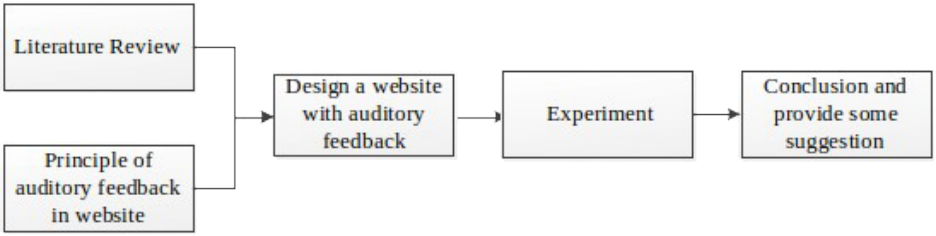
Research Framework The basic framework of this research was shown in Figure1. We design a website named UN.com that has auditory feedback according to the guidelines. Then an experiment was conducted to find out better situations. The major purpose of this study was to investigate the role of situation in auditory feedback.
Figure 1. Research Framework
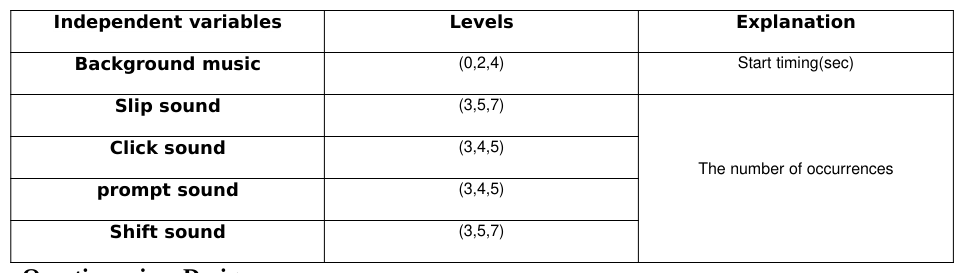
Experiment independent Variable In this experiment, we design different auditory feedback according to the general website principles as shown in Table1.
Table1: The levels of each auditory feedback Independent variables Levels Explanation
The questionnaire consisted of two sections, the first of which intended to elicit demographic information on the respondents. In the last section, subjects rated both helpful degree and annoying degree of auditory feedback by the questionnaire in a ten-point rating scale. The purpose of this part of the section is to understand the effect of individual auditory feedback. I Experimental Procedure
In this research, we design a website named UN.com that has three scenes and with different numbers of auditory feedback. These five kinds of auditory feedback are background music, slip sound, click sound, prompt sound and shift sound. In the experiment, the participants were 30 graduate students. The average number of online hours is six hours per day. Twenty of the participants were male and ten were female. All of the participants performed three different tasks. After each task, the subject as asked to fill out a questionnaire which elicited information concerning his/her feeling in auditory feedback. The independent variables were the different auditory feedbacks. The dependent variables were subjective helpful degree and annoying degree. We design three kinds of situations to find out the better timing and numbers of occurrences of auditory feedback.
RESULTS
We analyzed each auditory feedback on helpful and annoying. The result showed the effect of auditory feedback on annoying degree and helpful degree.
Back Ground music Effect of background music on helpful degree and annoying degree is not significantly different.
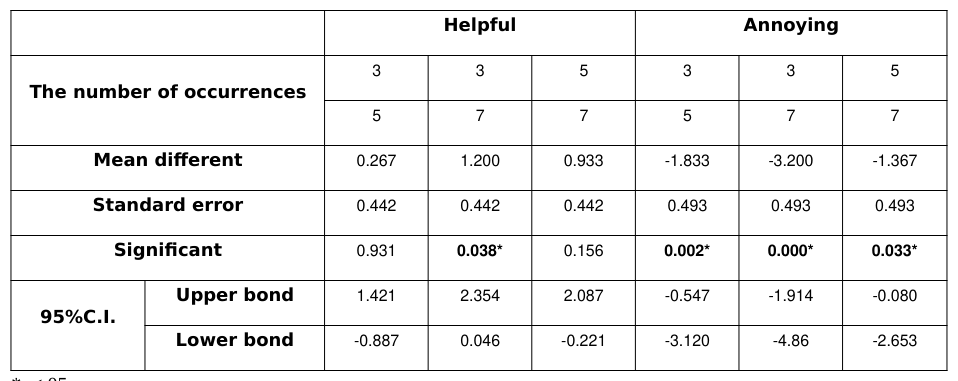
Slip Sound As for the multiple comparisons on the helpful degree among 3 levels, it shows that the effect of slip sound on helpful is significant. The more frequent occurrences of auditory feedbacks, the more annoying degree of the participants. We found that when the number of occurrences is bigger than five, the annoying degree would exceed the median value (M=5.23).These results are summarized in Table 2.
Table2: The multiple comparisons table used Tukey’s test for each number of sound Helpful Annoying
Click Sound
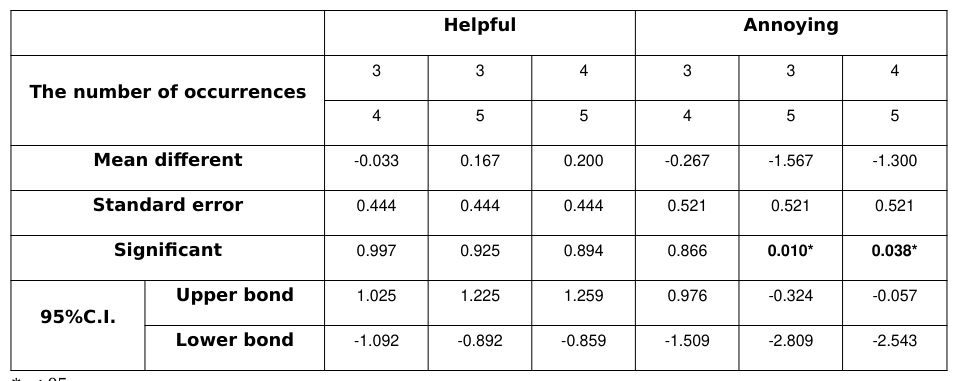
Table 3 shows the effects of click sound on helpful degree and annoying degree. The effect of click sound on annoying degree is not significant. The five times of occurrences resulted in highest annoying degree. No significant effect was found for click sound on helpful degree.
Table3: The multiple comparisons table used Tukey’s test for each number of sound Helpful Annoying
Prompt Sound The result showed that the helpful degree decreased significantly as the number of occurrences of prompt sound were from three to four (p<0.05), but the effect of prompt sound were not significant on annoying degree.
Shift Sound No significant effect was found for shift sound on helpful or annoying. However, the helpful degree of shift sound is the highest among the five types of sounds.
CONCLUSIONS
The present study is a preliminary research on auditory feedback in website. Some suggestions were proposed to prevent annoyance of the auditory feedback.
(i) We could find that the number of slip sound occurrences increase, it could cause annoying easily. Therefore, the frequency of slip sound should be fewer than five times.
(ii) Click sound is helpful for use on the website when the number of occurrences is fewer than five times.
(iii) The shift sound is helpful for the website users when the frequency of shift sound is fewer than seven times.
ACKNOWLEDGEMENTS
Partial of this study was supported by Advanced Manufacturing and Service Management Research Center at National Tsing Hua University through Toward World-Class Universities Project (ICT Product Interface Design and System Innovation, Project Number: 101N7071E1)
REFERENCES
LISTED IN THE AHFE DIGITAL BOOKSTORE CATALOGUE
Explore the complete digital volume
Advances in The Ergonomics in Manufacturing: Managing the Enterprise of the Future
Read this individual research paper free through the original publisher, or explore the full digital proceedings book.
ISBN 978-1-4951-2103-6
Explore this ISBN in the AHFE Bookstore ↗Listed in the July 2026 bookstore catalogue; search by ISBN to confirm current availability · Digital book purchase optional