Ales Bernatik, Ivana Bartlova (2018). Risk Assessment for LPG Storage. In: Advances in Physical Ergonomics and Human Factors: Part I. AHFE Open Access, vol. 1. https://doi.org/10.54941/10023
In view of the growing prices of petrol and oil, the interest of drivers in liquefied propane-butane (LPG) as a fuel for cars rises. The number of storage tanks for car filling, both stand-alone tanks and tanks as part of petrol filling stations increases. Prevention of accidents associated with LPG storage facilities is a priority in the protection of people in the vicinity of the facilities and equipment and forms an integral part of the management of system safety. The aim is to contribute to the prevention of accidents and incidents of process equipment with LPG based on the analysis of possible scenarios of accidents of LPG storage tanks and on the assessment of risks.
At present, the consumption of fuels, especially in connection with passenger and goods traffic grows continuously. In spite of the efforts made in the area of alternative fuels (liquefied natural gas LNG, compressed natural gas CNG, biofuels and hydrogen), classical fuels, such as petrol, oil, propane-butane (LPG) still predominate.
With the growing number of accidents and incidents involving the mentioned fuels, it is necessary to accelerate efforts to prevent possible extraordinary events. Accidents involving hazardous substances can cause serious injuries to people even outside inhabited areas and damage to the environment. Risk analysis and assessment represent one of the most significant steps in the framework of dealing with the prevention of and preparedness for accidents.
Equipment with propane-butane (pressure vessels, tanks for heating) together with its transport by road and rail represents a significant number of risk sources. In view of the growing prices of classical fuels, an interest in the cheaper LPG (liquefied propane-butane) increases. New LPG filling stations are built, but the issue of distances between them and petrol filling stations has not been sufficiently solved yet. During normal operation, fuel filling stations are not regarded as significant sources of risk in spite of the fact that from statistical data a certain level of major accident risk follows. In case of accident, a so-called domino effect, when an accident of one piece of equipment may cause a major accident of another piece of equipment (Bernatik, 2006), has to be considered.
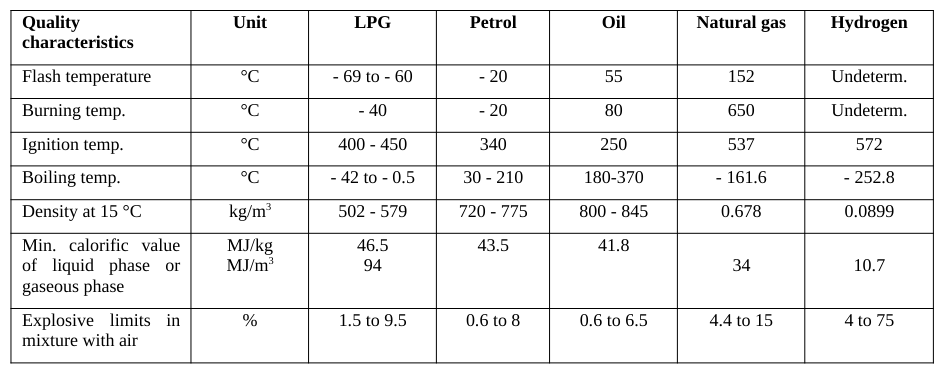
PROPANE-BUTANE PROPERTIES AND CHARACTERISTICS For carrying out risk analysis and assessment and for proposing preventive measures, it is necessary to know the physical and chemical properties of present hazardous substances and their technical and safety parameters and use them as a basis. In Table 1, technical and safety parameters of LPG and most widely used motor fuels are given for comparison.
Propane-butane (LPG) is a trade name for a liquefied mixture of lightweight hydrocarbons, mostly with 3-4 carbon atoms in one molecule. The liquefied LPG is a colourless, easily volatile liquid of specific odour. The LPG contains the greater amount of propane than that of butane. By evaporation of 1 m3 of liquefied propane-butane (about 550 kg) into the air, about 12 500 - 13 000 m3 of explosive mixture are produced in the case of gas dilution to the lower explosive limit; the explosive mixture is heavier than air and accumulates in low places.
Propane is an extremely flammable gas and has slightly narcotic effects. The narcotic effects manifest themselves at concentrations far higher than the explosive limits. If liquefied propane comes in contact with skin, frostbite similar to burns causing skin damage may occur.
Table 1: Technical and safety parameters of motor fuels (Analyza soucasne legislativy ..)
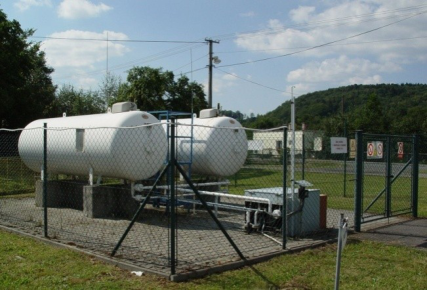
From the point of view of present amounts of stored LPG, the following facts can be stated. The amount of LPG in filling stations moves in a range from 2.1 t to 4.2 t in storage tanks of various sizes (e.g. a 5 m3storage tank contains 2.1 t of LPG). Similar tanks are used for house heating (1.1 or 2.1 t of LPG for family houses) and for establishments in isolated places (e.g. hotel – 8.4 t of LPG). These tanks can be of underground or aboveground type (see examples in Figure No. 1). Further, propane-butane is sold in pressure vessels of various sizes (2, 5, 10 and 33 kg of LPG). The sources of risk can be above all rather large storage facilities for vessels, when the total amount of propane-butane can be 1 to 4 t.
Figure 1: LPG filling station in a plant and that for domestic use
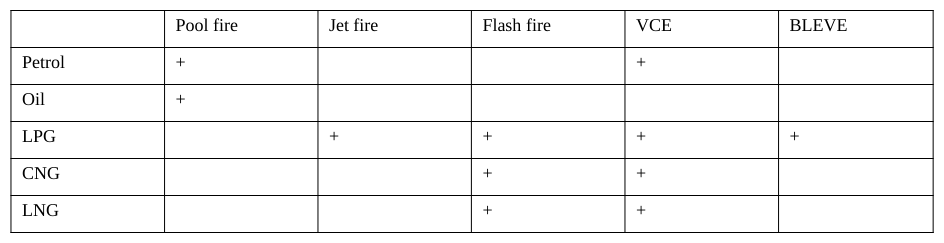
When storing the LPG in tanks, the following types of accidents may occur- Jet Fire, Flash Fire and VCE- type and BLEVE-type explosions. In the case of handling of LPG pressure vessels, the start of fire and explosion can be expected as well.
Table 2 presents the possible types of phenomena of accidents in the case of damaged equipment containing selected fuels and their subsequent leaks.
Table 2: Overview of phenomena of accidents involving specific fuels
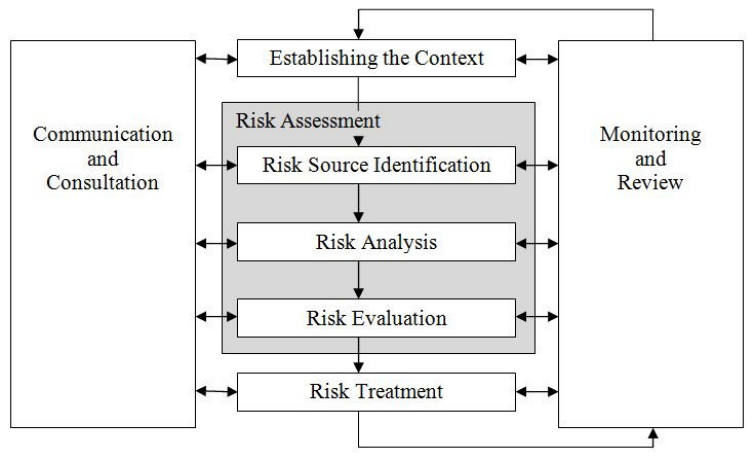
METHODS OF RISK ASSESSMENT A general procedure for major accident risk assessment and management according to ISO 31000:2009 Risk Management is shown in Figure 2.
Figure 2: Risk management process modified according to ISO 31000:2009 (ISO 31000, 2009)
Risk assessment can be carried out by quite a number of methods developed by modifying several most widely used methods. The publication “Review of 62 risk analysis methodologies of industrial plants” (Tixier, et al, 2002) summarises the best known methods of risk assessment. To the most significant publications in the area of quantitative risk assessment belong Lees’ Loss Prevention in the Process Industries, Hazard identification, assessment and control, 2005 (Mannam, 2005), Guidelines for Chemical Process Quantitative Risk Analysis - CPQRA, 1989 (CCPS, 1989) and Guidelines for Quantitative Risk Assessment –“Purple Book”, 1999 (Guidelines for Quantitative Risk Assessment, 1999). It is just the Dutch methodology CPR 18E Guidelines for Quantitative Risk Assessment known as “Purple Book” that represents a recognized approach to the overall risk assessment.
The methodology ARAMIS (“Accidental Risk Assessment Methodology for Industries in the framework of the SEVESO II directive”) was developed in the framework of an EU 5FP project. A harmonised methodology for risk assessment, aimed especially at reducing uncertainties and variability in results and at including the evaluation of risk management efficiency into the analysis, was proposed. It is necessary to regard ARAMIS as a comprehensive tool for efficient implementation of risk identification and analysis with many pre-prepared and recommended steps (ARAMIS, 2004).
For making the risk analysis, various methods exist that are used for individual steps of the analysis, namely risk source identification and determination of consequences and probabilities of scenarios. The first group of the methods can be characterised by taking pre-defined data from well-known literature based on experience from the past (they use so-called reference scenarios). The second group of methods uses a demanding procedure of the very generation of development of a scenario that is necessary, e.g. in the case of assessment of new technologies and new risks, when the first procedure of reference scenarios cannot be used owing to the lack of information and experience. The ARAMIS methodology, belonging to the second group, uses logical graphs - fault trees and event trees – for the preparation of accident scenarios. It was justly selected for the analysis and assessment of risks associated with the LPG filling station.
RISK ANALYSIS AND ASSESSMENT BY THE ARAMIS METHODOLOGY Risk analysis and assessment by the ARAMIS methodology were carried out in an industrial plant using the LPG for powering forklifts and having a built-up LPG filling station on its premises. The filling station consists of two cylindrical horizontal tanks; the total maximum amount of LPG is 4.9 t (see Figure 1). In the vicinity of the filling station, which is located on the boundary of the industrial plant, there are a housing estate and a public road. In case of major accident, a threat to both the employees of the plant and the population can be expected. For the purpose of simplification, other risk sources in the plant are not assessed.
The procedure of the ARAMIS methodology can be divided into three basic steps, the outputs of which are relevant indexes:
1. assessment of consequence severity (S - severity index),
2. evaluation of risk management efficiency (M - management index),
3. assessment of surrounding environment vulnerability (V- vulnerability index).
All the indexes can be evaluated separately, but above all the indexes S and M are considerably interconnected in the selection of reference accident scenarios and consequence severity determination, when efficient measures to reduce the risks can affect the frequency of accidents or to limit the consequences of them.
Furthermore, the procedure for determining the index S-assessment of consequence severity will be presented. In the first phase, a list of sources of risks of major chemical handling accidents is made up.
- LPG filling station, 4 900 kg of propane-butane, extremely flammable liquefied gas.
For the purpose of risk source identification, 16 types of equipment (selected EQ equipment) are defined in the methodology. In our case, it is EQ4–Pressure storage type of equipment.
To each selected risk source, a critical event has to be assigned (CE - Critical Event). The critical event is defined as a release of liquid content (LOC - Loss of Containment) from equipment. The method assumes 12 critical events. For our purposes, a critical event CE10 –Catastrophic ruptures was selected.
Further, fault trees and event trees that are connected to a so-called bow-tie (diagram) are built. Bow-ties are to be understood as major accident scenarios without considering installed safety systems. The result of this part is the construction of a bow-tie (will be explained during paper presentation).
The aim of the next phase of ARAMIS methodology is to select a reference scenario of accidents from scenarios identified in the first part. It is based on the study of influence of safety elements and risk management on selected scenarios. The reference accident scenarios (RAS) represent a real hazardous potential of equipment after considering safety systems (including management). In the methodology, the following items are taken into account:
safety systems installed on equipment,
safety management system,
frequency of accidents,
possible consequences of accidents.
For the determination of frequencies of initiating events, the methodology offers selected data in appendices; above all the summary of frequencies of initiating events from specialist literature, list of possible safety barriers, method of evaluation of effects of individual barriers are stated. For the needs of placement of barriers into the fault tress, the safety barriers are divided by actions to be achieved, namely to avoid, to prevent, to control, to detect and to limit. For the needs of evaluation of effects of the barriers, 4 main categories of safety barriers are defined: passive, activated, human actions and symbolic barriers. The very evaluation of barrier effects is carried out by means of three parameters, especially according to the level of confidence (Level of Confidence -LC), effectiveness and response time. The output is a fault tree with determined frequencies of critical events (will be discussed during paper presentation as well).
The result of this part of the methodology is the frequencies of critical event after considering safety barriers in the fault trees.
For CE10 –catastrophic rupture of LPG storage tank – 2.1.10-6 /year.
In the case of frequency of critical event of less than 10-7 /year, there is no need to apply subsequent steps.
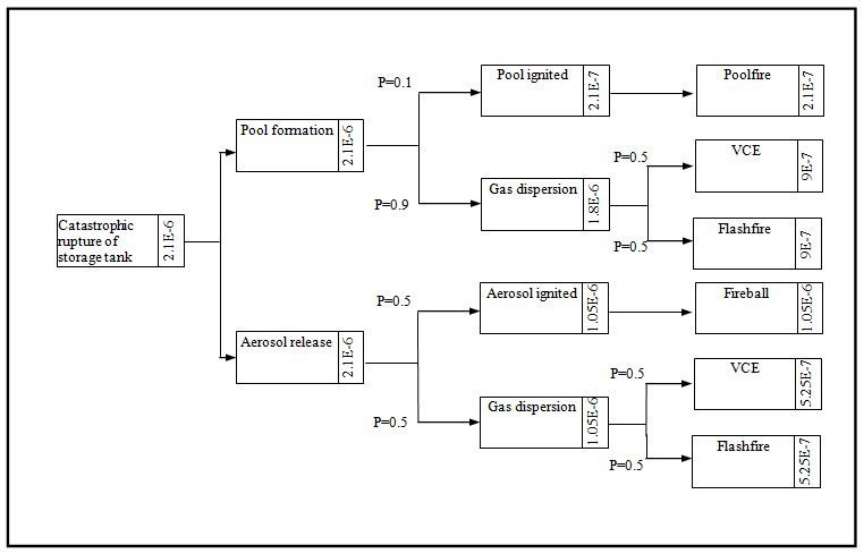
The aim of this step is to determine the frequencies of all dangerous phenomena of selected critical events. The procedure is based on considerations concerning the safety barriers in the event trees that can decrease the frequency or consequences of the dangerous phenomena.
Results for the selected critical event are illustrated in Figure 3.The methodology again offers rough values of probability of immediate ignition, probability of delayed ignition and probability of VCE from specialist literature.
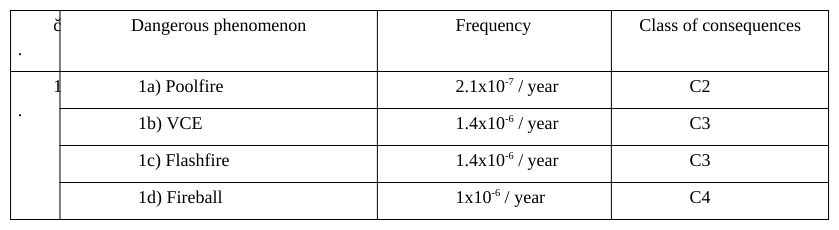
Figure 3: Event tree with the frequencies of dangerous phenomena – rupture of LPG storage tank In the next step, it is necessary to carry out the rough evaluation of consequences of dangerous phenomena. This qualitative evaluation of consequences is based on classifying the dangerous phenomena into 4 classes of
consequences (C1- 4), when the class C4 means the most serious consequences on human health and/or the environment. For individual dangerous phenomena the methodology offers pre-defined classes of consequences that can be modified according to the efficiency of barriers limiting the released amount of the substance or the impact of the dangerous phenomenon. The final classes of consequences are given in Table 3.
Table 3: Frequencies and classes of consequences of dangerous phenomena Dangerous phenomenon Frequency Class of consequences č .
Definition of classes of consequences: C1 - no injury or slight injury with no stoppage of work - only observable effects on the environment, no action C2 - injury leading to a hospitalisation more than 24 hours - serious effects on the environment, requiring local means of intervention C3 - irreversible injuries or death inside the site, reversible injuries outside the site - effects on the environment outside the site, requiring national means C4 - irreversible injuries or death outside the site - irreversible effects on the environment outside the site, requiring national means
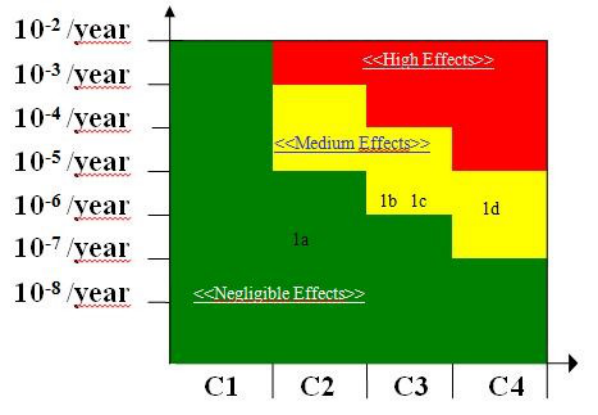
Reference scenarios are selected by means of a tool – risk matrix (see Figure 4). In the matrix, the following 3 zones are defined:
“Negligible effects” zone corresponds to dangerous phenomena with sufficiently low frequencies and consequences that probably will not be significant. There is no need to evaluate these scenarios any more.
“Medium effects” zone corresponds to the reference accident scenarios that will probably have significant impacts. These scenarios are selected for further detailed assessment of severity.
“High effects” zone corresponds to reference accident scenarios that will certainly have significant impacts. These scenarios are selected for further detailed assessment of severity and additional safety barriers should be proposed.
Figure 4: Risk matrix with results
It is necessary to state that the risk matrix in this phase of the methodology does not decide about the acceptability of risks but that it merely selects the reference accident scenarios that are further modelled for the purposes of severity determination.
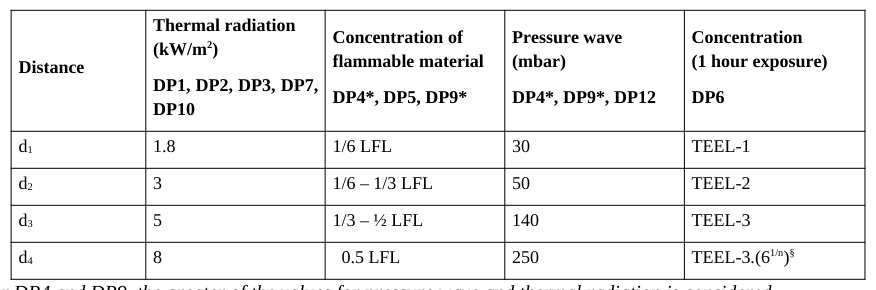
In the last phase of evaluation of index S by the ARAMIS methodology, the severity indexes of reference accident scenarios are determined using the proposed parameters. It is just the proposal of threshold values for individual effects of accidents that is another significant benefit of the methodology, because in the European Union uniform recommended values do not exist yet. Table 4 summarises the threshold values corresponding to four levels of consequences.
Table 4: Levels of individual dangerous phenomena for the determination of distances (Bernatik, 2006) Thermal radiation (kW/m2)
* for DP4 and DP9, the greater of the values for pressure wave and thermal radiation is considered.
§ this value represents the same dosage as TEEL-3, but at 10 min exposure For the determination of individual distances, any mathematical model can be used. With regard to the fact that the use of computing module is entirely independent of the methodology for the determination of index S, the user can employ any mathematical model for the evaluation of accident effects.
Because VSB – Technical University of Ostrava has a licence for the recognized Dutch model EFFECTS, distances for particular levels of effects were calculated using this model, One of advantages of this model is a possibility of calculation of consequences of fires, explosions and dispersion of toxic substances. Table 5 states the results in the form of distances (in metres) for particular levels of consequences d1 – d4 and for each dangerous phenomenon that was selected as a reference accident scenario. The type of consequences expresses one of four possible serious effects of accidents (thermal radiation, overpressure, missiles, toxic effects).
Table 5: Results of range distances of dangerous phenomena for CE10
Table available in the original PDF paper.
It is recommended to illustrate the resulting distances in maps using a GIS tool. With reference to rather high time demands of the application of geographic information systems, this is not necessary; the obtained results of distances can be put to the map of the plant in a simplified way.
CONCLUSIONS
The application of the ARAMIS methodology in an industrial plant using the LPG as a fuel for powering forklifts is described. The aim was to test the applicability of the methodology to such types of risk sources. The following conclusions can be stated: [Equation or mathematical symbol available in the original paper PDF] ARAMIS enables the assessment of risk sources containing the LPG.
[Equation or mathematical symbol available in the original paper PDF] In a number of steps, pre-defined data facilitate the procedure of detailed risk assessment.
[Equation or mathematical symbol available in the original paper PDF] However, making the analysis is difficult from the specialist as well as time point of view.
In spite of rather high professional and time demands, the ARAMIS methodology can be recommended as a suitable approach to the carrying out of quantitative risk analysis.
From the results it follows that it is the explosion of LPG storage tank (deadly consequences within a distance of about 195 m) that represents the greatest threat to the population and employees of the industrial plant. It is necessary to state that in the plant, high-level safety is ensured; many technical and organizational measures are implemented. For example, spraying equipment above storage tanks as a safety measure to protect against BLEVE type explosions was additionally installed. In the plant, the equipment was installed as a result of an accident of a similar filling station abroad and recommendations of the multinational owner.
This contribution was prepared with support from the project of Ministry of the Interior of the Czech Republic No. VF20112015018,”Citizen Safety – Crisis Management”.
REFERENCES
Bernatik, A. (2006), “Studie hodnoceni podlimitnich zdroju rizik (Habilitacni prace)”, “(Study Concerning Underlimit Risk Sources Assessment. Habilitation thesis)”, VSB–TU Ostrava, Fakulta bezpecnostniho inzenyrstvi, Ostrava, 121 pp. “Analyza soucasne legislativy v oblasti parkovani vozidel s pohonem na zemni plyn, vjezdu do podzemnich garazi a vybaveni
dilenskych prostor.”, “(Analysis of current legislation in the area of parking of natural gas-powered vehicles, entrance to underground car parks and equipment of shop premises).” ISO 31000:2009. “Risk management” Tixier J., Dusserre G., Salvi O., Gaston D. (2002), “Review of 62 risk analysis methodologies of industrial plants”, in: Journal of Loss Prevention in the Process Industries 15, Elsevier, pp. 291-303 Mannan, S. (Ed.). (2005). “Lees´ Loss Prevention in the Process Industries: Hazard identification, assessment and control, Third
Edition”, Elsevier, ISBN: 0-7506-7555-1 CCPS. (1989), “Guidelines for Chemical Process Quantitative Risk Analysis – CPQRA” (1989), Center for Chemical Process Safety of the American Institute of Chemical Engineers, New York, ISBN 0-8169-0402-2 “Guidelines for Quantitative Risk Assessment, “Purple Book”, CPR 18E”. (1999), TNO, The Hague, ISBN 90-12-087961 ARAMIS. (2004), “Accidental Risk Assessment Methodology for IndustrieS in the framework of the SEVESO II directive”,
User Guide, contract number: EVG1–CT–2001–00036, December 2004,Website: http://aramis.jrc.it
LISTED IN THE AHFE DIGITAL BOOKSTORE CATALOGUE
Explore the complete digital volume
Advances in Physical Ergonomics and Human Factors: Part I
Read this individual research paper free through the original publisher, or explore the full digital proceedings book.
ISBN 978-1-4951-2104-3
Explore this ISBN in the AHFE Bookstore ↗Listed in the July 2026 bookstore catalogue; search by ISBN to confirm current availability · Digital book purchase optional