Mario Penzkofer, Anna-Sophia Henke, Karsten Kluth (2018). Assessment of the Ergonomic Quality of European Screwdrivers. In: Advances in Physical Ergonomics and Human Factors: Part I. AHFE Open Access, vol. 1. https://doi.org/10.54941/10029
In a comparative ergonomic study, the ergonomic quality of 10 various screwdriver handles from European manufacturers which exhibited decisive differences in the design aspects “shape”, “dimension”, “material” and “surface” was tested. For this purpose, a test layout was developed in order to analyze the potential advantages and disadvantages of each handle type taking into account the anatomical and physiological characteristics of the human hand-arm-shoulder system. A group of 21 male right-handed test subjects (Ss) aged between 20 and 32 years, had to carry out different static and dynamic screw driving tests. In order to reveal possible model-specific differences in muscle strain, the electromyographic activity (EA) of 4 muscles involved in the different screwing tasks was measured via surface electrodes. Each of the Ss had to complete the test series with all screwdrivers under identical, controlled working conditions.Before and after the tests, the Ss had to assess specific criteria of the handles using a specially developed questionnaire addressing aspects such as handling, design features, material, surface finish as well as color design and manufacturing quality. In a second approach, the Ss were asked to express potential physical complaints in the fingers, hand, palm and forearm with respect to intensity and occurrence. This test-procedure with an objective and subjective evaluation offered a differentiated view on the impacts of the work situation and should reflect the advantages and disadvantages of the different handle types. When analyzing the results from the determined EA data and the users’ subjective perceptions while handling the screwdrivers, a great impact of the design features “shape”, “dimension”, “material” and “surface” became quite apparent. Only those screwdrivers designed according to appropriate ergonomic criteria enable a high operational performance with lower physiological costs which have to be paid by the muscles.
Apart from knives, screwdrivers are the most commonly used hand-held tools. They are part of the group of single- legged tools, which are characterized both by a finger dynamic mode of operation during fine-mechanical and electronic tasks as well as by a finger-static mode of operation during physically strenuous work. Their wide range of application is almost unlimited. Therefore, they are not only used for fastening and loosening screws, but, e.g., also for scraping, levering or chiseling. Therefore, screwdrivers continue to be a standard tool in all metal and wood- processing-jobs and are also widely used for home improvement and leisure tasks (cp. Kluth et al., 2007). The possibility to move a screwdriver freely in space leads to a wide variety of postures when using it. The operator can use it in an upright position or overhead, but also lying down or in restricted spaces, such as electrical cabinets or the engine compartment of a car. Due to this various application possibilities, special requirements arise for screwdrivers and so it is not surprising that in the course of time a large design and brand diversity for this traditional tool has been developed.
Screwdrivers must not only ensure a satisfactory result of the operation at hand through the design of the blade tip, they should also be designed to eliminate possible health risks for the user. Therefore, an ergonomic and safe design of the tool is indispensable (Cochran & Riley, 1986) and plays an important role in preventing work-related injuries in the upper extremities (Aghazadeh & Mital, 1987). Frequently working with improperly designed hand tools for extended periods of time can cause unnecessary, physiological costs or long-term cumulative trauma disorders (CTDs) and repetitive strain injuries (RSI), i.e. progressive damage to the tendons, tendon sheaths, and nerves of the hand, wrist, elbow and arm, possibly resulting in sub-standard performance and increased pain-related absence from work periods (cp. Keller et al., 2007). These negative issues could be prevented if hand tools were ergonomically well-designed combining user comfort and safety (Kluth et al., 2007, Lewis & Narayan, 1993).
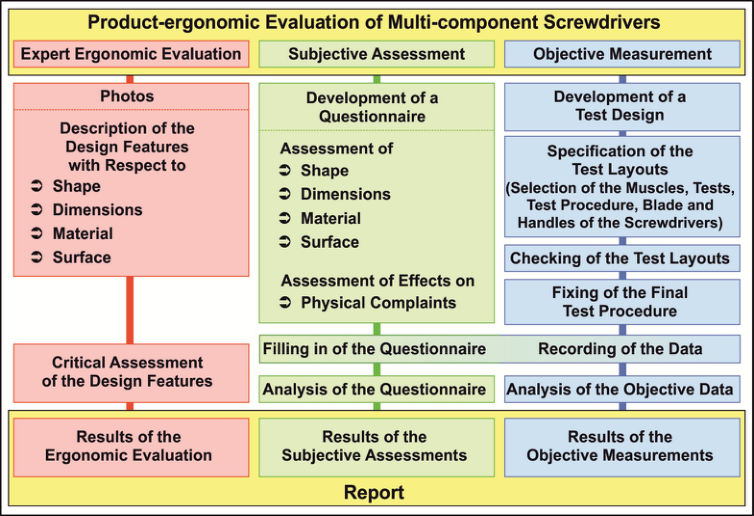
Standards are often necessary for product development and can help to establish ergonomic quality. However, with e.g. DIN EN 4357 (2008) and DIN ISO 8764 Part 1 and Part 2 (2006) only clear guidelines for the design of screwdriver blades are available. The only standard which provides specifications concerning the screwdriver handle (DIN 5268-2, 1973) was withdrawn in November 2003. Since then, manufacturers of screwdrivers have not been bound by limitations any more and, therefore, have had almost unlimited freedom in designing screwdriver handles. In order to gain knowledge of the ergonomic quality of their products, possibilities for the evaluation of screwdrivers are of elementary interest to the manufacturers. The evaluation process used in this study is shown in Fig. 1. In light of the European as well as the international competition, it is imperative for a manufacturer to increase an existing competitive advantage in order to clearly differentiate the own products from those of competitors. In today’s world, the necessary mean to that end is the systematic design of handles to ergonomic requirements (cp. Kluth & Strasser, 2005).
Figure 1. Project planning of the product-ergonomic evaluation of manual screwdrivers (cp. Kluth et al.,
2007)
Previous studies – investigating the design of different screwdriver handles (cp. Kluth et al., 2007 or Kong et al., 2007) – showed that an ergonomically well designed handle will not only increase operational performance and positively affects the subjective perception, but it will also reduce the objectively measurable strain on the muscles. Thus, a screwdriver handle which is designed compatible to the user’s hand reduces the stress at work and the risk of work-related long-term damages of the hand-arm-shoulder-system. Therefore, efforts to improve the handle design of work equipment can contribute to maintain a permanently high performance over the period of a working life.
METHODS
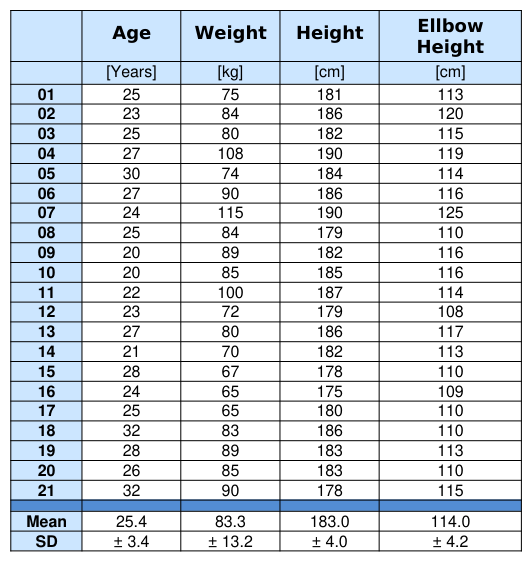
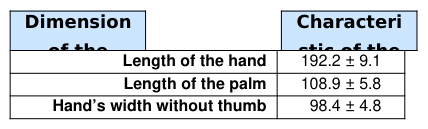
Test subjects A group of 21 male, voluntary, right-handed Subjects (Ss) shown in table 1, relatively homogenous with respect to age, body weight, height and elbow height participated in a series of screwdriver tests. The mean value of the test subjects’ hands (cp. table 2) corresponded to the statistically average German male hand. Hand and finger dimensions were determined with high precision, using a grid and a photocopier.
Table 1: Characteristics of the 21 male Ss Age Weight Height Ellbow HeightTable 2: Specific data of the Ss right hand (means and standard deviations of specific dimensions, N = 21)
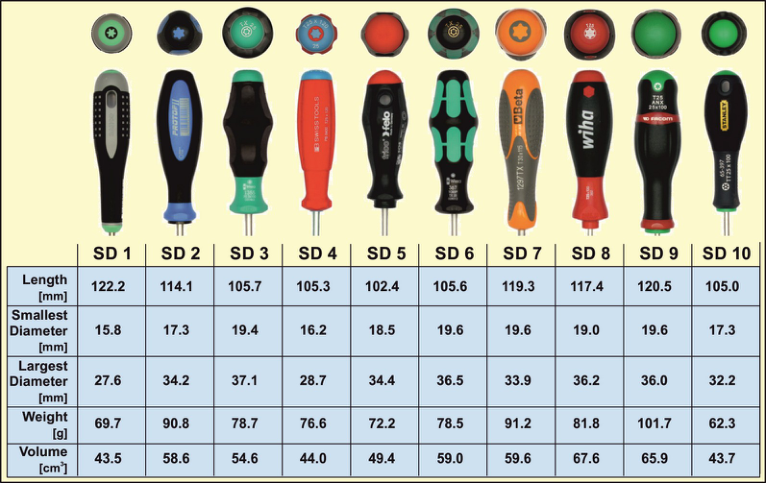
Test objects In certain areas, the screwdriver handles shown in figure 2 exhibited substantial differences with respect to the 4 most important design aspects “shape”, “dimensions”, “material”, and “surface”. Only screwdrivers with handles made of polyamide and thermoplastic elastomers were used differing in lengths, diameter, volume and degrees of hardness. Furthermore, screwdrivers were chosen with a three-edged, six-edged, eight-edged or rounded cross- section. However, in order to ensure comparability, the selected tools were all-purpose screwdrivers as promoted by the manufacturers claiming that applying higher torques is possible. The study was limited to the so-called workshop edition of screwdrivers whose handle and blade axis are aligned and which require friction coupling. Models with a pistol grip or a T-grip with form coupling were not considered for this study. Furthermore, the following blade tips were selected for the test series:
PoziDriv®-cross recessed head PZ2 – for the dynamic screw-driving tasks – with a blade length of 100 mm according to DIN ISO 8764 Part 1 and Part 2 and
TORX®-head – for the measurements of maximum torque and static holding – with a blade length of 100 mm and a head size T25 according to DIN EN 4357. Exception: Due to the fact that handle size depends on head size, T30 had to be used for three screwdrivers to guarantee comparability of the handle size.
Figure 2. Handles of screwdrivers for professional use (SD 1 to SD 10) from various manufacturers with their specific characteristics
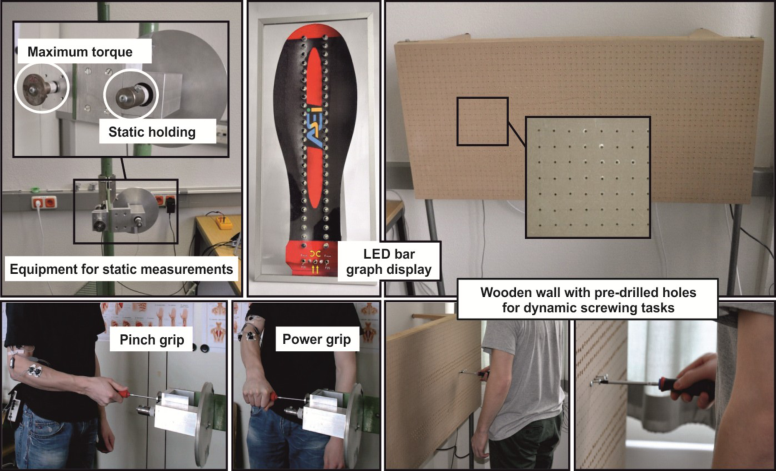
Test performance The tests were designed to analyze potential advantages and shortcomings of each handle type in a setting that simulated real working conditions taking the anatomical and physiological characteristics of the human hand-arm- shoulder system into consideration. Various test series – with static and dynamic screwing tasks – were carried out with the 10 types of screwdrivers. Using the experimental equipment shown in the upper left part of figure 3 maximum torque values over a 3-second period were at first determined for pronation and supination. Each experiment – interrupted by a 3-minute break – was repeated twice using a pinch grip and a power grip (cp. lower left part of figure 3). The maximum torque values were recorded via a Wheatstone bridge with downstream measuring amplifier. In addition, to motivate the Ss to apply maximum torques during the operation, the achieved values were synchronously to the operation presented on an LED bar graph display (cp. upper middle part of figure 3). Next, the Ss had to drive 4 recessed head screws (PZ2) into a wooden wall (cp. right part of figure 3) at a defined pace set by a metronome. During a following 10 minute break, the Ss were asked for their subjective assessments regarding perceptions and potential physical complaints. These test cycles – comprising the measurements of maximum torques and the dynamic screwing task – were first carried out with all screwdrivers. In the next experimental section, the Ss had to maintain 40% of their maximal torque – achieved with the reference screwdriver SD 8 – for 10 seconds while applying a pinch grip during supination. For this test, metal washers of different weight – depending on the Ss maximum torque values for SD 8 – were attached via a steel cable to a circular disk (radius: 100 mm). This test procedure was carried out with all screwdrivers consecutively in a randomized order, interrupted by a 1-minute break between each holding phase. Screwdriver SD 8 was chosen as the reference handle due to the fact that the handle has been already available on the market in almost unchanged design for several years and has been examined and positively assessed in several previous studies (e.g. N.N., 2003 or Kluth et al., 2007), thus serving as a suitable basis for comparisons.
Figure 3. Experimental equipment for static torque and static holding measurements (upper left part), the different grip types (lower left and middle part), LED display as motivating feedback (upper middle part) and the wooden wall for dynamic screwing tasks (right part)
For all tests, the coupling conditions with a pinch or power grip in a fixed body posture were specified. Furthermore, the working height was adjusted to the subjects’ elbow height, to ensure an optimal power transmission. The use of TORX-headed screws during the static tests made it possible to eliminate the axial forces created during the use of cross-recessed screws.
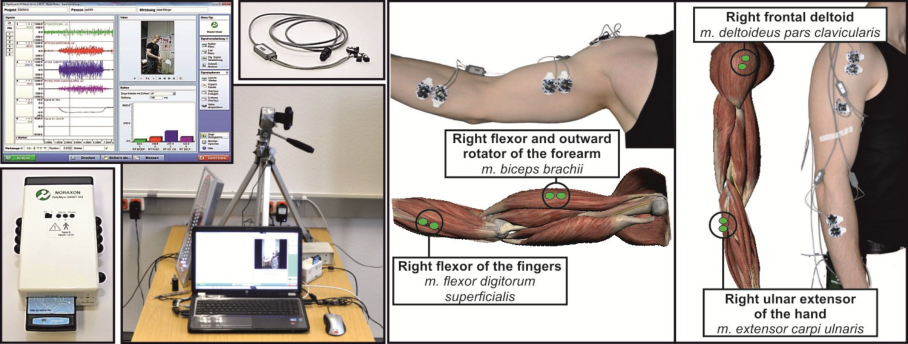
Objective measurements In order to reveal possible model-specific differences in muscle strain, the electromyographic activity (EA) of four muscles involved in the different screwing tasks (cp. right part of figure 4) was measured via bipolar surface electrodes using the multi-channel Noraxon TeleMyo EMG system which stored data on a computer via Wi-Fi connection (cp. left part of figure 4) and was used in a variety of other studies (e.g. Pigini et al., 2010; Daniell et al., 2013).
The myoelectric activity associated with the screwing tasks cannot be interpreted in terms of strain – defined as the demanded amount of the total individual capacity – without standardization (e.g. Kluth et al., 1994), e.g., the actual EA related to the maximum EA, arising under maximum voluntary contractions of a muscle (MVCs). The MVCs – measured for each muscle at the end of the experiment – in connection with the resting activity allowed calculating standardized electromyographic activities (sEA) for representing muscle strain in all working phases.
In order to ensure comparability, the selection of the recorded musculature was based on a previous study by Kluth et al. (2007). Musculus (m.) deltoideus, pars clavicularis, mainly in action when axial forces have to be exerted, m. biceps brachii – as powerful supinator – and m. flexor digitorum superficialis – as grip musculature – were monitored. Due to new findings, however, there was one exception. M. brachioradialis was replaced by m. extensor carpi ulnaris, which was meant to ensure the transfer of the muscle strength of the long finger flexors – located in the forearm – to the finger joints by fixation of the wrist
Figure 4. Noraxon TeleMyo EMG-system with Wi-Fi transmitter and HD camera system connected to a PC (lower left part), software screenshot and sensor with a preamplifier unit (upper left part). Location of monitored muscles of the right hand-arm-shoulder system (right part)
Besides to the electromyographic measurements, recordings with a handheld thermal camera (FLIR T250) were made of the right palm after the static as well as the dynamic screw driving tasks, in order to make potential symptoms of the hand visible. A thermal image taken prior to the practical series was used as a reference for comparison.
Subjective assessments In addition to the objective evaluation, the test objects were subjectively assessed by the test subjects. Before, during and after the tests, the Ss had to assess specific criteria of the handles using a specially developed and standardized questionnaire consisting of 30 items addressing aspects such as handling, design features, material, dimensions and surface-finish as well as color design and manufacturing quality. The question forms used in this case had already been proven in previous studies (cp. Kluth & Strasser, 2003 or Penzkofer et al., 2013). Following this, the items had to be rated on a bipolar scale from -4 (very bad) to +4 (very good). Furthermore, the requested answers were visually supported by the rating scale according to Kunin (1955) to make subjective assessments easier and to avoid making mistakes. The results were presented to reflect the advantages and shortcomings of the various models and to provide possibly guidance in future design. After working with each screwdriver, in a second test the Ss were asked to express potential physical complaints in the fingers, hand, palm and forearm with respect to intensity and occurrence.
This test-procedure – as already mentioned in figure 1 – using an objective and subjective evaluation offered a differentiated view on the impacts of the work situation and was meant to reflect the advantages and disadvantages of the different handle types.
RESULTS
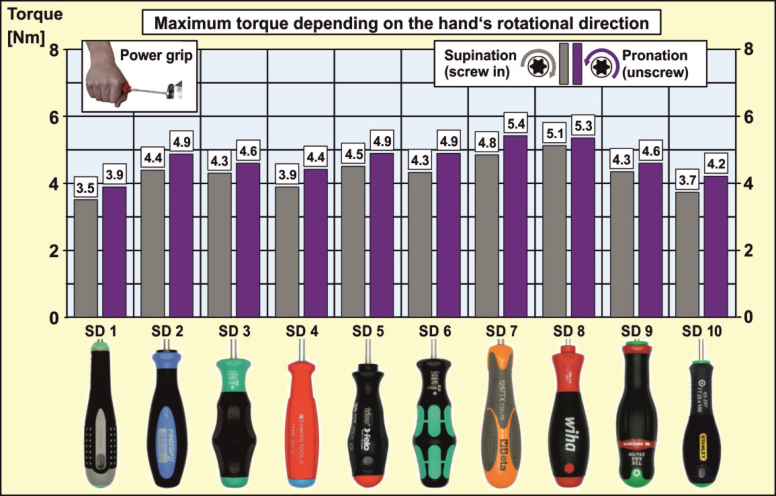
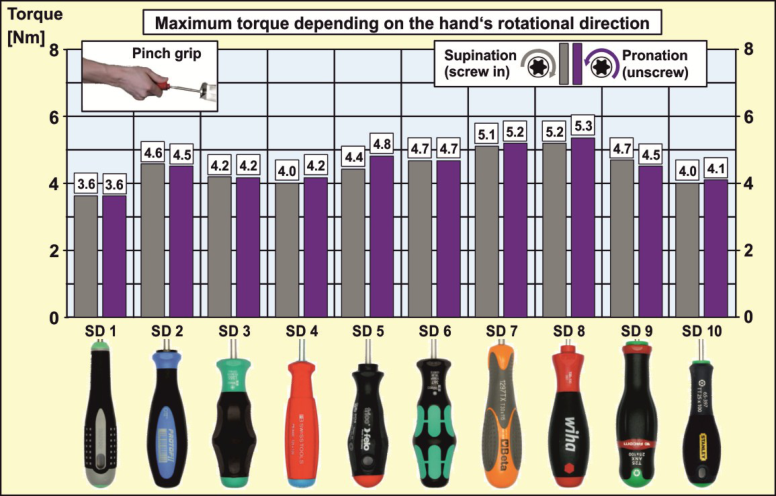
Maximum torque The study focused on measuring performance of various screwdriver handles under real-life working conditions with different hand rotational directions via maximum torque measurements. Maximum achievable torque values were determined for both supination of the right arm for screwing in a screw and pronation for unscrewing a screw. Figures 5 and 6 illustrate the results of the operational output measurements. The grey and the purple bars correspond with the maximum possible torque for the 10 screwdrivers while operating the tools in a power grip (cp. fig. 5) and a pinch grip (cp. fig. 6) during supination and pronation. There are some noticeable differences in the results for the various screwdrivers.
The achievable torque of SD 1 – while applying a power grip – was substantially and significantly lower compared to almost all other screwdrivers. The statistical significance of differences between the 10 screwdriver handles was verified with the two-sided t-test (cp. Sachs, 1974). Probably this is due to two factors: its very sleek contour and with less than 44 cm3 (cp. fig. 2) having the smallest volume of all screwdriver handles. Conversely, some of the test objects performed quite favorably, for example SD 7 and SD 8 – screwdrivers with larger volumes and diameters –, with maximum torque values of more than 5 Nm. In addition to the effects of the handle type, fig. 5 also illustrates results from tests that required rotation in both directions. Even a casual glance reveals that the purple bars, i.e., operating the tools with a power grip during pronation, are somewhat higher. An examination of the difference between supination and pronation confirms the pronation’s well-known advantage over supination, due to an even more favorable muscle load (cp. Strasser & Wang, 2007). However, the extent of the advantage varies and depends on the screwdriver that is used.
Figure 5. Maximum achievable torque while applying a power grip during supination and pronation, using various screwdriver handles (means of 21 Ss)Figure 6. Maximum achievable torque during supination and pronation while applying a pinch grip, using various screwdriver handles (means of 21 Ss)
While applying the pinch grip, the differences between supination and pronation are not so clear. In part, nearly identical torque values could be achieved in both directions. With an average of more than 5 Nm the screwdrivers SD 7 and SD 8 reached the highest values and again handles with a relatively small volume could achieve only significantly lower values. These losses in power transmission are probably due to less favorably coupling conditions between the hand and handle, based on lack of volume. However, the shape of the handles rather suggests a precision or electronic field of application, which rarely require maximum torque. Furthermore, it can be seen that the maximum values achieved in pinch grip were somewhat below the values achieved in power grip. This is due to better coupling conditions and the almost often rigid connection between the hand and the handle while applying the power grip.
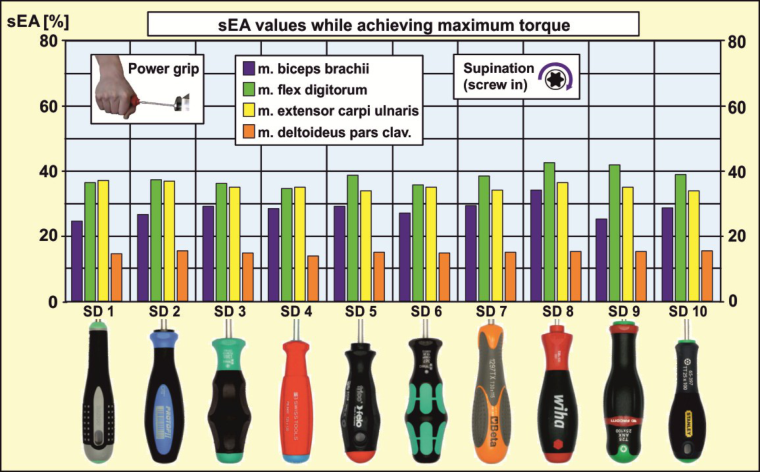
Standardized electromyographic activity The focus of the static measurements was placed on maximum torque. In this case, measuring of muscle strain only served as a quality control of the collected data. The nearly equal physiological costs that have to be paid by all four recorded muscles of the right hand-arm-shoulder-system could be seen as a sure sign for the same level of voluntary muscle contractions exerted while using the screwdriver handles in a) supination and b) pronation. Thus, the deduction of the EA implies both: a possibility of controlling maximum force measurements as well as a quality feature for torque measurements (cp. Kluth et al., 2004). Figure 7 shows sEA values of the four muscles during MVCs while handling the tool in a power grip during supination.
Figure 7. Maximum sEA values obtained from 4 muscles during supination while applying a power grip, using various screwdriver handles (means of 21 Ss)
Despite equal physiological costs during operating the various screwdrivers, considerable differences in the operational performance were noted, which resulted from more or less favorable grasping and coupling conditions.
The impact of the hand’s rotational direction on the sEA – proven in previous studies by e.g. Keller et al. (2007) or Strasser & Wang (2007) – could also be confirmed. Contrary to the physiological responses of the biceps brachii and the flexor digitorum, which showed clearly higher strain during supination (with values up to 40%) compared to pronation (with values below 10% for the biceps brachii and 20% for the flexor digitorum), the sEA values of the extensor carpi ulnaris are significantly higher during pronation (up to 70%) than during supination (35%). For the clavicular part of the deltoid, no significant differences between the directions could be measured. For both, supination and pronation, the sEA values ranged from 15% to 20%.
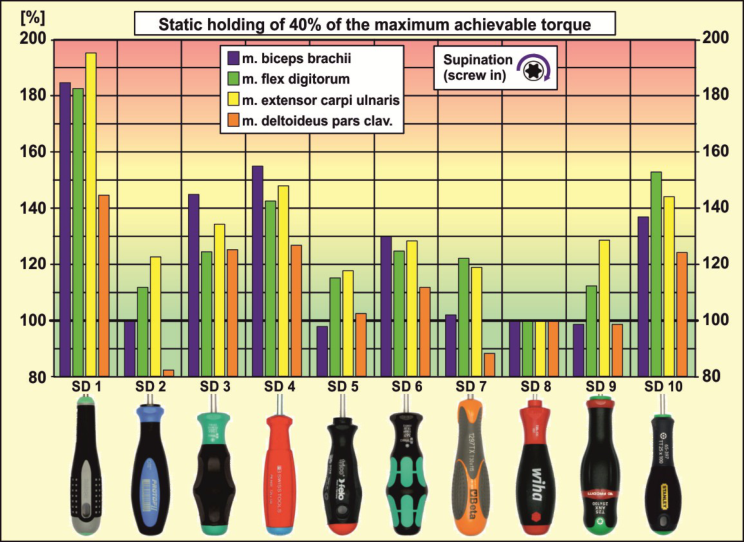
Somewhat different findings were obtained in an additional test, which involved sub-maximum torque. The test subjects had to maintain 40% of the maximum torque which had been applied with screwdriver SD 8 for 10 s in a pinch grip during supination. The results are shown in figure 8. To allow a comparison of the various screwdrivers, the sEA values achieved with SD 8 were set as the reference at 100%.
Figure 8. Comparison of the standardized electromyographic activity of 4 muscles during static holding in relation to the sEA values achieved with screwdriver SD 8, using various screwdriver handles (means of 21 Ss)
For operating SD 1, the screwdriver with the smallest grip diameter of 27.6 mm, almost twice as high physiological costs had to be paid by the muscles as compared to SD 8 with a diameter of 36.2 mm. Even in the case of SD 4 and SD 10, the two screwdrivers with the next larger diameters of 28.7 mm and 32.2 mm, the physiological costs increased by approximately 50% for fulfilling the same task. Generally speaking, it could be noted that no other screwdriver shows lower sEA values for all muscles than screwdriver SD 8. In particular, the flexor digitorum and the extensor carpi ulnaris are considerably more intensively involved in operating the tools compared to the reference screwdriver. Furthermore, it could also be noted that the hitherto rather “inconspicuous” screwdrivers SD 2 and SD 5 emerged positively. For both screwdrivers the muscular activities of the flexor digitorum and the extensor carpi ulnaris are barely 20% above the reference value and for the biceps brachii are even lower. The sEA of the clavicular part of the deltoid operating SD 2 is even approximately 20% lower than for SD 8. However, this had only little impact on the overall assessment because there was relatively low strain on the m. deltoideus during all the tests. The comparison of SD 3 and SD 6 clearly show that even small differences in design can affect the physiological costs substantially. Nearly identical in form and only slightly different in material and material distribution, the handles show significant differences of up to 15% for the biceps brachii.
Operating SD 9 is also quite difficult. Despite a handle-length of 120.5 mm and a diameter of 36 mm, the sEA values are considerably higher compared to the reference handle: more than 10% for the m. flexor digitorum and even more than 30% for m. extensor carpi ulnaris. This is probably due to SD 9’s very smooth surface, which requires an increased muscle effort and, therefore, causes higher physiological costs.
In addition to the static torque measurements, dynamic tests of screw driving were carried out, in which screws had to be driven into a wooden wall. As expected, all time courses of the electromyographic activities of all 4 muscles reflected an increase in work intensity the deeper the screw was driven into the wood. The screwdrivers with smallest volumes again exhibit slightly higher sEA values. However, the values for all other screwdrivers only show marginal differences and are, therefore, not presented here.
Subjective assessments
A first complex of questions was provided to assess subjectively experienced physical effects of the different static and dynamic screw-driving tasks in order to identify possible relationships between handle design and potentially resulting physical effects. The test subjects reported their physical complaints due to work with the different handle models with respect to their frequency and the extent of the complaints. It was found out that working with all screwdrivers caused no or only low strain in the front part of the shoulder, the upper arm and forearm. The recorded complaints concerning the wrist are minor and do not play a major role in everyday professional or leisure life and, therefore, do not require further analyses. It can be assumed that the identified strain is possibly exclusively due to the standardized body posture and the large number of torque measurements in the laboratory test situation.
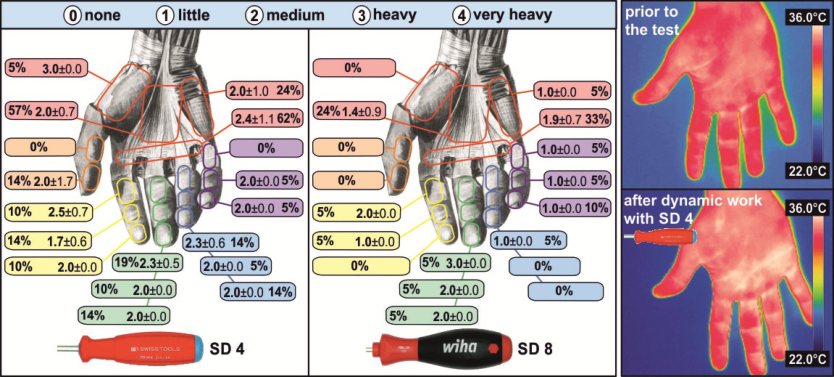
As far as the palm of the hand and the fingers are concerned, differences in strain that are attributable to the specified design characteristics of the screwdriver handles were substantial. An unfavorable design of the handle’s curvature and cross-section, a negatively assessed material hardness and surface as well as a low suitability for the transmission of body forces result – either as individual parameter or in conjunction with other factors – in a high risk of pressure spots during work with screwdrivers. The left part of figure 9 exemplifies the results with respect to frequency and intensity of the subjectively experienced physical complaints for the two screwdrivers with the poorest (SD1) and the best result (SD8). The very right part of fig. 9 represents images of the palm recorded with a thermal camera prior to the test (upper part) and after dynamic work (lower part).
Figure 9. Subjective assessment of complaints in the hand after the test. Relative frequency (in % of 21 Ss) of subjects who had any complaints in the visualized hand region while using SD 4 (left) and SD 8 (right) as well as intensity of complaints (means and standard deviations of 21 Ss). Thermal images prior to (upper right) and after the dynamic screwing task (lower right) SD 9, the “PB Swiss Tools SwissGrip” represented an excellent negative example. Coupled with a solid handle material and a small volume, its extreme surface profile led to an increased occurrence of complaints for the subjects. As shown in the thermal image (see very right part of fig. 9) the palm and especially the palm side of the fingers were affected. Sensations of pressure mostly occurred in these two areas of the hand (around 60%) with average ratings of “2” to “2.4” ranging from “medium” up to “heavy strong” (cp. very left part of fig. 9). However, even the fingers of some Ss were affected. For example, 19% experienced the sensations of pressure at the proximal phalanx of the middle finger with ratings up to “2.3”. On the other side (cp. middle part of fig. 9), the “Wiha Soft Finish” shows what a well-designed screwdriver should look like. Due to its rounded shape, the voluminous handle and its markedly rounded octagonal profile coupling conditions were created that caused virtually no complaints.
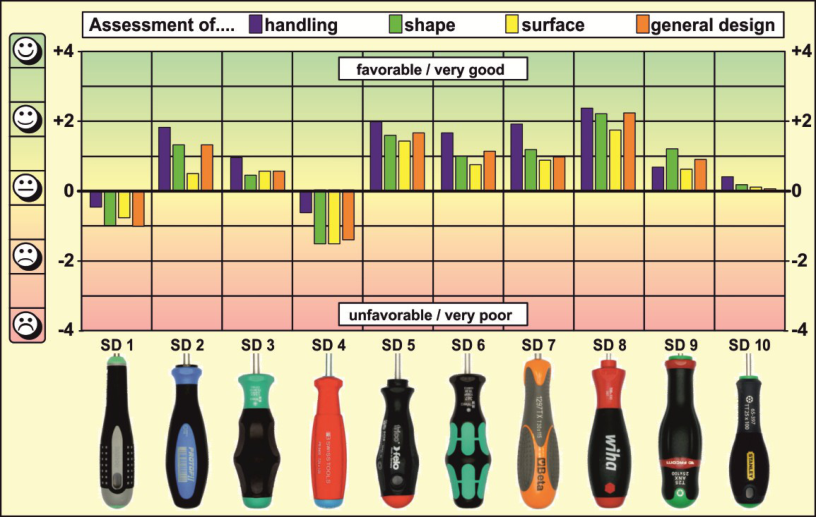
In order to analyze the working conditions when using the 10 screwdrivers examined as comprehensively as possible, the integral work-scientific analysis of the test objects also included each test subject’s personal statement regarding various design criteria of the handles as well as a personal overall judgment. Those were made in addition to the objectification of stress and strain via real-life tests of screw driving and the subjective assessment of the associated physical complaints. The goal of including such personal statements was to discover additional strengths, but also up to now unnoticed weaknesses of the screwdriver handles that could not be identified with the sensation of complaints alone. The following figure 10 shows the results of the subjective assessment of the handling and various design aspects of the screwdrivers during and after the screwing tests in the form of bar charts.
Figure 10 shows a profile of favorable, average, and poor results for the assessments of handling (blue bars), shape (green bars), surface (yellow bars) and the general design (orange bars) – a profile that was also noted for many of the other requested details. The influence of shape and volume of the handling (cp. blue bars of fig. 10) and the considered subjective criteria is clearly noticeable by the ratings of the screwdrivers. Thus, the screwdrivers all rated with “good” were relatively voluminous. Merely SD 9 slightly differed in this respect. Despite of its voluminous handle, SD 9 performs less well with ratings of 0.7 for handling. This is probably due to its flange forming linked with its smooth, hard surface and demonstrates the importance of a balanced interplay of all individual design criteria. This is also true for SD 3 and SD 6. Both screwdrivers are of almost identical shape but they were assessed differently by the Ss due to their material properties. As already mentioned, the screwdrivers SD 1 and SD 4 have the smallest volume and profile. This is probably the reason why booth screwdrivers received the lowest ratings in almost all categories. In addition, their unpleasant surface design marked by burling (SD 1) and striations (SD 4) were negatively rated, too. In contrast, SD 8 could achieve the best results in almost all categories, which is surprising because its rounded octagonal cross-section does not follow the usual design advices (cp. Bullinger & Solf, 1979). In accordance with this advice, the ideal design might be that of a rounded cross-section in form of a hexagonal shape and concave contours for the finger phalanges in the longitudinal section, as realized in the handles of SD 3, SD 5 and SD 6.
Figure 10. Subjective assessments of the screwdriver handling and further design aspects (means of
21 Ss)
DISCUSSION
Finally, based on the subjective and objective results, tops and flops can be identified in the tests concerning the ergonomic quality of the screwdriver handles examined. SD 8 emerged as the best, followed by SD 5, the latter complying with almost all design criteria, apart from its insufficient length. The weakest handles are SD 1 and SD 4 with which low-load screw driving tasks can be carried out quite fast, but based on the provided blade-size for this type of handle, frequent situations that require more force can be assumed. The handles of both screwdrivers are not suited for such tasks.
Based on the results of the subjective assessments as well as the achievable maximum torque and physiological costs of muscles involved in static and dynamic work, the thesis as to the importance of the design of the screwdriver handle – especially concerning shape, material, surface and dimension – has having a large impact on carrying out screw-driving tasks can be seen as confirmed. High torque and favorable subjective ratings were achieved only for those screwdrivers, which displayed an optimal interaction of these four criteria. This was mainly ensured due to a spherical longitudinal contour with a correspondingly large cross-section resulting in a large volume and sufficient dimensions. In this examination, with the Ss characteristics shown in table 1 and 2, the optimal dimensions for a screwdriver handle for achieving maximum torque should look as follows: The length should be approximately 115 mm, the largest cross-section about 36 mm and the volume of at least 65 cm 3. In general, it must be noted, however, that “the one handle suitable for all users” cannot exist, firstly because of the different requirements for a handle arise for the different tasks and secondly because of different anthropometric data for each user. The handle must fit the hand, as the design of footwear must fit the wearer’s feet, thus preventing long-term damage. Consequently – from an ergonomics point of view – tools should come in, at least, three different handle sizes, instead of just one standard size, in order to offer workers with small, medium-sized, and large hands appropriate coupling conditions. Such customization is desirable with respect to the handle length, the course of the lengthwise contour, the handle cross-section, the thumb rest, and the slip-guard. Although the cross-sectional shape should have a rounded hexagon which ensures that the antrum of the palm (and thus the hand’s coupling area during a power grip as well as a pinch grip) and the length of the phalanges are taken into consideration. However, very good results could also be reached with other forms such as triangular (SD 3 and SD 7) or octagonal (SD 8) handles. Furthermore, the flange should not only exhibit bevels as a roll protection, but also gradually starting from the thumb rest. The material’s friction coefficient between the skin and the handle is another important factor for the appropriate design, which varies according to load conditions and surface factors. While the friction coefficient varies under the influence of varying forces, the surface should be slightly rough and without distracting elements such as burling or striations. The use of modern multi-component composite materials – as found on all tested screwdrivers – and an optimized design are crucial for an ergonomically suitable screw-driving handle (cp. Kluth et al. 2007).
REFERENCES
Aghazadeh, F., Mital, A. (1987), “Injuries due to hand tools”, APPLIED ERGONOMICS Volume 18 No. 4. Bullinger, H.J., Solf, J.J. (1979), “Ergonomische Arbeitsmittelgestaltung II. Handgeführte Werkzeuge – Fallstudien“. Dortmund: Bundesanstalt für Arbeitsschutz und Unfallforschung, Wirtschaftsverlag NW. Cochran, D.J., Riley, M.W. (1986), “The effects of handle shape and size on exerted forces”, HUMAN FACTORS Volume 28 No. 3. Daniell, N., Merrett, S., Paul, G. (2013), “Effectiveness of powered hospital bed movers reducing physiological strain in back
muscle activation”, APPLIED ERGONOMICS http://dx.doi.org/10.1016/j.apergo.2013.11.001 DIN 5268-2 (1973), “Plastic handles for screwdrivers”. Berlin: Beuth Verlag. DIN EN 4357 (2008), “Aerospace series – Six lobe recess – Drivers, handle; German version EN 5347:2006”. Berlin: Beuth Verlag. DIN ISO 8764 (2006), “Assembly tools for screws and nuts – Screwdrivers for cross-recessed head screws”, “Part 1: Driver tips”,
“Part 2: General requirements, lengths of blades and marking of hand-operated screwdrivers”. Berlin: Beuth Verlag. Keller, E., Özalp, T., Strasser, H. (2007), “Maximum torque and muscle strain while using screwdrivers with clean and contaminated surfaces in bi-directional use”, in: Assessment of the Ergonomic Quality of Hand-Held Tools and Computer Input Devices, Strasser, H. (Ed.). pp. 173-181 Kluth, K., Böhlemann, J., Strasser, H. (1994). “A system for a strain oriented analysis of the layout of assembly workplaces“,
ERGONOMICS Volume 37 No. 9. Kluth, K., Chung, H.C., Strasser, H. (2004), “Verfahren und Methoden zur Prüfung der ergonomischen Qualität von handgeführten Arbeitsmitteln – Professionelle Schraubendreher im Test“. Schriftenreihe Ergo-Med Band 5. Heidelberg: Dr. Curt Haefner Verlag. Kluth, K., Chung, H.C., Strasser, H. (2007), “Ergonomic quality and design criteria of professional-grade screwdrivers”, in:
Assessment of the Ergonomic Quality of Hand-Held Tools and Computer Input Devices, Strasser, H. (Ed.). pp. 153-172 Kluth, K., Strasser, H. (2003), “Subjective evaluation of a newly developed scanner checkout in comparison with a conventional cash register system via standardized working tests”, in: Quality of Work and Products in Enterprises of the Future, Strasser, H., Kluth, K., Rausch, H., Bubb, H. (Eds.). pp. 275-278 Kluth, K., Strasser, H. (2005), “Assessment of the ergonomic quality of professional-grade screwdrivers using objective
methods”, in: Proceedings-CD of the XIXth Annual International Occupational Ergonomics and Safety Conference, Lockhart, T., Fernandez, J. (Eds.). pp. 189-194 Kong, Y.K., Lowe, B.D., Lee, S.J., Krieg, E.F. (2007), “Evaluation of handle design characteristics in a maximum screwdriving torque task”, ERGONOMICS Volume 50 No. 9. Kunin, T. (1955), “The construction of a new type of attitude measure”, PERSONNEL PSYCHOLOGY Volume 8 No. 1. Lewis, W.G., Narayan, C.V. (1993), “Design and sizing of ergonomic handles for hand tools”, APPLIED ERGONOMICS
Volume 24 No. 5. N.N. (2003), “Metallwerkzeuge im Vergleich: Der richtige Dreh“, HEIMWERKER PRAXIS Volume 5 Penzkofer, M., Kluth, K., Strasser, H. (2013), “Subjectively assessed age-related stress and strain associated with working in the cold”, THEORETICAL ISSUES IN ERGONOMICS SCIENCE Volume 14 No. 3. Pigini, L., Colombini, D., Rabuffetti, M., Ferrarin, M., Occhipinti, E. (2010), “Evaluation of work-related biomechanical overload:
Techniques for the acquisition and analysis of surface EMG signal”, LA MEDICINA DEL LAVORO Volume 101 No. 2.
Sachs, L. (1974), “Angewandte Statistik, Planung und Auswertung. Methoden und Modell“. Heidelberg: Springer Verlag. Strasser, H., Kluth, K., Keller, E. (2007), “A knowledge-based system for utilizing electromyographic methods for the measurement of physiological costs associated with operating hand-held tools and computer input devices”, in: Assessment of the Ergonomic Quality of Hand-Held Tools and Computer Input Devices, Strasser, H. (Ed.). pp. 41-55 Strasser, H., Wang, B. (2007), “Effects of hand preference and direction of rotation on screwdriver torque strength and
physiological costs of muscles involved in arm pronation and supination”, in: Assessment of the Ergonomic Quality of Hand-Held Tools and Computer Input Devices, Strasser, H. (Ed.). pp. 67-74
LISTED IN THE AHFE DIGITAL BOOKSTORE CATALOGUE
Explore the complete digital volume
Advances in Physical Ergonomics and Human Factors: Part I
Read this individual research paper free through the original publisher, or explore the full digital proceedings book.
ISBN 978-1-4951-2104-3
Explore this ISBN in the AHFE Bookstore ↗Listed in the July 2026 bookstore catalogue; search by ISBN to confirm current availability · Digital book purchase optional