Sandra Groos, Karsten Kluth (2018). Ergonomic Evaluation of Pressure Limits for the Fire Water Supply for Physically Feasible and Safe Indoor Fire-fighting. In: Advances in Physical Ergonomics and Human Factors: Part I. AHFE Open Access, vol. 1. https://doi.org/10.54941/10030
So far, there exists no internationally uniform regulation about the pressure limits of water used for putting out fires in multi-story buildings and large properties. In order to prove whether the nozzles work most efficient and a fire can be extinguished safely and precisely, 12 professional fire-fighters carried out simulated fire-fighting procedures under nearly realistic conditions. Throughout the entire test, the electromyographic activity (EA) from 7 muscles of the right hand-arm-shoulder system and one muscle of the left arm was recorded. Additionally, a special questionnaire had to be filled in to evaluate the subjective experiences when handling the nozzles. The EA – standardized through MVCs (Maximum Voluntary Contractions) – exceeded the limit for short-term static work for 3 muscles, especially when the pressure was 0.8 MPa and higher. The subjective ratings confirmed the measured physiological responses. Based on these results, the operating pressure for the fire water supply should not exceed 0.6 MPa (as compromise 0.7 MPa), in order to ensure safe and precise fire-fighting, and that the nozzles work most efficient.
Supplying fire-fighting water in tall buildings and horizontally expansive properties poses a challenge, as technical measures must be employed to ensure the constant availability of fire-fighting water. Classical measures for supplying water inside the buildings described above – where the supply of fire-fighting water is realized by means of a water source in combination with the fire engine – are strongly limited. Besides problems caused by access opportunities and the discharge head of the fire engine pump, the classical measure is generally not capable of supplying fire-fighting water to the higher floors or hydraulically unfavorable withdrawal points. Therefore, such buildings are equipped with fire-fighting water systems via permanently installed pumps according to statutory orders and technical standards.
The current administrative regulations and standards, e.g. from the National Fire Protection Association (NFPA), FM Global and the German and European Institutes for Standardization are inconsistent and mostly not based on the results of intensive research. The NFPA and FM Global standards are widely accepted internationally. According to Physical Ergonomics I (2018)
NFPA 14 (2013), the maximum residual pressure in hose-systems should not exceed 1.2 MPa. Even if the FM- Global 1-3 (2012) adopted most of the requirements of the NFPA 14, it established a lower value of 0.7 MPa for the maximum residual pressure. In Germany, the hydraulic requirements for hydrant systems were integrated in the standard DIN 14462 Supplement 1 (2012) which defined a maximum residual pressure value of 0.8 MPa for multi- story buildings. This value is based on the subjective experiences of fire-fighters with older technologies, such as the CM multifunction nozzle (maximum flow rate of 200 l/min), which is hardly used any more today by professional fire-fighters but remains widespread at voluntary fire departments, especially in Germany. Besides the maximum values, the minimum residual pressure is also regulated in the above-mentioned statutory orders and technical standards. The values vary from 0.4 MPa (FM Global 1-3, 2012) and 0.45 MPa (DIN 14462 Supplement 1, 2012) to 0.69 MPa (NFPA 14, 2013). Even if the DIN 14462 Supplement 1 from 2012 gives the impression that this standard is up to date, the value is also historically based on the practical experiences of fire-fighters with the older CM nozzle. A pressure of 0.45 MPa may be enough for the fire water supply of a CM nozzle with a maximum flow rate of 200 l/min but automatic fog nozzles, which are used mostly today, require higher pressure values. Within the framework of the product certification for fog nozzles, it should be additionally noted that a nominal pressure of 0.6 MPa is required by DIN EN 15182-2 (2010). Studies from de Vries (2008 and 2009) confirm this value since a residual pressure of approximately 0.6 MPa is required for certain types of fog nozzles to supply the required flow rate. The same studies also showed that automatic fog nozzles cannot guarantee any supply of fire-fighting water or any effective water discharging below a residual pressure of approximately 0.55 MPa. Independent of the standards, the subjective impressions of fire-fighters show that a residual pressure below 0.5 MPa is insufficient (e.g. Götsch et al., 2014).
Regarding the investigation and determination of pressure values it also has to be considered that according to Smith et al. (1996 and 2011) fire-fighting imposes significant cardiovascular strain on the professional fire-fighter due to a combination of heavy work, high environmental temperatures and personal protective equipment. Heart rate rises substantially during fire-fighting and may reach maximum levels, especially during long working periods (e.g. see Barnard and Duncan, 1975). Solely the wearing of personal protective equipment can increase oxygen uptake and heart rate significantly (e.g. Sköldström, 1987 and Smith et al., 2012). Under the conditions mentioned above, Duncan et al. (1979) and Smolander et al. (1984) stated, that the rectal temperatures of fire-fighters may reach levels indicating high thermal stress. The ability to perform strenuous work is reduced through the workload induced by heat and protective equipment. In this context, Sköldström (1987) found out that the combination of thick clothing and heavy breathing apparatus has a considerable limiting effect on the endurance of fire-fighters. As it is necessary to consider the effects of the working environment, the determination of minimum and especially maximum values should not be based on tests carried out in a laboratory under optimal conditions, rather, the researchers should attempt to provide realistic working conditions as much as possible.
The ergonomic evaluation presented in this paper should form the basis for generally applicable international technical requirements for ensuring a safe system operation by professional fire-fighters. The experimental study mainly aimed at the protection of all fire-fighters, which above all, presupposes a suitable residual pressure at the nozzle, particularly in generating a sufficient nozzle pressure, and consequently, providing an effective stream of fire-fighting water with sufficient range and penetrating force. On the other hand, according to Kemper (2009), the nozzle pressure must not be too large in order to ensure a safe nozzle handling. The decisive point of interest was the maximum possible pressure and flow rate at the nozzle which are reasonable from a physically feasible and safety perspective so that further technical requirements can be derived. Therefore, the physical load and strain on the nozzle operator had to be measured.
METHODS
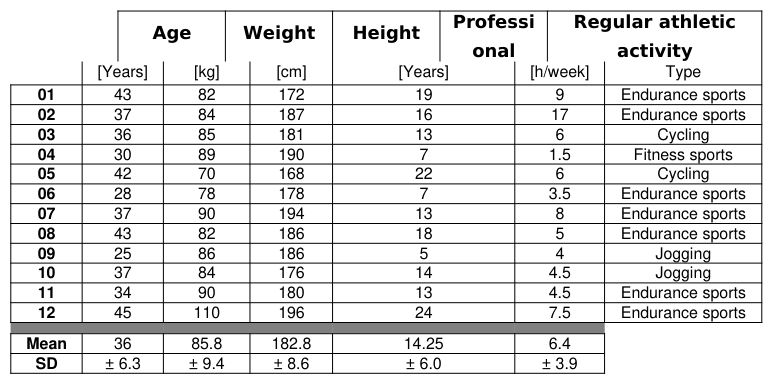
Test subjects To evaluate the strain resulting from the workload, 12 fire-fighters of the municipal fire department of the city of Siegen (Germany) performed simulated fire-fighting activities under nearly realistic conditions. With regard to gender, the test group was homogeneously assembled in order to obtain comparable results. However, data was collected exclusively from male participants as the municipal fire department of Siegen does not have a sufficient number of female fire-fighters. Table 1 shows the physical characteristics of the 12 test subjects (Ss). They have been in professional service for at least 5 years, whereby before, the majority of this group was already active in voluntary fire departments. All Ss were engaged in regular athletic activity and were right handed.
Test performance The tests described below were performed over 3 consecutive days on the outdoor grounds of a municipal fire department. In order to optimize the test design and to select the, indeed, relevant muscles, the main tests were preceded by intensive test preparations with two pretests under identical conditions. The tests were always performed alternatively by two Ss, while one person completed a test section, the second person could rest. This ensured that the Ss could start each test section after recovering from muscles fatigue associated with the test work.
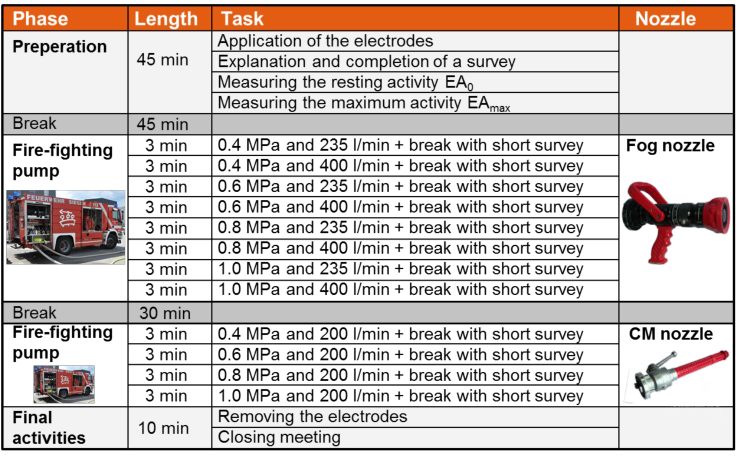
Figure 1 shows the rough structure of a test day which started with the main preparation of the Ss. For attaching the electrodes at the selected muscles, the skin was shaved and defatted. Afterwards, the Ss were asked to remain in a seated position and as calm as possible for recording the resting activity EA0 over the course of 2 minutes. As the preliminary tests showed that it was not possible to perform the test such as to avoid an impact on the musculature with sufficient reliability, the maximum voluntary contractions (MVCs) for determination of the maximum electromyography activity (EAmax) were recorded before the actual tests. To ensure that the muscle, briefly (3 seconds) strained to maximum, had a sufficiently long time to recover, the Ss had a very long pause of at least 45 minutes after the maximum force measurement. During the pause, each test subject was individually instructed as to the performance of the test. To guarantee the presence of an elevated heart rate similar to real fire-fighting conditions, the Ss exercised on a bicycle ergometer before each test phase until reaching a pulse rate of 130 beats per minute. Furthermore, the Ss had worn their own protective clothing for fire-fighting as well as a compressed air breathing apparatus with a weight of approximately 15 kg. The high thermal stress caused by the radiation from the fire could not be simulated in the tests, however, the surrounding temperature of about 25°C (77°F) in combination with the high workload led to thermal stress indicated through a high perspiration of the professional fire-fighters. To avoid transfer effects, the test phases and their sequence were varied randomly, e.g. by changing the setting for flow rate, changing the type of nozzle, etc.. Only for the residual pressure the test always started at 0.4 MPa and increased in steps of 0.2 MPa as it could not be estimated in advance for safety reasons what maximum residual pressure would be ranked as reasonably by the Ss. After every run at a defined pressure and flow rate, a subjective rating and the possibility of a further pressure increase were obtained from the Ss. The test day consisted of 4 working phases, however, for this paper only the two phases with the fire-fighting pump as pressure regulation method and the fog nozzle (flow rate 235 and 400 l/min) as well as the multifunction CM nozzle (flow rate 200 l/min) were of interest. The fire-fighters operated during the other two test phases also with the fog nozzle but the pressure was regulated via a pressure control valve or baffle plates with different diameters. The results of these measurements are presented in detail by Kluth and Groos (2014).
Figure 1. Rough structure of the test day with the fire-fighting pump and handling the fog and CM nozzle, respectively
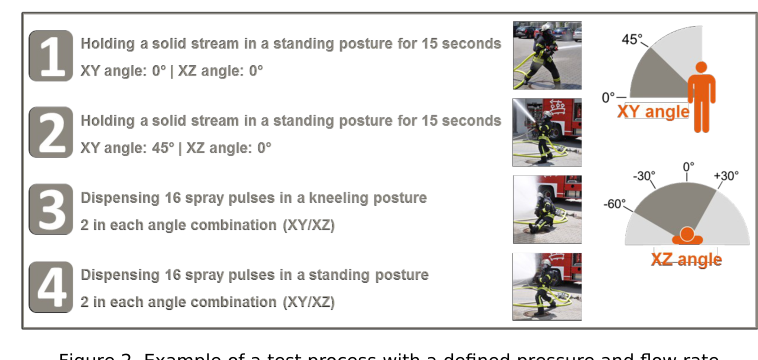
Each test process with a defined pressure and flow rate took place according to the same pattern, as shown in figure 2. The test started with operating the nozzle while standing in the solid stream setting with a sustained water discharge for 15 s at an XY angle of 0°, and afterwards for another 15 s at an XY angle of 45°. The test subject closed the water supply at the nozzle and adopted the typical kneeling posture for indoor fire-fighting. In this position the Ss discharged 16 spray pulses whereby the body position was changed in the XY and XZ axis after every 2 spray pulses. Thereafter, the spray pulses previously performed in the kneeling position were repeated in a standing posture. After each test cycle during the following pause, the Ss had to assess their subjective impression and physical exertion.
Figure 2. Example of a test process with a defined pressure and flow rate Electromyographic measurements
The electromyographic activity (EA) from several muscles was recorded via bipolar electrodes and a mobile recorder and saved on a computer over a WLAN connection. Amplitude values of the myoelectric activity cannot be directly interpreted as strain data (e.g. Böhlemann et al., 1994; Kluth et al., 1994; Strasser et al., 1994), therefore, reference values of the maximum exertions deliverable by a muscle were obtained by recording the EA during maximum voluntary contractions (MVCs). The MVCs in connection with the resting activity EA0 allowed calculating standardized (normalized) electromyographic activities (sEA) representing muscle strain in all working phases.
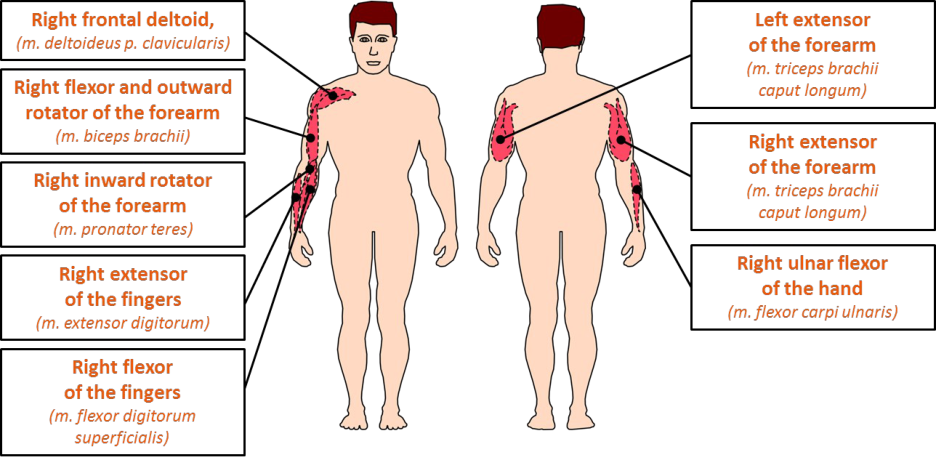
A series of muscles of the hand-arm-shoulder system as well as of the torso is involved in handling a nozzle. However, as shown in a previous study by Kluth et al. (2007), the bottleneck on the physical strain produced by a nozzle lies in the arm and shoulder area. Based on this study, for the initial preliminary tests, all relevant muscles and muscle parts of the hand-arm-shoulder system (in total 18) were selected. In addition, only muscles whose contours are easy to feel and which were large enough for application of surface electrodes were considered here (e.g. Kluth, 1996). After the preliminary tests, the 8 most heavily involved muscle parts were selected for the main tests. As shown in figure 3, seven muscles of the right and one muscle of the left hand-arm- shoulder system were monitored.
Figure 3. Selection of the muscles and muscle parts for the electromyographic measurements Subjective methods
Before the start of the tests, the questionnaires and special aspects of the performance of the test were explained first. This guaranteed a rapid answering of all the questions during the individual test. To evaluate the subjective impressions of whole body strain, the strain of hand, lower arm, upper arm and shoulder on the right and left part of the body as well as the subjective assessment of various aspects of the activities performed, a well-tried four-step bipolar scale using Kunin-items (e.g. Strasser et al., 1994; Penzkofer et al., 2010) was utilized. After each test run, the information was collected in an interview form from the Ss together with the respectively defined parameters “type of pressure regulation”, “pressure” and “flow rate”.
RESULTS
Standardized electromyographic activity The values recorded in all sub-tests with 12 Ss were compiled for the solid stream setting and the dispensing of spray pulses, whereby these settings were further differentiated for the body positions in the XY angle 0° and 45°. Since no significant differences could be identified in the sEA for the body posture in the XZ direction, these results are not presented. A movement and body posture analysis during the previous test showed that all muscles of the right hand-arm-shoulder system were involved in performing static muscle work. This makes sense for sustained discharging of water, since the fire-fighter is not engaged in any relevant movements except for opening and closing the nozzle and swiveling in the XY direction from 0° to 45°. When discharging spray pulses, the right hand-arm- shoulder system only absorbs the forces caused by the nozzle but it performs no major movements. However, since the opening and closing of the nozzle takes place via very rapidly repeated movements especially when discharging spray pulses, the left arm and, therefore, the left m. triceps brachii is strained dynamically.
In the following figures presenting the sEA measurement results, a color coding system is used similar to a traffic light for the visualization of the various load limits. Green means that the range for the given activity is considered unproblematic; yellow visualizes an acceptable load; values in the red range should, however, be avoided. In ergonomic analyses, the endurance level represents a limit value for the prolonged performance of static or dynamic muscle activity, which should ensure completing an 8-hour working day without additional pauses. According to Rohmert (1960) the maximum continuous exertion for static work amounts to approximately 15% of the maximum force, which is in the green range in the figures. Under the assumption that a nozzle need never be operated indoors without interruption for a duration of 8 hours, the limit can be raised. A typical indoor fire-fighting incident is limited in time by the compressed air breathing apparatus of the fire-fighter, which leads to a time frame of approximately 8-10 minutes for holding a solid stream. For this time, static holding work of 20% of the maximum force can be sustained, if a sufficiently long pause is taken afterwards. The range from 15-20% is shown in yellow in the figures and is perceived as a reasonable load during sustained water discharging and for all muscles which are involved in static work. As a fire-fighter discharges spray pulses very briefly, e.g. for maximal 1 minute, a strain of up to 50% of the maximum force is possible. This range can be adopted as the sEA limit and it is also shown in yellow in the graphs for discharging spray pulses. Even if the left m. triceps brachii, which carries out dynamic work, shows no borderline values and, therefore, is not presented in this paper. For this muscle, the maximum continuous exertion is placed at 50-60% of the maximum force.
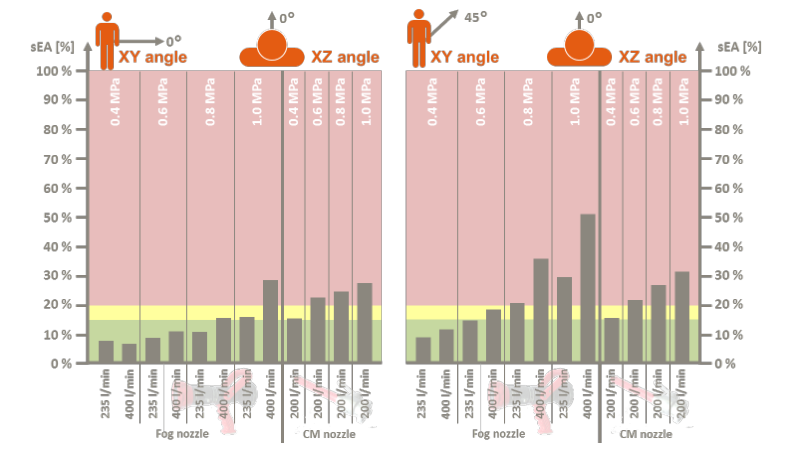
The m. biceps brachii is the strongest of all muscles investigated here. Across all measurements, sustained water discharging (see figure 4) yielded significantly lower sEA values than the discharging of spray pulses (see figure 5). This can be attributed to the fact that this muscle absorbs the high and rapid percussive forces that arise in the discharging of spray pulses. However, the sEA values for sustained water discharging are more critical than the one for dispensing spray pulses as the limit of 20% was exceeded with the fog nozzle at 0.8 MPa and 400 l/min as well as 1.0 MPa with both flow rates. In combination with the CM nozzle, the limit value was already exceeded even with 0.6 MPa and higher and a flow rate of just 200 l/min. During the discharging of spray pulses, the sEA limit value was exceeded with the fog nozzle only at 1.0 MPa and 400 l/min. All other results remained below the sEA limit value of 50%.
Figure 4. sEA values of the biceps brachii while holding a solid stream in a standing posture with the fog and CM nozzle as well as different pressure and flow rate settings. 15-s means of 12 professional fire-fighters
Figure available in the original PDF paper.
Figure 5. sEA values of the biceps brachii while dispensing spray pulses in a kneeling and standing posture with the fog and CM nozzle as well as different pressure and flow rate settings.
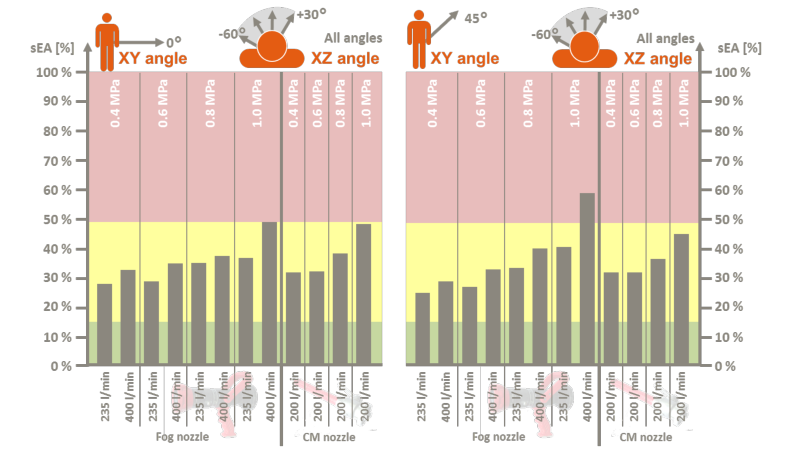
Means of dispensing 16 spray pulses of 12 professional fire-fighters The extensor digitorum is responsible for extending the hand and fingers. In general, the high values for the use of the CM nozzle in comparison to the fog nozzle are remarkably high (see figure 6) which can be attributed primarily to the different hand and body posture during fire-fighting. With an XY angle of 0°, the sEA limit was exceeded during sustained water discharging, first with the CM nozzle at 0.6 MPa and 200 l/min, and additionally with the fog nozzle at 1.0 MPa and 400 l/min. The sEA limit was exceeded at 0.8 MPa and 400 l/min and 1.0 MPa with both flow rates when the fog nozzle was held in an angle of 45° (XY) from the horizontal. When discharging spray pulses, which is not figured in this paper, the measurement with the fog nozzle at 1.0 MPa and 235 l/min as well as the measurement with the CM nozzle at 0.8 MPa and 200 l/min resulted in exceeding of the sEA limit of 50%.
Figure 6. sEA values of the extensor digitorum while holding a solid stream in a standing posture with the fog and CM nozzle as well as different pressure and flow rate settings. 15-s means of 12 professional fire-fighters
The m. flexor carpi ulnaris is responsible for the ulnar deviation of the hand, and plays an important role in operating a fog nozzle with pistol grip. This explains the higher values for the use of the fog nozzle in comparison to the CM nozzle which is shown in figure 7. The fog nozzle is held exclusively at the pistol grip with the right hand, and a majority of the forces arising are absorbed by the right hand-arm-shoulder system. On the other hand, the CM nozzle is additionally held in place and pushed down with the left hand. During operation of the fog nozzle, the sEA values are significantly higher for 0° than for 45° of the XY body posture. This is due to the fact that a fog nozzle constantly exerts forces upward the muscle part. The muscle must exert greater forces when the lower arm is in a horizontal position than when it is at the 45° position. During the measurement while dispensing spray pulses with the fog nozzle, acceptable values were observed at 235 l/min and 0.4 MPa for the 0° XY angle and up to 0.8 MPa and 400 l/min for the 45° angle.
Figure 7. sEA values of the flexor carpi ulnaris while dispensing spray pulses in a kneeling and standing posture with the fog and CM nozzle as well as different pressure and flow rate settings.
Figure available in the original PDF paper.
Means of dispensing 16 spray pulses of 12 professional fire-fighters For the m. flexor digitorum which is responsible for closing the hand, the sEA limit of 20% was exceeded at 1.0 MPa and 400 l/min during sustained water discharging with the fog nozzle. For the discharging of spray pulses, all results are constantly above 20% but remain below the sEA limit of 50%. The m. pronator teres, responsible for the inward rotation of the arm, was only slightly activated while holding the nozzle regardless of the angle. During sustained water discharging, the sEA value remains constantly below the endurance level of 15% when handling both nozzles. When discharging spray pulses, the measurement values are far below the sEA limit of 50%. The clavicular part of the right deltoid moves the arm forward and, therefore, absorbs the forces from the nozzle that act on the body. During sustained water discharging and the dispensing of spray pulses, all measurement values are below the sEA limit of 20% and 50%, respectively. The left m. triceps brachii which is the only muscle that is involved in dynamic work is slightly strained during the test. The sEA limit value for dynamic muscle work rose to 60% regardless of the working task (holding a solid stream or dispensing spray pulses). During none of the measurement series a sEA limit violation was recorded, however, the sEA values were significantly higher for the discharging of spray pulses compared to sustained water discharging.
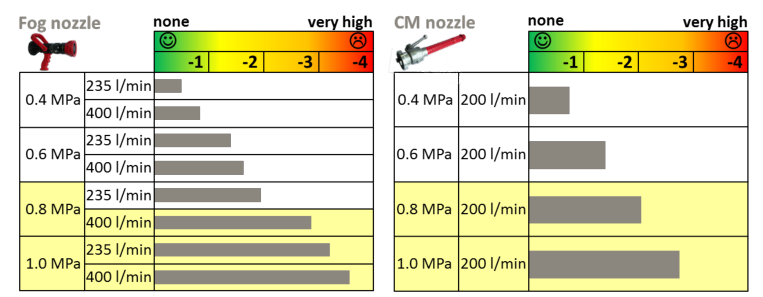
Subjective assessments The results of the subjective assessments presented below were intended to support the objective results obtained in the course of the measurement. Figure 8 illustrates the perceived whole body strain during the tests with the fog nozzle and the CM nozzle which increased with rising pressure and flow rate. Especially at a pressure of 0.8 MPa and higher, the subjectively perceived whole body strain was high with values between -3 and -4 for the fog nozzle and up to -3 for the CM nozzle.
Figure 8. Mean values of 12 professional fire-fighters for the subjective assessment of whole body strain while holding a solid stream and dispensing short sprays with the fog nozzle (left) and the CM nozzle
(right)
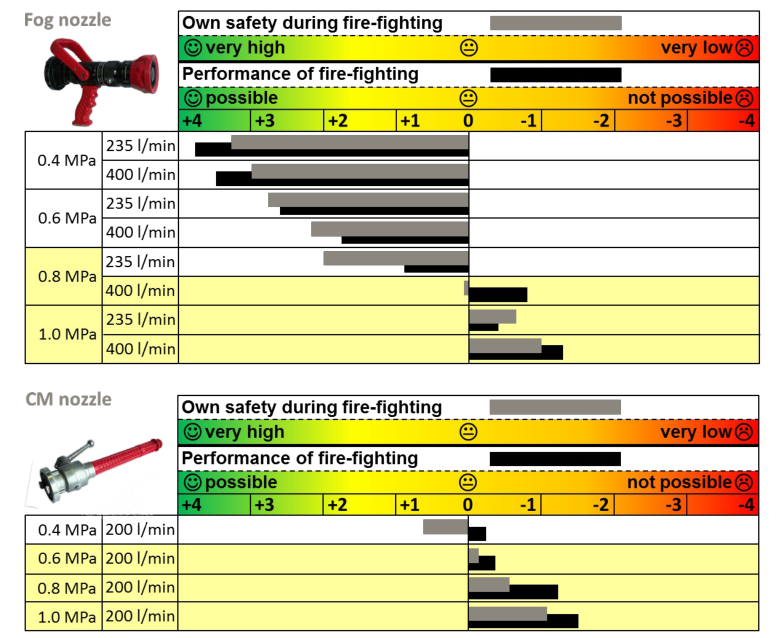
While whole body strain rises with rising pressure and flow rate, at the same time, the fire-fighters perception of his safety declined as shown in figure 9. The safety rating shifted from the positive to the negative range already at 0.8 MPa and 400 l/min when using the fog nozzle. The same perception was recorded in the general performance of the simulated fire-fighting. The CM nozzle is evaluated much more negatively than the fog nozzle with regard to safety and general performance. At 0.4 MPa, safety still achieves a slightly positive value, while at 0.6 MPa it is already rated as “somewhat low”. This negative impression continues to worsen when the pressure increases. As the fire-fighters clearly had problems with the handling of the CM nozzle, the general performance of the fire-fighting is consistently evaluated negative. Here as well, the extent of the negative evaluation increases with the pressure. In addition to the results presented, the Ss also provided detailed information concerning physical sensations in the individual areas of the hand-arm-shoulder system, which can be found in Kluth and Groos (2014).
Figure 9. Mean values of 12 professional fire-fighters for the subjective assessment of the own safety and performance while holding a solid stream and dispensing short sprays with the fog nozzle (upper part) and the CM nozzle (lower part)
DISCUSSION
The results of the electromyographic measurements on professional fire-fighters as well as their subjective assessments show that a need exists for uniform safety-related requirements regarding limit values for the pressure and flow rate at the nozzle in consideration of the pressure regulation method applied. While the pressure regulation method will not be discussed in this paper, however, the maximum residual pressure and the associated optimal flow rate can be derived from the results presented.
In summary, it can be stated that for the use of fog nozzles, a physiological limit value between 0.6 and 0.8 MPa was determined for a rated setting at the nozzle up to 235 l/min and a maximum residual pressure of 0.6 MPa for a rated setting of 400 l/min. A rated setting at the fog nozzle of approximately 200 l/min has been confirmed to be sufficient for indoor fire-fighting. In individual cases, the setting is rated up to approximately 400 l/min for the cooling of fire gases as well as for the protection of the fire-fighter. For the use of the CM nozzle, it can be stated in summary that a physiological limit value between 0.6 and 0.8 MPa was determined, too. However, it could be assumed that the CM nozzle should no longer be used for indoor fire-fighting because it is difficult to handle and offers fire-fighters only minimal safety. The measurement values with the CM nozzle were recorded and reported only for comparison purposes.
As a compromise from the values presented, a maximum of 0.7 MPa can consequently be proposed for the maximum residual pressure at the hose station in multi-story buildings and large properties. The compromise solution was chosen in order that reasonably priced technical solutions for standard methods of pressure regulation with respect to the required number of pressure levels can be taken into account. From an ergonomic perspective, however, technical methods should be preferred that do not exceed a limit value of 0.6 MPa at any individual withdrawal point regardless of the flow rate. The study does not present any results for the minimum pressure, as a low pressure results in a low muscular activity due to the reduced holding forces. However, the professional fire- fighters stated during the tests that a pressure value of 0.4 MPa is too low for an effective fire-fighting.
Based on the derived maximum residual pressure, the question may arise, why the maximum level is not 0.4 MPa as the m. flexor carpi ulnaris exceeded the limit values already at 0.4 MPa with the fog nozzle and a flow rate of 400 l/min. Even if this muscle is overstrained, it is not a bottle-neck muscle as other muscles can absorb the function of the m. flexor carpi ulnaris. The exceedance of limit values for the m. biceps brachii has been seen far more critical, because exhaustion of strength of this large muscle is a risk for the realization of the fire-fighting task.
Determining limit values, for tasks which lead to high muscular strain, only on the basis of male fire-fighters can be regarded as critical since females with their lower muscular strength must be able to withstand the acting forces during the fire-fighting, too. However, it must be noted that the definition of the limit values is based on the endurance level, which means that an exceeding of the endurance level can lead to a fatigue of the muscle. This does not necessarily mean that fire-fighting is generally not executable. Of significance in this regard is the fact, that indoor fire-fighting is time-limited by the compressed air breathing apparatus (approximately 20-40 minutes, walking time included). Furthermore, the mandatory rest period after fire-fighting deployment should provide sufficient muscle recovery.
CONCLUSION
• Fire-fighting leads to high muscular strain, especially in the hand-arm-shoulder system. The electromyographic activity (sEA) was highest for the biceps brachii, the extensor digitorum, and the flexor carpi ulnaris.
• The sEA exceeded the limit values for static muscular work in most cases at a pressure between 0.6 and 0.8 MPa depending on the flow rate and type of nozzle.
• The fire-fighters rated the subjectively assessed whole body strain as “high” for pressure values of 0.8 MPa and higher. At these pressure values the own safety and the general performance of the fire-fighting was rated negatively, for the CM nozzle even at 0.6 MPa.
• The results support the current opinion that the CM nozzle should no longer be used for indoor fire-fighting as it is difficult to handle and offers fire-fighters only minimal safety.
• The maximum residual pressure should be 0.6 MPa for a flow rate of approximately 200 l/min and 0.8 MPa for approximately 400 l/min.
• A maximum of 0.7 MPa can consequently be proposed for the maximum residual pressure at the hose station in multi-story buildings and large properties.
REFERENCES
Barnard, R.J., Suncan, H.W. (1975). “Heart rate and ECG responses of fire fighters”, JOURNAL OF OCCUPATIONAL MEDICINE Volume 17 No. 4. Böhlemann, J., Kluth, K., Kotzbauer, K., Strasser, H. (1994). „Ergonomic assessment of handle design by means of
electromyography and subjective rating“, APPLIED ERGONOMICS Volume 25 No. 6. de Vries, H. (2008), “Brandbekämpfung mit Wasser und Schaum – Technik und Taktik”, Cimolino, U. (Ed.). 3rd Edition, Landsberg: Verlagsgruppe Hüthig Jehle Rehm GmbH. de Vries, H. (2009), Messungen des Druckverlaufs an mit Wasser oder Druckluftschaum betriebenen Feuerlöschschläuchen und
deren Konsequenzen für die Brandbekämpfung“. Norderstedt: Libri Books on demand. DIN 14462 (2012), “Water conduit for the fire extinguishing – Planning, installation, operation and maintenance of fire hose systems and pillar fire hydrant and underground fire systems; Supplement 1: pressure regulating valves”. Berlin: Beuth Verlag.
DIN EN 15182-2 (2010), “Hand-held branchpipes for fire service use – Part 2: Combination branchpipes PN 16; German Version EN 15182-2:2007+A1:2009.” Berlin: Beuth Verlag. Duncan, H.W., Gardner, G.W., Barnard, R.J. (1979). “Physiological responses of men working in fire fighting equipment in the
heat”. ERGONOMICS Volume 22 No. 5. FM Global 1-3 (2012), “Property Loss Prevention Data Sheets, Data Sheet 1-3, High-Rise Buildings”. Factory Mutual Insurance Company. Götsch, E., Wozniak, G., Kluth, K., Fichtner, L., Pelzl, T., Municipal Authority of Frankfurt a.M. (2014). “Safe Fire-Fighting
Water Supply to Hydrants in High-Rises and Large Properties”, Mayer, C. (Ed.). Chemnitz: Verlag Page Pro Media. (in press) Kemper, H. (2009), “Fachwissen Feuerwehr: Löschwasserförderung”. Heidelberg/München/Landsberg/Frechen/Hamburg: Verlag ecomed SICHERHEIT. Kluth, K. (1996). „Physiologische Kosten repetitiver Bewegungen an planzeitorientierten Montagearbeitsplätzen mit sitzender
Tätigkeitsausführung“. Siegen: Höppner und Göttert. Kluth, K., Böhlemann, J., Strasser, H. (1994). „A system for a strain oriented analysis of the layout of assembly workplaces“, ERGONOMICS Volume 37 No. 9. Kluth, K, Groos, S. (2014), “Human factors evaluation of the holding forces at the nozzle”, in: Safe Fire-Fighting Water Supply
to Hydrants in High-Rises and Large Properties, Mayer, C. (Ed.). Chemnitz: Verlag Page Pro Media. (in press) Kluth, K., Pauly, O., Keller, K., Strasser, H. (2007), „Assessment of the ergonomic quality of fire nozzles“. in: Assessment of the Ergonomic Quality of Hand-Held Tools and Computer Input Devices, Strasser H. (Ed.). pp. 239-254 NFPA 14 (2013), „Standard for the Installation of Standpipe and Hose Systems“. Quincy, USA: National Fire Protection
Association. Penzkofer, M., Kluth, K., Strasser, H. (2010). „Order-picking in deep cold – a gender related analysis of subjectively assessed effects”, in: Advances in Occupational, Social, and Organizational Ergonomics, Vink, P., Kantola, J. (Eds.). pp. 168-177 Rohmert, W. (1960), “Statische Haltearbeit des Menschen”. Berlin: Beuth Verlag. Sköldström, B. (1987). „Physiological responses of fire fighters to workload and thermal stress”, ERGONOMICS Volume 30
No. 11. Smith, D.L., Fehling, P.C., Hultquist, E.M., Lefferts, W.K., Barr, D.A., Storer, T.W., Cooper, C.B. (2012). Firefighter’s personal protective equipment and the chronotopic index”. ERGONOMICS Volume 55 No. 10. Smith, D.L., Petruzzello, S.J., Goldstein, E., Ahmad, U., Tangella, K., Freund, G.G., Horn, G.P. (2011). “Effect of live-fire
training drills on firefighters’ platelet number and function”, PREHOSPITAL EMERGENCY CARE Volume 15 No. 2. Smith, D.L., Petruzzello, S.J., Kramer, J.M., Misner, J.E. (1996). “Physiological, psychophysical and psychological responses of firefighters to firefighting training drills”, AVIATION SPACE AND ENVIRONMENTAL MEDICINE Volume 67 No. 11. Smolander, J., Louhevaara, V., Tuomi, T., Korhonen, O., Jaakkola, J. (1984). “Cardiorespiratory and thermal effects of wearing
gas protective clothing”. INTERNATIONAL ARCHIVES OF OCCUPATIONAL AND ENVIRONMENTAL HEALTH Volume 54 No. 3. Strasser, H., Wang, B., Hoffmann, A. (1994), „Electromyographic and subjective assessment of mason’s trowels equipped with different handles”, in: Advances in Industrial Ergonomics and Safety VI, Aghazadeh F. (Ed.). pp. 553-560
LISTED IN THE AHFE DIGITAL BOOKSTORE CATALOGUE
Explore the complete digital volume
Advances in Physical Ergonomics and Human Factors: Part I
Read this individual research paper free through the original publisher, or explore the full digital proceedings book.
ISBN 978-1-4951-2104-3
Explore this ISBN in the AHFE Bookstore ↗Listed in the July 2026 bookstore catalogue; search by ISBN to confirm current availability · Digital book purchase optional