Bernd Hartmann (2018). Physical Stress and Disorders of the Hand-Arm System at Construction Workers. In: Advances in Physical Ergonomics and Human Factors: Part I. AHFE Open Access, vol. 1. https://doi.org/10.54941/10033
Occupational medical preventive health examinations of the upper extremities of workers in the construction industry should represent findings and their relationship to occupations and physical stress. The age-, load-and job-related evaluation of results is a cross-sectional study from screening tests to 103.913 (1991-1999) and 108.963 (1994-2003) predominantly male employees.Occupational physicians determine abnormal medical findings at the shoulder joints in men 2.6% / 1.6% in women, elbow joints 1.5% / 1.0% and wrists 0.8% / 0.7% as well as the finger joints 1,2% / 0.6%. All findings steady increase in age. At the shoulders are scaffolders, glaziers / window installers and carpenters with 3.5, 2.9 and 2.5% on the highest level. At the elbows stove builder, pavers and plasterer (2.1, 2.1 and 2.0%) have highest rates of findings. Both regions show dominance at the right site over left. Findings in wrists are most common in concrete block manufacturers, crane operators and glaziers (2.9% / 1.5% / 1.3%). Shoulder joint disorders are the most common problem and highly specific to age. There is evidence for the influence of occupational stress on the elbow joints. Forced postures and vibration loads are the most common causes. Also repetitive strain must be considered as risk factor.
Physical work of the hand-arm system was at work a vital base ("craft“) before the industrial revolution. Even today, disorders of the upper extremities can significantly limit the work and employability. There are opposite:
acute complaints mainly from muscles, but also tendons and tendon attachments,
chronic disorders and joint diseases with involvement of cartilage and bone structures and thus functionally related structures.
Epidemiologically mainly mechanical effects by regularly, uniformly and monotonous repeatedly applied forces (repetitive strain), extreme joint angle positions with high accelerations and vibrations in low - to medium- frequencies (1 to 100 Hz) are described as causes.
Anatomically may cooperate functionally as sprocked chains finger joints, the wrist, the elbow joints and shoulder joints. This is also true for the muscles.
Also on hand-arm-system exists a wide interindividual variability of loads and performances that cannot be Physical Ergonomics I (2018) explained solely on the age or training influences. In order to meet the performance requirements under preventive ergonomic aspects, thresholds for acceptable or tolerable workload would be necessary. However, there are currently no evidence-based limits or benchmarks permissible loads, but only evidence of particularly high loads in ergonomics.
Among the occupational disease (BK) in Germany were previously only the effects of hand-arm vibration (BK 2103) and mechanical excessive demands of the tendons and the peritendineum to find (BK 2101). A new focus is clear since 2009 with the scientific justification for a BK "carpal tunnel syndrome" (2009). With that now is also a widespread disease on the hand-arm system at the center of considerations.
About the occupational diseases, there are substantial uncertainties in the determination of faults and damage of the hand-arm system. For the first time had Hagberg et al. 1995 an internationally accepted overview of the main pathogenetic bases and influence factors of work-related musculoskeletal disorders (MSDs) published the upper extremities, which is essentially valid today.
As an internationally accepted consensus applies the criteria document for the determination of the work related musculoskeletal disorders of the upper extremities of Sluiter et al. (2001). They call by their frequencies of occurrence as the most important work-related disorders of the upper extremities: - Radiating neck pain - Rotator cuff syndrome - Lateral or medial epicondylitis - Carpal tunnel syndrome (CTS) - Osteoarthritis of the distal hand and finger joints - Raynaud's syndrome (vibration-induced white finger disease).
AIMS Based on a large group of employees of different activities in the construction industry are the most frequently functional physical impairments are investigated in the upper extremities. The age-, load- and career-related analysis of the findings should give an overview about diagnosis frequencies and the relationship of occupations and physical stress. From the results priorities for preventive action by stress-related aspects are to be derived.
METHODS AND MATERIAL The results of construction specific occupational medical examinations in occupational medicine service by the statutory accident insurance and prevention (BG BAU) have been analyzed statistically.
The records of the years 1991 to 2003 are based on routine documentation of occupational health physicians from the region of Hamburg, Schleswig-Holstein and Mecklenburg-Vorpommern. Methods and materials have been presented in detail in Hartmann & Seidel 2009.
It was made according to the scope of documentation being of each employee only the last examination has been received within the specified period of time in the pool is a pooling of the studies. For the evaluation were available:
Pool 1: 103 913 records (95 139 men / 8,714 women) from 1991 to 1999, all details on the work to the occupations in and complaints.
Pool 2: 108 936 records (99 000 men / 9,936 women) between 1994 and 2003, all the information on the occupations in and complaints.
RESULTS
Complaints in the upper extremities increase with age steadily on the shoulder joints and elbow joints as well as the finger joints (Figure 1). Only at the wrists is from the 20th age of observed almost a plateau. The level of discomfort moves for those aged 20 to ≥ 55 years at - Shoulder joints from 9.7 to 37.6% - Elbow joints from 3.5 to 11.9%, - Wrists from 3.1 to 4.7,
- Knuckles 2.0 to 5.1%.
Figure 1: Complaints at the upper extremities (construction worker)
Figure available in the original PDF paper.
The rates of medical findings are significantly lower than the discomfort rates for comparable regions. Here, for comparison, the results of 9,936 women examined from the construction shown, to 39.1% from white collars to 37.9% from cleaners and 6.7% and 16.2% for various commercial activities of the construction industry (preferably painters) assemble and other industries.
Findings were observed (crude prevalence without standardization) to - the shoulder joints in men and 2.6% in women 1.6%, - the elbow joints in men and 1.5% in women 1.0%, - the wrists of men and 0.8% in women 0.7%, and
- the finger joints in men and 1.2% in women 0.6%.
The age differences are significant at a steady increase in the prevalence rates. There are findings from people aged ≥ 55 years at the shoulder joints 6.9% (men) and 4.1% (women) to the elbow joints 2.7% (men) and 1.8% (women) and the finger joints 2.3% (men) and 1.4% (women) achieved. Priority in the consideration of work-related joint problems, which can be diagnosed adequate have the shoulder and elbow joints.
In addition, the age-specific frequencies are pursued taking into account the laterality of the findings of the paired limbs as well as the professional differences of finding frequencies. Given the small number of women studied, they are not included in the further presentation.
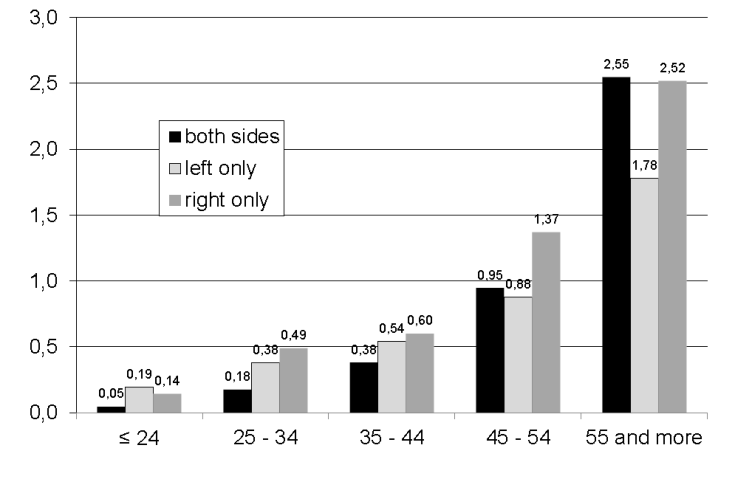
Considering the laterality of the findings in relation to the predominant right-handers (approximately 90%), so you can include work-related influences (Fig. 2).
Figure 2: Laterality of shoulder findings – prevalence /100 in relation to age and sides
Figure available in the original PDF paper.
At the shoulder joints finding of the right side are in the foreground. This increases with age steadily and reaches at the right side to 1.4 times the value of the left side.
Among the 16 occupations with the highest age-standardized prevalence rates of shoulder findings are the scaffolders, glaziers (including window fitter when installed) and carpenters with 3.5%, 2.9% and 2.5% on the first ranks (Fig. 3). The plasterers, floor layers and masons follow them. The right side is particularly concerned with glaziers, floor layers, concrete workers and roofers. This suggests different but mostly less strong influences of professional physical stress.
Figure 3: Laterality of shoulder findings for different professions – prevalence / 100
At the elbow joints finding of the right joint is already from 25th age in the foreground. It rises steadily with age and reaches from the 55th age to the right 1.6 times the value of the left side (Fig. 4). The proportion of persons with bilateral elbow joint findings is usually half as high as the right elbow joint.
Figure 4: Laterality of elbow joint findings – prevalence /100 in relation to age and sides
Figure available in the original PDF paper.
In the elbow region the stove fitters, plasterers and stucco-workers with 3.6%, 2.1% and 2.0% are in the top three ranks. The predominance of right-sided findings, particularly the plasterers, plasterers, bricklayers and carpenters fall.
Findings on the wrists only occur on both sides less than a quarter of people (in the age groups of figure 7 at 19.8% / 22.7% / 18.5% / 25.7% / 30.2% of the respective case number) on. It also dominates here the right side, but left- sided findings are to 54 Age with similar frequency.
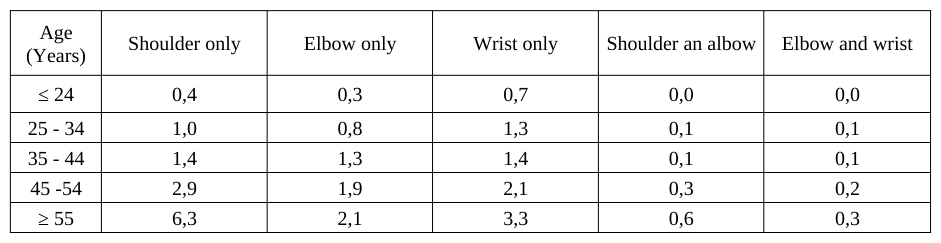
Table 2: Findings on shoulders, elbows and wrists individually and in combination with each other according to each age group (findings 100 Examined) Age (Years) Shoulder only Elbow only Wrist only Shoulder an albow Elbow and wrist
Furthermore, the association of findings in the shoulder, elbow-wrist region (Table 2) was tested. In all cases, the connection between the joints adjacent in the medical findings pronounced small and practically negligible.
The information on the physical demands of the employees have been raised according to the aim of the study in the context of medical preventive simple yes / no questions without further differentiation. Show (Figure 5) for
the impact of heavy loads only slightly and not significantly increased effects (ORs),
for exposure to awkward postures significant effects on shoulder, elbow and wrist with ORs of 1.85, 1.41 and 1.70,
for subjectively assessed exposure to hand-arm vibration significant effects with ORs for the shoulder, elbow, hand and finger joints of 2.35, 2.21, 2.48 and 2.20.
Figure 5 risks of findings in relation to physical loads and region of hand-arm-system (Odds-ratios and 95% CI)
DISCUSSION
The frequency of complaints in the upper extremities can only be compared in the same situation with the same survey methods inventory. In the self-reports of symptoms, the frequencies of the construction workers of our survey are similar in population studies, such as the comparison of the german BIBB BAuA survey 2012 (Safety and Health at Work 2012) shows.
The study is based on secondary data from routine occupational medical gained by physicians in a limited time frame in conjunction with other indicators of health with a full body examination.
Consideration must be given that able-bodied workers appear to checkups, who know that their career prospects through increased tendency to complain is not improved and thus specify the fewer complaints as a trigger for a search for findings. Relationships to physical stress can be assessed only on the basis of information provided by the employee and expert estimates for group typical load profiles here.
CONCLUSIONS
A consideration of the occupations that are particularly affected by musculoskeletal disorders of the hand-arm system give indications on causes and influencing factors:
The shoulder joints are the most common affected region. They can not be satisfactorily explained, because the function of this joint is complicated and because the findings on the pathology of tendon disorders are not processed scientifically satisfactory. The low side differences can be considered as an indication of moderate proportions of the work on the causes. However work with arms be executed tend to be more symmetrical both arms.
The elbow joints are primarily affected in occupations with repetitive force -fitting handmade by findings. The obvious side depending on the findings in some professions supports the hypothesis that a greater proportion caused by work is available.
At the wrists at the craft activities generally no significant findings accumulations. Please note are the combined effects of force, repetitiveness, extreme postures and vibrations.
REFERENCES
Hagberg M, Silverstein B, Wells R, Smith MJ, Hendrick HW, Carayon P, Perusse M (1995): Work Related Musculosceletal Disorders (WMSDs): A Reference Book for Prevention. London. Taylor & Francis. Shiri R, SluiterJK, Rest KM, Frings-Dresen MHW (2001): Criteria document for evaluating the work-relatedness of upper-
extremity musculoskeletal disorders. Scand J Work Environ Health 27 suppl 1: 1 – 102. Varonen H, Heliövaara M, Viikari-Juntura E (2007): Hand dominance in upper extremity musculoskeletal disorders. Journal of Rheumatology 34: 1076 – 1082. Walker-Bone K, Palmer KT, Reading I, Coggon D, Cooper C (2004): Prevalence and impact of musculoskeletal disorders of the
upper limb in the general population. Arthritis & Rheumatism 51; 642 – 651. .
LISTED IN THE AHFE DIGITAL BOOKSTORE CATALOGUE
Explore the complete digital volume
Advances in Physical Ergonomics and Human Factors: Part I
Read this individual research paper free through the original publisher, or explore the full digital proceedings book.
ISBN 978-1-4951-2104-3
Explore this ISBN in the AHFE Bookstore ↗Listed in the July 2026 bookstore catalogue; search by ISBN to confirm current availability · Digital book purchase optional