Chih-Wei Lu (2018). Medicine Slips Prevention for Patient Safety. In: Advances in Physical Ergonomics and Human Factors: Part I. AHFE Open Access, vol. 1. https://doi.org/10.54941/10041
The medicine deliver effect patient safety and prescription processes are always very important in the hospital. In Taiwan, the numbers of medicine event were 5960 (in 2008) and 9148 (in 2006). The trend of medicine events is increased, so medicine slips prevention is seriously. In this study, we analysis of factors medicine slips then by improving the environment of operating interface to prevent medicine events. Currently, the hospital into the computerized operations situation, deliver medicine correctly is an important part of patient safety, so human-computer interface design such as the computerized physician order entry (CPOE) system, with pop-ups, colors warning to remind staff s of hospitals to avoid the use of to allergy medications and repeated medicine, the errors of medicine name input, as well as the error of using wrong dose to reduce events of human error and decrease the medication slips and promote patient safety.
The trend of medicine events is increased, so medicine slips prevention is seriously. Now, patient safety is a key issue of the World Health Organization (WHO) the goal is to “let patient prevent any unnecessary accident or hurt during healthcare procedure” (WHO, 2013) and, combining medical ethic, patient safety and medicine quality to generate the win-win condition for patients and medics. In February 2003, The Bureau of health has constructed the committee of patient safety, to reinforce the patient safety and medical right (CL Hshe, 2004). In 2005, the committee had announced six activity goals and one of them was the patient slips prevention which would be done by the strategy of improvement of monitor and report patient fall case and degree of injury (TJCHA, 2005).
According to Taiwan Health Reform Foundation (THRF), there were 476 medical disputes, 56 cases were prescribing errors and about 10% of all errors (Jen, 2003). Types of errors included giving wrong medications; worsen after using the medication, giving a wrong dosage. In 1999, The USA Healthcare Society pointed that there 44,000 to 98,000 person’s death was due to medical negligence (Allan & Barker, 1990; Dean, 2002). Health care industry has started to face up and pay more attention to patient safety and prescription safety. All of medication errors were contributed to “human errors”. Based on the database of industrial accidents, more than 70% accidents were related to human errors. In all over the world, the safety engineer and enterprises work hard to control human errors (Ind. Safety & Health 2002, 2003).
METHODS AND TOOLS Three research methods (questionnaires, human error analysis and work environment survey) have been used for this study. The Figure 1 shows flow-chart of activity and human error analysis. The questionnaire has been designed to get the information of subjects such as height, years of work experience, gender, slips frequency and job Physical Ergonomics I (2018) conduction, major error evaluation and physiology and psychology conduction. The prescription prepare slips have been analyzed by the methods included job analysis methods and human error analysis method, and the Hierarchical Task Analysis (HTA) used to analysis the tasks of prescription, shown on the Figure 2 flow-chart of HTA. And, the systematic human error reduction & prediction approach (SHERPA) was used to analysis the human errors in the pharmacy. The tools used to collected data of work condition of pharmacy were ruler and stop watch and Digital video (DV). Furthermore, the error summary from the document of pharmacy error report system had been collected and analyzed. Figure 1 shows flow-chart of activity and human error analysis. First step, the standard operation procedures (SOP) was reviewed to generate the tables of task. Then, HTA and SHERPA were constructed. Finally, the error junctions had been classified and identified.
Figure 1 flow-chart of activity and human error analysis
The steps of HTA are jobs identification, data collection, first priority setting, second priority setting, second priority analysis…etc. It is a very popular method for process or job analysis method, which has been developed by Annett in 2002 (Annett, 2002), to detect potential error or slip points and to communicate operation head or supervisor to get some ideas for revising the sheet of human error molding.
Figure 2 flow-chart of Hierarchical Task Analysis (revised from Annett in 2002) The Error Report System of Pharmacy
The hospital already has the report system of error in the pharmacy department for patient safety. The study group has got the data and analyzed to find the risk factor of human error about prescription. The slip data about prescription process has been compared with the information of job analysis and HTA & SHERPA. The processes of SHERPA analysis were: Starting SHERPA, Job classification, human Error Identification, Result Analysis, Analysis Revise, Probability analyses, Key factor analysis, Analysis revise.
Data Analysis All the data had been collected and has been keyed into Microsoft office excel to create a database, Then, analyzed by using the software of Microsoft office Excel and SPSS 12.0.
RESULTS
The participators were 46 pharmacists from the medical center in the South of Taiwan, and the return rate of questionnaire, was 100%. The demography information of pharmacists showed that the average age (SD) was 35.2(7) years old; body weight (SD) was 53.4 (8.9) Kg; body height (SD) was 160.3 (8.4) cm; 10 persons (21.7%) were male and 36 (78.2%) were female. The mode of working experience was 1-5 years and the rate was 17.36%.
Figure 3 shows the self-report human error rate from pharmacists. All the people (100%) in the study had knew their job may slip up; 97.8% of them had heard colleague had mentioned mistake; 91.3% had even slip up during their job and 63% had ever slip up within three months.
I heard my colleague
mentioned mistake
I’ve ever slip up within
three months
no
I’ve ever slip up during
yes
my job
I know the job may
slip up
Figure 3 The self-report human error rate from pharmacists
Table 1 the ten most key human errors chosen by pharmacists
By using the methods of HTA and SHERPA methods to analyze prescription preparing human reliability, the error types had been summarized and been passed to pharmacies to judge the priority of error types. The ten most key human error types have chosen by pharmacist shows on Table 1. And, the error types were: miss the name of medicine, miss the quantity of medicine, attach wrong drugs, put it into wrong cabinet, do not find errors of medicine, maker up wring drugs, do not find error of quantity, miss some medicine, error judgment, and do not find error during tasks of check drug bags, check drug bags, attach drugs, put drug bag into cabinet, check drug bags, make up drugs by machine, double check, package drug bag, judge to attached drugs, check drug bags in sequence.
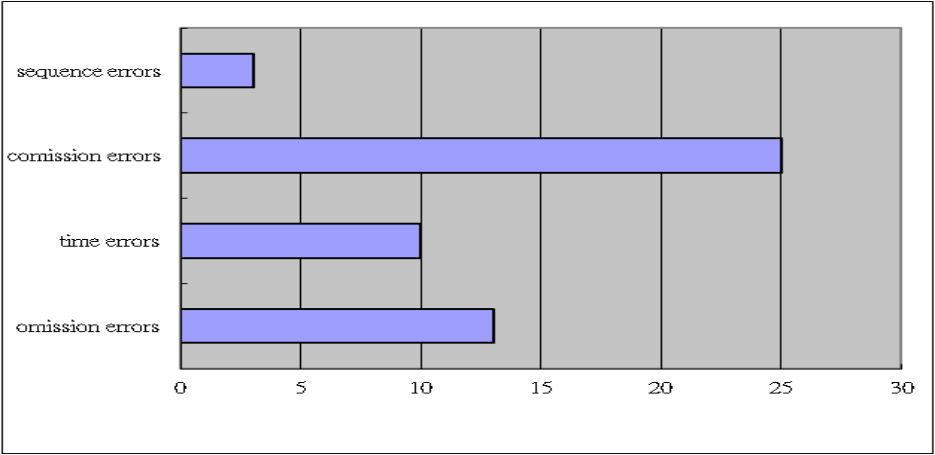
Based on the activity, the error types were classified by Swain’s method. The activity error types are: omission errors, commission errors, sequence errors, times errors. Figure 4 shows human error types of Swain. The commission error was the highest error rate (10.86%) and the omission error was the second high (26.09%); the third was timing error (19.57%) and the fourth was sequence error (4.35%).
Equation reproduced from the original PDF.
Based on type of human behavior, the error types were classified by Ramussen’s method. The type of behavior were: skill-based, ruled-based and knowledge. Figure 4 shows human error types of Ramussen’s. The rule- based error was the highest error rate (54.35%) and the skill-based error was the second high (32.61%); the third was knowledge-base error (19.57%).
Figure 4. Human error types of Ramussen’s classification (n=46) know ledge based
rule based
skill based
0 5 10 15 20 25 30
DISCUSSION
Based on information of demography data, this labor group was yang, and mean of age was 35.2 years and work - experience was 8.6 years. The type of omission error was few, but the type of commission error was majority which was due to un-appropriate activities. Because the pharmacy is a professional job and high education required, most pharmacist had been graduated from university (high school 4.4%, university 53.3%, graduated degree 42.2%), the error had been accrued by short of knowledge was very not many. The classification of Swain was based on the activity of human and the most common types of errors were commission, omission, and timing and sequence errors consecutively. The Ramussen ‘s classification was based on the human behavior. And the most common types of errors were rule-based, skill- based and knowledge-based errors sequentially. Most pharmacists thought the commission errors and ruled-based error were the most common types of error in the job of prescription preparing. Maybe most pharmacists have been extremely familiar with their jobs but careless occasionally or had done un- appropriate activity then made errors in the familiar job. Some serious of accidents about the medical errors happened. The event report pointed that fatigue, overtime or work stress were root of accident.
CONCLUSION & RECOMMENDATION Developed systematic methods to evaluate the performance of a pharmacy prescription prepare system with multiple risk assessment in parallel; classified the type of error by the principal of Rasmussen and Swain and evaluated the priority of error by order. Currently, the hospital into the computerized operations situation, deliver medicine correctly is an important part of patient safety, so human-computer interface design such as the computerized physician order entry (CPOE) system, with pop-ups, colors warning to remind staff s of hospitals to avoid the use of to allergy medications and repeated medicine, the errors of medicine name input, as well as the error of using wrong dose to reduce events of human error and decrease the medication slips and promote patient safety.
ACKNOLEDGEMENT This study has been supported by the National Science Council, Taiwan (NSC 99-2221-E037-070-MY3) and Chung Yuan Christine University (CYCU-EECS-9901). We specially express gratitude the pharmacists at the Kaohsiung Medical University Hospital for helping us the experimental apparatus, and giving us many valuable suggestions.
REFERENCES
Abood R.R.(1996). 〝Errors in pharmacy practice. 〞U.S Pharmacist 21:122_132. Allan EL, Barker KN. (1990). 〝Fundamental of medication error research.〝Am J Hosp Pharm 47(3):555-71. Allan EL, Barker KN, et al (1995). Dispensing errors and counseling in community practice 〞American Pharmacy NS 35(12):25-33. Chen, M.H. (2003); “Prescription slips in healthcare enterprise” TZU CHI Medical Journal, 15:247-58. Hshe CL (2004), “Introduction of five goal of patient safety”, The teaching and training conference of patient safety for local
hospitals, Taipei, Taiwan. Jen, W.P. (2003); “Introduction of basic cause analysis”, Communication of Taiwan Joint Commission on Hospital Accreditation, Volume 4, No.03 Raja I, Salgado et al., (2004), “Predictors of falling in elderly hospital patients”, Arch. Gerontol. Geriatr. 2004:38:213-219. Taiwan Joint Commission on Hospital Accreditation (TJCHA), (2005) Handbook of Fall Prevention and Treatment. World Health Organization (WHO) (2013), http://www.who.int/topics/patient_safety/en/.
LISTED IN THE AHFE DIGITAL BOOKSTORE CATALOGUE
Explore the complete digital volume
Advances in Physical Ergonomics and Human Factors: Part I
Read this individual research paper free through the original publisher, or explore the full digital proceedings book.
ISBN 978-1-4951-2104-3
Explore this ISBN in the AHFE Bookstore ↗Listed in the July 2026 bookstore catalogue; search by ISBN to confirm current availability · Digital book purchase optional