Yuichi Kurita, Kohei Sakurada, Tosho Tsuji (2018). Evaluation of Endpoint Compliance Based on the Estimation of the Muscle Activity. In: Advances in Physical Ergonomics and Human Factors: Part I. AHFE Open Access, vol. 1. https://doi.org/10.54941/10011
In this paper, endpoint compliance based on muscle activity is calculated by using a musculoskeletal model. Muscle force and muscle activity during a reaching movement are estimated by an optimization calculation based on the musculoskeletal and muscular contraction models. The calculated endpoint compliance during the reaching movement is shown by an ellipsoid. The difference between the muscle force- and the muscle activity-based endpoint compliance ellipsoids are discussed. The simulation results show that the short axes of the muscle activity-based ellipsoids tend to become longer than those of the muscle force-based ellipsoids.
Recent advances in assistive technologies provide technical aids for improving quality of life. To support the human motions in a safe and acceptable manner, understanding musculoskeletal dynamics of humans and building models of human's motion are helpful to evaluate subjective efforts associated with intuitive, safe, and easy-to-use design of a product. Humans are able to control the endpoint impedance of their arms by modulating their muscle activation. Traditionally, a method of characterizing endpoint stiffness or compliance on either the joint level or muscle force level has been proposed to evaluate postural stability and motion characteristics of a human limb [Mussa Ivaldi,1985, Ito,1988, Shadmeh,1993]. Humans generate joint torque by cooperatively controlling voluntary muscular exertion of multiple muscles. Because the maximum voluntary muscular contraction force changes depending on individual muscles, the subjective effort to exert desired joint torque changes depending on muscles used. It is thought that the perception of effort arises in the brain from corollary discharges of the central motor command [de Morree, 2012]. To evaluate the motor command, the muscular contraction model should be considered. In this context, this paper proposes an evaluation method of endpoint compliance of a human upper extremity on the muscle activity level that takes advantage of the physiological characteristics of the muscular contraction.
METHODS
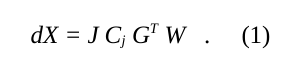
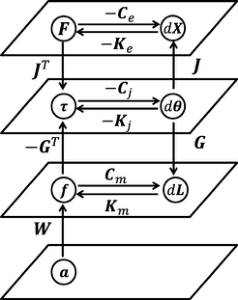
Musculoskeletal model The mathematical relationship among the muscle activity, muscle force, joint torque, and end-point position is shown in Figure 1. In this figure, C and K are the compliance and stiffness matrixes, J and G are the Jacobian matrixes, and W is the transform matrix from muscle activity [Equation or mathematical symbol available in the original paper PDF]to muscle force f. From this relationship, the displacement at the end-point level dX can be given by:
Equation reproduced from the original PDF.
Based on this relationship, the set of dX under ||[Equation or mathematical symbol available in the original paper PDF]||2 < 1 can be shown by an ellipsoid: dXT [ (J Cj GT W) (J Cj GT W)T ]-1 dX < 1. (2)
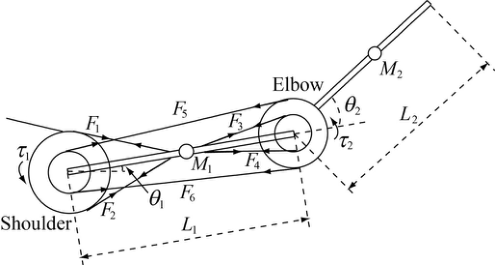
The muscle activity during a reaching movement was estimated by an optimization calculation based on a musculoskeletal and a muscular contraction model. The muscle force that satisfies given joint torque was estimated based on the musculoskeletal model of a human arm shown in Figure 2. The kinematics of the musculoskeletal model was modeled by two links, which indicate the upper arm and forearm, and six muscles, which consist of four single joint muscles and two multiple joint muscles. The anatomical and physiological characteristics of a muscle were also taken into account. In order to calculate the muscle force during the motion, the cost function was employed that minimizes a sum of muscle activity. The endpoint compliance, which is quantified as the relationship between the muscle activity and the resultant endpoint displacement, was shown by an ellipsoid.
Figure 1. Impedance relationships among muscle, joint, and end-point levelsFigure 2. 2-links 6-muscles arm model
RESULTS
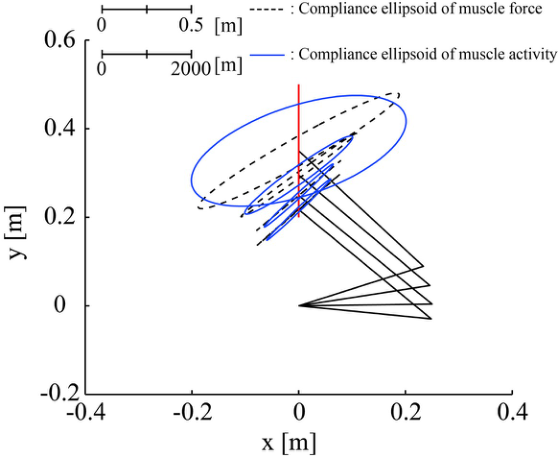
The endpoint compliance for a forward trajectory was calculated by a computer simulation. We calculated the muscle force-based and muscle activity-based endpoint compliance ellipsoids. The experimental results are shown in Figure 3. The results show that the angle between the forearm link and the longer axis of the ellipsoid is almost perpendicular for both of the muscle force- and muscle activity-based endpoint ellipsoids. However, the short axes of the muscle activity-based ellipsoids tend to become longer than those of the muscle force-based ellipsoids. Because the muscle activity-based endpoint compliance considers the muscular contraction dynamics, i.e., the maximum contraction force, the contraction velocity, and the length-tension relation of the contractile element, the resultant endpoint compliance ellipsoids are expected to be much closer to the subjective effort of humans than those calculated on the muscle force level.
Figure 3. Endpoint compliance ellipsoid in muscle force and muscle activity levels
CONCLUSIONS
This study proposed a calculation method of endpoint compliance based on muscle activity. The muscle force and muscle activity during a reaching movement were estimated by an optimization calculation based on a 2-links and 6muscles musculoskeletal model with a muscular contraction model. Based on the mathematical relationship among the muscle activity, muscle force, joint torque, and end-point position, the endpoint compliance can be shown by an ellipsoid. The simulation confirms that there is a difference in the shape of the ellipsoid between the muscle force- and the muscle activity-based endpoint compliance ellipsoids. Future work includes improving the accuracy of the muscle force estimation by inputting more detailed physical and motion data.
REFERENCES
de Morree, H. M. (2012), “Perception of effort and movement-related cortical potential during weight lifting”, Brain Products Press Release, Volume 45. Ito, K., Tsuji, T. and Nagamachi, M. (1988), “Motor Impedance and Inverse Kinematics in Musculoskeletal Systems”, In Proc. of
IEEE Engineering in Medicine & Biology Society 10th Annual International Conference, pp. 635-636. Mussa Ivaldi, F. A. (1985), “Neural, Mechanical, and Geometric Factors Subserving Arm Postures in Humans”, Journal of Neuroscience, Volume 5, pp.2737-2743. Shadmehr, R. (1993), “Control of Equilibrium Position and Stiffness through Postural Modules”, Journal of Motor Behavior,
Volume 25, pp. 228-241
LISTED IN THE AHFE DIGITAL BOOKSTORE CATALOGUE
Explore the complete digital volume
Advances in Physical Ergonomics and Human Factors: Part I
Read this individual research paper free through the original publisher, or explore the full digital proceedings book.
ISBN 978-1-4951-2104-3
Explore this ISBN in the AHFE Bookstore ↗Listed in the July 2026 bookstore catalogue; search by ISBN to confirm current availability · Digital book purchase optional