Ray F. Lin, Yi-Chien Tsai, Chi-Yu Huang, Min-Hsin Lin (2022). An Application of Ballistic Movement Method for Evaluating the Effects of Movement Direction Using a Standard Mouse. In: Advances in Ergonomics In Design, Usability & Special Populations: Part II. AHFE Open Access, vol. 19. https://doi.org/10.54941/ahfe1001268
Most studies on the effect of movement direction utilized Fitts’ law; however, the use of Fitts’ law has a limitation of discriminating the extent to which properties of speed and accuracy contribute to the aiming movement time. Hence, this study aimed at utilizing the two ballistic movement models to separately assess speed and accuracy. Four participants performed ballistic movements with a standard computer mouse in eight radial directions. The measured movement time and two axes of end-point variability were analyzed using the two ballistic movement models. The results showed that two ballistic movement models accounted well for the measured data in various movement directions, and movement direction had certain effects on movement time, aiming-constant error, and aiming-variable error. Movements took the shortest times in the directions of 0° and 180°. Participants aimed targets with a counterclockwise angle when moving toward 90°, 135°, 180°, and 225°, and with a clockwise angle when moving toward 270°, 315°, 0°, and 45°. Aiming-variable errors were relatively smaller along cross axes, compared to those along diagonal axes. Ballistic movement models, compared to Fitts’ law, provided individual performance information of “speed” and “accuracy”, helping provide detail information for HCI designs.
Pointing movements, such as pointing the cursor to an icon or a button, are one of the most essential operations performed in current graphic user interfaces. To enhance task performance and user satisfaction, many researchers study the effects of movement direction on pointing movements. While using a standard (conventional) computer mouse, in general, aiming movement times are the shortest when performing pointing movements in horizontal directions and the longest in vertical directions (Radwin et al. 1990, Whisenand and Emurian 1999, Thompson et al. 2004). These findings of the effect of movement direction help interaction designers develop appropriate input devices and interface techniques via meeting human capabilities and compensating human limitations. However, the Fitts’ law method (Fitts 1954, MacKenzie 1992), used by most studies, cannot provide separate performance information of movement properties of speed and accuracy. To obtain detail information of the human-computer system, it is necessary to use a more effective methodology.
Effects of Movement Direction on Mouse Control Because of the limb structure restrictions, pointing movements in different directions result in unequal movement times. Many studies of hand-control movement have explored the variation of execution time under different conditions. For example, Schmidtke and Stier (1960) found that aiming movements on a horizontal plane in front of the body take the longest times in directions of 55° and 235° for right-handed persons. Similar results were reported by Iwase and Murata (2002) and Murata and Iwase (2005) who tested aiming movement using a touch panel. However, this effect of movement direction varies while using computer mice. Most of studies on computer mice (Whisenand and Emurian 1996, Whisenand and Emurian 1999, Scarlett 2005) found that movements took the shortest time in the horizontal directions at 0° and 180° and took longer times in the directions of diagonal (45°, 90°, 135°, and 315°) and vertical (90°) angles. At the first glance, the effects of movement direction are inconsistent. However, a general concept is that the less number of limb segments or smaller segment(s) involved in performing movements, the shorter movement time required. According to Balakrishnan and MacKenzie (1997), the time required to perform movements that vary in the classification of limbs and joints. When performing movement in front of the body, movements in the directions of 55° and 235° involves the less body segments and angles, mainly forearm and elbow. Whereas, when using a computer mouse, because the mouse is usually place at the right front location, concur movements in the directions of 0° and 180° involves the less body segments and angles.
Although these findings related the effects of movement direction help design human-computer interaction, few studies analyzed how movement directions affect movement accuracy. In fact, studies that used Fitts’ law as an evaluation method reported movement time as a confounded performance. Fitts’ law is easy to apply, but as mentioned in Lin and Shih (2013), Fitts’ law only provides an overall performance measure that is resulted from two motor properties: speed and accuracy. More specifically, Fitts’ law has difficulty determining whether long movement times required by movements in certain directions are due to slow movement speed or low movement accuracy; Fitts’ law does not provide information about how the two movement properties contribute to the overall movement time. A slow aiming movement could be formed with any combination of speed and accuracy movement properties (Lin et al. 2009, Lin and Drury 2010). To obtain detailed and independent motor abilities of speed and accuracy, the ballistic movement method was utilized in this study.
Ballistic Movement Method Lin et al. (2009) and Lin and Drury (2010) illustrated that a self-paced aiming movement modeled by Fiits’ law is composed of one or more than one ballistic movements. To study how ballistic movements are related to self-paced aiming movements, Lin and Drury (2013) verified two models for predicting two-dimensional ballistic movements performed on a drawing tablet. Ballistic movement time represents the required time for performing a ballistic movement. As shown in Equation 1, the ballistic movement time (t ballistic) is linearly related to the square root of
ballistic movement distance (√du), where e and f are experimentally determined constants. Ballistic movement variability describes the endpoint variability of a ballistic movement. While performing a ballistic movement, the probability of its endpoint location would be a bivariate normal distribution around the aimed point. Stopping error is measured parallel to the moving direction; whereas, aiming error is measured perpendicularly to the moving direction. As shown in Equation 2, the ballistic movement variability model predicts two directions of end-point variance (measured by standard deviation) are linearly related to the ballistic movement distance (du), where i and j are experimentally determined constants.
Equation reproduced from the original PDF.
Two ballistic movement models have been validated for a variety of hand-control movements in a different dimensions and with various input devices (Lin and Ho 2011, Lin et al. 2013, Lin and Drury 2013, Lin and Shih 2013). Lin and Drury (2013) verified the two models by performing ballistic movements in a single direction on a drawing tablet. Lin and Ho (2011) tested these models for movements performed in a real three-dimensional environment. Lin and Shih (2013) used these models for describing the differences between the elderly and the young while using a touch screen. Lin et al. (2013) validated the ballistic movement models for providing separate performance measurement of speed and accuracy for assessing various computer mice. Ergonomics In Design, Usability & Special Populations II
Research Objective To assess the effect of movement direction, Fitts’ law (1954) is an effective method that has been widely utilized by relevant studies (e.g., Card et al. 1978, Epps 1986). Although Fitts’ law has significant contributions in the field of HCI, it has limitations of theoretical derivation (Zhai 2004, Hoffmann 2013). Despite the theoretical issues, Lin and Shih (2013) pointed out that Fitts’ law only allows experimenters to obtain a confounded performance of movement time. That is, Fitts’ law cannot help us to determine that movements performed in a certain direction that take longer times are completely due to lower movement speed or a combination of lower movement speed and lower accuracy as well. To overcome this limitation, the main objective of this study was to use the ballistic movement models proposed by Lin and Drury (2013) to assess the effects of movement direction on movement speed and movement accuracy, separately. Different from the overall movement time obtained by Fitts’ law, this study emphasized on testing the superiority of the ballistic movement models that can provide individual performances of speed and accuracy.
METHOD
Participants and Apparatus Four participants who had average age of 22 years were recruited in this pilot study. All of the participants were right-handed with normal or corrected-to-normal vision. Experimental equipment was a personal computer with a standard computer mouse. A self-developed Visual Basic 6.0 experimental program was run by the personal computer for participants performing ballistic movements.
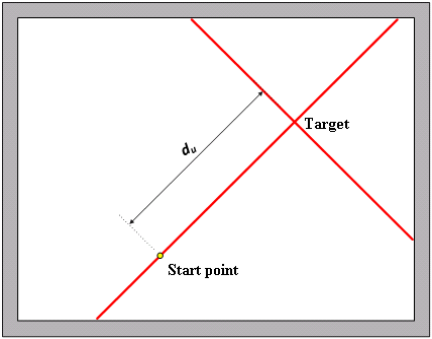
Experimental Setting and Procedures To perform the experimental task, the participants use the computer mouse to drew a line from a start point to the center of a cross target at one of eight radial directions and ten distances from the start point. As shown in the left of Figure 1, participants first moved the cursor on the start point and clicked down the left button of the mouse for preparing movement execution toward the 45° direction. Once the cursor was moved away from the start point, the start point, cursor and the cross target temporarily disappeared and the movement time started to record. Once the movement completed, as shown in the right of Figure 1, the screen displayed the information about the movement path and the endpoint. Participants could then click the left button of the mouse at any place of the screen to continue on the next trial.
Figure 1. Executions of ballistic movement (an example of 45°) using a general computer mouse.
Experimental Variables The independent variables were movement direction and distance. The eight radial movement directions were 0°, 45°, 90°, 135°, 180°, 225°, 270° and 315°. The ten ballistic movement distances were 45, 51, 69, 99, 141, 195, 261, 339, 429, and 531 pixels (1 pixel ≒ 0.294 mm). Every experimental combination was replicated four times, resulting in a total 320 trials. All the trials were randomly conducted by each participant, taking about 15 to 25 minutes to finish in the formal measurement. Each participant performed the experiment three times in three individual days. The first two experiments were for practicing, and only the data obtained in final experiment were analyzed.
Three types of performance data, comprising ballistic movement time (t ballistict ballistic), stopping error, and aiming error, were automatically recorded by the experimental program after every successful experimental trial. As mentioned in the literature section, stopping error is measured parallel to the moving direction; whereas, aiming error is measured perpendicularly to the moving direction. These two directions of error were further calculated as constant error and variable error after experiments.
RESULTS
Performance of Speed Analysis of variance was performed on the movement time, using a mixed model with Direction and Square Root of Distance as fixed effects and Participant as random, in which the interaction effect between these two fixed effects were analyzed. The results showed significant main effects of Participant (F3,2477=524.38, p<0.001),
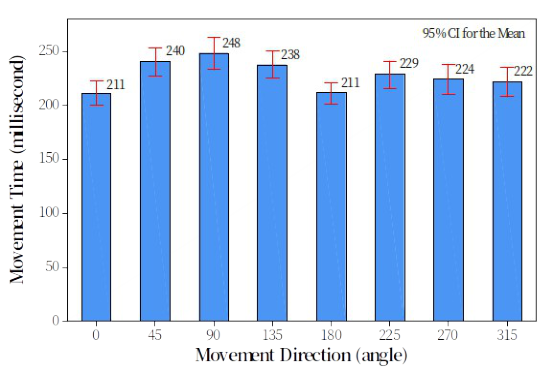
Directions (F7,2477=10.98, p<0.001) and Square Root of Distance (F9,2477=267.39, p<0.001). The effect of Participant was considered as a blocking effect, which was not interested in. Figure 2 shows that participants performed ballistic movements with different ballistic movement times in different directions. Participants took the shortest movement times while performing movements in directions of 0°, 180°, 270°, and 315°, and took the longest movement times while performing movements in directions of 45°, 90°, and 135°.
90°
180°
0°
Figure 2. Ballistic movement times under different directions (milliseconds).
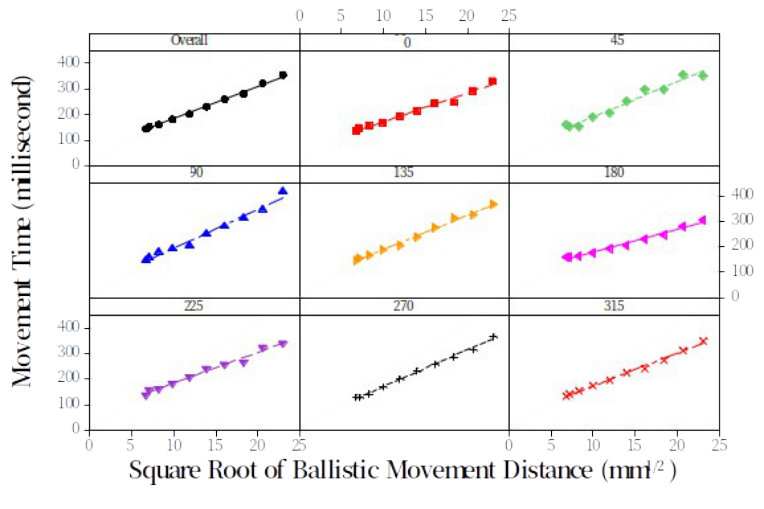
Because significant main effect of Square Root of Distance was found, the test of Equation 1 could be performed. The means of ballistic movement time (t ballistic) were regressed on to the square root of ballistic movement distance (√du¿. As shown in Figure 3, the increased square root of ballistic movement distance resulted in increased ballistic movement time. Equation 1 accounted for 99.7 % variance of the overall data and accounted for 98.5% on average and at least 96.9% for movements performed in the eight radial directions.
Figure 3. Relationship between ballistic movement time and the square root of ballistic movement distance for overall and the eight individual movement directions.
Performance of Accuracy The movement errors consisted of constant error and variable error. To analyze whether the independent variables had significant effects on these two types of errors, four replications of each experimental combination were first calculated as the constant error (measured by mean) and the variable error (measured by variance). Analysis of variance was then performed on stopping-constant error, aiming-constant error, stopping-variable error, and aiming- variable error, using a mixed model with Direction, Distance as fixed effects and Participant as random. Again, the effect of Participant was considered as a blocking effect, which was not interested in.
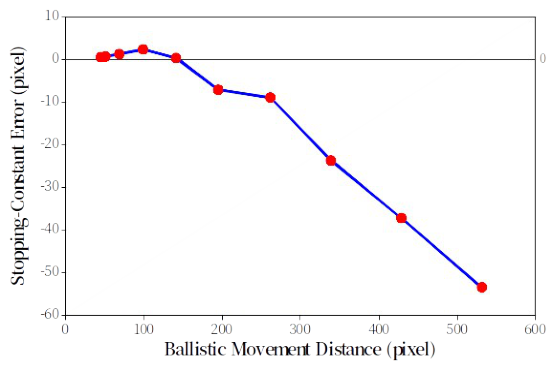
Figure 4. Relationship between stopping-constant error and ballistic movement distance.
Regarding to constant errors, Participant had a significant effect on both stopping-constant error (
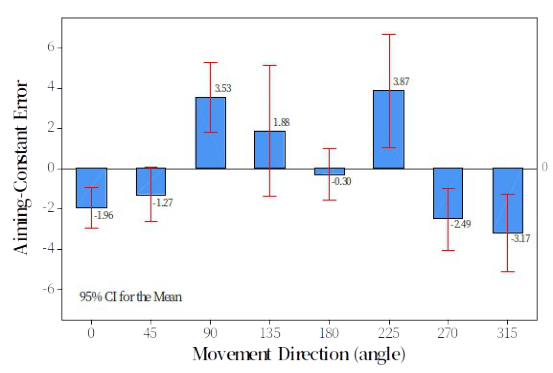
F3,237=43.85, p<0.001) and aiming-constant error (F3,237=6.18, p<0.001), Distance had a significant effect on stopping-constant error (F9,237=56.98, p<0.001), and Direction had a significant effect on aiming- constant error (F7,237=7.41, p<0.001). As shown in Figure 4, increased ballistic movement distance resulted in increased negative stopping-constant error (i.e., undershoot), especially when movement distances were longer than 140 pixels. Figure 5 shows that aiming-constant error varied in eight movement directions. A positive value means that the angle between the real aiming direction and the anticipated movement direction was a counterclockwise angle and vice versa. The participants aimed targets with a counterclockwise angle when movements were moved toward 90°, 135°, 180°, and 225°, and with a clockwise angle when movements were moved toward 270°, 315°, 0°, and 45°.
90°
180°
0°
Figure 5. Effect of movement direction on aiming-constant error.
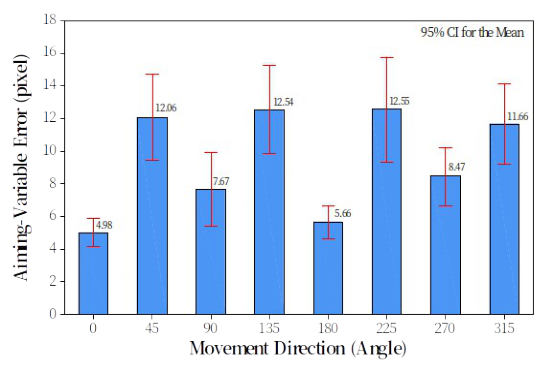
Regarding to variable errors, Participant had a significant effect on both stopping-variable error (F3,237=4.87, p<0.05) and aiming-variable error (F3,237=27.22, p<0.001), Direction had a significant effect on aimingvariable error (F7,237=19.06, p<0.001), and Distance had a significant effect on both stopping-variable error ( F9,237=36.6, p<0.001) and aiming-variable error (F9,237=38.52, p<0.001). As shown in Figure 6, aiming- variable errors were relatively smaller along cross axes (i.e., 0°, 90°, 180° and 270°), compared to those along diagonal axes (i.e., 45°, 135°, 225° and 315°).
90°
180°
0°
Figure 6. Effect of movement direction on aiming-variable error.
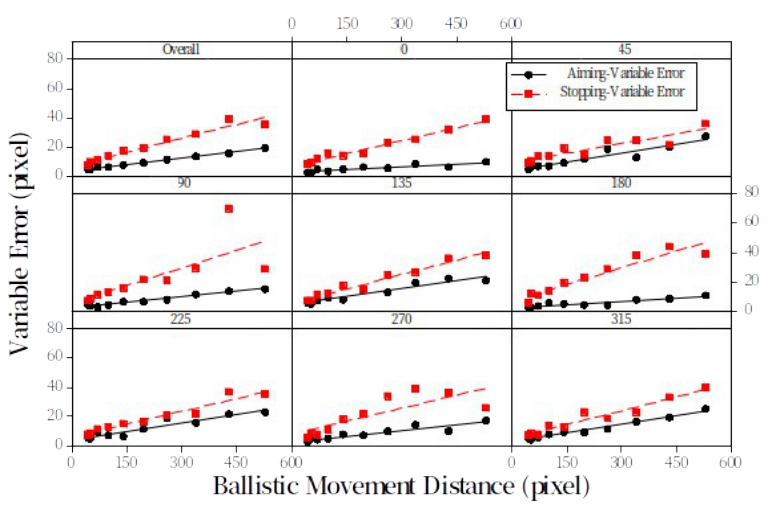
Because the effect of Distance was found significant on both stopping-variable error and aiming-variable error, the test of Equation 2 could be performed. The means of two types of ballistic movement variability were regressed on to the of ballistic movement distance (du). As shown in Figure 7, the increased ballistic movement distance resulted in increased ballistic movement variability for both stopping- and aiming-variable errors. Stopping-variable errors were greater than aiming-variable errors. However, the discrepancy between two types of variable errors varied across movement directions. Regarding to the stopping-variable error, Equation 2 accounted for 94.8% variance of the overall data and accounted for 84.68% on average and at least 56.3% for movements under eight individual directions. Regarding to the aiming-variable error, Equation 2 accounted for 99.6% variance of the overall data and accounted for 89.35% on average and at least 77.6% for movements under eight individual directions.
Figure 7. Relationship between stopping- and aiming-variable errors and the ballistic movement distance under different movement directions.
DISCUSSION
The use of two ballistic movement models helps reveal effects of movement direction on five dependent measurements (see Table 1). Regarding to movement time, both movement distance and direction had significant effects on ballistic movement time. As expected, the ballistic movement time was linearly related to the square root of ballistic movement distance, and the ballistic movement time model (Equation 1) predicted well this relationship (see Figure 3). Our finding related to ballistic movement time is similar to that reported by previous studies (Whisenand and Emurian 1996, Whisenand and Emurian 1999, Scarlett 2005) that studied aiming movement time. As shown in Figure 2, movements took the shortest time in the horizontal directions at 0° and 180° and took longest times in the vertical (90°) angle. This result confirms the concept that the less number of limb segments or smaller segment(s) involved in performing movements, the shorter movement time required. Regarding constant errors, movement distance had an effect on stopping-variable error and movement direction had an effect on aiming- constant error. Increased movement distance resulted in increased undershoots of the target (Figure 4). Participants aimed targets with a counterclockwise-angle deviation when moving toward 90°, 135°, 180°, and 225°, and with a clockwise-angle deviation when moving toward 270°, 315°, 0°, and 45° (Figure 5). Both effects would not be available when using Fitts’ law as an evaluation method, because another ballistic movement will be performed to correct these constant errors of the first ballistic movement (Lin et al. 2009, Lin and Drury 2010). Regarding to variable errors, movement distance had significant effects on both stopping- and aiming-variable errors, and movement direction only had a significant effect on aiming-variable error. As expected, both the stopping- and aiming-variable errors were linearly related to ballistic movement distance, and the ballistic movement variability model (Equation 2) predicted well these relationships (see Figure 7). As shown in Figure 6, we found that aiming- variable error were relatively smaller along cross axes, compared to those along diagonal axes, similar to that reported by Radwin et al. (1990) who found that movement deviation was lowest at off-diagonal directions (0°, 90°, 180°, and 270°).
Table 1. Effects of movement direction and distance on five measured movement properties.
This study showed the potential benefits of ballistic movement models for analyzing the effect of movement direction when using a standard computer mouse. While Fitts’ law only provides an overall performance measure that is confounded with two motor properties of speed and accuracy, the use of two ballistic movement models separates movement properties of movement time, stopping-constant error, aiming-constant error, stopping-variable error, and aiming-variable error. By using Fitts’ law as an evaluation method, we know that movements performed at 0° and 180° required the shortest movement times when using a standard computer mouse. With the ballistic movement method, we understand that these shortest times are a consequence of better movement speed (i.e., short movement time) and better movement accuracy (aiming-variable error). By separating movement properties in details, human-computer interaction designers can develop better hardware and software by focusing on specific properties of the human-machine system.
CONCLUSIONS
The study utilized two ballistic movement models for analyzing effects of movement direction when using a standard (congenital) computer mouse. The ballistic movement method, superior than Fitts’ law, provides detail movement properties of movement time, stopping-constant error, aiming-constant error, stopping-variable error, and aiming-variable error. While Fitts’ law only shows that movements performed at 0° and 180° required the shortest movement time, the ballistic movement method found that the phenomenon is resulted from greater performance of movement time and aiming-variable error when performing in these two directions. This study demonstrates the application and benefits of the ballistic movement method. Future research should recruit adequate amount of participants to obtain representative results for further HCI designs.
ACKNOWLEDGMENT
We would like to acknowledge the grant support from Taiwan National Science Council (NSC100-2815-C-155-004- E & NSC102-2221-E-155-049) for funding the study and the paper presentation.
REFERENCES
Balakrishnan, R. and Mackenzie, I.S., 1997. Performance differences in the fingers, wrist, and forearm in computer input control. CHI. 303-310. Card, S.K., English, W.K. and Burr, B.J., 1978. Evaluation of mouse, rate-controlled isometric joystick, step keys
and text keys for text selection on a crt. Ergonomics, 21 (8), 601-613. Epps, B.W., 1986. Comparison of six cursor control devices based on fitts' law models. Proceedings of the Human Factors and Ergonomics Society Annual MeetingSAGE Publications, 327-331. Fitts, P.M., 1954. The information capacity of the human motor system in controlling the amplitude of movement.
Journal of Experimental Psychology, 47, 381-391. Hoffmann, E.R., 2013. Which version/variation of fitts' law? A critique of information-thoery models. Journal of Motor Behavior, 45 (3), 205-215. Iwase, H. and Murata, A., 2002. Empirical study on the improvement of usability for touch-panel for elderly:
Comparison of usability between touch-panel and mouse. Proceedings of Systems, Man and Cybernetics. Hammamet, Tunisia, 252-257. Lin, J.-F. and Drury, C.G., 2010. Modeling fitts' law. In Lin, D.-Y.M. and Chen, H.-C. eds. Ergonomics for all: Celebrating ppcoe's 20 years of excellence: Selected papers of the pan-pacific conference on ergonomics. Taiwan: CRC Press, 561-567. Lin, J.-F., Drury, C.G., Karwan, M. and Paquet, V., 2009. A general model that accounts for fitts' law and drury's
model. Proceedings of the 17th Congress of the International Ergonomics Association, Beijing, China. Lin, R.F., Chung, C.-W., Tsai, Y.-C. and Huang, C.-Y., 2013. An application of the ballistic movement method of evaluating computer mice. Proceedings of the 15th internation conference on human-computer interaction, Las Vegas, Nevada, USA. Lin, R.F. and Drury, C.G., 2013. Verification of models for ballistic movement time and end-point variability.
Ergonomics, 56 (4), 623-636. Lin, R.F. and Ho, Y.-C., 2011. Verification of ballistic movement models in a true 3d environment. Proceedings of the 2nd East Asian Ergonomics Federation Symposium, National Tsing Hua University, Hsinchu, Taiwan. Lin, R.F. and Shih, S.-W., 2013. Assessing age differences in touchscreen pointing movements using the method of
ballistic movement. Journal of Industrial and Production Engineering, 30 (3), 173-180. Mackenzie, I.S., 1992. Fitts' law as a research and design tool in human-computer interaction. Human-Computer Interaction, 7 (1), 91-139. Murata, A. and Iwase, H., 2005. Usability of touch-panel interfaces for older adults. Human Factors, 47 (4), 767-
776. Radwin, R.G., Vanderheiden, G.C. and Lin, M.-L., 1990. A method for evaluating head-controlled input devices using fitts' law. Human Factors, 32, 423-438. Scarlett, D., 2005. Ergonomic mice: Comparison of performance and perceived exertion. Usability News, 7 (1). Schmidtke, H. and Stier, F., 1960. Der aufbau komplexer begegungsablaufe aus elementarbewegungen.
Forschungsberichte des Landes Nordrhein-Westfalen, 822, 13-32. Thompson, S., Slocum, J. and Bohan, M., 2004. Gain and angle of approach effects on cursor positioning time with a mouse in consideration of fitts law. the Human Factors and Ergonomics Society 48th Annual Meeting. Whisenand, T.G. and Emurian, H.H., 1996. Effects of angle of approach on cursor movement with a mouse:
Consideration of fitts' law. Computers in Human Behavior, 12 (3), 481-495. Whisenand, T.G. and Emurian, H.H., 1999. Analysis of cursor movements with a mouse. Computers in Human Behavior, 15, 85-103. Zhai, S., 2004. Characterizing computer input with fitts' law parameters - the information and non-information
aspects of pointing. International Journal of Human-Computer Studies, 61, 791-809.
LISTED IN THE AHFE DIGITAL BOOKSTORE CATALOGUE
Explore the complete digital volume
Advances in Ergonomics In Design, Usability & Special Populations: Part II
Read this individual research paper free through the original publisher, or explore the full digital proceedings book.
ISBN 978-1-4951-2107-4
Explore this ISBN in the AHFE Bookstore ↗Listed in the July 2026 bookstore catalogue; search by ISBN to confirm current availability · Digital book purchase optional