Dan - Radu Moga (2022). Classification of Seating Postures. In: Advances in Ergonomics In Design, Usability & Special Populations: Part II. AHFE Open Access, vol. 19. https://doi.org/10.54941/ahfe1001277
A classification of seating postures is necessary for a systemic approach in chair ergonomics. The methodology used criteria for differentiating and grouping seating variants into categories. Morphological (hip flexion, trunk inclination, lumbar lordosis, and muscular involvement), functional (the relationship with working areas), and cultural criteria (conventional and unconventional) were brought into discussion with arguments for validation. Each valid criterion describes, by its degree of expression, two categories. Cases of particular interest were found, when two or more criteria behave interdependently. The combined categories, defined by several criteria, were used to build up a classification. Discussions resumed conventions and described multi-criteria categories.
At present, the use of the term seated posture covers a wide variety of situations. Often, two versions, both considered seated postures, reveal major differences when submitted to a postural analysis. The term sitting posture becomes relatively insufficient to describe variants resulting from design improvements and innovations. The chair design classifications, used as the sole criterion, places the human subject in a passive perspective, ignoring morphological, functional and environmental conditions. There are situations where identical or similar positions are offered by different seats and situations where the same seat allows different positions (Baumgartner, Zemp, List, Stoop, Naxera, Elsig, Lorenzetti, 2012), (Zemp, Taylor, Lorenzetti, 2013), giving reasons for the dynamic, active sitting concept in chair design. The epistemic framework should be widened by using specific terms for categories that the various versions of seating posture will fall into.
The basic principles of human-factor analysis draw attention to the systemic approach. The analysis should refer to the individual – chair system, both subsystems being interrelated, consequently, both the morphological and the functional characteristics of the subject are being considered. Each seating instrument determines a different response from the biomechanics of the human body. The differences are obvious in terms of the osteo - articular system and the muscular system. But even the proximal environment, with work areas for the upper limbs or the sight, may differ (Mandal, 1981).
Ergonomics In Design, Usability & Special Populations II https://openaccess.cms-conferences.org/#/publications/book/978-1-4951-2107-4
CRITERIA FOR CATEGORIZATION The first objective of the study was finding a valid set of criteria. A valid criterion in describing sitting posture categories should derive as a direct consequence of the seated posture, whether it is a structural, functional or cultural one. A valid criterion should also be found in, and be able to describe all seated postures, but at the same time its high or low value of association should differentiate between categories. The interdependence between criteria led to multi-criteria categories for classification. Grouping and verifying categories for different situations completed our classification proposal.
Seating position recognizes different definitions, has a broad acceptance, and we preferred an approach based on the individual-chair system. Since ergonomics must address this wide systemic perspective, a suitable classification should take into an account the potential outcome of the system - the mission, the anatomical response of the body, the human behavior and the expectations regarding a certain seated posture. Differentiating criteria between seating postures have been used in previous studies. Bush and Hubbard (2008) considered geometric and kinematic criteria for evaluating body response, in different seating postures. Other studies used trunk inclination, trunk-thigh angle and lumbar lordosis for research categories (Benett, Gillis, Gross Portney, Romanow and Sanchez, 1989), (Bridger, Wilkinson, van Howeninge, 1989), (Link, Nicholson, Shaddeau, Birch, Gossman, 1990). Functional criteria, with a special focus on work areas, were also used, (Bendix, 1984), (Bridger, 1988). Thus, the body alignment, the purpose of the seated posture and its acceptance, meaning the morphological, functional and cultural point of view, were used as a source of obtaining criteria.
Morphological criteria Morphological criteria are those derived from standing to sitting changes. Regardless of the type of chair or the type of the seated posture adopted, the torso and limb orientation will change adaptively, the lumbar lordosis will be affected and postural muscular response will be different. Thus, three morphological criteria were used: hip joint flexion/trunk-thigh angle, trunk orientation, postural muscle response and lumbar lordosis.
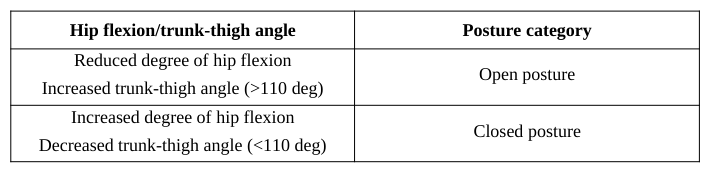
The hip flexion\ trunk-thigh angle Notably the most frequently recognized consequence, and always associated with seating posture, hip flexion, will induce a trunk - thigh angle that can vary more or less than 110 degrees. Perceived as a postural response to the angle between back tangent line and bottom tangent line (seat-back inclination) of the respective seated geometry, hip flexion is the major change when passing from the standing to the seated posture, thus thigh and knee positions requiring the clearance space in the anterior-inferior area of pelvis. Values of 110 degrees are considered optimal for backrest inclination (Harrison, Harrison, Croft, Harrison, Troyanovich, 1999), (Sitting and Chair Design, 2013). The terms open or closed can describe the postures with trunk-thigh angle above or below this value (see Table 1).
Table 1: Hip flexion/trunk-thigh angle and related categories Hip flexion/trunk-thigh angle Posture category
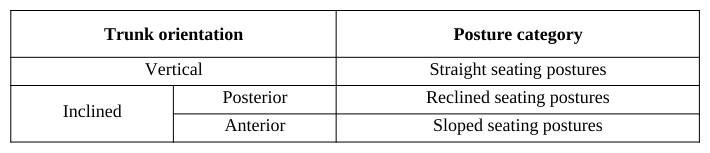
Changing trunk profile orientation is another consequence of sitting posture. A vertical trunk orientation with an open hip flexion angle is observed in kneeling chairs without back rest. Anterior slope of the trunk is often a consequence of a reduced pelvic angle with torso flexion and is associated with faulty posture and kiphosis. Backward inclination of the torso occurs in seated geometry with inclined back tangent line offered by the seat backrest. The latter generates two more situations according to the presence or absence of the lumbar support in Ergonomics In Design, Usability & Special Populations II https://openaccess.cms-conferences.org/#/publications/book/978-1-4951-2107-4 chair design (see Table 2). Anterior inclined, vertical and posterior inclined are the most acknowledged trunk orientation in comparative studies on sitting postures.
Table 2: Trunk orientation and related categories Trunk orientation Posture category
Lumbar lordosis Conducting a study on four types of seating postures, Bridger, Von Eisenhart Rothe and Henneberg (1989), used lumbar angles in standing posture, as reference. Other studies suggested that, regardless the seating posture category, lumbar curvature is greater in standing posture (Benett et al., 1989) Lumbar curvature type is the main spine postural change from standing to sitting. Orthostatic posture ensures, via muscular engagement, an active lordosis for the lumbar region, and changes in seating posture muscular response can add another criterion: the degree in maintaining active lumbar lordosis.
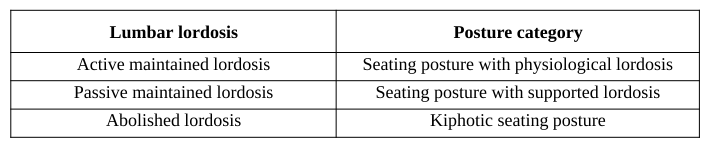
Maintaining lumbar lordosis is the hardest challenge to chair design constructive solutions. Lumbar lordosis in sitting posture can be maintained in an active way for those geometries associated with a moderate hip flexion (kneeling chairs or saddle chair), allowing an involvement of the postural muscle (Benett et al., 1989), (Frey and Tecklin, 1986), (Link et al., 1990). Passive systems of maintaining lumbar curvature are achieved by corrective design solutions of the sitting instrument, mainly a backrest with lumbar support. In their absence, a reclined sitting posture is characterized by cancellation of lumbar lordosis and resulting lumbar kiphosis (see Table 3).
Table 3: Lumbar lordosis and related categories Lumbar lordosis Posture category
Postural muscles involvement The main purpose of the sitting posture is to reduce postural muscle fatigue for the lower limb. As sitting posture geometry resides between two opposite situations, orthostatic and clinostatic, various degrees of muscular involvement may still be observed for different types of seated geometry. Lower limbs are excluded from main postural muscles chains. Lumbopelvic postural chains are the ones left responsible for seating posture: superficial lumbar multifidus, internal oblique and thoracic erector spinae (O’Sullivan, Grahamslaw, Kendell, Lapenskie, Moller, Richards, 2002). Tonus can be maintained for the cervical region or for the cervical and thoracic regions if, a medium or low-level backrest is provided, accordingly. Recent studies suggested the importance of a dynamic type of sitting with postural tonus and seating posture adaptation (Baumgartner et al., 2012), (Zemp et al., 2013). A reclined backrest with a muscular relaxation for the entire length of erector spinae will exclude any postural chain tonus, and the posture characterized by it can be classified as relaxed (see Table 4).
Table 4: Postural muscle involvement and related categories Postural muscle involvement
Functional criteria Far from being just a solution to ensure rest, sitting posture is an important resource for work. What defines a work destination for a seated posture is the relation of the human body with the proximal environment that is to be reached by hand or touch. A useful proximal environment for the upper limbs, visual field and visual inspection of the working areas represents the main criteria for defining the functional attribute for the seating posture.
Typically, the work areas for the upper limbs are arranged in a horizontal or tilted plane. Under those circumstances, the proper orientation of the trunk is vertical or closer to vertical, allowing a natural approach of peripheral analyzers and upper limbs to the working area and facilitating its control (Mandal, 1981). Tonic sitting postures, characterized by maintaining muscular tonus and a vertical orientation of the trunk in such a way that the visual field includes the area of interest or control, facilitate work. In the situations when the seated posture is designed to be inclined, the working or controlling areas are tilted in a similar way, to afford proper hand or sensorial reach. Reaching and controlling the working area further divide seated postures into active and passive ones (see Table 5).
Table 5: Functional criterion and related categories
Cultural criteria It is important to evaluate what is conventional about seating postures and how this can be taken into consideration from different human-factor perspectives. The cultural background of individuals can shape expectances. Seating makes no exception and there is a widespread, conventional image of how a chair or a seated person looks like. A 90-degree angle between hips and torso, a vertical or inclined trunk, is likely to be the representation of the sitting posture. Seating geometry and postures that move outside expectance boundaries may trigger behaviors that can alter or delay performance, especially for innovative design solutions in chairs with work destination.
Relatively recent breakthroughs in seating design are a proof of the fertility of this field of research. Drury and Francher (1985) used the term “conventional” as opposed to the forward sloped chair. Lander, Korbon, DeGood and Rowlingson (1987), comparing popliteal blood flow and muscular activity for seating posture in Balans chair and usual office chair, have used the term “conventional” for the latter. The term conventional seems to describe rather an expectance for an acknowledged sitting geometry. Using the term “unconventional” for postures with vertical trunk orientation, moderate hip flexion and increased trunk-thigh angle, like in kneeling- or saddle-chair postures, can be useful for describing a seating posture category, as complementary to conventional category (see Table 6).
Table 6: Cultural criterion and related categories Traditional seating geometries Innovative seating geometries
Interdependence between morphological criteria led to categories simultaneously described by three or more criteria. The hip flexion criterion is associated with trunk inclination and acts interdependently with the lumbar lordosis criterion. In a comparative study on four sitting postures categories, Bridger et al. (1989), used hip flexion and bottom tangent line as differentiating criteria. Hip flexion values were 90 and 65 degree and bottom tangent line corresponded to a flat or forward - sloping seat surface. Bridger (1988) described an association between sloped chair (anterior inclined seat surface) and decrease in trunk flexion. Forward sloping seat with 65 deg hip flexion positively associates, in a further study, with physiological lumbar lordosis and lumbar kiphosis associates with 90 deg of hip flexion. (Bridger et al., 1989). The absence of a backrest with lumbar support will generate backward Ergonomics In Design, Usability & Special Populations II https://openaccess.cms-conferences.org/#/publications/book/978-1-4951-2107-4 pelvic tilt, with torso flexion (Benett et al.1989) and, eventually, kiphosis (slump sitting). Hip angle has an important influence on lumbar lordosis (Eklund, Liew, 1991). Bridger et al. (1989) found an association between decrease of lumbar curvature and decreased trunk-thigh angle. Benett et al.(1989) and Bendix (1984) found that increasing seat height will allow a better seat inclination forward and prevent kiphosis.
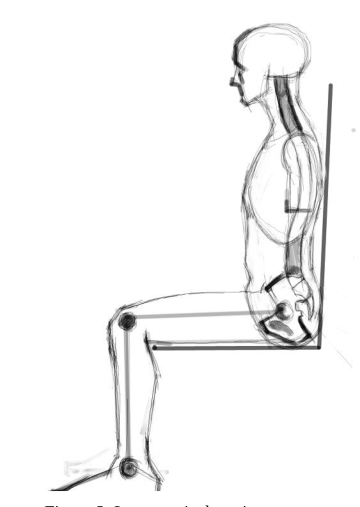
Interaction between above mentioned criteria is vividly seen in two opposite situations: frontward or backward tilting of the pelvis. A horizontal or posterior inclined bottom tangent line will leave the pelvis with no defense from the tendency to tilt backwards. A closed trunk-thigh angle can still be associated with a vertical trunk orientation, provided that a backrest will support lumbar lordosis. A closed posture can also be associated with backward trunk inclination. Usually, in such postures, the seat reference line is tilted, lowering hips under the knee level. A part of the trunk weight will transfer to the backrest. Lumbar support, if provided by chair design, induces a certain lordosis. In its absence, a variable degree of kiphosis can occur.
A normally anterior oriented pelvis, assumes an open hip angle applicable when the bottom tangent line is inclined forward, meaning that the hip level is above the knee one, as observed in a kneeling- or saddle-chair. In both types of chairs, the moderate hip flexion is achieved by a high position of the pelvis and implicitly, a greater vertical distance between hip and ankle. A moderate hip flexion with anterior inclined bottom tangent line will prevent pelvis from tilting backwards and implicitly a backward trunk inclination.
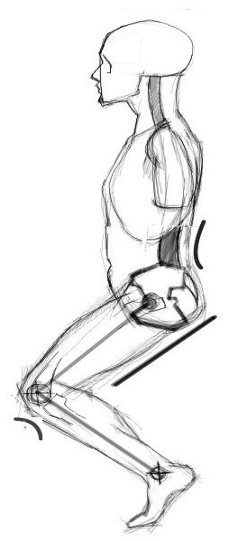
As consequence of the acquired pelvic support and seat surface, the hip joint will describe its flexion angle in relation with the vertical distance between hip and ankle. A shortening of this distance will increase hip flexion. Therefore, hip flexion and trunk-thigh angle is associated with the height of the Seat Reference Point. High or low profile of the seated posture will then be associated with reduced or increased degree of hip flexion, respectively. Hip flexion, trunk inclination and lumbar lordosis, when differentiating accordingly, generate two multi-criteria categories: high-profile seating posture and low-profile seating posture. Since a horizontal seat surface cannot, by itself, ensure the physiological tilt of the pelvis, the high category should only include postures with the hip level above the knee one, i. e., the popliteal height. A lumbar lordosis and trunk orientation criterion includes the values of association for each category.
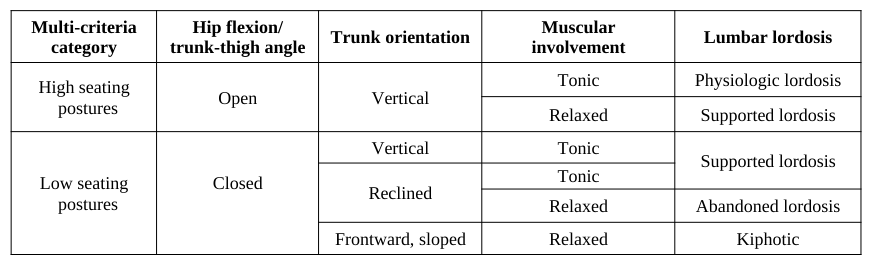
Thus, two types of high seating posture can be described, both with open hip angle and vertical trunk orientation, one with physiological lordosis, the other with supported lumbar lordosis. Four low-seating postures can be summed up; the first two describe postures with closed trunk-thigh angle and supported lumbar lordosis, one with vertical trunk orientation, the other with inclined one. The other two low postures refer both to lumbar kiphosis. The first is the one typically blamed for allowing a backward pelvis, kiphosis and anterior torso slope. This avoided vicious posture is still a seated posture even if arguments against it developed an important core in seating ergonomics. The second is the low sitting posture with the trunk inclined backwards, and abandoned lordosis.
Adding muscular activity to multi-criteria category There are associations between the muscular response and the multi-criteria category mentioned above. Soderberg, Blanco, Cosentino and Kurdelmeier, (1986) found a decreased EMG activity at cervical thoracic and lumbar level during anteriorly inclined sitting. For a high vertical seated posture, as observed in ones for saddle chairs or kneeling chairs, the trunk will gain vertical orientation, postural muscle tonus ensuring a physiological lordosis (Bridger et al., 1989), (Benett et al. 1989). Beside, Benett et al. (1989) found that “voluntarily actions to seat erect in the Balance Chair had a minimal effect on lumbar curvature” suggesting that high seating with anterior tilted bottom line generates a sufficient postural tonus for a self maintained lordosis.
The association of the muscular criterion should follow logic consistent with the natural behavioral tendency of the vertebral column. A tonic type of posture will be associated with high vertical posture and physiological lordosis. Since a high seating type will naturally prevent backward pelvic rotation and kiphosis, any support for lumbar or thoracic areas triggering lumbar relaxation will generate the relaxed attribute. If the high seated posture gain a backrest with lumbar support, postural muscles will abandon tonus at least for the lower part of the trunk. A relaxed type of posture will then be associated with high, vertical posture with supported lordosis.
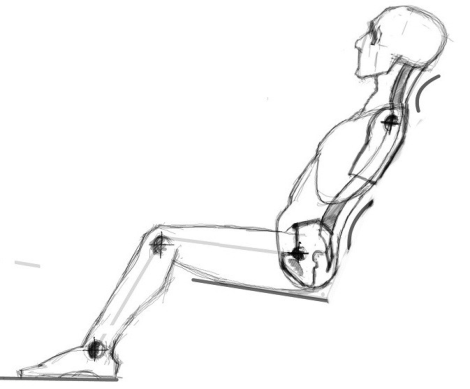
Since low sitting postures will have the natural tendency for backward pelvis (Mandal, 1981) (Benett et al.,1989) and lumbar kiphosis with muscular relaxation over the backrest, any situations where cervical or thoracic areas will remain tonic, free of support, will add the tonic attribute. For a low vertical posture, with only low level backrest, for a supported lordosis, postural muscles will maintain their tonus for the mid and upper areas of the torso. The muscular criteria will sum up to describe a vertical, tonic, low seated posture category. For the low and inclined postures, with lumbar and thoracic regions supported by a mid-level backrest, shoulders and cervical areas are still Ergonomics In Design, Usability & Special Populations II https://openaccess.cms-conferences.org/#/publications/book/978-1-4951-2107-4 active. The attribute association will generate a category described by inclined, tonic, low sitting posture. The only inclined, relaxed, low sitting posture will be described when a complete relaxation of lumbo-pelvic muscles and erector spinae is to be found, including the cervical area, with a high level backrest provided by chair design (see Table 7).
Table 7: Multi-criteria categories
Adding the functional and cultural criteria to multi-criteria category Functional criteria add different particularities. Association between morphological and functional criteria was considered useful by Bush and Hubbard (2008), Mandal(1981), in evaluating a working posture category in relation with different types of chair design. Not all tonic seated postures are active: tonic, vertical, high seating postures with supported lumbar lordosis are equally suitable for work and leisure. Not all relaxed postures are passive, since seating geometry for cockpits or vehicles belongs to the inclined, relaxed, low sitting posture category. Provided that the degree of trunk inclination and head position still allows hands and visual field to reach and control the surrounding working areas, those types of posture are still considered active. Otherwise the functional criterion will attribute them to the passive type of seating posture. The cultural criterion can be easily associated with the height criterion, since high sitting posture with open hip angle is, mainly, the result of the kneeling or saddle chairs. Both conventional and unconventional categories will positively associate with the functional criterion, resting and active, or with the morphological one, relaxed or tonic.
DISCUSSION
Using the above mentioned criteria for generating categories, opens three topics of discussion. One regarding the way to denominate categories, another resuming the conventions used in evaluating criteria and the third, resuming the classification by illustrating six types of seating geometry.
Categories denomination A useful description of sitting postures can be accomplished, under the above mentioned mono- and multi- criteria categories. A classification can use a compact denomination, applying attributes that solely differentiate a category from the rest. The active or passive attribute will denominate the two major classes. Choosing between a suitable work and leisure posture will give the oriented value for the posture destination. Similarly, adding the conventional or unconventional attribute for class denomination will guide the expectance and fulfill the recognition necessities. Morphological criteria will then further differentiate between variants, since the multi-criteria category will address differences inside a class, using high – low terms for denomination, forming the core of each denomination, with particular focus on trunk inclination and muscular tonus. Since there are six core categories, the functional and cultural criteria will be associated accordingly, completing the denomination (see Table 8).
Table 8: Classification of seating postures
Table available in the original PDF paper.
Ergonomics In Design, Usability & Special Populations II https://openaccess.cms-conferences.org/#/publications/book/978-1-4951-2107-4
Conventions Resuming conventions used for constructing low\high categories can avoid confusions: from the beginning we oriented our analysis on posture and not on chair. What differentiates high postures is the hip position, leveled or lifted above popliteal height. This is why a high type of chair is not always associated with high type of posture. The muscular criterion is used in a different manner of association. Muscular activity must be interpreted in relation with the natural tendency of abandon or maintaining tonus of the two major morphological categories. High postures will naturally maintain tonus while low postures will naturally abandon it. A muscular relaxation, restricted for lumbar area, in high vertical postures, will add the attribute “relaxed” to the respective category, while in low ones will add the attribute “tonic”. Consequently, the chair design requires a lumbar support for low vertical or low tonic postures but not necessarily for high tonic ones.
Illustrating core categories The “vertical” attribute can be avoided when denominating high categories since the only differentiating criterion is muscular activity (see Figure 1 and Figure 2). Low vertical postures, being always associated with a tonic attribute, need no mention about muscular criteria (see Figure 3). The inclined category is common for both low tonic and low relaxed types; therefore it doesn’t even need to be mentioned (see Figure 5 and Figure 6). The kiphotic denomination can describe solely the category since this vicious posture only result from a trunk sloped forwards, and the consequent morphological characteristics (see Figure 4).
Classification is useful since it allows grouping different sitting types into categories with similar characteristics. Sitting-posture categories focus on the human body and on its basic geometries, and may suggest different chair solutions. The classification of seated postures should not be fully identified based on the classification of chair design solutions, thus ergonomics must address the human body as the demanding subsystem, not only as the compliant one.
Useful criteria for sitting-posture classification must refer to human morphological characteristics, intended destinations and personal response. We have omitted criteria used for chair classification, although certain design particularities correspond with some morphological characteristics e. g., inclined trunk demands for an inclined https://openaccess.cms-conferences.org/#/publications/book/978-1-4951-2107-4 Ergonomics In Design, Usability & Special Populations II backrest as a solution for the chair design. Mono-criteria categories can be used as a simple tool for classification when addressing a single sitting requirement (vertical or inclined sitting posture). Multi-criteria categories push forward and exploit various data and bring more accuracy to the description.
Often, for a certain task, a certain chair solution is taken into consideration. Decision sequence, surpassing the human posture as a direct task requirement, presupposes that the human body simply duplicates seat geometry. Accepting systemic approach implies interdependence between chair design and human body posture. Shadowing the human body posture contradicts systemic approach. The categories included in the seated posture satisfy the demands of the respective task (ex. horizontal working area with visual control requires an unconventional, high tonic posture, suitable for work). Consequently, chair design offers the response to the demands of the seated posture category.
REFERENCES
Baumgartner, D., Zemp, R., List, R., Stoop M., Naxera, J., Elsig, J. P., Lorenzetti, S. (2012), “The Spinal Curvature of Three Different Sitting Positions Analysed in an Open MRI Scanner” ScientificWorldJournal, 2012; 2012: 184016. Published online 2012 November 25, doi: 10.1100/2012/184016 Benett, D.L., Gillis, D.K., Gross Portney, L., Romanow, M., Sanchez, A.S. (1989), “Comparison of integrated
Factors and Ergonomics Society, 30 (2), 237-247, retrieved from: http://hfs.sagepub.com/ Bridger, R.S., Eisenhart-Rothe Von, C., Henneberg, M. (1989), “Effects of Seat Slope and Hip Flexion on Spinal Angles in Sitting”, Human Factors: The Journal of the Human Factors and Ergonomics Society, 31(6), 679-688, retrieved from: http://hfs.sagepub.com/ Bridger, R. S., Wilkinson, D., van Houweninge, T. (1989), Hip joint mobility and spinal angles in standing and in different
sitting postures”, Human Factors, 31(2):229-41, retrieved from http://www.ncbi.nlm.nih.gov/pubmed/ Bush, T. R., Hubbard, R. P. (2008), “A Comparison of Four Office Chairs Using Biomechanical Measures”, Human Factors: The Journal of the Human Factors and Ergonomics Society, 50 (4) 629-642, retrieved from:http://hfs.sagepub.com/ Drury, C. G., Francher, M. (1985), "Evaluation of a forward-sloping chair", Applied ergonomics, 16 (1), 41–47, doi:
10.1016/0003-6870(85)90145-0, retrieved from http://www.sciencedirect.com/ Eklund, J., Liew, M. (1991), ,,Evaluation of seating: The influence of hip and knee angles on spinal posture,, International Journal of Industrial Ergonomics, 8(1), 67-73, http://dx.doi.org/10.1016/0169-8141(91)90026-I, retrieved from http://www.sciencedirect.com/ Frey, J.K., Tecklin, J.S. (1986), “Comparison of Lumbar Curves when Sitting on the Westnofa Balans Multi-Chair, Sitting on a
Ergonomic Comparison with the Conventional Sitting Position”, Spine, 12 (3), 269-272, retrieved from: http://journals.lww.com/spinejournal/ Link, C. S., Nicholson, G. G., Shaddeau, S. A. Birch, R., Gossman M. R. (1990), “Lumbar Curvature in Standing and Sitting in Two Types of Chairs: Relationship of Hamstring and Hip Flexor Muscle Length”, Physical Therapy, 70 (10), 611-618, retrieved from http://ptjournal.apta.org/ Mandal, A. C. (1981), “The seated man (Homo Sedens) the seated work position. Theory and practice”, Applied ergonomics,
12(1), 19-26, retrieved from http://www.sciencedirect.com/ O Sullivan, P.B., Grahamslaw, K.M., Kendell, M., Lapenskie, S.C., Moller, N.E., Richards, K. V. (2002), “The Effect of Different Standing and Sitting Postures on Trunk Muscle Activity in a Pain-Free Population”, Spine, 27(11), 1238-1244, retrieved from http://www.researchgate.net/ Sitting and Chair Design, DEA 3250/6510 Class Notes, 2013 Cornell University Ergonomics Web, retrieved December 2013
from http://ergo.human.cornell.edu/dea3250notes/sitting.html Soderberg, G. L., Blanco, M. K., Cosentino, T. L., Kurdelmeier, K. A. (1986), “An EMG Analysis of Posterior Trunk Musculature during Flat and Anteriorly Inclined Sitting”, Human Factors: The Journal of the Human Factors and Ergonomics Society, 28(4), 483-491, retrieved from: http://hfs.sagepub.com/ Zemp, R.,Taylor, W.R., Lorenzetti, S., (2013) “ In Vivo Spinal Posture during Upright and Reclined Sitting in an Office Chair”,
Biomed Res Int. 2013; 2013: 916045. Published online 2013 September 24, doi: 10.1155/2013/916045
Ergonomics In Design, Usability & Special Populations II https://openaccess.cms-conferences.org/#/publications/book/978-1-4951-2107-4
LISTED IN THE AHFE DIGITAL BOOKSTORE CATALOGUE
Explore the complete digital volume
Advances in Ergonomics In Design, Usability & Special Populations: Part II
Read this individual research paper free through the original publisher, or explore the full digital proceedings book.
ISBN 978-1-4951-2107-4
Explore this ISBN in the AHFE Bookstore ↗Listed in the July 2026 bookstore catalogue; search by ISBN to confirm current availability · Digital book purchase optional