Justyna Mojsa-Kaja, Magda Gawlowska, Ewa Beldzik, Aleksandra Domagalik, Tadeusz Marek (2020). The Error-Related Negativity as a Neural Indicator of Error Processing and its Modulation by Individual Differences. In: Advances in Science, Technology, Higher Education and Society in the Conceptual Age: STHESCA. AHFE Open Access, vol. 10. https://doi.org/10.54941/ahfe100385
The error-related negativity (ERN) is a negative deflection in the event-related potential that is maximal approximately 50 ms after the commission of an error. The ERN is generated in the anterior cingulate cortex (ACC), a region implicated in both cognitive and emotional processing. Despite a growing body of research concerning the ERN, discussion regarding its functional significance remains open. The conflict and reinforcement-learning theories point at specific, ACC-related processes, involved in generation of the ERN and describe the process of error monitoring itself in human brain. Above mentioned theories explain what happens on neuronal level when individual commits an error, but they do not emphasize the crucial role of individual differences in modulating the ERN magnitude. On the other hand, there is a dynamically growing area of research suggesting that ERN is heritable, stable over time and linked with several dimensions of personality, that may interact with motivational, contextual factors and moderate the magnitude of the ERN. This approach defines ERN as a neural marker of a neurobehavioral trait and variation in its amplitude is linked with individual differences having impact on emotional or motivational aspects of error processing. Therefore, we would focus on selective literature review concerning ERN in the light of motivational factors and individual differences and present implications and future research directions in this area.
Effective behavior-monitoring is critical for the efficient generation of goal-directed behavior. Humans must continually evaluate its actions in the context of motivational goals to determine if those actions are effective and adaptive to changing environmental demands. Essential to this evaluation of one's action is a neural circuit, which is responsible for detecting commitment of an error. Cognitive neuroscientists have associated this mental process with a response-locked event-related brain potential (ERP) called error-related negativity (ERN). ERN can be observed after committing an error in any cognitively demanding tasks (Falkenstein et al,. 1990; Gehring et al., 1993). It peaks 40-100 ms after the response (Falkenstein et al., 1990; Hoffmann and Falkenstein, 2011) with maximal amplitude at fronto-central recording sites of the scalp (Falkenstein et al., 1990; Gehring et al., 1990).
Studies using source localization (Miltner et al., 1997; Holroyd et al., 1998) suggest that the ERN, generated by the error detection system, has been associated with brain region called anterior cingulate cortex (ACC), implicated in processing both cognitive conflict and aversive affective information (Busch et al., 2000). ERN can be elicited by stimuli presented in different modalities (somatosensory, auditory, and visual - Falkenstein et al., 1999, Holroyd, 2002) and can be recorded at the scalp via electroencephalogram (EEG) while participants are engaged a wide variety of cognitive tasks such as: Go/Nogo (Falkenstein et al., 2000), oddball (Brazdil et al., 2002), antisaccade (Nieuwenhius et al., 2001), Flanker task (Luu et al., 2000; Tops et al., 2006) and Stroop like task (Hajcak et al., 2004).
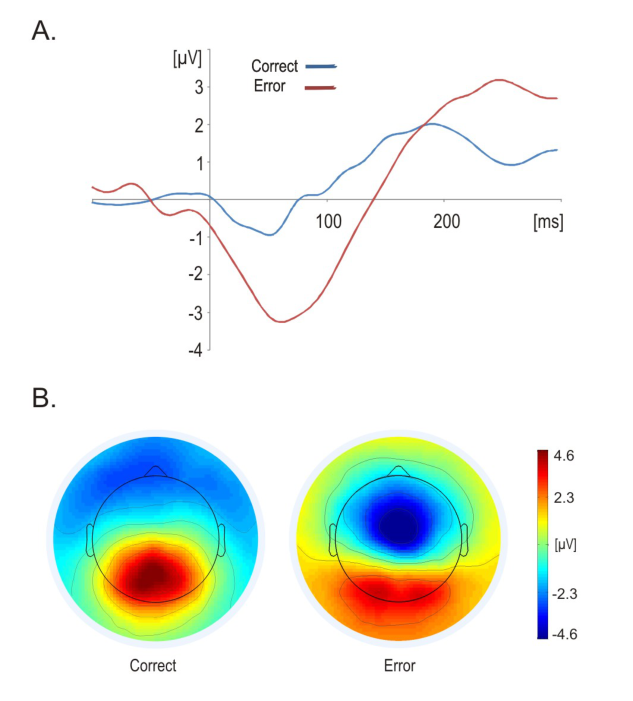
We have conducted a dense-array EEG study, where 20 participants performed the numerical Stroop task. Within this task, participants are shown a pair of digits and asked to choose the one with greater numerical dimension. The task provides a well-suited model for investigating erroneous responses as it introduces three levels of congruency - when the numerically larger digit is physically smaller, equal or larger. The incongruent trials require from participants to ignore the automatically processed, but task-irrelevant, physical features of the digits (Posner, 1978) what often results in commision of an error (Suárez-Pellicioni et al., 2013). The ERP analysis time-locked to the occurrence of an error revealed strong ERN peaking 68 ms after the response (Fig 1). In contrast, correct responses evoked strong centro-parietal positivity at this time range. ERN is thought to be one of the most distinctive and significant brain potentials, that could easily be observed in raw data (Luu et al., 2004).
Figure 1. Response-locked ERPs evoked by numerical Stroop task. (A) Time course at electrode Fz aligned to correct and erroneous responses. (B) Scalp topography at 68 ms after the response onset for correct and errors.
Scientific understanding of the neural basis of error processing has become an important goal of research in the field of the neurocognitive psychology. Despite a growing body of research concerning the ERN, discussion regarding its functional significance still persists on the ground of the most influential theories.
THEORIES OF THE ERROR-RELATED NEGATIVITY Mismatch Theory
One of the earliest attempts to understand the ERN was the Mismatch Theory according to which errors occur in result of a comparator system that evaluates the mental representations of the correct and actual response. The mismatch between these two representations are hypothesized to elicit the ERN and the degree of this mismatch seems to related to the magnitude of the ERN (Falkenstein et al., 1991; Bernstein et al., 1995).
The influence of the degree of this mismatch on the ERN magnitude is enhanced when subjects are more confident in committing an error, therefore, when the mental representation of the actual response is stronger (Scheffers and Coles, 2000).
From the perspective of functionality, this mismatch is considered to create an element of an internal feedback loop by which errors can be remediated in the short term (partial errors) or in a long term perspective in reducing the probability of future errors (Weinberg et al., 2012). However, there are some arguments in opposition to this theory, suggesting that the ERN signals the comparison process rather than its outcome (Frankenstein et al., 2000).
Conflict Monitoring Theory The Conflict Monitoring theory is based on the assumption that ACC is sensitive to response conflict, the coactivation of mutually incompatible responses and its function is to monitor conflict between simultaneously activated response channels (Carter and van Veen, 2007). This theory postulates that errors are detected by the same process responsible for detecting conflicts and the ERN is taken to index increased response conflict on error trials in the response-locked ERP (Carter et al., 1998).
Despite the fact that Conflict Theory grew out of the Mismatch Theory and are closely related, they differ from each other. The former one denies existence of dedicated error monitoring system responsible for response checking process postulated by the Mismatch Theory and explain errors in the term of ongoing conflict monitoring.
Reinforcement Learning Theory The most influential theory of the functional significance of ERN - the Reinforcement Learning (Holroyd and Coles, 2002; Holroyd et al., 2005), stands that the monitoring mechanism, placed in the basal ganglia, produces an error signal, which is transferred through midbrain dopamine system to the ACC, when the outcome of action appears to be “worse than expected”. The expectation is a result of learning through experience of previous reinforcements associated with a response. The response errors or negative feedback are believed to cause a decrease in the dopamine level, what results in disinhibiting the apical dendrites of motor neurons in the ACC, more precisely in the dorsal part of ACC (Debener et al., 2005; Taylor et al., 2007), and in consequence, generation of the ERN (Jocham and Ullsperger, 2009). In general, this theory suggests that the ERN is elicited when action are evaluated as worse than expected, based on actual performance, and that this information is used to adjust behavior.
Those cognitive theories of the ERN are crucial from the perspective of understanding and explaining the conditions of occurrence and processing of an error in the brain. However, there are less powerful in explaining the variability of the ERN amplitude between subjects. Nowadays, several authors have assigned a crucial role for affective and motivational factors in their conceptualization of the ERN (Gehring and Willoughby, 2002; Luu et al., 2003, Pailing and Segalowitz, 2004).
Factors Modulating ERN Amplitude
As of today, there is a considerable scientific attempt to understand the associations among contextual factors, personality, and brain activation during performance monitoring (Noordt and Segalowitz, 2012).
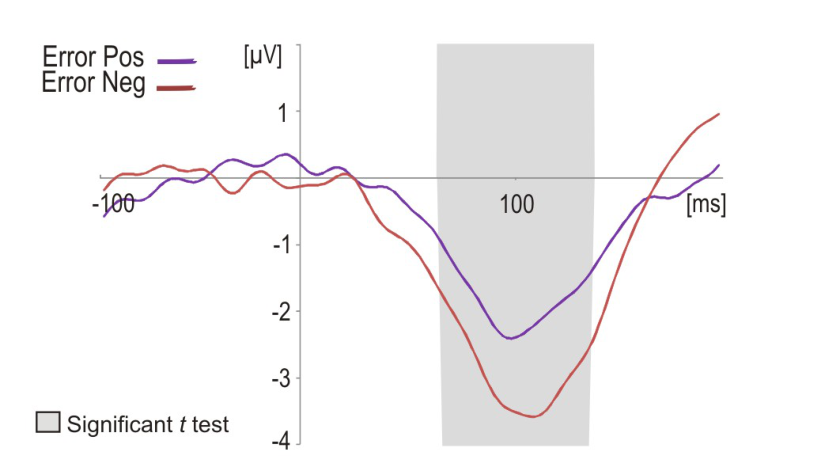
ERN and Motivational Factors Several studies have shown that motivational factors can affect the amplitude of the ERN. Ghering et al. (1993) found that the ERN was larger when participants were rewarded for being accurate rather than fast. Hajcak et al. (2005) manipulated the value of errors on a trial-by-trial basis and found that 100-point errors were characterized by a larger ERN than 5-point errors. Moreover, there were no differences in terms of any behavioral measures (accuracy, reaction times- RTs) between high - and low value errors. Therefore, by showing that the magnitude of the ERN is significantly enhanced for more valuable errors they confirmed that the error-detection system is sensitive to the significance of errors. Recently, Potts et al. (2011) found that the ERN was larger to errors under punishment condition, in which the error resulted in monetary loss, compared to reward condition, where the error led to failure to acquire a monetary reward. Moreover, it has been shown that external evaluation of behavior influences the amplitude of the ERN. When participants were informed that experimenter compares their performance with results obtained by other participants, they had the ERN of a greater amplitude (Hajcak et al., 2005). In our preliminary study (12 subjects) we confirmed the abovementioned effects: the valence of feedback modulated the perceived value of the error indicated by the decreased amplitude of ERN in negative vs. positive feedback condition (mean amplitude from 64 to 136 ms after the response; t(1,11)=3,15; p<0.01; Fig 2).
Figure 2. ERN obtained from preliminary study with numerical Stroop paradigm under the conditions of a positive feedback after correct trials (Error Pos) and negative feedback after erroneous trials (Error Neg). Grey shadings indicate significant difference between the conditions.
On the contrary, manipulations that reduce the perceived value of errors such as alcohol application (Easdon et al., 2005; Ridderinkhof et al., 2002) or sleep deprivation (Hsieh et al., 2007; Hsieh et al., 2010; Tsai et al., 2005; however, see Murphy et al., 2006) have been linked to reduced ERN magnitude. Those findings are line with the view that the ERN reflects the motivational significance of errors and conveys information beyond purely error monitoring. It suggests that the behavior monitoring system performs a function other than the simple detecting behavioral errors, perhaps performing some evaluation of executed actions in the context of motivational goals (Phan et al., 2004; Suchan et al., 2003).
ERN and Personality
A growing number of research verifies the role of individual differences, particularly with respect to variation in temperament and personality, in magnitude of ERN. If affective processes are reflected in the ERN (as suggested by motivational model), individual differences in this brain signal may reflect the extent to which an individual is emotionally invested in error monitoring.
For example, Luu et al., (2000) found significant correlations between negative affect (NA) and ERN amplitude in college students. Precisely, ERNs were enhanced in students who were high on self-reported NA. However, high- NA students had larger ERNs only in the first testing quartile: the relationship between NA and ERN was in the opposite direction later in the course of testing. Luu et al., (2000) interpret this results in terms of task disengagement over time in this group of high-NA students. Hajcak et al., (2004) confirmed that participants scoring high on self-reported negative affect were characterized by enhanced ERN and therefore supported the explanation of the increased ERN in terms of the over-engagement of the response monitoring system in the high-NA group.
Another factor, from the area of individual differences, modulating the ERN amplitude is impulsiveness. Ruschow et al., (2005) while investigating electrophysiological correlates of this trait discovered that participants with higher impulsiveness showed smaller ERN amplitude than subjects with lower impulsiveness.
Further research conducted by Tops et al., (2006) proved that personality traits that relate to concerns over social evaluation and mistakes, both personality measures reflecting positive affectivity (e.g. agreeableness) and those reflecting negative affectivity (e.g. behavioral shame proneness) are associated with an increased likelihood of high task engagement and hence to increased ERN amplitude.
Individual differences in punishment and reward sensitivity are also correlated with error-related ERP components. Boksem et al., (2006) based their research one of the most popular temperament theory referred to as the Reinforcement Sensitivity Theory (RST) which explain fundamental human personality traits in terms of individual differences in the sensitivity of basic brain-behavioral systems that respond to reinforcing stimuli (Gray, 1987). This theory proposed two basic systems known as behavioral activation system (BAS) and behavioral inhibition system (BIS) and outlined that both BAS and BIS have the potential to influence punishment-mediated and reward- mediated behavior. More precisely, the BAS facilitates and the BIS antagonizes the process of reward stimuli, i.e., high-BAS/low-BIS individuals display the highest appetitive responses and positive emotions to these stimuli. Therefore, the learning of highly BAS-reactive individuals is more strongly affected by positive reinforcements compared to those with low BAS-reactivity. Similarly, the BIS facilitates and the BAS antagonizes the process of punishment stimuli, i.e., high-BIS/low-BAS individuals show the highest aversive responses and negative emotions to these stimuli. Boksem et al., (2006) found that subjects scoring high on the BIS scale displayed larger ERN amplitudes compared to subjects with lower BIS scores. Therefore, ERN amplitude has been shown to vary with personality traits in which sensitivity to negative stimuli (e.g. negative affectivity, high-BIS) and monitoring problems (e.g. impulsiveness) are crucial elements.
Finally, there are findings emphasizing that to understand an individual’s response to errors, it is necessary to simultaneously account for motivational states as well as personality traits that may influence sensitivity to motivational incentives and play the role of moderating variable for motivation-related changes. Pailing and Sagalowitz (2004) using both a motivational and a personality approach examined changes in the ERN and discovered that however motivation effects were not observed for the entire sample of university students, there was evidence that error salience was reflected only for individuals scoring high on Neurotism or low on Conscientiousness. However it is worth to notice, that Neuroticism accounted for more variance in ERN- motivational effects than did Conscientiousness and is more directly related to the affective-related changes in the ERN. Dikman and Alen (2000) examined ERN under conditions of reward and punishment among participants who scored extremely low or high on the socialization scale. Participants were rewarded for correct responses and punished for incorrect responses. A significant interaction between socialization and motivational condition revealed that low socialized participants produced smaller ERNs during the punishment task than during the reward task, whereas high socialized participants produced similar ERNs in both conditions. Potts and co-authors (2006) also examined ERN under conditions of reward and punishment among undergraduate students separated into high- and low- impulsive groups. Their results showed that high-impulsive group had a smaller ERN on punishment trials than the low-impulsive group. Finally, the interaction between personality (precisely, temperament) measures and reinforcement conditions was also interest of the scientific research. Boksem et al., (2008) discovered that high-BIS individuals displayed a larger ERN in the punishment condition than in reward condition, whereas low-BIS individuals displayed a larger ERN in the reward condition. Thus, from these studies it is apparent that the ERN amplitude is significantly dependent on motivational factors and their interaction with selected personality traits.
ERN and Pathology Another line of research focuses on how various pathological factors influence the ERN. It is well established that the amplitude of the ERN is enhanced among individuals who experience errors as abnormally salient and aversive. Studies on clinical groups of patients with general anxiety disorder (GAD; Weinberg et al., 2010; Xiao et al., 2011), and obsessive-compulsive disorder (OCD; Endrass et al., 2008; Gehring et al., 2000), showed increase in the ERN amplitude, compared to healthy controls. Interestingly, Endrass and colleagues (2010) reported that when the experimental design involves external manipulation by punishing errors with monetary loss, this additional condition has no impact on the already-enhanced ERN among OCD patients, while it does increases the ERN among healthy controls. There is also evidence for relationship between the increased ERN amplitude and depression (Chiu and Deldin 2007; Holmes and Pizzagalli, 2008, 2010), however the results are far less consistent (Olvet et al., 2010; Ruchsow et al., 2006), what may be caused by the heterogeneity of depressive symptoms among subjects (e.g. medication, severity of symptoms etc.). Moreover, researches on non-clinical groups of individuals with high levels of negative affect (Hajcak et al., 2004), high trait anxiety (Hajcak et al., 2003; Pourtois et al., 2010), and obsessive– compulsive characteristics (Grundler et al., 2009; Hajcak and Simons, 2002) are also characterized by increased ERN amplitudes.
On the contrary, there has been observed association between the reduced ERN amplitude and schizophrenia (Alain et al., 2002; Mathalon et al., 2002; Mathalon et al., 2009), psychopathy (Munro et al., 2007; von Borries et al., 2010; however, see Brazil et al., 2009), borderline personality disorder (de Bruijn et al., 2006), ADHD (Herrmann et al., 2010; van Meel et al., 2007; however, see Burgio-Murphy et al., 2007; Van De Voorde et al., 2010), autism (Henderson et al., 2006; South et al., 2010; however, see Groen et al., 2008), and substance abuse (Franken et al., 2007; however, see Schellekens et al., 2010). It is still under discussion, what causes decrease in the ERN amplitude. In the majority of the above presented studies, participants presented poorer performance, compared to controls - thus one of the possible explanations states that complex of factors, like decrease in the motivational salience of errors associated directly with clinical characteristic of presented disorders; lack of engagement in the task; and finally low performance level could together account for the smaller ERN (Weinberg et al., 2012).
ERN and Learning Considerable scientific interest gained the neuropsychological analysis of mechanisms through which individual differences in personality may further influence error-related processing and learning. These two processes are strongly connected with error-sensitive components of brain potentials, i.e. the ERN and fERN. The fERN appears in EEG recording after presenting participants with an external negative feedback e.g. in time estimation task (Miltner et al., 1997; Holroyd et al., 2004). It reflects a difference in neural processing between error feedback and correct feedback while guessing or performing trial-and-error learning task (Holroyd and Coles, 2008). Its’ peak can be observed about 250 ms after the onset of a negative feedback and shows a scalp distribution similar to ERN. The fERN is elicited when an achieved result is below the expectancies, irrespective to whether the response is an error or not (Nieuwenhuis et al., 2004), based on binary categorization of the outcome as “better or worse than expected” (Holroyd and Coles, 2002).
The ability to detect errors and respond to them with performance improvement remains crucial for the whole process of learning per se. Frank and colleagues (Frank et al., 2005) proposed a model of negative and positive learners according to which positive learners perform better in learning task while presented with positive feedback, informing about correct answers. In contrast to positive, negative learners learn more efficiently when presented with negative feedback informing about committed errors. Frank et al., (2007) based on the assumption that amplitude of the ERN can reflect the degree to which subjects are focused on their mistakes, discovered that negative learners had larger ERNs than positive learners. Additionally, negative learners had also larger fERNs following negative feedback, what may suggests that the fERN may index a trait associated with whether participants are more responsive to positive or negative reinforcement.
Direction for Future Research Recently, there is a rapid development of genetic research on personality, and the obtained results allow to conclude that the genetic factor is one of the most important determinants of individual differences in temperament.
According to Plomin and Kosslyn, 2001 diagnostic methods based on molecular genetics will soon become the standard way of studying personality. Psychobiological model of personality provided by Cloninger (1994a; 1994b) makes a huge contribution to the determination of individual differences based on genetically determined differences in activities of neurotransmitters systems (dopaminergic, serotonergic and noradrenergic).
Our research aims at characterizing neural correlates of the genetically determined temperament dimensions, proposed by Robert Cloninger, in error detection and learning under the conditions of reward and punishment. Neural indicators will be achieved by applying dense electroencephalography (dEEG) and functional magnetic resonance imaging (fMRI) techniques to participants who perform two cognitive tasks: (1) the numerical and physical Stroop Task and (2) the modified version of paired associate learning paradigm (PAL). Cloninger’s psychobiological personality model (Cloninger, 1994a; Cloninger, 1994b) comprises four heritable and independent temperamental dimensions and three environmentally shaped character dimensions. The study will focus on the first, three main temperament dimensions as they have a precisely defined biological basis. Novelty Seeking (NS) is the tendency to respond actively to novel stimuli leading to pursuit of rewards and escape from punishment. Harm Avoidance (HA) is the tendency to inhibit responses to signals of aversive stimuli that lead to avoidance of punishment and non-reward, while Reward Dependence (RD) is a tendency for a positive response to conditioned signals of reward that maintain behavior. In the model, temperament refers to an automatic emotional arousal in response to events that is heritable, stable through life, and defined in terms of individual differences in learning by reward and punishment (Cloninger, 2002).
Therefore, further research is required to shed light on temperamentally driven differences in error-related processing explaining motivational differences in task engagement. People with strong HA dimension might be motivated differently than those with strong NS dimension. The possible explanation is that people with high HA, while avoiding the punishment, activate the amygdala as a response to the fear of failure, while people with high NS, looking for stimulation from their performance, activate reward system as a response to the positive emotional stimuli.
Therefore, the neural pathways of both, positive and negative, motivation might have a different output in the ACC. This project will verify whether there are relations between temperamental traits and activation of different parts of the ACC engaged during error detection and learning under conditions of reward or punishment. To the best of our knowledge, there was no previous research study providing the answer, if genetically determined temperamental differences (based on psychobiological model of personality proposed by Cloninger) influence the ERN or characteristics and if there are any differences in those neural indicators under condition of rewards and punishments. Moreover, although there is a logical link between temperamental differences in sensitivity to reward/punishment and learning types, none of research has analyzed those relationships on the neuronal level. Finally, there is no study concerning correlates of temperamental traits to brain activation obtained with fMRI in error processing.
Thus, the currently conducted project is innovative due to implementing complementary neuroimaging techniques (dEEG and fMRI) to characterize neural correlates of the genetically determined temperament dimensions in error detection and learning under the conditions of reward and punishment. It is one of the first studies focused on explanation of those individual differences in the sensitivity to reinforcement stimuli in terms of neural patterns (including temporal and spatial information).
ACKNOWLEDGMENT
The preparation of this manuscript was supported by a grant from the National Science Centre (research project 2012/05/E/HS6/03553, head J. Mojsa - Kaja).
REFERENCES
Alain, C., McNeely, H. E., He, Y., Christensen, B. K., & West, R. (2002). Neurophysiological evidence of error-monitoring deficits in patients with schizophrenia. Cerebral Cortex (New York, N.Y. : 1991), 12, 840–6. Bernstein, P. S., Scheffers, M. K., & Coles, M. G. (1995). " Where did I go wrong?" A psychophysiological analysis of error
detection. Journal of Experimental Psychology: Human Perception and Performance, 21(6), 1312.
Boksem, M. A., Tops, M., Wester, A. E., Meijman, T. F., & Lorist, M. M. (2006). Error-related ERP components and individual differences in punishment and reward sensitivity. Brain research, 1101(1), 92-101. Boksem, M.S., Tops, M., Kostermans, E., De Cremer, D. (2008). Sensitivity to punishment and reward omission: Evidence from
error-related ERP components. Biological Psychology, 79, 185-192. Brázdil, M., Roman, R., Falkenstein, M., Daniel, P., Jurák, P., & Rektor, I. (2002). Error processing–evidence from intracerebral ERP recordings. Experimental Brain Research, 146(4), 460-466. Brazil, I. a, de Bruijn, E. R. a, Bulten, B. H., von Borries, a K. L., van Lankveld, J. J. D. M., Buitelaar, J. K., & Verkes, R. J.
(2009). Early and late components of error monitoring in violent offenders with psychopathy. Biological Psychiatry, 65, 137–43. Burgio-Murphy, A., & Klorman, R. (2007). Error-related event-related potentials in children with attention-deficit hyperactivity disorder, oppositional defiant disorder, reading disorder, and math disorder. Biological Psychology, 75, 75–86. Bush, G., Luu, P., & Posner, M. I. (2000). Cognitive and emotional influences in anterior cingulate cortex. Trends in cognitive
sciences, 4(6), 215-222. Carter, C. S., & Van Veen, V. (2007). Anterior cingulate cortex and conflict detection: an update of theory and data. Cognitive, Affective, & Behavioral Neuroscience, 7(4), 367-379. Carter, C. S., Braver, T. S., Barch, D. M., Botvinick, M. M., Noll, D., & Cohen, J. D. (1998). Anterior cingulate cortex, error
detection, and the online monitoring of performance. Science, 280(5364), 747-749. Chiu, P. H., & Deldin, P. J. (2007). Neural evidence for enhanced error detection in major depressive disorder. The American Journal of Psychiatry, 164, 608–616. Cloninger, C. R. (1994a). Temperament and personality. Current opinion in neurobiology, 4(2), 266-273. Cloninger, C. R. (1994b). The genetic structure of personality and learning: a phylogenetic model. Clinical genetics, 46(1), 124-
137. Cloninger, C. R. (2002). Relevance of normal personality for psychiatrists. Molecular genetics and the human personality, 33-42. De Bruijn, E. R. a, Grootens, K. P., Verkes, R. J., Buchholz, V., Hummelen, J. W., & Hulstijn, W. (2006). Neural correlates of impulsive responding in borderline personality disorder: ERP evidence for reduced action monitoring. Journal of Psychiatric Research, 40, 428–37. Debener, S., Ullsperger, M., Siegel, M., Fiehler, K., Von Cramon, D. Y., & Engel, A. K. (2005). Trial-by-trial coupling of
concurrent electroencephalogram and functional magnetic resonance imaging identifies the dynamics of performance monitoring. The Journal of Neuroscience, 25(50), 11730-11737. Dikman, Z. V., & Allen, J. J. (2000). Error monitoring during reward and avoidance learning in high-and low-socialized individuals. Psychophysiology, 37(1), 43-54. Easdon, C., Izenberg, A., Armilio, M. L., Yu, H., & Alain, C. (2005). Alcohol consumption impairs stimulus- and error-related
processing during a Go/No-Go Task. Brain Research. Cognitive Brain Research, 25, 873–83. Endrass, T., Klawohn, J., Schuster, F., & Kathmann, N. (2008). Overactive performance monitoring in obsessive-compulsive disorder: ERP evidence from correct and erroneous reactions. Neuropsychologia, 46, 1877–1887. Endrass, T., Schuermann, B., Kaufmann, C., Spielberg, R., Kniesche, R., & Kathmann, N. (2010). Performance monitoring and
error significance in patients with obsessive-compulsive disorder. Biological Psychology, 84, 257–263. Falkenstein, M., Hohnsbein, J., Hoormann, J., Blanke, L. (1990), „ Effects of errors in choice reaction tasks on the ERP under focused and divided attention”, in: Psychophysiological brain research, Brunia, Cornelis, Gaillard, Anthony, Kok, Albert (Eds.), pp. 192-195. Falkenstein, M., Hohnsbein, J., Hoormann, J., & Blanke, L. (1991). Effects of crossmodal divided attention on late ERP
components. II. Error processing in choice reaction tasks. Electroencephalography and clinical neurophysiology, 78(6), 447-455. Falkenstein, M., Hoormann, J., & Hohnsbein, J. (1999). ERP components in Go/Nogo tasks and their relation to inhibition. Acta psychologica, 101(2), 267-291. Falkenstein, M., Hoormann, J., & Hohnsbein, J. (2002). Inhibition-related ERP components: Variation with modality, age, and
time-on-task. Journal of Psychophysiology, 16(3), 167. Falkenstein, M., Hoormann, J., Christ, S., & Hohnsbein, J. (2000). ERP components on reaction errors and their functional significance: a tutorial. Biological psychology, 51(2), 87-107. Frank, M. J., D’Lauro, C., & Curran, T. (2007). Cross-task individual differences in error processing: neural,
electrophysiological, and genetic components. Cognitive, Affective, & Behavioral Neuroscience, 7(4), 297-308. Frank, M. J., Woroch, B. S., & Curran, T. (2005). Error-related negativity predicts reinforcement learning and conflict biases.
Neuron, 47(4), 495-501. Franken, I. H., van Strien, J. W., Franzek, E. J., & van de Wetering, B. J. (2007). Error-processing deficits in patients with cocaine dependence. Biological Psychology, 75, 45–51. Gehring, W. J., & Willoughby, A. R. (2002). The medial frontal cortex and the rapid processing of monetary gains and losses.
Science, 295(5563), 2279-2282. Gehring, W. J., Coles, M. G. H., Meyer, D. E., & Donchin, E. (1990). The error-related negativity: an event-related brain potential accompanying errors. Psychophysiology, 27(4), S34. Gehring, W. J., Goss, B., Coles, M. G. H., Meyer, D. E., & Donchin, E. (1993). A neural system for error detection and
compensation. Psychological Science, 4, 385–391. Gehring, W. J., Himle, J., & Nisenson, L. G. (2000). Action-Monitoring Dysfunction In Obsessive-Compulsive Disorder.
Psychological Science, 11, 1–6. Gray, J. A. (1987), “The neuropsychology of emotion and personality”, in: Cognitive neurochemistry, Stahl, S. M., Iverson, S. D.
& Goodman ,E. C. (Eds.), pp.171-190. Groen, Y., Wijers, A., & Mulder, L. (2008). Error and feedback processing in children with ADHD and children with Autistic
Spectrum Disorder: an EEG event-related potential study. Clinical Neurophysiology, 119, 2476–2493. Gründler, T., Cavanagh, J., & Figueroa, C. (2009). Task-related dissociation in ERN amplitude as a function of obsessive– compulsive symptoms. Neuropsychologia, 47, 1978–1987. Hajcak, G., & Simons, R. F. (2002). Error-related brain activity in obsessive – compulsive, 110, 63–72. Hajcak, G., McDonald, N., & Simons, R. F. (2003). To err is autonomic: Error-related brain potentials, ANS activity, and post-
error compensatory behavior. Psychophysiology, 40, 895–903. Hajcak, G., McDonald, N., & Simons, R. F. (2004). Error-related psychophysiology and negative affect. Brain and cognition, 56(2), 189-197. Hajcak, G., Moser, J. S., Yeung, N., & Simons, R. F. (2005). On the ERN and the significance of errors. Psychophysiology, 42,
151–60. Herrmann, M., & Mader, K. (2010). Neural correlates of performance monitoring in adult patients with attention deficit hyperactivity disorder (ADHD). World Journal of Biological Psychiatry, 11. Hoffmann, S., & Falkenstein, M. (2012). Predictive information processing in the brain: errors and response monitoring.
International Journal of Psychophysiology, 83(2), 208-212. Holmes, A. J., & Pizzagalli, D. A. (2008). Spatiotemporal dynamics of error processing dysfunctions in major depressive disorder. Archives of General Psychiatry, 65, 179–188. Holmes, A. J., & Pizzagalli, D. A. (2010). Effects of task-relevant incentives on the electrophysiological correlates of error
processing in major depressive disorder. Cognitive, Affective, & Behavioral Neuroscience, 10, 119–128. Holroyd, C. B., & Coles, M. G. (2002). The neural basis of human error processing: reinforcement learning, dopamine, and the error-related negativity. Psychological review, 109(4), 679. Holroyd, C. B., Dien, J., & Coles, M. G. (1998). Error-related scalp potentials elicited by hand and foot movements: evidence for
an output-independent error-processing system in humans. Neuroscience letters, 242(2), 65-68. Holroyd, C. B., Larsen, J. T., & Cohen, J. D. (2004). Context dependence of the event-related brain potential associated with reward and punishment. Psychophysiology, 41(2), 245-253 Holroyd, C. B., Yeung, N., Coles, M. G., & Cohen, J. D. (2005). A mechanism for error detection in speeded response time tasks.
Journal of Experimental Psychology: General, 134(2), 163. Hsieh, S., Cheng, I.-C., & Tsai, L.-L. (2007). Immediate error correction process following sleep deprivation. Journal of sleep research, 16, 137–47. Hsieh, S., Li, T.-H., & Tsai, L.-L. (2010). Impact of monetary incentives on cognitive performance and error monitoring
following sleep deprivation. Sleep, 33, 499–507. Jocham, G., & Ullsperger, M. (2009). Neuropharmacology of performance monitoring. Neuroscience & Biobehavioral Reviews, 33(1), 48-60. Luu, P., Collins, P., & Tucker, D. M. (2000). Mood, personality, and self-monitoring: negative affect and emotionality in relation
to frontal lobe mechanisms of error monitoring. Journal of Experimental Psychology: General, 129(1), 43. Luu, P., Tucker, D. M., Derryberry, D., Reed, M., & Poulsen, C. (2003). Electrophysiological responses to errors and feedback in the process of action regulation. Psychological Science, 14(1), 47-53. Luu, P., Tucker, D. M., & Makeig, S. (2004). Frontal midline theta and the error-related negativity: neurophysiological
mechanisms of action regulation. Clinical Neurophysiology, 115(8), 1821-1835. Mathalon, D. H., Fedor, M., Faustman, W. O., Gray, M., Askari, N., & Ford, J. M. (2002). Response-monitoring dysfunction in schizophrenia: An event-related brain potential study. Journal of Abnormal Psychology, 111, 22–41. Mathalon, D. H., Jorgensen, K. W., Roach, B. J., & Ford, J. M. (2009). Error detection failures in schizophrenia: ERPs and
FMRI. International journal of psychophysiology : official journal of the International Organization of Psychophysiology, 73, 109–17. Miltner, W. H., Braun, C. H., & Coles, M. G. (1997). Event-related brain potentials following incorrect feedback in a timeestimation task: Evidence for a “generic” neural system for error detection. Journal of cognitive neuroscience, 9(6), 788- 798. Munro, G. E. S., Dywan, J., Harris, G. T., McKee, S., Unsal, A., & Segalowitz, S. J. (2007). ERN varies with degree of
psychopathy in an emotion discrimination task. Biological psychology, 76, 31–42. Murphy, T. I., Richard, M., Masaki, H., & Segalowitz, S. J. (2006). The effect of sleepiness on performance monitoring: I know what I am doing, but do I care? Journal of sleep research, 15, 15–21. Nieuwenhuis, S., Holroyd, C. B., Mol, N., & Coles, M. G. (2004). Reinforcement-related brain potentials from medial frontal
cortex: origins and functional significance. Neuroscience & Biobehavioral Reviews, 28(4), 441-448. Nieuwenhuis, S., Ridderinkhof, K. R., Blom, J., Band, G. P., & Kok, A. (2001). Error-related brain potentials are differentially related to awareness of response errors: Evidence from an antisaccade task. Psychophysiology, 38(5), 752-760. Nieuwenhuis, S., Ridderinkhof, K. R., Talsma, D., Coles, M. G. H., Holroyd, C. B., Kok, A., & van der Molen, M. W. (2002). A
computational account of altered error processing in older age: dopamine and the error-related negativity. Cognitive, affective & behavioral neuroscience, 2, 19–36. Olvet, D. M., Klein, D. N., & Hajcak, G. (2010). Depression symptom severity and error-related brain activity. Psychiatry research, 179, 30–7. Pailing, P. E., & Segalowitz, S. J. (2004). The error-related negativity as a state and trait measure: Motivation, personality, and
ERPs in response to errors. Psychophysiology, 41(1), 84-95. Plomin, R., & Kosslyn, S. M. (2001). Genes, brain and cognition. Nature neuroscience, 4, 1153-1154. Phan, L., Don, M.T., Scott, M. (2004). Frontal midline theta and the error-related negativity: neurophysiological mechanisms of action regulation. Clinical Neurophysiology, 115, 1821–1835. Posner, M. (1978). Chronometric explorations of mind. Hillsdale, NJ: Erlbaum Associates. Potts, G. F. (2011). Impact of reward and punishment motivation on behavior monitoring as indexed by the error-related negativity. International journal of psychophysiology: official journal of the International Organization of Psychophysiology, 81, 324–31. Potts, G. F., George, M. R. M., Martin, L. E., & Barratt, E. S. (2006). Reduced punishment sensitivity in neural systems of behavior monitoring in impulsive individuals. Neuroscience Letters, 397(1), 130-134. Pourtois, G., Vocat, R., N’diaye, K., Spinelli, L., Seeck, M., & Vuilleumier, P. (2010). Errors recruit both cognitive and emotional monitoring systems: simultaneous intracranial recordings in the dorsal anterior cingulate gyrus and amygdala combined with fMRI. Neuropsychologia, 48, 1144–59. Ridderinkhof, K. R., de Vlugt, Y., Bramlage, A., Spaan, M., Elton, M., Snel, J., & Band, G. P. H. (2002). Alcohol consumption impairs detection of performance errors in mediofrontal cortex. Science (New York, N.Y.), 298, 2209–11. Ruchsow, M., Herrnberger, B., Beschoner, P., Grön, G., Spitzer, M., & Kiefer, M. (2006). Error processing in major depressive
disorder: evidence from event-related potentials. Journal of Psychiatric Research, 40, 37–46. Ruchsow, M., Spitzer, M., Grön, G., Grothe, J., & Kiefer, M. (2005). Error processing and impulsiveness in normals: evidence from event-related potentials. Cognitive Brain Research, 24(2), 317-325. Scheffers, M. K., & Coles, M. G. (2000). Performance monitoring in a confusing world: error-related brain activity, judgments of
response accuracy, and types of errors. Journal of Experimental Psychology: Human Perception and Performance, 26(1), 141. Schellekens, A. F. a, de Bruijn, E. R. a, van Lankveld, C. a a, Hulstijn, W., Buitelaar, J. K., de Jong, C. a J., & Verkes, R. J.
(2010). Alcohol dependence and anxiety increase error-related brain activity. Addiction (Abingdon, England), 105, 1928– 34. South, M., Larson, M. J., Krauskopf, E., & Clawson, A. (2010). Error processing in high-functioning Autism Spectrum Disorders. Biological psychology, 85, 242–51. Suárez-Pellicioni, M., Núñez-Peña, M. I., & Colomé, À. (2013). Abnormal Error Monitoring in Math-Anxious Individuals:
Evidence from Error-Related Brain Potentials. PloS one, 8(11), e81143. Suchan, B., Zoppelt, D., Daum, I. (2003). Frontocentral negativity in electroencephalogram reflects motor response evaluation in humans on correct trials. Neuroscience Letters, 350, 101–104. Taylor, S. F., Stern, E. R., & Gehring, W. J. (2007). Neural Systems for Error Monitoring Recent Findings and Theoretical
Perspectives. The Neuroscientist, 13(2), 160-172. Tops, M., Boksem, M. A., Wester, A. E., Lorist, M. M., & Meijman, T. F. (2006). Task engagement and the relationships between the error-related negativity, agreeableness, behavioral shame proneness and cortisol. Psychoneuroendocrinology, 31(7), 847-858. Tsai, L.-L., Young, H.-Y., Hsieh, S., & Lee, C.-S. (2005). Impairment of error monitoring following sleep deprivation. Sleep, 28,
707–13. Van De Voorde, S., Roeyers, H., & Wiersema, J. R. (2010). Error monitoring in children with ADHD or reading disorder: An event-related potential study. Biological psychology, 84, 176–85. Van Meel, C. S., Heslenfeld, D. J., Oosterlaan, J., & Sergeant, J. a. (2007). Adaptive control deficits in
attention-deficit/hyperactivity disorder (ADHD): the role of error processing. Psychiatry research, 151, 211–20. Van Noordt, S. J., & Segalowitz, S. J. (2012). Performance monitoring and the medial prefrontal cortex: a review of individual differences and context effects as a window on self-regulation. Frontiers in human neuroscience, 6. Weinberg, A., Olvet, D. M., & Hajcak, G. (2010). Increased error-related brain activity in generalized anxiety disorder.
Biological psychology, 85, 472–80. Weinberg, A., Riesel, A., & Hajcak, G. (2012). Integrating multiple perspectives on error-related brain activity: the ERN as a neural indicator of trait defensive reactivity. Motivation and Emotion, 36(1), 84-100. Xiao, Z., Wang, J., Zhang, M., Li, H., Tang, Y., Wang, Y., … Fromson, J. a. (2011). Error-related negativity abnormalities in
generalized anxiety disorder and obsessive-compulsive disorder. Progress in neuro-psychopharmacology & biological psychiatry, 35, 265–72.
LISTED IN THE AHFE DIGITAL BOOKSTORE CATALOGUE
Explore the complete digital volume
Advances in Science, Technology, Higher Education and Society in the Conceptual Age: STHESCA
Read this individual research paper free through the original publisher, or explore the full digital proceedings book.
ISBN 978-1-4951-2110-4
Explore this ISBN in the AHFE Bookstore ↗Listed in the July 2026 bookstore catalogue; search by ISBN to confirm current availability · Digital book purchase optional