Stefania Camplone, Giuseppe Di Bucchianico, Stefano Picciani (2020). New Concepts for Brand Design in an Inclusive Society. In: Advances in Science, Technology, Higher Education and Society in the Conceptual Age: STHESCA. AHFE Open Access, vol. 10. https://doi.org/10.54941/ahfe100374
It is clear that the brand has become a construct more complex than a promise, an image or a sign of recognition. It has its own architecture which includes several critical elements and requires strategy and constant attention. Also the role of stakeholders, both internal and external to the brand, has changed in the creation, development and management of the brand itself. It is increasingly moving from a passive rapport to a real and vital relationship. In fact, engagement, collaboration, participation and co-creation, are the newest concepts that are increasingly defining the brand design in all its phases. In addition, the relationship between the introduction of these new concepts and some of the changes that are shaping contemporary society is very close. Indeed, since the contemporary society is primarily expressed through the diversity between individuals - both in terms of physical and psychological abilities and on the social and cultural level - it requires increasing attention and particular practices that ensure participation and social inclusion. The paper offers a consideration on the people’s participation in brand design. In particular, it recognizes and identifies two possible positions: 1) participation as a fundamental tool in the process of brand design, to create a transparent and shared brand; 2) participation as the ultimate goal of brand design project, in order to create place brands able to generate inclusion. Doing so, this paper seeks to outline for the two positions the contribution of the Design for All, which is the "design of human diversity, social inclusion and equality” describing the results of a research developed by “Inclusivo”, Spin Off of d'Annunzio University of Chieti-Pescara, as a concrete case to highlight the innovative aspects of Design for All in the activities of brand design.
NEW CONCEPTS FOR AN INCLUSIVE SOCIETY ‘We are all people. But that is where the similarity stops. (...) The path to a society where everyone has the same possibilities must start from the fact that we are all different – so wonderfully different.’ (EIDD Design for All Europe, 2006)
‘Social investment is key if we want to emerge from the crisis stronger, more cohesive and more competitive. Within existing budget constraints, Member States need to shift their focus to investment in human capital and social cohesion.’ (European Union, 2013)
These short sentences, although from different perspectives, identify one of the main objectives of social inclusion that governments and institutions, national and supranational, hope to see materialized increasingly in contemporary society. The social inclusion policies presume that the social condition not only affects forms of material deprivation and social fragility, such as economic and material poverty, but also shortcomings with regard to family and social bonds, housing systems, services networks for support and social integration, training and monetary forms of work and social marginalization. So, the issues are: poverty – relative, absolute, subjective – education and training, continuing education, new technologies knowledge, aging of the population, employment, the shortening of the distance from market, access to services, access to social protection, meeting the specific groups needs - the disabled, the elderly and immigrants. (United Nations Development Programme, 2011) To face these issues with the aim to achieve a more inclusive society needs also a set of planning actions. In fact, they are essential to face and solve the challenges that these issues require to the governments, institutions but also to the economic market world. Our living and meeting places, for example, are increasingly taking the form of a genuine melting pot, that are places where occurs a mix of different elements (ethnic, religious, cultural, experiential, etc..) and where the idea that all people, regardless of age, sex, culture, physical and psycho-sensory, should have the same opportunity to develop a life of dignity and to decide on their business, home or lifestyle, is increasingly widespread. But to reach, fulfill and include all people, is a challenge that can not be faced and solved without a new way of thinking and planning.
One of the design approaches to creatively respond to these challenges is Design for All (DfA), which is the "design of human diversity, social inclusion and equality”. It proposes a holistic and innovative approach to the project, which considers the differences between individuals as an important resource for economic and social development, rather than as a "problem" or a "limitation" for the project. It is appropriate at this point to dwell on a few key concepts through which the design approach of DfA can help to generate truly inclusive solutions.
The first key concept concerns the issue of diversity of people which is seen as a resource rather than a problem. In fact, the assumption that the entire population is composed of individuals who are deeply and radically different - biologically, culturally, socially, by birth, ethnically, pathologically, experientially, etc. - is seen as a positive value of our society and a resource for the improvement of the quality of life. The DfA tries to thwart that these differences change into disabilities by the services and products design able to meet as much as possible the diversity of human needs. (Accolla, 2009).
The second key concept concerns the issue of people’s engagement and participation in the design process. The DfA approach tries to include all the involved people and not only some of them. In the participatory design process the participation is meant both as modality – design ‘method’– and as result – final design ‘goal’– in order to create place brands able to generate inclusion. The participation implies and is also realized through a continuous sharing process between the involved people in order to achieve two fundamental goals: to enable all the involved people in handing out their own and unique contribution, and to respect and value their individual peculiarity.
So, the inclusive society is also the place in which is possible to see in a new way – as a resource and not as a problem – the people’s diversity. It is also the place in which all the people can see themselves as an active part of the transformation and construction processes of the reality through participation, involvement and co-creation in a unique way.
The paper intent is to examine the effects of these two key concepts within the brand design specific application field, through a concrete research experience that presents the results of the meeting between the DfA inclusive approach and the construction and communication of a brand meanings.
THE BRAND DESIGN ROLE IN THE INCLUSIVE SOCIETY The Brand Design refers to the construction and the communication of brand meanings through the design of communicative artefacts. In this process the Design competences are useful to guarantee the following goals:
the brand values have to echoes back coherently in all the brand concrete manifestations;
the distinctive brand style have to communicate its values in an efficient way in order to be immediately recognizable to consumers.
The Brand Design can be used as a competitive tool able to allow the construction of a unique and not duplicable proposal, giving personality to a product, a company, a territory, or any other entity and making them different. (Grizzanti 2011). In order to achieve this result, the participation of all the involved people is fundamental. The brand, infact, has become a construct more complex than a promise, an image or a sign of recognition. It has its own architecture which includes several critical elements and requires strategy and constant attention. Brand, today, is an idea, a possible world, a highly symbolic territory, and it can also be applied to places, events or individuals. It relates closely to the concept of identity, is about having a unique idea, personality and style and demonstrating it in products, in behaviors, in communications, advertising and other promotions campaigns, and in environments, offices and showrooms. So, brand design doesn’t mean only producing image but, above all, connections and relationships in which it is able to create values, lifestyles and new meanings that constitute all the reasons why a person buys or has a preference.
In this new way of viewing brand and brand design, the participation of people, both internal and external to brand – employees and consumers – is increasingly important (Hatch and Shultz, 2008). The interaction between brands and consumers goes beyond conventional relantionships where companies ‘talk’ to consumers through their brand. This interaction brings multiple perspectives and participants to the process of creating, replicating and re-creating meanings (Aitken and Campelo, 2009). In particular there are two possible way to conceive the participation within the brand design processes: a) participation as a fundamental tool in the process of brand design, to create a transparent and shared brand; b) participation as the ultimate goal of brand design project, in order to create brands able to generate inclusion.
Participation as Method of Brand Design Process This first way is in contrast to a more traditional view that branding id done by marketers and designers to people internal and external of brand, where the firsts decide what are the meanings and values of the brand and the latter develop only images and associations to the brand. Brand meanings, instead, can be seen as prerogative of the people who adds to it or not, reinforces or changes the brand message though their use and experience of the brand (Hatch and Shultz, 2008). In particular, in the participatory approach to the construction of the brand meanings and values, important is the concept of co-creation of brand. (Kavaratzis, 2012). This concept refers to a process that integrating and getting people together around a shared identity and image (Aitken and Campelo, 2009), and, through people, is influenced by culture including historical perspective and local context. This inform not only the process of how meanings are ascribed but which meanings are ascribed.
The construction of brand identity today can not be reduced to a simple set of attributes that consumers/users just accept consenting and as a closed box. It is rather a system that, in a society inclusion-oriented, increasingly appears have to be necessarily generated through complex dynamics of interaction between transmitter (company/institution), receiver (consumer/user) and context (physical/social). It 's the result of an ideal alchemy between social and product values, emotional and rational contents, collective and corporate cultures. The brand meanings and values are increasingly based on innovative sharing contents rather than on prescriptive strategies of persuasion. No longer an authoritarian and exclusive branding, based on the extreme fragmentation of the target, but a shared and participatory branding, that more and more must refer to the valuesof diversity and equality (Di Bucchianico et all, 2013) Participation as Goal of Brand Design Project
The second way is consequent from the first. The first uses the people’s participation to create shared brand meanings and values; while the second intends the people’s participation as their will to adopt and reinforce those brand meanings and values. So, from this point of view, the participation becomes the final goal of the brand design actions. This goal is achieved through brand communication strategies that cause inclusion and wholeness.
In this second approach is essential the change of the brand ownership concept. In fact, the co-creation of brand meanings by people shift brand ownership from the managerial and legalist sphere of intellectual property rights and trademarks to brand users, and, in particular, people internal of brand (Aitken and Campelo, 2009; Jones, 2012). If they co-create brand meanings, they have the power of renforces the brand message or not through their use of the brand too. So, not only managers but all the involved people are called to act according to their own unique and specific skills, in order to increase and communicate in the best way the brand values and promises. In this way the brand produce inclusion. The studies and the researches on issues like the employee engagement, cultural change management and organizational alignment around brand values are essential for this second approach (Golant, 2012).
The paper presents the specific research results in order to explain in a concrete way the implications of this two possible ways to intend participation in the brand design processes. This research has been carried out by Inclusivo, Spin-off at the University of Chieti-Pescara.
THE RESEARCH ABOUT THE UNIVERSITY OF CHIETI- PESCARA BRAND The research has examined the University of Chieti-Pescara brand. It has studied the processes of definition and communication of its meanings and values through a DfA approach. The overall objective of the research is to identify a methodology to define objective criteria and guidelines of an "inclusive" visual brand identity.
The specific objectives of the research are:
Define a first set of tools useful for the designer to identify, in a participatory manner and according to the inclusive criteria of Design for All, the values of a brand identity;
Define a second set of tools useful to identify the most promising "strategies" for the communication of identity itself, in order to product inclusion processes between the people internal to the brand.
In order to reach these objectives the research has proceeded this two steps: a) the identification in a participatory manner of the University brand meanings and values; b) the design of communicative artefacts able to product inclusion processes between the people internal to the University.
In the first research step, has been developed a questionnaire administered to a representative sample of people internal to the brand. The data processing has defined the most shared brand meanings and values. In the second step the research has developed two communicative artefact systems and some criteria about the inclusive use of materials.
Participation as Method: The Participate Identity of University of Chieti-Pescara brand In order to define the brand identity in a participative way, the research has defined a questionnaire through which to get the values and the fundamental statements of the brand by "internal" users. For the construction of the questionnaire three models were used as reference: the "project/manifestations" model of semiotic approach to brand (Semprini, 2006), which was useful to articulate the entire research in two fundamental phases related to the "brand identity" (expressed from the inside) and to the "brand image" (perceived from the outside); the model of Aaker & Joachimsthaler (Aaker and Joachimsthaler, 2001) also called "of the four connotations" of the brand, useful for identifying the connotations of the brand; the "prism of identity" of the six elements of brand (Turinetto, 2005), whose concepts have been used later to build and articulate the questions.
Two basic moments were thus identified, with respect to which to articulate the formulation of questions: a first moment of "descriptive" kind as well as a later stage of "interpretation" kind. At the first stage (descriptive) belong the questions useful to identify the key features of the brand. In particular:
the "role" and the raison d'etre of the brand; Technology, Higher Education and Society (2020)
the "ultimate promise" that the brand proposes to fulfill its role;
the "specification of promise" and its characters of originality;
the identification of the main products and services provided.
To the second stage (interpretation), however, belong the identification of the values-oriented questions of identity. For this purpose, starting from the model of Aaker & Joachimsthaler, were considered the results of a subsequent research (Turinetto, 2005) that had further broken down the four "connotations" in six "dimensions" as well as, for each of them, in a pair of "characteristics "in which can be articulated and composed a brand identity:
1. brand as a product: the brand identity is characterized by the attributes of both its individual products/services and the whole range of supply;
2. brand as a function: brand identity is characterized by both practical and functional benefits that the "customers" receive, and the attitude with which the brand offers its services.
3. brand as an organization: the identity of the brand is characterized by both the institutional structure to which it refers to, and to the territorial dimension in which it operates.
4. brand as a person: the identity of the brand is characterized by its personality, the way it interacts with the "clients" and, in the specific case study of an institution like the University, it was decided to add also a third characteristic concerning the "name".
5. brand as a symbol: the brand identity is characterized both by its metaphors and/or iconography, and by its heritage and tradition.
6. brand as a benefit: the identity of the brand is characterized by both the benefits of self-expression of clients, and from the emotional benefits of them when they relate with the brand.
For each of the six dimensions were therefore identified two questions (three for the "person" dimension), one for each characteristic.
To the first thirteen questions of the "interpretive" stage that orient to a reflection on the current state of the brand identity, thirteen more questions have joined, useful for gathering thoughts on a possible and desirable evolution of the brand in the following years. All survey questions were formulated in order to get very synthetic answers (an adjective, a noun, etc.): this synthesis is required for the subsequent reprocessing of the data. One last question, concerning the identification, among all the short answers previously given, of a selection of the best "words" useful to "represent" the brand, also allows to identify the "features" more representative among the values and concepts expressed by the interviewed.
The sample has been defined through the organogram within the University website. The data collection has been done in ten weeks. The data processing taked four other weeks. The gathering of adjectives/nouns in clusters has been done in an ‘interpretative’ manner, considering the ‘descriptive’ and ‘qualitative’ nature of the answers.
Participation as goal: The Inclusive Artifacts of University of Chieti-Pescara brand In the second step the research has developed two communicative artefact systems and some criteria about the inclusive use of materials. In particular has been developed:
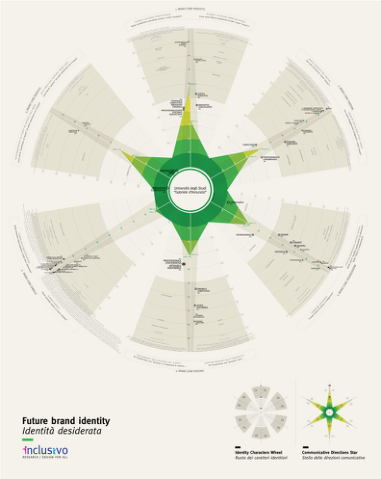
a tool made by two systems of data visualization (1. ICW_Identity Characters Wheel + CDS_Communicative Directions Star) in order to show the complexity of interviewed people answers and activate thinking over processes between all the people internal to the brand;
an internal communication campaign (2. Re-Branding Posters) made by posters able to communicate to all the principal changes of the brand values.
a set of criteria about the inclusive use of materials (3. Inclusive Materials), by which is possible to design all the different communicative artefacts of the University new brand.
ICW_Identity Characters Wheel + CDS_Communicative Directions Star The first result has been a tool made by two systems of data visualization (ICW_Identity Characters Wheel + CDS_Communicative Directions Star) in order to show the complexity of interviewed people answers and activate thinking over processes between all the people internal to the brand. The research has developed two versions of this tool, one for the present values and one for the future values of the University of Chieti-Pescara brand (see Fig. 1).
This tool graphically represents the set of identity values and concepts emerged through the questionnaire. It is organized on the basis of the six "dimensions" of the brand identity, and in each direction the "values" are placed in a "weighted" way: the values that identify the most of the essence, the "bottom promise" and the mission of the brand are placed closer to the "center" of the star (core identity), while those additional attributes that do not fall within the central "core" identity, but which specify better the identity meaning are projected outward (identity extended). The Identity Characters Wheel (ICW) shows the ‘distance’ of each identity characters from the “Brand Essence”, placed in the center of the. The Communicative Directions Star (CDS), instead, shows the ‘dimensions’ felt as most characterizing the brand identity and the ‘directions’ that seems to be more promising to communicate the same identity.
Re-Branding Posters The second result is represented by an internal communication campaign made by posters able to communicate to all the principal changes of the brand values in order to activate in an inclusive and not authoritarian manner, wholeness processes among employees, around the new purposes of University of Chieti-Pescara. (see Fig.2).
The six designed poster show the most shared values and meanings that were identified by the questionnaire. The poster compare two concepts/values: the most present shared one and the most wanted for the future through a graphical visualization in order to product participation and cohesion among all the people internal to the brand.
Figure 2. Re-branding Posters
Figure available in the original PDF paper.
Inclusive Materials Guidelines The third result is represented by a set of criteria about the inclusive use of materials by which is possible to design all the different communicative artefacts of the University new brand in order to transmit the brand values through the use of the five senses. In particular, it refers to the ability of the brand, through an innovative use of certain materials, to relate to people's senses. In fact, the materials with sensorial and expressive features can produce pleasure through their ‘personality’, the way they are perceived and the associations and emotions they create.
When they are associated to brand meanings and values, they transmit the personality of brand through their own sensorial and expressive features – tactile, visual, olfactory, gustatory, auditive either than those most perceptive, and emotional. Due to the advanced research in the new materials field, are now available some ‘smart materials’ able to thought-provoking and to interact with final user. For example there are materials that release sound, change their shape or their colour; other that have the ability to release light or that are able to convert it through reflection features and also other able to move themselves independently or able to change their temperature, to absorb energy and to transfer it when it is needed etc.
The research has proved that the ‘smart materials’ are one of the effective and innovative possible tools to produce inclusive brand design solutions.
CONCLUSIONS
The research is a first attempt to relate to each other participation and brand design, in order to:
make the brand design processes most participatory as possible;
make the brand meanings and values really shared;
make the brand communicative artefacts able to produce inclusion and wholeness processes.
In particular, the research has defined a first set of tools useful for the designer to identify, in a participatory manner and according to the inclusive criteria of Design for All, the values of a brand identity, a second set of tools useful to Technology, Higher Education and Society (2020) communicate in an inclusive manner the brand values, and finally a set of criteria to guide the designers in the selection of inclusive materials.
These tools proceed from the will to put into effect the two possible positions about the role of the participation in the brand design: participation as a fundamental tool in the process of brand design, to create a transparent and shared brand; participation as the ultimate goal of brand design project, in order to create place brands able to generate inclusion.
CREDITS The varous paragraphs of the present paper can be considered as a consequence of a common discussion and a collective review among authors. In particular the wirting of the various paragraphs can be attributed to: Giuseppe Di Bucchianico (1), Stefania Camplone (3) and Stefano Picciani (2 and 4).
REFERENCES
Aaker, D.A., Joachimsthaler, E. (2001), “Brand Leadership”, FrancoAngeli (Ed.). Accolla, A. (2009), “Design for All. Il progetto per l’individuo reale”, FrancoAngeli (Ed.). Aitken, R. Campelo, A. (2009), “The four R’s of place branding” paper presented at the ANZMAC 2009 ‘Sustainable Management and Marketing’ Conference. Design for All Foundation (2003), “Dossier Design for All”. Di Bucchianico, G., Camplone, S., Picciani, S., (2013), “Branding “for All”: Toward the Definition of Inclusive Toolkits of
Analysis and Visual Communication for Brand Identities”, in Proceedings of the Second International Conference on Design, User Experience, and Usability, Springer (Ed.). EIDD Design for All Europe (2006), “Liberate diversity”, brochure of Swedish campaign launched in November 2006, p.1 European Union (2013), “Promoting jobs, inclusion and social policy as an investment”, 'European Union explained' series, p.1 Golant, B.D. (2012), “Bringin the corporate brand to life: the brand manager as practical author”, Journal of Brand management, Vol. 20, 2, pp. 115-127. Grizzanti, G. (2011), “Brand Identikit. Trasformare un marchio in una marca”, Fausto Lupetti (Ed.). Hatch, M.J. and Schultz, M. (2010), “Toward a theory of brand co-creation with implications for brand governance”, Journal of
Brand Management, Vol. 17 No. 8, pp. 590-604. Jones, R. (2012), “Five ways branding is changing”, in Journal of Brand Management, Vol. 20, 2, pp. 77-79. Kapferer, J.-N. (2000), “Les marques. Capital de l’Enterprise”, Éditions d’Organisation (Ed.). Kavaratzis, M. (2012), “From ‘necessary evil’ to necessity: stakeholders’ involvement in place branding”, in Journal of Place Management and Development, Vol. 5 No. 1, pp. 7-19. Semprini, A. (2006), “La marca postmoderna. Potere e fragilità della marca nelle società contemporanee” FrancoAngeli (Ed.). Turinetto, M. (2005), “Be Different. Il valore attrattivo del brand-design nelle imprese moda”, Edizioni POLI.Design (Ed.). United Nations Development Programme. (2011), “Sustainability and Equity: A Better Future for All”, in: Human Development
Report. United Nations Development Programme.
LISTED IN THE AHFE DIGITAL BOOKSTORE CATALOGUE
Explore the complete digital volume
Advances in Science, Technology, Higher Education and Society in the Conceptual Age: STHESCA
Read this individual research paper free through the original publisher, or explore the full digital proceedings book.
ISBN 978-1-4951-2110-4
Explore this ISBN in the AHFE Bookstore ↗Listed in the July 2026 bookstore catalogue; search by ISBN to confirm current availability · Digital book purchase optional