Stefania Camplone, Alessio D'Onofrio, Antonio Marano, Ivo Spitilli (2024). Design Process for Technological and Meaningful Innovation: A Case Study of Light Solar Design Lab. In: Intelligent Human Systems Integration (IHSI 2024): Integrating People and Intelligent Systems. AHFE Open Access, vol. 119, pp. 541–547. https://doi.org/10.54941/ahfe1004519
In the context of contemporary design culture, technological innovation applied to Intelligent Light Solutions does not always align with the evolution of language and the new and potential utilitarian, symbolic, and emotional meanings that Light Solar Design products could assume to enhance the decor of the urban and territorial landscape. This subject has been addressed as an educational and design research experience, based on a multidisciplinary approach of Design Driven Innovation, using the methodologies, tools, and guidelines of Solar Design and Life Cycle Design (LCD). The paper proposes a critical discussion on the methods, tools, and design outcomes.
In urban and territorial contexts, the growing demand for the aesthetics of industrial products and the rapid development of Intelligent Light Solu- tions and renewable energy require a Design Driven Innovation approach (Verganti, 2009) to initiate a process of research and experimental appli- cation on technological and meaningful innovation. In alignment with this strategic orientation, the Eco Product Design laboratory, an integral part of the Master’s Degree program in Eco Inclusive Design at the Department of Architecture, University of Chieti-Pescara, undertook a research project focused on Light Solar Design. The objective was to make the scene of col- lective outdoor spaces more visible and attractive, to achieve sustainable, efficient, and aesthetically appealing products, to define the role of materials in the pursuit of eco-efficiency, and in the representation of the aesthetic- communicative value of Light Solar Design products, conceived as works beyond anonymity.
ECO PRODUCT DESIGN LAB In the context of contemporary urban and territorial culture, technolog- ical innovation in the field of Intelligent Light Solutions and renewable energy enables the networking of all the components of a system and the
transmission of information and services for safety, monitoring and con- trol of environmental conditions, as well as the flow of people, goods, and energy. Presently, technological innovation in the evolution of the concept of highly energy-autonomous intelligent lighting does not seem to simul- taneously inspire an evolution in language and new utilitarian, symbolic, and emotional meanings (Verganti, 2018). Such innovations are crucial for addressing the pervasive degradation of urban spaces, including cities, his- toric centers, green areas, and water bodies. In the Eco Product Design laboratory, our research has focused on the theme of enhancing outdoor spaces within urban and territorial landscapes. The primary objective has been to identify, as key areas of application, the most promising innovation topics within the Core Function of Energy Lighting. This includes applica- tions in diverse settings such as coastal and water landscapes, urban and mountain parks, areas of urban mobility and safety, agricultural cultiva- tion and urban gardens, art cities, prestigious locations, historic centers, and potential uses in Arctic regions and sites suitable for amateur astronomical observation.
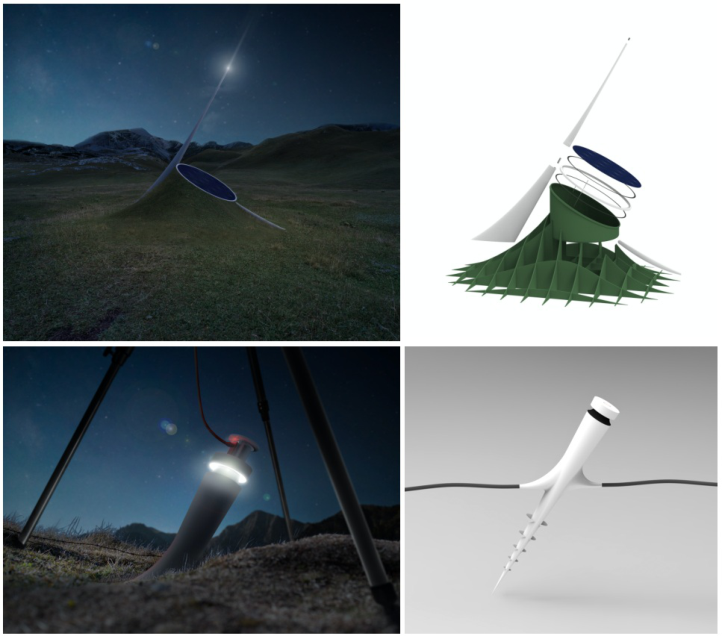
Figure 1: ‘IComet’, an eco-product for amateur astronomical observation sites: the ‘iSun’ signaling system and ‘iSpot’ positioning system for lighting, charging, and ‘light pollution’ monitoring. Concept design by Davide Galieri (2023).
Design Process for Technological and Meaningful Innovation 543
The design process has been two-pronged: On one side, it involved con- textual research, encompassing an analysis of constraints, regulations, case studies, current market trends, and available technologies. On the other side, it included exploratory research into potential scenarios and innovation opportunities, focusing on new interpretations of light, emerging urban and territorial narratives, and the aspirations for a more inclusive social life. The metadesign research phase further integrated an examination of the atmo- spheres, culture, forms, stratifications, and objects of different places, delving into both the tangible and intangible values of the Genius loci. This investi- gation also covered the distinct functionalities between Core Function (C.F.) for lighting and renewable energy, basic functionalities (F.B.) for monitoring and control (including security, microclimate, mobility, and the flow of peo- ple, objects, and energy), and value-added functionalities (F.V.A.) aimed at enhancing people’s lives, such as information, interactivity, data collection, Wi-Fi access, physical, sensory, and emotional well-being, and facilities for resting, socializing, and charging electronic devices like bicycles and cars. The outcomes of the contextual and exploratory research phases have been compiled into ‘Knowledge and Constraints Dossiers’, which detail the system of constraints and are later integrated into project development, and ‘Vision Dossiers’, which offer a collection of suggestions and themes to guide the conceptual design activity. To ensure the efficiency and feasibility of these proposed solutions, concept development was conducted through an educa- tional laboratory framework, primarily via a series of intensive workshops. These workshops involved collaboration with companies such as i.Guzzini, a leader in innovative lighting systems, and Matrec, a consulting and research firm specializing in material sustainability and circularity.
LCD TOOLS AND METHODS To steer the design process toward new environmentally sustainable solu- tions, the Life Cycle Design (LCD) tool is employed. Utilizing LCD in the early stages of ideation and conceptualization significantly enhances the like- lihood of developing innovative, eco-efficient designs. The fundamental aim of LCD is to reduce both the input of materials and energy and the output in terms of waste and emissions, encompassing the entire life cycle of the prod- uct, from pre-production, production, and distribution to its usage, eventual disposal, and the potential recycling of its constituent resources.
LCD implements design strategies and guidelines centered on resource minimization, the adoption of low-impact resources and processes, opti- mization of product life, extension of material lifespan, and facilitation of disassembly (Vezzoli, 2007). Within the Eco Product Design laboratory, the strategies found to be most effective for innovating Light Solar Design proposals included minimizing material usage, selecting renewable energy sources, and incorporating Design for Disassembly principles. Pertaining to specific LCD strategies, the focus was primarily on enhancing product maintainability, upgradability, and reparability. This was achieved through developing solutions that simplify assembly and disassembly processes, par- ticularly by employing easily removable connections.
Regarding the strategies aimed at minimizing material and energy expen- diture, guidelines were followed that encouraged the design of functionally efficient systems, wherein hypothesized production methods facilitated mate- rial reduction (primarily via the use of structural ribs to stiffen and thin out materials). Furthermore, these guidelines directed the creation of eco-efficient products that promote sustainable consumption patterns, chiefly during their operational phase, and ensure minimal environmental impact through the integration of renewable energy sources, such as photovoltaic panels. Addi- tionally, the proposed solutions adhered to guidelines advocating the use of renewable or recycled materials that are not in danger of depletion, while con- currently aiming to reduce harmful emissions by considering the processes of material transformation, production, distribution, and disposal treatments.
SOLAR LIGHT DESIGN Solar Design defines the scope of designing industrial products that utilize photovoltaic technology. The photovoltaic system consists of a set of elec- trical components (photovoltaic module, inverter, battery, charge controller) which collectively convert solar energy into electrical energy. Achieving max- imal efficiency in this conversion necessitates accounting for optimal solar irradiation conditions, which are influenced by factors like the geographical location’s tilt angle, the orientation’s azimuth angle, and varying conditions based on the latitude where the product will be installed.
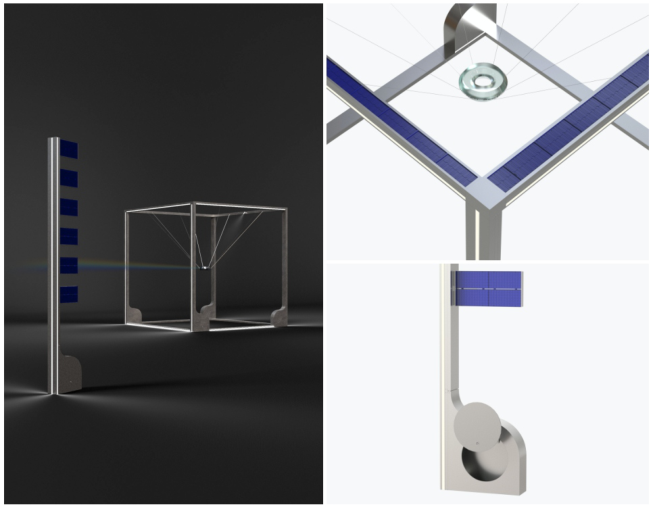
Figure 2: ‘Genderlight’, an eco-product for urban safety: information-communicative installation and flag-mounted solar panel streetlight. Concept design by Lara Pulcina (2022).
Design Process for Technological and Meaningful Innovation 545
In the market, the prevalent types of photovoltaic cells are monocrys- talline, polycrystalline, and amorphous (thin-film) cells, each differing in efficiency, structural design, and aesthetic. The design process in the Eco- Product Design laboratory involved a meticulous assessment of the appro- priate photovoltaic cell type, considering the morphological characteristics of the product surfaces, irradiation conditions, and the system’s energy require- ments. In optimizing the efficiency of Solar Light products (Marano, 2013), the design strategy primarily focused on embedding photovoltaic cells in the most sun-exposed upper sections of the lighting fixtures. For certain appli- cations, broader surfaces positioned vertically were utilized, integrating sails or grids laden with photovoltaic cells. When the available surface area was insufficient for the required energy output, more efficient monocrystalline silicon cells were chosen over their amorphous counterparts. In designs fea- turing curved surfaces, amorphous silicon photovoltaic cells with a thin, semi-flexible film were employed, adaptable to various curvatures. Con- versely, for products with circular, irregular, or complex shapes, thin-film amorphous silicon cells, capable of conforming to any form to compre- hensively cover the surface, were used. In some instances, polycrystalline silicon cells, customizable into optimal shapes for the specific surface, were selected. The design development phase benefited significantly from the collaboration and consultancy with iGuzzini, a firm specializing in advanc- ing Intelligent Light Solutions. This partnership facilitated the integration and networking of all system components, the employment of smartphone- based light management technologies (Smart Light Control), and the deliv- ery of information and services directly from the lighting installations (Smart Services).
MATERIALS AND TECHNOLOGIES FOR ECO-DESIGN In addressing environmental issues, materials assume a crucial role in both advancing product eco-efficiency and in representing their aesthetic- communicative value. Within the context of Life Cycle Design (LCD) strategies, materials play a decisive role in: choosing materials with low environmental impact (reduced waste production and CO2 emissions dur- ing both production and the product’s end-of-life phase); exploring circular economy solutions; selecting durable and high-quality materials (extending product lifespan and consequently delaying waste generation while indi- rectly reducing the need for new resources); using non-toxic or bio-based materials; adopting secondary raw materials as substitutes for traditional materials; adopting secondary raw materials as alternatives to conventional ones; Allowing the possibility of material reuse in the product’s end-of-life phase.
However, materials also directly influence the appearance and sensory per- ception of products. Materials directly related to nature, such as wood, stone, or glass, can give the product a more organic appearance, while materials like steel or aluminum may convey a colder, yet more technologically efficient aspect.
Emerging materials, including bio-composites and, more recently, biodegradable eco-plastics (Pellizzari, 2017), not only embody new socio- ethical values but also enable the creation of complex morphologies and inno- vative aesthetic, expressive, and sensory qualities. For companies, embracing sustainability is not just a response to increasing environmental conscious- ness among consumers; it is an opportunity for innovation and competitive repositioning in the market.
Specifically, in the realm of Light Solar Design products, a central con- cern is energy consumption reduction via renewable resource utilization. This strategic approach gains further significance when integrated with other LCD strategic priorities based on the conscious and appropriate selection of materials.
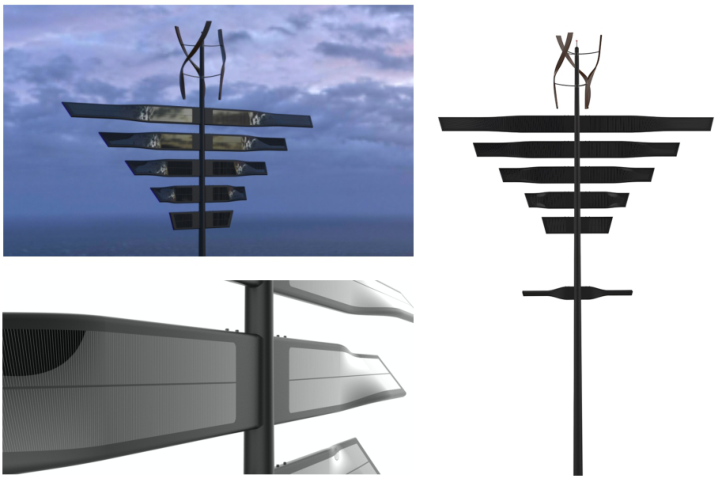
Figure 3: ‘Light Solar Eolic Design’, an eco-product for Arctic countries: smart inte- grated lighting and eolic system. Concept design by Simone Giancaspero (2022).
In the concept development processes undertaken in the Eco-Product Design Laboratory, a comprehensive evaluation of the selected materials’ physical, chemical, and mechanical properties (such as optical, thermal, mag- netic, and electrical attributes) and their eco-compatibility aspects (including recyclability, renewability, biodegradability, and compostability) was con- ducted. Moreover, each design underwent a thorough analysis, breaking down the product into subsystems and components, with a detailed exami- nation of connections aimed at reducing their quantity and variety, thereby simplifying disassembly operations. Additionally, the analysis and optimiza- tion of production processes, in line with eco-efficiency strategies, were enhanced through the use of the Matrec Databases, a research and consulting firm specializing in the measurement of product circularity.
Design Process for Technological and Meaningful Innovation 547
CONCLUSION
The Eco Product Design laboratory has initiated a thoughtful exploration into the environmental aspects of design culture, along with a research endeavor in Design Driven Innovation specific to the Light Solar Design sector.
This case study accentuates the significance of the theme ‘Living in Out- door Spaces in Urban and Territorial Landscapes,’ and sheds light on the most promising innovation themes within the Core Function of Lighting Energy.
It delineates the selection of Life Cycle Design (LCD) strategies and guidelines optimal for achieving product eco-efficiency, explores potential applications of Solar Design, and examines the role of materials both in achieving eco-efficiency and in conveying the aesthetic and communicative value of Light Solar Design products.
Through an in-depth analysis of the tools and methodologies employed in the Design Process, along with a succinct overview of the resultant design solutions, this paper endeavors to make a meaningful contribution to the ongoing discourse in technological innovation and the evolution of significance in Light Solar Design.
ACKNOWLEDGMENT
The different sections of this paper are the result of collaborative discussions and joint reviews among the authors. Specifically, the composition of the various sections is credited to: S. Camplone (Materials and Technologies for Eco-design), A. D’Onofrio (Solar Light Design), A. Marano (Introduction, Eco Product Design Lab, Conclusion), I. Spitilli (LCD Tools and Methods).
REFERENCES
Marano, A. (2013). Design solare. Roma: Gangemi editore. Pellizzari, A. Genovesi, E. (2017). NeoMateriali nell’economia circolare. Milano: Edizioni Ambiente. Verganti, R. (2009). Design-Driven Innovation. Milano: Rizzoli Etas. Verganti, R. (2018). Overcrowed. Milano: Hoepli. Vezzoli, C. (2007). Design per la sostenibilità ambientale. Bologna: Zanichelli.
LISTED IN THE AHFE DIGITAL BOOKSTORE CATALOGUE
Explore the complete digital volume
Intelligent Human Systems Integration (IHSI 2024): Integrating People and Intelligent Systems
Read this individual research paper free through the original publisher, or explore the full digital proceedings book.
ISBN 978-1-958651-95-7
Explore this ISBN in the AHFE Bookstore ↗Listed in the July 2026 bookstore catalogue; search by ISBN to confirm current availability · Digital book purchase optional